
In This Article
Picture this: you’ve invested in premium grow lights, quality nutrients, and a solid ventilation system—but your plants still look stressed, with crispy leaf edges and stunted growth. The culprit? Improper humidity levels can lead to stress on plants and reduced yields.
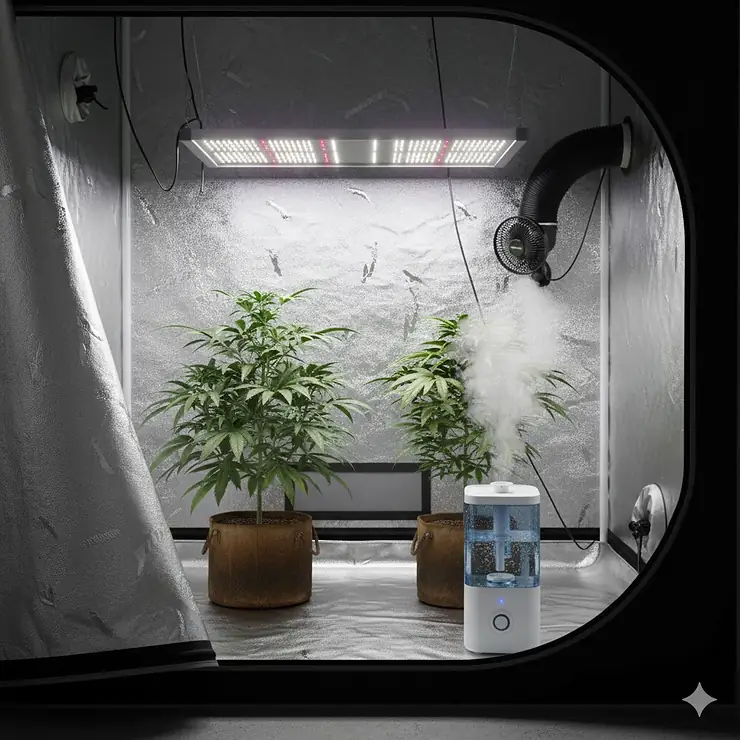
A grow tent humidifier isn’t just another gadget; it’s the secret weapon that separates mediocre harvests from exceptional ones. Whether you’re cultivating delicate seedlings or pushing through the flowering stage, maintaining the right temperature and humidity levels in a grow tent has become crucial for successful plant growth. The controlled environment demands precise moisture management, and that’s where specialized humidifiers come into play.
In this comprehensive guide, I’ll walk you through the seven best grow tent humidifiers available in 2025, helping you choose the perfect unit that matches your setup, budget, and growing goals. From compact 4×4 tent solutions to heavy-duty units for commercial operations, we’ve got you covered.
Quick Comparison Table
| Humidifier Model | Capacity | Coverage | Smart Features | Price Range | Best For |
|---|---|---|---|---|---|
| AC Infinity CLOUDFORGE T3 | 4.5L | 2×2 – 2×4 ft | VPD controls, 10 levels | $80-$110 | Small tents, precision control |
| Spider Farmer 5L | 5L | 3×3 – 4×4 ft | App control, sensor probe | $60-$90 | Mid-size tents, budget-friendly |
| MARS HYDRO 15L | 15L | 4×4 – 5×5 ft | Humidity sensor, 12-hour timer | $120-$160 | Large tents, extended runtime |
| VIVOSUN AeroStream H09 | 9L | 4×4 ft | Wi-Fi, smart grow system | $90-$120 | Tech-savvy growers |
| BLEREMA 3L | 3L | 2×2 – 2×4 ft | Dual mist output, leak-proof | $45-$65 | Budget option, small spaces |
| Spider Farmer 16L | 16L | 5×5 – 8×8 ft | Multi-hose, humidity probe | $150-$200 | Commercial grows, large spaces |
| VIVOSUN AeroStream H19 | 19L | 6×6 ft+ | Top control, mobile casters | $160-$210 | Professional setups |
💬 Just one click – help others make better buying decisions too! 😊
Top 7 Grow Tent Humidifiers: Expert Analysis
1. AC Infinity CLOUDFORGE T3 – Best Overall Smart Humidifier
Price: $80-$110
The AC Infinity CLOUDFORGE T3 represents the pinnacle of precision humidity control for serious growers. This 4.5L powerhouse features an innovative EC ultrasonic vaporizer that delivers 10 distinct mist levels-not just the typical “high/medium/low” you’ll find elsewhere.
Key Specifications:
- 4.5L capacity with extendable 4-foot tubing
- VPD humidity controls with 10-level precision vaporizer
- Corded sensor probe for accurate readings
- No-leak water-resistant seal design
What sets this unit apart is its backlit display that can be toggled off to prevent night cycle disruption, making it perfect for photoperiod plants. The humidifier integrates seamlessly with AC Infinity’s UIS platform, allowing you to sync with exhaust fans, controllers, and other equipment via WiFi.
Customer feedback consistently praises the build quality. One verified buyer noted: “Gets the humidity where it needs to be quickly. The probe is accurate +/- 2°F and % humidity.”
✅ Pros:
- Exceptional precision with 10 mist levels
- Smart automation via app
- Leak-proof design extends lifespan
❌ Cons:
- Higher price point than basic models
- Smaller capacity requires more frequent refills
Best for: Growers prioritizing VPD optimization and smart automation
2. Spider Farmer 5L – Best Value for Mid-Size Tents
Price: $60-$90
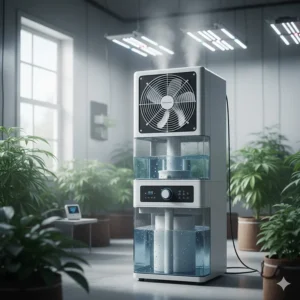
Spider Farmer has earned its reputation for delivering professional-grade equipment at accessible prices, and their 5L humidifier exemplifies this philosophy. With a maximum output of 1400ML/H, this unit punches well above its weight class.
Key Specifications:
- 5L opaque tank prevents algae buildup
- Independent sensor probe with digital display
- 4 adjustable mist levels
- Up to 32 hours continuous operation
The 2025 version includes an RJ12 port for seamless integration with Spider Farmer’s GGS controller system. This means you can automate humidity levels based on temperature readings, growth stages, or custom schedules—all through your smartphone.
The extendable forked hose allows you to position the humidifier outside your tent while directing mist precisely where it’s needed. This design choice saves precious floor space and prevents water puddles from condensing on tent surfaces.
✅ Pros:
- Excellent price-to-performance ratio
- Long runtime minimizes refills
- Screen automatically turns off
❌ Cons:
- Manual refilling only (no auto-fill option)
- Hose positioning requires careful setup
Best for: Budget-conscious growers with 3×3 to 4×4 tents
3. MARS HYDRO 15L – Best for Large Grow Operations
Price: $120-$160
When you’re managing a 4×4 or 5×5 tent packed with plants, the MARS HYDRO 15L becomes your humidity workhorse. This beast provides up to 29 hours of continuous mist output, meaning you can leave for a weekend without worrying about your plants drying out.
Key Specifications:
- Massive 15L water tank capacity
- Adjustable humidity range: 35%-95%
- 12-hour programmable timer
- Whisper-quiet operation under 40dB
The built-in temperature and humidity sensor provides real-time monitoring, while the telescopic hose system ensures even moisture distribution throughout your growing space. One unique feature is the screen’s ability to turn off completely during operation—essential for preventing light interruption during dark cycles.
Commercial growers particularly appreciate the unit’s robust construction. Reviews highlight that even after months of continuous use, the atomizer maintains consistent output without clogging or deterioration.
✅ Pros:
- Extended runtime ideal for busy schedules
- Wide humidity adjustment range
- Professional-grade durability
❌ Cons:
- Larger footprint requires space
- Heavier when full (consider placement)
Best for: Serious growers with large tents or multiple growing zones
4. VIVOSUN AeroStream H09 – Best Smart Integration
Price: $90-$120
VIVOSUN’s AeroStream series represents their commitment to smart growing technology. The H09 model bridges the gap between affordability and advanced features, offering Wi-Fi connectivity for seamless connection to the VIVOSUN app with remote control and real-time notifications.
Key Specifications:
- 9L (2.38 gallon) capacity
- Phantom mode disables screen lighting
- 1% humidity resolution accuracy
- Compatible with Smart Grow System (SGS)
What makes this humidifier special is its integration with VIVOSUN’s ecosystem. When paired with their SGS system, you can create automated “grow recipes” that adjust humidity based on plant growth stages. The system even synchronizes with connected lights and fans for truly automated climate control.
The opaque water tank prevents light penetration, which stops algae growth—a common problem with clear-tank models. The top-fill design makes refilling effortless without dismantling the unit.
✅ Pros:
- Comprehensive smart features
- Precise 1% humidity resolution
- Ecosystem integration potential
❌ Cons:
- Full features require additional VIVOSUN equipment
- Learning curve for app setup
Best for: Growers building an integrated smart grow system
5. BLEREMA 3L – Best Budget-Friendly Option
Price: $45-$65
Don’t let the bargain price fool you—the BLEREMA 3L delivers solid performance for small to medium tents without breaking the bank. Its compact footprint makes it perfect for 2×2 or 2×4 spaces where every inch counts.
Key Specifications:
- 3L unibody leak-proof water tank
- Dual mist output options (single or two hoses)
- Ultrasonic cool mist with 5μm water particles
- Top-fill design for easy maintenance
The standout feature is the unibody construction—crafted as a single seamless piece that eliminates leak risks entirely. You can confidently position this unit inside your tent without worrying about water damage to electronics or creating humidity pockets.
Beginners especially appreciate the simple operation: fill, plug in, and adjust the dial. No complicated menus, no app downloads, just straightforward humidity control that works.
✅ Pros:
- Unbeatable value for money
- Genuinely leak-proof design
- Simple plug-and-play operation
❌ Cons:
- No automation features
- Smaller capacity needs frequent refilling
Best for: First-time growers and small tent owners on a budget
6. Spider Farmer 16L – Best for Commercial Applications
Price: $150-$200
Step into commercial territory with the Spider Farmer 16L, a beast designed for serious cultivators managing large spaces or multiple tents. With 1400ML/H output capacity and support for up to four extended hoses, this unit can humidify areas up to 2000 square feet.
Key Specifications:
- Enormous 16L (4.2 gallon) capacity
- Multi-hose splicing capability
- Independent humidity sensor probe
- Professional-grade construction
The ability to split mist output across four hoses means you can create customized humidity zones within a large tent or distribute moisture to multiple smaller tents from a single unit. This versatility makes it incredibly cost-effective for scaling operations.
User testimonials emphasize the whisper-quiet operation: “It holds about 5 gallons. Runs very smooth and whisper quiet I will recommend this to anyone.”
✅ Pros:
- Commercial-grade capacity and durability
- Multi-zone humidity distribution
- Minimal maintenance requirements
❌ Cons:
- Premium pricing
- Overkill for small personal grows
Best for: Commercial operations and large-scale personal grows
7. VIVOSUN AeroStream H19 – Best High-Capacity Professional Unit
Price: $160-$210
The VIVOSUN AeroStream H19 sits at the top of the consumer humidifier hierarchy. With its massive 19L capacity and top-mounted control panel for effortless operation without bending, this unit caters to professional growers who demand convenience alongside performance.
Key Specifications:
- 19L opaque water tank (5 gallons)
- Bottom casters and side handles for mobility
- 5-way and elbow nozzle options included
- Integrated water level indicator
The professional features extend beyond just capacity. The unit includes a comprehensive accessory package with multiple nozzle configurations, allowing you to adapt the mist distribution to any environment. The bottom casters transform what would be a cumbersome unit into something easily repositionable for cleaning or reconfiguration.
Mobile growers particularly value the top-fill design combined with the visual water level indicator—you can check and refill without moving the unit or interrupting your grow cycle.
✅ Pros:
- Massive capacity minimizes refills
- Professional mobility features
- Comprehensive nozzle options
❌ Cons:
- Substantial investment required
- Requires adequate floor space
Best for: Professional grow facilities and serious commercial operations
✨ Don’t Miss These Exclusive Deals!
🔍 Take your indoor gardening to the next level with these carefully selected humidifiers. Click on any highlighted product to check current pricing and availability. These tools will help you create authentic growing conditions your plants will love!
Understanding Grow Tent Humidity: Why It Matters
The Science Behind Plant Transpiration
Plants transpire much like humans sweat, adding to the relative humidity. This is done by opening their stomata, which is the only time plants can photosynthesize. When humidity levels fall outside the optimal range, plants experience stress that manifests in multiple ways.
Think of humidity as your plants’ lifeline for nutrient transport. Plants release water vapor through their leaves in a process called transpiration, which helps them move nutrients and water from roots to leaves. This process doesn’t just move water—it creates a negative pressure that pulls dissolved minerals upward, feeding your plants from root to canopy.
Optimal Humidity Levels by Growth Stage
Different growth phases demand specific humidity ranges for maximum performance:
Seedling Stage (First 2-3 weeks):
- Humidity level for seedlings is 65-70%. This high humidity helps young plants absorb moisture through their leaves as their root systems are still developing
- Young plants lack fully developed root systems and rely heavily on foliar absorption
- High humidity prevents excessive moisture loss that can stress vulnerable seedlings
Vegetative Growth:
- Aim for humidity levels between 40% and 60%. This range allows for healthy plant growth and reduces the risk of fungal diseases
- Plants rapidly build biomass and require consistent moisture for cell expansion
- Moderate humidity balances growth speed with disease prevention
Flowering Stage:
- As plants enter the flowering stage, gradually decrease humidity levels to around 40% to 50%. This helps prevent issues like bud rot and encourages proper flower development
- Lower humidity reduces fungal disease risks as bud density increases
- Resin production often improves under slightly drier conditions
VPD: The Game-Changing Metric You Need to Know
Vapor Pressure Deficit (VPD) takes humidity management to the next level. VPD measures the difference between the amount of moisture in the air and how much moisture the air can hold when fully saturated at a specific temperature.
Why does VPD matter more than simple humidity readings? Because it accounts for temperature’s dramatic effect on how much water vapor air can hold. VPD helps you identify the correct range of temperature and humidity to aim for in your grow space, ensuring your plants transpire at optimal rates without experiencing stress.
Optimal VPD Ranges:
- Seedlings: 0.4-0.8 kPa (encourages root development)
- Vegetative: 0.8-1.2 kPa (promotes vigorous growth)
- Flowering: 1.2-1.6 kPa (enhances resin production)
For growers serious about maximizing yields, understanding and managing VPD represents the difference between good results and exceptional harvests.
How to Choose the Right Humidifier for Your Grow Tent
1. Calculate Your Space Requirements
Start by measuring your tent dimensions. A 2×2 tent (4 square feet) has vastly different needs than a 5×5 tent (25 square feet). As a general rule:
- Small tents (2×2 to 3×3): 3-5L capacity
- Medium tents (3×3 to 4×4): 5-9L capacity
- Large tents (4×4 to 6×6): 10-16L capacity
- Commercial spaces (6×6+): 16L+ capacity
Don’t forget vertical space—taller tents may need more powerful output to reach upper canopy levels effectively.
2. Consider Automation Features
Manual humidifiers work but require constant attention. Smart humidifiers with built-in sensors and automation save time while delivering superior results. Look for:
- Humidity sensors that trigger automatic on/off cycles
- VPD calculation features for advanced optimization
- App connectivity for remote monitoring and adjustment
- Timer functions to align with light cycles
The initial investment in smart features pays dividends through reduced maintenance and improved plant health.
3. Evaluate Tank Capacity vs. Runtime
Tank size isn’t everything—output rate determines how long your humidifier actually runs. A 5L unit outputting 200ML/hour lasts 25 hours, while the same tank with 400ML/hour output runs only 12.5 hours.
Match refill frequency to your schedule. If you’re away for work all day, choose a unit that runs 16+ hours. Weekend travelers need 48+ hour capacity or risk returning to stressed plants.
4. Position Matters: Inside vs. Outside Your Tent
Inside placement:
- Direct humidity distribution
- Compact setups save space
- Risk of water spills near electronics
- Easier to monitor and refill
Outside placement:
- Safer for equipment
- Easier maintenance access
- Requires extendable hoses
- May create condensation in hoses
Most modern grow tent humidifiers include hoses specifically designed for external placement, offering the best of both worlds.
5. Noise Levels and Light Leakage
Ultrasonic humidifiers generally operate quieter than evaporative models, typically under 40dB (library quiet). If your grow space is near living areas, prioritize whisper-quiet operation.
Light leakage from LED displays can disrupt photoperiod plants during dark cycles. Always choose models with screen-off modes or position displays away from light-sensitive plants.
Benefits vs Traditional Alternatives Comparison
| Feature | Grow Tent Humidifier | Household Humidifier | DIY Methods |
|---|---|---|---|
| Precision Control | ✅ 1-5% accuracy with sensors | ❌ 10-15% accuracy | ❌ Inconsistent |
| Automation | ✅ Smart sensors & timers | 🔶 Basic timers only | ❌ Manual only |
| Targeted Distribution | ✅ Hoses direct mist | ❌ Room-wide only | ❌ Random |
| VPD Optimization | ✅ Built-in or compatible | ❌ No VPD features | ❌ Manual calculation |
| Light-Safe Design | ✅ Screen-off modes | ❌ Bright LEDs | N/A |
| Cost Efficiency | 🔶 $45-$210 | ✅ $30-$100 | ✅ Under $20 |
| Longevity | ✅ 2-5 years typical | 🔶 1-3 years | ❌ Days to weeks |
Troubleshooting Common Humidifier Issues
Problem: White Dust Accumulation on Plants
Cause: Mineral deposits from tap water Solution: Switch to distilled or reverse osmosis water, or add a demineralization cartridge to your humidifier. The small investment prevents nutrient lockout caused by mineral buildup on leaves.
Problem: Mold or Mildew Growth Despite Humidity Control
Cause: Poor air circulation creating stagnant humid pockets Solution: Install oscillating fans to maintain constant airflow. Proper ventilation creates perfect equilibrium between fresh air and humidity retention, preventing localized moisture buildup that encourages fungal growth.
Problem: Humidity Readings Don’t Match Humidifier Display
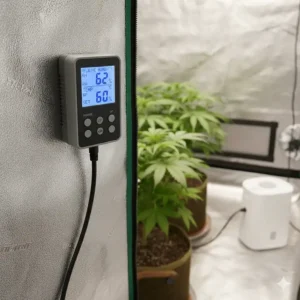
Cause: Sensor placement or calibration issues Solution: Position your hygrometer at canopy level, not near walls or air intakes where readings skew. Calibrate sensors monthly using the salt test method for accuracy.
Problem: Humidifier Runs Constantly But Humidity Stays Low
Cause: Excessive ventilation removing moisture faster than humidifier can produce Solution: Reduce exhaust fan speed or run on a timer cycle. Seal any tent leaks with duct tape. Consider upgrading to a higher-capacity humidifier if your current unit simply can’t keep pace.
Problem: Condensation Dripping From Hoses
Cause: Temperature differential causing moisture to condense inside tubing Solution: Insulate hoses with foam sleeves. Position hoses at a slight upward angle so any condensation drips back into the humidifier reservoir rather than into your tent.
Maintenance Tips for Longevity
Weekly Tasks:
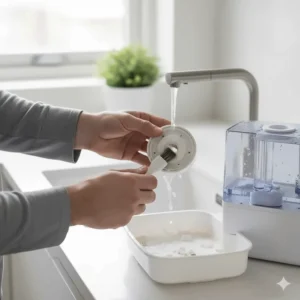
- Empty and rinse tank with clean water
- Wipe down exterior surfaces
- Check and clean mist nozzle for clogs
Monthly Deep Clean:
- Disassemble all removable components
- Soak in white vinegar solution (1:3 ratio) for 30 minutes
- Scrub atomizer plate gently with soft brush
- Rinse thoroughly and air dry completely
- Calibrate humidity sensor if applicable
Pro Maintenance Tip: Add a few drops of hydrogen peroxide to your water tank to prevent algae and bacterial growth without harming plants. This simple step extends cleaning intervals and keeps your mist pure.
Humidity Management Beyond the Humidifier
Complement Your Humidifier with These Strategies
Optimize Your Ventilation: Air exchange is crucial, but aggressive ventilation strips humidity. Reduce exhaust fan speed to retain more humidity inside the tent during stages requiring higher moisture levels. Variable-speed controllers give you precise control over air exchange rates.
Strategic Plant Arrangement: Group plants closer together as they create a collective microclimate that naturally maintains higher humidity. This clustering effect means your humidifier works less hard while achieving better results.
Mulch Your Growing Medium: A layer of organic mulch or even clean straw on soil surfaces dramatically reduces evaporation rates. This passive strategy helps maintain consistent moisture levels while reducing humidifier runtime and water consumption.
Consider Thermal Mass: Water-filled containers placed strategically in your tent act as humidity buffers, slowly releasing moisture between humidifier cycles. They also help stabilize temperature fluctuations—double benefit from a simple intervention.
Energy Efficiency and Cost Analysis
Operating Cost Breakdown
| Humidifier Size | Daily Energy Use | Monthly Cost (at $0.15/kWh) | Water Consumption |
|---|---|---|---|
| 3-5L Unit | 0.5-0.8 kWh | $2.25-$3.60 | 3-5L daily |
| 6-9L Unit | 0.8-1.2 kWh | $3.60-$5.40 | 6-9L daily |
| 10-16L Unit | 1.2-1.8 kWh | $5.40-$8.10 | 10-15L daily |
| 19L+ Unit | 1.8-2.5 kWh | $8.10-$11.25 | 15-20L daily |
Based on continuous operation. Smart models with automatic cycles reduce costs by 30-50%.
Ultrasonic humidifiers consume significantly less energy than evaporative models, making them the preferred choice for 24/7 grow tent operation. The difference can save $10-20 monthly on electricity bills.
Advanced Growing Techniques with Precision Humidity Control
High-Stress Training (HST) and Humidity
When implementing aggressive training techniques like supercropping or manifolding, proper humidity levels allow plants to absorb nutrients more effectively, accelerating recovery from the intentional damage. Maintain 55-65% RH during recovery periods to support rapid healing.
Cloning Success Through Humidity
Cloning requires extreme humidity—80-90% RH creates the dome-like environment that encourages root development before plants establish water uptake capability. A dedicated small humidifier for your cloning station dramatically improves success rates.
Late-Flowering Humidity Manipulation
Some growers intentionally drop humidity to 30-35% in the final 1-2 weeks before harvest. This stress response can trigger increased resin production as the plant attempts to protect itself from perceived drought conditions. Execute this technique cautiously with close monitoring.
FAQ
❓ How often should I clean my grow tent humidifier?
❓ Can I use a regular household humidifier in my grow tent?
❓ What's the difference between ultrasonic and evaporative humidifiers for grow tents?
❓ How do I prevent mold while using a humidifier in my grow tent?
❓ Should I place my grow tent humidifier inside or outside the tent?
Conclusion: Transform Your Growing Environment
Mastering humidity control separates struggling growers from cultivators who consistently achieve exceptional results. The right grow tent humidifier doesn’t just maintain moisture levels—it optimizes plant transpiration, enhances nutrient uptake, prevents stress, and ultimately maximizes your genetic potential.
After reviewing dozens of units, the AC Infinity CLOUDFORGE T3 earns our top recommendation for its precision VPD controls and smart automation, while the Spider Farmer 5L delivers unbeatable value for budget-conscious growers. Large operations will find the Spider Farmer 16L or VIVOSUN AeroStream H19 indispensable for maintaining consistent conditions across extensive growing spaces.
Remember that a humidifier is one component in your environmental control system. Combine proper humidity management with adequate ventilation, strategic air circulation, and stage-appropriate temperature control to create the perfect growing environment your plants deserve.
Your next harvest starts with dialing in these fundamental environmental factors. Choose the humidifier that matches your setup, implement the strategies we’ve covered, and watch your plants respond with vigorous growth and impressive yields.
Ready to optimize your grow tent humidity? Start by honestly assessing your space requirements, decide between smart features or manual control based on your involvement level, and invest in quality equipment that will serve you reliably for years. Your plants are waiting.
Recommended for You
- 7 Best Dehumidifiers for Grow Tent 2025: Expert Reviews
- Mushroom Grow Tent: 7 Best Options for 2025 Success
- 4×4 Grow Light: 7 Best Options for Maximum Yields (2025)
Disclaimer: This article contains affiliate links. If you purchase products through these links, we may earn a small commission at no additional cost to you.
✨ Found this helpful? Share it with your friends! 💬🤗
