

In This Article
What is an 8 inch inline fan? An 8 inch inline fan is a ducted blower that mounts between two sections of 8-inch ducting and pulls or pushes air along the run. Consumer models usually move 400 to 850 CFM, which makes them the go-to choice for large grow tents, workshops, and HVAC booster jobs.
Here’s the thing about big-tent ventilation: it’s where budgets go to die. You price out a 5×5 or 4×8 tent, feel pretty good about it, and then discover that your fan, carbon filter, and ducting add up to a second mortgage. The humble 8 inch inline fan is the one place where you can claw some of that money back without gutting performance.
Airflow is measured in cubic feet per minute, and an 8-inch duct simply carries more of it with less resistance than a 6-inch duct. A single 8 inch inline fan can often replace two 6-inch fans, which means one cord, one controller, and one set of ducting to hang.
But “budget” is a slippery word. A $30 booster and a $160 EC-motor fan both wear the same 8-inch label. They behave very differently once a carbon filter is bolted to the intake.
This guide ranks seven real options, from cheap reliable 8 inch inline fan picks to a premium benchmark. We lean on the manufacturer specs and the review patterns we could verify. Nobody here is claiming lab tests, and prices are shown as ranges because they change constantly. Along the way we cover CFM per dollar, warranty length, and what a large tent ventilation budget really needs.
Quick Comparison: 8 Inch Inline Fan Picks at a Glance
| Product | Rated CFM | Motor / Control | Price Range* | Best For |
|---|---|---|---|---|
| TerraBloom 8″ Inline Fan (DBF8) | 400 | Basic, no controller listed | Under $50 | Intake duty on a tight budget |
| Hon&Guan 8 Inch Inline Booster (PM442) | 623 (listed) | DC, 3 power levels | Budget tier | Low-wattage, light-duty exhaust |
| TerraBloom MFIF-8 | 735 | AC, built-in speed control | Roughly $80-$100 | Cheap full-size exhaust |
| iPower 8 Inch Inline Fan (745 CFM) | 745 | AC, no controller | Roughly $80-$100 | Raw CFM per dollar, metal housing |
| VIVOSUN R8 | 720 | AC, variable controller | Mid-range | Plug-and-play tent exhaust |
| VIVOSUN AeroZesh S8 | 830 | EC, PWM, E12 controller | Around $140-$170 | Efficient high-CFM mid-range |
| AC Infinity Cloudline S8 | 807 | EC, 10-speed controller | Around $150-$180 | Quiet, long-warranty benchmark |
*Prices were gathered at the time of research and change often. Check current price before you buy.
Looking at the table, the iPower 8 Inch Inline Fan and TerraBloom MFIF-8 deliver the most rated air per dollar, but both use older AC motors. The AC Infinity Cloudline S8 and VIVOSUN AeroZesh S8 cost roughly double, and what you get for that is efficient EC motors, finer speed control, and quieter low-speed operation. Buyers who only need a cheap intake fan can skip the middle of the table and look at the TerraBloom 8″ Inline Fan (DBF8).
💬 Just one click — help others make better buying decisions too!😊
Top 7 8 Inch Inline Fan Picks: Expert Analysis
1. TerraBloom 8″ Inline Fan (DBF8) — cheapest way into 8-inch ducting
The TerraBloom 8″ Inline Fan is the entry ticket. It’s a 400 CFM metal-housed unit with a pre-wired 6-foot grounded cord and an ETL listing. The listing positions it as an intake fan, or as an exhaust for smaller setups running lights under roughly 600W.
That positioning is honest, and it matters. At 400 CFM on paper, the TerraBloom 8″ Inline Fan has about half the muscle of the 800 CFM models. Once a carbon filter and a few duct bends are in the path, real delivered airflow drops further. On paper this is a fan for pushing fresh air into a tent, not for hauling hot air out of a packed 5×5.
The housing is just 7.25 inches long, so it slots into cramped closets and attics easily. There’s no speed controller listed, so expect to buy a separate dimmer or run it flat out.
Review data I could verify for this exact model was thin. Treat the listing’s own limits as the real guidance. The one-year warranty is handled through Amazon, which is typical at this price.
Pros:
- ✅ Metal housing at a bargain-bin price
- ✅ ETL listed with a grounded pre-wired cord
- ✅ Short body fits tight mounting spots
Cons:
- ❌ 400 CFM is thin for large-tent exhaust
- ❌ No built-in speed control
Price range: under $50. Verdict: great value as an intake fan, poor value if you need it to be your only exhaust.

2. Hon&Guan 8 Inch Inline Booster (PM442) — lightest and lowest-wattage of the bunch
The Hon&Guan 8 Inch Inline Booster is the odd one out. It’s a 3.2-pound plastic unit with a DC motor drawing about 44W, a listed 45 dBA, and three power levels. Its listed airflow is 623 CFM.
Those numbers are striking, and a skeptical eye is healthy here. A 44W motor claiming 600-plus CFM is almost certainly quoting free-air flow with no filter and no duct. Once the Hon&Guan 8 Inch Inline Booster meets a carbon filter, expect a meaningful drop. The spec sheet won’t tell you that, but basic fan physics does.
That said, the efficiency angle is real. If your tent runs a modest LED and you want the lowest possible electric bill, a 44W fan is genuinely appealing. It also mounts with duct tape or clamps because it weighs so little, which suits renters.
The listing showed a strong category rank in hydroponic ventilation equipment at the time of research. I couldn’t isolate model-specific review text I trusted, so this one earns a “promising, verify before committing” label.
Pros:
- ✅ Very low power draw for its size
- ✅ Light enough to hang from ducting
- ✅ Three-speed control built in
Cons:
- ❌ Listed CFM likely drops sharply under filter load
- ❌ All-plastic body feels less durable
Price range: budget tier, so check current price. Verdict: worth considering for small, low-heat setups where noise and electricity matter more than raw airflow.
3. TerraBloom MFIF-8 — cheap full-size exhaust with a built-in dial
The TerraBloom MFIF-8 is the model most people mean when they search for an affordable 8 inch grow tent fan. It’s rated at 735 CFM, draws 205W, spins at 2450 RPM, and has a speed controller built into the unit.
That built-in controller is the quiet hero. Most cheap 8-inch fans force you to buy a dimmer. Here, the dial lets you throttle down at night when the lights are off and the tent needs less exhaust. Based on the spec comparison, that single feature saves you roughly the cost of a separate controller.
The housing is ABS plastic at 7.7 pounds, with removable duct ends for cleaning and a bracket that fits only one way, so you can’t mount it backward. At 205W it’s a thirstier design than the EC-motor options, which matters over months of 24/7 running.
Reviewer sentiment for TerraBloom’s wider 8-inch lineup is mixed. Some buyers call the fans quiet and long-lived. Others report louder-than-advertised operation or airflow that fell short of the label. That pattern suggests real unit-to-unit variance, so keep your return window in mind.
Pros:
- ✅ Built-in speed controller included
- ✅ 735 CFM rating at a budget price
- ✅ Removable ends make cleaning easy
Cons:
- ❌ 205W draw is high versus EC models
- ❌ Mixed noise reports across the brand
Price range: roughly $80-$100. Verdict: one of the strongest values here if you accept the power draw.
4. iPower 8 Inch Inline Fan (745 CFM) — most raw airflow per dollar in a metal body
The iPower 8 Inch Inline Fan is the blunt instrument of this list. It carries a 745 CFM rating in a metal housing, rated for ambient temperatures up to 176°F. It ships without a speed controller.
Without a controller, you’re running one speed: loud and fast. That’s fine for a closet exhaust or an attic booster, but in a bedroom tent you’ll want to add a dimmer or a thermostat controller. Budget for that when you compare prices, because it narrows the gap with the TerraBloom MFIF-8.
The metal housing is the selling point. It tolerates heat better than the thin plastic bodies and tends to feel more solid when strapped to a tent frame. It’s also bulkier, with a footprint around 15 by 13.5 inches, so measure your space first.
I couldn’t pin down a trustworthy review sample for this exact 745 CFM model. The closely related iPower 420 CFM booster sat around 3.6 stars on a small review base (roughly 170 ratings). That suggests iPower’s budget line is hit-or-miss, so stick to retailers with easy returns.
Pros:
- ✅ Metal housing handles heat well
- ✅ 745 CFM rating for a low price
- ✅ Rated to 176°F ambient
Cons:
- ❌ No speed controller included
- ❌ Bulky footprint and louder at full speed
Price range: roughly $80-$100. Verdict: best raw CFM per dollar, as long as you add a controller and accept noise.
5. VIVOSUN R8 — the plug-and-play tent exhaust
The VIVOSUN R8 is a straightforward 8 inch inline fan: 720 CFM, 2450 RPM, a listed 40 dB, and a variable speed controller in the box. It’s built for tents and pairs naturally with VIVOSUN carbon filters.
Look at the draw, though: 190W. That’s a heavier electrical appetite than the 75W EC alternatives. Over a long flowering cycle the VIVOSUN R8 will quietly cost you more in electricity than the sticker gap suggests. We’ll run that math in the long-term cost section below.
The 40 dB rating is respectable for an AC motor, and the included controller means you can throttle it without buying extras. At 9.5 pounds it’s solid enough to feel substantial but light enough to hang from rope ratchets.
Verified review volume for this model was small. One retailer-mirrored review praised its quietness and efficiency, but a single review proves nothing. Treat it as an unremarkable, predictable mid-pack option rather than a standout.
VIVOSUN lists a one-year after-sale service window on its fans, which is on the short side compared to the market’s best.
Pros:
- ✅ Variable speed controller included
- ✅ 720 CFM suits 4×8 and 5×5 tents
- ✅ Listed 40 dB is reasonable for AC
Cons:
- ❌ 190W draw adds up over time
- ❌ One-year coverage is short
Price range: mid-range, so check current price. Verdict: a solid middle-of-the-road pick, but the EC-motor AeroZesh may beat it on running cost.
6. VIVOSUN AeroZesh S8 — efficient high-CFM mid-range
The VIVOSUN AeroZesh S8 steps up to an EC motor with PWM control and an E12 controller. It’s listed at 830 CFM and 75W, and it’s the highest airflow rating in this roundup.
The efficiency story is the headline. Compare it to the R8: roughly 110 more CFM for about 115 fewer watts on paper. For anyone running 24/7, that’s a meaningful long-term saving, and it’s why the VIVOSUN AeroZesh S8 earns a spot as the value pick among EC fans.
Noise is where you need to read carefully. One retailer spec table lists it around 51 dB, and another VIVOSUN comparison table shows a higher figure for the S8. Spec sheets disagree, so assume it’s audible at full speed and plan to run it at 50-70% most of the time.
The fan connects to VIVOSUN’s GrowHub ecosystem, which is useful if you already own their gear. The company states a one-year warranty plus 30 days of free returns.
Review volume was thin at the time of research. A handful of ratings on VIVOSUN’s own site isn’t a reliable sample, so lean on the return window.
Pros:
- ✅ EC motor draws only about 75W
- ✅ 830 CFM is the highest here
- ✅ 30-day free returns reduce risk
Cons:
- ❌ Noise specs vary between listings
- ❌ Thin verified review history
Price range: around $140-$170. Verdict: strong efficiency and airflow for the money, with a short warranty as the trade-off.
7. AC Infinity Cloudline S8 — the quiet, long-warranty benchmark
The AC Infinity Cloudline S8 is the one the rest get measured against. It’s rated at 807 CFM, 39 dBA, and 746 Pa of static pressure, using a mixed-flow EC motor and dual ball bearings. The manufacturer cites an L10 life of 67,000 hours.
Static pressure is the number people ignore, and it’s the one that matters most. A carbon filter, a silencer, and a few feet of flexible duct all fight your fan. A fan with high static pressure keeps pushing, while a low-pressure fan stalls. Buyers who upgraded to the 8-inch system report that their filters finally ran without choking airflow.
Reviewer sentiment is the strongest in this roundup. A retailer listing showed roughly a 4.7-star average across nearly 10,000 reviews at the time of research. That is a large, believable sample.
Then there’s coverage: AC Infinity states a two-year warranty, double what many rivals offer. Some third-party listings show different numbers, so confirm on the product page. The AC Infinity Cloudline S8 also pairs with the smart T8 variant if you later want temperature and humidity automation.
Pros:
- ✅ Strong static pressure for filter-heavy setups
- ✅ Two-year warranty and long rated bearing life
- ✅ Large, favorable review base
Cons:
- ❌ Highest sticker price in this list
- ❌ EC fans can’t daisy-chain with DC-motor models
Price range: around $150-$180. Verdict: the “buy once” option, and the best value if you keep gear for several grows.
✨ Don’t Miss These Value Picks!
🔍 Take your large tent ventilation to the next level with these carefully selected fans. Click on any highlighted product name to check current pricing and availability. Whether you want a bargain intake fan or a quiet premium workhorse, one of these will keep your tent fresh and your plants happy!
CFM Per Dollar Value: Which 8 Inch Inline Fan Gives You the Most Air?
CFM per dollar is the metric every budget buyer secretly wants. It’s also easy to misuse, so here’s the honest version: divide rated CFM by price range, then discount for filter loss, noise, and running cost.
| Product | Approx. CFM per Dollar* | Real-World Caveat | Best For |
|---|---|---|---|
| TerraBloom 8″ Inline Fan (DBF8) | 8+ | Low absolute CFM | Intake on a shoestring |
| TerraBloom MFIF-8 | ~7-9 | High wattage | Budget exhaust with dial |
| iPower 8 Inch Inline Fan | ~7-9 | No controller, loud | Max air, no frills |
| VIVOSUN AeroZesh S8 | ~5-6 | EC efficiency, 1-year warranty | Efficient mid-range |
| AC Infinity Cloudline S8 | ~4.5-5.5 | Pricey but quiet, 2-year warranty | Long-term ownership |
*Estimated from rated CFM divided by the price ranges above; ratings are free-air figures, not delivered airflow.
The analysis is simple. On raw CFM per dollar, the AC fans win and the EC fans trail. But free-air ratings flatter cheap motors, which lose a larger share of their airflow once a filter and duct bends are attached. A higher static-pressure fan like the AC Infinity Cloudline S8 gives up less. That’s why a fan that looks twice as expensive can actually deliver comparable real airflow in a filtered tent.
For buyers prioritizing CFM per dollar value above everything, the iPower 8 Inch Inline Fan and TerraBloom MFIF-8 are the mathematical winners. Add a controller budget and the gap narrows quickly.
Warranty Length: What Each Brand Actually Covers
Warranty length is a proxy for how much a manufacturer trusts its own motor. Here is what the listings showed at the time of research.
- AC Infinity Cloudline S8: two years, from the original purchase date, per the manufacturer’s page. Consumable parts are excluded.
- VIVOSUN fans (R8, AeroZesh S8): one year after-sale service, plus a 30-day free-return window on the AeroZesh listing.
- TerraBloom 8″ Inline Fan (DBF8): one year, serviced through Amazon.
- iPower and Hon&Guan: terms vary by listing, so confirm before purchasing.
One wrinkle: a few third-party retailers list a different warranty length than the manufacturer for the same AC Infinity model. Always trust the brand’s own page, and save your order confirmation.
Why this matters financially: if a fan costs twice as much but carries twice the coverage, the premium is partly self-funding. A fan that lasts only 14 months because its warranty expired, then dies, costs you more than a pricier model that runs for years. That’s the whole logic behind “cheap reliable 8 inch inline fan” shopping: reliability is a number you can partly read off the warranty page.
How to Choose an 8 Inch Inline Fan
Choosing well takes five minutes and saves a lot of regret. Work through these in order.
- Match CFM to tent volume. A rough rule is to exchange the tent’s air once a minute, then add 25-50% for filter and duct loss. Larger tents (5×5 and up) are where 8-inch fans earn their keep.
- Check static pressure. If you’re using a carbon filter, a silencer, or long duct runs, higher static pressure (hundreds of Pa) matters more than the headline CFM.
- Decide AC versus EC motor. EC motors cost more upfront but sip power and throttle quietly. AC motors are cheaper and louder.
- Confirm a controller. Budget fans often skip it. Add the cost of a dimmer or thermostat controller to your comparison.
- Compare warranty and returns. Two years beats one, and a 30-day return window protects you against unit variance.
- Measure your space. Metal-housed 8-inch fans can be nearly 16 inches long, and ducting needs clearance to avoid sharp bends.
Based on that list, most large-tent growers should rank motor type and static pressure above sticker CFM. It’s the difference between a fan that looks good on paper and one that actually moves air.
Affordable 8 Inch Grow Tent Fan: Features That Actually Matter
Shopping for an affordable 8 inch grow tent fan means sorting signal from marketing noise. Here’s the filter.
Features that matter: static pressure, motor type, built-in speed control, and noise at your actual operating speed. These decide whether the fan works well in your tent.
Features that don’t: exaggerated “max CFM” banners, fancy packaging, and bundled accessories you’ll never use. A glossy app isn’t worth much if the fan can’t overcome a filter.
Noise deserves a special note. Manufacturers quote decibels at different distances and speeds, so a “39 dB” fan and a “45 dB” fan may not be directly comparable. Plan to run any fan at 50-70% most of the time, and you’ll rarely hear the difference.
Metal versus plastic housing is the other common debate. Metal tolerates heat better and feels sturdier, while plastic is lighter and quieter to mount. In a typical tent, either works, but if your exhaust sits near hot lights, metal gives you a little extra margin.
Budget 8 Inch Exhaust Fan vs Premium EC Motor Fan
Is a premium EC fan worth double the money? Let’s compare the two approaches directly.
| Factor | Budget AC Fan | Premium EC Fan |
|---|---|---|
| Upfront cost | Lower | Roughly double |
| Power draw | ~190-205W | ~75W |
| Low-speed noise | Often hummy | Typically quiet |
| Speed control | Dimmer or basic dial | Precise PWM steps |
| Warranty | Often one year | Up to two years |
| Best For | Short grows, tight budgets | Long-term, 24/7 use |
A budget 8 inch exhaust fan makes sense when you run a seasonal grow, need a backup, or are testing a new space. The savings are real at purchase.
An EC fan pays you back through lower electricity and quieter nights. Over several grows, the premium AC Infinity Cloudline S8 and VIVOSUN AeroZesh S8 can come out ahead on total ownership cost, even though they hurt more at checkout. If you’re unsure, a mid-priced AC fan like the TerraBloom MFIF-8 is a sensible compromise.
Large Tent Ventilation Budget: Three Real-World Scenarios
Spec sheets are abstract. Here are three buyer profiles and the fans that fit them.
Scenario 1: The renter with a 4×8 tent and a $150 airflow budget. Space is tight, noise matters, and money is limited. A TerraBloom MFIF-8 with its built-in dial keeps costs low, and you’ll spend the savings on a decent carbon filter. Run it at moderate speed to keep neighbors happy.
Scenario 2: The 5×5 hobbyist who runs lights 18 hours a day. Here electricity and noise add up. The VIVOSUN AeroZesh S8, at about 75W, cuts the running bill compared to a 190W AC fan. It’s the efficient, mid-priced path.
Scenario 3: The long-term grower with a filtered, ducted room. Long duct runs and a heavy carbon filter demand high static pressure. The AC Infinity Cloudline S8 earns its price by holding airflow where cheaper fans stall, and its two-year warranty covers the first few grows.
Notice a pattern: the “right” fan depends on environment, hours per day, and your tolerance for noise. A bigger large tent ventilation budget isn’t always required, but spending it on static pressure and motor efficiency usually beats spending it on bundled extras.
Practical Usage Guide: Setting Up Your 8 Inch Inline Fan
A good fan installed badly performs like a bad fan. These steps get the most from any 8 inch inline fan.
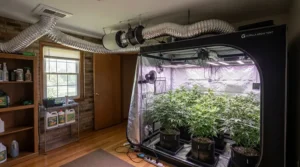
Mount it outside the tent when possible. Hanging the fan from the tent frame transmits vibration and noise. Place it on a shelf or hang it from the ceiling with rope ratchets and rubber isolators.
Keep duct runs short and straight. Flexible ducts have higher pressure loss than most other duct types, so every bend or kink steals airflow. Stretch the ducting taut and keep bends gentle, since a duct folded like an accordion can cut effective CFM sharply.
Place the filter on the intake side of the fan. Pulling air through the carbon filter keeps the tent under negative pressure, which helps contain odors. Mount the fan after the filter, not before it.
Set a speed schedule. Run higher speeds while lights are on and drop down at night. A controller with a thermostat probe automates this and saves electricity.
In the first 30 days, watch for two mistakes: undersizing the intake openings (starving the fan) and leaving duct joints unsealed. Foil tape and proper clamps fix both.
Problem → Solution Guide for 8 Inch Inline Fan Owners
Problem: the fan sounds like a jet engine. Drop the speed, add a duct silencer, and isolate the mount with rubber. A fan that hums at full speed is often quiet at 60%.
Problem: airflow feels weak. Check for a clogged filter, crushed ducting, or an undersized intake. A weak fan often means a restricted path, not a failing motor.
Problem: the tent walls collapse inward. That’s strong negative pressure, a sign the fan is outpacing your intake. Open passive intake vents or add an intake fan like the TerraBloom 8″ Inline Fan (DBF8).
Problem: temperatures spike when the lights come on. Move to a thermostat-driven controller so the fan ramps up automatically. The AC Infinity Cloudline S8 supports this through compatible controllers.
Problem: the fan vibrates the whole frame. Remove it from the tent frame and hang it from a separate support with rubber isolators.
Cheap Reliable 8 Inch Inline Fan: Common Buying Mistakes to Avoid
Hunting for a cheap reliable 8 inch inline fan is a balancing act. Here are the traps that catch most budget shoppers.
Trusting free-air CFM. The number printed on the box rarely reflects airflow through a filter. Prefer fans that publish static pressure.
Ignoring wattage. A fan that saves you $30 upfront can cost you more in electricity within a year. Check the power draw alongside the price.
Skipping the controller. Many budget fans don’t include one. A $15-$25 add-on changes your real cost.
Overlooking warranty terms. A one-year warranty on a heavily used fan is thin. If you’ll run it 24/7, aim for more coverage or a generous return window.
Buying one size up out of habit. Bigger is only better when your tent can use it. A 10-inch fan in a small tent just wastes money and noise.
Cheap doesn’t have to mean unreliable, but it does mean doing your homework. Cross-check specs, scan review patterns, and keep your receipts.
Long-Term Cost & Maintenance of an 8 Inch Inline Fan
Electricity is the hidden line item. Here’s an illustrative comparison using an assumed rate of 17 cents per kWh, running 24 hours a day for a month.
- A 190W fan like the VIVOSUN R8 uses roughly 137 kWh a month, around $23.
- A 75W EC fan like the VIVOSUN AeroZesh S8 uses roughly 54 kWh, around $9.
That gap is roughly $14 a month. Over a year it’s in the neighborhood of $170, which can exceed the price premium of the EC fan. Your own rate and run hours will change the result, so treat this as a framework, not a promise.
Maintenance is straightforward. Wipe dust from the blades and housing every few months, check the clamps, and inspect the cord. Models with removable duct ends, like the TerraBloom MFIF-8, are easier to clean. Fans with ball bearings, such as the AC Infinity Cloudline S8, are rated for long life, but no motor is maintenance-free.
If a fan starts rattling or slowing, replace it before it fails mid-grow.
Safety, Humidity, and Compliance for 8 Inch Inline Fan Setups
Ventilation is about more than comfort. Moisture control matters for your plants and your home.
The EPA advises that indoor relative humidity should stay under 60%, with 30% to 50% preferred to discourage mold growth. A tent without adequate exhaust can push humidity well past that, and a properly sized 8 inch inline fan helps keep moisture in check.
A few practical safety notes:
- Look for ETL or UL listings where available. The TerraBloom 8″ Inline Fan (DBF8) lists an ETL certification, while some premium fans list none, so verify on the product page.
- Use grounded outlets and avoid overloading power strips, especially with 200W-class motors.
- Keep fans away from standing water and wet surfaces.
- Check local regulations on indoor cultivation, since rules differ by state.
None of this replaces professional electrical advice, but it covers the common mistakes that cause problems.
FAQ: 8 Inch Inline Fan Questions Answered
❓ How many CFM do I need for an 8 inch inline fan in a large tent?
❓ Is an EC motor worth it on an 8 inch inline fan?
❓ Can I use a budget 8 inch exhaust fan with a carbon filter?
❓ How long should a cheap reliable 8 inch inline fan last?
❓ Do I need a speed controller for my 8 inch inline fan?
Conclusion: Which 8 Inch Inline Fan Should You Buy?
The right 8 inch inline fan depends on how you grow, not just what you spend. If you want the cheapest entry, the TerraBloom 8″ Inline Fan (DBF8) handles intake duty, and the TerraBloom MFIF-8 or iPower 8 Inch Inline Fan deliver the most rated air per dollar for exhaust. If you run long hours, the VIVOSUN AeroZesh S8 trims electricity costs, and if you want a fan you’ll still trust in a few grows, the AC Infinity Cloudline S8 earns its premium through static pressure, quiet operation, and a two-year warranty.
Keep three rules in mind: check static pressure, budget for a controller, and read the warranty page. Do that, and an affordable 8 inch grow tent fan can perform like a far more expensive one.
✨ Ready to upgrade your tent’s airflow?
🔍 Compare the picks above, click any highlighted product name to check current pricing and availability, and give your plants the fresh air they’ve been waiting for! 🌿
Recommended for You
- Terrabloom 6 Inch Fan For Basement Ventilation: 7 Proven Picks 2026
- Terrabloom 6 Inch Inline Fan Noise Level: 7 Quiet Fans (2026)
- Terrabloom 6 Inch Fan For 4×4 Grow Tent: 7 Proven Picks (2026)
Disclaimer: This article contains affiliate links. As an Amazon Associate, I earn from qualifying purchases. If you purchase products through these links, we may earn a small commission at no additional cost to you.
✨ Found this helpful? Share it with your friends! 💬🤗
