

In This Article
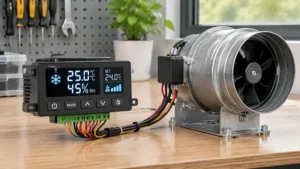
A Terrabloom 6 inch fan EC motor is a 150 mm inline duct fan driven by a brushless, electronically commutated motor. The headline spec is roughly 288 CFM from about 36 watts, with speed control built into the electronics instead of bolted on. In plain English: it moves a lot of air, quietly, for about what a night-light costs to run. For background on the motor type, Wikipedia’s overview of brushless DC motors is a solid primer.

Nobody thinks about ventilation gear until it’s loud, hot, or expensive. A cheap AC-motor fan at full blast is a leaf blower with a day job. An EC fan idles at a whisper and sips power. That’s why the Terrabloom 6 inch fan EC motor has become a go-to for grow tents, AV closets, basements, and duct boosters.
But is it still the right 6-inch fan in November 2026? The field has gotten crowded. This guide compares seven real, currently listed options and runs the energy math using U.S. average electricity rates. It also tackles the questions buyers actually ask:
- What does the EC motor efficiency Terrabloom advertises look like against the numbers?
- What does an honest Terrabloom energy savings review conclude?
- How does the EC vs AC motor inline fan debate play out in practice?
- How does variable speed efficiency really work?
One note on method. Everything below comes from spec sheets, retailer listings, and aggregated buyer feedback, not hands-on testing. Treat it as careful research, not a lab report.
Quick Comparison: Terrabloom 6 inch fan EC motor vs. Six Rivals
| Product | Airflow | Power | Noise | Control | Best For |
|---|---|---|---|---|---|
| TerraBloom ECMF-150 | 288 CFM | 36W | 31–60 dBA | Wired dial; PWM/0–10V capable | Quiet everyday ventilation |
| TerraBloom ECMF-150-S | Up to 288 CFM | 36W | 31–50 dBA | Dial + 8-speed digital | Noise-critical rooms |
| TerraBloom ECMF-150-S2 | Lab-tested (figures unverified) | Not verified | Silenced EPP housing | 2026 model | Buyers wanting the newest silenced build |
| AC Infinity Cloudline Pro S6 | 402 CFM | 38W | 32 dBA | 8–10 speed controller | Carbon-filter setups |
| VIVOSUN AeroZesh T6 | 408 CFM | 35W | 32–45 dB (listings vary) | E12 PWM; Wi-Fi upgrade | Smart climate control |
| VEVOR 6 Inch EC (402 CFM) | 402 CFM | Not verified | 32 dB | 10-speed PWM + app | Automation on a budget |
| Hon&Guan 6 Inch EC (469 CFM) | 469 CFM | 77W | 55 dBA | Stepless dial | Long duct runs |
Look at the table with a skeptical eye. The TerraBloom ECMF-150 isn’t the airflow champion, and it isn’t the CFM-per-watt champion either. Its case rests on quiet partial-speed running and certified numbers. If raw volume is your priority, the AC Infinity Cloudline Pro S6 and VIVOSUN AeroZesh T6 deliver about 40% more air for nearly the same wattage. The Hon&Guan 6 Inch EC (469 CFM) buys the most air at roughly double the draw.
💬 Just one click — help others make better buying decisions too!😊
Top 7 Picks: Terrabloom 6 inch fan EC motor Models and Rivals, Analyzed
1. TerraBloom ECMF-150 — the quiet, efficient benchmark
This is where the Terrabloom 6 inch fan EC motor conversation starts. It pairs a respectable airflow rating with a power draw smaller than most reading lamps.
Listing data points to 288 CFM at 36W. Noise runs from about 31 dBA at the lowest setting to the 60 dBA range at full speed, with static pressure near 396 Pa. Dual ball bearings and a coated steel housing suggest a unit meant to be mounted and forgotten. In practice, 36W at full speed costs only a few dollars a month to run around the clock, and far less at lower settings.
Based on the spec comparison, this fits buyers who value low noise at partial speed over maximum airflow. If you must push 400+ CFM through a dense carbon filter, the paper numbers say look elsewhere. Some retailer listings also show a 350 CFM / 40W variant, so confirm which version you’re buying.
Reviewers consistently describe it as very quiet through the first few speed settings, getting louder as the dial climbs. A recurring theme is swapping out a cheaper fan and running this one at 30–40% for similar results with far lower wattage. A few mention a 5–10 second startup delay. One listing snapshot showed about 4.6 out of 5 across roughly 560 ratings.
Pros:
- ✅ Very quiet at low and mid speeds
- ✅ Low 36W draw at full speed
- ✅ Works horizontally or vertically
Cons:
- ❌ Noisier toward full speed
- ❌ Less max airflow than 400 CFM rivals
Price range: roughly $95–$140 at the time of research, so check current price. Verdict: strong value if quiet matters more than headline CFM.

2. TerraBloom ECMF-150-S — silenced build for bedrooms and tight spaces
Think of the “S” as the same engine in a sound-dampened coat.
Per listing data, a 2-inch acoustic foam layer and a spring-suspended motor cut noise by 10–15 dBA compared with the standard ECMF. Output is the same: up to 288 CFM at 36W, with typical noise of 31–50 dBA. The package includes two wired controllers (an analog dial and an 8-speed digital unit). It also accepts PWM and 0–10V signals through a 3.5 mm port. The listing cites an IP64 rating, HVI certification, and an ENERGY STAR Most Efficient listing from 2021. Verify those on the current label.
What the spec sheet won’t tell you is the trade-off. Foam and a bigger housing mean a longer body, roughly 21.5 inches. That matters in a cramped closet or a short tent port run.
I couldn’t verify user reviews for this model, so I won’t characterize owner sentiment. The spec case rests on the noise reduction. It’s best for anyone running a fan within earshot of sleeping space.
Pros:
- ✅ 10–15 dBA quieter than standard ECMF
- ✅ Two controllers included in the box
- ✅ PWM and 0–10V control support
Cons:
- ❌ Longer, bulkier housing
- ❌ No verified owner reviews found
Price range: not verified at the time of research, and expect a premium over the standard model, so check current price. Verdict: worth it only when noise is the deciding factor.
3. TerraBloom ECMF-150-S2 — the 2026 silenced refresh with a dust-tight rating
The newest entry in the lineup swaps the foam-lined steel for a sound-insulating EPP housing.
According to the listing, the 2026 model pairs a brushless EC motor and dual-jet impeller with that EPP shell and an “IP 6X” ingress rating. It also states the performance figures are independently lab-tested. Here’s where honesty matters: I couldn’t verify CFM, wattage, or decibel figures for this exact model. Confirm them on the current product page before buying.
On paper, EPP is a lightweight, vibration-damping material, which suits a silenced fan. IP6X means dust-tight, which suits a dusty workshop or a grow room with fine debris. But the missing second digit means no water-resistance rating is claimed. Keep it dry.
This is a “buy it if you want the latest revision” pick, not an “everyone should upgrade” pick. There are no user comments on the data source I checked, so long-term reliability is unproven.
Pros:
- ✅ Dust-tight ingress rating (IP6X)
- ✅ Lab-tested specs claimed by the brand
- ✅ Newest silenced design in the family
Cons:
- ❌ Key specs unverified in my research
- ❌ No owner review history yet
Price range: not verified, so check current price. Verdict: promising, but wait for field feedback unless you need the dust rating.
4. AC Infinity Cloudline Pro S6 — best airflow per watt among verified picks
If the Terrabloom 6 inch fan EC motor is the quiet specialist, this is the efficiency overachiever.
Listings show 402 CFM at 38W and 32 dBA, which works out to about 10.6 CFM per watt. That beats the TerraBloom ECMF-150 at about 8. It uses a mixed-flow EC design with dual ball bearings, a quoted L10 life of 67,000 hours, an IP44 rating, and a two-year warranty. Retailer data varies on speed steps (8 or 10) and wattage, so verify before ordering.
The extra 114 CFM is meaningful. It’s the difference between breathing through a straw and a coffee stirrer when a carbon filter chokes airflow. One retailer’s spec table lists the S6 as not ETL or UL listed. If certification matters for your install, check the current documentation.
Buyers consistently praise the quietness, build quality, and packaging. Use cases they mention range from grow tents to a cooled mining closet to boosting a portable AC exhaust. It also plugs into the brand’s wider controller ecosystem.
Pros:
- ✅ About 10.6 CFM per watt at full speed
- ✅ 402 CFM handles filtered tent setups
- ✅ Strong buyer feedback on quietness
Cons:
- ❌ Certification listing may be missing
- ❌ Basic controller; app needs a pricier model
Price range: not verified at the time of research, so check current price. Verdict: the efficiency pick for filtered setups.
5. VIVOSUN AeroZesh T6 — 408 CFM with a smart-control upgrade path
This one takes the highest CFM-per-watt crown in the verified set, at about 11.7.
The brand lists 408 CFM, 3100 RPM, and about 35W from a PWM-controlled EC motor in a mixed-flow design with a steel housing. It ships with an E12 speed controller and probe, upgradeable to the Wi-Fi GrowHub E42A. Noise is listed anywhere from 32 to 45 dB depending on the page, and one third-party manual shows 50W. When specs disagree, trust the manufacturer’s current page and test at your intended speed.
The real appeal is the upgrade path. You can start with a basic dial and graduate to temperature- and humidity-driven automation without replacing the fan. That’s the practical edge over a plain-dial unit like the TerraBloom ECMF-150.
I couldn’t verify detailed T6 owner sentiment. The brand’s store shows a modest review count on related AeroZesh models, but nothing I could characterize responsibly.
Pros:
- ✅ Highest verified CFM per watt
- ✅ Upgradeable to Wi-Fi controller
- ✅ Steel housing for durability
Cons:
- ❌ Noise and wattage listings conflict
- ❌ Owner feedback hard to verify
Price range: around $110–$140 with the E12 controller, so check current price. Verdict: best for growers who want automation.

6. VEVOR 6 Inch EC Inline Duct Fan (402 CFM) — app control on a value-focused spec sheet
VEVOR’s version chases the same 402 CFM / 32 dB target as the AC Infinity Cloudline Pro S6.
Listings and roundups describe a 10-speed PWM controller, app control, a temperature and humidity sensor, and included clamps and vibration mats. That’s a lot of “extras in the box” for the category.
The catch is evidence. I couldn’t verify its wattage, and one major retailer listing showed reviews as “coming soon.” Without watts, I can’t calculate CFM per watt, which is the number that tells you whether an EC fan lives up to its label. Based on the spec comparison, treat this as a promising but unproven alternative.
It suits tinkerers who want automation without paying for a bigger brand name. If you’re unsure, the VIVOSUN AeroZesh T6 offers clearer, better-documented numbers.
Pros:
- ✅ App control included in listings
- ✅ Temperature and humidity sensor bundled
- ✅ Clamps and vibration mats included
Cons:
- ❌ Wattage not verified
- ❌ Little verifiable review history
Price range: not verified, so check current price. Verdict: a gamble with upside; require a good return policy.
7. Hon&Guan 6 Inch EC Inline Duct Fan (469 CFM) — brute-force airflow for long duct runs
Where the others sip, this one drinks.
The listing shows 469 CFM from a 77W draw at 4300 RPM, 55 dBA, an IP44 rating, and static pressure near 542 Pa. That works out to roughly 6.1 CFM per watt, the weakest ratio here despite the EC label. A stepless controller lets you dial it down, and the cube-law savings below will help.
The higher static pressure matters for long ducts, bends, and boosters. That’s the use case where a TerraBloom ECMF-150 might run out of steam. But 55 dBA at full speed is noticeably louder, so this is a garage-or-attic fan more than a bedroom fan.
I couldn’t verify owner reviews for this exact 469 CFM model. Hon&Guan sells other 6-inch models with different specs, so don’t assume feedback transfers.
Pros:
- ✅ Highest airflow in this lineup
- ✅ Higher static pressure for long runs
- ✅ Stepless speed control included
Cons:
- ❌ 77W draw at full speed
- ❌ Louder at 55 dBA
Price range: roughly $90–$120 per listing snapshots, so check current price. Verdict: pick it for airflow, not efficiency.
| Product | Price Range | Rating Snapshot | CFM per Watt (max) | Best For |
|---|---|---|---|---|
| TerraBloom ECMF-150 | ~$95–$140 | ~4.6/5 (~560 ratings) | ~8.0 | Quiet, balanced ventilation |
| TerraBloom ECMF-150-S | Not verified | Not verified | ~8.0 | Noise-sensitive rooms |
| TerraBloom ECMF-150-S2 | Not verified | Not verified | Not verified | Early adopters |
| AC Infinity Cloudline Pro S6 | Not verified | Not verified | ~10.6 | Filtered tents |
| VIVOSUN AeroZesh T6 | ~$110–$140 | Not verified | ~11.7 | Smart climate control |
| VEVOR 6 Inch EC (402 CFM) | Not verified | Not verified | Not verified | Budget automation |
| Hon&Guan 6 Inch EC (469 CFM) | ~$90–$120 | Not verified | ~6.1 | Long duct runs |
Notice what the table says. Efficiency at maximum speed favors the VIVOSUN AeroZesh T6 and AC Infinity Cloudline Pro S6, while the TerraBloom ECMF-150 sits mid-pack on that one metric. Its edge is quiet partial-speed operation and a long track record. The Hon&Guan 6 Inch EC (469 CFM) trades efficiency for sheer airflow, and the unverified rows are a reminder to read current listings before you click.
Setup and Tuning Guide: Get the Most From Your Terrabloom 6 inch fan EC motor
Buying the fan is the easy half. Installing it smartly is where the quietness actually shows up.
Mounting. The manual says the TerraBloom ECMF-150 can be installed horizontally or vertically. Hang it with straps or on rubber isolators so vibration doesn’t telegraph into walls or tent poles.
Ducting. Keep runs short and straight. Every sag in flexible duct is a tiny speed bump for air. Clamp both ends firmly, and stretch the duct taut instead of letting it accordion.
Dial it in. Start at 30–40% and work upward. Because variable speed efficiency rewards slow running (more on that below), the best fan setting is usually the lowest one that holds your target temperature or humidity.
Automate it. Terrabloom sells a programmable thermostat speed controller with a temperature probe for under $50 per listings. It supports the wired ECMF-100, -150, -200, -250, and -315 models and can drive up to four fans. It does not support the wireless “R” versions, so check your fan’s controller jack first.
Maintenance rhythm.
- Every month: glance at clamps and listen for new noises.
- Every quarter: power down and wipe dust from the impeller and intake.
- Every year: inspect the power cord and controller cable for wear.
First-30-day mistakes. Buying too much fan, running it flat out “just in case,” and routing the controller cable across a wet floor. Treat those three as the usual suspects.
Real-World Scenarios: Matching the Fan to the Room
Scenario 1: The apartment grower. A 2×4 tent, nighttime light cycles, thin walls, and a budget near $150. The spec case points to the TerraBloom ECMF-150-S if the fan sits near a bedroom, or the standard TerraBloom ECMF-150 if the tent lives in a spare room. Running at 30–40% most of the day keeps noise low and the bill smaller.
Scenario 2: The 4×4 tent with a carbon filter. One roundup suggests 340–405 CFM for a 4×4 tent. With a filter eating airflow, the AC Infinity Cloudline Pro S6 or VIVOSUN AeroZesh T6 give you headroom without a big wattage penalty.
Scenario 3: The basement duct booster. One reviewer installed a TerraBloom ECMF-150 inline in basement ductwork, which suggests it works in HVAC-boosting roles too. For longer, twistier runs, the extra static pressure of the Hon&Guan 6 Inch EC (469 CFM) is worth considering, as long as you tolerate the noise.
Scenario 4: The always-on equipment closet. A 24/7 duty cycle punishes wattage. Here the efficiency math favors a 35–38W unit, with a thermostat controller trimming speed when it’s cool.
EC motor efficiency Terrabloom: Reading the Spec Sheet Without Getting Fooled
Marketing loves a big percentage. Terrabloom’s listings claim 40–75% better efficiency than AC fans. That’s plausible as a range, but it needs context.
According to Machine Design’s breakdown of AC, DC and EC motors, shaded-pole motors manage about 15–25% efficiency and permanent-split capacitor motors about 30–50%. EC motors land around 60–75%. The article also notes a 2013 Department of Energy report that ranked EC motors as the most efficient upgrade option. So the claim holds against weak AC designs. Against a good AC motor with a proper speed drive, the gap narrows.
Here’s the part the spec sheet won’t tell you. At max speed, EC motor efficiency Terrabloom delivers (about 8 CFM per watt) trails the VIVOSUN AeroZesh T6 and AC Infinity Cloudline Pro S6. The brand’s real advantages are elsewhere:
- Verified, lab-tested numbers (the listing cites HVI testing)
- Low-speed behavior
- A mature accessory ecosystem
Also remember that CFM ratings are usually measured in free air. Add a filter or a long duct and real airflow drops. That drop hits every fan on this list, so compare at the speed and static pressure you’ll actually use.
EC vs AC motor inline fan: What Actually Changes
Switching to an EC fan is a bit like swapping an incandescent bulb for an LED. ebm-papst’s explanation of EC fan technology makes that same comparison. The motor, impeller, and control electronics come as a single plug-and-play package, and the fan generates less heat.
| Feature | EC Inline Fan | Traditional AC Inline Fan (basic controller) |
|---|---|---|
| Efficiency at low speed | Stays high across the range | Drops off significantly |
| Speed control | Built into the electronics | Needs an add-on controller |
| Low-speed noise | Typically smooth and quiet | Can hum with cheap controllers |
| Upfront cost | Higher | Lower |
| Best For | Quiet 24/7 running, e.g. the TerraBloom ECMF-150 | Short, full-speed jobs on a tight budget |
The nuance: engineering sources point out that if you run at 75–100% speed all day, the efficiency gap between EC and a well-driven AC motor can be small. The EC vs AC motor inline fan decision really turns on how you’ll run it. If you’ll spend most of your time at 30–60% speed, EC wins clearly. If you’ll run flat out, the premium buys you less. A cheap transformer-style controller on an AC fan can also add an audible buzz that an integrated EC system avoids.
Variable speed efficiency: Why 40% Speed Costs Far Less Than 40% Power
This is the quiet superpower behind every fan on this list.
For centrifugal fans, the affinity laws say airflow scales with speed but power scales with the cube of speed. That produces some striking numbers:
- At 80% speed, power falls to roughly half (about 51%).
- At 50% speed, power drops to about one-eighth.
- At 30–40% speed, an ideal fan would use only a few percent of its full-speed power.
Apply that to a 36W fan. In an idealized case, 80% speed is about 18W and 50% speed is around 4–5W. Real fans won’t hit the textbook numbers, because electronics and bearings carry a fixed overhead. One reviewer reported roughly a tenth of the watts at 30–40% compared with a cheaper fan, which squares with the physics.
Variable speed efficiency has a catch. Static pressure from carbon filters and long ducts limits how far you can slow the fan before airflow collapses. That’s why a thermostat or humidity-driven controller beats a fixed dial. It rides the lowest speed that does the job, then ramps up only when heat or moisture demands it.
Practical takeaway: buy a fan with a little headroom, then run it slow. A 400 CFM fan at 60% often beats a 288 CFM fan at 100%, in noise, wear, and watts.
Terrabloom energy savings review: What 24/7 Operation Really Costs
Let’s put real numbers on it. The EIA’s Short-Term Energy Outlook puts the average U.S. residential electricity price at roughly 18 cents per kWh in 2026. State rates vary enormously: Louisiana was near 12–13 cents in mid-2026, while Hawaii topped 40. Using the national average, here is the cost of running each fan flat out, all year.
| Fan (max speed) | Watts | kWh per Year (24/7) | Approx. Annual Cost | Best For |
|---|---|---|---|---|
| TerraBloom ECMF-150 | 36W | ~315 | ~$55–$60 | Quiet everyday use |
| VIVOSUN AeroZesh T6 | 35W | ~307 | ~$55–$60 | Smart climate control |
| AC Infinity Cloudline Pro S6 | 38W | ~333 | ~$60–$65 | Filtered tents |
| Hon&Guan 6 Inch EC (469 CFM) | 77W | ~675 | ~$120–$125 | Long duct runs |
The honest verdict of this Terrabloom energy savings review: the savings are real but modest in absolute dollars. Against the Hon&Guan 6 Inch EC (469 CFM), the TerraBloom ECMF-150 saves roughly $65 a year at full speed, and much more once you run slower. The savings only add up if the fan runs most of the year and you actually use the low settings. Replacing an old higher-draw fan pays back faster than buying an EC unit to run at 100%.

How to Choose a Terrabloom 6 inch fan EC motor (or Any 6-Inch EC Fan)
Here’s a step-by-step method that cuts through the spec-sheet noise.
- Size the airflow to the space. One roundup suggests 340–405 CFM for a 4×4 tent, so don’t buy a firehose for a closet.
- Subtract for restrictions. Carbon filters, bends, and long ducts all cut real airflow. Plan for headroom.
- Set a noise target. Under about 35 dBA is bedroom-friendly. A 10–15 dBA reduction, as with the TerraBloom ECMF-150-S, is clearly audible.
- Pick your control level. A dial is simple, a thermostat controller automates, and PWM or app control suits the VIVOSUN AeroZesh T6 and VEVOR 6 Inch EC (402 CFM) crowd.
- Check certifications and ratings. Look for ETL, UL, or CSA marks where required, and read IP ratings carefully (more below).
- Compare watts at your real speed. Max-speed CFM per watt is a starting point, not the finish line.
- Confirm warranty and returns. Two years is common among the brands here.
✨ Don’t Miss These Top Picks!
🔍 Take your airflow setup to the next level with these carefully compared fans. Click on any highlighted fan name to check current pricing and availability. The right fan will help you create a quieter, cheaper-to-run space you’ll actually enjoy!
Common Mistakes When Buying a 6-Inch EC Inline Fan
Mistake 1: Chasing peak CFM. A bigger number feels safer, but an oversized fan at 100% is louder and costlier than a right-sized fan at 60%.
Mistake 2: Ignoring static pressure. A fan rated at 400 CFM in free air may deliver far less through a filter and ducting. Compare pressure ratings, such as the 396 Pa on the TerraBloom ECMF-150 and about 542 Pa on the Hon&Guan 6 Inch EC (469 CFM).
Mistake 3: Mixing up variants. Terrabloom listings show both 288 CFM / 36W and 350 CFM / 40W versions of the 6-inch fan. Check the model, the label, and the images before you order.
Mistake 4: Assuming controllers are interchangeable. The thermostat controller works with wired ECMF models and not the wireless “R” versions. One ECMF-100 reviewer also noted that fan was tied to its own controller.
Mistake 5: Trusting listing data blindly. Listings for the same Terrabloom fan show different blade counts (2 in one place, 7 in another). That’s a clue to verify specs against the manual or manufacturer page.
Mistake 6: Forgetting startup behavior. A few buyers note a 5–10 second delay before the fan spins up. It’s harmless, but don’t mistake it for a dead unit.
Features That Actually Matter (And Those That Don’t)
What matters:
- Static pressure. It decides whether the fan can push through a filter and long ducts.
- Bearings. Dual ball bearings (listed on the TerraBloom ECMF-150 and AC Infinity Cloudline Pro S6) suggest longer life than cheaper sleeve designs.
- Controller quality. A responsive dial or a decent thermostat is worth more than a fancy case.
- Honest watts at partial speed. This is the real driver of your electric bill.
What doesn’t:
- Peak CFM bragging rights. You’ll rarely run flat out.
- Blade count and spin-speed trivia. Listings can’t even agree on them.
- Marketing phrases like “German engineering,” which appears in some listing copy but tells you nothing measurable.
- App features you won’t use. Smart control is lovely if you’ll automate, and dead weight if you won’t.
The pattern holds across the lineup. The VIVOSUN AeroZesh T6 and VEVOR 6 Inch EC (402 CFM) lean into smart control. The TerraBloom ECMF-150 leans into quiet simplicity. Pick the philosophy that matches how you’ll live with the fan.
Safety, Certifications, and Noise Guide
Electrical listings. One listing shows CSA, UL, and ETL marks for the TerraBloom ECMF-150, and another shows ETL for the ECMF-100. A retailer table for the AC Infinity Cloudline Pro S6 lists no ETL or UL listing. If your local code, landlord, or insurer cares, check the marks on the actual product label. For permanent wiring, hire a licensed electrician.
Ingress ratings, decoded. The first digit covers dust and the second covers water. IP44 (as listed for the Hon&Guan 6 Inch EC (469 CFM) and AC Infinity Cloudline Pro S6) gives basic splash and debris protection. IP64 on the TerraBloom ECMF-150-S means dust-tight with splash protection. IP6X on the TerraBloom ECMF-150-S2 is dust-tight with no water claim. None of these means “outdoor-ready.”
Noise. Decibels are logarithmic. A 10 dBA difference is generally heard as roughly twice as loud, so 31 dBA versus 55 dBA is a night-and-day gap.
Duct safety. Don’t pull air through ducting that serves a combustion appliance without professional advice. Backdrafting is a real hazard. For kitchen or bathroom exhaust, check local ventilation requirements.

FAQ: Terrabloom 6 inch fan EC motor Questions Answered
❓ Can I use a thermostat controller with a Terrabloom 6 inch fan EC motor?
❓ Can a Terrabloom 6 inch fan EC motor be mounted vertically?
❓ Does a Terrabloom 6 inch fan EC motor work with a carbon filter?
❓ Is EC vs AC motor inline fan lifespan really different?
❓ Why does my fan take a few seconds to start?
Final Verdict: Is the Terrabloom 6 inch fan EC motor Worth It in 2026?
Short answer: yes, for the right buyer. The Terrabloom 6 inch fan EC motor wins on quiet partial-speed running, certified-spec transparency, and a deep accessory lineup. It does not win on peak CFM per watt, and the unverified details on the newer models are worth double-checking.
Here’s the round-up:
- Best overall for quiet balance: the TerraBloom ECMF-150.
- Best for bedroom-adjacent setups: the TerraBloom ECMF-150-S, with the TerraBloom ECMF-150-S2 worth watching once more data lands.
- Best efficiency per watt (filtered setups): the AC Infinity Cloudline Pro S6 or VIVOSUN AeroZesh T6.
- Best budget automation gamble: the VEVOR 6 Inch EC (402 CFM).
- Best raw airflow for long runs: the Hon&Guan 6 Inch EC (469 CFM).
The deeper lesson from the EC vs AC motor inline fan question is that variable speed efficiency is the real prize. Buy a little headroom, run it slow, and let a thermostat do the thinking. Your ears, your plants, and your power bill will all quietly thank you.
✨ Ready to Upgrade Your Airflow?
🔍 Compare the fans above, click any highlighted name to check current pricing and availability, and choose the one that fits your space. A quieter, more efficient setup is one smart purchase away!
Recommended for You
- Terrabloom 6 Inch Inline Fan Review For Grow Tent: 7 Best (2026)
- Terrabloom 6 Inch Fan And Filter Combo Kit: 7 Best Buys 2026
- Price Terrabloom 6 Inch Inline Fan: 7 Smart Buys (2026)
Disclaimer: This article contains affiliate links. As an Amazon Associate, I earn from qualifying purchases. If you purchase products through these links, we may earn a small commission at no additional cost to you.
✨ Found this helpful? Share it with your friends! 💬🤗
