

In This Article
Fluorescent grow lights are the old reliable of indoor gardening. They hum, they glow a slightly nerdy shade of white, and for decades they’ve turned dark basements and bookshelves into seedling nurseries. In 2026, LEDs get all the headlines. Yet fluorescent grow lights still earn a spot on shelves, in propagation racks, and in budget-conscious grow tents. The reason is simple: they’re cheap to start, gentle on young plants, and almost impossible to burn leaves with.
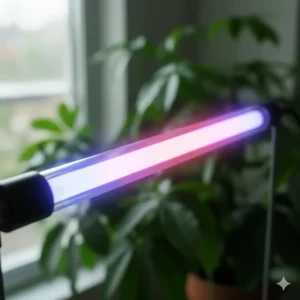
What are fluorescent grow lights? They are low-pressure mercury-vapor lamps, usually long glass tubes, that convert electricity into ultraviolet light, which a phosphor coating turns into light plants can use. The most popular type for gardeners today is the T5 high-output (HO) tube. It delivers strong, even, low-heat light for seedlings, cuttings, herbs, and leafy greens.
This guide skips the brochure talk. We’ll compare seven real fixtures, from a compact 2-foot strip to an eight-tube powerhouse. We’ll also explain what each spec means in practice and where fluorescent grow lights beat LEDs (and where they don’t). Extension horticulturists are refreshingly blunt on that last point: the University of Maryland Extension notes that common fluorescent and LED tubes both give off enough light to grow healthy transplants, with no need for special blue or red bulbs. That’s good news for your wallet.
One note on method. The analysis below draws on published specifications and widely reported buyer sentiment, not hands-on bench testing. Where individual reviews couldn’t be verified, we say so. Prices appear only as ranges and may vary, so check current pricing before you buy.
Quick Comparison Table: 7 Fluorescent Grow Lights at a Glance
| Product | Size / Tubes | Approx. Lamp Wattage | Price Range* | Best For |
|---|---|---|---|---|
| Hydrofarm FLT44 4′ 4-Tube System | 4 ft / 4 | ~216W | Mid-range | All-round seed starting and veg |
| Durolux DL824 T5 2 FT 4 Lamps | 2 ft / 4 | ~96W | Budget | Beginners on a tight budget |
| Hydrofarm Agrobrite Designer T5 4′ 8-Tube | 4 ft / 8 | ~432W | Premium | Grow tents and serious canopy coverage |
| Sunblaster 2′ Strip Light | 2 ft / 1 | ~24W | Budget | Shelves, herbs, tight spaces |
| VIVOSUN HO 2-Bulb 2 ft T5 | 2 ft / 2 | ~48W | Budget | Countertop herbs and microgreens |
| HTGSupply 4′ 2-Tube HO T5 | 4 ft / 2 | ~108W | Mid-range | Slim fixture for propagation trays |
| GrowBright 4′ 4-Lamp HO T5 | 4 ft / 4 | ~216W | Mid-range | Shelf racks and mixed seed trays |
*Wattage is estimated from standard 24W (2 ft) and 54W (4 ft) T5 HO lamps. Price ranges are approximate and change often.
Look at the pattern: wattage tracks tube count almost perfectly. So the real decision is footprint, not brand. The Durolux DL824 T5 2 FT 4 Lamps and VIVOSUN HO 2-Bulb 2 ft T5 suit small spaces and small budgets. The Hydrofarm FLT44 4′ 4-Tube System and GrowBright 4′ 4-Lamp HO T5 hit the sweet spot for a standard 4-foot shelf. Only the Hydrofarm Agrobrite Designer T5 4′ 8-Tube really makes sense once you’ve graduated to a tent.
💬 Just one click — help others make better buying decisions too!😊
Top 7 Fluorescent Grow Lights: Expert Analysis
1. Hydrofarm FLT44 4′ 4-Tube System — the dependable all-rounder
The Hydrofarm FLT44 4′ 4-Tube System is the fixture most often named “best overall” in T5 roundups, and the logic is easy to follow. Four 4-foot tubes cover a standard 2-by-4-foot growing area with even light and very little fuss.
With four 54W-class T5 HO lamps, you’re looking at roughly 216 watts of tube power. Practically, that’s enough intensity for dense flats of seedlings, lettuce, and herbs. Gentle heat means you can hang the lamps close without scorching tender leaves. Keep T5 lamps about 6 to 8 inches above the canopy, as retailers such as 1000Bulbs recommend.
Think of this as the fixture for someone who wants one purchase to handle seed starting, cuttings, and leafy veg. Reviewers of this type of fixture commonly praise the ease of assembly and even coverage. Common gripes include flimsy hanging hardware and the need to buy replacement tubes eventually. We couldn’t verify review counts here, so treat those as general themes.
Pros:
- ✅ Even light across a 2×4 ft footprint
- ✅ Four tubes cover multiple trays at once
- ✅ Low heat lets you hang lamps close
Cons:
- ❌ Hanging hardware feels basic for the weight
- ❌ Tubes will need replacing within a year or two
Typically sits in the mid-range price bracket (check current price). The value verdict: strong, especially if you’d otherwise buy a cheaper fixture twice.
2. Durolux DL824 T5 2 FT 4 Lamps — most light per dollar in a compact frame
The Durolux DL824 T5 2 FT 4 Lamps packs four 2-foot tubes into a fixture that fits a standard shelf. That’s a lot of light density for a small footprint.
Four 24W lamps give you about 96 watts. In practice, that’s plenty for a 2-by-2-foot tray of seedlings or a small herb garden. The shorter tubes also mean easier storage and cheaper replacements, which matters because bulbs are the recurring cost of fluorescent grow lights.
Our honest analytical take: this is the best entry point for anyone testing the hobby without committing to a full rack. It won’t flood a big tent, but it doesn’t need to. Buyers of budget T5 fixtures like this commonly report good seedling results and a slightly less sturdy build than premium brands. That’s an inference from the category rather than a verified review count.
Pros:
- ✅ Four lamps in a shelf-friendly size
- ✅ Cheap, easy-to-find 2 ft replacement tubes
- ✅ Great starter for seed trays and herbs
Cons:
- ❌ Too small for tents or large canopies
- ❌ Build quality trails premium fixtures
Budget range at the time of research (prices vary). Value verdict: arguably the best low-risk entry in this list.
3. Hydrofarm Agrobrite Designer T5 4′ 8-Tube — the powerhouse for serious canopies
The Hydrofarm Agrobrite Designer T5 4′ 8-Tube is the heavyweight here. Eight 4-foot tubes means roughly 432 watts of fluorescent output, which is a seriously dense wall of light.
This is the one that can sensibly sit inside a grow tent. All that output supports vigorous vegetative growth and heavy clone benches, not just seedling flats. Because T5 HO tubes run cool compared with metal halide or HPS, you can keep them near the canopy without cooking leaves. One grower on a hobby forum reported replacing a pair of 400W metal halides with two six-lamp T5 fixtures and finding they worked well. That’s an anecdote, not data, but it illustrates the niche.
Here’s the catch: more tubes mean more ballast weight, more heat in the room, and a higher electric bill. At 16 hours a day, this fixture uses around 7 kWh daily, so run the numbers before you commit.
Pros:
- ✅ Massive coverage for tents and benches
- ✅ Strong output for vegetative growth and clones
- ✅ Designed for serious, repeatable setups
Cons:
- ❌ Highest upfront cost on this list
- ❌ Heavy power draw and bulky footprint
Premium price bracket (check current price). Value verdict: worth it only if you truly need the coverage. Otherwise two smaller fixtures are more flexible.
4. Sunblaster 2′ Strip Light — the shelf-mounted space saver
The Sunblaster 2′ Strip Light is a single-lamp T5 HO strip. It’s a tiny fixture that solves a specific problem: lighting a narrow shelf without a bulky frame.
One 2-foot lamp, around 24 watts, is modest on paper. But strip lights are meant to be daisy-chained or stacked in rows. Mounted under a shelf directly above a seed tray, a single strip gives surprisingly uniform light across a narrow bench. That’s the advantage of linear fluorescent light over spot-style bulbs.
This one is for herb growers, microgreen fans, and anyone building a multi-tier rack one shelf at a time. Reviewers of strip lights in this category typically like the low profile and easy mounting, and note that coverage per strip is narrow. We couldn’t verify specific review numbers for this listing.
Pros:
- ✅ Slim profile fits under shelves
- ✅ Easy to expand one strip at a time
- ✅ Low heat, safe for close placement
Cons:
- ❌ One lamp covers only a narrow strip
- ❌ Cost per square foot climbs if you need many
Budget range at the time of research. Value verdict: excellent for small, incremental setups.
5. VIVOSUN HO 2-Bulb 2 ft T5 — the countertop-friendly two-tube
The VIVOSUN HO 2-Bulb 2 ft T5 has been called a top countertop T5 pick for good reason. Two 2-foot tubes strike a balance between coverage and kitchen-friendly size.
Two 24W lamps total about 48 watts. In real terms, that’s a good fit for a windowless kitchen corner growing basil, mint, chives, or a tray of microgreens. It’s also a fixture that doesn’t scream “grow room” to roommates. T5 HO tubes are about 5/8 inch in diameter, so the whole unit stays slim.
It’s the best match for first-time growers who care about footprint over maximum output. Buyers of compact two-tube fixtures commonly describe them as quiet and simple. Common criticisms involve modest reach for anything beyond herbs and greens. These are category themes, not verified counts.
Pros:
- ✅ Compact enough for kitchen counters
- ✅ Two tubes balance output and size
- ✅ Simple to set up and hang
Cons:
- ❌ Limited coverage beyond a small tray
- ❌ Not enough for fruiting crops alone
Budget price bracket (prices vary). Value verdict: a smart, low-commitment buy for herb and microgreen fans.
6. HTGSupply 4′ 2-Tube HO T5 — the slim 4-foot fixture
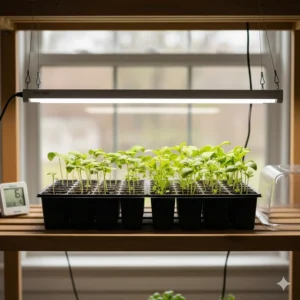
The HTGSupply 4′ 2-Tube HO T5 gives you full 4-foot length without the four-tube footprint. It’s long, narrow, and efficient for propagation tables.
Two 54W-class lamps put out about 108 watts, and the length means you can span an entire shelf. T5 HO lamps emit between 2,000 and 7,000 lumens depending on length and type, so even two tubes deliver serious brightness along a long, thin bench. HTG also sells tubes in multiple spectrums, from 6500K for veg to 3000K for bloom, which helps if you ever want to change purposes.
This is the right fixture for cloning, narrow shelves, and anyone building a long, shallow propagation setup. Reviewers of 2-tube 4-foot fixtures generally highlight the clean light line and mention that you’ll want two units for wider trays.
Pros:
- ✅ Full 4-foot reach in a slim body
- ✅ Spectrum options available for tubes
- ✅ Well suited to cloning and propagation
Cons:
- ❌ Only two tubes, so narrow coverage
- ❌ Wider benches need multiple fixtures
Mid-range bracket (check current price). Value verdict: solid for long, narrow growing areas.
7. GrowBright 4′ 4-Lamp HO T5 — the straightforward rack workhorse
The GrowBright 4′ 4-Lamp HO T5 is a no-frills four-tube fixture that competes directly with the Hydrofarm FLT44 4′ 4-Tube System. It’s the kind of fixture that disappears into a rack and just works.
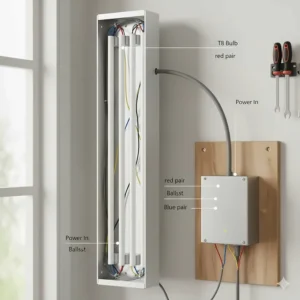
Four 54W-class T5 HO tubes again means about 216 watts and good coverage for a 2-by-4-foot tray area. Retail listings describe the line as available with grow, bloom, or specialty bulbs, which gives you spectrum flexibility from day one. Remember that T5 HO lamps must be paired with an HO-rated ballast and fixture. Mismatched parts are a common headache, and buying a complete system avoids it.
The best candidates are shelf-rack builders who want identical fixtures across multiple tiers. Reviewers of complete T5 systems typically praise the plug-and-play nature. Some mention that the bundled tubes are the first thing they upgrade. We couldn’t verify review volume for this listing.
Pros:
- ✅ Complete system, ready to hang
- ✅ Matches well in multi-tier racks
- ✅ Spectrum options for different stages
Cons:
- ❌ Bundled tubes may not be premium
- ❌ Basic hardware, no frills
Mid-range price bracket (prices vary). Value verdict: a dependable choice when you want repeatable, rack-friendly lighting.
How to Choose Fluorescent Grow Lights (7 Steps)
Picking fluorescent grow lights doesn’t require a physics degree. It does require a few smart decisions, in roughly this order.
- Measure your space first. Fixtures should cover your tray footprint evenly. A 2-foot fixture over a 4-foot tray leaves dark corners, and leggy seedlings are the result.
- Match tube length to the shelf. T5 lamps come in 2-foot (F24T5HO) and 4-foot (F54T5HO) lengths. Pick the one that fits without wasting space.
- Insist on HO-rated components. An HO lamp needs an HO ballast and fixture. Mixing standard and HO parts causes problems.
- Pick the spectrum for the job. 6500K is the all-purpose choice for seedlings and veg. 3000K bloom tubes lean redder for flowering. A balanced 5400K tube sits in between.
- Count tubes, not marketing claims. Total wattage divided by shelf area tells you real light density.
- Plan for replacements. Tubes are consumables. Check that replacement lamps are easy to find and affordable.
- Check mounting. Adjustable chains or hangers matter, because you’ll raise the lights as plants grow.
If you only follow one rule, make it number 3. Mismatched HO parts are the most common avoidable mistake with fluorescent grow lights.
T5 vs T8 vs CFL: Which Fluorescent Grow Light Type Wins?
Not all fluorescent grow lights are equal. Three formats dominate, and each has a distinct personality.
| Type | Tube Diameter | Strength | Weakness | Best For |
|---|---|---|---|---|
| T5 HO | 5/8 in | Highest output per tube | Needs HO ballast and fixture | Seedlings, clones, veg |
| T8 | 1 in | Cheap, widely available | Lower output than T5 HO | Basic seed starting |
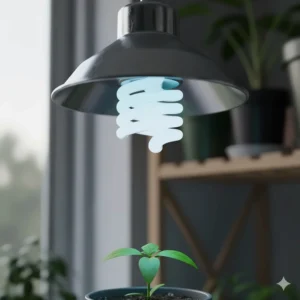
| CFL | Compact bulb | Fits standard sockets | Hard to cover large areas | Single plants, small spots |
T5 stands for the tube diameter in eighths of an inch, so T8 is 1 inch and T12 is 1.5 inches. One retailer notes that modern HO T5 tubes offer roughly twice the output of comparable T8 grow tubes. That’s why most “serious” fluorescent grow lights today are T5.
Reading the table: T5 HO wins for most gardeners because it packs more light into the same shelf space. T8 is a perfectly fine option if you already own a shop-light fixture. CFLs are best treated as spot lighting, since they struggle to cover a whole tray evenly.
Fluorescent Grow Lights vs LED Grow Lights: An Honest Comparison
This is the question every buyer asks. The honest answer: LEDs usually win on long-term efficiency, while fluorescent grow lights often win on upfront cost and simplicity.
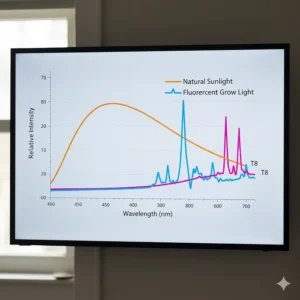
According to the University of Nebraska–Lincoln Extension, standard cool-white fluorescents produce mostly blue light and are low in red. Most foliage plants grow fine under that spectrum. Blooming plants, however, need special horticultural fluorescents or “grow bars” with more red. That same publication cites Purdue research showing LEDs can deliver a more beneficial spectrum while using about 75% less electricity.
| Feature | Fluorescent (T5 HO) | LED |
|---|---|---|
| Upfront cost | Lower | Higher |
| Electricity use | Higher | Lower |
| Heat output | Low to moderate | Very low |
| Tube/bulb life | Shorter, needs replacing | Often rated up to 50,000 hours |
| Best for | Seedlings, clones, budget racks | Long-term, high-yield setups |
Some sources cite quality LED fixtures lasting up to 50,000 hours before dimming to about 70% output. Fluorescent tubes, by comparison, need periodic replacement.
Here’s how to read this: if you grow seedlings a few months a year, the lower upfront cost of fluorescent grow lights often wins. If you run lights year-round, LED’s efficiency eventually pays back the higher purchase price. And a Maryland Extension specialist makes a point worth remembering: LEDs save a little on your electric bill, but transplants are unlikely to be superior, so there’s no need to rush an upgrade while your fluorescent tubes still work.
Features That Actually Matter (And Those That Don’t)
Marketing copy loves a big number. Here’s what’s worth your attention.
Features that matter:
- HO compatibility. Without it, you’re wasting tube potential.
- Adjustable hanging. You must raise lights as plants grow.
- Tube availability. Easy, cheap replacements keep the cost of fluorescent grow lights low over time.
- Reflector or housing quality. A decent reflector can noticeably improve how much light actually reaches leaves.
Features that matter less:
- Exotic spectrum claims. Extension guidance suggests ordinary tubes grow healthy transplants fine. Mississippi State’s extension team goes further, noting that regular shop fluorescents work if placed close enough and left on long enough.
- Designer looks. Pretty fixtures are nice, but plants don’t read design magazines.
- Fancy bundled accessories. Timers and chains matter. Everything else is optional.
What the spec sheet won’t tell you: tube condition affects results more than brand. A fresh, mid-priced tube often beats an aging premium one.
Setup and Maintenance Guide: Get More From Fluorescent Grow Lights
Setup is where most beginners either win or lose. This section is pure practical value you won’t find on a product page.
Step 1: Position the lights. For T5 lamps, aim for roughly 6 to 8 inches above the canopy. For seedlings specifically, many extension sources recommend 6 to 10 inches above for fluorescent lights, and note that fluorescents produce more heat and need more distance than LEDs. Start at the higher end for sensitive young plants.
Step 2: Set a timer. Seedlings generally prefer 14 to 16 hours of light daily, according to UConn extension guidance. A cheap outlet timer removes the guesswork and the human error.
Step 3: Raise the lights as plants grow. Keep that spacing constant. A fixed light plus a rising plant equals scorched leaves or stretched stems.
Step 4: Use reflection. White walls, reflective film, or even foil-lined cardboard bounce light back to the canopy.
Step 5: Clean tubes occasionally. Dust blocks light. A dry microfiber cloth on a cool, unplugged tube is enough.
Step 6: Track tube age. Fluorescent output fades long before tubes fail completely. Many growers write the install date on the end cap and replace tubes roughly yearly. That’s a common practice rather than a hard rule, so adjust based on plant performance.
Common first-30-day mistakes: hanging lights too high, skipping the timer, and forgetting to raise fixtures as plants rise.
Real-World Scenarios: Which Fluorescent Grow Light Fits You?
Numbers are fine, but scenarios stick. Here are three buyer profiles and the fixtures that match.
Scenario 1: The apartment herb gardener. You’ve got a kitchen counter, a love of basil, and a roommate who values clean aesthetics. The VIVOSUN HO 2-Bulb 2 ft T5 or Sunblaster 2′ Strip Light fits the space and the budget. Run it 14 hours daily on a timer.
Scenario 2: The spring seed-starter. You start 100-plus tomato, pepper, and flower seedlings every February in the garage. A Hydrofarm FLT44 4′ 4-Tube System or GrowBright 4′ 4-Lamp HO T5 over each shelf handles it. Usage is seasonal, so the lower upfront cost of fluorescent grow lights makes perfect sense.
Scenario 3: The tent grower. You’re running a 4-by-4-foot tent year-round. The Hydrofarm Agrobrite Designer T5 4′ 8-Tube gives dense, cool coverage for veg and clones. Because usage is continuous, factor electricity costs carefully, and consider whether LED would be cheaper over time.
For narrow propagation benches or cloning shelves, the HTGSupply 4′ 2-Tube HO T5 fits neatly. And if you’re buying your very first light, the Durolux DL824 T5 2 FT 4 Lamps is the gentlest on both the wallet and the learning curve.
Problem → Solution Guide for Fluorescent Grow Lights
Even great setups hit snags. Here are the most common, with fixes.
Problem 1: Leggy, stretched seedlings. Stems reaching and thin means the light is too far or too weak. Lower the fixture toward the 6 to 8 inch range, and check tube age.
Problem 2: Pale, bleached leaf tips. Light too close or too long. Raise slightly and confirm your timer isn’t stuck.
Problem 3: Flickering or buzzing. Usually an aging tube, loose pin connection, or mismatched ballast. Reseat the tube, then confirm HO compatibility.
Problem 4: Uneven growth across the tray. Trays at the edge get less light. Rotate trays regularly, or add a reflective surface around the sides.
Problem 5: Seedlings fine, flowering weak. Cool-white tubes lean blue. If you want blooms, switch to a bloom-spectrum tube or supplement with a red-rich option, as the Nebraska extension notes.
Most of these fixes cost nothing but attention. That’s the quiet charm of fluorescent grow lights: they’re forgiving.
Long-Term Cost and Maintenance: What Fluorescent Grow Lights Really Cost
Upfront price is only the beginning. Total cost includes electricity and tube replacement.
Here’s an illustrative electricity estimate, assuming $0.17 per kWh and 16 hours of light daily. Your local rate will differ.
| Fixture | Approx. Lamp Wattage | Daily kWh | Approx. Monthly Electricity |
|---|---|---|---|
| Sunblaster 2′ Strip Light | ~24W | ~0.4 | ~$2 |
| VIVOSUN HO 2-Bulb 2 ft T5 | ~48W | ~0.8 | ~$4 |
| Durolux DL824 T5 2 FT 4 Lamps | ~96W | ~1.5 | ~$8 |
| Hydrofarm FLT44 4′ 4-Tube System | ~216W | ~3.5 | ~$18 |
| Hydrofarm Agrobrite Designer T5 4′ 8-Tube | ~432W | ~6.9 | ~$35 |
These figures count tube wattage only. Ballast losses add a little more.
The numbers show why scale matters. A small strip costs pocket change to run, but an eight-tube fixture quietly adds a meaningful line to your monthly bill. If you’re running year-round, that difference can eventually justify a higher-priced LED. If your use is seasonal, fluorescent grow lights keep total cost of ownership low. And don’t forget replacement tubes: budget for a fresh set roughly yearly if you run lights daily.
Safety, Mercury, and Disposal: What to Know About Fluorescent Grow Lights
Fluorescent grow lights contain mercury, and a responsible guide has to say so plainly. According to Wikipedia’s overview of fluorescent lamp recycling, mercury content ranges from about 3 to 46 mg depending on lamp size and age, and a broken tube releases it. The same source notes roughly 620 million fluorescent lamps are discarded annually in the United States, and that most states require recycling for commercial facilities.
For home gardeners, the practical rules are straightforward:
- Handle tubes gently. Most accidents happen during installation.
- Never toss spent tubes in the trash. Rules vary by state and locality, so check with your local household hazardous waste program or a retailer take-back option.
- If a tube breaks, ventilate and clean carefully. The EPA publishes steps in its guidance on cleaning up a broken CFL, which is a sensible reference for broken fluorescent glass too.
- Store spare tubes in their original boxes. It protects them and makes recycling easier.
None of this should scare you off. Used and disposed of responsibly, fluorescent grow lights are a safe, proven tool. It’s simply a reason to plan your end-of-life routine before you buy.
Common Mistakes When Buying Fluorescent Grow Lights
Let’s save you some regret. These are the pitfalls that catch newcomers most often.
Mistake 1: Ignoring HO compatibility. Buying HO tubes for a standard ballast, or vice versa, wastes money and light.
Mistake 2: Buying too small. A tiny fixture over a big tray guarantees weak edges. Match coverage to footprint.
Mistake 3: Choosing by spectrum hype. Extension guidance repeatedly says ordinary tubes grow healthy transplants. Don’t pay a premium for exotic colors you don’t need.
Mistake 4: Forgetting the replacement budget. Tubes are consumables. Cheap fixtures with obscure tube sizes become expensive to maintain.
Mistake 5: Skipping a timer. Manual switching is how a 16-hour schedule becomes 22 hours, then 8.
Mistake 6: Running them too close or too far. Both extremes harm plants. Aim for that 6 to 8 inch band and adjust to your plants’ response.
Mistake 7: Overbuying power. More tubes cost more to run. If you only grow herbs, an eight-tube fixture is overkill.
Fluorescent Grow Lights for Specific Audiences
Different growers want different things. Here’s tailored guidance.
Beginners. Start small with the Durolux DL824 T5 2 FT 4 Lamps or VIVOSUN HO 2-Bulb 2 ft T5. Low cost, low risk, and plenty of room to learn.
Seed-starting gardeners. The Hydrofarm FLT44 4′ 4-Tube System and GrowBright 4′ 4-Lamp HO T5 cover standard flats and work seasonally without a big investment.
Propagators and cloners. The HTGSupply 4′ 2-Tube HO T5 and Sunblaster 2′ Strip Light offer low-heat, even light over rooting trays.
Tent growers. The Hydrofarm Agrobrite Designer T5 4′ 8-Tube is the only fixture here with the density for a full canopy. Many tent growers now pair or replace T5 with LED, so weigh your options.
Budget-conscious families. Fluorescent grow lights let kids start a windowsill garden without a big outlay. Keep tubes out of reach and follow the disposal rules above.
FAQ: Fluorescent Grow Lights
❓ How many hours a day should fluorescent grow lights run for seedlings?
❓ Can fluorescent grow lights replace sunlight completely?
❓ Do fluorescent plant lights need a special ballast?
❓ How often should I replace fluorescent grow light tubes?
❓ Are T5 fluorescent grow lights better than T8?
Conclusion: Are Fluorescent Grow Lights the Right Call?
Fluorescent grow lights remain a smart, honest choice in 2026 for seed starting, cloning, herbs, and budget racks. They’re forgiving, cool-running, and cheap to begin with. LEDs do beat them on efficiency over the long haul, and the mercury in the tubes demands responsible disposal. But for seasonal growers and beginners, the lower upfront cost is hard to argue with.
Here’s the short version. Choose the Durolux DL824 T5 2 FT 4 Lamps or VIVOSUN HO 2-Bulb 2 ft T5 to start small. Pick the Hydrofarm FLT44 4′ 4-Tube System or GrowBright 4′ 4-Lamp HO T5 for standard seed-starting shelves. Reach for the HTGSupply 4′ 2-Tube HO T5 or Sunblaster 2′ Strip Light for narrow benches and incremental builds. Save the Hydrofarm Agrobrite Designer T5 4′ 8-Tube for a true tent canopy.
✨ Ready to light up your indoor garden? 🌱 Click any highlighted product above to check current pricing and availability, then match the fixture to your space and start growing. 🔦
Recommended for You
- 1000 Watt Grow Light: 7 Best Picks for 2026 (Ranked)
- Full Spectrum LED Grow Light: 7 Best Picks for 2026
Disclaimer: This article contains affiliate links. As an Amazon Associate, I earn from qualifying purchases. If you purchase products through these links, we may earn a small commission at no additional cost to you.
✨ Found this helpful? Share it with your friends! 💬🤗
