
In This Article
What is AC Infinity Cloudline 6 inch vs Vivosun 6 inch? It’s a head-to-head comparison of two brands’ 6-inch inline duct fans, the speed-controlled units that pull air through a grow tent’s carbon filter or boost airflow down a stubborn duct run. They’re judged here on airflow, noise, construction and value.
Here’s what makes this matchup interesting: on paper, it’s a draw. The AC Infinity Cloudline S6 is rated at 402 CFM. The VIVOSUN AeroZesh T6 lists 408. That gap is a rounding error. CFM, or cubic feet per minute, is a volume-per-minute rating, and brands usually measure it in free air, with no filter, no bends and no long duct run. So the headline number tells you very little about which fan wins once it’s bolted into a real setup.
What separates these two brands is everything the spec sheet buries. Think controller ecosystems, housing materials, bearing design and how much fuss you’ll tolerate at 2 a.m. when something starts buzzing. Meanwhile, Vivosun’s budget lineup undercuts the Cloudline family by a wide margin, which is why the AC Infinity Cloudline 6 inch vs Vivosun 6 inch question lands in so many search bars.
This guide works from real spec sheets and aggregated review patterns, not hands-on testing. It ranks seven genuine 6-inch fans, explains what each number means in practice, and shows who should buy what. Read on, and you’ll know exactly where your money works hardest.
Quick Comparison Table: AC Infinity Cloudline 6 Inch vs Vivosun 6 Inch at a Glance
| Fan | Max CFM | Rated Noise | Motor | Price Range | Best For |
|---|---|---|---|---|---|
| AC Infinity Cloudline S6 | 402 | 32 dBA | EC, PWM | Around $100-$120 | Quiet, no-fuss tent exhaust |
| AC Infinity Cloudline T6 | 402 | 32 dBA | EC, PWM | $150-$190 range | Automated temp/humidity/VPD control |
| AC Infinity Cloudline A6 | 352 | 34 dBA | EC, PWM | Around $90 | Budget-minded Cloudline fans |
| VIVOSUN AeroZesh T6 | 408 | Listings vary (see below) | EC, PWM | Roughly $100-$180 depending on controller | Vivosun GrowHub ecosystem users |
| VIVOSUN R6 | 390 | Under 37 dB | Brushless, plastic body | Roughly $60-$80 | Tight budgets |
Looking at the table, the Cloudline S6 and AeroZesh T6 are near-identical on airflow, so the decision comes down to noise confidence and ecosystem. The Cloudline A6 gives up about 50 CFM in exchange for a lower price while keeping the Cloudline motor design. Anyone watching the wallet closely should note that the R6 is the cheapest 6-inch option here, but it trades away the EC motor and the metal-housing feel of its pricier siblings.
💬 Just one click — help others make better buying decisions too!😊
Top 7 6 Inch Inline Fans: Expert Analysis
1. AC Infinity Cloudline S6 — the quiet benchmark everything else chases
The AC Infinity Cloudline S6 earns its reputation by doing one thing exceptionally well: moving serious air without announcing it. It pairs a PWM-controlled EC motor with a mixed-flow impeller. That mixed-flow design is the key detail, because it keeps pushing air even when a carbon filter and a few bends are fighting back.
On paper it’s 402 CFM at 32 dBA, drawing roughly 35-38 watts, with dual ball bearings and a motor box that detaches from the mounting frame for cleaning. In practice, a 4×4 tent holds about 104 cubic feet. Even after a carbon filter eats a quarter or more of that airflow, you’re still turning the tent’s air over several times a minute at modest speeds. That headroom is why you can run it at 40-60% and keep it whisper-quiet.
Based on the spec comparison, this is the fan to measure rivals against. Reviewers consistently praise the low noise at low-to-mid speeds, though a common observation is that it gets noticeably louder past the first few speed settings. That’s physics, not a flaw.
Pros:
- ✅ Quiet at low and mid speeds
- ✅ Mixed-flow design resists filter backpressure
- ✅ Detachable motor box simplifies cleaning
Cons:
- ❌ Noise climbs past lower speed settings
- ❌ Basic wired controller, no automation out of the box
Prices sit around $100-$120 at the time of research, which is strong value for a fan this refined.
2. AC Infinity Cloudline T6 — the smart one that thinks about humidity for you
The AC Infinity Cloudline T6 is the Cloudline S6 with a brain. The fan hardware is the same 402 CFM, 32 dBA package, but the bundled Controller 69 Pro adds temperature, humidity and VPD-based automation, plus app control with notifications and historical charts.
Why does that matter? VPD, or vapour-pressure deficit, links temperature and humidity into one number that tracks how hard plants have to work to transpire. A fan that reacts to it ramps up when the tent runs warm and humid, then backs off when conditions settle. That means fewer swings and less manual fiddling, and it’s the single most compelling reason to pay the premium.
The spec sheet won’t tell you this, but user reports suggest the app is where buyers spend their happiest hours. Setup is described as easy, and the controller can link additional AC Infinity devices. One caution from review sentiment: one reviewer noted measurable CFM loss on the intake side from a filter, which is a reminder to plan duct runs sensibly.
Pros:
- ✅ VPD, temperature and humidity automation
- ✅ App control with climate history and alerts
- ✅ Same quiet 32 dBA fan as the S6
Cons:
- ❌ Roughly $50-$70 more than the S6
- ❌ Features wasted if you prefer manual control
Expect a $150-$190 range, which pays off only if you’ll actually use the automation.
3. AC Infinity Cloudline A6 — Cloudline DNA on a diet
The AC Infinity Cloudline A6 is AC Infinity’s answer to “I want the brand, not the bill.” It keeps the EC motor and PWM control, adds a plastic mounting base to dampen vibration, and trims airflow to 352 CFM at 34 dBA.
Fifty fewer CFM sounds like a big sacrifice, but it isn’t for most tents. Remember the 4×4 example: roughly 104 cubic feet of volume. At 352 CFM, even with a filter dragging output down, you still have plenty of margin for a single-tent exhaust at moderate speeds. Where you’d feel the difference is a long duct run, a dense filter, or a hot room with strong lights, where the extra 50 CFM of the Cloudline S6 earns its keep.
Marketplace data captured during research showed this fan sitting at roughly 4.8 stars across more than 700 reviews. That’s a snapshot, so check current numbers, but it signals broad satisfaction. It’s also compatible with Cloudline smart controllers, so you can upgrade the brain later without replacing the fan.
Pros:
- ✅ Cloudline EC motor at a lower price
- ✅ Accepts AC Infinity smart controllers later
- ✅ Vibration-damping plastic mounting base
Cons:
- ❌ Roughly 50 CFM less than the S6
- ❌ Slightly louder rating at 34 dBA
At around $90, it’s the smart way into the Cloudline family.
4. VIVOSUN AeroZesh T6 — the closest Vivosun gets to a Cloudline rival
The VIVOSUN AeroZesh T6 is the fan that makes the AC Infinity Cloudline 6 inch vs Vivosun 6 inch debate genuinely interesting. It’s a PWM-controlled EC fan with a mixed-flow design, 408 CFM at 3100 RPM and a 35-watt draw. That’s on par with the Cloudline S6 on airflow and power.
The wrinkle is noise. Vivosun’s own listings report “under 45 dB” in the spec table, yet one marketing bullet promises 28 dB operation. Those numbers can’t both describe maximum speed, so treat the quietest claim cautiously until you see measured data. The housing is described as steel, which suggests a stiffer shell than plastic rivals.
Its real draw is the ecosystem: the E12 controller offers ten speeds with backup memory and cycle modes, and you can upgrade to the E42A multi-device controller and GrowHub app. Retailer pages I found carried no customer reviews yet, so I can’t summarize review sentiment honestly. That alone is worth weighing.
Pros:
- ✅ 408 CFM matches the Cloudline S6
- ✅ Upgradeable to GrowHub automation
- ✅ Steel construction described by retailers
Cons:
- ❌ Conflicting noise claims in listings
- ❌ Limited verifiable review history so far
Pricing runs roughly $100-$180 depending on the controller bundle, with the E42A kit at the high end.
5. VIVOSUN AeroZesh G6 — the quieter-minded Vivosun EC option
The VIVOSUN AeroZesh G6 slots below the AeroZesh T6 at 388 CFM. It keeps the PWM-controlled EC motor and mixed-flow design but trims airflow slightly and arrives with the E12 speed controller.
That 388 CFM figure is close enough to the Cloudline A6‘s 352 and the R6‘s 390 that the numbers alone won’t help you choose. What does matter is that it uses an EC motor, which is the efficiency and low-speed-smoothness feature that separates modern grow fans from cheap AC-driven ones. It’s also compatible with Vivosun’s GrowHub controller, so automation is a later upgrade rather than a new purchase.
The honest caveat is information depth. Verified review volume for this model was thin during research, and noise figures weren’t clearly stated on the pages I could confirm. A reasonable reading is that it targets growers who want an EC fan without paying T-series pricing. Treat it as promising rather than proven.
Pros:
- ✅ EC motor at a more modest tier
- ✅ GrowHub-compatible for later automation
- ✅ 388 CFM suits most 4×4 tents
Cons:
- ❌ Sparse verified review data
- ❌ Noise rating not clearly published
Reseller listings put it in the $80-$100 range, so confirm current pricing before buying.
6. VIVOSUN R6 — the cheapest way into a 6-inch grow fan
The VIVOSUN R6 is the budget workhorse. It lists 390 CFM at 2550 RPM with a variable speed controller, a durable plastic housing and blades, and noise rated under 37 dB. For a fan in the $60-$80 neighborhood, those numbers are striking.
The catch is construction. Plastic housing and blades keep weight and cost down, but they don’t dampen vibration or resist heat the way heavier materials can. And the speed controller on a basic fan like this is simpler than the PWM-driven EC systems above, so low-speed behavior is often less refined.
An older industry roundup crowned this fan the best price in its fan battle, though it ranked it last in at least one of its four test categories. That fits the profile: you’re buying airflow and a low price tag, not refinement. A Happy Hydro fan battle concluded the Cloudline S6 edged the overall win.
Pros:
- ✅ Lowest price among 6-inch grow fans here
- ✅ 390 CFM rated airflow
- ✅ Includes variable speed controller
Cons:
- ❌ Plastic build feels less premium
- ❌ Less refined low-speed control
Around $60-$80, this is the budget alternative to Cloudline 6 inch that most shoppers mean.
7. Hon&Guan 6 Inch Inline Booster Fan — the surprise ultra-budget contender
The Hon&Guan 6 Inch Inline Booster Fan isn’t a grow-brand fan, which is exactly why it belongs here. It lists 345 CFM at 3300 RPM, a very low 19.2-watt maximum draw, a 32 dB rating and a variable speed controller, all in an all-plastic body.
Do the math: 19.2 watts for 345 CFM is exceptionally frugal. That efficiency makes it a smart pick for always-on duct boosting or intake duty where you want low running cost more than premium durability. Don’t expect Cloudline-grade fit and finish, though.
Review sentiment is encouraging but mixed. One buyer compared it to a pricier metal home-center duct fan and reported the claimed airflow held up, with lower power use and noise. Another observation across the brand’s lineup mentions a fan blade breaking after several years of use, plus a report of a fan cycling on and off. That’s a classic budget trade-off, and for an intake fan it may be perfectly acceptable.
Pros:
- ✅ Remarkably low 19.2-watt power draw
- ✅ Claimed 345 CFM confirmed by some buyers
- ✅ Lowest cost in this roundup
Cons:
- ❌ All-plastic body, durability questions
- ❌ Basic controls, no automation path
Expect to pay well under $40, making it the value floor for this comparison.
Top 7 6 Inch Inline Fans Compared Side by Side
| Fan | CFM | Noise | Housing | Control | Review Signal | Price Range | Best For |
|---|---|---|---|---|---|---|---|
| AC Infinity Cloudline S6 | 402 | 32 dBA | Metal-feel, detachable motor box | 10-speed wired | Consistently praised for quiet | $100-$120 | Quiet tent exhaust |
| AC Infinity Cloudline T6 | 402 | 32 dBA | Same as S6 | WiFi/VPD controller | Praised for app setup | $150-$190 | Automation fans |
| AC Infinity Cloudline A6 | 352 | 34 dBA | Plastic mount base | 10-speed wired | About 4.8 stars at snapshot | About $90 | Value Cloudline |
| VIVOSUN AeroZesh T6 | 408 | Listings vary | Steel (per retailers) | E12 / E42A | Limited reviews found | $100-$180 | GrowHub users |
| VIVOSUN AeroZesh G6 | 388 | Not clearly stated | Not confirmed | E12 | Sparse data | $80-$100 | Entry EC |
| VIVOSUN R6 | 390 | Under 37 dB | Plastic | Variable controller | Cheap, less refined | $60-$80 | Tight budgets |
| Hon&Guan 6 Inch Inline Booster Fan | 345 | 32 dB | Plastic | Variable controller | Mixed, efficient | Under $40 | Intake/boost |
Read the table sideways and a pattern emerges. The EC-motor fans cluster between 350 and 410 CFM with very similar noise claims. The real separation is controller sophistication and review depth. If you value verified, long-running customer feedback, the Cloudline family wins by a wide margin. If you value raw price, the R6 and Hon&Guan 6 Inch Inline Booster Fan dominate, and the AeroZesh T6 only makes sense if you already live in the GrowHub world.
Cloudline vs Vivosun 6 Inch CFM: What the Numbers Really Mean
Cloudline vs Vivosun 6 inch CFM comparisons trip people up because the numbers look interchangeable. They aren’t. A free-air CFM rating is a ceiling, not a delivery guarantee.
Consider what actually resists airflow in a tent. A carbon filter is a dense bed that air has to squeeze through. Each duct bend and each foot of flexible ducting adds friction. One distributor estimates real-world flow with a filter drops 25-35%, which puts a 402 CFM fan around 260-300 CFM at the tent. A T6 reviewer reported roughly a 40% intake reduction from a filter, so treat that range as realistic.
That’s where mixed-flow design earns its keep. The Cloudline family and the AeroZesh T6 both use it, because mixed-flow impellers hold up better against static pressure than plain axial blades. By contrast, a bargain plastic-bladed fan like the R6 may deliver a smaller fraction of its 390 CFM rating once a filter joins the chain. In plain terms, 402 versus 408 is a tie; 402 through a filter versus 390 through the same filter is where design shows. The takeaway: buy the fan whose airflow degrades gracefully, not the one with the biggest sticker.
Build Quality Comparison: Metal, Plastic and What Actually Lasts
A build quality comparison between these brands starts with a simple principle: the quietest fan is the one that vibrates least. Housing material, bearing type and mounting hardware matter more than CFM once you’ve got adequate airflow.
The Cloudline S6 uses dual ball bearings and a detachable motor box, which means you can pull the impeller assembly out and clean dust without disconnecting ducting. AC Infinity’s lite Cloudline A6 compensates for its cost-cut by adding a plastic mounting base to dampen vibration. Vivosun’s AeroZesh T6 is described by retailers as steel-bodied, a good sign for rigidity, while the R6 and Hon&Guan 6 Inch Inline Booster Fan rely on plastic housings and blades.
What does that mean after a year? Reviewers on budget fans occasionally report a fan getting noticeably louder over time, or a blade failing after several years. Those are anecdotes, not statistics, but they fit the material story. Plastic is perfectly adequate for intake duty in a closet. For an exhaust fan running 24 hours a day behind a carbon filter, the sturdier build quality of the Cloudline S-series and the AeroZesh T6 is simply a safer bet. Warranty length also deserves a glance, since AC Infinity commonly lists two years on these fans.
Price-to-Performance Ratio: Where Your Money Goes Furthest
The price-to-performance ratio here is not about picking the cheapest fan. It’s about how much airflow, quiet and longevity each dollar buys.
| Fan | Price Range | CFM | Controller Included | Value Verdict |
|---|---|---|---|---|
| VIVOSUN R6 | $60-$80 | 390 | Basic | Best raw CFM per dollar |
| Cloudline A6 | About $90 | 352 | 10-speed wired | Best entry to EC quality |
| Cloudline S6 | $100-$120 | 402 | 10-speed wired | Best all-around value |
| VIVOSUN AeroZesh T6 | $100-$180 | 408 | E12 or E42A | Good only if you want GrowHub |
| Cloudline T6 | $150-$190 | 402 | Smart controller | Best if automation matters |
On pure CFM per dollar, the R6 and Hon&Guan 6 Inch Inline Booster Fan win. But long-term, the Cloudline S6 is the sweet spot. Its EC motor sips power, it holds airflow against a filter, and it runs quietly enough that you won’t want to replace it with something calmer. That’s the heart of the price-to-performance ratio argument: a fan you never regret costs less than a cheaper fan you swap out in a year. Anyone choosing between the AeroZesh T6 and the Cloudline S6 should note that similar airflow and similar power draw leave AC Infinity ahead on documented noise and review depth.
Budget Alternative to Cloudline 6 Inch: Is Vivosun the Answer?
If you’re hunting for a budget alternative to Cloudline 6 inch fans, Vivosun is the obvious first stop, and the R6 is its sharpest weapon. At roughly $60-$80, it undercuts even the Cloudline A6 while listing 390 CFM, more than the A6’s 352.
So what do you give up? Mainly refinement. The R6 uses a plastic housing and a simpler speed controller, which tends to mean less precise low-speed behavior and more noise as the fan ages. The Cloudline A6, by contrast, is the better budget alternative to Cloudline 6 inch if you want the EC motor and plan to automate later, since it accepts Cloudline smart controllers.
There’s a third path: the Hon&Guan 6 Inch Inline Booster Fan, which undercuts everything at under $40. It makes sense as an intake or booster fan where noise and longevity matter less. Here’s a simple rule: use the cheap fan for intake, and spend on the exhaust fan, since exhaust runs harder against the filter. Mixing a Cloudline S6 exhaust with an R6 or Hon&Guan 6 Inch Inline Booster Fan intake gives you premium behavior where it counts and savings where it doesn’t.
6 Inch Fan Brand Comparison: AC Infinity, Vivosun, TerraBloom and Hon&Guan
A fair 6 inch fan brand comparison has to look past the two headliners. AC Infinity leads on ecosystem and documentation: nearly every Cloudline fan works with the same controllers, so upgrades are painless. Vivosun competes with sheer breadth, offering EC fans, budget blowers and a GrowHub system, though its listings are less consistent about noise claims.
TerraBloom is the quiet challenger. Its TerraBloom ECMF-150 is a 6-inch EC fan with a metal casing, IPX4 protection, 36-watt draw and a 31 dBA noise rating, at about 288 CFM per the listing. Another source cites 351 CFM and 44 watts for the same family, so confirm the exact figure when buying. It’s the efficiency-focused alternative, but with noticeably less airflow headroom than the 400 CFM class.
Hon&Guan occupies the extreme budget end and is better described as a home-ventilation brand that happens to suit grow tents. In an independent grow-tent fan roundup, both Vivosun and the Cloudline S6 picked up category wins, but the S6 took the overall title. Putting it plainly: AC Infinity wins on polish, Vivosun wins on price and breadth, TerraBloom wins on efficiency, and Hon&Guan wins on bare-bones cost.
How to Choose a 6 Inch Inline Fan
- Match the fan to your tent size. A 6-inch fan fits roughly 3×3 to 4×4 tents, and some growers stretch it to 4×8 with good filtration.
- Plan for filter loss. Subtract 25-35% from the rated CFM if a carbon filter is inline, then check that the remainder still beats your needs.
- Pick a motor type. EC motors run quieter at low speed and use less power than basic AC motors, which is why they dominate the top of this list.
- Decide on control level. A simple dial is fine for steady rooms; temperature and VPD control suits tents where conditions swing.
- Check build and warranty. Metal housings and detachable motor boxes mean easier cleaning and often longer life.
- Budget for accessories. Silencers, quality ducting and clamps influence noise more than people expect.
Features That Actually Matter (And Those That Don’t)
Marketing loves big numbers, but only a handful of specs change your daily experience. The ones that matter are the motor type, the impeller design and the controller’s low-speed behavior. Energy research from PNNL notes that electronically commutated motors can cut fan energy use by 25-75% versus older designs in air-handler applications, and the same efficiency logic helps explain why EC grow fans run cool and quiet.
Features that matter less: headline CFM beyond your actual need, and exotic “hydrodynamic” blade descriptions. Those aren’t useless; they’re just not decisive. Likewise, WiFi control is wonderful if you’ll use it and dead weight if you won’t.
One feature that quietly matters is cord length to the controller. The Cloudline T6 pairs with a controller cord of about 240 inches, which makes placement outside a tent far easier. Another is a detachable motor box, as on the Cloudline S6, because dust buildup is the slow killer of airflow. When the spec sheet shows near-identical airflow, as with the Cloudline S6 and AeroZesh T6, these practical details break the tie.
Benefits vs Traditional Alternatives: EC Inline Fans vs Basic AC Duct Fans
| Factor | Modern EC Inline Fan (Cloudline, AeroZesh) | Traditional AC Duct Fan |
|---|---|---|
| Speed control | Smooth, low-RPM capable | Voltage reduction, can hum |
| Noise at low speed | Very low | Often audible |
| Power draw | Low (about 35-38 W class) | Higher |
| Smart automation | Often available | Rarely |
| Best For | Long-running tents, bedrooms | Short-term boosting |
AC Infinity points out that common AC-powered duct fans control speed by suppressing voltage, which can cause motor hum and limits smooth low-speed operation. EC motors with PWM control avoid that. In simple terms, an EC fan is a better fit for anything that runs all day and sits near people.
The analysis is straightforward: the extra upfront cost of an EC fan like the Cloudline S6 buys lower power bills, quieter nights and finer control. Traditional AC fans still make sense for temporary jobs, like a workshop booster or a one-off exhaust run, where the lowest purchase price outweighs everything else.
Practical Usage Guide: Setting Up Your 6 Inch Fan the Right Way
Good hardware can still perform badly when installed carelessly, and these steps cover what spec sheets skip.
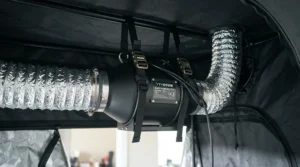
Setup. Hang the fan with its mounting hardware or sturdy straps rather than resting it on the tent poles, so vibration doesn’t travel through the frame. Place the filter on the intake side, so the fan pulls air through it and the tent stays under slight negative pressure. Keep ducting as straight and short as you can, since every bend cuts CFM.
First 30 days. Start at about 40% speed and adjust in small steps. If you picked a smart fan like the Cloudline T6, set VPD targets by growth stage. VPD is the difference between the moisture the air holds and what it could hold when saturated, and it tracks plant water demand better than humidity alone.
Maintenance. Every month or two, wipe dust off blades and the filter housing. The Cloudline S6 lets you detach the motor box for easy cleaning.
Common mistakes: Running at full speed constantly, kinking flexible ducting, and skipping a silencer when the tent shares a room with sleeping space. A duct silencer is usually the cheapest noise fix available.
Real-World Scenarios: Which Fan for Which Grower
The apartment grower with a 3×3 tent. Noise is everything here. The Cloudline S6 at low speed, or the Cloudline A6 if budget is tight, keeps noise down. Add a silencer and you’re nearly silent.
The hobbyist with a 4×4 tent and a long duct run. A hot room and a dense filter demand headroom. The Cloudline S6 or the VIVOSUN AeroZesh T6 give you roughly 400 CFM to work with, and the extra 50 CFM over the Cloudline A6 is useful here.
The data-driven grower running multiple stages. The Cloudline T6 handles VPD automation and logs climate history, which matters if you tweak conditions weekly. Anyone invested in Vivosun’s lighting can do similarly with the AeroZesh T6 and GrowHub.
The cost-conscious beginner. Pair a Cloudline S6 exhaust with a VIVOSUN R6 or Hon&Guan 6 Inch Inline Booster Fan intake. You spend where it counts, with a monthly dust check as the only upkeep.
Frequently Asked Questions
❓ Is the Vivosun 6 inch fan as good as the AC Infinity Cloudline?
❓ How much CFM do I need for a 4x4 grow tent?
❓ Can I mix a Cloudline fan with a cheaper intake fan?
❓ Do I need a smart controller for a 6 inch inline fan?
❓ Which 6 inch fan is quietest?
Conclusion: Which 6 Inch Fan Wins?
So, who wins the AC Infinity Cloudline 6 inch vs Vivosun 6 inch showdown? The honest answer is that it depends on what you value, but the pattern is clear.
For most buyers, the Cloudline S6 is the best all-rounder. It combines roughly 402 CFM, a documented 32 dBA rating, a detachable motor box and the deepest review track record, all around $100-$120. Choose the Cloudline T6 if automation excites you, and the Cloudline A6 if you want Cloudline quality on a tighter budget.
Vivosun earns its place in two situations. The VIVOSUN AeroZesh T6 suits anyone already committed to GrowHub, and the VIVOSUN R6 is the budget alternative to Cloudline 6 inch fans for people who prize price above all. For intake duty or short-term boosting, the Hon&Guan 6 Inch Inline Booster Fan is hard to beat on cost.
Whichever you choose, match the fan to your tent, budget for filter losses, and invest in a silencer if noise matters. Do that, and any pick on this list will serve you well.
Recommended for You
- AC Infinity Cloudline 6 Inch Review For 4×4 Tent: 7 Proven Fans 2026
- Price AC Infinity Cloudline 6 Inch Fan: 7 Smart Buys (2026)
- AC Infinity Cloudline 6 Inch Bundle Deal With Filter: 7 Best 2026
Disclaimer: This article contains affiliate links. As an Amazon Associate, I earn from qualifying purchases. If you purchase products through these links, we may earn a small commission at no additional cost to you.
✨ Found this helpful? Share it with your friends! 💬🤗
