

In This Article
You have a 4×8 tent, two lights, a carbon filter, and a shopping cart holding two fans. One is 6 inches. The other is 8. The price gap looks small, the airflow gap looks enormous, and every forum thread about it ends in an argument. So which one wins?

The honest answer to the 6 inch inline fan vs 8 inch for 4×8 tent question is “it depends.” But it depends on four things you can measure, and this guide walks through each one.
Here’s the short version. A 4×8 tent holds roughly 200-225 cubic feet of air. Ventilation guides commonly suggest swapping that air every one to two minutes. Once you add a carbon filter, duct bends, and light heat, the number climbs fast. That’s why several retailers point 4×8 growers to an 8 inch fan, while a good 6 inch EC model can still work in cool rooms with efficient LEDs.
CFM (cubic feet per minute) is just the volume of air a fan moves. Wikipedia’s airflow entry explains how it connects to air changes per hour, the yardstick we’ll use throughout.
We researched seven real fans, four 6 inch and three 8 inch, from AC Infinity, VIVOSUN, and VEVOR. You’ll get spec interpretation, worked math, ducting rules, oversizing traps, and buyer scenarios. Everything here is spec analysis and published data, not hands-on testing. Fair warning: the answer is less dramatic than the internet suggests, and a bit more useful.
Quick Comparison: 6 Inch vs 8 Inch Inline Fans at a Glance
Here’s the head-to-head for a typical 4x8x7 tent (224 cubic feet). The “after filter” row assumes a 25% airflow penalty. That’s a planning estimate, not a lab result.
| Metric | 6 inch class (~400 CFM) | 8 inch class (~807-830 CFM) |
|---|---|---|
| Rated free-air CFM | 402-405 CFM | 807-830 CFM |
| Air changes per minute (free air) | ~1.8 | ~3.6 |
| Estimated CFM after filter (~25% loss) | ~300 | ~600-620 |
| Air changes per minute (after filter) | ~1.3 | ~2.7 |
| Duct and filter size | 6 inch | 8 inch |
| Best For | Cool rooms, efficient LEDs, short duct runs, e.g. Cloudline T6 | Warm rooms, hotter lights, long ducts, e.g. Cloudline T8 |
Read the table as two different safety margins. The 6 inch class clears the “one air change per two minutes” rule easily. It only gets tight when you push toward one change per minute in a hot room. The 8 inch class clears both with room to spare. You can run it at partial speed and still hit your number, which is the real appeal.
The catch is that headroom costs money, space, and a bit of complexity. Buyers in cooler climates with modern LEDs may be paying for airflow they never use. Buyers in garages or attics may be dangerously short without it.
💬 Just one click — help others make better buying decisions too!😊
Top 7 Fans for a 4×8 Tent: Expert Analysis
Every fan below is a real, currently listed model. Prices are approximate bands at the time of research, so check current price before buying. Where independent review data couldn’t be verified in depth, we say so instead of inventing sentiment.
1. Cloudline T8 — quietest 8 inch with full climate automation
The standout here is the bundled Controller 69 Pro, which reacts to temperature, humidity, and VPD instead of spinning at one fixed speed.
The spec sheet lists 807 CFM through an 8 inch duct, an EC motor with PWM control, and a mixed-flow design. Noise is rated at 39 dBA (some listings say 38). In practice, 807 CFM means about 3.6 air changes per minute in a 4x8x7 tent at free air. Even after a 25% filter penalty you’re near 600 CFM. Mixed-flow matters because it keeps pushing air when filters and elbows add resistance. The listing also gives a 2.27 amp draw, which is a ceiling, since EC fans draw much less at lower speeds.
Based on the specs, this is the “set it and forget it” pick for a garage or spare room where temperatures swing. You can set a low minimum speed and let it ramp only when the tent warms. That turns oversizing into a buffer instead of a problem. The trade-off is the 8.5 x 11.9 x 9.2 inch housing, which needs solid hanging points and space for 8 inch duct.
Independent review data couldn’t be verified in depth here, so check recent buyer reviews for app stability and durability.
Pros:
- ✅ Rated around 39 dBA even at high output
- ✅ Temperature, humidity, and VPD automation included
- ✅ Big headroom for filter and duct losses
Cons:
- ❌ Premium price versus budget 8 inch fans
- ❌ Bulky housing and 8 inch ducting need space
Expect roughly $130-$190. It’s the best value if automation matters to you.
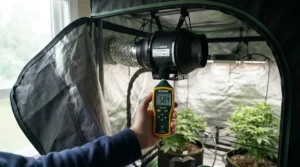
2. Cloudline T6 — best 6 inch pick for cool, quiet rooms
Same brain, smaller body: the Cloudline T6 pairs the same smart controller with a 402 CFM, 6 inch mixed-flow EC fan.
Listed dimensions are 7.9 x 12.6 x 8.4 inches, and the draw is 1.67 amps. That 402 CFM covers a 4x8x7 tent’s volume about 1.8 times per minute at free air. After a carbon filter, expect roughly 300 CFM delivered. That’s fine for a mild-climate room with efficient LEDs and a short, straight duct run.
Analytically, the Cloudline T6 is the sensible answer for growers who value quiet and space savings and know their room stays under about 75°F. Its weakness is headroom. If summer arrives, a second light goes in, or the duct run grows, you’ll be at full speed with nothing left to give. It’s also the one to buy if your tent has 6 inch ports and you don’t want reducers.
Buyer sentiment couldn’t be verified in enough depth for this write-up. Read the current reviews on the product page before you commit.
Pros:
- ✅ Smart temp and humidity control included
- ✅ Compact housing suits tight tent tops
- ✅ Matches 6 inch tent ports directly
Cons:
- ❌ Little headroom in hot rooms
- ❌ Costs more than basic 6 inch fans
Expect roughly $100-$150. It’s a good value if your room stays cool.
3. AeroZesh S8 — highest airflow rating in this roundup
The AeroZesh S8 lists 830 CFM, the highest rating in this comparison.
It’s an EC-motor, PWM-controlled, mixed-flow fan with an included E12 controller offering ten speed steps. That controller can be upgraded to the E42A GrowHub system for app control. The listed noise is 51 dB, notably higher than the 39 dBA rating on the Cloudline T8. Manufacturers measure noise differently, so treat the gap as a directional warning, not a verdict. VIVOSUN also sells a newer AeroZesh T8 at 832 CFM and 45 dB, which is worth comparing if noise matters to you.
The analytical take: the AeroZesh S8 suits growers who want big-fan headroom and expandable automation without paying the top premium. Ten speed steps let you dial back airflow, which matters because at full blast this fan is more than a 4×8 usually needs. The E12 alone gives no climate-based control, so you’ll add a controller if you want temperature-triggered speed.
Review data on the retailer listings we saw was too thin to summarize fairly. Check current customer reviews before buying.
Pros:
- ✅ Highest airflow rating in this roundup
- ✅ Ten speed steps for fine-tuning
- ✅ Upgrade path to full app control
Cons:
- ❌ Listed 51 dB is louder than rivals
- ❌ Basic controller lacks climate triggers
Expect roughly $100-$150. It’s a good value if you need airflow more than silence.
4. AeroZesh S6 — value EC 6 inch with a smart upgrade path
The AeroZesh S6 is the budget-friendly way into EC-motor 6 inch ventilation, at 405 CFM and a listed 45 dB.
It uses the same PWM, mixed-flow design as its bigger sibling and works with the E12 controller or the upgraded GrowHub E42A. That means you can start simple and add automation later. On paper, 405 CFM lines up with the Cloudline T6, but noise and controller details differ, so compare them line by line.
For a 4×8, the AeroZesh S6 is a “cool-room specialist.” Think a basement or interior room with efficient LEDs and a short duct run. Analytically, its best feature is the upgrade path: buy the fan now, add climate control when your budget allows. Its weakness is identical to any 6 inch fan in this tent size: hot summers can outrun it.
One retailer listing showed a 4.6 out of 5 average from just nine reviews at the time of research. That pool is too small to draw conclusions from.
Pros:
- ✅ EC motor at a modest price
- ✅ Upgradeable to app-based control
- ✅ Listed 45 dB is reasonably quiet
Cons:
- ❌ Limited headroom in warm rooms
- ❌ Small review pool on some listings
Expect roughly $70-$110. It’s a strong value for cool spaces.
5. VIVOSUN P6 — cheapest way to test a 6 inch setup
The VIVOSUN P6 is the budget floor of this roundup: an AC-motor 6 inch fan rated at 345 CFM with a speed regulator.
That 345 CFM is noticeably below the 400+ class, and AC motors generally lack the fine-grained, quiet low-speed control EC motors offer. After a filter penalty, you’re looking at roughly 260 CFM delivered. That’s about 1.2 air changes per minute in a 4x8x7 tent, which is workable for a cool room but leaves little margin.
Analytically, this fan makes more sense for a 4×4 or smaller tent, or as a secondary circulation or intake helper. It’s not our first pick for a 4×8. If you’re testing a setup before spending more, though, it’s the cheapest experiment in the roundup. Note that a speed regulator is a blunt control compared with a temperature-triggered EC controller.
Aggregated review sentiment couldn’t be verified in enough depth here. Read the current reviews before buying.
Pros:
- ✅ Lowest entry cost in this roundup
- ✅ Simple speed regulator included
- ✅ Handy as a secondary or intake fan
Cons:
- ❌ 345 CFM leaves thin margin for 4×8
- ❌ AC motor is less refined at low speeds
Expect under $50. It’s a fair value for small tents, but a stretch for a 4×8.
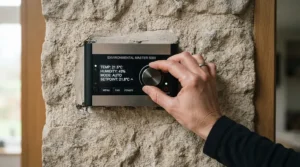
6. VEVOR 8-inch 807 CFM — big EC airflow at a lower entry price
The VEVOR 8-inch 807 CFM matches the Cloudline T8 on rated airflow while listing with a temperature and humidity controller and an EC motor.
Matching the 807 CFM headline means the same math applies. You get roughly 3.6 air changes per minute at free air and around 600 CFM after a filter. The value question is what you can’t see on the listing: independent noise measurements, controller responsiveness, and long-term bearing quality. Those details deserve a close read of buyer reviews.
Analytically, this is the “8 inch on a tighter budget” option. It suits a 4×8 in a warmer space where headroom matters more than brand polish. The trade-off is less verifiable track record than the Cloudline T8, so check warranty terms and recent reviews.
Pros:
- ✅ 807 CFM headline at a lower price band
- ✅ EC motor with temperature and humidity control
- ✅ Plenty of headroom for a 4×8
Cons:
- ❌ Less verified noise and durability data
- ❌ Fewer ecosystem and app options
Expect roughly $90-$150. It’s a strong value if reviews check out.
7. VEVOR 6-inch 402 CFM — timer and circulation modes on a budget
The VEVOR 6-inch 402 CFM is an EC-motor fan with three-speed circulation, a ten-speed PWM controller, and timer-controlled operation.
Its 402 CFM rating matches the Cloudline T6, and its feature list leans on scheduling instead of full climate automation. Timer modes are handy if you want the fan to cycle for humidity control in a stable room. But timers don’t respond to conditions the way temperature triggers do, so a warm afternoon can catch you off guard.
For a 4×8, this is a budget cool-room choice. It pairs well with a small standalone thermostat if you want reactive control. Analytically, the main risk is the same as any 6 inch fan here: you’re near the ceiling on airflow when summer heat arrives. The feature list is generous for the price, but durability data is worth checking.
Pros:
- ✅ EC motor with ten-speed PWM control
- ✅ Timer and circulation modes included
- ✅ Same 402 CFM rating as pricier rivals
Cons:
- ❌ Timer control isn’t climate-reactive
- ❌ Limited headroom for a hot 4×8
Expect roughly $60-$100. It’s a good budget value for cool rooms.
Here’s how all seven line up. Prices are approximate bands, so check current price.
| Product | Size | Rated CFM | Motor | Price band | Best For |
|---|---|---|---|---|---|
| Cloudline T8 | 8 inch | 807 | EC | $130-$190 | Smart control, hot rooms |
| Cloudline T6 | 6 inch | 402 | EC | $100-$150 | Cool, quiet rooms |
| AeroZesh S8 | 8 inch | 830 | EC | $100-$150 | Max airflow, upgrades |
| AeroZesh S6 | 6 inch | 405 | EC | $70-$110 | Budget EC, cool rooms |
| VIVOSUN P6 | 6 inch | 345 | AC | Under $50 | Small tents, testing |
| VEVOR 8-inch 807 CFM | 8 inch | 807 | EC | $90-$150 | Budget 8 inch headroom |
| VEVOR 6-inch 402 CFM | 6 inch | 402 | EC | $60-$100 | Timer-based cool rooms |
The pattern is plain. All three 8 inch options offer about twice the airflow of the 6 inch EC options for a moderate price step. For a 4×8, the Cloudline T8 and VEVOR 8-inch 807 CFM are the safest bets in warm spaces. The AeroZesh S6 and VEVOR 6-inch 402 CFM are the value plays for cool ones. The VIVOSUN P6 is best kept for smaller tents.
Tent Volume and CFM Math: A Step-by-Step Worksheet
Skip the guessing. This worksheet takes about two minutes and works for any tent.
Worked example: a 4x8x7 tent with one carbon filter and about 10 feet of duct with two bends.
- Volume: 4 x 8 x 7 = 224 cubic feet. (If your tent is 6.5 feet tall, use 208.)
- Base airflow: One air change every two minutes needs 112 CFM. One change per minute, the “hot room” target, needs 224 CFM. GrowersHouse walks through this same volume-to-CFM method.
- Filter penalty: A carbon filter commonly costs about 25-30% of rated airflow. To deliver 224 CFM, divide by 0.75, which gives about 299 CFM. The cool-room target becomes about 149 CFM.
- Duct and bends: Add roughly 10-15% for a 10-foot run with two bends. That’s about 329 CFM in the hot case.
- Heat and headroom: Add 25% for hot lights or summer. The hot case lands around 410 CFM.
The result is a range of roughly 150 to 410 CFM. A 402 CFM 6 inch fan sits right at the top of that range at full speed. An 807 CFM 8 inch fan covers it about twice over. One forum poster running a heat-load calculation on a 4×8 arrived at 775 CFM, which shows how much your room and lights move the answer. Treat the range as a planning estimate, since real results depend on your filter, ducting, and intake.

Real-World Scenarios: Three 4×8 Setups Matched to the Right Fan
Numbers are abstract. Here are three grower profiles matched to specific fans.
Scenario 1: The apartment grower. A spare bedroom held near 72°F, two efficient LEDs totaling about 300-400 watts, a short vertical duct run, and a strong preference for silence. Run time is 18 hours daily. The Cloudline T6 or AeroZesh S6 at 40-60% speed fits this profile. Their airflow covers a cool room’s needs, and the smaller housing leaves space for the filter. Budget: $70-$150.
Scenario 2: The garage grower in a hot climate. Summer ambient reaches 90°F, two higher-output lights run for 12 hours, and the duct run is 12 feet with three bends. This is the profile where the Cloudline T8 or AeroZesh S8 earns its price. The controller can hold a temperature target and only ramp when needed. If your tent’s ports are 8 inch, the fit is natural. Budget: $100-$190.
Scenario 3: The budget-first starter. A cool basement, a modest 600-watt-class light setup, and a hard spending cap. The VEVOR 6-inch 402 CFM or AeroZesh S6 works if you accept limited summer headroom. Choose the one that lets you add a thermostat or controller later, since reactive control is worth more than a few extra CFM. Budget: $60-$110.
The pattern: your room temperature and light heat decide the fan, not the tent’s footprint alone.
✨ Don’t Miss These Fan Deals!
🔍 Take your ventilation to the next level with these carefully selected fans. Click any highlighted product name to check current pricing and availability. The right size means a cooler, quieter tent and healthier plants!
What Is 6 Inch Inline Fan vs 8 Inch for 4×8 Tent?
The 6 inch inline fan vs 8 inch for 4×8 tent decision is a choice between two duct-fan sizes, typically about 400 CFM versus about 800 CFM, for exhausting heat, humidity, and odor from a roughly 4-by-8-foot grow tent. Six inches suits cool, low-heat setups. Eight inches suits warmer rooms, filters, and long ducts.
Why does this matter? Because a tent is a sealed box that traps light heat and plant moisture. The exhaust fan is the lungs: it pulls hot, humid air out and draws fresh air in through intake vents. Too little airflow and temperatures climb. Too much, and you trade heat problems for noise and dry air.
Two ideas make the choice easier. First, the fan’s rating is a best-case free-air number, so real-world delivery is lower. Second, the smaller fan isn’t “worse.” It’s a tighter fit, and that fit works well in the right room.
Choosing Fan Size for 4×8 Tent: 7 Steps That Remove the Guesswork
Here’s a repeatable method for choosing fan size for 4×8 tent setups. It works for any brand.
- Measure real volume. Multiply length x width x height, using the interior height. A 4x8x7 tent is 224 cubic feet.
- Pick an air-change target. Two minutes per change is a common baseline; one minute suits hot rooms or high-heat lights.
- Add the filter penalty. Divide your target by about 0.75 to cover a carbon filter’s resistance.
- Add duct losses. Add 10-15% for a 10-foot run with a few bends, more for long or crushed ducting.
- Factor in heat. Hot climates, big lights, or CO2 enrichment justify extra headroom. An attic or garage should be treated as a hot room.
- Check port and duct diameter. Confirm your tent’s port size, and buy fan, duct, and filter in one diameter.
- Choose control. A temperature-triggered controller lets a bigger fan idle quietly, which is the safest way to buy headroom.
If steps 1 through 5 give you under about 300 CFM and your room stays cool, a 6 inch EC fan is reasonable. If they push toward 400 or beyond, go 8 inch.
6 Inch vs 8 Inch CFM Comparison: What the Numbers Really Mean
This 6 inch vs 8 inch CFM comparison focuses on delivered performance instead of headline numbers.
| Factor | 6 inch class | 8 inch class |
|---|---|---|
| Rated CFM | ~402-405 (e.g., Cloudline T6, AeroZesh S6) | ~807-830 (e.g., Cloudline T8, AeroZesh S8) |
| Est. delivered CFM after filter | ~300 | ~600 |
| Listed noise in this roundup | 45 dB (AeroZesh S6) | 39 dBA (Cloudline T8) to 51 dB (AeroZesh S8) |
| Listed amp draw | 1.67 A (Cloudline T6) | 2.27 A (Cloudline T8) |
| Best For | Cool rooms, short ducts | Warm rooms, long ducts |
The counterintuitive point is noise. A bigger fan running at half speed can move as much air as a smaller fan at full speed, often with less strain. That’s why a well-controlled 8 inch fan can end up quieter in practice, though you should confirm this with the manufacturer’s performance data instead of assuming.
Note also that listed dB figures aren’t measured under one standard, so don’t compare 45 dB against 39 dBA as a strict ranking. The amp difference is small, and EC fans use much less power below full speed. The real cost of the 8 inch is footprint and duct stiffness, not electricity.
Ducting Diameter Compatibility: Why Your Duct Decides Everything
Ducting diameter compatibility is the most overlooked part of this decision. A fan can only deliver what its ducting, filter, and tent ports let through.
The rule is simple: match diameter across the whole chain, meaning tent port, duct, filter, and fan. Airflow always drops as resistance rises. University of Arizona extension guidance explains that fan performance is rated against static pressure, and delivered airflow falls as resistance climbs. Ducts, filters, and dirty components all add resistance.
Common problems and fixes:
- 8 inch fan, 6 inch port: a reducer chokes airflow and adds noise. Either buy a 6 inch fan or use an 8 inch port.
- Crushed or kinked flex duct: stretch it taut and support it with hangers.
- Filter too small for the fan: match the filter’s rated CFM to your real airflow, not just the diameter.
- Long, bendy runs: shorten the path and use gentle curves.
- Starved intake: if the tent walls suck in hard, add intake openings. A common rule is total intake area of three to four times the exhaust opening.
Always check your tent’s actual port sizes before buying, since 4×8 tents vary between 6 and 8 inch openings.

Oversized Fan Drawbacks: When Bigger Isn’t Better
The oversized fan drawbacks are real, but they’re smaller than the forum myths suggest, provided you can control speed.
Where oversizing hurts:
- Noise: a fan at full blast is loud. Buying big only makes sense if you’ll run it slower.
- Negative pressure: too much exhaust with too little intake sucks tent walls inward and can strain the frame. One retailer specifically warns against running cheap fans at maximum all day, citing noise, collapsed walls, and worn motors.
- Over-drying: blowing away humidity can stress plants in dry climates.
- Temperature drops: especially at lights-off, an oversized fan can chill the tent.
- Cost and space: bigger housings and 8 inch ducting are heavier and harder to route.
Where it doesn’t hurt: an EC fan with a temperature-triggered controller and a set minimum speed. Analytically, that setup makes oversizing a feature.
If you’re buying a basic AC fan without a controller, the risk is higher. That’s the one case where a smaller fan may be the wiser choice.
Right Fan Size for Large Tent: Beyond the 4×8
Finding the right fan size for large tent setups uses the same math, but the stakes rise.
For a 5x10x7 tent (350 cubic feet), one change per two minutes needs 175 CFM, and one per minute needs 350 CFM. Add filter and duct penalties and you’re near 470 CFM in a hot case. One published sizing table lists the same standard light and filter count for 4×8 and 5×10 tents, and points both toward the 8 inch class.
For an 8x8x7 tent (448 cubic feet), GrowersHouse’s example gives a 224 CFM minimum at one change per two minutes. With four lights and two filters, that climbs quickly. Guides note that once you exceed about 807 CFM, you should plan on multiple fans instead of one giant unit.
Practical takeaways:
- Up to 4×8: one 6 inch or 8 inch fan, depending on heat.
- 5×10: an 8 inch fan is the safer starting point.
- 8×8 and up: consider two fans, each with its own filter and duct run.
- Always check intake area, since bigger tents need proportionally bigger intake openings.
Long-Term Cost and Maintenance: What You’ll Really Spend
Purchase price is only part of the story. Here’s how each tier looks over a year of use. Bands are approximate, so check current price.
| Tier | Example | Price band | Long-term angle | Best For |
|---|---|---|---|---|
| Budget 6 inch | VIVOSUN P6 | Under $50 | AC motor, blunt control | Small tents |
| Mid 6 inch EC | AeroZesh S6, VEVOR 6-inch 402 CFM | $60-$110 | Efficient, upgradeable | Cool 4×8 rooms |
| Mid 8 inch EC | VEVOR 8-inch 807 CFM, AeroZesh S8 | $90-$150 | Headroom, more duct cost | Warm 4×8 rooms |
| Premium EC | Cloudline T6, Cloudline T8 | $100-$190 | Smart automation | Hands-off growers |
Electricity is modest. The Cloudline T8 lists 2.27 amps, which is an upper bound at full speed. Fans draw far less at reduced speeds, so a controlled EC fan costs little to run. The larger costs are replacement filters, durable ducting, and, for cheaper fans, earlier replacement.
Maintenance is simple: clean the blades and housing every few months, since the Cloudline T8 has a motor box that detaches for cleaning. Replace carbon filters on schedule, and check clamps and hangers each season.
The takeaway: a $30-$60 premium for EC and control often pays back in quiet operation and longevity.
Features That Actually Matter (And Those That Don’t)
Listings are packed with claims. Here’s how to filter them.
Matter most:
- EC motor: quieter, more efficient, and usually better at low speeds.
- Controller with minimum speed: lets an oversized fan idle instead of blasting.
- Static pressure capability: Greenhouse Management notes that airflow can drop 10-15% between zero and a modest 0.1 inch of static pressure. Manufacturers who only publish zero-pressure numbers flatter their fans.
- Realistic noise data: look for a stated dB or dBA figure and remember it isn’t standardized.
- Serviceability: a detachable motor box, like the one on the Cloudline T8, makes cleaning easy.
Matter less:
- Peak free-air CFM alone: it’s a best-case number.
- App gimmicks: useful for some, unnecessary for many.
- Extra speed steps: ten steps are plenty.
If you only remember one thing, remember this: buy a fan whose curve suits your duct, filter, and room, then control its speed.
Frequently Asked Questions
❓ Can a 6 inch inline fan handle a 4x8 tent?
❓ Can I run an 8 inch fan at low speed in a 4x8 tent?
❓ Is an 8 inch inline fan too loud for a 4x8 tent?
❓ Do I need an intake fan with an 8 inch exhaust in a 4x8 tent?
❓ Can I use two 6 inch fans instead of one 8 inch fan for a 4x8 tent?
Conclusion
So, which wins in the 6 inch inline fan vs 8 inch for 4×8 tent showdown? For most 4×8 tents, especially in garages, attics, or warm climates, the 8 inch is the safer bet. It hands you headroom for filter loss, duct bends, and summer heat, and a controller lets it run quiet. The Cloudline T8 leads for automation. The VEVOR 8-inch 807 CFM is the budget alternative, and the AeroZesh S8 is the airflow-first choice.
If your room stays cool, your lights are efficient, and your duct runs are short, a 6 inch EC fan is a perfectly sensible pick. The Cloudline T6, AeroZesh S6, and VEVOR 6-inch 402 CFM each serve that profile, while the VIVOSUN P6 is best kept for smaller tents.
Do the math, check your port sizes, and put speed control on whatever you buy. If you’re unsure, choosing fan size for 4×8 tent setups comes down to one rule: buy the headroom, then control it.
Recommended for You
- Quietest 6 Inch Inline Duct Fan For Grow Room: 7 Silent Picks
- 6 Inch Inline Fan For Basement Grow Room: 7 Best Picks (2026)
- 6 Inch Inline Fan For 4×4 Grow Tent: 7 Proven 2026 Picks
Disclaimer: This article contains affiliate links. As an Amazon Associate, I earn from qualifying purchases. If you purchase products through these links, we may earn a small commission at no additional cost to you.
✨ Found this helpful? Share it with your friends! 💬🤗
