

In This Article
Basements lie to you. They feel cool and stable, so it’s easy to assume your plants will be fine down there with a box fan and good intentions. They won’t. A basement is a sealed concrete box with almost no natural air exchange, and that’s exactly the environment where heat, humidity, and stale CO2 pile up fastest. The fix isn’t complicated, but it does require the right hardware: a 6 inch inline fan for basement grow room use, sized and installed correctly, is the single piece of equipment that turns a damp, stuffy corner into a space your plants can actually thrive in.
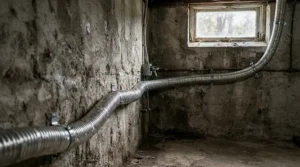
A 6 inch inline fan for basement grow room ventilation is a mixed-flow or centrifugal duct fan, rated for 6-inch ducting, that pulls stale air out of an enclosed grow space and exhausts it elsewhere — typically through a carbon filter to control odor. Most models move somewhere between 250 and 450 CFM, which covers the majority of home basement setups from a single 4×4 tent to a small dedicated grow room.
Below, we’ve dug into real specs, aggregated review sentiment, and honest side-by-side comparisons across seven fans that consistently show up in serious grower discussions — from bargain workhorses to the near-silent premium units that basement growers with finished ceilings and light sleepers upstairs tend to gravitate toward. We’ll also get into the part most buying guides skip entirely: what changes about ventilation math once you’re underground.
Quick Comparison Table
| Fan | CFM | Noise Level | Best For |
|---|---|---|---|
| AC Infinity CLOUDLINE T6 | 402 CFM | ~32 dBA | Hands-off climate automation |
| Vortex S-Line 6″ | 347 CFM | Very low (insulated walls) | Whisper-quiet basements near living space |
| AC Infinity CLOUDLINE PRO S6 | 402 CFM | ~32 dBA | Max airflow, no smart controller needed |
| iPower 6″ 442 CFM Combo | 442 CFM | Moderate | Budget buyers who want a full kit |
| VIVOSUN 6″ 390 CFM | 390-395 CFM | Moderate | First-time growers on a budget |
| TerraBloom ECMF-150 | 288 CFM | ~31 dBA | Small basement corners, EC efficiency |
| Hon&Guan 6-Inch | ~350 CFM | Moderate-loud | Absolute lowest upfront cost |
A few things jump out right away. Raw CFM isn’t the whole story — the iPower 6″ 442 CFM Combo technically moves the most air, but the Vortex S-Line 6″ and TerraBloom ECMF-150 win on noise, which matters enormously in a basement that shares a wall or ceiling with a bedroom. If you’re chasing pure hands-off convenience, the AC Infinity CLOUDLINE T6 is really in a category of its own thanks to its onboard controller.
💬 Found a fan that fits your space already? Skip ahead — the full breakdown is below, and every pick links out to current availability.
Top 7 6 Inch Inline Fans for Basement Grow Rooms: Expert Analysis
1. AC Infinity CLOUDLINE T6 — smart controller that reads your room
The standout feature here isn’t the motor, it’s the brain attached to it. The AC Infinity CLOUDLINE T6 pairs a mixed-flow EC motor rated around 402 CFM with a controller that lets you set temperature and humidity targets, and the fan adjusts its own speed to hit them. That’s a genuinely different category of product than a fan with a manual dial. A powder-coated steel housing and EC motor design mean it draws noticeably less power than a comparable AC-motor fan running the same CFM, and the programmable thresholds let you set day and night schedules so the fan runs harder when your lights are on and backs off when the room cools naturally.
Based on the spec comparison, this is the fan for growers who don’t want to babysit their basement environment — set your VPD-informed targets once, and the controller handles the rest, which matters more underground than anywhere else in the house since basements swing less predictably with the seasons. Reviewers consistently report that the automation genuinely reduces the number of times they have to walk down and manually adjust anything, and the biggest recurring gripe is that the controller and cabling take up more space than a bare fan would.
Pros:
- ✅ Automated temp/humidity-based speed control
- ✅ EC motor cuts electricity use versus AC models
- ✅ Quiet operation even at higher CFM settings
Cons:
- ❌ Higher upfront cost than basic inline fans
- ❌ Controller adds bulk and wiring to manage
Expect to pay in the $140-$170 range for the T6 at the time of research; given how much manual adjustment it replaces, it’s a strong value pick for anyone running a basement grow unattended for stretches of the day. Check current price and availability before buying.

2. Vortex S-Line 6″ — quietest mixed-flow motor in its class
The Vortex S-Line 6″ leads with double-insulated polycarbonate walls wrapped around a brushless AC motor — a construction choice aimed squarely at noise, not just airflow. It’s rated at 347 CFM, which lands a notch below the AC Infinity pair, but the fan runs at 2,720 RPM through a mixed-flow dual-impeller design that keeps the sound signature low even at that speed. What most buyers overlook about this model is the integrated backdraft damper, which stops air (and odor) from leaking back into the room when the fan cycles off — a detail that matters if you’re running a carbon filter for smell control in a finished basement.
On paper, 347 CFM comfortably handles a 4×4 tent with a carbon filter attached and leaves headroom for a small 4×8 space if you’re not maxing out light wattage. The high-impact polycarbonate casing and 10-year warranty point to a company betting on long-term reliability rather than a cheap plastic housing that cracks after a couple of seasons. Aggregated reviewer sentiment describes the fan as noticeably quieter than comparably rated steel-body competitors, with the main complaint being that its price sits well above budget alternatives for similar airflow.
Pros:
- ✅ Double-insulated housing for genuinely low noise
- ✅ Integrated backdraft damper blocks air leak-back
- ✅ 10-year warranty signals long-term build confidence
Cons:
- ❌ Premium price relative to CFM delivered
- ❌ Lower CFM ceiling than the 400+ CFM competitors
Prices for the S-Line 6″ run in the $300-$350 range at the time of research, positioning it as the splurge pick for basements where noise is the priority over raw airflow. Check current price before ordering, since Vortex pricing shifts more than most brands in this category.
3. AC Infinity CLOUDLINE PRO S6 — same muscle, no frills
Think of the AC Infinity CLOUDLINE PRO S6 as the T6’s leaner sibling. It shares essentially the same EC motor and 402 CFM airflow rating, and testers clocked it around 32 dBA, but it skips the programmable climate controller entirely in favor of a straightforward speed dial. That’s the whole pitch: identical core performance, lower price, less to configure.
Here’s what to weigh — if you already own a separate humidity or temperature controller (an Inkbird unit, for example), pairing it with the S6 gets you nearly the same automated result as the T6 for meaningfully less money, since you’re not paying twice for climate-sensing hardware. The compact 6-inch housing skips adapters entirely on standard ducting, and the fan includes a generously long power cord that gives you real flexibility on where you mount it relative to your outlet. Reviewers who’ve run this model in grow tents and basement corners alike report that build quality and quiet operation hold up even after a full season of continuous use, with the only recurring criticism being the lack of any onboard display to check settings at a glance.
Pros:
- ✅ 402 CFM and EC efficiency at a lower price than the T6
- ✅ Compact housing fits standard 6-inch ducting directly
- ✅ Long power cord simplifies awkward basement mounting
Cons:
- ❌ No built-in automation — manual speed dial only
- ❌ No display to confirm current speed setting
Expect a price somewhere in the $120-$150 range. If you already have climate controls elsewhere in your setup, this is arguably the smarter dollar-for-dollar buy over the T6.
4. iPower 6 Inch 442 CFM Combo — most CFM per dollar
The iPower 6 Inch 442 CFM Combo leads with sheer output — at 442 CFM, it’s the highest-rated fan on this list, and it typically ships bundled with a carbon filter and a long run of ducting, sometimes 25 feet. That bundling is the real story here: instead of piecing together a fan, filter, and ducting separately, you get a complete exhaust system in one box.
What that extra CFM buys you in practice is headroom. A 4×8 basement grow with two lights running hot will lean on every bit of that airflow once you factor in resistance from a carbon filter and any bends in your ducting — the 25-30% CFM buffer rule exists precisely because filters and long duct runs eat into a fan’s free-air rating fast. Reviewers note the variable speed controller lets you dial back the aggressive top-end CFM for smaller tents where full power would be overkill (and unnecessarily loud). The rope hanger included in most combo kits is a small but genuinely useful touch for basement ceiling joists without drilled mounting points. The main complaint in aggregated feedback centers on the plastic housing feeling less substantial than the metal-bodied competitors at this CFM tier.
Pros:
- ✅ Highest CFM rating in this roundup at 442 CFM
- ✅ Combo kit includes carbon filter and long ducting
- ✅ Variable speed controller included for flexibility
Cons:
- ❌ Plastic housing feels less durable than steel models
- ❌ Louder at max speed than the EC-motor options
The combo kit typically runs in the $80-$110 range depending on the ducting length included — a genuinely strong value if you’re building a basement exhaust system from zero and don’t already own a filter.
5. VIVOSUN 6 Inch 390 CFM — proven budget workhorse
The VIVOSUN 6 Inch 390 CFM has been a default recommendation in grower forums for years, and the reason is consistency rather than any standout feature. It ships with a built-in speed regulator, moves a respectable 390-395 CFM, and — notably — shows up in reviews for uses well beyond grow tents, including basement HVAC boosting and bathroom exhaust, which speaks to how dependable buyers have found the core motor to be across different applications.
Reviewers consistently note that 390 CFM comfortably covers small-to-mid basement grow spaces, and the included speed controller lets you throttle it down during cooler overnight hours to avoid over-drying a small tent. The recurring complaint in aggregated feedback is about the plastic fan blades, which some buyers report developing a faint scraping noise after months of continuous operation — worth listening for after the first few weeks, since it’s usually a sign the blade has shifted slightly on the shaft rather than a fatal flaw. This is a fan bought in volume by first-time growers for a reason: it does the job without asking you to think hard about it.
Pros:
- ✅ Reliable core motor across many home ventilation uses
- ✅ Built-in speed controller included standard
- ✅ Affordable enough for a first basement grow build
Cons:
- ❌ Plastic blades occasionally develop noise over time
- ❌ No EC motor, so it draws more power at full speed
Prices sit in the $50-$70 range for the fan alone, with combo kits including a filter and monitor pushing toward the low-$100s. Check current pricing, since VIVOSUN runs frequent bundle changes.
6. TerraBloom ECMF-150 — EC efficiency in a small footprint
The TerraBloom ECMF-150 takes a different approach than the high-CFM options above it: a 36-watt brushless EC motor pushing 288 CFM at a remarkably quiet 31 dBA, wrapped in a powder-coated metal casing instead of plastic. What most buyers overlook about this model is the efficiency number — at roughly 8 CFM per watt, it’s doing meaningfully more work per watt of electricity than the AC-motor fans on this list, which adds up over months of 24/7 basement operation.
Here’s what to weigh: 288 CFM is lower than every other fan here, so this isn’t the pick for a 4×8 room running multiple lights. But for a single 4×4 tent, or a smaller basement grow corner where noise matters more than maximum output, the tradeoff makes sense. The variable 0-100% speed control gives fine-grained adjustment rather than a handful of fixed steps, and the 2-year warranty on the ECMF series suggests the company stands behind the motor’s longevity. Aggregated reviews describe the noise level as genuinely lower than comparably sized budget fans, with occasional feedback noting the metal housing runs slightly warm to the touch during extended high-speed use — expected with any compact motor housing, but worth knowing before you tuck it into a tight space.
Pros:
- ✅ EC motor delivers strong CFM-per-watt efficiency
- ✅ 31 dBA noise level among the quietest here
- ✅ Durable powder-coated metal housing, not plastic
Cons:
- ❌ Lower CFM ceiling limits it to smaller spaces
- ❌ Housing can run warm during extended high-speed use
Expect a price in the $90-$120 range at the time of research — a reasonable premium for the efficiency and noise profile if your basement space is on the smaller side.
7. Hon&Guan 6-Inch — lowest-cost way to move air
The Hon&Guan 6-Inch exists for one reason: to move a meaningful volume of air through 6-inch ducting for the lowest possible price. It’s designed specifically to maintain strong airflow through long stretches of ducting, which makes it a reasonable pick if your fan needs to sit far from your tent or push air through a lengthy basement duct run to an exterior vent.
Based on the spec comparison, there’s no smart controller, no EC motor, and no premium housing material here — this is a bare-bones inline fan aimed at buyers who need functional ventilation and nothing else. Reviewers who buy this model tend to already know exactly what they need and aren’t looking for extras; the honest tradeoff is that it runs louder and less efficiently than every other fan on this list, and the housing is a step down in durability from the steel-bodied Vortex or TerraBloom units. For an occasional-use basement space, or as a backup fan kept in reserve, that tradeoff is often perfectly reasonable.
Pros:
- ✅ Lowest price point of any fan in this roundup
- ✅ Maintains airflow well through longer duct runs
- ✅ Simple, no-frills design with fewer failure points
Cons:
- ❌ Noticeably louder than EC-motor competitors
- ❌ Basic housing material feels less premium
Pricing typically falls in the $40-$60 range, making it the entry point for anyone testing out a first basement grow without committing much capital to ventilation yet.
How to Choose a 6 Inch Inline Fan for a Basement Grow Room
Picking the right fan comes down to running a few numbers before you fall in love with a feature list.
- Calculate your room’s cubic footage. Multiply length by width by height. A 4x4x7 tent, for example, works out to 112 cubic feet.
- Add 25% for carbon filter resistance. Pulling air through a filter creates static pressure that eats into a fan’s free-air CFM rating, so build in the buffer.
- Add another 20-30% if your duct run is long or has bends. Basements often force awkward, bent duct paths to reach an exterior vent, and every bend costs airflow.
- Match the fan to that adjusted number, not the raw room volume. A 6 inch inline fan for basement grow room use typically covers the 300-450 CFM range that this math produces for most home setups.
- Weigh noise against location. If the basement sits under a bedroom or living space, prioritize EC-motor and insulated-housing models even if it means slightly less CFM.
- Check duct diameter compatibility. Your fan size should match your ducting size exactly — a 6-inch fan needs 6-inch ducting, not an adapter stack.
- Decide if you want automation. A smart controller is worth the premium if you can’t check the room daily; a manual speed dial is fine if you’re down there often anyway.
Practical Usage Guide: Setup, First 30 Days, and Common Mistakes
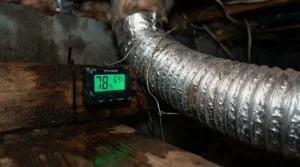
Getting a 6 inch inline fan for basement grow room ventilation running correctly is less about brute force and more about airflow direction. Always mount the fan to pull air through your carbon filter, not push it — filter, then fan, then ducting to your exit point. Pushing air through a filter instead of pulling wastes filtration efficiency and shortens the filter’s usable life. Use your fan’s speed controller to start on a lower setting for the first few days, watching how quickly your tent or room temperature and humidity respond, then adjust upward as needed rather than guessing at full speed from day one.
The most common first-30-days mistake is duct sag — a long run of flex ducting hanging loose between the fan and the exterior vent creates soft bends that quietly rob you of a huge percentage of your rated CFM. Support the ducting every few feet with hangers or straps so it stays as straight as possible. The second common mistake is skipping a backdraft damper on the exhaust end; without one, outside air (and cold basement drafts) can flow back into your tent when the fan isn’t running, undoing your climate control overnight. Finally, resist the urge to oversize dramatically “just in case” — a fan running at 20% of its rated capacity all the time is often noisier and less efficient than a correctly sized fan running comfortably at 60-70%.
For maintenance, wipe down fan blades every one to two months, since dust buildup on the blades reduces airflow and adds vibration noise over time, and inspect the carbon filter’s intake sock or pre-filter monthly if you have one — a clogged pre-filter forces your fan to work harder than the CFM math ever accounted for.
Problem → Solution: Humidity Control Basement Grow Guide
Humidity control basement grow setups face a problem that upstairs rooms mostly don’t: basements sit closer to the water table, against uninsulated concrete, and often have little to no natural air exchange with the outdoors. That combination pushes ambient humidity higher than almost anywhere else in the house before you’ve even introduced a single plant.
Problem 1: Baseline basement humidity is already high before lights go on. Solution — run your inline fan on a low continuous setting even during dark periods to keep air moving, rather than shutting it off completely, and consider a dedicated basement dehumidifier working alongside the fan rather than relying on exhaust alone.
Problem 2: Condensation forms on cool basement walls and ducting. Solution — insulate exposed ducting runs, especially anywhere they pass near an exterior wall, since the temperature differential between the humid tent exhaust and a cold basement wall is exactly what triggers condensation.
Problem 3: Humidity spikes after watering plants. Solution — bump your inline fan’s speed manually (or let a smart controller like the one on the AC Infinity CLOUDLINE T6 do it automatically) for a few hours post-watering, when transpiration and evaporation both spike.
Problem 4: Musty odor even with a working carbon filter. Solution — check for a moisture source in the basement itself, not just the grow space; per EPA guidance, the key to mold control is moisture control, and an inline fan can’t outrun an active basement leak or persistent dampness in the foundation.
Problem 5: Humidity swings wildly between day and night. Solution — pair your fan with a simple hygrometer at canopy height, not near the light or the fan’s direct airflow, since sensor placement skews readings and leads to overcorrection in either direction.
Basement Grow Room Ventilation Fan Placement & Airflow Design
A basement grow room ventilation fan only performs as well as its placement lets it. The core principle is negative pressure: air should be pulled into your tent or room through small passive intake gaps, then exhausted out through the fan and filter, so the space always runs slightly negative relative to the rest of the basement. That negative pressure is what keeps grow-room odor from drifting into the rest of your house — a bigger concern in a basement that connects to shared HVAC returns than almost anywhere else.
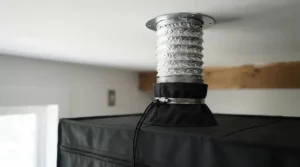
Mount your basement grow room ventilation fan as close to the carbon filter as possible, ideally hanging both together near the top of the tent where hot, humid air naturally collects. From there, route ducting by the shortest reasonable path to an exterior vent, dryer vent adapter, or basement window kit — every unnecessary foot of ducting and every 90-degree bend chips away at real-world CFM versus the fan’s rated number. If your basement has exposed floor joists, use them to run ducting flat and level rather than looping it, since sagging duct sections create the soft kinks that quietly kill airflow. Vibration matters more underground too: basements with concrete floors and block walls transmit fan hum surprisingly well through the structure, so a rubber isolation mount or a short section of non-rigid ducting between the fan and any rigid mounting point can noticeably cut down on the low-frequency drone that travels through a house’s framing.
6 Inch Inline Fan vs 4 Inch and 8 Inch Alternatives
| Fan Size | Typical CFM Range | Best Room Size | Best For |
|---|---|---|---|
| 4-inch | 100-205 CFM | 2×4 to small 3×3 tents | Closets, micro-grows |
| 6-inch | 250-450 CFM | 4×4 to 4×8 rooms | Most basement grow spaces |
| 8-inch | 550-750 CFM | 5×5 and larger rooms | Dedicated commercial-style rooms |
The jump from 4-inch to 6-inch fans is usually a jump from “barely adequate” to “comfortable with headroom,” while the jump from 6-inch to 8-inch is more about scale than performance — most basement setups simply don’t have the room volume or light load to need 8-inch airflow. Undersizing costs you heat and humidity control; oversizing costs you money, noise, and sometimes over-drying a small space. For the vast majority of basement growers running one to two lights in a 4×4 or 4×8 footprint, a 6 inch inline fan for basement grow room ventilation sits squarely in the sweet spot between those two extremes.
What to Expect: Real-World Performance Underground
Specs on a box rarely translate one-to-one once a fan is actually running in a finished basement. A fan rated at 400 CFM free-air will realistically deliver noticeably less once it’s pulling through a carbon filter and a bent duct run — expect something closer to 280-320 CFM of real-world exhaust in a typical installation, which is exactly why the 25-30% buffer rule in the sizing math matters so much. Noise also behaves differently underground: concrete surfaces reflect sound rather than absorbing it the way drywall and carpet do upstairs, so a fan rated at 32 dBA in a lab test can feel louder in an unfinished basement corner than the number suggests. Temperature swings tend to be gentler in basements than in upstairs rooms — the thermal mass of surrounding concrete buffers against rapid changes — but that same stability means humidity, once elevated, tends to linger longer without strong, consistent airflow to clear it out.
Common Mistakes When Buying a 6 Inch Inline Fan
The single most common mistake is buying based on maximum CFM alone without accounting for filter and ducting resistance, which routinely leaves growers with a fan that “should” be plenty but runs hot and humid anyway. A close second is ignoring noise ratings entirely, then discovering after installation that a fan humming at 45+ dBA is audible through a shared basement ceiling at 2 a.m. Buyers also frequently skip checking duct diameter compatibility, ending up with a fan and ducting mismatch that requires an adapter — and every adapter and reducer in a duct run costs airflow. Finally, plenty of first-time buyers overlook the power draw difference between AC and EC motors; running an older AC-motor fan continuously for months adds up on an electric bill in a way that’s easy to underestimate upfront.
Long-Term Cost & Maintenance
An inline fan is a 24/7 appliance for most of a grow cycle, so wattage matters more over a full season than the sticker price does. An EC-motor fan like the TerraBloom ECMF-150 or the AC Infinity CLOUDLINE models typically draws meaningfully less power at a comparable CFM than an AC-motor fan like the Hon&Guan 6-Inch or standard VIVOSUN 6 Inch 390 CFM, and that difference compounds across months of continuous runtime. Total cost of ownership should also factor in replacement carbon filters, which most quality filters need roughly every one to two years of continuous use — a sign it’s time to swap is when odors start getting through even at full fan speed. Bearings and motor longevity vary by build quality, which is part of why the metal-housed, sealed-bearing options on this list carry longer warranties than the budget plastic models; a 10-year warranty, as seen on the Vortex S-Line 6″, reflects genuine confidence in long-term reliability rather than marketing language.
Safety, Wiring & Noise Guide for Basement Installations
Basements bring specific safety considerations that upstairs grow spaces don’t. Route power cords away from any area prone to moisture or standing water, and use a grounded, GFCI-protected outlet given the higher ambient dampness underground. Never daisy-chain multiple high-draw appliances — fan, lights, dehumidifier — off a single extension cord; run dedicated circuits where possible. On noise, it’s worth knowing that NIOSH’s guidance on hazardous noise exposure centers on sustained exposure at or above 85 dBA, a level nowhere near what even the loudest inline fan on this list produces — but for comfort rather than hearing-safety reasons, most basement growers still find fans in the low-to-mid 30s dBA far more livable for daily proximity. Secure ducting connections with clamps rather than tape alone, since a loose duct joint in a basement is both an airflow leak and, over time, a moisture and condensation point.
FAQ
❓ What size inline fan do I need for a basement grow tent?
❓ Is a 6 inch inline fan loud enough to hear upstairs?
❓ Do I need a carbon filter with my inline fan?
❓ How often should I replace my carbon filter?
❓ Can a 6 inch inline fan help with basement humidity control?
Conclusion
A basement grow room lives or dies on airflow you can’t see happening — the quiet, constant exchange of stale, humid air for something drier and more stable. That’s the entire job of a 6 inch inline fan for basement grow room ventilation, and as this roundup hopefully made clear, there’s a genuinely right-sized option whether you’re chasing hands-off automation with the AC Infinity CLOUDLINE T6, near-silent operation with the Vortex S-Line 6″, or you just need something functional and affordable to get a first grow off the ground with the Hon&Guan 6-Inch or VIVOSUN 6 Inch 390 CFM.
The math is the same regardless of which fan you pick: calculate your room’s real volume, buffer for filter and ducting resistance, match CFM to that adjusted number, and route your ducting as short and straight as your basement layout allows. Get that right, and even a budget fan will outperform an oversized, poorly installed premium one. If your basement’s biggest issue has been persistent dampness or musty air more than heat, pay close attention to the humidity control basement grow section above — airflow alone can’t fix an active moisture problem, but it’s the tool that makes every other humidity fix actually work.
Recommended for You
- 6 Inch Inline Fan For 4×4 Grow Tent: 7 Proven 2026 Picks
- 7 Best 6 Inch Inline Fans Of 2026 — Quiet Picks That Actually Deliver
- Vivosun 4 Inch Inline Fan For Small Closet Grow: 7 Best Picks 2026
Disclaimer: This article contains affiliate links. As an Amazon Associate, I earn from qualifying purchases. If you purchase products through these links, we may earn a small commission at no additional cost to you.
✨ Found this helpful? Share it with your friends! 💬🤗
