
In This Article
Here’s something most new growers don’t realize until it’s too late – your neighbors can smell your indoor garden from three houses away. That delightful aroma you barely notice? It’s broadcasting your growing operation like a neon billboard.
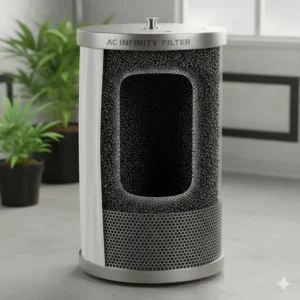
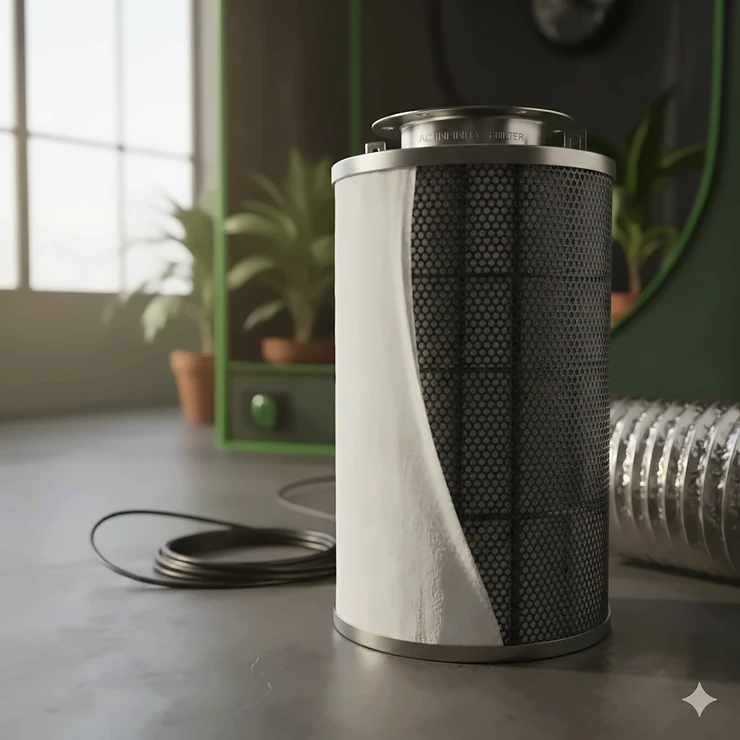
A carbon filter for grow tent isn’t just nice to have, it’s essential. Whether you’re cultivating herbs, vegetables, or aromatic plants, these cylindrical workhorses quietly scrub your grow tent air clean, trapping odor molecules before they escape into your living space. Think of it as an invisibility cloak for smells.
The science is fascinating. Activated carbon features microscopic pores that create an enormous surface area – a single teaspoon contains more surface area than a football field! As air passes through, odor molecules stick to the carbon surface through a process called adsorption (yes, with a ‘d’, not absorption). Those molecules get trapped in the carbon’s maze-like structure and never escape.
But here’s the challenge: walk into any hydroponics store or browse Amazon, and you’ll face dozens of options ranging from $30 budget filters to $200 premium models. Which one actually works? Which brands deliver real performance versus marketing hype? That’s exactly what we’re breaking down today.
Quick Comparison Table
| Carbon Filter | Size | CFM Rating | Carbon Type | Price Range | Best For |
|---|---|---|---|---|---|
| AC Infinity 6″ | 6″ x 16″ | 410 CFM | Australian RC412 | $65-75 | Best Overall |
| VIVOSUN 4″ | 4″ x 12″ | 223 CFM | Australian Virgin | $35-45 | Budget Pick |
| AC Infinity Refillable 6″ | 6″ x 17″ | 410 CFM | Australian Virgin | $135-145 | Eco-Friendly |
| Spider Farmer 6″ | 6″ x 16″ | 400 CFM | Australian Activated | $60-70 | Premium Quality |
| MARS HYDRO 4″ | 4″ x 12″ | 210 CFM | Australian Virgin | $30-40 | Small Tents |
| VIVOSUN 6″ | 6″ x 18″ | 384 CFM | RC 412 Australian | $50-60 | Value Pick |
| MELONFARM 4″ | 4″ x 11″ | 190 CFM | Australian Virgin | $32-42 | Compact Spaces |
💬 Just one click – help others make better buying decisions too! 😊
Top 7 Carbon Filter for Grow Tent: Expert Analysis
1. AC Infinity Air Carbon Filter 6“ – Best Overall Performance
The AC Infinity Air Carbon Filter 6″ dominates the market for good reason. This isn’t just another filter – it’s engineered precision that actually works.
Key Specifications:
- 6″ duct opening x 16″ length
- 410 CFM airflow rating
- Premium Australian RC412 charcoal at 1200+ IAV
- 38mm carbon bed thickness
What sets this filter apart is the build quality. The powder-coated gunmetal finish resists corrosion in humid grow environments, while dual-sided galvanized steel mesh allows 100% air passthrough. You get aluminum flanges (not cheap plastic), reversible for extended life, plus two washable pre-filters, rope clips, and hanging straps.
Customer feedback consistently praises its effectiveness. Growers report zero odor leakage even during peak flowering, which is when most cheaper filters fail. One reviewer mentioned pairing it with their 3×3 tent and Cloudline T6 fan – complete odor elimination for over 14 months.
✅ Pros:
- Superior construction quality
- Reversible flanges double lifespan
- Includes premium accessories
- Proven long-term performance
❌ Cons:
- Higher initial cost
- Heavier than budget options
Price: $65-75 | Rating: 4.8/5
2. VIVOSUN 4 Inch Air Carbon Filter – Budget Champion
Don’t let the affordable price fool you. The VIVOSUN 4 Inch Air Carbon Filter delivers impressive performance for smaller setups without breaking the bank.
Key Specifications:
- 4″ flange x 12″ length
- 223 CFM maximum airflow
- 1200+ RC 412 Australian Virgin charcoal
- Reversible iron flange and base
VIVOSUN engineered this filter with a unique dual-sided galvanized steel mesh featuring round hole design. This increases open area dramatically, ensuring you get that full 223 CFM without restriction. The lengthened carbon canister means higher filtration rates compared to shorter 4″ models.
The reversible flange system is clever engineering. When one side of the carbon bed becomes saturated, flip it around and extend the filter’s life by months. Growers report 12-18 months of effective odor control when properly maintained, which is exceptional at this price point.
✅ Pros:
- Unbeatable price-to-performance ratio
- Reversible design extends lifespan
- Detachable pre-filter for easy maintenance
- Perfect for 2×2 or 3×3 tents
❌ Cons:
- Not suitable for larger grow spaces
- Lower CFM than 6″ models
Price: $35-45 | Rating: 4.6/5
3. AC Infinity Refillable Carbon Filter Kit 6“ – Sustainable Choice
Here’s innovation that makes both economic and environmental sense. The AC Infinity Refillable Carbon Filter Kit 6″ eliminates the need to buy replacement filters every year.
Key Specifications:
- Patented refillable design
- Includes funnel, scoop, and one charcoal refill
- Equivalent capacity to two standard 6″ filters
- 410 CFM rating with expanded chamber
This iF Award-winning design features twist-off flanges that let you refill the carbon without tools. The expanded chamber means you achieve factory-level carbon compression without manual effort. One refill costs about $45 versus $70 for a new filter – the savings add up fast.
Lab testing confirms it blocks odors as effectively as traditional filters. The dual-layered steel mesh with protective coating withstands high humidity through multiple grow cycles. Environmental growers love that it reduces landfill waste.
✅ Pros:
- Refills cost 35% less than new filters
- Reduces environmental impact
- Easy, tool-free refilling process
- Premium build quality
❌ Cons:
- Higher upfront investment
- Need to purchase refills separately after first one
Price: $135-145 | Rating: 4.7/5
4. Spider Farmer 6 Inch Air Carbon Filter – Premium Quality
Spider Farmer brings their reputation for quality from grow lights to air filtration. The Spider Farmer 6 Inch Air Carbon Filter uses highest-grade granular Australian activated charcoal for superior adsorption.
Key Specifications:
- 6″ flange x 16″ length
- 400 CFM airflow capacity
- Premium Australian activated charcoal
- Heavy-duty aluminum flanges
What impressed us most is the carbon porosity. Spider Farmer specifically sources charcoal with optimal pore structure for capturing odor molecules and VOCs. This isn’t just marketing – growers notice the difference. The filter scrubs air more thoroughly and maintains effectiveness longer than comparable models.
The washable pre-filter is thick and durable, easily blocking 99% of particulates before they reach the carbon bed. This pre-filtration extends the main filter’s lifespan significantly. Customers report 18-24 months of excellent odor control with proper pre-filter maintenance.
✅ Pros:
- Exceptionally pure carbon quality
- Longer service life than competitors
- Compatible with all major inline fans
- Sturdy, galvanized steel construction
❌ Cons:
- Slightly lower CFM than AC Infinity
- Premium pricing tier
Price: $60-70 | Rating: 4.7/5
5. MARS HYDRO 4 Inch Carbon Filter – Compact Powerhouse
MARS HYDRO designed this filter specifically for growers working with limited space. The MARS HYDRO 4 Inch Carbon Filter packs serious odor-fighting capability into a compact package.
Key Specifications:
- 4″ flange x 12″ length
- 210 CFM airflow rating
- Australian Virgin Charcoal
- Aluminum flanges with galvanized steel mesh
This filter excels in 2×2 tents or closet grows where space is precious. The activated carbon eliminates odors from aromatic plants while also absorbing pet smells and smoke if your grow space shares air with living areas. MARS HYDRO includes a machine-washable pre-filter that prevents carbon residue buildup.
Multiple configuration options make it versatile. Use it as intake or exhaust, pair it with any 4″ inline fan, and the reversible flange extends operational life. Customers particularly appreciate that it ships ready to install – no assembly required.
✅ Pros:
- Ideal compact size for small tents
- Multiple installation configurations
- Pre-filter included
- Ready to use out of box
❌ Cons:
- Belts sold separately
- Limited to smaller grow spaces
Price: $30-40 | Rating: 4.5/5
6. VIVOSUN 6 Inch Air Carbon Filter – Value Leader
When you need 6″ performance without premium pricing, the VIVOSUN 6 Inch Air Carbon Filter delivers. This is value engineering done right.
Key Specifications:
- 6″ flange x 18″ length (extra-long)
- 384 CFM maximum airflow
- Premium RC 412 Australian Virgin charcoal at 1200+ IAV
- 38mm thick carbon bed
The standout feature is the lengthened canister. At 18 inches, this filter provides more contact time between air and carbon, resulting in superior filtration. VIVOSUN uses their signature dual-sided galvanized steel mesh with round hole design to maximize open area and maintain high CFM.
Growers appreciate the detachable pre-filter cloth that blocks 99% of particles. This pre-filtration keeps the carbon bed cleaner longer, extending effective life to 12-18 months with proper maintenance. The reversible flange and base system means you can flip it for exhaustive smell filtration when one side saturates.
✅ Pros:
- Extra-long design for better filtration
- Excellent CFM for the price
- High-quality Australian charcoal
- Great mid-range value
❌ Cons:
- Length may not fit all tent configurations
- Slightly heavier than shorter models
Price: $50-60 | Rating: 4.6/5
7. MELONFARM 4 Inch Air Carbon Filter – Insulated Excellence
MELONFARM brings unique innovation with their insulated flange design. The MELONFARM 4 Inch Air Carbon Filter focuses on preventing carbon leakage while maximizing adsorption.
Key Specifications:
- 4″ flange x 11″ length
- 190 CFM airflow capacity
- 1050+ IAV Australian virgin charcoal bed
- 38mm thick charcoal layer
The insulated flange with honeycomb structure sets this filter apart. This design creates a precision seal that prevents carbon particles from escaping while maintaining structural integrity under pressure. The conical inner base optimizes airflow patterns for thorough odor capture.
MELONFARM rates their charcoal at 1050+ IAV, providing 100% filtered airflow with higher microporosity for better adsorption. The non-removable flange and base construction ensures durability and longevity. Customers report this filter handles grow tents, kitchens, bathrooms, and basements effectively.
✅ Pros:
- Innovative insulated flange design
- Prevents carbon leakage
- Versatile applications beyond grow tents
- Competitive pricing
❌ Cons:
- Lower CFM than some 4″ competitors
- Non-removable components limit reversibility
Price: $32-42 | Rating: 4.5/5
🔍 Don’t Miss These Exclusive Deals!
Take your grow tent ventilation to the next level with these carefully selected products. Click on any highlighted item to check current pricing and availability. These tools will help you create an odor-free environment your plants will thrive in! ⚡
What is a Carbon Filter for Grow Tent?
A carbon filter for grow tent is a cylindrical device filled with activated charcoal designed to remove odors, volatile organic compounds (VOCs), and airborne particles from your growing environment. Unlike simple mesh filters that only trap dust, carbon filters actually capture and neutralize odor molecules at a molecular level.
The magic happens through adsorption (not absorption – there’s a crucial difference). When odorous air passes through the filter, molecules stick to the activated carbon’s surface and become trapped in its microscopic pore structure. According to the Environmental Protection Agency, activated carbon can effectively remove over 225 identified chemicals from air streams.
How Does a Carbon Filter for Grow Tent Work?
The Science of Activated Carbon
Activated carbon undergoes a special treatment process that creates millions of tiny pores between carbon atoms. These pores provide an enormous surface area – one gram of activated carbon contains up to 3,000 square meters of surface area. That’s why such a small amount of material can capture massive quantities of odor molecules.
The Adsorption Process
When you install a carbon filter for grow tent with an inline fan, you create negative pressure that forces air through the carbon bed. As odorous air molecules pass through, they encounter the carbon’s porous structure. Van der Waals forces and electrostatic attraction cause these molecules to adhere to the carbon surface.
This isn’t mechanical filtration where particles get stuck in holes. The carbon chemically attracts and binds odor molecules, trapping them permanently. That’s why carbon filters eventually become saturated and need replacement – once all the adsorption sites fill up, the filter can’t capture more molecules.
Components Working Together
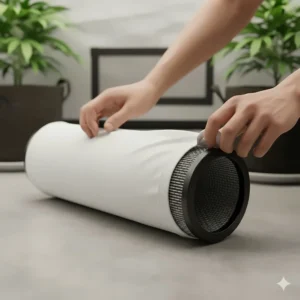
A complete carbon filter for grow tent system includes several components. The carbon filter itself contains the activated charcoal bed, typically Australian virgin charcoal rated at 1050-1200+ IAV (Iodine Adsorption Value, which measures carbon quality). Pre-filters wrap around the outside to catch larger particles like dust and pollen before they reach the carbon. Flanges on each end connect to ducting and inline fans. Finally, heavy-duty mesh (usually galvanized steel or aluminum) contains the carbon while allowing maximum airflow.
Types of Carbon Filter for Grow Tent
Standard Activated Carbon Filters
These traditional filters contain virgin activated carbon that you use until saturated, then replace entirely. They’re the most common type and range from 4″ to 12″ diameter with varying lengths. Standard filters typically last 12-18 months depending on usage intensity.
Refillable Carbon Filters
Innovative designs like the AC Infinity Refillable system let you replace just the carbon media instead of buying a whole new filter. Initial cost is higher, but refills cost 30-40% less than new filters. These are environmentally friendly and economically smart for long-term growers.
Lightweight vs Heavy-Duty
Budget filters often use plastic components and thinner carbon beds (25-30mm), making them lighter but less effective. Heavy-duty filters feature aluminum flanges, galvanized steel mesh, and thicker carbon beds (38-46mm) for superior performance and durability. Weight increases, but so does filtration quality and lifespan.
Size Variations
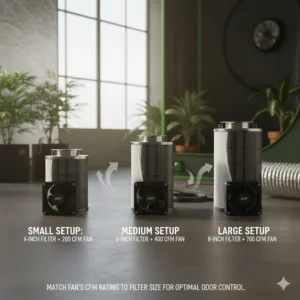
4-inch filters work perfectly for small tents (2×2 to 3×3 feet) with CFM ratings around 190-220. 6-inch models suit medium to large tents (3×3 to 5×5 feet) with CFM ratings of 350-450. 8-inch and larger filters handle commercial operations or very large grow spaces. Always match filter CFM to your inline fan’s capacity.
Benefits of Using a Carbon Filter for Grow Tent
Complete Odor Elimination
The primary benefit is obvious but crucial – your grow tent won’t advertise itself to neighbors, landlords, or visitors. Even the most aromatic plants produce zero detectable smell outside when properly filtered. This privacy and discretion makes indoor growing practical in apartments, condos, and residential neighborhoods.
Improved Air Quality
Carbon filters don’t just remove odors. They also capture mold spores, pollen, dust, and other airborne contaminants that could harm your plants or affect your respiratory health. This creates a cleaner, healthier environment for both plants and growers.
VOC Removal
Volatile organic compounds from fertilizers, growing media, and plant processes get scrubbed from the air. This prevents potential buildup of harmful compounds and reduces the risk of chemical sensitivities or respiratory irritation when working in your grow space.
Extended Equipment Life
By filtering particulates before they reach your inline fan, carbon filters protect expensive ventilation equipment from dust buildup and premature wear. The pre-filter alone can add years to your fan’s operational life.
Versatility Beyond Growing
Quality carbon filters work equally well for eliminating cooking odors, pet smells, smoke, and bathroom odors. Many growers use their filters year-round for general home air purification even between growing cycles.
Property Value Protection
Strong persistent odors can damage property value and violate lease agreements. Carbon filtration protects your investment whether you rent or own, ensuring you can grow without compromising your living situation.
How to Choose the Right Carbon Filter for Grow Tent
Calculating Required CFM
Start by calculating your grow tent’s cubic footage. Multiply height × width × length. For example, a 4x4x6 tent equals 96 cubic feet. Multiply by 60 to determine the CFM needed for one complete air exchange per minute. In this case, you need approximately 96-100 CFM minimum.
However, carbon filters create resistance, so increase your target CFM by 25%. For our example tent, aim for 120-125 CFM. This ensures adequate airflow even with the filter’s restriction. Many growers prefer even higher exchange rates (every 30-45 seconds) for better temperature and humidity control.
Matching Filter to Fan
Your carbon filter’s CFM rating should equal or slightly exceed your inline fan’s CFM at maximum speed. If your fan runs at 400 CFM, choose a filter rated for 400+ CFM. Running an undersized filter forces the fan to work harder and reduces both components’ lifespan.
Never pair a 200 CFM filter with a 450 CFM fan – you’ll overwhelm the filter and odors will leak through. Conversely, an oversized filter (500 CFM paired with 250 CFM fan) works fine but represents wasted money.
Carbon Quality Matters
Australian virgin charcoal remains the gold standard. Look for filters rated at 1050+ IAV (Iodine Adsorption Value) or RC 412/RC 48 specifications. These ratings indicate pore size and adsorption capacity. Cheaper filters often use lower-grade carbon or recycled charcoal that saturates faster.
The carbon bed thickness also matters significantly. Budget filters typically have 25-30mm beds, while premium filters feature 38-46mm thickness. Thicker beds provide more contact time and adsorption capacity, translating to better odor removal and longer lifespan.
Build Quality and Materials
Inspect the construction carefully. Aluminum flanges resist corrosion better than plastic in humid environments. Galvanized steel mesh prevents rust while allowing maximum airflow. Check that pre-filters are included and machine-washable.
Reversible flanges add tremendous value by letting you flip the filter when one end saturates. This simple feature can double your filter’s effective life from 12 months to 24 months.
Size and Space Constraints
Measure your tent carefully before ordering. A 6″ x 16″ filter might be perfect performance-wise but won’t fit if you only have 14″ of vertical clearance. Consider filter length, diameter, and flange extensions when calculating fit.
Also think about hanging options. Most carbon filters for grow tent hang from tent frames using rope ratchets or straps. Ensure your tent frame can support the weight – larger filters can weigh 15-25 pounds when loaded with carbon.
Installation Guide for Carbon Filter for Grow Tent
📍 Optimal Placement Position
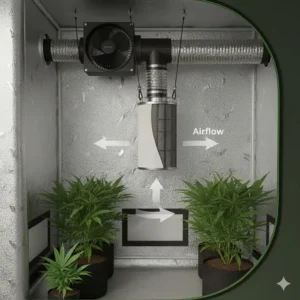
Install your carbon filter at the highest point inside your grow tent. Hot air rises, carrying odor molecules upward, so positioning the filter near the ceiling ensures you capture the most aromatic air. This placement also maximizes the negative pressure effect that pulls air through the entire tent.
Step-by-Step Installation Process
Step 1: Attach the pre-filter sleeve over the carbon filter. Most slip on like a sock and secure with velcro or elastic bands. Some growers skip this step initially, but you’ll replace the carbon filter three times faster without pre-filtration.
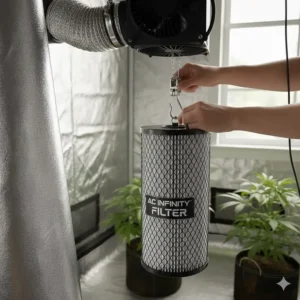
Step 2: Hang the carbon filter from your tent frame using the included rope ratchets, straps, or heavy-duty hooks. Position it horizontally for best results, though vertical mounting works if space is limited. Ensure it’s secure – filters weighing 20+ pounds will damage tent frames if they fall.
Step 3: Connect ducting to the filter’s flange. Use duct clamps to create an airtight seal. Any air leaks mean unfiltered odors escaping, so tighten clamps firmly.
Step 4: Attach the other end of ducting to your inline fan’s intake. Again, use clamps for airtight connections. The fan should pull air through the filter, not push it.
Step 5: Connect exhaust ducting from the fan’s output to your tent’s vent port. This carries filtered air outside the tent or out a window.
Step 6: Run the fan and check for proper airflow. You should feel slight negative pressure when you put your hand near tent seams – fabric should pull inward slightly. This confirms all air exiting the tent passes through your carbon filter.
Configuration Options
Inline Setup: Filter → Ducting → Fan → Ducting → Exhaust. This is the most common configuration and works excellently for most situations.
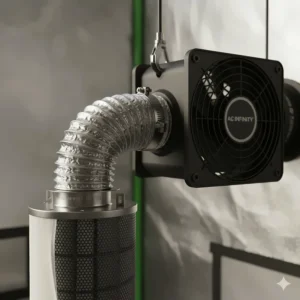
Direct Mounting: Filter connects directly to fan with no ducting between them. This saves space but requires the fan to hang inside the tent, which can increase noise.
External Setup: Some growers place the filter outside the tent with the fan pulling air through ducting. This frees interior space but means unfiltered air travels through ducting before filtration, which isn’t ideal.
Maintenance Tips for Carbon Filter for Grow Tent
Pre-Filter Cleaning Schedule
Wash your pre-filter every 2-4 weeks depending on dust levels. Simply remove it, shake out loose debris, then machine wash on gentle cycle with mild detergent. Let it air dry completely before reinstalling. A clean pre-filter maintains proper airflow and protects the carbon bed from premature clogging.
Some growers keep two pre-filters and rotate them – one in use, one clean and ready. This eliminates downtime while washing.
Monitoring Filter Performance
Your nose is the best indicator. If you start detecting odors outside your grow tent, the carbon filter is approaching saturation. Don’t wait until smell becomes obvious – replace proactively when you first notice any scent leakage.
Also watch for reduced airflow. If your inline fan seems to be working harder or air exchange slows down, the carbon bed might be clogged. Check the pre-filter first, as 90% of airflow issues stem from dirty pre-filters rather than saturated carbon.
Extending Filter Lifespan
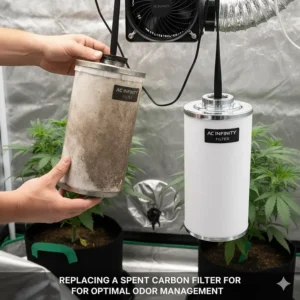
For filters with reversible flanges, flip the filter when you first notice minor odor breakthrough. This exposes fresh carbon and can extend life by 6-12 months. Mark the filter with the installation date and flip date so you track usage accurately.
Store unused filters in airtight plastic bags. Activated carbon adsorbs moisture and odors from surrounding air even when not in use, so sealed storage preserves capacity until installation.
Replacement Timeline
Most carbon filters for grow tent last 12-18 months with proper maintenance in typical home growing environments. Commercial operations with 24/7 airflow might need replacement every 8-12 months. Factors affecting lifespan include humidity levels, particulate contamination, CFM load, and carbon quality.
When in doubt, replace annually. The cost of a new filter ($35-75) is trivial compared to the consequences of odor leakage.
Common Mistakes to Avoid
Undersizing the Filter
The biggest mistake new growers make is buying a carbon filter with insufficient CFM for their tent and fan. An undersized filter forces air through too quickly, preventing adequate contact time with carbon. Result? Odor breakthrough even with a new filter.
Always calculate required CFM properly and add 25% for carbon filter resistance. It’s better to slightly oversize than undersize.
Skipping the Pre-Filter
Some growers remove pre-filters thinking they restrict airflow. This is penny-wise and pound-foolish. Without pre-filtration, dust and particulates clog the carbon bed rapidly, reducing effectiveness and cutting lifespan by 50-70%.
Pre-filters cost $10-15 and are reusable. Carbon filters cost $35-75 and aren’t. The math is simple.
Wrong Airflow Direction
Carbon filters work optimally when air flows from outside → through carbon → out the center flange. Installing backwards (pushing air out through the carbon bed) reduces efficiency and can cause carbon dust to escape into your tent.
Most filters clearly mark the correct airflow direction. Follow it.
Neglecting Duct Seal Quality
Air leaks around connections mean unfiltered odors escaping. Use proper duct clamps (not tape) and create tight seals at every connection point. Check connections monthly and tighten as needed – vibration from fans can loosen clamps over time.
Forgetting About Humidity
High humidity (above 70-80%) reduces activated carbon’s effectiveness by filling pores with water molecules instead of odor molecules. Maintain proper grow tent humidity (40-60% for most plants) for optimal filter performance.
Using Cheap Carbon
All activated carbon isn’t created equal. Cheap filters use low-grade carbon, thin beds, or even recycled charcoal. These might cost $20-25 but fail after 3-6 months. Quality filters cost $40-75 but last 12-18 months. The expensive filter is actually cheaper long-term.
Comparison: Carbon Filter for Grow Tent vs Traditional Filtration
| Feature | Carbon Filter | HEPA Filter | Basic Mesh Filter |
|---|---|---|---|
| Odor Removal | Excellent | None | None |
| VOC Capture | Excellent | Minimal | None |
| Particulate Filtration | Good (with pre-filter) | Excellent | Good |
| Lifespan | 12-18 months | 6-12 months | 3-6 months |
| Cost | $35-150 | $40-100 | $10-25 |
| Airflow Restriction | Moderate | High | Low |
| Maintenance | Replace annually | Replace bi-annually | Clean monthly |
Troubleshooting Common Carbon Filter Issues
Problem: Odor Breakthrough Before Expected
Solution: Check pre-filter cleanliness first. A clogged pre-filter forces air around the filter instead of through it. Clean or replace the pre-filter. If odors persist, verify all ducting connections are airtight using duct clamps. Any gaps allow unfiltered air to escape.
If connections are tight and pre-filter is clean, your carbon might be saturated early due to high humidity or excessive odor load. Replace the filter and improve humidity control.
Problem: Reduced Airflow
Solution: Inspect the pre-filter for clogging. Even slight restriction dramatically impacts CFM. Clean the pre-filter thoroughly. Check ducting for kinks, tears, or compression that restricts flow. Ensure your fan is operating at proper speed if it has a controller.
Problem: Carbon Dust Escaping
Solution: This typically indicates airflow direction is reversed or the filter was jostled during installation, creating gaps in the carbon bed. Verify air flows from the outside mesh → through carbon → out the center flange. If direction is correct, the filter might be defective – contact the manufacturer.
Problem: Noise or Vibration
Solution: Carbon filters themselves make no noise, but heavy weight can cause tent frames to vibrate when fans run. Ensure the filter hangs securely from strong frame points. Use rope ratchets instead of chains to reduce vibration transmission. If your fan is noisy, consider duct silencers or upgrading to a quieter EC motor fan.
❓ FAQ About Carbon Filter for Grow Tent
❓ How long does a carbon filter for grow tent typically last?
❓ Can I clean and reuse my carbon filter for grow tent?
❓ What size carbon filter for grow tent do I need for a 4x4 tent?
❓ Do I need a carbon filter for grow tent if I'm only growing vegetables?
❓ Can I use a carbon filter for grow tent without an inline fan?
Conclusion: Choosing Your Perfect Carbon Filter for Grow Tent
Selecting the right carbon filter for grow tent transforms your growing experience from a smelly ordeal into discreet indoor gardening. The difference between cheap filters and quality options is dramatic – we’re talking about the difference between neighbors knocking on your door and total odor invisibility.
For most growers, the AC Infinity Air Carbon Filter 6″ ($65-75) represents the sweet spot of performance, durability, and value. Its premium Australian RC412 charcoal, reversible flanges, and robust construction justify the investment through extended lifespan and reliable odor elimination.
Budget-conscious growers should consider the VIVOSUN 4 Inch ($35-45) for smaller tents or the VIVOSUN 6 Inch ($50-60) for larger spaces. Both deliver solid performance at accessible prices.
Environmentally minded growers will love the AC Infinity Refillable ($135-145). While pricier initially, refills cost 35% less than new filters, paying for itself after the second refill while dramatically reducing waste.
The key is matching filter CFM to your tent size and inline fan capacity, choosing quality Australian virgin charcoal, and committing to regular pre-filter maintenance. Do these three things right, and your carbon filter will serve you reliably for 12-18 months of odor-free growing.
Remember – a carbon filter for grow tent isn’t an expense, it’s an investment in privacy, property protection, and peace of mind. Choose wisely, maintain properly, and enjoy truly discreet indoor growing.
🌟 Ready to Upgrade Your Ventilation?
Check out these top-rated carbon filters and start enjoying odor-free growing today! Click any highlighted product to see current deals and read verified customer reviews. Your neighbors will thank you! 🎯
Recommended for You
- 7 Best Grow Tent Fan Options for 2025 (Performance Tested)
- 7 Best Grow Tent AC 2025: Ultimate Cooling Guide
- Best Grow Tent Heater 2025: Top 7 Smart Temperature Controls
Disclaimer: This article contains affiliate links. If you purchase products through these links, we may earn a small commission at no additional cost to you.
✨ Found this helpful? Share it with your friends! 💬🤗
