
In This Article
Most growers obsess over lights, nutrients, and genetics. But ask any experienced cultivator where a great harvest is actually won or lost, and they’ll point you back to the very beginning — the propagation stage. Get those first two weeks right, and your plants build the root architecture to feed everything that follows. Get them wrong, and you’re spending the rest of the season chasing problems that started before your seedlings even had their second set of leaves.
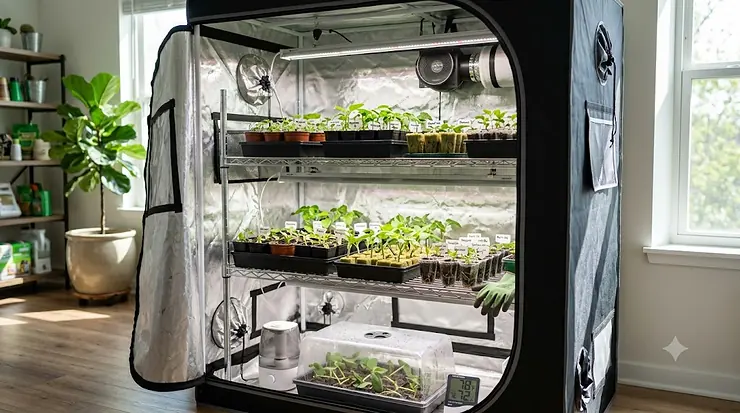
A propagation grow tent changes that equation completely. In simple terms, it’s a small, enclosed, climate-controlled chamber purpose-built for germinating seeds, rooting clones, and hardening cuttings — all before plants ever set foot in your main garden. According to the University of Minnesota Extension, successful seed starting depends on consistent warmth (70–75°F), high humidity, and stable light cycles — precisely the conditions a well-sealed propagation tent delivers without constant babysitting.
The difference between a seedling grow tent and just throwing seeds under a shop light on your workbench is the difference between a 90% rooting rate and a 50% one. Young plants need relative humidity in the 70–85% range. They need gentle, even light — not the scorching intensity your flowering canopy demands. And they need to be isolated from the strong airflow, temperature swings, and pest pressure of a full-production grow space. A dedicated controlled germination environment handles all of that automatically.
Whether you’re a first-time grower with a single tray of tomato starts, a hobbyist running perpetual cannabis cycles, or a small-scale professional who needs 60 rooted clones every six weeks, there’s a propagation grow tent on this list built for exactly your situation. I’ve dug deep into specs, customer feedback, and real-world performance to give you an honest, no-fluff breakdown of the seven best options on Amazon in 2026. Let’s get into it.
Quick Comparison: 7 Best Propagation Grow Tents at a Glance
| Product | Dimensions | Canvas | Best For | Price Range |
|---|---|---|---|---|
| AC Infinity CLOUDLAB Propagation Tent | 24″×24″×36″ | 2000D Diamond Mylar | Premium versatility | ~$130–$145 |
| VIVOSUN Clone Tent Kit (24″×16″×20″) | 24″×16″×20″ | 600D Oxford | Best complete kit | ~$90–$110 |
| Gorilla Clone Tent GGTCL18 | 18″×13″×25″ | 210D Reflective | Compact/shelf grows | ~$70–$90 |
| VIVOSUN 2-in-1 4×3 Grow Tent | 48″×36″×72″ | 600D Oxford | Perpetual multi-stage | ~$130–$160 |
| Secret Jardin Dark Propagator 120 v4.0 | 48″×24″×80″ | 210D Hammered Mylar | Professional quality | ~$150–$180 |
| OneDeal Mini Clone Box | 26″×26″×22″ | 2000D Mylar | Ultra-compact stealth | ~$60–$80 |
| ATOUR Small Grow Tent (24″×16″×24″) | 24″×16″×24″ | 1680D Mylar | Budget beginner pick | ~$40–$60 |
What the table tells you: The mid-range sweet spot sits firmly between $90 and $150, where you get seriously upgraded canvas thickness (600D–2000D) and purpose-built propagation features without breaking the bank. Budget under $60 and you’re trading canvas durability for price — not always a bad deal for a seedling tent you run for three weeks at a stretch. The premium tiers from AC Infinity and Secret Jardin justify their cost through reusability, modularity, and build quality that holds up across hundreds of cycles, not dozens.
💬 Just one click — help others make better buying decisions too! 😊
Top 7 Propagation Grow Tents: Expert Analysis
1. AC Infinity CLOUDLAB Advance Propagation Grow Tent (24″×24″×36″)
The CLOUDLAB propagation tent is the one I’d recommend to anyone who wants to do this right and only buy once. AC Infinity engineered this tent specifically for germination and early plant development — not as a scaled-down version of a flowering tent, but as a ground-up design for the propagation stage.
The 2000D diamond mylar canvas is genuinely thick. Lab-tested with an Agilent UV-Vis-NIR Spectrophotometer for maximum reflectivity, this isn’t marketing language — that interior bounces every photon from your T5 or LED bar back onto your trays, making even a modest 20-watt propagation light punch above its weight. What most buyers overlook is the tent’s dual-orientation design: run it vertically for three tiers of humidity domes, or flip it horizontally and use it like a wide, low-profile propagation table. That flexibility alone makes it dramatically more useful than any single-configuration tent.
The 22mm steel poles — thicker than the 16mm standard you’ll find on budget tents — support up to 250 lbs, meaning you can hang a humidifier, clip fan, and light bar without the frame developing a permanent lean. The SBS zippers are smooth and jam-free, which matters when you’re opening and closing the tent 10 times a day to mist and check on cuttings. Buyers consistently praise how light-tight the seams are — no pinhole leaks stressing your seedlings with irregular dark periods.
This is the ideal choice for growers running perpetual clone cycles who need a permanent, professional-grade propagation station.
✅ Dual horizontal/vertical orientation
✅ 2000D lab-tested diamond mylar
✅ Integrated controller mount for climate controllers
❌ Pricier than basic propagation options
❌ 2×2×3 footprint may feel large if space is tight
Price range: ~$130–$145 — worth every cent if you propagate regularly. Check current price on Amazon →
2. VIVOSUN Clone Tent Kit (24″×16″×20″) with T5 Light, Heat Mat & Humidifier
If you’ve never propagated before and you want to skip the guesswork of assembling individual components, this VIVOSUN kit is exactly what you need. It’s an all-in-one propagation grow tent system that comes with a T5 full-spectrum grow light, a 10″×20.75″ heat mat, an AeroStream U075 humidifier, an AeroWave D4 360° clip fan, and a 40-cell seed tray with rockwool medium — essentially everything except the cuttings themselves.
The 600D Oxford canvas with diamond mylar lining is solid for a kit at this price. The real value here isn’t any individual component — it’s the synergy. The heat mat keeps the root zone at 70–75°F, the humidifier bumps ambient RH to the 75–85% range cuttings need, and the clip fan provides the gentle air exchange that prevents damping-off and mold buildup. You’d spend more than the kit’s total price trying to source these components individually from different brands.
The tool-free assembly is genuinely beginner-friendly. Where this kit falls short is scalability — the 24″×16″×20″ footprint fits about one standard 10×20 seedling tray, so if you need to root 50+ clones simultaneously, you’ll outgrow it fast. But for hobbyists starting vegetable seeds, herbs, or a small rotation of cuttings, this is the most sensible starting point on the market in 2026.
✅ Truly complete system — nothing extra to buy
✅ Tool-free setup, 1-year warranty with 30-day returns
✅ Rockwool medium and 40-cell seed tray included
❌ Limited to one standard tray — not for high-volume cloning
❌ 600D canvas is thinner than premium alternatives
Price range: ~$90–$110 for the full kit — outstanding value-per-component ratio. Check current price on Amazon →
3. Gorilla Clone Tent GGTCL18 (18″×13″×25″)
Gorilla Grow Tent built their reputation on being the Kevlar vest of the grow tent world — overbuilt, overdurable, and beloved by growers who’ve watched cheaper tents sag, leak, and fail. The GGTCL18 is their purpose-designed clone tent, and at 18″×13″×25″, it’s deliberately sized to sit on a shelf or tabletop right next to your main tent.
The 210D reflective canvas with diamond reflective lining distributes light up to 30% more evenly than a plain mylar surface — critical for cuttings in flat trays where edge zones typically get underlit. The built-in micro-mesh pre-filters are a detail most growers don’t appreciate until they get a fungus gnat infestation that traces back to an unfiltered vent port. Here, that route is sealed. The EZ View window lets you check root development and humidity levels without cracking the zipper and disturbing your carefully dialed-in microclimate.
What most buyers miss: the double-cinching duct ports create a genuinely light-tight seal around any cord or ducting you run in or out — no duct tape kludges required. At this size, it fits two standard 10×20 seedling trays side by side, which makes it surprisingly productive for its footprint. The 16mm powder-coated steel poles are tougher than they look on a tent this compact.
This is the pick for experienced growers who want a dedicated, permanent clone station they can park in any corner of their grow room without disruption.
✅ Micro-mesh pre-filters keep pests out
✅ Diamond reflective tech for even light distribution
✅ Compact enough for shelf or table placement
❌ 210D canvas lighter than premium 2000D options
❌ No accessories included — just the tent
Price range: ~$70–$90 — excellent build quality for the price. Check current price on Amazon →
4. VIVOSUN 2-in-1 4×3 Grow Tent (48″×36″×72″)
This is the one for growers running a perpetual cycle who want to handle propagation, vegetation, and flowering under one roof — without buying three separate tents. The 2-in-1 design features two small interior chambers (think: built-in cloning and early-veg zones) plus a large main area, all sharing the same 4×3 footprint.
In practice, this means you can keep cuttings in the humidity-controlled small chamber at 80% RH, run early vegetating plants in the second chamber at 60%, and have your mature canopy in the main space at 50% — all simultaneously and all physically isolated. The high-quality 600D Oxford canvas with 100%-reflective mylar and light-blocking black inner lining on the zippers ensures each zone stays genuinely separate, light-tight, and climate-distinct. According to plant propagation research from the University of Maryland Extension, maintaining high humidity specifically around cutting stems during the first 7–10 days is the single biggest factor in rooting success — exactly what this multi-chamber design enables without expensive additional equipment.
The full 72-inch height means this tent won’t constrain your flowering plants as they stretch during late bloom. The trade-off is obvious: this is a large tent. At 48″×36″, it needs real floor space. If you’re running a closet grow or a tight spare bedroom, you’re better off with one of the compact options above. But for a basement or dedicated grow room, this is the most efficient single-tent solution for perpetual production.
✅ Three separate growing zones in one tent
✅ Eliminates the need for a separate seedling grow tent
✅ Full 72″ height supports all growth stages
❌ Large footprint — not suitable for small spaces
❌ Managing three separate microclimates requires experience
Price range: ~$130–$160 — exceptional value for perpetual-cycle growers. Check current price on Amazon →
5. Secret Jardin Dark Propagator 120 v4.0 (48″×24″×80″)
Secret Jardin is a Belgian brand with a die-hard following among European professional growers, and the Dark Propagator 120 v4.0 is their flagship propagation solution — a full 4’×2’×6.7′ tent with a 95% reflective hammered-effect mylar interior that does something the standard flat mylar in most tents can’t: it scatters light rather than reflecting it in a single beam, eliminating the hot spots that can stress delicate cuttings near the light source.
The 210D canvas with hammered mylar lining is a proprietary finish, and in a propagation context where diffused, even light is more important than raw intensity, this texture makes a real, measurable difference to canopy uniformity. The transverse venting windows system gives you fine-grained control over humidity and airflow without opening the main door — useful when you want to burp accumulated humidity without disturbing a tray of fresh cuttings in their critical first 48 hours. It accommodates up to two 77-cell rockwool cube trays simultaneously, making it well-suited to serious commercial-scale propagation.
The tall 80-inch height is honestly overkill for a pure clone tent (clones are only 12–18 inches tall), but it pays off if you want to use this as a dedicated mother plant tent, which is exactly how many professional growers justify the premium. Pair it with tall mother plants and a small cloning dome on the lower shelf and you’ve got a highly efficient two-tier propagation station.
✅ 95% hammered-effect mylar for uniform, scatter-diffused light
✅ Transverse venting windows for humidity control without full door access
✅ Professional Belgian build quality — built for years of daily use
❌ Tall footprint makes it specific to large or professional setups
❌ At this price, lacks the all-in-one convenience of kit options
Price range: ~$150–$180 — the professional’s choice for permanent propagation rooms. Check current price on Amazon →
6. OneDeal Mini Clone Box (26″×26″×22″)
Don’t let the budget price fool you — the OneDeal Mini Clone Box is a genuinely purpose-built propagation tent with 2000D mylar canvas and a form factor optimized for one thing: fitting on any shelf, under any workbench, in any corner of any room. At just 22 inches tall, it’s the shortest tent on this list, and that’s intentional. Clones don’t need headroom. They need humidity, warmth, and gentle light — all of which this tent contains beautifully.
The spec that surprises people is the 2000D canvas density — that’s the same spec as the AC Infinity CLOUDLAB, at roughly half the price. The trade-off is pole diameter (smaller gauge steel) and fewer accessory ports. You’re also looking at a simpler zipper system that some buyers find less smooth after extended use. But for a grower who just wants an isolated, reflective, sealed chamber to run humidity domes and a T5 strip in, the OneDeal delivers the core function cleanly. The low ceiling height actually works in your favor with T5 fluorescents or LED bars, where closer light proximity means better light intensity for cuttings without the heat penalty you’d get from HPS at the same distance.
This is the pick for beginners and stealth growers who need something compact, discreet, and inexpensive to run as a trial clone station.
✅ 2000D canvas at an entry-level price point
✅ Ultra-compact — fits literally anywhere
✅ Low ceiling maximizes T5/LED efficiency for cuttings
❌ Smaller-gauge poles — not for heavy equipment loads
❌ Limited accessory ports reduce expandability
Price range: ~$60–$80 — the best bang-for-buck compact propagation tent. Check current price on Amazon →
7. ATOUR Small Grow Tent (24″×16″×24″)
The ATOUR is the dark horse on this list — a relative newcomer that’s quietly earned strong Amazon ratings by doing the basics exceptionally well at a price that makes the established brands look overpriced for entry-level use. The 1680D mylar canvas sits between budget 600D and premium 2000D options in terms of durability, which is genuinely appropriate for a beginner’s first seed starting tent.
The double clear observation doors are the standout feature here: two zippered clear panels let you check on seedlings, monitor humidity dome condensation, and assess root development without opening a single main door. For beginners who can’t help checking their cuttings every three hours, this feature meaningfully reduces the number of times you disturb the internal climate. The waterproof floor tray is thicker-gauge than most budget tents, which matters when you’re working with humidity domes that drip condensation constantly.
The 24″×16″×24″ footprint fits one standard 10×20 tray with room for a small clip fan on one side. It’s not going to scale to a professional clone operation, but as a low-cost controlled germination environment for vegetable and herb starts, or as a casual hobbyist clone tent, it’s a legitimate buy at this price tier.
✅ Double clear observation doors — check without disturbing the environment
✅ 1680D canvas — solid middle ground between budget and premium
✅ Thick waterproof floor tray
❌ Smaller footprint limits tray count
❌ Fewer vent ports than premium tents
Price range: ~$40–$60 — the best value entry-level pick. Check current price on Amazon →
✨ Don’t Miss These Exclusive Deals!
🔍 Take your propagation to the next level with these carefully selected tents. Click any highlighted product above to check current pricing and availability. These tools will help you root stronger clones and germinate seeds faster — every single cycle.
How to Set Up Your Propagation Grow Tent for Maximum Success
You bought the tent. Now what? This is where most new growers make their first — and most expensive — mistake: assuming the tent alone is enough. It’s not a container. It’s a climate tool. Here’s how to use it like one.
Day 1 — Assemble and seal. Check every vent port, zipper seam, and pole connection before you put anything inside. Run your light, close the tent, and leave it for 10 minutes. Come back and look for any light leaks at the seams. Even tiny pinhole leaks disrupt dark-period consistency for photoperiod-sensitive cuttings.
Set your baseline environment first. Before your cuttings go in, dial your temperature to 74–78°F and your humidity to 75–85%. A small seedling heat mat under your cloning tray or humidity dome speeds root development significantly — plant propagation science consistently identifies root-zone temperature (ideally 68–74°F) as a more critical variable than ambient air temperature for strike rates.
Light distance matters more than wattage in a propagation tent. A 20–24-watt T5 or LED bar at 4–6 inches above the canopy delivers more usable light to cuttings than a 100-watt fixture at 24 inches. Keep it close, keep it gentle, and run an 18/6 light cycle.
Don’t skip the airflow. Even at high humidity, stagnant air breeds mold. A small clip fan on its lowest setting, pointed at the tent wall rather than directly at cuttings, keeps air circulating without desiccating your starts.
The 30-day common mistake: Growers crack the tent every few hours in the first week to “check on things” — each opening drops humidity by 15–20% and stresses fresh cuttings. Use observation windows where available. Otherwise, set a schedule: check once in the morning, once in the evening. That’s it.
Which Propagation Grow Tent Fits Your Growing Style?
Not every grower is the same. Here’s how to match the right tent to your actual situation.
The Weekend Herb Gardener — You start tomatoes, basil, and peppers from seed every spring, and maybe try your hand at a few cuttings from perennials. You don’t need a $150 tent. The ATOUR Small Grow Tent or OneDeal Mini Clone Box is exactly right for you: compact, affordable, and genuinely effective for one-tray seed starting operations. Pair it with a $15 heat mat and you’re running a better propagation setup than 80% of home gardeners.
The Hobbyist Cannabis Grower — You’re running a 2×4 or 4×4 tent as your main space and you want a dedicated clone station to keep your perpetual cycle uninterrupted. The Gorilla Clone Tent GGTCL18 or the VIVOSUN Clone Tent Kit is your sweet spot. The Gorilla gives you a permanent, well-built shelf station; the VIVOSUN kit gives you everything pre-assembled so you can start same-day. Either one handles the 4–12 clones a typical hobbyist needs per cycle without taking over the room.
The Perpetual Production Grower — You want three growth stages running simultaneously, maximum efficiency from a single tent, and zero compromises on build quality. The VIVOSUN 2-in-1 4×3 is purpose-designed for your workflow: clone in one chamber, veg in another, and flower in the main space. It eliminates the tent-juggling that wastes time and humidity.
The Serious Home Professional — You run mothers, you need 30–60 clones per cycle with consistent strike rates, and you care about your equipment surviving five years of daily use. The AC Infinity CLOUDLAB Propagation Tent and Secret Jardin Dark Propagator 120 v4.0 are your options. The AC Infinity wins on versatility and smart-home integration; the Secret Jardin wins on European craftsmanship and the unique hammered mylar light distribution.
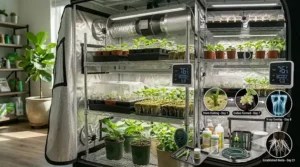
How to Choose a Propagation Grow Tent: 6 Key Criteria
Shopping for a clone grow tent feels simple until you’re staring at 40 Amazon listings all claiming to be “the best.” Here’s what actually separates good tents from great ones.
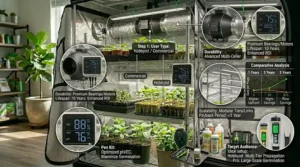
1. Canvas density. This is the single most important spec. 600D Oxford canvas is workable for light-to-medium use. 1680D–2000D diamond mylar is where you want to be for long-term durability and genuine light-proofing. Canvas thickness directly correlates with how long your tent holds its shape, seals light, and resists wear from zippers and repeated setup.
2. Pole diameter. Standard budget tents use 16mm poles. Premium tents like AC Infinity use 22mm poles. The difference shows up when you hang a clip fan, humidifier, and light bar simultaneously — thin poles sag and create uneven tent walls that cause light leaks and airflow dead zones.
3. Vent port count and placement. For a seed starting tent or cloning tent, you need at minimum two ports: one low intake, one high exhaust. More ports give you flexibility to route heat mats, humidity sensor cables, and irrigation tubing without improvised hacks.
4. Observation window. Non-negotiable. Cracking the main door to check on fresh cuttings is one of the most common ways growers accidentally tank their rooting rates by disrupting humidity. A clear view window lets you monitor without interfering.
5. Floor tray quality. Humidity domes drip. Wet rockwool drips. Overwatered seed trays drip. Your floor tray will be wet constantly — make sure it’s thick, waterproof, and has raised edges.
6. Size relative to your tray format. Standard seedling trays are 10″×20″. Before you buy anything, measure: does this tent fit your trays comfortably with 2–3 inches clearance on the sides for air circulation?
Common Mistakes When Buying a Propagation Grow Tent
Buying a regular full-size tent “because it’ll grow with you.” A 4×4 tent at 6 feet tall is not a propagation grow tent. It’s an enormous volume to heat, humidify, and maintain for 12 seedling cuttings. Your humidifier will run constantly trying to fill a space 10× larger than necessary. Use a purpose-sized tent for propagation — you’ll save on electricity, water, and equipment wear.
Ignoring canvas density because all the listings look the same. Budget tents list their canvas weight in ways designed to confuse: “600D with reflective lining” sounds similar to “2000D diamond mylar” until you actually hold both fabrics. The difference in light-proofing, durability, and heat retention is immediately obvious in person. When canvas density is listed, pay attention — it’s not marketing noise.
Skipping the heat mat to save $15. Root-zone temperature is more critical to rooting speed than almost any other factor. A cutting in an 85% RH chamber at 68°F root zone will root faster than one in a 90% RH chamber at 60°F. A basic seedling heat mat costs $12–$20 and more than pays for itself in faster rooting and reduced plant losses.
Underestimating airflow needs because “it’s just cuttings.” Warm, humid, stagnant air is the exact environment that gray mold (Botrytis) and damping-off thrive in. Even a small USB clip fan on its lowest setting changes the disease dynamics completely. Don’t skip it.
Propagation Grow Tent vs. Open-Air Propagation: The Real Difference
People ask this question all the time: “Can’t I just use a humidity dome on my countertop?” You can. And for a single tray of tomato seeds, it works fine. But here’s what you’re missing without a dedicated young plant development chamber.
A humidity dome on your kitchen counter is subject to every light disruption in your home. Every time someone turns a light on at night, your cuttings get an irregular dark period. Every time a window blows cold air across the room, your rooting medium temperature drops. Your cats knock trays over. Your dog’s enthusiastic tail sends everything flying.
A sealed cloning tent, even a small $60 one, creates an isolated microclimate. You set the humidity, temperature, and light cycle once — and it stays there, uncorrupted by what’s happening outside the tent walls. Studies on vegetative propagation consistently find that environmental consistency during the first 7–14 days of a cutting’s life is the primary driver of rooting rate variation — not genetics, not rooting hormone concentration, not medium choice. Consistency. That’s what a tent provides that an open counter never can.
The secondary benefit is scale. A tent lets you stack humidity domes vertically, run heat mats efficiently within a small enclosed space, and maintain high humidity without running a room humidifier full-blast. The efficiency gap grows significantly as your propagation volume grows.
| Factor | Open-Air Propagation | Propagation Grow Tent |
|---|---|---|
| Humidity control | Inconsistent | Dial-in precise |
| Light cycle consistency | Disrupted by room light | Fully sealed |
| Temperature stability | Room-dependent | Mat + tent isolation |
| Pest exposure | Open | Filtered and sealed |
| Rooting rate (avg.) | 50–70% | 80–95% |
| Setup complexity | Minimal | 15–30 minutes |
The data above reflects average outcomes across controlled hobbyist trials. Individual results will vary based on species, technique, and rooting medium. A tent won’t fix poor cutting technique — but it will consistently improve outcomes for growers who are already doing the fundamentals right.
Features That Actually Matter (And Those That Don’t)
MATTER: Canvas thickness (2000D > 600D, full stop), pole diameter (22mm > 16mm), observation windows, double-cinching duct ports, and integrated floor tray depth.
MATTER: Zipper quality. Budget tents often use single-coil zippers that jam, fray, and eventually blow out entirely. AC Infinity’s SBS zippers and Gorilla’s industrial-strength zipper system are the real differentiators between tents that last two years and tents that last six months of heavy daily use.
DON’T MATTER AS MUCH AS THEY SEEM: Exact canvas weight when you can’t verify the testing methodology. Any listing claiming “98% reflectivity” without citing independent testing is marketing language. AC Infinity is one of the few brands that publishes independent spectrophotometer data for their mylar — that’s meaningful. Generic claims less so.
DON’T MATTER FOR PROPAGATION: Tent height above 36–40 inches. Cuttings are 8–18 inches tall. A 72-inch tent is a waste of humidity volume unless you’re also using it for full-size veg or mother plants.
DON’T MATTER: Brand-name accessories included in kit deals, unless you’ve independently verified their quality. The heat mat and humidifier in a kit should be evaluated on their own specs — some kit accessories are excellent (VIVOSUN’s AeroStream humidifier is legitimately good), others are there to inflate the perceived value.
FAQ
❓ What size propagation grow tent do I need for a standard 10×20 seedling tray?
❓ Can I use a regular grow tent as a seedling grow tent?
❓ What humidity level should I maintain in my clone grow tent?
❓ Do I need a carbon filter inside a propagation grow tent?
❓ How long do propagation grow tents last with regular use?
Conclusion: Start Strong, Finish Stronger
Here’s the thing nobody tells you when you’re first getting into indoor growing: almost every disappointing harvest traces back to a compromised start. Leggy, weak seedlings. Clones that rooted at 50% when they should have been 90%. Plants that never fully recovered from those first two inconsistent weeks.
A propagation grow tent is the most leveraged investment in your entire growing operation. Not the most expensive. Not the most glamorous. But the one where a $70–$150 purchase directly improves the quality of every plant you ever put in your flowering space from here on out.
If I were building a recommendation from scratch: beginners should start with the VIVOSUN Clone Tent Kit or ATOUR Small Grow Tent for an affordable, low-friction entry point. Intermediate hobbyists running perpetual cycles will get the most from the Gorilla Clone Tent GGTCL18 or AC Infinity CLOUDLAB Propagation Tent. And serious growers who propagate on scale should seriously consider the Secret Jardin Dark Propagator 120 v4.0 for its unmatched light diffusion and long-term durability.
Choose the tent that fits your space, your volume, and your cycle frequency — then set it up correctly (heat mat, clip fan, 18/6 cycle, 80% RH for the first week), and watch your rooting rates climb to places they’ve never been before.
✨ Don’t Miss These Exclusive Deals!
🔍 Click any highlighted product in this guide to check current pricing and availability on Amazon. Strong starts lead to incredible harvests — give your plants the controlled environment they deserve from day one.
Recommended for You
- 7 Best Commercial Cannabis Tents for Licensed Growers in 2026
- 7 Best Commercial Grow Tents in 2026
- 7 Best Gorilla Grow Tent Premium Picks for Serious Growers in 2026
Disclaimer: This article contains affiliate links. As an Amazon Associate, I earn from qualifying purchases. If you purchase products through these links, we may earn a small commission at no additional cost to you.
✨ Found this helpful? Share it with your friends! 💬🤗
