
In This Article
There’s a moment every indoor grower knows. You’ve just rolled back the zipper on a bargain-bin tent for the third time this season, and a seam has split, a zipper pull has snapped, and faint light is bleeding through the corner — again. That moment has a name. It’s called “I should’ve just bought the Gorilla.”
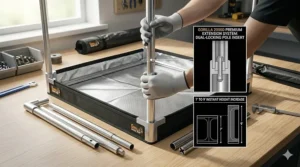
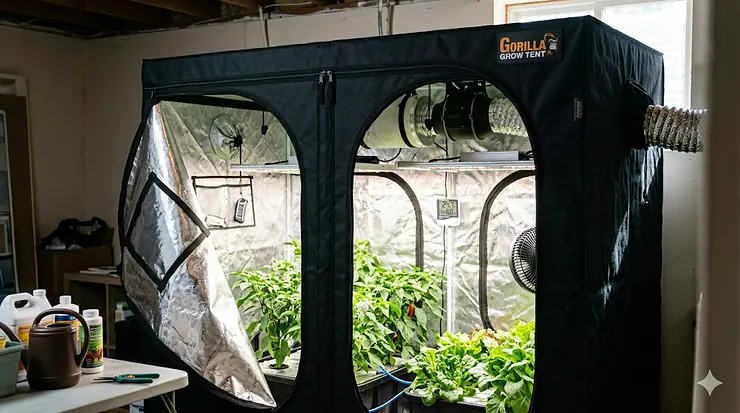
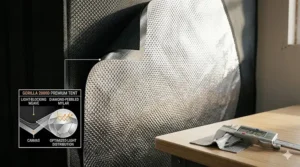
A gorilla grow tent premium isn’t just a canvas box you hang lights in. It’s a controlled micro-climate that determines whether your plants thrive or merely survive. Since 2011, Gorilla Grow Tent — built by Grow Strong Industries out of California — has been the benchmark serious cultivators measure everything else against. The brand’s core obsession? Three things: height, thickness, and structural integrity that borders on paranoid. We’re talking 1680D threaded canvas that’s 3 to 9 times denser than competing fabrics, all-steel interlocking frames with 300-pound hang capacity, and a patented height-extension system that lets your tent grow as your skills do.
What most buyers overlook at first glance is that paying more upfront for a gorilla grow tent premium translates directly into cheaper electricity bills (better light reflection = same output from fewer watts), fewer replacement cycles, and crucially — consistent photoperiod control that budget tents simply cannot deliver. A single failed zipper seal at the wrong point in a light-sensitive cycle can cost you an entire flower set.
In this guide, we’ve done the deep work: seven real Gorilla Grow Tent models currently available on Amazon, each broken down not just by spec sheet but by what those specs actually mean inside your grow room. Whether you’re fitting a 2×4 into a bedroom closet or running a 5×9 two-light flower room in the garage, there’s a gorilla grow tent premium configuration built for exactly that situation.
Quick Comparison Table: Top 7 Gorilla Grow Tent Premium Models
| Model | Size | Canvas Density | Max Height | Frame | Best For |
|---|---|---|---|---|---|
| Gorilla Grow Tent Pro 4×4 | 4′ × 4′ | 1680D | 8’11” (w/ 2′ kit) | 19mm steel | Solo LED home grower |
| Gorilla Grow Tent Pro 5×5 | 5′ × 5′ | 1680D | 8’11” (w/ 2′ kit) | 19mm steel | Two-light hobbyist |
| Gorilla Grow Tent Pro 4×8 | 4′ × 8′ | 1680D | 8’11” (w/ 2′ kit) | 19mm steel | Sea-of-green setups |
| Gorilla Grow Tent Pro 5×9 | 5′ × 9′ | 1680D | 8’11” (w/ 2′ kit) | 22mm steel | Commercial-grade home grow |
| Gorilla Grow Tent Pro 2×4 | 2′ × 4′ | 1680D | 7’11” (w/ 1′ kit) | 19mm steel | Beginner / tight spaces |
| Gorilla Grow Tent SHORTY 4×4 | 4′ × 4′ | 1680D | 5’8″ (w/ 9″ kit) | 19mm steel | Low-ceiling basements |
| Gorilla Grow Tent Original 8×8 | 8′ × 8′ | 1680D | 8’11” (w/ 2′ kit) | 22mm steel | Semi-commercial operations |
The table above tells one story clearly: Gorilla’s height-extension capability is a genuine differentiator across nearly every size. Most competitors top out at a fixed 80 inches and call it done. Gorilla frames the extra vertical space as yield space — and that’s not marketing spin. Taller canopy headroom allows for more advanced plant-training techniques like ScrOG and LST without cramping your light-to-canopy distance. If you’re choosing between the 4×4 Pro and the 5×5 Pro, the decision usually comes down to whether you’re running one 400–500W LED or two — not the size of your ambition.
💬 Just one click — help others make better buying decisions too! 😊
Top 7 Gorilla Grow Tent Premium Options: Expert Analysis
1. Gorilla Grow Tent Pro 4×4 — The Flagship Home Grow Tent
The Pro 4×4 is where most serious hobbyists land after their first real upgrade, and it’s easy to see why. This is the workhorse of the gorilla grow tent premium lineup — 16 square feet of canopy, 1680D canvas, and a patented height-adjustable frame that ships at 6’11” but extends to 7’11” with the included 1-foot kit, and all the way to a ceiling-brushing 8’11” with the optional 2-foot extension.
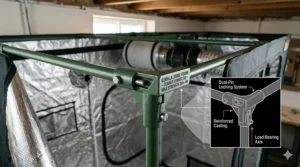
That 19mm all-steel interlocking pole system supports 300 pounds of hanging load. In practical terms, that means a 600W LED fixture, a carbon filter, an inline fan, and a pair of oscillating clip fans can all be rigged simultaneously without the frame even flinching. Budget tents with plastic connectors at those weights? They bow, they crack, and they fail — usually at the most inconvenient moment.
The EZ View windows are a detail that sounds minor until you’ve actually used them. Being able to check plant health without unzipping the tent and disrupting your photoperiod is genuinely game-changing, especially during the final weeks of flower. The 360-degree zipper access is industrial-strength with double cinching ducting ports sized at 11 inches — big enough for most 6-inch and 8-inch inline fan setups without improvised workarounds.
Growers on Amazon consistently highlight the zero-light-leak construction as the standout feature, with many noting it holds up beautifully after two to three full grow cycles with no seam degradation. Priced in the $300–$450 range, it’s the sweet spot for serious hobbyists.
✅ Genuine zero-light-leak construction
✅ 300lb hang capacity handles a full equipment loadout
✅ Height adjusts to 8’11” — future-proofs your setup
❌ Higher upfront cost than budget alternatives
❌ Heavier than lighter-canvas tents at assembly
Best for: The dedicated home grower running a single high-power LED who wants commercial-grade durability without the commercial footprint.
2. Gorilla Grow Tent Pro 5×5 — The Two-Light Sweet Spot
s the magic number where most intermediate growers realize they need to step up — and the Gorilla Pro 5×5 is built for exactly that transition. Same 1680D canvas and 300lb-rated 19mm steel frame as the 4×4, but now you have room to run two mid-powered LEDs side-by-side, or one high-output fixture in a configuration that gives your plants real space to express themselves.
What the spec sheet won’t tell you is how noticeably better the interior light distribution becomes at this footprint. With 25 sq ft of diamond-reflective mylar interior, a single-LED setup in the 4×4 creates decent coverage, but the 5×5 is where dialed-in PAR distribution really shines — especially with the added height for proper light-to-canopy spacing. The included 1-foot extension kit brings you to 7’11” out of the box, and if you’re growing tall varieties or running a SCROG net with a significant canopy height, the optional 2-foot kit takes you to 8’11”.
The 360-degree wrap-around zipper access is particularly useful at this size — no more contorting yourself to reach back-row plants. Buyers frequently mention that the 5×5 is where Gorilla’s odor containment really earns its keep, thanks to the dense canvas combined with 11-inch double-cinching ports that mate tightly with 6-inch duct systems. In the $350–$500 range, this is one of the best per-square-foot values in the gorilla grow tent premium tier.
✅ Ideal footprint for two-light setups
✅ Exceptional interior reflectivity for even PAR distribution
✅ Included extension kit delivers immediate headroom advantage
❌ Requires more floor space — measure your room carefully
❌ Takes 45–60 minutes for first assembly (plan ahead)
Best for: Intermediate growers ready to scale beyond a single-plant setup, or anyone running a multi-light LED configuration in a dedicated grow room.
3.Gorilla Grow Tent Pro 4×8 — The Rectangle That Professionals Love
Here’s what makes the 4×8 interesting: it’s not just a bigger tent — it’s a different shape of tent, and that matters more than most buyers realize. The 32-square-foot rectangular footprint suits sea-of-green and perpetual harvest setups far better than a square tent does, because you can divide it lengthwise into two distinct zones — one for veg, one for flower — using a light-blocking curtain. That’s a workflow that’s basically impossible in a 4×4 or 5×5.
The 19mm steel frame handles the extended span without any middle sag, which is impressive. Other brands’ 4×8 offerings often develop a pronounced droop in the center pole run after a few cycles under a heavy equipment load. Gorilla’s interlocking joint design distributes load across all pole connections, not just the corners, and it shows in the longevity. The same 1680D canvas, the same 300lb hang rating, the same height-extension capability from 6’11” up to 8’11” — all in a format that gives serious growers genuine operational flexibility.
The double-door access on the long side is a feature that sounds obvious but many 4×8 designs bungle — Gorilla gets it right, positioning the doors and ducting ports for real-world workflow rather than render-friendly marketing shots. In the $400–$700 range, it commands a premium but the build quality justifies it.
✅ Rectangular footprint enables two-zone perpetual harvest
✅ No center sag — frame integrity holds under full load
✅All standard gorilla grow tent premium features intacthttps://amzn.to/4vtQFmnhttps://amzn.to/4vtQFmn
❌ Requires a dedicated room — won’t fit casual spaces
❌ Higher assembly complexity than square models
Best for: Semi-advanced growers running perpetual or sea-of-green harvests who want to separate their veg and flower environments without buying two tents.
4. Gorilla Grow Tent Pro 5×9 — Near-Commercial Performance at Home
The 5×9 is the tent that separates serious hobbyists from people who are essentially running a small operation. Forty-five square feet. A 22mm pole diameter that’s a step up even from the standard Pro line. Three access doors. This is Gorilla’s answer to growers who’ve maxed out a 4×8 and are ready for the next tier — but aren’t quite ready to invest in a commercial build-out.
The 22mm pole diameter is worth dwelling on, because this is where the 5×9 earns its commercial-quality construction reputation. Heavier equipment — think 1000W HPS fixtures, dual carbon filter setups, multiple oscillating fans — demands poles that won’t torque under side-loading. The 22mm diameter with reinforced corner connectors means this tent can be pushed hard, season after season, without structural compromise.
At 5×9 you’re also looking at the territory where light coverage planning becomes critical. The elongated format suits three-light setups beautifully — one LED per 3-foot run — and the 8’11” maximum height leaves genuine clearance for even the most aggressive plant training. Reviewers of the 5×9 Pro consistently describe it as the last tent they’ll ever buy, which is exactly the kind of long-term value proposition that justifies the $500–$800 range pricing.
✅ 22mm steel poles — true commercial-grade frame strength
✅ 45 sq ft supports multi-light, multi-equipment configurations
✅ Three-door access — real ergonomics for big grows
❌ Significant space commitment — measure twice
❌ Price reflects what it is: near-commercial infrastructure
Best for: Dedicated cultivators who’ve outgrown mid-size tents and want to consolidate into one large, permanent-feeling grow space with room to run serious equipment.
5. Gorilla Grow Tent Pro 2×4 — The Entry Point That Doesn’t Compromise
The 2×4 deserves far more credit than it usually gets, because it’s where most growers begin their gorilla grow tent premium journey — and it proves that the brand doesn’t cut corners on small sizes. Eight square feet might sound modest, but with 1680D canvas, industrial-strength zippers, and a frame that holds 300 pounds, this tent is genuinely overbuilt for its footprint in the best possible way.
The height extends from 6’11” to 7’11” with the included 1-foot kit — a standout for a tent this size. Most entry-level 2x4s from competing brands are fixed-height at around 5.5 feet, which severely limits your light distance control and makes tall varieties a constant headache. The Gorilla 2×4 Pro’s extra headroom means you can run a 200–300W LED at the proper DLI distance without burning your canopy, even during explosive stretch.
The real-world appeal of the 2×4 is in its versatility: it fits in a large closet, in the corner of a spare bedroom, or in a utility room without dominating the space. It’s also a popular choice as a dedicated mother plant tent or a propagation environment alongside a larger flower tent. Buyers consistently mention assembly ease and the noticeably better quality versus similarly priced competitors. In the $200–$350 range, it’s genuinely the best-built small tent on Amazon for what you pay.
✅ Same premium 1680D canvas as large models — no quality cuts
✅ Height extension at this size is genuinely rare and valuable
✅ Perfect closet fit for space-limited growers
❌ 8 sq ft limits you to 2–4 plants maximum
❌ Single-door access is fine, but tighter to work in than larger models
Best for: Beginners making their first serious tent investment, experienced growers adding a second tent for propagation or mother plants, or anyone working with space constraints who refuses to sacrifice quality.
6. Gorilla Grow Tent SHORTY 4×4 — The Low-Ceiling Problem Solver
Not everyone grows in a room with 9-foot ceilings. Basements, attics, converted spaces — these environments have real height restrictions, and standard grow tents designed for 7-foot clearance simply don’t fit. The SHORTY is Gorilla’s solution, and it’s an elegant one. Same 16 square feet, same 1680D canvas, same 300lb-rated 19mm steel frame, but starting height is compressed to 4’11” — with the included 9-inch extension kit bringing maximum height to 5’8″.
What most buyers don’t realize until they actually measure is that 5’8″ is plenty for most low-stress training grows. A well-managed ScrOG canopy rarely needs more than 3–4 feet of vertical grow space above the net. The SHORTY’s light-tight construction means you get the full Gorilla quality experience in a package that fits under rafters, in under-stair storage conversions, or in rooms where the ceiling simply says no.
The spec sheet is identical to the standard Pro 4×4 in every respect except height — same EZ View windows, same 360-degree zipper access, same double-cinching 11-inch ducting ports. The diamond-reflective interior actually benefits shorter canopies because the ceiling is closer to the plants, bouncing light back downward with less distance to travel. Priced in the $200–$300 range, it’s actually more accessible than the Pro 4×4.
✅ Solves the low-ceiling problem elegantly and permanently
✅ Same build quality as full-size Pro line — zero compromises
✅ Compatible with standard 2-foot extension kit for occasional extra height
❌ Not suitable if you want to train plants beyond 4 feet of canopy height
❌ Some LED fixtures hang awkwardly low without proper hanging hardware
Best for: Basement and attic growers, anyone with ceilings under 8 feet who refuses to buy a flimsy budget tent, and experienced growers who prefer low-stress training techniques.
7. Gorilla Grow Tent Original 8×8 (GGT88) — The Room Within a Room
Sixty-four square feet. Three doors. A 22mm pole diameter. The Gorilla GGT88 isn’t a tent in the casual sense — it’s a semi-permanent infrastructure decision. When this thing is assembled and running, you can physically walk into it and forget you’re inside a fabric structure. It comes in two boxes for a reason: the frame components alone weigh in at 139 pounds, and assembly is a two-person operation that takes the better part of an afternoon.
The 1680D canvas, the 300lb hang capacity, and the height-extension system (from 6’11” up to 8’11” with the 2-foot kit) are all present at full scale. But what the 8×8 adds is operational capability that smaller tents fundamentally can’t replicate: you can run four 600W LEDs in a true 2×2 arrangement, mount multiple environmental controllers, and still have walkable space between your plant rows. For RDWC systems with heavy reservoir equipment, this footprint is essential.
Amazon customers running the 8×8 consistently describe it as a one-time purchase — the tent that ended the upgrade cycle. One reviewer memorably demonstrated that the frame, loaded with 200 pounds of equipment, barely deflected when tested. At the $900–$1,200 range, it’s a serious investment — but for semi-commercial or dedicated home operations, it’s genuinely cost-effective per square foot compared to custom room buildouts.
✅ 64 sq ft — walk-in operational space
✅ 22mm heavy-duty frame for maximum equipment load
✅ Three-door access enables true commercial-style workflow
❌ Requires dedicated space — this is a room-within-a-room commitment
❌ Two-person assembly required; plan for 2–3 hours
Best for: Serious cultivators running large operations who need walk-in access, multi-light configurations, and the kind of structural integrity that a custom build-out delivers without custom build-out pricing.
Top 7 Products at a Glance
| Model | Price Range | Frame | Canvas | Rating |
|---|---|---|---|---|
| Pro 4×4 | $300–$450 | 19mm steel | 1680D | ⭐⭐⭐⭐⭐ |
| Pro 5×5 | $350–$500 | 19mm steel | 1680D | ⭐⭐⭐⭐⭐ |
| Pro 4×8 | $400–$700 | 19mm steel | 1680D | ⭐⭐⭐⭐½ |
| Pro 5×9 | $500–$800 | 22mm steel | 1680D | ⭐⭐⭐⭐⭐ |
| Pro 2×4 | $200–$350 | 19mm steel | 1680D | ⭐⭐⭐⭐½ |
| SHORTY 4×4 | $200–$300 | 19mm steel | 1680D | ⭐⭐⭐⭐½ |
| Original 8×8 | $900–$1,200 | 22mm steel | 1680D | ⭐⭐⭐⭐⭐ |
The 22mm frame on the 5×9 and 8×8 models isn’t just an incremental upgrade — it’s a fundamentally different load-bearing architecture designed for heavier equipment. If your setup involves dual carbon filters, multiple fans, or high-wattage HPS fixtures rather than LEDs, size up to the models with the 22mm frame. Budget-tier buyers choosing between the SHORTY 4×4 and the Pro 2×4 should note that the decision is purely dimensional — both offer identical material quality at similar price points.
✨ Don’t Miss These Exclusive Deals!
🔍 Take Your Indoor Grow to the Next Level!
Click on any highlighted product above to check current pricing and availability on Amazon. These tents represent the best of what gorilla grow tent premium engineering has to offer — built to last through seasons, not just a single harvest.
Setting Up Your Gorilla Grow Tent Premium: First 30 Days Done Right
The tent you buy is only half the investment. How you set it up determines whether you’re harvesting to the tent’s potential or leaving yield on the table.
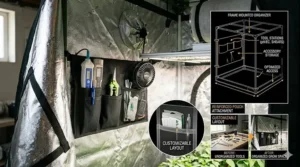
Assembly day: Lay out every component on a clean floor before you start. The interlocking steel pins connect in a specific sequence, and going out of order means you’ll be disassembling joints halfway through — frustrating and avoidable. Start with the floor frame, build up the corner uprights, and complete the roof frame before attaching any canvas. Two people make this considerably smoother; one to hold the frame, one to thread canvas channels.
Before your first run: Seal every unused ducting port with the included port covers. This sounds obvious but is the single most common source of light leaks. Run your intake and exhaust fans for 24 hours before introducing plants, checking every seam and corner with a flashlight in a darkened room. A minor leak caught now is far easier to address than one discovered during week six of flower.
Humidity control: The 1680D canvas is excellent at containing humidity, which is a feature that cuts both ways. According to the EPA’s indoor air quality guidelines, excess moisture in enclosed growing environments creates mold pressure regardless of how well-built the tent is. Keep a calibrated hygrometer inside from day one, and make sure your exhaust fan is appropriately sized for the tent volume — aim for a complete air exchange every 1–3 minutes during active growth phases.
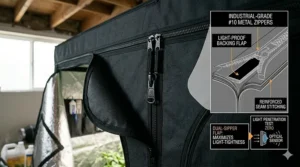
The 30-day mistake: Most new gorilla grow tent premium owners over-tighten the zipper pulls in the first month, forcing zippers around corners with too much lateral pressure. Gorilla’s zippers are industrial-strength, but proper technique extends their life significantly: run the zipper slowly at corners rather than yanking it through. It’s a small habit that protects a significant investment.
Extension kit timing: Don’t add height extension until your plants actually need it. A smaller air volume is easier to control for temperature and humidity. Add the extension kit when your canopy reaches about 18 inches below the light — that’s when the extra vertical space starts paying dividends rather than just creating dead air.
Who Should Buy Which Gorilla Tent? 3 Real Grower Profiles
The “best” gorilla grow tent premium is entirely situational. Here’s how that plays out across three real-world scenarios.
Profile 1: The Dedicated Bedroom Grower Jordan runs a single-tent setup in a spare bedroom — 9-foot ceilings, standard ventilation, a 2-plant limit by preference. The Pro 4×4 is the obvious choice: 16 sq ft supports a single 400–500W LED perfectly, the height extension handles the largest plants Jordan is likely to train, and the price point sits in range for a one-time quality investment. If Jordan’s ceiling were under 8 feet, the SHORTY 4×4 delivers identical quality with a shape that fits.
Profile 2: The Basement Operation Builder Sam has a basement with 7-foot ceilings, a dedicated circuit, and serious ambitions. The Pro 4×8 makes strategic sense here: the rectangular footprint allows a perpetual harvest workflow (veg one end, flower the other), the height maxes at 7’11” with the included extension — which clears 7-foot ceilings with no issue — and the 32 sq ft gives enough room for meaningful production. If Sam ever wants to scale further, the Pro 5×9 with its 22mm frame is the natural next step.
Profile 3: The Propagation-Plus-Flower Setup Alex already has a 4×4 flower tent and wants to add a dedicated veg and clone space without spending heavily. The Pro 2×4 slots in alongside the existing setup perfectly: small enough to fit beside a 4×4, big enough for 4–6 plants in early veg, and robust enough that it won’t become a light-leak liability. Many experienced growers run exactly this configuration — a Pro 4×4 for flower, a Pro 2×4 for veg, both sealed and separate.
How to Choose the Right Gorilla Grow Tent Premium: 6 Questions That Matter
Shopping for a gorilla grow tent premium without answering these six questions first is the fastest route to buying twice.
1. What’s your actual available floor space — not your estimated space? Measure with a tape measure, not with optimism. Allow 6 inches of clearance on every side of the tent for ducting runs and access. A 4×4 tent in a 5×5 alcove is functional; a 5×5 tent in a 5×5 alcove is a daily frustration.
2. What’s your ceiling height? Standard Pro line tents ship at 6’11” and can reach 8’11” with the full 2-foot extension. If your ceiling is under 8 feet, the SHORTY line eliminates the height problem entirely. Indoor gardening researchers at Purdue University’s horticulture extension consistently note that adequate headroom is the single most underestimated factor in hobby grow environment design.
3. How many lights are you running? One LED up to 500W → 4×4. Two LEDs or one 600W+ fixture → 5×5. Three or more → 4×8, 5×9, or 8×8. Undersizing your tent relative to your lighting creates thermal management nightmares that no amount of ventilation will fully solve.
4. What’s your hang load? Add up the weight of your lights, carbon filter, fan, and any hanging accessories. If that number approaches or exceeds 150 pounds, the 22mm frame of the 5×9 or 8×8 is worth the size step-up even if the footprint is more than you strictly need.
5. Is this a permanent installation or a moveable setup? Gorilla tents are not designed for frequent assembly and disassembly. The steel frame tolerates it, but the canvas channels and zipper seams will wear faster with repeated cycling. If portability matters, the Pro 2×4 is the most manageable option for regular moves.
6. What’s your honest long-term plan? If you think you’ll be in a 4×4 for two years and then upgrade to a 5×5, just buy the 5×5 now. The resale value on Gorilla tents is solid, but the upgrade tax — selling at a loss, rebuy, new equipment reconfiguration — almost always costs more than simply buying the size you’ll want next.
Common Mistakes When Buying a Gorilla Grow Tent Premium
Even experienced growers make these errors. Knowing them in advance is the difference between a setup that hums and one that frustrates.
Mistake 1: Buying for current plant count, not future plant count. The plant you put in a 2×4 on day one isn’t the plant you’ll have on day 60. Cannabis and tomatoes alike have a way of filling available space more aggressively than beginners anticipate. Size up by one tier from what you think you need on your first serious tent purchase.
Mistake 2: Ignoring the extension kit math. The included 1-foot kit is genuinely useful. The optional 2-foot kit is a separate purchase that most buyers regret not adding at checkout. Order both when you buy the tent — shipping costs make ordering them separately a poor value.
Mistake 3: Treating all 1680D as equal. Not all grow tent manufacturers use the same thread construction at the same stated density. Gorilla’s 1680D uses a specifically threaded construction that indoor cultivation experts note achieves genuine light-block performance where cheaper 1680D alternatives — using different weave densities — develop pinhole leaks within one or two grows. The number alone isn’t the whole story.
Mistake 4: Skimping on ducting port covers. Every unused port is a potential light leak and pest entry point. Gorilla includes covers, but many growers lose them during setup. Order a spare set — they cost almost nothing and save a lot of headaches.
Mistake 5: Expecting the tent to substitute for proper climate control. A gorilla grow tent premium creates a sealed, controllable environment. What goes inside that environment — intake air temperature, humidity management, CO₂ levels — is still entirely your responsibility. The tent is the infrastructure; the grower is the operator.
Features That Actually Matter (And Those That Don’t)
The indoor growing market is full of features that look impressive in product photography but contribute little to actual plant performance. Here’s an honest breakdown.
Matters enormously: Canvas thread density (genuine 1680D vs. marketing-grade numbers), frame material (steel vs. aluminum vs. fiberglass), zipper quality (industrial-strength vs. standard), and light-tightness (zero-leak vs. “almost zero-leak”). Gorilla excels across all four.
Matters a lot: Height adjustability. The entire gorilla grow tent premium value proposition is built around this. A tent that can grow with your skill level is a fundamentally smarter investment than a fixed-height structure that becomes limiting as you develop more advanced training techniques.
Matters situationally: Number of access doors. For tents up to 4×4, one main door is workable. For 4×8 and larger, dual or triple access becomes genuinely ergonomic rather than a marketing checkbox. The EZ View window matters most in light-sensitive cycles — if you’re growing photoperiod-sensitive crops, it earns its place every day.
Matters less than marketing suggests: Exact pole diameter within the same category. The difference between 19mm and 22mm poles matters when scaling to large commercial sizes or heavy hanging loads — but within the same size class at the same load rating, it’s rarely the deciding factor. Reflectivity percentages in marketing materials are often measured under ideal laboratory conditions; real-world differences between well-made mylar interiors are smaller than the advertising suggests.
Doesn’t matter at all: Floor tray color, brand logo placement, and minor variation in port count between competing models at the same size. These are aesthetic choices the internet argues about endlessly to no practical effect.
Long-Term Cost & Maintenance: The True Value of Going Premium
Here’s a calculation most buyers don’t run: a budget grow tent in the $80–$120 range replaced every 18 months (a common cycle among regular growers due to zipper failure, light leaks, and seam splits) costs $160–$240 over three years, plus the productivity loss during switchover periods. A gorilla grow tent premium in the $300–$450 range, maintained properly, routinely lasts five to ten years. The math isn’t subtle.
Maintenance is minimal but specific. Clean the interior mylar with a damp cloth after each grow cycle — never solvents, which degrade the reflective coating. Inspect zipper seams every six months for any sign of thread separation and address it immediately with seam sealer. Store extension kits in labeled bags so poles don’t get mixed between sizes.
Gorilla Grow Tent products are backed by an industry-leading lifetime warranty coverage policy through Grow Strong Industries — an actual lifetime warranty, not the “limited warranty” fine-print that many competitors offer. For a structural component like a grow tent where failure modes are gradual rather than catastrophic, a lifetime warranty is both genuinely meaningful and a signal of the manufacturer’s confidence in their own build quality.
One grower’s review on Amazon captures the economics cleanly: after using a Gorilla 4×4 through nine consecutive grows — roughly three years of continuous use — the frame, canvas, and zippers showed no functional degradation. Total cost per grow cycle: around $45. Budget tents rarely make it past the fourth grow without at least one structural issue.
FAQ: Gorilla Grow Tent Premium — Questions Answered
❓ Is a gorilla grow tent premium actually worth the higher price versus budget alternatives?
❓ What's the best gorilla grow tent premium size for a first-time grower?
❓ Can a gorilla grow tent premium handle high-wattage HPS lighting or only LEDs?
❓ Does the height extension kit come included with gorilla grow tent premium models?
❓ How do gorilla grow tent premium models compare to light proof grow tent options from competitors like AC Infinity?
Conclusion: The Gorilla Isn’t for Everyone — But It Might Be for You
Let’s be honest about what a gorilla grow tent premium is and isn’t. It isn’t the cheapest option on the page. It isn’t designed for people who want to run a single autoflower in a closet for three months and never try again. It isn’t marketed at the casual or the uncommitted.
What it is, without apology, is the best-built grow tent you can buy on Amazon today for serious indoor cultivation. The 1680D canvas. The interlocking steel frame that holds 300 pounds without flinching. The height-extension system that lets one tent scale across years of improving skill. The lifetime warranty that says exactly what the manufacturer thinks of their own product.
If you grow regularly, intend to keep growing, and want to stop replacing equipment on a budget cycle that costs more than the premium you’re avoiding — the Gorilla Pro line is the answer that actually ends the search. The Pro 4×4 for most home growers. The Pro 4×8 or 5×9 for those who are ready to scale. The SHORTY for the ceiling-constrained. The 8×8 for anyone who’s stopped pretending they’re a hobbyist.
Buy the right size once. Grow seriously for years. That’s the gorilla grow tent premium proposition — and for the growers it’s built for, it delivers exactly that.
✨ Don’t Miss These Exclusive Deals!
🔍 Ready to invest in your best grow yet? Click any linked product above to check current pricing and availability on Amazon. These gorilla grow tent premium options will transform your indoor setup — season after season.
Recommended for You
- 7 Best 2000D Grow Tent in 2026: Heavy Duty & Built to Last
- 7 Best Quality Grow Tents 2026: Expert Reviews & Buyer’s Guide
- Best 1680D Grow Tent 2026: 7 Heavy-Duty Picks That Won’t Fail You
Disclaimer: This article contains affiliate links. As an Amazon Associate, I earn from qualifying purchases. If you purchase products through these links, we may earn a small commission at no additional cost to you.
✨ Found this helpful? Share it with your friends! 💬🤗
