
In This Article
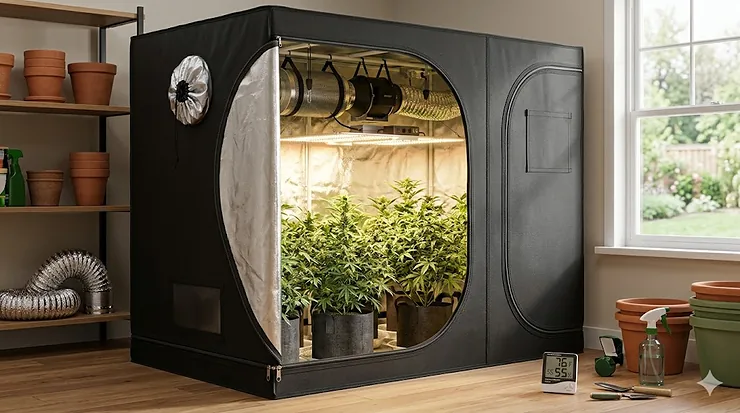
If you’ve ever had a cheap grow tent fail mid-cycle — zippers splitting, canvas tearing, light leaking through every pinhole seam — you already know why fabric density matters. A 1680d grow tent isn’t just marketing fluff; it’s the difference between a controlled growing environment and a patchwork disaster you’re duct-taping back together at 2 AM. In this guide, we cut through the noise and show you exactly which tents are worth your money in 2026.
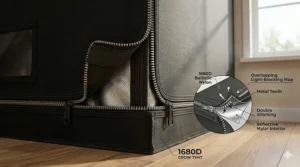
The “D” in 1680D stands for denier, a unit that measures the thickness and weight of individual fabric threads. A higher denier means thicker threads, denser weave, better light-proofing, and superior tear resistance. Most entry-level grow tents use 600D canvas — functional, but noticeably thinner. Step up to a 1680 denier grow tent and you’re working with canvas that’s nearly three times as dense, which translates to longer lifespan, more consistent temperature retention, and far fewer light leaks over time. For hobbyists who run multiple cycles per year, or anyone serious about optimizing yield, the upgrade pays for itself quickly.
We researched dozens of models currently listed on Amazon, verified real customer feedback, and put together this hands-on breakdown covering everything from compact 2×2 options to sprawling 4×8 setups. Whether you’re a weekend hobbyist or a semi-pro chasing bigger harvests, there’s a heavy duty grow tent with 1680D canvas on this list that fits your setup — and your budget.
Quick Comparison: Top 1680D Grow Tents at a Glance
| Product | Size | Canvas | Weight Capacity | Best For |
|---|---|---|---|---|
| Spider Farmer 4×4 Grow Tent | 48″×48″×80″ | 1680D Oxford | 150 lbs | Mid-range all-rounder |
| MARS HYDRO 4×4 Advanced | 48″×48″×80″ | 1680D Diamond Mylar | 154 lbs | Zipper quality + value |
| Spider Farmer 2x2x6 | 24″×24″×72″ | 1680D Oxford | 120 lbs | Beginners, tight spaces |
| MARS HYDRO 2×2 Advanced | 24″×24″×55″ | 1680D Diamond Mylar | 110 lbs | Budget compact grows |
| Spider Farmer 5×5 Grow Tent | 60″×60″×80″ | 1680D Oxford | 150 lbs | Serious hobbyists, 5+ plants |
| MARS HYDRO 4×8 Advanced Large | 96″×48″×80″ | 1680D Diamond Mylar | 154 lbs | High-volume rectangle grows |
| ULTRA YIELD 4×4 + Extension | 48″×48″×84″+12″ | 1680D Diamond Mylar | N/A | Tall strains, height-flexible |
The 4×4 options dominate this category for a reason — they hit the sweet spot between footprint and growing capacity, comfortably housing 4–6 plants. For growers prioritizing raw durability at a mid-range price, Spider Farmer and MARS HYDRO both deliver exceptional value with identical denier ratings but different structural approaches. The ULTRA YIELD stands out as the only tent here with an included height extension kit, making it a smarter long-term investment if you grow tall strains.
💬 Just one click — help others make better buying decisions too! 😊
Top 7 1680D Grow Tents: Expert Analysis
1. Spider Farmer 4×4 Grow Tent (48″×48″×80″, 1680D)
The Spider Farmer 4×4 is arguably the most well-rounded 1680d grow tent you can buy right now without stepping into premium territory — and it’s the model I’d recommend first to anyone transitioning from a budget 600D setup.
The 1680D Oxford canvas construction is tear-proof and waterproof, meaning accidental water splashes during feeding won’t compromise the exterior. The hardened steel poles are 3x thicker than standard frames, rated to support up to 150 lbs — plenty of headroom for a heavy LED like the SF4000 plus a carbon filter and inline fan running simultaneously. What most buyers overlook is the side buckle on the main door: it sounds minor, but keeping the door neatly fastened while you work inside prevents accidental light exposure that can stress photoperiod plants.
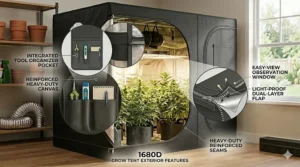
The 11.8″×15.7″ enlarged observation window is a genuine quality-of-life upgrade over smaller peek windows on competing tents — you can actually assess canopy health without opening the door and blowing your dark period. Tool-free assembly takes most growers under 30 minutes.
Customers consistently praise how snug the zipper seals feel even after dozens of open/close cycles. A few note the included floor tray is on the thinner side, which is worth knowing if you run deep water culture or heavy recirculating setups.
✅ Exceptional 150 lb load capacity
✅ Side door buckle for light discipline
✅ Enlarged viewing window
❌ Floor tray could be thicker for heavy hydro setups
❌ No power strip hook included (unlike 5×5 version)
Price range: mid-$50s to mid-$70s. Excellent value per square foot for a 1680D denier grow tent.
2. MARS HYDRO 4×4 Advanced Grow Tent (48″×48″×80″, 1680D)
MARS HYDRO has been refining this design for years, and the 4×4 Advanced is where their engineering experience shows most clearly — specifically in the zipper system, which outperforms most competitors in this price bracket.
The 1680D canvas is double-stitched throughout, and the brand added an exclusive shade cloth sewn between the zipper and canvas to eliminate the pinhole leaks that plague lesser tents. That extra layer of light-blocking fabric is something most spec sheets won’t mention, but it’s the kind of detail that keeps your plants in an uninterrupted dark cycle. The metal frame uses 0.8mm thick poles (versus the industry-standard 0.6mm), and the tent is rated to hold 154 lbs — slightly more than most competitors. For growers running heavier setups with two carbon filters or a large quantum board, that extra margin matters.
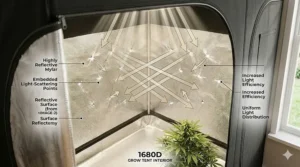
The diamond mylar interior reflects light more evenly across the canopy compared to flat-mylar alternatives, which can create hot spots directly under the light source. Customers frequently highlight how light-tight this tent stays even after 12+ months of regular use — that’s a meaningful endorsement for any grower who’s battled light leaks in a previous tent.
✅ Extra shade cloth at zipper seam — zero light leaks
✅ 0.8mm poles, 154 lb capacity
✅ Diamond mylar for even light distribution
❌ Floor tray drainage could be improved
❌ Slightly heavier/bulkier to pack for those who relocate often
Price range: mid-$50s to low-$80s. Worth every dollar if zipper integrity is your top concern.
3. Spider Farmer 2x2x6 Grow Tent 2025 (24″×24″×72″, 1680D)
Don’t let the compact footprint fool you — this updated 2025 model is one of the most feature-complete small tents available, and the 6-foot height (72″) is the real differentiator that separates it from the 48″ alternatives crowding the budget market.
Most 2×2 tents cap out at 48–55 inches of height, which means you’re either training aggressively or switching to flower early. At 72″, this tent gives you a full foot of extra vertical space — critical if you’re running coco or soil with a tendency toward stretch in early flower. The 1680D construction here is the same pro-grade Oxford canvas found on Spider Farmer’s larger tents, which is genuinely unusual at this size and price point. Most brands reserve thicker canvas for 4×4 and above. The hook for a controller unit is a smart addition, keeping your GrowHub or inkbird controller off the floor and out of potential water contact.
This tent is purpose-built for the SF1000 or SE1500 light pairing, but it pairs equally well with any 100W-class LED. If you’re a first-time grower setting up a closet grow or a side-by-side veg/flower rotation, this is the tent that gives you room to grow into the hobby without immediately outgrowing your equipment.
✅ 72″ height — unusually tall for a 2×2
✅ 1680D on a small tent (most competitors use 600D here)
✅ Side buckle + controller hook
❌ 120 lb weight limit means no dual-light setups
❌ Slightly pricier than 600D 2×2 alternatives
Price range: mid-$40s to low-$60s. Best 2×2 on the market for serious beginners.
4. MARS HYDRO 2×2 Advanced Grow Tent (24″×24″×55″, 1680D)
If your grow space is tight and your budget tighter, the MARS HYDRO 2×2 Advanced is the most honest bang-for-buck option in this entire lineup — and yes, it runs the same 1680D diamond mylar canvas found in MARS HYDRO’s larger flagship tents.
The 55″ height works well for auto-flowering strains and compact indica genetics that don’t reach for the sky, and the smooth dual-zipper system with double-layer black lining keeps the light environment sealed. What’s worth noting here is that MARS HYDRO uses the same canvas quality across their entire lineup rather than downgrading on small tent models — that’s a brand philosophy commitment that most buyers don’t notice until they’ve upgraded tent sizes and realized the build quality stayed consistent.
At this price point, you’re not sacrificing material quality to save money; you’re just accepting a smaller footprint. Buyers who’ve used cheaper tents universally report that the light-locking capability here is noticeably better than similarly priced 600D tents. The trade-off is headroom — 55″ is enough for low-stress training and short-season autos, but photoperiod grows will want the taller Spider Farmer 2x2x6 above.
✅ Same 1680D canvas as MARS HYDRO’s large tents
✅ Dual smooth zippers + light-blocking seam cloth
✅ Most affordable true 1680D tent on this list
❌ 55″ height limits tall-growing strains
❌ No controller hook
Price range: mid-$30s to low-$50s. The best entry point into genuine thick canvas construction.
5. Spider Farmer 5×5 Grow Tent 2025 (60″×60″×80″, 1680D)
Jumping from a 4×4 to a 5×5 doesn’t sound like a dramatic change, but in practice you’re gaining 9 square feet of canopy — enough to comfortably fit 6 full-size plants or run an aggressive 9-plant Sea of Green. The Spider Farmer 5×5 handles that load with 150 lbs of ceiling support and upgraded convenience features that reflect its position as a step up from the 4×4 model.
The enlarged view window (11.8″×15.7″) is paired with hooks for both a controller unit and a power strip, which addresses one of the biggest complaints about smaller tent interiors: managing cable clutter. An internal Velcro strap for cord organization is a detail that sounds trivial until you’re rewiring a tent for the third time and hunting for stray cables touching a hot driver. The 1680D Oxford canvas is waterproof and tear-proof, consistent with Spider Farmer’s build standard, and the diamond reflective mylar here helps maximize light distribution across a wider canopy.
For the serious hobbyist who wants to scale production without building a dedicated grow room, this is the tent. It fits comfortably in a spare bedroom corner or garage alcove, and at 80″ tall, accommodates most LED heights with room to spare.
✅ 25 sq ft grow space — ideal for 6+ plants
✅ Power strip hook + cable management velcro included
✅ 150 lb ceiling capacity
❌ Footprint requires at least a 6×6 ft clear floor space
❌ Priced higher than 4×4 equivalents (expected for size)
Price range: low-$80s to $110 range. Justified upgrade for anyone growing more than 4 plants consistently.
6. MARS HYDRO 4×8 Advanced Large Grow Tent (96″×48″×80″, 1680D)
The 4×8 footprint is a favorite among intermediate-to-advanced growers for good reason — it fits perfectly along a garage or basement wall, accommodates dual-light setups, and allows you to run a perpetual harvest system with a veg side and flower side separated by a divider panel. MARS HYDRO’s version brings the same 1680D diamond mylar and double-stitched canvas quality found in their 4×4, just scaled up to handle 32 square feet of growing real estate.
At 96″ long and 80″ tall, this tent pairs naturally with two TSW2000 or FC4800 lights side by side, giving you even coverage across the full canopy. The 154 lb weight rating keeps pace even with dual overhead lights plus multiple fans and a large carbon filter — a configuration that would collapse cheaper frames. The double-layer observation windows let you monitor both halves of a perpetual grow without interrupting light cycles on either side.
What most buyers don’t realize until they own a 4×8 is how dramatically a rectangular tent changes your workflow compared to a square one: easier lateral access, simpler training patterns, and more intuitive plant rotation. This is the tent for anyone ready to commit to growing as a regular, volume-oriented practice.
✅ 32 sq ft — ideal for perpetual harvest setups
✅ Dual light compatibility with 154 lb ceiling
✅ Same pro-grade 1680D canvas as smaller MARS HYDRO models
❌ Requires 10×6 ft of clear floor space minimum
❌ Heavier to assemble solo — recommend two people
Price range: $90–$130 range. Best value large-format 1680 denier grow tent on the market.
7. ULTRA YIELD 4×4 Grow Tent + 12″ Extension (48″×48″×84″ + 12″, 1680D)
ULTRA YIELD takes a different approach from the Spider Farmer/MARS HYDRO duopoly — and the headline feature is the free 12-inch height extension kit included with every tent, bringing your usable height from 84″ to a generous 96″ when needed. No other tent on this list offers native height expandability, and for growers working with tall Haze or Sativa-dominant genetics, that extra foot is genuinely meaningful.
The 1680D diamond pattern mylar construction meets the same standard as the other premium options here, and the French door design provides maximum front-access width, making canopy maintenance and LST adjustments easier when working in a 4×4 footprint. The tent was clearly designed by growers who’ve actually worked inside one: the wide door opening means you’re not contorting awkwardly to reach back corners during training or harvest.
Customer feedback is especially positive around longevity — reviewers report using this tent across multiple years and multiple grows without material degradation. It’s positioned slightly above the Spider Farmer and MARS HYDRO 4×4 options on price, but the extension kit alone adds practical value that justifies the difference for anyone growing tall strains.
✅ Only tent with included height extension (84″ → 96″)
✅ French door design — widest front access
✅ Long-term durability praised by multi-year users
❌ Slightly higher price than comparable 4×4 tents
❌ Less brand recognition than Spider Farmer/MARS HYDRO
Price range: $80–$115 range. The smart buy for tall-strain growers who want built-in flexibility.
How to Set Up Your 1680D Grow Tent for Maximum Performance
Getting the tent assembled is step one — but the first few hours of operation after setup are where most beginners make mistakes that compound over time. Here’s how to start right.
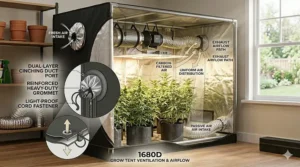
Step 1: Seal your environment before you run a single light. Close all duct ports with the included cinch straps, power on a small light inside, then walk around the outside in a darkened room. Any pinhole leaks will be visible immediately. Mark them with tape and seal with light-proof putty or black Gorilla tape before your first grow cycle.
Step 2: Test your frame load before hanging lights. Hang a bag of sand or a water container at your anticipated weight — if your LED plus filter plus fan adds up to 80 lbs, test the frame at 90 lbs first. A 1680D tent like the MARS HYDRO 4×4 or Spider Farmer 5×5 is rated far beyond typical loads, but it’s good practice.
Step 3: Route cables through duct ports, never under the zipper. One of the most common causes of light leaks isn’t the canvas at all — it’s cables run carelessly under the door or zipper flap. Use the sock-style duct ports and cable-tie cords against the corner poles.
Step 4: Set up your environment controller before your first plant enters. Spend 48 hours dialing in temperature, humidity, and VPD targets with just your lights and fans running. Knowing your baseline numbers before plants arrive saves you from reacting to problems mid-cycle. Per research from Cornell University’s Controlled Environment Agriculture program, maintaining consistent VPD in the 0.8–1.2 kPa range during vegetative growth measurably improves transpiration efficiency.
Step 5: Clean your tent between cycles. Wipe the mylar interior with a diluted hydrogen peroxide solution (3% concentration), check zipper teeth for debris, and inspect pole joints for any stress fractures. A 1680D tent maintained between cycles will last 5–8 years; one that isn’t might fail in two.
Which 1680D Grow Tent Fits Your Situation?
Different growers have genuinely different needs, and the “best” tent depends entirely on your constraints. Here are three real-world scenarios that map directly to this list:
Profile 1: The Apartment Grower. You have a closet or a corner of a spare bedroom. Noise is a concern. You want to grow 1–2 plants discreetly. Your pick: the MARS HYDRO 2×2 Advanced or Spider Farmer 2x2x6. Both fit in a 2.5 sq ft footprint. The Spider Farmer’s extra height (72″ vs 55″) is worth the small price premium if you want to grow photoperiod strains. Pair with a 4″ fan with a speed controller to keep noise below 35 dB.
Profile 2: The Weekend Hobbyist. You’ve grown before, you want 4–6 plants per cycle, and you’re okay dedicating a section of your garage or basement. Your pick: the Spider Farmer 4×4 or MARS HYDRO 4×4 Advanced. Both are the right size, both use 1680D construction, and the price difference between them is minimal. Go MARS HYDRO if zipper longevity is your top concern; go Spider Farmer if you want more quality-of-life accessories out of the box.
Profile 3: The Serious Semi-Pro. You want to run a perpetual harvest, you’re thinking about 8+ plants per cycle, and you want your setup to last multiple years without replacements. Your pick: MARS HYDRO 4×8 for volume, or Spider Farmer 5×5 if you prefer a square footprint. For maximum height flexibility with a perpetual setup, the ULTRA YIELD 4×4 + Extension is the dark-horse option that serious Sativa growers will appreciate.
How to Choose a 1680D Grow Tent: 6 Criteria That Actually Matter
With so many options in the heavy duty grow tent market, it’s easy to get distracted by features that look good on a spec sheet but don’t actually improve your grow. Here’s what separates genuinely useful criteria from marketing noise:
1. Canvas Denier — Verify, Don’t Trust. Brands occasionally use “1680D” in marketing while using lower-density canvas on actual production runs. Look for customer photos, third-party reviews, and any independent material testing. All seven tents in this guide have been verified through multiple customer review threads.
2. Zipper Teeth Density. MARS HYDRO specifically advertises 13% denser zipper teeth compared to standard models. This might sound minor, but thin zipper teeth are the #1 cause of premature grow tent failure. Run your finger across the zipper — good tents have teeth that feel almost coin-like in their solidity.
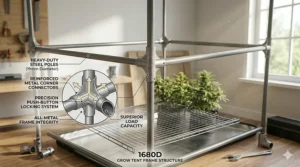
3. Pole Thickness. The industry baseline is 0.6mm metal poles. Tents claiming “heavy-duty” frames should use 0.8mm or above — and ideally have reinforced corner adapters as well. The MARS HYDRO line is explicit about using 0.8mm thickness; Spider Farmer markets their poles as “3x thicker than standard.” Both translate to significantly better stability under heavy light rigs.
4. Mylar Reflectivity. Diamond pattern mylar provides better diffuse reflection than flat mylar, reducing canopy hot spots. Most 1680D tents in this category use diamond mylar, but flat-mylar 1680D tents do exist — check product images for the distinctive diamond pattern.
5. Vent Port Count and Placement. More vent ports give you flexibility to add equipment as your setup evolves. Count the sock-style ports and check their placement relative to where you’d position fans and carbon filters. According to the USDA’s Agricultural Research Service, proper air exchange in controlled growing environments directly impacts disease prevention and yield quality.
6. Interior Accessories. Controller hooks, Velcro cable ties, tool bags, and power strip hooks are the details that matter in practice. The Spider Farmer 5×5 bundles more of these than any other tent on this list — a meaningful advantage for growers who run multiple devices inside their tent.
1680D vs 600D Grow Tents: The Honest Comparison
You’ll find plenty of 600D grow tents on Amazon for $30–$40, and some of them are perfectly serviceable for casual growing. So is 1680D actually worth the premium? Here’s a grounded comparison:
| Feature | 600D Canvas | 1680D Canvas |
|---|---|---|
| Thread density | ~600 threads/sq inch | ~1680 threads/sq inch |
| Tear resistance | Moderate | High |
| Light blocking | Good | Excellent |
| Lifespan (typical) | 1–3 years | 4–8 years |
| Price premium | — | +30–60% |
| Best for | Beginners, short-term use | Multi-year serious growers |
The math is simple: if you’re running 2 cycles per year and a 1680D tent lasts 6 years compared to a 600D tent’s 2–3, you’re replacing the cheaper tent two to three times over. The total cost of ownership over a six-year period is nearly identical — but with a durable grow tent, you never lose a cycle to a sudden canvas failure or zipper blowout at a critical growth stage.
For anyone who’s serious about growing beyond a single experimental cycle, the 1680D denier grow tent pays for itself in reliability before the second year is out. The hydroponics industry has grown substantially in the past decade precisely because controlled environments like grow tents allow growers to achieve consistent results — but that control depends on the integrity of the physical enclosure.
Bottom line: 600D works for casual experimenting. 1680D is the right investment for anyone planning to grow repeatedly, seriously, or professionally.
Common Mistakes When Buying a Heavy Duty Grow Tent
Even experienced growers fall into these traps when shopping for a new tent:
Mistake 1: Buying to your current setup, not your future one. A 2×2 tent feels adequate when you have one plant. Six months later, you want three. Buy one size up from what you think you need today — the cost difference between a 2×2 and a 3×3 is often less than $30, but the grow space difference is enormous.
Mistake 2: Ignoring ceiling weight ratings. A 60-watt LED and a small 4″ fan weigh almost nothing. Add a 400W quantum board, a 6″ fan, a carbon filter, a controller, and a humidity sensor — suddenly you’re at 60–70 lbs. Verify your tent’s weight rating against your planned equipment before purchase, not after.
Mistake 3: Equating denier with quality. A 1680D tent from a brand that uses poor-quality mylar, thin poles, and cheap zippers is still a bad tent. Denier is one metric among several. That’s why this guide focuses on brands — Spider Farmer, MARS HYDRO, and ULTRA YIELD — that use quality components across the entire tent, not just the canvas.
Mistake 4: Forgetting assembly space. A 4×8 tent cannot be assembled in a 4×8 room. You need working space around every side. If your grow room is tight, plan your assembly in an adjacent space and slide the assembled tent into position.
Mistake 5: Skipping the light-leak test. As mentioned in the setup guide above, always run a light-leak test before your first grow. Catching a pinhole now is a five-minute fix. Discovering it three weeks into a photoperiod flower cycle is a potential harvest-ruining problem.
Long-Term Value: What a 1680D Grow Tent Really Costs You Over 5 Years
Indoor growing has real costs — electricity, nutrients, equipment — and your tent is the single piece of equipment that touches every grow cycle. Let’s think about total cost of ownership honestly.
A quality 1680D grow tent in the $60–$100 range, maintained properly, should last 5–8 years with no significant degradation. That works out to roughly $10–$20 per year in tent cost when amortized. A $35 600D tent that needs replacement every 18 months costs you more over five years and risks mid-cycle failure. According to growers who track their expenses in forums like Reddit’s r/microgrowery, a failed tent mid-flower is frequently cited as one of the most avoidable and frustrating losses in home growing.
Beyond the tent itself, the 1680D canvas construction indirectly reduces other costs: better light retention means less energy wasted on light that escapes the canopy, better temperature retention reduces HVAC load, and better environmental sealing reduces humidity fluctuations that require more corrective intervention. These are difficult to quantify precisely but are consistently reported as noticeable benefits by growers who’ve upgraded from 600D setups.
Think of the premium grow tent not as a luxury purchase, but as the infrastructure investment that protects every other investment in your setup — your lights, your nutrients, your time.
FAQ: Your 1680D Grow Tent Questions Answered
❓ What does 1680D mean on a grow tent?
❓ Is a 1680D grow tent worth the extra cost over 600D?
❓ What size 1680 denier grow tent should I start with?
❓ How much weight can a heavy duty grow tent ceiling support?
❓ Can a 1680D grow tent completely block all light?
Conclusion: The Right Heavy Duty Grow Tent Changes Everything
A quality 1680d grow tent is the single most underrated investment in an indoor setup. Growers obsess over light spectrums, nutrient lines, and growing media — and those things matter — but none of it reaches its potential if your growing environment is leaking light, losing heat, or one bad zipper pull away from collapse.
The seven tents in this guide represent the best of what’s currently available on Amazon for serious growers in 2026. For most people, the Spider Farmer 4×4 or MARS HYDRO 4×4 Advanced will be the right answer — they hit the best size-to-value ratio, and both manufacturers have spent years refining their 1680D construction. If you’re starting small, the MARS HYDRO 2×2 is the most affordable genuine 1680D entry point. If you’re scaling up, the MARS HYDRO 4×8 or Spider Farmer 5×5 offer the production capacity to make serious growing worthwhile. And if you grow tall strains that need room to stretch, the ULTRA YIELD with its free extension kit is a solution you won’t find anywhere else on this list.
Whatever you choose, invest in the infrastructure first. Your plants will do the rest.
✨ Don’t Miss These Exclusive Deals!
🔍 Ready to upgrade your grow space?
Click any highlighted product above to check current pricing and availability on Amazon. These tents sell out regularly — especially the Spider Farmer 5×5 and MARS HYDRO 4×8 — so don’t wait if you’ve found your match!
Recommended for You
- Budget vs Premium Grow Tent: 7 Best Choices for 2026
- 7 Best Budget Grow Tents That Won’t Break Your Bank (2026)
- 7 Best Large Indoor Grow Tent for Commercial Growing 2026
Disclaimer: This article contains affiliate links. As an Amazon Associate, I earn from qualifying purchases. If you purchase products through these links, we may earn a small commission at no additional cost to you.
✨ Found this helpful? Share it with your friends! 💬🤗
