
In This Article
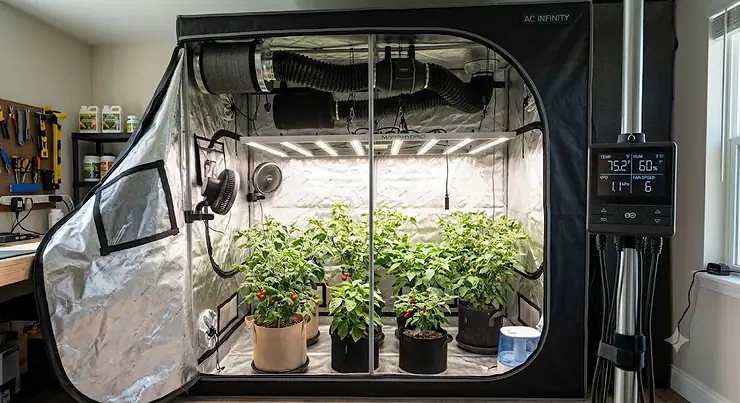
A climate control grow tent is an enclosed indoor growing space equipped with temperature and humidity management hardware — fans, air conditioners, mini splits, or smart controllers — that automatically holds the environment inside a target range regardless of what’s happening outside the tent. If you’ve ever walked into your grow tent at 3 p.m. and found the thermometer reading 91°F when your lights kicked on at noon, you already know why this matters more than almost anything else in your setup. Heat stress doesn’t announce itself politely. It shows up as curling leaves, stalled growth, and a harvest that’s smaller and less potent than it should have been.
Here’s the thing nobody tells beginners: buying a good tent and a good light is maybe half the job. The other half is managing the microclimate you’ve just sealed yourself into. Grow lights, especially anything pushing real wattage, dump heat into a space that has nowhere to go unless you engineer an exit. Add a dehumidifier or CO2 supplementation into the mix and the math gets trickier fast. This guide walks through seven real climate control grow tent products spanning budget thermostats to full mini split systems, explains what the specs actually mean for your plants, and gives you a framework for matching hardware to your specific tent size and climate. As with any environmental science, understanding vapor pressure deficit — the gap between how much moisture is in the air and how much it could hold before saturating — will come up more than once, because it’s the real target behind every temperature and humidity number below.
Quick Comparison Table: Climate Control Grow Tent Systems at a Glance
| Product | Type | Cooling Capacity | Best For | Price Range |
|---|---|---|---|---|
| AC Infinity TERRAFORM 8 | All-in-one AC | 12,000 BTU | Sealed 4×4-5×5 tents, VPD precision | Premium |
| Senville LETO 12000 BTU Mini Split | Ductless mini split | 12,000 BTU | Dedicated grow rooms, year-round use | Premium |
| VIVOSUN AeroLush C08 | Portable AC w/ sensor | 8,000 BTU | Canopy-level monitoring | Mid-range |
| Ideal-Air 14,000 BTU Portable AC | Portable AC | 14,000 BTU | Larger tents, hot climates | Mid-range |
| AC Infinity Controller 69 Pro+ | Smart environment controller | N/A (automation hub) | Automating existing fans/AC | Mid-range |
| Garvee 3-in-1 Portable AC | Portable AC | 8,000 BTU | Budget cooling, quiet operation | Budget |
| Inkbird ITC-308 | Plug-in thermostat | N/A (relay controller) | Basic on/off temperature control | Budget |
Looking at the spread above, there’s a clear pattern: the higher the price, the more the system does the thinking for you. Budget options like the Inkbird ITC-308 simply switch equipment on and off at set thresholds, while the AC Infinity TERRAFORM 8 and Senville LETO 12000 BTU Mini Split actively regulate temperature, humidity, and — in the AC Infinity’s case — vapor pressure deficit without you touching anything. If you’re running a single 4×4 tent with a mid-power LED, a mid-range portable unit or a smart controller paired with your existing fan is usually enough; sealed rooms, HID lighting, or hot-climate garages tend to push growers toward the premium tier.
💬 Found a system that fits your setup? Bookmark this guide and come back before you check out — the buyer’s framework further down could save you from an expensive sizing mistake.
💬 Just one click — help others make better buying decisions too!😊
Top 7 Climate Control Grow Tent Products: Expert Analysis
1. AC Infinity TERRAFORM 8 — self-evaporating VPD-driven cooling and heating
The standout here is that the AC Infinity TERRAFORM 8 doesn’t just cool your tent — it manages the whole climate equation, cooling, heating, and dehumidifying through a single duct while chasing a VPD target instead of a plain temperature number. Under the hood is a 12,000 BTU inverter compressor that delivers dynamic cooling and heating through that single duct, using an onboard algorithm to self-regulate toward your VPD setpoint rather than a fixed number. In practice, that means the unit ramps its output up and down instead of slamming on and off, avoiding the temperature overshoot that plagues cheaper fixed-speed ACs. What most buyers overlook about this model is the self-evaporative design: rather than filling a bucket you have to dump daily, it pumps condensate to the condenser and evaporates a large share of it automatically, cutting maintenance to an occasional check rather than a chore. Based on the spec sheet and aggregated buyer feedback, this unit is built for growers running sealed 4×4 to 5×5 tents who want to stop babysitting a thermostat. Reviewers consistently report that it pulls a hot tent down from the high 80s into the mid-70s within minutes, though several also note the unit is heavy at roughly 70 pounds and can pressurize a small tent, so you’ll want an open passive vent to prevent ballooning.
Pros:
- ✅ VPD-based auto-regulation removes guesswork from daily adjustments
- ✅ Self-evaporative condenser drastically cuts manual maintenance
- ✅ Single-duct design keeps installation relatively simple for a full AC
Cons:
- ❌ 70-pound unit is heavy and can be overkill for tents under 4×4
- ❌ Cooling efficiency reportedly drops once ambient room air exceeds 85°F
At the premium end of the market, the AC Infinity TERRAFORM 8 is priced for serious growers rather than hobbyists dipping a toe in — expect it to sit well above the portable-AC tier, likely in the $700-$900+ range depending on retailer. For a sealed tent where every degree matters, the value case is strong: you’re paying for automation that would otherwise cost you hours of manual monitoring every week.
2. Senville LETO 12000 BTU Mini Split — quietest true HVAC integration
The Senville LETO 12000 BTU Mini Split standout feature is that it’s genuine ductless HVAC, not a repackaged portable unit — an indoor air handler and outdoor condenser working together the way a home mini split would. That distinction matters in practice because mini splits are inherently more efficient than single-hose portables, which have to fight their own negative pressure. This unit carries a roughly 21 SEER2 efficiency rating and a built-in heat pump rated to operate down to about 5°F, plus DC inverter technology that the manufacturer states can cut energy consumption meaningfully compared to non-inverter units. In practical terms, a higher SEER2 number means the compressor sips power instead of gulping it during long summer cooling cycles — the updated testing standard behind that rating, introduced by the U.S. Department of Energy, is designed specifically to reflect real-world rather than laboratory-ideal performance. Growers running a dedicated grow room rather than a single tent are the clear audience here; the built-in dehumidification and turbo modes mean one appliance replaces what would otherwise be a portable AC, a separate dehumidifier, and a space heater for cold nights. The tradeoff worth knowing before you buy: professional installation is required to keep the manufacturer’s warranty valid, which adds real cost and complexity that portable units simply don’t have.
Pros:
- ✅ True ductless HVAC efficiency beats portable AC designs
- ✅ Heat pump adds cold-weather heating without a separate device
- ✅ Alexa and app control for remote schedule adjustments
Cons:
- ❌ Requires professional installation to keep the warranty valid
- ❌ Outdoor condenser unit isn’t practical for apartment or rental setups
Pricing sits firmly in the premium tier once you factor in the compressor, indoor handler, and installation labor — likely in the $800-$1,200+ range before labor costs, a bigger financial commitment than any portable AC on this list. For a permanent grow room running multiple tents or a large single space, though, the long-term energy savings from that SEER2 rating start closing the gap fast.
3. VIVOSUN AeroLush C08 — best canopy-level sensor accuracy
What sets the VIVOSUN AeroLush C08 apart from a generic portable AC is the placement of its sensing hardware: instead of reading air temperature near the unit itself, it uses a probe you can physically position inside the canopy. In hands-on testing, its 8,000 BTU compressor handled the heat from a 600W LED setup comfortably, keeping the tent at a steady 75°F even when ambient room temperatures climbed into the mid-80s. Here’s what most spec sheets won’t tell you: an AC that only reads the air near its own intake can be badly fooled by a hot pocket forming right where your top colas are sitting, which is exactly the blind spot the canopy probe solves. App integration lets you check temperature and humidity readings remotely and receive alerts if conditions drift outside your set parameters, a genuinely useful feature for anyone who travels or works long shifts away from the grow space. This unit is purpose-built for the grower running a single 4×4 or 5×5 sealed tent with LED lighting who wants grow-specific intelligence without stepping up to a full mini split. The honest limitation, per the same testing, is scale — the 8,000 BTU rating starts to struggle in larger open grow rooms or with multiple high-wattage HID fixtures.
Pros:
- ✅ Canopy-level probe placement avoids misleading air readings
- ✅ App alerts catch environmental drift before plants stress
- ✅ Purpose-built grow features beyond a generic portable AC
Cons:
- ❌ 8,000 BTU capacity isn’t enough for rooms over roughly 350 sq ft
- ❌ Grow-specific sensors add cost versus a bare-bones portable unit
Priced in the mid-range tier, typically in the $350-$450 range, the VIVOSUN AeroLush C08 sits comfortably above a bargain portable AC but well under mini split territory — a reasonable middle path if sensor accuracy matters more to you than raw capacity.
4. Ideal-Air 14,000 BTU Portable AC — best for large or hot-climate tents
The Ideal-Air 14,000 BTU Portable AC‘s standout advantage is sheer thermal headroom: where most tent-oriented ACs top out around 8,000-12,000 BTU, this unit is built for larger sealed spaces or growers battling genuinely hot ambient conditions. Sizing math from hydroponics suppliers backs this up — a 600W LED typically adds roughly 2,000-2,500 BTU per hour of heat to a room, while a 1000W HPS fixture can add 3,000-3,500 BTU per hour, so once you’re running multiple lights or a larger tent footprint, the 8,000 BTU class simply runs out of headroom (this grow room AC sizing guide walks through the full calculation if you want to run your own numbers). That extra capacity means the compressor cycles less often at full tilt, which in practice translates to steadier temperatures and less wear over a long flowering cycle. This unit earns its place for growers in the Southwest or Southeast running warm garages, or anyone with a 6×6-plus tent and heavier lighting. The honest tradeoff is efficiency: portable AC units are generally less energy-efficient than mini split systems and are better suited to spaces where a permanent installation isn’t practical, so you’re trading some electricity cost for flexibility and a much simpler install than a mini split demands.
Pros:
- ✅ Extra BTU headroom handles multiple lights or larger footprints
- ✅ No permanent installation required, unlike mini split systems
- ✅ Straightforward single or dual-hose exhaust setup
Cons:
- ❌ Less energy-efficient per BTU than a comparable mini split
- ❌ Larger footprint takes up meaningful floor space near the tent
Sitting in the mid-to-upper range for portable units, typically $500-$700, the Ideal-Air 14,000 BTU Portable AC costs more upfront than an 8,000 BTU model but avoids the far larger jump to mini split pricing — a sensible middle ground for anyone scaling past a single small tent.
5. AC Infinity Controller 69 Pro+ — best automated environment brain
Rather than cooling anything itself, the AC Infinity Controller 69 Pro+ standout feature is turning whatever fans, lights, and humidifiers you already own into an automated system. It connects with up to eight different devices, from fans to lights, giving each its own independent climate and time-based programming, and can dynamically change fan speed and light intensity in response to temperature, humidity, and VPD readings. What that means practically: instead of manually cranking your exhaust fan up every afternoon when lights heat the tent, the controller ramps fan speed automatically as temperature climbs and eases off once it’s back in range, which both stabilizes your climate and extends fan motor life by avoiding constant full-speed cycling. Its sensor probe, mounted on a roughly 12-foot cable with a thermal-alloy head, accurately detects current temperature and humidity, and pairing it with the included wall-mount hardware keeps the display out of the way while still readable at a glance. This is the pick for growers who already own decent ventilation hardware and want AC Infinity’s automation layered on top rather than paying for a whole new cooling appliance. The catch worth flagging honestly is ecosystem lock-in — full automation benefits require AC Infinity’s own UIS-compatible fans and lights, so mixing brands means losing some of the dynamic programming.
Pros:
- ✅ Automates up to eight devices from a single interactive hub
- ✅ Dynamic fan-speed response reduces temperature swings automatically
- ✅ Extends existing equipment’s usefulness instead of replacing it
Cons:
- ❌ Full feature set favors AC Infinity’s own UIS-connected devices
- ❌ Doesn’t add any actual cooling capacity on its own
Priced well under any of the AC units on this list, typically in the $90-$130 range, the AC Infinity Controller 69 Pro+ is one of the highest-value additions here precisely because it multiplies the effectiveness of equipment you likely already own rather than requiring a fresh purchase.
6. Garvee 3-in-1 Portable AC — quietest budget cooling
The Garvee 3-in-1 Portable AC‘s calling card is proving that a budget-friendly price tag doesn’t have to mean a noisy, underpowered unit. In two months of real-world testing in a 5×5 tent, its 8,000 BTU cooling capacity handled a 400W CMH light setup without issues, maintaining temperatures in the high 70s even during the hottest part of summer days. Reviewers were most impressed by its operation under roughly 51 decibels, notably quieter than most portable ACs in its price class. For stealth growers or anyone with a tent in a shared living space, that noise floor is a genuinely practical advantage — you can run this unit around the clock without it becoming the background hum everyone in the house notices. Its 3-in-1 functionality covers cooling, fan circulation during cooler periods, and a dry mode that pulls moisture from the air, giving budget-conscious growers most of what a dedicated dehumidifier would add, bundled into one machine. This unit is the honest pick for anyone running a 4×4 or 5×5 tent with moderate lighting who needs reliable cooling without premium-tier spending. Where it comes up short is capacity for anything beyond that; a 1000W HID light or a warehouse-scale space will overwhelm an 8,000 BTU budget compressor quickly.
Pros:
- ✅ Sub-51 decibel operation is genuinely quiet for the price tier
- ✅ 3-in-1 cooling, fan, and dehumidify modes add real versatility
- ✅ Handles moderate LED or CMH lighting loads reliably
Cons:
- ❌ 8,000 BTU capacity limits it to smaller tents and lighter setups
- ❌ Budget build quality generally means a shorter expected lifespan
At the budget end of the spectrum, typically well under $300, the Garvee 3-in-1 Portable AC delivers a strong value proposition for first-time growers who need functional cooling now and can always upgrade to a grow-specific unit later.
7. Inkbird ITC-308 — cheapest reliable on/off temperature control
The Inkbird ITC-308‘s standout feature is radical simplicity at a rock-bottom price: it’s a pre-wired dual-relay thermostat, not an AC unit itself, that switches whatever heating or cooling equipment you plug into it on and off based on a target temperature. Specs show a wide control range spanning roughly -58°F to 248°F, with a maximum load around 1100W at 110V, meaning it can safely control a small space heater on one outlet and a fan or fridge-based cooling setup on the other simultaneously. What this device does that many growers overlook is act as a safety net: even if you’re relying on passive ventilation most of the time, plugging a backup fan into the cooling relay means a sudden heat spike triggers automatic intervention rather than going unnoticed until you check the tent hours later. Aggregated buyer sentiment is notably strong for a budget device — independent review roundups routinely note overall ratings sitting at or above 4.5 out of 5 across large sample sizes on Amazon. This is the pick for growers on a tight budget who already own a fan or small AC and just need reliable automatic triggering, not a beginner looking for a complete cooling solution out of the box.
Pros:
- ✅ Extremely low price point compared to any dedicated AC unit
- ✅ Dual relay lets you automate both heating and cooling equipment
- ✅ Strong aggregated review sentiment for reliability and ease of use
Cons:
- ❌ Provides zero cooling capacity on its own — it only triggers your equipment
- ❌ Basic on/off control lacks the smoothness of inverter-based systems
Often available for well under $40, the Inkbird ITC-308 is arguably the single highest-ROI item on this list for anyone who already owns cooling hardware but has been running it manually.
Practical Usage Guide: Setting Up Your Climate Control System Right
Getting a climate control grow tent system working well in the first 30 days comes down to sensor placement and airflow direction more than any single piece of hardware. Start by mounting your temperature and humidity probe at canopy height, roughly where the top of your plants will sit during flower, not near the tent’s intake or exhaust port where readings skew artificially cool. If you’re running something like the VIVOSUN AeroLush C08 or the AC Infinity Controller 69 Pro+, this step alone prevents the most common first-month mistake: an AC that thinks the tent is fine while the canopy is baking a few degrees hotter.
Next, think about pressure balance. A single-duct unit like the AC Infinity TERRAFORM 8 exhausts air out of the tent without pulling in an equal amount, which builds positive pressure and can billow tent walls if there’s no passive intake vent open. Crack one mesh vent partway and you’ll usually solve it. For dual-hose portables and the Ideal-Air 14,000 BTU Portable AC, make sure both hoses run as short and straight as possible — every extra bend in flexible ducting reduces airflow efficiency measurably.
Maintenance-wise, wipe down or replace intake filters monthly to prevent dust buildup from choking airflow, and if you’re running a self-evaporative unit like the TERRAFORM 8, still check the condensate reservoir periodically during humid stretches when evaporation can’t keep pace. A common first-month mistake worth calling out directly: setting your target temperature too aggressively low. Chasing 68°F in a sealed tent with an 8,000 BTU unit forces the compressor to run near-constantly, shortening its lifespan for marginal benefit — most vegetative and flowering stages tolerate a comfortable 72-78°F range just fine.
✨ Ready to stop guessing at your grow tent’s climate? Explore the systems above and check current availability before your next lighting upgrade pushes temperatures out of range.
Real-World Scenarios: Matching Climate Control to Your Grow
Consider three growers with genuinely different needs. The first is a college student running a single 2×4 tent in a dorm-adjacent apartment with one 300W LED — budget and noise matter more than raw capacity here, and the Inkbird ITC-308 paired with a small existing fan handles the modest heat load without drawing attention or draining a student budget. The second is a hobbyist with a dedicated 4×4 tent in a spare bedroom running a 600W LED and chasing consistent yields season after season; this is squarely the VIVOSUN AeroLush C08‘s target profile, since the canopy sensor and app alerts fit someone checking in from work rather than standing in the room all day.
The third scenario is a small commercial operator converting a garage into a sealed grow room with two 5×5 tents and 1000W-equivalent lighting throughout, based in a warm climate where ambient summer temperatures regularly hit the high 80s. That heat load and the need for genuine year-round reliability point toward the Senville LETO 12000 BTU Mini Split or the AC Infinity TERRAFORM 8, since portable units in that scenario would be cycling near-constantly and burning through their expected service life fast. None of these three growers should buy the same equipment, and that’s the point — the right climate control grow tent setup follows your square footage, lighting wattage, and ambient climate, not the other way around.
How to Choose a Climate Control Grow Tent System
- Calculate your actual heat load first. Add up your lighting wattage and remember LED fixtures contribute meaningfully less heat per watt than HID, then size your cooling capacity with margin rather than cutting it close.
- Match capacity to tent size, not just light wattage. A 12,000 BTU unit in a 2×4 tent is overkill; an 8,000 BTU unit in a 6×6 sealed room chasing two lights will run constantly and wear out early.
- Decide between portable and permanent early. Portables install in minutes but sacrifice some efficiency; mini splits demand professional installation but pay it back in energy savings for dedicated grow rooms.
- Prioritize sensor placement over marketing claims. A unit with a remote canopy probe will consistently outperform a higher-BTU unit reading only its own intake air.
- Factor in humidity control, not just temperature. Look for built-in dehumidify modes or plan a separate dehumidifier, since a cooled tent that’s still humid invites mold regardless of temperature.
- Check the noise rating if you’re growing near living spaces. Decibel ratings vary widely between otherwise similar-capacity units.
- Budget for ducting, filters, and — for mini splits — installation labor. The sticker price on the unit itself is rarely the full cost of ownership.
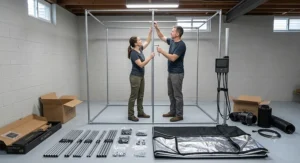
Common Mistakes When Buying Climate Control Equipment
The single most common mistake is undersizing cooling capacity to save money upfront, then discovering the unit can’t keep pace once flower-stage lighting kicks in at full intensity. A close second is ignoring negative or positive pressure effects — growers install a single-hose portable AC, seal the tent completely, and end up pulling in unfiltered air through every seam because the unit is depressurizing the space. Buyers also frequently trust a unit’s internal sensor without verifying canopy-level readings, which can mean plants are stressed for weeks before anyone notices the thermometer was misleading. Finally, many first-time buyers skip reading return-air and clearance requirements for mini splits, then discover professional installation costs more than expected because their garage or shed didn’t have adequate outdoor unit placement.
Climate Control Grow Tent vs Passive Ventilation
Passive ventilation — just running an inline exhaust fan with a passive or lightly-powered intake — works fine for growers in mild climates with modest lighting, and it’s dramatically cheaper than any AC-based system. The tradeoff is control: passive ventilation can only pull your tent toward ambient room temperature, so if your room itself runs hot, a fan alone can’t fix that. Active climate control, by contrast, can cool below ambient regardless of what the rest of the house is doing.
| Factor | Passive Ventilation | Active Climate Control |
|---|---|---|
| Upfront Cost | Low | Moderate to high |
| Cooling Below Ambient | No | Yes |
| Humidity Management | Limited | Often built-in |
| Best For | Mild climates, modest lighting | Hot climates, sealed rooms, heavy lighting |
The analysis here is straightforward: if your grow room ambient temperature never climbs much above your target range, passive ventilation with a good inline fan is genuinely sufficient and you don’t need to spend on an AC unit. But once ambient temperatures regularly exceed your target — which is common with HID lighting or summer heat — active systems like the Garvee 3-in-1 Portable AC or AC Infinity TERRAFORM 8 become less of a luxury and more of a yield-protection necessity.
💬 Not sure which category fits your grow room? The scenarios above walk through three common setups — find the one closest to yours.
Temperature Control Tent Systems for Different Grower Types
A temperature control tent setup for a first-time hobbyist looks very different from one for a small commercial operator, and matching the equipment to the grower matters as much as matching it to the room. Beginners generally benefit most from simple, forgiving systems — a plug-and-play thermostat like the Inkbird ITC-308 paired with an inexpensive fan removes complexity while still providing genuine protection against heat spikes, and the learning curve is close to zero. Intermediate growers running a dialed-in single tent tend to get the most value from sensor-equipped portables like the VIVOSUN AeroLush C08, since the app alerts compensate for not being able to check the tent constantly.
For seniors or anyone managing a grow tent with limited mobility, remote app control becomes less of a convenience and more of a necessity — being able to verify and adjust conditions from a phone without physically checking the tent multiple times a day meaningfully reduces the maintenance burden. Commercial-minded growers scaling toward multiple tents or a converted room should treat a temperature control tent purchase as infrastructure rather than an accessory, which is where the Senville LETO 12000 BTU Mini Split‘s efficiency and durability start to justify the higher upfront cost through years of lower operating expense.
Cooling System Grow Tent: What to Expect in Real-World Performance
Specs on a box rarely match the lived experience of running a cooling system grow tent day to day, so here’s what actually happens across a typical grow cycle. During the vegetative stage, heat load is modest and most cooling systems on this list will barely need to work hard — you’ll notice the compressor cycling infrequently. Once flower stage begins and lighting intensity often increases, that changes fast; a properly sized unit will settle into a steady rhythm of cycling on for a period, cooling the tent back to target, then resting, while an undersized unit runs continuously and never quite catches up.
Noise is another real-world factor spec sheets understate. A unit rated at 51 decibels sounds meaningfully different inside a small closet-converted grow space than the same rating would suggest in an open room, because enclosed spaces amplify perceived loudness. Expect a genuine adjustment period of a few days as you dial in target temperatures and humidity setpoints; most growers find their systems need one or two tweaks after the first week once they see how the unit actually responds to their specific tent’s insulation and light schedule.
Long-Term Cost & Maintenance of Automated Environment Management
Automated environment management systems carry a real ongoing cost beyond the sticker price, and it’s worth running the numbers honestly before you buy. Electricity is the biggest recurring expense — a compressor-based AC running several hours daily during flower will visibly show up on your power bill, which is exactly why the SEER2 rating on mini splits matters so much for anyone running climate control year-round. SEER2 is the U.S. Department of Energy’s current efficiency standard for cooling equipment, and the ENERGY STAR efficiency criteria for ductless systems show just how wide the efficiency gap can be between a baseline unit and a high-efficiency one, a difference that compounds meaningfully over years of continuous operation.
| System Type | Typical Upfront Cost | Ongoing Cost Driver | Maintenance Frequency |
|---|---|---|---|
| Plug-in thermostat (Inkbird ITC-308) | Budget | Whatever equipment it controls | Minimal |
| Portable AC (Garvee 3-in-1, VIVOSUN AeroLush C08) | Mid-range | Electricity, filter replacement | Monthly filter checks |
| Mini split (Senville LETO 12000 BTU) | Premium | Electricity (offset by SEER2 efficiency) | Annual professional service |
The analysis worth sitting with here: a cheaper portable AC that runs constantly because it’s undersized can end up costing more in electricity over two or three seasons than a properly sized, more efficient unit would have from the start. Total cost of ownership, not just the number on the price tag, is the number that actually matters for anyone running a grow tent long-term.
Precision Temperature Regulation: Features That Actually Matter
Marketing copy on climate control equipment loves to list features, but not all of them meaningfully affect your grow. Precision temperature regulation genuinely matters when it comes from inverter-based compressors — the kind found in the AC Infinity TERRAFORM 8 and Senville LETO 12000 BTU Mini Split — because ramping output up and down avoids the overshoot-and-undershoot cycle of cheaper fixed-speed units. Remote sensor probes that read canopy-level conditions, as found on the VIVOSUN AeroLush C08, also matter substantially, since they solve the real problem of an AC misjudging conditions based on air near its own intake.
What matters far less than the marketing suggests: app connectivity for its own sake. Being able to see a graph of your tent’s temperature history is nice, but it doesn’t cool anything — the underlying hardware quality is what determines your actual results. Similarly, Bluetooth-only control without WiFi (common on cheaper smart devices) sounds modern but limits you to being physically near the tent anyway, undercutting the main benefit of remote monitoring. Growers should prioritize sensor accuracy and compressor type over app polish when comparing precision temperature regulation claims across products.
Integrated HVAC Solutions: Safety and Electrical Considerations
Integrated HVAC solutions for grow spaces come with real electrical and safety considerations that are easy to overlook when you’re focused on temperature numbers. Any unit drawing significant current — mini splits and larger portable ACs especially — should run on a dedicated circuit rather than sharing an outlet with grow lights and fans, since overloading a standard 15-amp household circuit is a genuine fire risk, not a hypothetical one. Extension cords are a common shortcut that becomes a real hazard with high-draw HVAC equipment; if a unit’s power cord doesn’t comfortably reach an outlet, that’s a sign to have an electrician add one rather than bridging the gap with a cheap cord.
Humidity control ties directly into safety too, and not just for plant health. University-based pest management research on powdery mildew notes that the conditions that favor mildew development include low light and high relative humidity, and that greenhouse-style enclosed environments are often ideal for the disease to take hold. Keeping relative humidity in a moderate, well-monitored range through your climate control system isn’t just about avoiding stunted growth — it directly reduces mold and mildew risk that can otherwise force you to discard an entire harvest. For mini split installations specifically, follow manufacturer clearance requirements around the outdoor condenser unit exactly; improper clearance is one of the most common reasons warranty claims get denied.
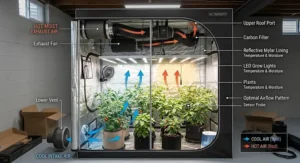
Frequently Asked Questions
❓ What is the best climate control grow tent setup for a 4x4 tent?
❓ How much does a grow tent AC unit cost?
❓ Can I use a regular window AC unit in a grow tent?
❓ What temperature and humidity should a grow tent stay at?
❓ Do I need a mini split for a grow tent, or is a portable AC enough?
Conclusion
Choosing the right climate control grow tent setup isn’t about buying the most expensive unit on the shelf — it’s about honestly sizing your equipment to your tent, your lighting, and your climate, then layering in the sensor accuracy and automation that fit how closely you can actually monitor things day to day. A student running a single small tent has genuinely different needs than a commercial grower converting a garage, and the seven products covered here — from the budget-friendly Inkbird ITC-308 up through the automation-forward AC Infinity TERRAFORM 8 and the efficiency-focused Senville LETO 12000 BTU Mini Split — reflect that real range of use cases rather than a single “best” answer.
What matters most, regardless of which system you land on, is treating temperature and humidity management as core infrastructure rather than an afterthought. The VIVOSUN AeroLush C08‘s canopy sensor, the AC Infinity Controller 69 Pro+‘s automation, and the Ideal-Air 14,000 BTU Portable AC‘s raw capacity all solve different pieces of the same underlying problem: keeping your plants inside the narrow window where they actually thrive. Get that right, and the rest of your grow — nutrients, training, lighting schedule — has a far better chance of showing up in your final harvest the way you intended.
Recommended for You
- Portable AC for Grow Tent: 7 Best Cooling Picks for 2026
- Fogger for Grow Tent: 7 Proven Picks That Fix Dry Air Fast (2026)
- Cool Mist Humidifier Grow Tent: 7 Best Picks for 2026
Disclaimer: This article contains affiliate links. As an Amazon Associate, I earn from qualifying purchases. If you purchase products through these links, we may earn a small commission at no additional cost to you.
✨ Found this helpful? Share it with your friends! 💬🤗
