
In This Article
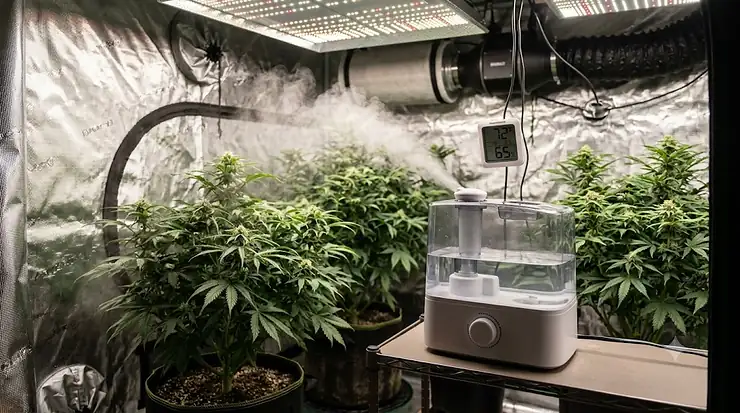
Here’s a scene every indoor grower knows too well: you check your hygrometer at 2 a.m., the humidity has cratered to 35%, and your seedlings look like they’ve been left out in a desert wind. A fogger for grow tent setups solves exactly this problem — it’s a compact ultrasonic device that turns still water into a fine, breathable mist and pumps it directly into your enclosed grow space. Unlike a bulky household humidifier parked outside the tent, a purpose-built fogger threads a hose right through your port and delivers moisture where your canopy actually needs it.
What is a fogger for grow tent use? It’s an ultrasonic misting device with a water reservoir, a vibrating diaphragm that atomizes water into micro-droplets, and (on better models) a probe that reads humidity inside the tent and adjusts output automatically. Think of it as the difference between hoping the weather cooperates and actually running your own climate.
I’ve spent the past few weeks digging through spec sheets, manufacturer documentation, and aggregated review data across seven real, currently-sold units — from budget reptile-style foggers repurposed by growers to dedicated VPD-aware grow tech from AC Infinity and VIVOSUN. Below, you’ll get honest analysis of what each one actually does in a tent, not just what the box claims. Whether you’re nursing clones through their first fragile week or trying to keep a flowering room from crashing below 40% RH, there’s a fit here for your budget and your grow.
Managing humidity isn’t just about comfort — it directly affects transpiration, nutrient uptake, and disease pressure, a relationship researchers describe through vapor pressure deficit, which matters more to plant health than relative humidity alone.
Quick Comparison Table
| Product | Tank Size | Output | Smart Control | Best For |
|---|---|---|---|---|
| AC Infinity CLOUDFORGE T3 | 4.5L | Up to 240 ml/h, 10 levels | VPD + humidity trigger, app | Serious growers wanting precision |
| VIVOSUN AeroStream H09 | 9L | Adjustable, WiFi remote | Temp/humidity probe, app | Larger tents, less refilling |
| VIVOSUN AeroStream H05 | 5L | Adjustable, WiFi remote | Temp/humidity probe, app | Mid-size tents on a budget |
| AILINKE Humidifier for Plants | 8L | Adjustable cool mist | Humidity probe, manual dial | Big reservoirs without smart premium |
| LRAZU 6L Fogger Humidifier | 6L | 400 ml/h | Temp/humidity probe | Budget-conscious precision seekers |
| Inkbird Reptile Humidifier Fogger | 4L | Adjustable | Dry-out protection only | Small tents, simple reliability |
| REPTI ZOO 4L Fogger Mister | 4L | Adjustable, intermittent timing | Digital tank timer | Tightest budgets, 2×2 tents |
Looking at this table, the split is pretty clean: the AC Infinity CLOUDFORGE T3 and both VIVOSUN AeroStream units dominate anyone who wants the fogger to think for itself, while the LRAZU, Inkbird, and REPTI ZOO units trade automation for a much lower buy-in cost. The AILINKE splits the difference — a genuinely large tank without the WiFi premium. None of these are “bad” picks; they’re just built for different tolerances for manual babysitting.
💬 Already have a favorite from the table above? Jump straight to its full review below — or keep reading for the honest trade-offs.
💬 Just one click — help other golfers find the right club for their game too!😊
Top 7 Fogger for Grow Tent Options: Expert Analysis
1. AC Infinity CLOUDFORGE T3 — VPD-based automation for serious growers
The AC Infinity CLOUDFORGE T3 is the closest thing on this list to a “set it and mostly forget it” system, because it doesn’t just react to humidity — it reacts to vapor pressure deficit, the metric that actually predicts how hard your plants are working to hold onto water. The 4.5-liter tank pairs with an EC ultrasonic vaporizer capable of 10 output levels and a rated maximum of roughly 240 ml/h, with a corded external probe feeding real-time data back to the onboard display. What that means in practice: instead of guessing at a percentage, you can tell the unit to maintain a specific VPD band appropriate for veg or late flower, and it throttles mist output accordingly rather than blasting full fog until a humidity number is hit.
This is squarely built for growers who already run other AC Infinity gear, since it plugs into the UIS controller ecosystem for shared scheduling with fans and lights. Reviewers frequently cite the quiet operation and the no-leak tank seal as standout points, and aggregated feedback consistently flags the extendable four-foot hose as genuinely useful for directing mist away from seedlings and toward drier corners of a tent. A common critique in user discussions is that the four-level onboard control feels limiting without pairing it to a separate UIS controller for the full ten levels — a detail Amazon’s product page doesn’t emphasize.
Pros:
- ✅ VPD-based triggering, not just flat humidity percentage
- ✅ Extendable 4+ foot hose for targeted misting
- ✅ Integrates with AC Infinity’s UIS controller ecosystem
Cons:
- ❌ Full 10-level control requires a separate UIS controller
- ❌ Smaller 4.5L tank means more frequent refills in larger tents
Expect this unit in the roughly $60-$80 range at the time of research (check current price for accuracy), and for growers who already lean on data over guesswork, it’s worth the premium over a basic fogger.
2. VIVOSUN AeroStream H09 — largest smart tank for bigger tents
The VIVOSUN AeroStream H09 is built for growers tired of refilling a tank every eight hours. At roughly 9 liters (2.38 gallons), it’s the biggest reservoir on this list by a wide margin, and it pairs that capacity with a WiFi-connected app, a temperature/humidity probe, and remote scheduling. In real-world terms, a 9L tank in a moderately humid tent can often stretch past 24 hours of runtime before needing attention, which matters enormously if your grow room isn’t somewhere you walk past daily.
Aggregated buyer feedback on VIVOSUN’s smart humidifier line tends to praise the app’s scheduling flexibility and the convenience of adjusting settings without opening the tent (which itself helps stabilize internal climate by avoiding unnecessary door-opening). Based on the spec sheet, the trade-off is footprint: a tank this size takes up meaningfully more floor or shelf real estate than the compact reptile-style foggers on this list, so it fits best in 4×4 tents and larger rather than a cramped 2×2. What most buyers overlook is that a larger water reservoir also means more standing water sitting between cleanings, so the maintenance cadence shouldn’t slip just because you’re refilling less often.
Pros:
- ✅ 9L tank dramatically cuts refill frequency
- ✅ WiFi app control with temp/humidity probe feedback
- ✅ Well-suited to larger 4×4+ tent footprints
Cons:
- ❌ Bulkier footprint, less ideal for small tents
- ❌ Standing water volume demands more diligent cleaning
Price sits in roughly the $90-$130 range at the time of research — a fair ask for growers managing bigger spaces who value fewer trips to the tent.
3. VIVOSUN AeroStream H05 — smart control at a friendlier price
The VIVOSUN AeroStream H05 takes the same WiFi-and-probe smart architecture as its bigger sibling and packages it into a 5-liter (1.32-gallon) tank, landing it as the more attainable entry point into VIVOSUN’s smart humidifier ecosystem. The core value proposition here is straightforward: you get remote app control and a temperature/humidity probe for real feedback, without paying for tank capacity you may not need in a 2×4 or 3×3 tent.
Here’s what the spec sheet doesn’t fully convey — a 5L tank in this app-connected format hits a sweet spot for growers who want smart features but don’t want to manage a large reservoir on a small shelf. Based on the comparison against the H09, the tighter tank means slightly more frequent top-offs, but for most single-tent home growers that’s a minor daily task rather than a real burden. Aggregated user commentary on VIVOSUN’s smart line generally points to a smooth setup process and reliable WiFi connectivity, with occasional notes that firmware updates are recommended shortly after unboxing for the most stable app performance.
Pros:
- ✅ Same smart app and probe tech as the larger H09
- ✅ Compact 5L tank fits smaller tent footprints
- ✅ Lower buy-in than the 9L sibling model
Cons:
- ❌ Requires more frequent refilling than larger tanks
- ❌ Smart features add a learning curve versus manual dial units
Expect a price in roughly the $60-$90 range at the time of research, positioning it as the mid-tier pick for anyone who wants automation without the premium tank size.
4. AILINKE Humidifier for Plants — big capacity without the smart-home premium
The AILINKE Humidifier for Plants takes a different approach: instead of chasing app connectivity, it leans into raw tank capacity and a genuinely functional humidity probe at a price point below the VIVOSUN smart line. At 8 liters (2.1 gallons), it slots in just under the AeroStream H09 for capacity while skipping the WiFi layer entirely — a reasonable trade for growers who’d rather adjust a dial than open an app.
What most buyers overlook about this category of humidifier is that the expandable hose length matters just as much as tank size for actual coverage inside a tent; a big reservoir that dumps all its mist in one spot still leaves corners dry. The AILINKE unit’s extendable hose and probe placement flexibility address this directly, letting growers route the humidity sensor to the driest zone of the canopy rather than trusting a fixed internal sensor. Based on the spec comparison, this unit earns its keep in tents where WiFi connectivity isn’t a priority but consistent, hands-off humidity control still is.
Pros:
- ✅ Large 8L tank without WiFi-tier pricing
- ✅ Expandable hose for flexible probe and mist placement
- ✅ Straightforward manual controls with humidity feedback
Cons:
- ❌ No remote app control or scheduling
- ❌ Manual dial requires more hands-on adjustment over time
At around $50-$75 at the time of research, it’s a strong value pick for growers who want capacity and accuracy without paying for smart-home integration they won’t use.
5. LRAZU 6L Reptile Fogger Humidifier — precision probe at a reptile-fogger price
The LRAZU 6L Reptile Fogger Humidifier started life in the terrarium aisle but has quietly become a favorite among budget-conscious growers, largely because it packs a genuine temperature and humidity probe — not just a timer — into a 6-liter tank rated for roughly 400 ml/h output. That probe is the differentiator here: rather than misting on a blind schedule, the unit reads actual tent conditions and adjusts, which is a meaningfully more useful feature than most units at this price tier offer.
The extendable targeting hose lets you route mist away from your light and toward the driest part of the canopy, addressing a common complaint about fixed-nozzle foggers dumping moisture in one spot and creating uneven humidity pockets. Reviewers aggregated across retail listings consistently describe the unit as quiet and easy to fill, with a recurring note that the tank benefits from weekly descaling if your tap water runs hard — consistent with broader guidance from the EPA on humidifier maintenance, which flags mineral buildup and microbial growth as the two main risks with any ultrasonic unit left uncleaned.
Pros:
- ✅ Real temp/humidity probe, not just a blind timer
- ✅ Extendable hose helps target dry canopy zones
- ✅ Strong output-to-price ratio versus smart-tier units
Cons:
- ❌ No app or remote scheduling
- ❌ Reptile-market branding means less grow-specific documentation
Priced around $35-$55 at the time of research, this is one of the better value plays on the list for growers who want real probe-based control without paying smart-humidifier prices.
6. Inkbird Reptile Humidifier Fogger — simple, leak-resistant, and dependable
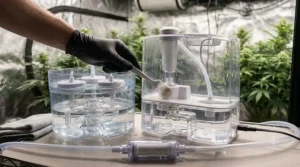
The Inkbird Reptile Humidifier Fogger trades smart features for dead-simple reliability, and for a lot of small-tent growers, that’s exactly the trade they want. Its 4-liter (1-gallon) detachable tank is designed to avoid leaking when removed for refilling — a small detail that matters more than it sounds once you’ve dealt with a tank that dribbles down your shelf every time you top it off. The extendable hose stretches from about 25 to 68 inches, giving enough reach to route mist across a small-to-mid tent without repositioning the whole unit.
What genuinely stands out here is the dry-out protection: a white buoy sensor detects when the tank runs empty and shuts the unit down rather than letting it run dry and burn out the ultrasonic disc, with a clear red indicator light confirming the shutoff. Based on the spec comparison, this is a meaningful safety feature that budget foggers sometimes skip entirely, and reviewers frequently cite it as the reason the unit survives longer than similarly priced alternatives. The honest trade-off: there’s no humidity probe here, so you’re setting mist output manually and checking your own hygrometer rather than letting the unit self-regulate.
Pros:
- ✅ Dry-out protection prevents running the unit empty
- ✅ Detachable tank designed to resist leaking on refill
- ✅ Extendable hose reaches up to 68 inches
Cons:
- ❌ No built-in humidity probe for automatic adjustment
- ❌ Manual monitoring required to avoid over- or under-misting
At roughly $30-$45 at the time of research, it’s a dependable budget pick for anyone who doesn’t mind checking a hygrometer themselves in exchange for a lower price and genuine safety features.
7. REPTI ZOO 4L Fogger Mister — the tightest budget for a 2×2 tent
Rounding out the list, the REPTI ZOO 4L Fogger Mister is built around an integrated water tank designed to reduce the leaking that plagues cheaper detachable-tank units, paired with a digital timer for intermittent humidification cycles rather than constant misting. For a small 2×2 or 2×3 tent — the kind used for a single mother plant, a handful of clones, or a small mushroom fruiting chamber — intermittent cycling is often exactly what’s needed, since continuous fog in a tiny enclosed space can quickly overshoot your target humidity and start dripping condensation onto leaves.
Here’s what the spec sheet won’t tell you directly: the digital tank timing feature is less about precision automation and more about preventing the classic beginner mistake of leaving a fogger running non-stop and soaking a small tent. Aggregated review sentiment tends to describe the unit as quiet and easy to program, with recurring notes that the ultra-quiet operation makes it suitable for growers keeping a tent in a bedroom or closet. The honest limitation is that this timer-based cycling isn’t the same as a true feedback-based humidity probe — it schedules bursts rather than responding to actual conditions, so you’ll still want your own hygrometer to fine-tune the cycle length.
Pros:
- ✅ Integrated tank design reduces leak risk
- ✅ Digital interval timer prevents tent overshoot
- ✅ Ultra-quiet operation suits bedroom or closet tents
Cons:
- ❌ Timer cycling, not true probe-based humidity feedback
- ❌ Smallest tank on the list means frequent refills
Expect this one around $25-$40 at the time of research — the lowest entry point on this list and a sensible starting point for a first small-tent setup.
Top 7 Products Comparison Table
| Product | Price Range | Best For | Rating Signal (Aggregated) |
|---|---|---|---|
| AC Infinity CLOUDFORGE T3 | ~$60-$80 | VPD-focused growers | Consistently praised for quiet, precise operation |
| VIVOSUN AeroStream H09 | ~$90-$130 | Large tents, infrequent refills | Praised for app scheduling and tank capacity |
| VIVOSUN AeroStream H05 | ~$60-$90 | Mid-size smart-control tents | Praised for easy setup, smooth WiFi pairing |
| AILINKE Humidifier for Plants | ~$50-$75 | Big capacity without WiFi | Noted for reliable probe accuracy |
| LRAZU 6L Fogger Humidifier | ~$35-$55 | Budget precision seekers | Praised for quiet output and probe accuracy |
| Inkbird Reptile Humidifier Fogger | ~$30-$45 | Small tents, dependable basics | Praised for dry-out protection, no-leak tank |
| REPTI ZOO 4L Fogger Mister | ~$25-$40 | Tightest budgets, small tents | Noted for quiet operation, easy timer setup |
Stacked side by side, the pricing tiers map almost perfectly onto the feature tiers: probe-based smart control costs roughly double what a timer-based budget fogger runs. If your tent is under 3×3, the REPTI ZOO or Inkbird covers the job without overspending on capacity you can’t use, while anyone running 4×4 or bigger should lean toward the VIVOSUN AeroStream H09 or AILINKE simply to avoid multiple daily refills.
✨ Ready to stop guessing at your tent’s humidity? Compare current prices on any of the seven picks above and pick the one that matches your tent size.
Practical Usage Guide: Setting Up Your Fogger the Right Way
Getting a new fogger for grow tent installation right in the first week prevents most of the headaches growers report later. Start by placing the unit on a stable, level surface below your canopy line — never directly under a light, since heat can warp plastic housings and skew probe readings. Run the extendable hose upward at a slight angle so mist rises rather than pooling condensation back into the unit; several manufacturers explicitly warn against letting hose sections dip below the fogger’s outlet.
For the first 30 days, resist the urge to run the unit at maximum output around the clock. A common mistake is chasing a humidity spike by cranking the dial to full, overshooting into the 70-80% range, and inviting mold or powdery mildew — particularly risky during flowering. Instead, set a target based on your growth stage (higher for clones and seedlings, lower as flowers mature) and let a probe-equipped unit self-correct. Clean the tank every three to five days using a soft brush, and switch to distilled or reverse-osmosis water if you notice white mineral dust settling on leaves or tent walls, since hard tap water accelerates scale buildup on the ultrasonic disc.
Real-World Scenario: Matching a Fogger to Your Grow
Consider three common setups. A college student running a single 2×2 closet tent with a couple of autoflowers doesn’t need WiFi scheduling or a nine-liter tank — the REPTI ZOO 4L Fogger Mister or Inkbird Reptile Humidifier Fogger covers that footprint affordably, with enough runtime between refills to fit a busy class schedule. A hobbyist mushroom grower running a Martha tent for oyster or lion’s mane fruiting bodies needs sustained high humidity (often 90%+) without constant babysitting, making the probe-based LRAZU 6L or the VPD-savvy AC Infinity CLOUDFORGE T3 a better match, since both can hold a steady target without manual dial-checking every few hours.
Then there’s the grower with a 4×8 multi-plant flowering room who travels for work several days a month. For that setup, tank capacity and remote visibility matter more than anything else — the VIVOSUN AeroStream H09‘s nine-liter reservoir and app-based monitoring mean a missed refill day doesn’t tank the whole crop, and a quick phone check confirms the tent hasn’t drifted into dangerous territory while away.
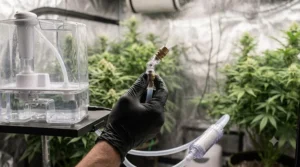
How to Choose a Fogger for Grow Tent Setups
- Match tank size to tent size. A 2×2 tent rarely needs more than 4-6L; a 4×4 or larger benefits from 8L+ to avoid daily refills.
- Decide if you need a real humidity probe. Timer-based units are cheaper but require more manual hygrometer-checking; probe-equipped units self-correct.
- Check hose length and routing. Longer, more flexible hoses let you target the driest zone of the canopy instead of misting one fixed spot.
- Consider your grow stage. Clones and seedlings favor steady, low-output misting; flowering rooms favor precise, VPD-aware control to avoid mold risk.
- Weigh app/smart features honestly. WiFi scheduling is genuinely useful for larger operations or frequent travelers, but adds cost you may not need for a single small tent.
- Factor in water type and maintenance. Hard tap water means more frequent descaling regardless of which unit you buy — budget that time in, not just the purchase price.
- Look for safety shutoffs. Dry-out protection and no-leak tank seals prevent burnout and mess, and are worth prioritizing over marginal capacity gains.
Fogger vs Traditional Humidifier: What Actually Changes
A fogger for grow tent use and a standard household humidifier both add moisture to the air, but the delivery mechanism changes the outcome inside an enclosed space. Traditional humidifiers are designed to diffuse mist broadly across an open room, which works fine for a bedroom but wastes most of its output in a sealed tent — much of the mist condenses on tent walls before it ever reaches the canopy. A dedicated fogger’s extendable hose routes mist directly into the growing zone, meaning less water wasted and faster, more even humidity gains exactly where plants transpire.
The trade-off runs the other way too: household humidifiers typically hold larger tanks and are built for continuous, unsupervised operation in living spaces, while grow-tent foggers are engineered for compact footprints and probe placement flexibility rather than raw runtime. If you’re deciding between repurposing a bedroom humidifier and buying a dedicated fogger, the deciding factor is really about targeting — a general-purpose humidifier raises humidity in the room; a fogger raises humidity specifically at your plants.
Common Mistakes When Buying a Fogger
The most frequent misstep is buying based on tank size alone without checking output rate — a huge tank paired with a weak ultrasonic disc still won’t keep a large tent humid during a dry spell. Another common error is skipping the probe question entirely; growers who buy a timer-only unit often end up manually checking a hygrometer multiple times a day, effectively doing the job the probe would have automated. A third mistake is ignoring hose routing until after setup, then discovering the fixed nozzle dumps all the mist onto one corner of the canopy while the rest of the tent stays dry.
Buyers also frequently underestimate maintenance time. A fogger that never gets descaled or cleaned will eventually disperse mineral dust and, per EPA guidance on ultrasonic units, potentially microorganisms into the tent — not a great outcome in a space you’re trying to keep clean for edible or medicinal plants. Finally, some growers buy the flashiest smart-connected unit without checking whether their tent size actually benefits from that tank capacity, paying a premium for capabilities a 2×2 tent will never use.
Long-Term Cost and Maintenance
Beyond the sticker price, real ownership cost includes replacement parts, water type, and electricity. Probe-equipped units in the $60-$130 range generally justify their higher upfront cost through reduced wasted water and fewer humidity swings that stress plants — a swing severe enough to stunt growth or invite mold can cost far more in lost yield than the price difference between a budget and mid-tier fogger. Distilled water adds a small recurring cost (often just a few dollars a month for a single tent) but meaningfully extends the ultrasonic disc’s working life by reducing mineral scale buildup, a maintenance detail the EPA’s guidance on home humidifiers specifically calls out as a top cause of premature failure and white dust dispersal.
Electricity draw across these units is modest — most run well under 30 watts — so the real long-term cost differentiator isn’t power consumption but replacement frequency. Budget units with simpler builds sometimes need disc replacement or full unit swap-out after a year or two of daily use, while sealed, better-engineered tanks on the pricier picks tend to hold up longer under continuous humid-environment operation.
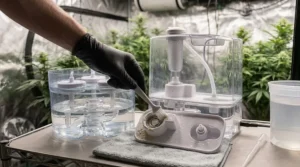
Safety and Environmental Considerations
Running any ultrasonic device inside a sealed tent means paying attention to more than just plant health. The EPA’s guidance on portable humidifiers notes that ultrasonic and impeller-style units can disperse minerals and microorganisms into the air if the tank isn’t cleaned regularly, which is exactly why every product review above flagged cleaning cadence as a real factor, not an afterthought. Keeping tent humidity within a sensible band — generally not letting it sit above 60-65% for extended stretches during flowering — reduces mold and mildew risk substantially, echoing the same VPD-based reasoning that MSU Extension researchers apply to greenhouse crop management.
Electrical safety matters too: since foggers sit inside a humid, enclosed tent, make sure cords and power strips are routed away from standing water and that the unit itself carries a legitimate safety certification. A tripped GFCI outlet is a minor inconvenience; water intrusion into an uncertified power strip inside a tent is not.
Frequently Asked Questions
❓ How often should I clean a fogger for grow tent use?
❓ Can a fogger replace a traditional humidifier in a grow tent?
❓ What humidity level should I target in a grow tent?
❓ Do foggers work better than misting systems for even coverage?
❓ Is tap water safe to use in a grow tent fogger?
Conclusion
Picking the right fogger for grow tent conditions really comes down to matching the unit’s tank size and control style to your actual tent footprint and how much manual monitoring you’re willing to do. If you want the closest thing to hands-off precision, the AC Infinity CLOUDFORGE T3‘s VPD-based control earns its higher price. Growers managing bigger tents or frequent travel should lean toward the VIVOSUN AeroStream H09‘s tank capacity and app visibility, while anyone starting small can get real value from the LRAZU 6L, Inkbird, or REPTI ZOO without overspending on features a 2×2 tent won’t use.
Whichever you choose, the real long-term win isn’t the unit itself — it’s building the habit of regular cleaning, using low-mineral water, and checking your hygrometer even on the smart, probe-equipped models. A fogger is a tool that makes consistent humidity achievable; it still needs you paying a little attention to actually deliver it.
Recommended for You
- Cool Mist Humidifier Grow Tent: 7 Best Picks for 2026
- Electric Dehumidifier Tent: 7 Top Picks to Stop Mold in 2026
- Small dehumidifier grow tent: 7 Real Picks to Stop Mold in 2026
Disclaimer: This article contains affiliate links. As an Amazon Associate, I earn from qualifying purchases. If you purchase products through these links, we may earn a small commission at no additional cost to you.
✨ Found this helpful? Share it with your friends! 💬🤗
