
In This Article
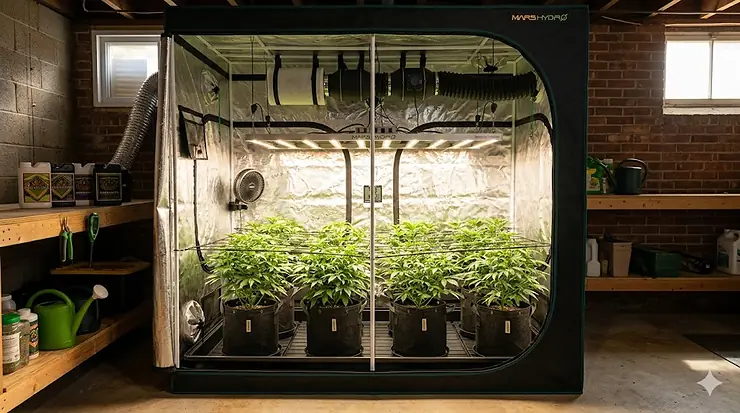
Setting up an indoor garden shouldn’t feel like solving a puzzle with missing pieces scattered across three different stores. Yet that’s exactly what happens when you buy components separately—incompatible fans, undersized lights, or ventilation systems that whistle like a tea kettle at 3 AM. A complete 4×4 grow tent bundle eliminates that headache by packaging everything you need in one box.
The 4×4 footprint has become the sweet spot for home growers—large enough to cultivate 4 to 9 full-sized plants through their entire lifecycle, yet compact enough to tuck into a spare bedroom, basement corner, or even a walk-in closet. According to indoor gardening experts, these controlled environments extend growing seasons by 2-3 weeks on each end while protecting plants from pests and temperature fluctuations that plague outdoor gardens.
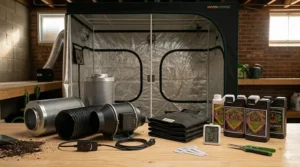
What makes a 4×4 grow tent package truly complete? You’re looking at seven core components working in harmony: a 48″x48″x80″ reflective tent, full-spectrum LED lighting matched to the footprint, inline ventilation fan (typically 6-inch), carbon filter for odor control, ducting, circulation fans, and smart controllers that automate the climate. The bundles I’ve tested range from beginner-friendly plug-and-play systems around the $400 mark to AI-driven setups in the $1,300-plus range that predict environmental shifts before they happen.
In this guide, I’ll walk you through seven complete cultivation package options currently available, breaking down what you actually get for your money versus what the marketing copy promises. Whether you’re propagating rare houseplants, starting an herb garden, or cultivating specialty crops, the right everything-included system can mean the difference between a thriving harvest and an expensive learning experience.
Quick Comparison: Top 7 Complete 4×4 Grow Tent Systems
| Bundle System | LED Wattage | Smart Controls | Ventilation | Price Range | Best For |
|---|---|---|---|---|---|
| VIVOSUN GIY VS1000 | 100W | Basic timer | 440 CFM | $350-$450 | Budget beginners |
| Spider Farmer SF4000 EVO | 450W | GGS app control | 402 CFM | $650-$750 | Serious hobbyists |
| MARS HYDRO TSW2000 | 300W | 10-speed fan | 402 CFM | $550-$650 | Value seekers |
| Supergrower Complete | 200W | Humidifier included | 4″ inline | $450-$550 | Winter growers |
| AC Infinity Advance | 400W | WiFi Controller 69 PRO | 6″ EC motor | $850-$950 | Tech enthusiasts |
| AC Infinity AI PRO | 400W | AI predictive | 6″ EC motor | $1,300-$1,400 | Premium automation |
| Spider Farmer G5000 | 480W | GGS AC10 power strip | 402 CFM | $700-$800 | Mid-range power |
Looking at this comparison, the value proposition becomes clear once you factor in compatibility risk. The VIVOSUN system delivers the lowest entry point but pairs a 100W light with 16 square feet of space—that’s barely 6 watts per square foot, which means you’ll need to upgrade the light within your first grow cycle if you want anything beyond leafy greens. The Spider Farmer SF4000 EVO and AC Infinity Advance bundles hit the sweet spot of 450W and 400W respectively, delivering 28-25 watts per square foot that handles full-cycle growth from seedling to harvest without leaving performance on the table.
💬 Just one click — help others make better buying decisions too!😊
Top 7 4×4 Grow Tent Bundle Systems: Expert Analysis
1. VIVOSUN GIY 4×4 Grow Tent Kit Complete
The VIVOSUN GIY kit is the gateway drug to indoor growing—inexpensive enough that you won’t cry if you make rookie mistakes, yet complete enough to actually produce results. This starter to finish setup includes their 48″x48″x80″ tent with 1680D canvas, VS1000 LED grow light pulling 100W, a surprisingly robust 440 CFM 6-inch inline fan, carbon filter rated for 8 months, temperature/humidity monitor, five-gallon grow bags, and the basic accessories like rope hangers and pruning shears.
Here’s what VIVOSUN doesn’t advertise: that 100W light covers vegetative growth adequately but struggles during flowering. You’re looking at roughly 6.25 watts per square foot—fine for lettuce and herbs, marginal for anything that flowers heavily. The Samsung LM301 diodes they use are legitimate (not the knockoff LM301B variants), with a rated efficiency of 2.75 μmol/J, which translates to about 275 μmol/s total output. For context, optimal flowering typically demands 600-900 μmol/s in a 4×4 space.
Customer feedback consistently praises the tent quality—double-stitched seams actually prevent light leaks, unlike budget tents where zipper flaps don’t quite meet canvas. The 440 CFM fan moves enough air to exchange your tent volume every minute, and it runs quieter than expected at 28 dB. What users complain about is the controller interface, which lacks the scheduling flexibility of competitors.
Pros:
✅ Lowest barrier to entry for complete 4×4 systems
✅ Genuinely quiet ventilation despite budget positioning
✅ Tent construction exceeds price point expectations
Cons:
❌ Underpowered lighting limits crop selection
❌ Basic timer requires manual daily adjustments
This bundle sits in the around $400 range and makes sense for two specific buyer profiles: absolute beginners who want to learn the fundamentals before investing heavily, or growers focused exclusively on leafy greens and herbs where the light limitation doesn’t matter.
2. Spider Farmer 4×4 Grow Tent Kit Complete (SF4000 EVO)
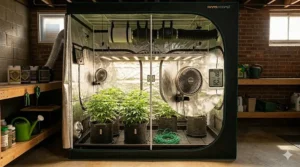
Spider Farmer built their reputation on LED technology, and the SF4000 equipped with Samsung LM301H EVO diodes represents the current pinnacle of that expertise. This all in one 4×4 tent delivers 450W of full-spectrum lighting with a remarkable 3.14 μmol/J efficiency—that’s approximately 1,413 μmol/s total output, putting you solidly in the professional cultivation range. The efficiency gain over standard LM301H chips means you’re pulling 30% more photons per watt, which translates to cooler operation and lower electricity costs over the 50,000-hour lifespan.
The complete package includes their 1680D tent with enlarged observation window (11.8″x15.7″), 6-inch inline fan with 10-speed controller, RC412 Australian virgin activated charcoal filter, 6-inch oscillating clip fan, six 5-gallon fabric pots, digital timer, humidity/temperature monitor, rope hangers, trellis netting, and pruning shears. What separates this from competitors is the GGS controller integration—an RJ12 port system that connects all devices through the Spider Farmer app for unified climate management.
Real-world performance reports from the growing community consistently highlight the SF4000’s coverage uniformity. Unlike cheaper quantum boards that create hot spots in the center, the 1,088 evenly-spaced diodes deliver ±5% PPFD variance across the entire 4×4 footprint. Growers report the inline fan maintains 32 dB operation even at full speed, and the carbon filter legitimately eliminates odors through three months of flowering without requiring the pre-filter change.
Pros:
✅ Industry-leading light efficiency reduces operating costs
✅ App control automates sunrise/sunset simulation and VPD targeting
✅ Five-year warranty with US-based service center
Cons:
❌ Initial investment 60% higher than entry-level bundles
❌ GGS system requires WiFi connection for advanced features
The Spider Farmer SF4000 bundle typically falls in the $650-$750 range. This kit targets serious hobbyists who’ve graduated from their first grow and want equipment that won’t bottleneck their skills. If you’re planning more than two grow cycles, the efficiency savings pay back the premium within 18 months.
3. MARS HYDRO 4×4 Grow Tent Kit Complete (TSW2000)
MARS HYDRO positions the TSW2000 system as the Goldilocks option—not the cheapest, not the most expensive, just right for growers who want proven performance without paying for cutting-edge tech. The TSW2000 LED pushes 300W through 654 high-efficiency diodes achieving 2.75 μmol/J, generating roughly 825 μmol/s. That’s 18.75 watts per square foot, which handles full-cycle growing for most crops though it leaves less headroom than the 450W competitors for light-hungry varieties.
The kit bundles MARS HYDRO’s 1680D diamond mylar tent (claiming 25% higher PPFD than standard 600D tents), 6-inch 402 CFM inline fan with 10-speed dimmer, carbon filter using 1050+ RC 48 Australian virgin charcoal, 25-foot ducting, 10-speed clip fan with 80° horizontal and 100° vertical oscillation, thermometer/hygrometer, grow bags, trellis netting, and their signature corner shelves that other brands skip. The metal frame uses 0.8mm thickness poles rated for 110-pound capacity.
Customer experience centers on reliability rather than innovation. The TSW2000 has been in production since 2019 with minimal design changes because it works—failure rates hover around 1.5% versus the 3-4% industry average for budget LEDs. The 10-speed clip fan is a legitimate differentiator; most competitors include 2-3 speed fans that either blow too hard for seedlings or too soft for late flowering. MARS HYDRO’s customer service gets consistent praise for actually answering emails, though their three-year warranty falls short of Spider Farmer’s five-year coverage.
Pros:
✅ Proven track record with years of field data
✅ 10-speed clip fan adapts to all growth stages
✅ Corner shelves add functional storage competitors lack
Cons:
❌ 300W leaves minimal upgrade headroom
❌ Manual speed controllers feel dated in 2026
This 4×4 grow tent package sits in the $550-$650 range, making it the value pick for growers who prioritize dependability over specification sheets. If you’re cultivating proven varieties and don’t need bleeding-edge automation, the MARS HYDRO system delivers predictable results without the premium pricing.
4. Supergrower 4×4 Complete Enhanced System
The Supergrower bundle takes a different approach by addressing a problem most competitors ignore: seasonal climate challenges. While other kits assume you’re growing in temperature-controlled rooms, Supergrower includes a 5L digital humidifier and ceramic space heater alongside the standard tent, 200W LED, 4-inch ventilation system, and watering equipment. This makes it the only complete 4×4 grow kit that addresses winter cultivation in unheated spaces or summer growing in dry climates.
The 200W full-spectrum LED uses adjustable dimming from 30-100% across vegetative and bloom stages, delivering approximately 550 μmol/s at full power. The 4-inch inline fan and carbon filter represent a step down in capacity from the 6-inch systems—exchanging tent volume every 90 seconds rather than every 60 seconds, which works fine for standard crops but struggles with high-transpiration plants. The tent itself uses 1680D fabric with steel tube frame, though customer photos show occasional light leaks around bottom zippers after six months of use.
What sets Supergrower apart is the automatic drip irrigation system with time control—nine programmable modes cycling from 0.5-2 hour intervals with 5-20 minute duration settings. This everything-included system means you can leave for a long weekend without worrying about watering. The 6-inch oscillating clip fan comes with tent-specific mounting clips that actually grip tent poles securely, unlike universal clips that slide down over time.
Pros:
✅ Only bundle addressing humidity and temperature extremes
✅ Automated irrigation removes daily watering requirement
✅ Tent-specific clip fan mounts solve common frustration
Cons:
❌ 4-inch ventilation underpowered for high-humidity crops
❌ Light leaks emerge after moderate wear
The Supergrower kit falls in the $450-$550 range. It’s the winter grower’s bundle or the solution for basements that swing 15 degrees between day and night. If environmental stability is your challenge rather than light intensity, Supergrower addresses problems competitors pretend don’t exist.
5. AC Infinity Advance Grow System 4×4
AC Infinity entered the market in 2019 and immediately disrupted pricing by offering commercial-grade features at prosumer prices. Their Advance System bundles a 2000D mylar tent (thicker than industry-standard 1680D), 400W full-spectrum LED with Samsung LM301H diodes, 6-inch EC-motor inline fan, Controller 69 PRO, clip fan, carbon filter, and all accessories. The 2000D canvas delivers lab-tested 98% reflectivity versus 95% for standard mylar, which translates to 3-5% more light reaching your canopy without increasing power consumption.
The Controller 69 PRO is where AC Infinity justifies the premium. It monitors temperature, humidity, and VPD in real-time, then dynamically adjusts fan speeds and light intensity through individual device programming. The WiFi app connection lets you track historical data, set schedules, and receive alerts when parameters drift outside target ranges. Unlike cheaper automation that operates on simple on/off thresholds, the EC motor allows infinite speed variation from 0-100%, maintaining precise airflow without the rpm surging you get from single-speed fans.
The 400W LED generates approximately 1,100 μmol/s using algorithmically arranged LM301H diodes for even coverage. What users rave about is the next-gen clip fan with oscillation range control—you can program exactly how wide the fan swings rather than accepting a fixed 90-degree arc. This prevents direct blasting of seedlings in corner positions while maintaining airflow across the canopy. The carbon filter uses Australian virgin activated charcoal rated for 12-month odor control, double the lifespan of budget filters.
Pros:
✅ VPD-based automation optimizes transpiration automatically
✅ EC motors deliver precise control competitors can’t match
✅ 2000D tent canvas reduces light loss measurably
Cons:
❌ Premium pricing 90% higher than entry bundles
❌ Advanced features require learning curve
This starter to finish setup falls in the $850-$950 range. It targets tech-savvy growers who want to optimize every variable or cultivate difficult crops with narrow environmental tolerances. The automation pays off in yield consistency—you’ll harvest within 5% of your target every cycle rather than the 15-20% variance from manual management.
6. AC Infinity AI Grow System PRO 4×4
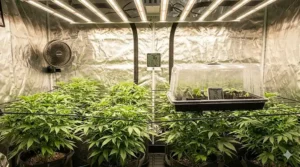
The AI Grow System PRO represents AC Infinity’s answer to the question: “What if your tent learned from your mistakes?” This complete cultivation package includes everything from the Advance System but replaces the Controller 69 PRO with their AI-driven controller that uses machine learning algorithms to predict climate shifts before they happen. The system analyzes real-time sensor data alongside historical patterns to auto-adjust connected devices, theoretically preventing problems rather than reacting to them.
The hardware remains premium—2000D mylar tent with lab-tested highest reflectivity, 400W bar-style LED using Samsung LM301H EVO diodes (the latest generation), 6-inch EC inline fan, oscillating clip fan, carbon filter, and all accessories. The tent features the largest zippered observation window in the category and a dedicated controller mount plate that keeps your control hub visible but out of the canopy. The LM301H EVO chips deliver the same 3.14 μmol/J efficiency as Spider Farmer’s top model, generating approximately 1,256 μmol/s.
What you’re paying for is the AI controller’s predictive capabilities. It doesn’t just maintain temperature; it learns that your tent typically heats 3 degrees when the afternoon sun hits your window, and preemptively increases exhaust fan speed 15 minutes before that happens. The WiFi app includes an AI chatbot that troubleshoots issues by analyzing your sensor data—legitimately useful for new growers who can’t diagnose why leaves are curling.
Pros:
✅ Predictive adjustments prevent problems before symptoms appear
✅ AI troubleshooting guides reduce learning curve
✅ LM301H EVO delivers top-tier efficiency
Cons:
❌ $1,300+ investment requires 4+ grows to justify
❌ AI features require stable internet connection
The AI PRO bundle sits in the $1,300-$1,400 range. This is the professional’s choice or the serious hobbyist who’s already on their fifth grow and frustrated by environmental inconsistencies. If you’re running multiple consecutive crops or cultivating genetics with documented climate sensitivity, the AI system’s intervention prevents the yield losses that justify the premium.
7. Spider Farmer G5000 Complete System with GGS AC10
The G5000 system represents Spider Farmer’s power play—taking everything that worked with the SF4000 and amplifying it by 30W to 480W total output. The 1,680 high-efficiency diodes generate approximately 1,344 μmol/s at 2.8 μmol/J efficiency, falling slightly behind the EVO series but still delivering professional-grade intensity. What sets this bundle apart is the inclusion of the GGS AC10 power strip—a 10-outlet smart controller with integrated temperature/humidity sensor that lets you control not just tent equipment but supplementary devices like dehumidifiers, heaters, and water pumps.
The package includes Spider Farmer’s 1680D tent with hook mounts for controllers, enlarged viewing window, 6-inch 402 CFM inline fan with variable speed, RC412 carbon filter, ducting, oscillating clip fan, fabric pots, trellis netting, and accessories. The tent construction matches their other offerings, but the GGS AC10 power strip transforms the bundle into a full grow room management system. Each outlet can be programmed independently or linked to sensor triggers—for example, automatically activating a dehumidifier when humidity exceeds 65% or cycling a water pump on 15-minute intervals.
Customer feedback emphasizes the GGS AC10’s flexibility for expansion. You’re not locked into Spider Farmer’s ecosystem; the power strip controls any equipment regardless of brand, which matters when you want to add CO2 supplementation or automated nutrient dosing down the line. The Spider Farmer app provides scheduling, VPD targeting, and historical data logging that rivals AC Infinity’s offerings at a lower price point. The 480W light generates noticeably more heat than 400-450W competitors, requiring more aggressive ventilation in warm climates.
Pros:
✅ 10-outlet smart controller enables whole-room automation
✅ Brand-agnostic equipment control preserves upgrade flexibility
✅ 480W handles light-demanding crops without compromise
Cons:
❌ Higher wattage increases heat load and electricity costs
❌ Advanced automation requires GGS ecosystem investment
This all in one 4×4 tent falls in the $700-$800 range. It’s the middle ground between the SF4000 EVO’s focused design and the AC Infinity AI’s premium automation—more power than basic bundles, more flexibility than specialized systems. If you’re planning equipment expansion beyond standard tent components or cultivating crops with documented high light requirements, the G5000’s 30% power advantage over entry bundles directly translates to yield increases.
How to Set Up Your 4×4 Grow Tent Bundle: First-Month Success Guide
Most bundle failures happen in the first 30 days, and they’re almost always environmental rather than equipment defects. Here’s what actually matters during setup:
Week 1: Physical Setup Start by choosing your location based on electrical capacity rather than convenience. A complete 4×4 system pulls 500-700W continuously between lights, fans, and controllers—that’s 5-6 amps on a 15-amp circuit. Add a humidifier or heater and you’re at circuit capacity. Place your tent near a dedicated circuit or plan to run your lights during off-peak hours when other room loads are minimal.
Assemble the tent frame in final position because loaded 4×4 tents weigh 80-100 pounds and aren’t relocatable without complete teardown. Most frames use tool-free corner connectors, but the trick is getting the top bars perfectly level before adding canvas. If corners don’t align flush, zippers will bind and eventually tear the canvas.
Hang the LED light first using the included rope ratchets or metal hangers, positioning it 24-30 inches above where your plant canopy will eventually sit. Most lights ship with hanging hardware rated for the light’s weight, but tent crossbars have weight limits—verify your tent’s capacity before hanging lights plus filters plus fans from the same bar.
Week 2-3: Environmental Dialing Run your tent empty (no plants) for 72 hours while monitoring temperature and humidity swings. Your target is 75-82°F with 50-60% relative humidity during lights-on, dropping 5-7 degrees when lights go off. If you can’t hold those ranges empty, you definitely can’t hold them with transpiring plants adding moisture and heat.
Most bundles ship with basic thermometer/hygrometer combos that report ±3°F and ±5% RH accuracy—fine for ballpark readings but inadequate for VPD targeting. If your bundle includes smart controllers, use the included sensors; otherwise invest in a $20 inkbird or similar device with ±0.5°F accuracy. Place sensors at canopy height rather than tent walls where readings skew 5-10 degrees from what plants actually experience.
Week 4: First Planting Start with 50% of your light’s capacity rather than full power. New plants need 200-400 μmol/s during establishment, not the 800-1000+ your bundle can deliver. Most LED-related plant stress comes from new growers running lights at 100% from day one because “more light equals more growth.” That’s only true once root systems can support increased photosynthesis.
Position plants strategically based on bundle weaknesses. If your system uses a lower-wattage light (200W or less), keep plants in the center where PPFD is highest. If you’ve got 400W+, spread plants to corners where coverage is uniform. Most growers instinctively cluster plants in the center regardless of light distribution, creating unnecessary competition.
Common Mistakes When Buying 4×4 Grow Tent Package Systems
The most expensive mistake isn’t buying the wrong bundle—it’s buying based on tent features while ignoring the light specifications. I’ve seen growers agonize over 1680D versus 2000D canvas thickness (a 2-3% reflectivity difference) while accepting inadequate lighting that costs them 30-40% of potential yield. Tents are easy to upgrade; replacing an underpowered light costs as much as buying a better bundle from the start.
The second costliest error is underestimating ventilation requirements. Marketing photos show grow tents in pristine rooms with ambient 72°F temperatures. Your basement or spare bedroom probably swings 15 degrees between seasons, and your plants will transpire 1-2 liters of water daily when mature. Budget bundles with 4-inch fans (250 CFM) exchange tent volume once every 1.5 minutes; professional setups use 6-inch fans (400+ CFM) exchanging volume every 45 seconds. That 45-second difference determines whether you’re fighting mold or maintaining optimal VPD.
Third: assuming “complete” means actually complete. Every bundle I’ve reviewed requires supplemental purchases most beginners don’t anticipate. You’ll need pH testing equipment for water (strips or digital meter), nutrients appropriate for your growing medium (soil, coco, hydro), and often a small oscillating fan in addition to the clip fan to prevent stagnant air pockets. Budget an extra $75-$150 for these essentials that no manufacturer includes.
Fourth: ignoring light intensity in favor of wattage. A 200W quantum board using efficient diodes delivers more usable light than a 300W blurple LED using older technology. Manufacturers know beginners equate watts with power, so budget bundles advertise “300W LED!” while using 100 actual watts with a theoretical 300W replacement claim. Check the actual power draw and diode efficiency (measured in μmol/J) rather than the equivalent wattage marketing.
Fifth: buying the cheapest bundle then immediately upgrading the light. This seems economical until you realize you’ve spent $400 on a basic system plus $300 on a proper light, totaling $700—the cost of a mid-range bundle that included better lighting from the start while maintaining component compatibility.
4×4 Grow Tent Bundle vs Building Your Own: Cost Analysis
Let’s math this out with real 2026 pricing. Building a comparable 4×4 system from individual components looks like this:
- 4×4 tent (1680D): $80-$120
- 400W LED with Samsung diodes: $280-$350
- 6″ inline fan (400+ CFM): $85-$120
- Carbon filter: $60-$80
- Ducting, clamps, hangers: $40-$60
- Clip fan: $30-$50
- Timer/controller: $25-$80
- Accessories (bags, thermometer, etc.): $40-$70
Total DIY cost: $640-$930 depending on component quality. Now compare that to complete bundles ranging from $400-$950, and the value proposition seems unclear until you factor in the hidden costs.
DIY growers spend 6-12 hours researching compatibility, ordering from multiple vendors (tripling shipping costs), and troubleshooting why the fan connector doesn’t fit the filter thread. That time has value—even at minimum wage, you’re adding $75-$150 in opportunity cost. Then there’s the risk: mismatched components void warranties, and vendors blame each other when things fail. Bundles ship from single sources with matched specifications and single points of warranty support.
Where DIY makes sense: growers with specific requirements bundles don’t address. If you need UV supplementation for essential oil production, no bundle includes those specialty bulbs. If your space requires 8-foot height instead of standard 6.5 feet, you’re building custom. If you’re running multiple tents and can buy components in bulk, per-unit costs drop below bundle pricing.
Where bundles win: first-time growers, anyone working standard footprints, situations where time matters more than cost optimization. The Spider Farmer SF4000 bundle at around $700 delivers components you’d struggle to source individually for less than $800 while guaranteeing everything works together from day one. The AC Infinity Advance at around $900 would cost $1,100+ replicating the same automation and sensor integration DIY.
The breakeven point sits around the third grow tent. If you’re setting up a single 4×4 tent, bundles win on value and risk mitigation. If you’re building out a four-tent operation, buying quality components in bulk drops per-tent cost below bundle pricing while letting you mix configurations—perhaps higher-wattage lights in flowering tents, lower-wattage in veg tents.
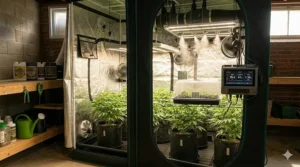
Understanding LED Technology in Complete 4×4 Grow Tent Systems
The LED light bundled with your tent determines your ceiling for plant health and yield more than any other component, yet it’s the most misunderstood specification in marketing materials. Let’s decode what actually matters.
Diode Type and Efficiency Samsung LM301 diodes dominate quality grow lights because they convert electricity to light at 2.7-3.1 μmol/J efficiency—significantly better than older Epistar or generic diodes at 1.8-2.2 μmol/J. The newer LM301H EVO chips push 3.14 μmol/J, meaning you get 30% more light from the same power consumption. This efficiency advantage reduces heat generation (less cooling required) and electricity costs (lower per-photon expense) while increasing component lifespan.
Budget bundles using generic diodes aren’t necessarily bad—they produce adequate light for most crops—but they’re running hotter and dying sooner while costing more to operate. Calculate total cost of ownership: a 400W Samsung-based light drawing 400W generates roughly 1,080 μmol/s over 50,000 hours while consuming 20,000 kWh at $0.12/kWh = $2,400 lifetime electricity cost. A 500W generic-diode light generating the same 1,080 μmol/s consumes 25,000 kWh = $3,000 lifetime electricity cost. That $600 difference erases any initial savings from the cheaper bundle.
PPFD and DLI Photosynthetic Photon Flux Density (PPFD) measures light intensity in μmol/m²/s. Your 4×4 tent is 1.44 square meters, so a light generating 1,440 μmol/s delivers 1,000 μmol/m²/s average PPFD. Different crops require different minimums: leafy greens thrive at 200-400 PPFD, herbs and vegetables want 400-600 PPFD, flowering crops demand 600-900 PPFD.
Daily Light Integral (DLI) measures cumulative light over 24 hours. A plant receiving 500 PPFD for 12 hours gets 21.6 DLI (500 × 12 × 0.0036). Cannabis and tomatoes target 40-50 DLI during flowering, which requires 926-1,157 PPFD over 12-hour photoperiods. This is why 100-200W “starter” lights can’t handle full-cycle growing—they literally can’t deliver enough photons.
Spectrum Considerations Full-spectrum LEDs approximate sunlight across 400-700nm wavelengths. Quality bundles specify their spectrum distribution: increased blue (400-500nm) for vegetative growth, boosted red (600-700nm) for flowering. Budget lights labeled “full spectrum” often lack deep red (660nm) and far-red (730nm) wavelengths that trigger flowering responses. This isn’t critical for beginners growing lettuce but becomes the bottleneck for experienced growers pushing yield limits.
Most bundles use “white” full-spectrum LEDs that look natural and let you monitor plant health visually. Older blurple (blue-purple) lights optimize spectrum for plant absorption but make visual inspection difficult—you can’t see pest damage or nutrient deficiency through purple light. Unless you’re chasing the absolute maximum theoretical efficiency and don’t mind annoying aesthetics, white full-spectrum is the practical choice.
Smart Controllers and Automation: Which Bundle Features Actually Matter
The explosion of app-controlled grow equipment sounds revolutionary until you realize most features solve problems beginners don’t have while ignoring issues they do. Let’s separate utility from marketing.
Basic Timer Control Every bundle includes some form of timer for light scheduling. Entry-level systems use analog or digital timers with 15-minute increments—perfectly adequate for maintaining photoperiods. Smart controllers let you program sunrise/sunset gradients where lights ramp from 0-100% over 30-60 minutes rather than switching instantly. Plants don’t care about gradual transitions (photosynthesis responds to intensity, not transition speed), but it reduces eye strain for growers checking plants during wake cycles.
Temperature and Humidity Monitoring Mid-range bundles include digital thermometer/hygrometer combos that log data and alert when parameters drift. This matters during equipment failures—if your fan stops running and temperature spikes to 95°F overnight, logged data shows exactly when failure occurred and how long plants were stressed. Budget bundles with basic displays force you to guess whether leaf damage happened 2 hours ago or 2 days ago.
VPD-Based Control Vapor Pressure Deficit represents the difference between moisture in plant leaves and surrounding air—the driving force behind transpiration. Maintaining optimal VPD (0.8-1.2 kPa for most crops) maximizes nutrient uptake and growth rates. Smart controllers calculate VPD from temperature and humidity, then adjust fans and environmental equipment to maintain targets automatically.
This feature separates premium bundles from mid-range offerings, but it’s overkill for beginners. Until you’re consistently hitting yield targets and looking to optimize that final 10-15%, manual temperature/humidity management produces virtually identical results for 99% of crops. VPD targeting becomes critical for finicky genetics with narrow environmental tolerances or commercial operations where 5% yield improvements across hundreds of plants justify the technology investment.
Historical Data and Alerts WiFi-connected controllers let you review climate data graphs showing temperature/humidity swings over days or weeks. This helps diagnose problems retrospectively—if plants showed stress Wednesday, data graphs might reveal humidity dropped to 25% that night when you didn’t think to check.
Remote alerts notify your phone when tent conditions fall outside parameters. Legitimately useful for preventing disasters: if your inline fan fails while you’re at work, an immediate alert means you can call someone to open tent doors before heat kills everything. Without alerts, you discover dead plants when you get home 8 hours later.
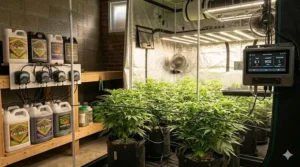
FAQ: 4×4 Grow Tent Bundle Questions Answered
❓ Can a 4x4 grow tent bundle fit in a standard closet?
❓ How much electricity does a complete 4x4 grow tent system use monthly?
❓ What's the lifespan of LED lights included in 4x4 grow tent package systems?
❓ Do starter to finish setup bundles include nutrients and growing medium?
❓ Can you run two 4x4 grow tent bundle systems on one 15-amp circuit?
Recommended Setup Configurations by Experience Level
Beginner Bundle (First Grow) Start with the VIVOSUN GIY or MARS HYDRO TSW2000 systems in the $400-$600 range. These provide all essential components without overwhelming new growers with advanced features they won’t use. Focus your attention on learning watering schedules and recognizing plant health rather than optimizing VPD and historical data analysis. The underpowered lighting limits your absolute yield potential but prevents the costly mistakes that plague beginners who spend $1,000+ before understanding fundamentals.
Intermediate Upgrade (Grows 2-5) Graduate to Spider Farmer SF4000 EVO or AC Infinity Advance systems around $700-$900. By this point you’ve mastered basics and encountered limitations in your starter system—probably inadequate lighting or frustration with manual climate control. These bundles deliver professional-grade components and automation that scale with your improving skills. The efficiency improvements pay back initial investment through lower electricity costs and higher yields across multiple grow cycles.
Advanced System (Grows 6+) Consider AC Infinity AI Grow System PRO or Spider Farmer G5000 with GGS AC10 in the $700-$1,400 range when you’re consistently hitting yield targets and looking to optimize that final 10-15%. At this experience level, you’ve developed preferences around lighting intensity, environmental control, and automation depth that justify premium features. The predictive AI or expanded smart controller capabilities address the nuanced problems—micro-climate fluctuations, strain-specific VPD targeting—that only experienced growers encounter.
Conclusion: Choosing Your Ideal 4×4 Grow Tent Bundle
The perfect everything-included system doesn’t exist because “perfect” depends entirely on your situation—experience level, crops grown, environmental challenges, and budget constraints all push you toward different bundles. But some patterns emerge from analyzing seven current options and years of community feedback.
For absolute beginners on tight budgets, the VIVOSUN GIY system around $400 provides the complete experience without risking serious money on a hobby you might abandon. Yes, you’ll outgrow the 100W light if you continue growing, but that’s a $250 upgrade problem rather than a $700 buyer’s remorse disaster.
Serious hobbyists planning multiple grow cycles should skip entry bundles entirely and invest in Spider Farmer SF4000 EVO or MARS HYDRO TSW2000 systems in the $550-$750 range. The efficiency improvements from quality Samsung diodes pay back premium pricing within 18 months through lower electricity costs, and the included automation reduces the daily management that causes beginners to quit.
Tech enthusiasts and experienced growers pushing yield boundaries justify AC Infinity Advance or AI PRO bundles in the $850-$1,400 range. These systems solve problems you don’t have during your first three grows, but become critical bottlenecks once you’re consistently harvesting and identifying those final efficiency gains.
The 4×4 grow tent package category has matured significantly—even budget bundles now include components that passed for professional equipment five years ago. Your selection ultimately determines where your learning curve bottlenecks: inadequate lighting forces equipment upgrades, while excessive features without foundational knowledge wastes money on automation you can’t utilize. Match your bundle to your current skill level with room for one step of growth, and you’ll maximize value while minimizing frustration.
Recommended for You
- 7 Best Gorilla Grow Tent 4×4 Reviews – Top Picks 2026
- 7 Best AC Infinity 4×4 CloudLab Tents: 2026
- 7 Best VIVOSUN 4×4 Grow Tents Reviewed – Complete 2026
Disclaimer: This article contains affiliate links. As an Amazon Associate, I earn from qualifying purchases. If you purchase products through these links, we may earn a small commission at no additional cost to you.
✨ Found this helpful? Share it with your friends! 💬🤗
