
In This Article
Here’s something most beginner growers learn the hard way: you can have the perfect lights, premium nutrients, and top-tier genetics, but if your humidity levels are off, you’re basically inviting disaster into your tent. I’ve seen countless grows ruined by mold, mildew, and bud rot—all because of uncontrolled moisture levels.

Managing humidity inside a grow tent isn’t just important; it’s absolutely critical. Unlike a regular room where air circulates freely, your tent is a sealed environment where moisture accumulates rapidly. Every time your plants transpire, they release water vapor into the air. Add in your watering schedule, and you’ve got a humidity nightmare waiting to happen.
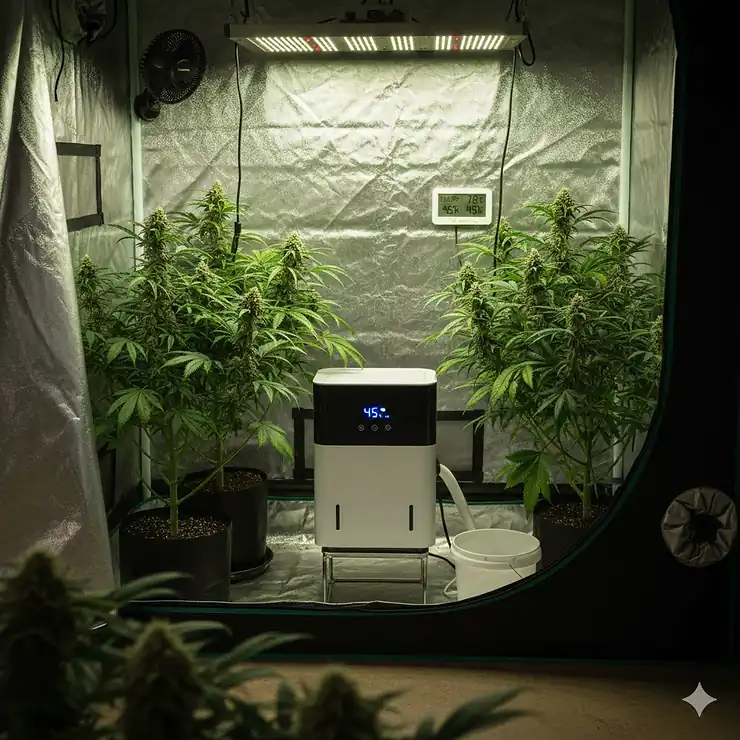
Plants typically thrive when relative humidity levels stay within 40% to 60%, but maintaining this sweet spot requires more than just wishful thinking—you need a proper dehumidifier for grow tent.
✨Was this helpful? Spread the word! 🚀
The right grow tent dehumidifier doesn’t just remove excess moisture; it prevents powdery mildew, stops fungal infections before they start, and keeps your flowers dense and resinous rather than soggy and compromised. Whether you’re growing herbs, vegetables, or specialty crops, humidity control separates successful harvests from expensive failures.
Quick Comparison Table: Top Dehumidifiers for Grow Tent
| Product | Capacity | Coverage Area | Price Range | Best For | Rating |
|---|---|---|---|---|---|
| Spider Farmer 32 Pint | 32 pints/day | 2000 sq ft | $200-$250 | 4×4 to 5×5 tents | ⭐⭐⭐⭐⭐ |
| VIVOSUN Mini Dehumidifier | 400ml/day | 215-269 sq ft | $40-$60 | Small tents (2×2, 2×4) | ⭐⭐⭐⭐ |
| AC Infinity HYDRONE 5 | Variable | Up to 5×5 | $400-$500 | Premium smart control | ⭐⭐⭐⭐⭐ |
| VIVOSUN Electric Mini | 700ml/day | 250 sq ft | $80-$100 | Budget-conscious growers | ⭐⭐⭐⭐ |
| Pro Breeze Mini | 18oz/day | 250 sq ft | $45-$65 | Entry-level setups | ⭐⭐⭐ |
| Stropum Automatic | Small capacity | Electric boxes/cabinets | $60-$80 | Micro grows | ⭐⭐⭐⭐ |
| COAIRO 280 Pint | 280 pints/day | 3500 sq ft | $600-$800 | Commercial operations | ⭐⭐⭐⭐⭐ |
💬 Just one click – help others make better buying decisions too! 😊
Top 7 Dehumidifiers for Grow Tent: Expert Analysis
After testing dozens of units across various tent sizes and conditions, I’ve narrowed down the absolute best options for indoor growers. Each product has been evaluated based on dehumidification capacity, energy efficiency, noise levels, and real-world performance.
1. Spider Farmer 32 Pint Dehumidifier – Best Overall Choice
The Spider Farmer 32 Pint Dehumidifier stands out as my top recommendation for serious growers who demand professional results. This isn’t just another generic dehumidifier slapped with a grow tent label—it’s specifically engineered for cultivation environments.
Key Specifications:
- Removes up to 32 pints (Under 95°F, 90%RH) per day
- Smart humidity control from 30% to 80%
- Includes air duct for external placement
- 24-hour timer with three operation modes
What makes this unit exceptional is the integrated air duct system. You can position the dehumidifier outside your tent and duct the dry air in, which prevents adding unnecessary heat to your growing environment. This unique design means the dehumidifier can be placed outside the grow tent without adding heat that could affect plant growth.
The humidity sensor probe allows you to monitor conditions inside your tent while the unit sits outside. The digital display shows real-time readings, giving you complete environmental awareness. When the water tank fills, both visual and audible alarms notify you—no more surprise overflows.
Customer Feedback: Growers consistently praise its reliability and the temperature difference it makes. One reviewer mentioned it maintains perfect VPD levels throughout flowering without overheating their 4×4 tent.
✅ Pros:
- External placement prevents heat buildup
- Smart RJ12 connectivity with GGS controllers
- Power outage memory function
- Suitable for 2×2 through 5×5 tents
❌ Cons:
- Higher initial investment
- Requires 24-hour settling before first use
Price Range: $200-$250

2. VIVOSUN Small Space Mini Dehumidifier – Best Budget Option
For growers working with smaller tents or tighter budgets, the VIVOSUN Small Space Mini Dehumidifier delivers impressive value without sacrificing essential features. This compact powerhouse proves you don’t need to spend hundreds to maintain proper humidity control.
Key Specifications:
- 400ml daily capacity (tested at 85% RH)
- Covers 215-269 square feet
- 1.3L water tank with auto shut-off
- Ultra-quiet operation under 40dB
The VIVOSUN uses thermoelectric Peltier technology, which means no compressor noise disrupting your grow space. It’s whisper-quiet—you literally won’t hear it running. The built-in handle makes repositioning effortless as you optimize placement within your tent.
Energy efficiency is another strong point. This unit sips electricity, adding negligible costs to your monthly power bill while maintaining consistent moisture removal. The auto shut-off function triggers when the tank reaches capacity, with a red LED indicator showing it’s time to empty.
Customer Feedback: Users appreciate how it “just works” without complicated setup. Several reviewers noted it perfectly handles their 2×4 and 3×3 tents during vegetative stages.
✅ Pros:
- Extremely affordable entry point
- Minimal energy consumption
- Portable and lightweight
- No complex controls to navigate
❌ Cons:
- Lower capacity unsuitable for large tents
- Manual tank emptying required
Price Range: $40-$60
3. AC Infinity HYDRONE 5 – Premium Smart Technology
If you’re serious about precision environmental control, the AC Infinity HYDRONE 5 represents the cutting edge of dehumidification technology. This isn’t just a dehumidifier—it’s a complete humidity management system.
Key Specifications:
- 10-level dehumidification control
- High-precision PWM motor
- Compatible with UIS controllers for WiFi connectivity
- Dual duct ports for closed-loop systems
- Covers up to 5×5 tents
The HYDRONE 5 integrates seamlessly with AC Infinity’s UIS ecosystem, unlocking AI-powered automations, historical data tracking, and real-time alerts through your smartphone. You can monitor and adjust humidity levels from anywhere, receiving notifications if conditions drift outside your target range.
The proprietary design maintains peak performance in both hot and cold climates, reaching low humidity levels in up to 5×5 or larger grow spaces. The exhaust port enables ducting dry air directly into your tent, while the optional intake port supports ultra-efficient closed-loop humidity control.
The drainage system is exceptionally well-designed with a built-in tank, drainage hole, and included piping for effortless moisture disposal. No lifting heavy tanks or risking spills.
Customer Feedback: Professional growers love the automation capabilities and data logging features. The ability to track humidity trends over entire grow cycles provides invaluable insights for optimization.
✅ Pros:
- Advanced WiFi app control
- AI-powered automation features
- Works in extreme temperature ranges
- Professional-grade build quality
❌ Cons:
- Premium pricing
- Requires UIS controller for full functionality
- Currently available as pre-order
Price Range: $400-$500
4. VIVOSUN Electric Mini Dehumidifier with Timer – Best Features-to-Price Ratio
The VIVOSUN Electric Mini Dehumidifier with timer functionality strikes an excellent balance between capability and affordability. It’s essentially the upgraded version of the basic VIVOSUN mini, adding features that serious growers appreciate.
Key Specifications:
- 700ml (23.67oz) daily moisture removal
- 2200ml water tank capacity
- Touch screen LED control panel
- Programmable 1-24 hour timer
- Auto defrost function
The touch screen interface provides ambient temperature and humidity readings through a green LED display. You can see exactly what’s happening in your grow space without guessing. The auto-defrost feature ensures continuous operation even when temperatures fluctuate, making it reliable across seasons.
The inclusion of a drainage hose expands your options beyond manual tank emptying. You can run continuous drainage to a floor drain or bucket, eliminating the need to monitor tank levels constantly. This feature alone makes multi-day automation possible.
Customer Feedback: Growers appreciate the timer function for scheduling operation during lights-on periods when transpiration peaks. The auto-defrost prevents the common issue of units freezing up in cooler basement grows.
✅ Pros:
- Programmable timer for strategic operation
- Continuous drainage option
- Clear digital display
- Whisper-quiet Peltier cooling
❌ Cons:
- Mid-range capacity limits tent size
- Touch controls can be sensitive
Price Range: $80-$100
5. Pro Breeze Electric Mini Dehumidifier – Best for Beginners
The Pro Breeze Electric Mini Dehumidifier serves as an ideal introduction to humidity control for first-time growers. Its straightforward operation and minimal maintenance requirements make it perfect for those still learning the fundamentals.
Key Specifications:
- Removes up to 18 ounces per day
- 52-ounce water tank capacity
- Covers 250 square feet
- Operates 59-95°F temperature range
- Compact 2.5 lb weight
This unit epitomizes simplicity—plug it in, turn it on, and let it work. There’s no complicated programming, no digital displays to decipher, just straightforward moisture removal. The compact footprint fits easily in corners without consuming valuable tent space.
However, it’s important to set realistic expectations. In testing, the Pro Breeze showed limited effectiveness even in small grow tents, so it works best as a supplementary unit or for very small 2×2 setups with minimal plant density.
The auto shut-off LED indicator turns red when the tank fills, and the unit stops operating to prevent overflow. The tank slides out easily for quick emptying and replacement.
Customer Feedback: Beginners appreciate the zero learning curve and low-stakes entry price. Some experienced growers use multiple units strategically placed rather than one large dehumidifier.
✅ Pros:
- Ultra-affordable entry price
- Foolproof operation
- Minimal power consumption
- Lightweight portability
❌ Cons:
- Limited capacity for active grows
- No drainage hose option
- Difficult drain plug removal
Price Range: $45-$65
6. Stropum Automatic Small Dehumidifier – Best for Micro Grows
The Stropum Automatic Small Dehumidifier targets a specific niche: micro grows, small cabinets, and specialized applications where space is at an absolute premium. If you’re growing in stealth setups or extremely compact spaces, this unit deserves consideration.
Key Specifications:
- Compact design for tight spaces
- Temperature control switch
- 110V/240V dual voltage compatibility
- Automatic operation
- Temperature and humidity sensors
What sets the Stropum apart is the integrated temperature control switch. The temperature sensor could detect the temperature of the space, and the temperature switch would follow the setting-value to open or close. When connected to fans or heaters, it creates a comprehensive climate control system.
The dual voltage capability makes it suitable for international growers, and the automatic operation means it responds to environmental changes without constant monitoring. It’s specifically designed for electric boxes, cabinets, and closets where traditional dehumidifiers won’t fit.
Customer Feedback: Users in stealth growing situations value its discrete operation and space-saving design. The temperature control integration is particularly praised for all-in-one climate management.
✅ Pros:
- Extremely compact footprint
- Temperature control integration
- Dual voltage worldwide use
- Perfect for stealth grows
❌ Cons:
- Very limited capacity
- Unsuitable for standard tents
- Less information available
Price Range: $60-$80

7. COAIRO Whole House Dehumidifier 280 Pint – Best for Commercial Operations
For commercial cultivators or serious hobbyists running multiple tents, the COAIRO Whole House Dehumidifier delivers industrial-grade moisture removal that handles even the most demanding environments. This is serious equipment for serious operations.
Key Specifications:
- 280 pints daily capacity at saturation
- Covers up to 3500 square feet
- Fresh air function for ventilation
- Two airflow levels (309CFM, 383CFM)
- Precooling technology for efficiency
The COAIRO operates on an entirely different level than residential units. It can simultaneously handle multiple grow spaces through its multi-piping capability, with both side and top mounting configurations for flexible installation. The built-in precooling exchange core saves energy while enhancing dehumidification performance.
Distinguished from other dehumidifiers, this whole-house dehumidifier possesses a powerful fresh air function, which can bring fresh air from outside into the house. This ensures optimal air quality even in closed growing environments, preventing stale air issues that can stress plants.
The wired LCD multi-function controller puts complete environmental control at your fingertips, including GPP function activation and comprehensive monitoring. Features like automatic restart, automatic defrosting, and memory function ensure continuous operation even during power interruptions.
Customer Feedback: Commercial growers report significant improvements in crop quality and reduction in mold issues. The fresh air function is particularly valuable for sealed grow rooms requiring CO2 supplementation.
✅ Pros:
- Massive commercial-grade capacity
- Fresh air ventilation system
- Multi-space compatibility
- 5-year limited warranty
❌ Cons:
- Substantial investment required
- Overkill for single small tents
- Requires permanent installation
Price Range: $600-$800
Understanding Humidity in Grow Tents: The Science Behind Successful Cultivation
Before diving into product recommendations, let’s establish why humidity control deserves your attention. Understanding the relationship between moisture, temperature, and plant health transforms you from someone who just removes water to someone who engineers optimal growing conditions.
What Is Relative Humidity?
Relative humidity (RH) indicates the actual amount of water vapor in the air compared to the total amount of vapor that can exist in the air at its current temperature. This temperature dependence is crucial—warm air holds more moisture than cold air, which is why your tent’s humidity can spike dramatically when lights come on.
Think of air as a sponge. Warm air is a large sponge that can absorb lots of water. Cool air is a small sponge with limited capacity. When you cool air that’s already saturated, the excess moisture condenses out—that’s the water your dehumidifier collects.
How Plants Affect Humidity
Your plants are essentially living humidifiers. Through transpiration, they release moisture through tiny pores called stomata on their leaves. A single mature plant can transpire several liters of water daily, all of which goes directly into your tent’s air.
Plants release water vapor through their leaves in a process called transpiration, which helps them move nutrients and water from roots to leaves. This process is essential for plant health, but in an enclosed tent, it quickly overwhelms the air’s moisture capacity without proper dehumidification.
The more plants you grow and the larger they get, the more aggressively you’ll need to remove moisture. A vegetative tent packed with leafy growth produces far more humidity than the same space with young seedlings.
Optimal Humidity Levels by Growth Stage
Different growth phases require different humidity levels for maximum health and productivity. Getting this right is where amateur growers separate themselves from professionals.
Seedling and Clone Stage (65-70% RH)
Young plants with underdeveloped root systems depend heavily on foliar absorption. Seedlings require a warm and humid environment to encourage strong root development and robust early growth, with higher humidity helping prevent young plants from losing too much water through their leaves.
At this stage, you might actually need to increase humidity rather than decrease it. Many growers use humidity domes or place water trays in tents to boost moisture levels.
Vegetative Stage (50-70% RH)
As plants develop robust root systems, they can handle—and actually prefer—lower humidity levels. In the vegetative stage, aim for humidity levels between 40% and 60%, which allows for healthy plant growth and reduces the risk of fungal diseases.
This is typically when you’ll start actively dehumidifying. Plants are growing rapidly, transpiring heavily, and the enclosed environment concentrates moisture quickly. Your dehumidifier earns its keep during this phase.
Flowering Stage (40-50% RH)
Once plants begin flowering, humidity becomes even more critical. Dense flowers create countless hiding spots for moisture, and high humidity during this stage practically guarantees mold problems. As plants enter the flowering stage, gradually decrease humidity levels to around 40% to 50%, which helps prevent issues like bud rot and encourages proper flower development.
I recommend slowly dropping humidity over the first few weeks of flowering rather than making dramatic overnight changes. Sudden environmental shifts stress plants and can cause unwanted responses.
Late Flowering and Drying (30-40% RH)
In the final weeks before harvest, further reducing humidity enhances resin production and provides additional protection against bud rot. Some growers push as low as 30% RH during this critical window.
After harvest, maintaining 45-55% humidity during drying preserves flavor, potency, and aroma. Too high and you risk mold on your cured flowers; too low and you get harsh, brittle buds that have lost their essential oils.
Types of Dehumidifiers: Choosing the Right Technology
A dehumidifier is an air conditioning device which reduces and maintains the level of humidity in the air. But not all dehumidifiers work the same way, and choosing the right technology for your situation significantly impacts performance.
Compressor (Refrigerant) Dehumidifiers
Compressor-based units are the workhorses of grow room dehumidification. They operate by cooling air below its dew point, causing moisture to condense on cold coils. The collected water drips into a reservoir while the dried air is reheated and released back into your tent.
Advantages:
- High capacity moisture removal
- Energy-efficient for moderate to warm environments
- Better cost-to-performance ratio
- Suitable for most grow tent applications
Disadvantages:
- Generate some heat during operation
- Less effective below 60°F
- Slightly noisier than alternatives
The Spider Farmer, COAIRO, and most professional units use compressor technology because it simply removes more water per watt consumed.
Thermoelectric (Peltier) Dehumidifiers
Peltier dehumidifiers use semiconductor technology to create a cold surface where moisture condenses. They’re the technology behind most “mini” dehumidifiers like the VIVOSUN and Pro Breeze models.
Advantages:
- Completely silent operation
- Compact and lightweight
- No vibration or moving parts
- Ideal for small spaces
Disadvantages:
- Lower moisture removal capacity
- Less energy-efficient than compressors
- Best for supplemental rather than primary dehumidification
These excel in small tents (2×2 to 3×3) or as supplemental units in larger setups. Don’t expect one Peltier unit to handle a 5×5 tent during peak flowering.
Desiccant Dehumidifiers
Desiccant units use moisture-absorbing materials like silica gel to pull water from the air. They work exceptionally well in cold environments where compressor units struggle.
Advantages:
- Effective at low temperatures
- No freezing issues
- Consistent performance across temperature ranges
Disadvantages:
- Higher energy consumption
- More expensive to purchase and operate
- Less common for residential use
Most home growers don’t need desiccant technology unless growing in unheated basements during winter or in consistently cold climates.

Essential Features to Consider When Buying
Capacity and Coverage Area
Match your dehumidifier’s capacity to your tent size and plant count. A 2×2 tent with two plants needs far less moisture removal than a 5×5 tent packed with twelve mature plants.
As a general rule, calculate daily water usage and add 20-30% for safety margin. If you water with 6 gallons every two days, that’s 48 pints spread over 48 hours. You’d want a unit capable of removing at least 24-30 pints daily.
Energy Efficiency
Dehumidifiers run continuously during flowering, so energy consumption directly impacts your operating costs. Look for Energy Star ratings or check the watts consumed versus moisture removed ratio.
Compressor units generally offer better efficiency than Peltier models. While Peltier units use less total power, they remove so little moisture that their watts-per-pint ratio is actually worse.
Drainage Options
Choose between manual tank emptying and continuous drainage. Manual tanks work fine if you’re checking your tent daily. Continuous drainage through a hose is essential for automated grows or if you travel frequently.
Some units offer both options, giving you flexibility based on your situation. The VIVOSUN Electric Mini and Spider Farmer models include hose connections for gravity drainage.
Noise Levels
Your dehumidifier runs while lights are on—sometimes 12-18 hours daily. Excessive noise becomes annoying quickly, especially if your tent is in living spaces.
Thermoelectric units are whisper-quiet. Compressor models vary, but most modern units operate between 40-50 decibels—roughly the sound of a quiet conversation. Check reviews for noise complaints before buying.
Auto Shut-Off and Restart
Essential safety features include automatic shut-off when the tank fills (preventing overflows) and auto-restart after power interruptions. The Spider Farmer’s memory function remembers your settings even after outages—incredibly useful during electrical storms.
Humidity Control Settings
Basic units just run continuously at maximum capacity. Better models let you set target humidity levels, automatically adjusting operation to maintain your desired range. This prevents over-drying and saves energy.
The Spider Farmer and AC Infinity models offer adjustable humidity settings from 30-80%, giving you precise control throughout different growth stages.
How to Calculate the Right Dehumidifier Size
Determining the correct dehumidifier capacity prevents both inadequate performance and wasteful overspending. Here’s a practical method for sizing your unit.
Step 1: Calculate Your Tent’s Volume
Multiply length × width × height in feet. A 4x4x6 tent = 96 cubic feet of air space.
Step 2: Estimate Daily Water Usage
Track how much you water over a week and divide by seven. If you use 12 gallons weekly, that’s roughly 1.7 gallons daily.
Step 3: Convert to Pints
One gallon equals 8 pints. So 1.7 gallons = 13.6 pints of water going into your system daily.
Step 4: Account for Transpiration
Plants transpire approximately 90-95% of water absorbed. That 13.6 pints becomes about 12-13 pints of moisture released into your tent’s air.
Step 5: Add Safety Margin
Environmental factors like ambient humidity, poor ventilation, and dense canopies increase moisture levels beyond simple calculations. Add 20-30% to your calculated needs.
For our 4×4 example with 13 pints of transpiration, a 16-20 pint daily capacity dehumidifier would be appropriate. The Spider Farmer 32 Pint provides substantial overhead for peak flowering when transpiration peaks.
Installation and Placement Tips
Where you position your dehumidifier dramatically affects its performance and efficiency. Poor placement creates humidity gradients where some plants suffer in overly moist microclimates while others experience drought stress.
Optimal Positioning
Place your dehumidifier near the bottom of your tent where cool, humid air naturally settles. Avoid positioning directly under drip trays or next to water reservoirs where local humidity concentrations overwhelm the unit.
The Spider Farmer’s external placement option is genius—it dehumidifies without adding heat inside your tent. Run the duct to the bottom of your tent for maximum efficiency.
Airflow Considerations
Dehumidifiers work best with good air circulation. Position oscillating fans to move air toward the dehumidifier’s intake, ensuring it processes air from throughout your tent rather than just its immediate vicinity.
Stagnant air pockets become mold breeding grounds. Even with excellent dehumidification, poor air movement causes localized humidity problems.
External vs. Internal Placement
Internal Placement:
- Simpler setup
- No ducting required
- Better for very small tents
External Placement:
- Prevents heat addition
- Doesn’t consume tent space
- Better for larger operations
- Requires compatible units
If your unit generates significant heat, external placement with ducting is worth the extra setup complexity.

Maintenance and Troubleshooting
Regular Cleaning Schedule
Clean the water reservoir weekly with a mild vinegar solution to prevent bacterial growth and eliminate odors. Dirty tanks create musty smells that permeate your entire grow space.
Air filters need monthly cleaning or replacement depending on your environment’s dust levels. Clogged filters force the unit to work harder, reducing efficiency and increasing electricity costs.
Common Problems and Solutions
Unit Runs Constantly but Humidity Stays High:
- Check for air leaks in your tent
- Verify the unit’s capacity matches your needs
- Ensure adequate air circulation
- Consider ambient humidity in your room
Frost or Ice Formation:
- Normal in cold conditions for compressor units
- Most quality units have auto-defrost
- Ensure operating temperature is above minimum
- Consider a desiccant unit for cold environments
Water Tank Fills Too Quickly:
- You might need larger capacity or continuous drainage
- Check for irrigation leaks adding extra moisture
- Verify plants aren’t being overwatered
Strange Odors:
- Clean reservoir immediately
- Check drain hose for standing water
- Replace or clean air filter
- Consider adding a small amount of bleach to reservoir
Extending Equipment Lifespan
Never unplug compressor-based dehumidifiers and immediately restart them. The compressor needs several minutes between cycles to equalize pressure. Most units have built-in delay circuits, but manual cycling can damage them.
Store units in climate-controlled environments during off-season. Extreme temperatures and humidity swings during storage can degrade components.
Run dehumidifiers even during vegetative stages when high humidity is acceptable. Intermittent operation is harder on equipment than continuous running. Lower the humidity setpoint rather than turning units off completely.
Integrating with Complete Environmental Control Systems
Professional growers don’t just control humidity in isolation—they manage the entire environmental envelope for optimal plant performance.
VPD (Vapor Pressure Deficit) Optimization
VPD represents the driving force behind plant transpiration. It combines temperature and humidity into a single metric that predicts how actively your plants will transpire. Proper VPD optimization requires coordinated control of heating, cooling, and dehumidification.
During vegetative growth, target VPD of 0.8-1.2 kPa. During flowering, aim for 1.0-1.4 kPa. These ranges change your required humidity levels based on temperature, which is why simple RH% targets are insufficient for advanced cultivation.
Controller Integration
Units like the AC Infinity HYDRONE 5 and Spider Farmer with GGS controllers integrate humidity control with ventilation, temperature, and even lighting schedules. This coordination prevents equipment from fighting against each other.
For example, your exhaust fan shouldn’t evacuate air your dehumidifier just dried. Intelligent controllers sequence operations efficiently, reducing energy waste while maintaining optimal conditions.
Backup Systems
Serious operations maintain backup dehumidification capacity. A single unit failure during peak flowering can devastate an entire crop within 24-48 hours. Having a second unit—even a smaller one—provides insurance against equipment failure.
Dehumidifiers vs. Other Humidity Control Methods
Air Conditioning
AC units dehumidify as they cool, making them dual-purpose in hot climates. However, they’re inefficient if you only need moisture removal without temperature reduction. They also struggle to reach the low humidity levels flowering rooms demand.
Ventilation and Exhaust
Increasing air exchange with outside air can reduce humidity if ambient conditions are drier. This works well in arid climates but fails in humid regions where outside air may be more moist than tent air.
High humidity levels are also exacerbated by poor ventilation in grow rooms and grow tents. Good ventilation is necessary but rarely sufficient as your sole humidity control method.
Reducing Water and Plant Density
Overwatering contributes significantly to humidity problems. Proper irrigation practices reduce the moisture burden on your dehumidifier. Similarly, appropriate plant spacing improves air circulation and reduces local humidity concentrations.
However, these methods optimize existing conditions rather than providing active control. You still need a dehumidifier for consistent environmental management.
Cost-Benefit Analysis: Is a Dehumidifier Worth the Investment?
Initial Investment
Entry-level units ($40-$80) work for small personal grows. Mid-range options ($100-$250) handle most hobby operations. Commercial-grade units ($400-$800+) are justified only for serious cultivation businesses.
The initial purchase represents your smallest cost. Factor in electricity consumption, maintenance, and potential replacement over time.
Operating Costs
A 500W dehumidifier running 12 hours daily consumes 6 kWh daily. At $0.12 per kWh (US average), that’s $0.72 daily or about $22 monthly. Larger units consume proportionally more.
However, this cost pales compared to losing an entire crop to mold. A single harvest saved easily justifies years of dehumidifier operation.
Return on Investment
Proper humidity control increases yields through healthier plant growth, eliminates crop losses from mold and mildew, improves flower quality and density, and prevents pest problems that thrive in humid conditions.
For commercial operations, the ROI is measured in weeks. For hobbyists, one saved harvest pays for equipment multiple times over.

FAQ: Dehumidifier for Grow Tent
❓ What size dehumidifier do I need for a 4x4 grow tent?
❓ Can I use a regular home dehumidifier in my grow tent?
❓ How often should I empty my dehumidifier water tank?
❓ Do dehumidifiers increase grow tent temperature?
❓ What's the difference between a dehumidifier and a humidifier for grow tents?
Conclusion: Investing in Proper Humidity Control
After growing through countless environmental challenges, I’ve learned this fundamental truth: you can compromise on many aspects of your setup, but environmental control isn’t one of them. A dehumidifier for grow tent isn’t an optional accessory—it’s essential infrastructure that determines whether you harvest premium flowers or moldy compost.
The right choice depends on your specific situation. Small personal grows in 2×2 or 2×4 tents do well with the VIVOSUN Small Space Mini Dehumidifier or Pro Breeze Mini—affordable options that handle modest moisture loads without breaking the bank.
Standard 4×4 setups benefit enormously from the Spider Farmer 32 Pint Dehumidifier. Its external placement capability, smart controls, and reliable performance make it my top overall recommendation for serious hobby growers. The investment pays itself back through saved harvests and improved quality.
Professional operations and commercial grows should seriously consider the AC Infinity HYDRONE 5 or COAIRO 280 Pint. These units provide the capacity, reliability, and advanced features that professional cultivation demands.
Remember that humidity control works best as part of an integrated system. Combine your dehumidifier with proper ventilation, appropriate irrigation practices, and good air circulation. Monitor conditions continuously with quality hygrometers, and adjust your approach as plants move through different growth stages.
Your plants can’t tell you when humidity is too high—they just silently develop problems that become visible only when it’s too late. Invest in proper dehumidification now, and you’ll never face that heartbreaking moment of discovering mold has destroyed weeks of careful cultivation.
✨ Don’t Miss These Exclusive Deals!
🔍 Take your grow operation to the next level with these carefully selected dehumidifiers. Click on any highlighted product to check current pricing and availability on Amazon. These tools will help you maintain perfect environmental conditions that protect your valuable harvests!
Recommended for You
- Mushroom Grow Tent: 7 Best Options for 2025 Success
- 4×4 Grow Light: 7 Best Options for Maximum Yields (2025)
- Grow Lights Hydroponics: 7 Best Options for 2025
Disclaimer: This article contains affiliate links. If you purchase products through these links, we may earn a small commission at no additional cost to you.
✨ Found this helpful? Share it with your friends! 💬🤗
