
In This Article
If you’ve ever tried to run a serious indoor growing operation out of a hodgepodge of tarps, panda film, and wishful thinking — you already know exactly why a quality commercial grow tent matters. Not just a little. A lot.
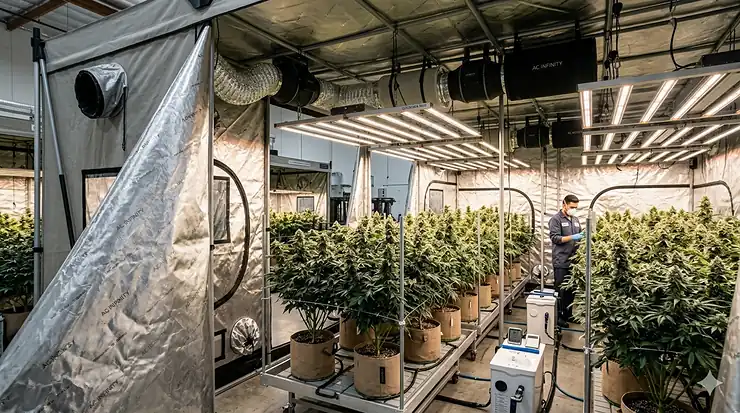
A commercial grow tent is a heavy-duty, light-sealed, climate-controlled enclosure engineered for large-scale or professional cultivation indoors. Unlike the small hobbyist tents you’d use for a 2×2 closet setup, commercial-grade units are typically 8×8 feet or larger, built from industrial-density canvas (1680D–2000D), reinforced steel framing, and multi-port ventilation systems capable of handling serious HVAC loads. The difference between a $60 Amazon tent and a proper commercial grow tent isn’t just price — it’s the difference between a structure that survives two years of daily zips and humidity swings, and one that sags, leaks light, and collapses under its own hanging equipment within six months.
For anyone running a professional cultivation business, a serious home production setup, or a commercial microgreens or herb operation, the tent is the foundation. Get it wrong, and every dollar you spend on lighting, nutrients, and genetics is undermined by an unstable environment. Get it right, and you’ve built the climate-controlled backbone that makes consistent, high-capacity production actually achievable.
In 2026, the market for large-scale indoor growing infrastructure has matured significantly. Brands like AC Infinity, Gorilla Grow Tent, VIVOSUN, Mars Hydro, Spider Farmer, and iPower have all pushed into industrial-grade territory. According to the USDA’s Agricultural Research Service, controlled environment agriculture — the umbrella category that includes grow tent operations — is one of the fastest-growing segments of U.S. food production. That’s not a trend. That’s a market signal.
This guide breaks down the 7 best commercial grow tents currently available on Amazon, with real-world analysis, honest comparisons, and the practical insights that no product listing will ever give you.
Quick Comparison Table: Top 7 Commercial Grow Tents at a Glance
| Product | Size | Canvas | Frame | Hang Capacity | Best For |
|---|---|---|---|---|---|
| AC Infinity CLOUDLAB 811 | 10×10 | 2000D | 22mm steel | 250 lbs | Premium all-around |
| Gorilla Grow Tent Pro 10×10 | 10×10 | Gorilla canvas | All-steel interlocking | 300 lbs | Max durability |
| VIVOSUN S108 | 10×10 | 600D Oxford | Metal poles | 250 lbs/bar | Budget-friendly large |
| VIVOSUN P108 Pro | 10×10 | 2000D | 1″ steel | 150–400 lbs | Mid-range upgrade |
| Mars Hydro 8×8 | 8×8 | 1680D | Steel | 110 lbs | Mid-scale production |
| Spider Farmer 8×8 Pro | 8×8 | 1680D | Steel | 110 lbs | Smart-connected grows |
| iPower 10×10 | 10×10 | 600D | Metal | Standard | Entry-level commercial |
Table analysis: The AC Infinity and Gorilla Pro clearly dominate in structural specs, but they occupy different premium tiers — AC Infinity wins on smart ecosystem integration, while Gorilla edges it out on raw hang capacity (300 lbs vs. 250 lbs), which matters enormously when you’re running multiple heavy LED bars and a 10-inch fan combo. Budget buyers comparing the VIVOSUN S108 against the iPower 10×10 should know the VIVOSUN’s 600D fabric still outperforms iPower’s on light-sealing consistency, thanks to the upgraded black inner lining on the zipper track — a detail that sounds minor until you’re troubleshooting a light leak at 2 AM.
💬 Just one click — help others make better buying decisions too! 😊
Top 7 Commercial Grow Tents: Expert Analysis
1. AC Infinity CLOUDLAB 811 — The All-Around Professional Standard
The CLOUDLAB 811 is the grow tent that serious growers keep recommending to other serious growers — and for good reason. At 10×10 feet (120″x120″x80″), it’s built on an ethos of “no compromises” that you can actually feel the moment you unbox it.
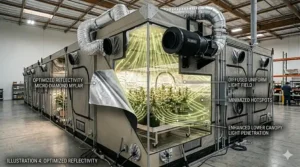
What the specs actually mean in practice: The 2000D diamond mylar canvas is lab-tested using an Agilent™ UV-Vis-NIR Spectrophotometer for maximum light reflectivity. That’s not marketing fluff — it means less light scatter and more usable photons hitting your canopy. The 22mm steel poles (vs. the 18mm industry standard) are 50% thicker, and the difference becomes obvious when you’re hanging a pair of heavy commercial LED bars plus a carbon filter and inline fan on the same crossbar. At 250 lbs of hang capacity, this tent won’t sag.
The integrated controller mounting plate with lightproof cable passthrough is something competitors should be embarrassed they haven’t copied yet. It means you can route your climate controller cables cleanly without taping up a duct port or cutting holes in the canvas — a small thing that prevents a lot of annoying light leaks over time.
Expert opinion: This is the commercial grow tent I’d recommend to anyone who wants the best balance of build quality, tech integration, and long-term reliability. It’s particularly ideal for growers who use AC Infinity fans (the CLOUDLINE series snaps directly into the ecosystem) or anyone running an automated climate setup. The 30-plant capacity makes it genuinely viable for professional herb, microgreen, or specialty crop operations.
Customer feedback summary: Buyers consistently praise the build quality and the ease of the controller mount plate. A small number of users note the large footprint requires two people for assembly — so plan accordingly.
✅ Largest observation window on the market
✅ Lab-tested diamond mylar reflectivity
✅ Smart controller integration built in
❌ Premium price point
❌ Large size requires two-person setup
Price range: $500–$600 range. For professional cultivation, this is one of the strongest value propositions at this scale.
2. Gorilla Grow Tent Pro 10×10 — The Tank of the Industry
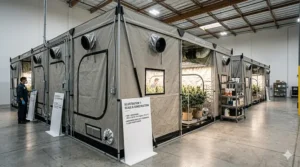
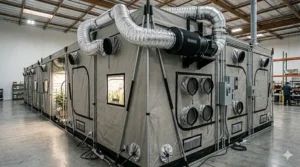
If AC Infinity wins on smart design, Gorilla wins on sheer, stubborn toughness. The Gorilla Grow Tent Pro 10×10 (10’x10′, adjustable from 6’11” to 7’11” with included extension kit) has been the benchmark for professional indoor cultivation for years. And the Pro version takes everything that already made Gorilla famous and cranks it up.
What actually matters here: The canvas density is a proprietary Gorilla blend — thicker than the original Gorilla lineup, which was already 1680D (up to 9x denser than the 200D–600D fabric you’ll find in budget tents). The all-steel interlocking pin frame system is the real story: competitors use basic pole sleeves that can work loose over time. Gorilla’s interlocking pins lock together like Lego, and the structure holds its shape for years of heavy use. With 300 lbs of hang capacity, this is the tent you want when you’re running four large commercial LED fixtures simultaneously.
The height extension kit — which bumps ceiling height from 6’11” to 7’11” — is included at no extra cost. For high-training grows like SCROG setups, that additional foot of vertical clearance isn’t a luxury; it’s a growing strategy.
Expert opinion: Best suited for large-scale cultivators who prioritize structural integrity above all else. If you’re running a professional operation and plan to run this tent for three to five years through multiple harvests, the Gorilla Pro pays for itself in longevity alone. It’s also the tent I’d choose for a humid environment — the canvas construction has a reputation for handling moisture pressure better than lighter-duty alternatives.
Customer feedback summary: Users repeatedly describe it as “worth every penny” for professional use, though some note the weight (177 lbs assembled) makes repositioning a two-person job.
✅ 300 lb hang capacity — highest in this roundup
✅ Height extension kit included
✅ Industry-leading canvas density
❌ Heaviest and most expensive option
❌ Less smart-ecosystem integration than AC Infinity
Price range: $600–$800 range depending on configuration. The premium is real, but so is the tent.
3. VIVOSUN S108 — The Accessible 10×10 That Delivers the Basics
Here’s the truth about commercial grow tents that the premium brands don’t love to advertise: for a large percentage of growers, the $500–$800 flagships are overkill. The VIVOSUN S108 (120″x120″x80″, 24–32 plants) is the tent that makes professional-scale growing financially accessible without catastrophically compromising on quality.
What you need to know about the 600D canvas: Yes, it’s not 2000D. But VIVOSUN’s 600D Oxford fabric is reinforced with a PE layer and 100% reflective mylar interior, double-stitched at the seams, with a black inner zipper lining to prevent light entry. In a properly darkened grow room, the S108 performs admirably. Where it shows its budget DNA is in high-humidity environments or grows that run the zipper hard multiple times daily — the zipper seal can develop minor inconsistencies over time that the 2000D tents handle better.
The top hanging bar system supports 250 lbs per bar — which is actually the same rated capacity as the AC Infinity CLOUDLAB 811. What you’re giving up is pole thickness (VIVOSUN uses standard metal poles vs. the 22mm steel found in premium models), but for typical grow equipment loads, the structure holds reliably.
Expert opinion: The S108 hits the sweet spot for small commercial operations, professional herb or microgreen growers, and serious hobbyists scaling up for the first time. It’s also the tent I’d recommend for a business grow tent in a purpose-built grow room (not a garage or basement), where ambient light control is already handled by the room itself.
Customer feedback summary: Strong reviews across thousands of buyers; most note excellent value. A portion of users report needing additional duct tape around zipper edges if running light-dependent crop cycles in partially lit environments.
✅ Budget-friendly at commercial scal
✅ 250 lbs hanging capacity per bar
✅ Tool-free corner connectors for faster assembly
❌ 600D canvas less durable than premium options
❌ Minor zipper light-sealing inconsistencies in some units
Price range: $250–$350 range. An absolute steal for anyone who needs 100 sq ft of grow space without the flagship price tag.
4. VIVOSUN P108 Pro — The Mid-Range Upgrade You Actually Want
If you love the idea of VIVOSUN’s price discipline but want a canvas and frame closer to the AC Infinity experience, the P108 Pro is the answer. This is VIVOSUN’s professional-tier 10×10 tent — and it’s a meaningful step up from the standard S108, not just a cosmetic refresh.
Why the upgrade matters: The P108 Pro runs 2000D Oxford canvas (vs. 600D on the S108) with the same triple-layer design found in premium builds — PE layer, reflective mylar, and heavy outer canvas. More importantly, it swaps in 1″ (22mm) steel poles, matching the AC Infinity CLOUDLAB standard. The hang capacity range of 150–400 lbs depending on configuration is genuinely commercial-grade. VIVOSUN also added an enlarged observation window and SBS zippers — the same zipper standard used by high-end tent manufacturers for jam-free operation.
Expert opinion: This is the tent I’d pick if I were building out a professional growing tent for the first time and wanted to avoid ever regretting a “cheap out.” It bridges the gap between the accessible S108 and the premium flagships at a price point that makes commercial sense. Particularly good for business grow tent applications where operational longevity matters but you can’t justify a Gorilla Pro budget.
Customer feedback summary: Buyers upgrading from the S108 consistently note the quality jump is significant and worth the price difference.
✅ 2000D canvas — premium build at mid-range price
✅ 1″ steel poles matching premium standards
✅ Wide 150–400 lb hanging range
❌ Fewer ecosystem integrations than AC Infinity
❌ Assembly can be complex for first-time large tent builders
Price range: $350–$480 range. Outstanding value for what you’re getting.
5. Mars Hydro 8×8 Grow Tent — Professional Mid-Scale Production
Not every large-scale operation needs a 10×10. Sometimes 8×8 feet is exactly the right footprint — enough space for 16 to 36 plants in a 5-gallon grow bag setup, without consuming the ceiling real estate of a full 100 sq ft tent. The Mars Hydro 8×8 (96″x96″x80″) is where Mars Hydro’s industrial-grade grow tent philosophy meets practical mid-scale production.
The 1680D difference on this model: Mars Hydro uses 1680D diamond mylar fabric that they claim delivers 25% more PPFD (photosynthetic photon flux density) than 600D alternatives. What that means practically: more usable light gets reflected back to your plants instead of being absorbed into the walls. For high-intensity LED setups — which is exactly what you’d be running in a commercial grow tent — this matters for yield optimization. The double-stitched seams and zipper cover flap (which seals the zipper track against pinholes) give this tent a solid light-proof reputation across the growing community.
Expert opinion: Mars Hydro’s 8×8 punches above its weight for mid-scale professional cultivation. The 1680D build quality is a genuine differentiator at its price tier. If your commercial operation is running two to four large LED fixtures (think Mars Hydro FC-E6500 or similar), this tent is designed around that load. It’s particularly strong for legal cannabis cultivators, high-value herb operations, and commercial microgreen producers who don’t need the full 10×10 footprint.
Customer feedback summary: Highly rated for build quality and light-sealing; some buyers note the 110 lb hang rating is lower than comparable 10×10 competitors, so calculate your equipment load before purchasing.
✅ 1680D diamond mylar for enhanced PPFD
✅ Dedicated zipper cover flap — zero pinholes
✅ Purpose-built for Mars Hydro LED ecosystem
❌ Lower hang capacity (110 lbs) than the 10×10 options
❌ 8×8 footprint may outgrow quickly in expanding operations
Price range: $200–$280 range. Excellent ROI for mid-scale professional growing tent operations.
6. Spider Farmer 8×8 Pro-Grade Grow Tent — The Smart Grower’s 8×8
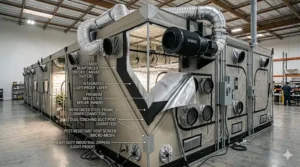
Spider Farmer has been quietly building one of the best vertical ecosystems in indoor growing — and their 8×8 Pro-Grade tent (8’x8’x6.5′, 240cm×240cm×200cm) is the piece of infrastructure that ties their smart growing ecosystem together. If you’re already using or considering Spider Farmer lights and their GGS smart controller platform, this tent is the logical anchor.
What separates this from generic 8×8 tents: The 1680D thickened Mylar canvas is combined with the GGS-compatible smart hook system — a detail that might sound minor until you realize it means your controller, power strip, and inline fan integration is purpose-designed rather than kludged together with bungee cords. The enlarged observation window and upgraded zipper design are meaningful quality-of-life improvements over the previous generation. Spider Farmer claims support for 24 medium-to-large plants or up to 30 smaller plants — competitive capacity for an 8×8 footprint.
Expert opinion: This is the professional growing tent I’d recommend for operations building out a fully integrated Spider Farmer smart environment. The GGS controller compatibility transforms the tent from passive structure into an active part of your climate management system — you can automate ventilation, monitor temperature and humidity by zone, and track historical grow data through the Spider Farmer app. For a commercial cultivation business focused on data-driven growing, that’s not a gimmick; it’s infrastructure.
Customer feedback summary: Spider Farmer community members praise the ecosystem integration and build quality improvements in the 2025 updated models.
✅ GGS smart controller compatible
✅ 24–30 plant capacity for 8×8 footprint
✅ Enlarged observation window + upgraded zippers
❌ Best value only within Spider Farmer ecosystem
❌ 8×8 limits scalability compared to 10×10 options
Price range: $180–$260 range. Best value when paired with Spider Farmer lights and GGS controller.
7. iPower 10×10 Grow Tent — The Entry Point for Large-Scale Indoor Growing
Sometimes a business grow tent decision comes down to one question: “Is 10×10 square feet of grow space within budget, period?” The iPower 10×10 (120″x120″x78″) answers that question with a clear yes.
Honest assessment of the 600D build: This tent is not for commercial-grade daily operations that demand five-plus years of service from a single structure. The 600D Mylar fabric does the job of light-sealing reasonably well in a dark room, and the observation window and removable floor tray are practical features you’d want regardless of price tier. What you’re accepting with iPower is a lighter frame, thinner canvas, and less precise light-sealing versus the premium builds.
Expert opinion: The iPower 10×10 makes the most sense as an entry-level commercial grow tent for operations just getting started — a market garden testing indoor production, a first-year hemp or specialty crop business, or a grower transitioning from outdoor to indoor who needs maximum square footage without maximum investment. It’s also a strong secondary tent for propagation, cloning, or vegetative stages when you don’t need the durability of your main production tent. Don’t run your full commercial harvest operation through this for years on end — but as a starting point or supporting structure, it earns its place.
Customer feedback summary: Buyers appreciate the 10×10 size at a dramatically lower price point; some note assembly requires patience given the thinner frame components.
✅ Lowest price for 10×10 square footage
✅ Good for propagation and secondary grow stages
✅ Observation window and floor tray included
❌ 600D canvas less durable for daily heavy use
❌ Shorter 78″ height (vs. 80″ on most competitors)
Price range: $130–$200 range. The most accessible entry point to industrial grow tent scale.
Check current price and availability on Amazon →
✨ Don’t Miss These Exclusive Deals!
🔍 Ready to take your commercial cultivation to the next level?
Click any highlighted product above to check current pricing and availability on Amazon. These professional growing tents are the foundation of any serious indoor production operation — get the right one and your whole grow rewards you for it.
Which Commercial Grow Tent Is Right for You? A Practical Decision Framework
Choosing between seven quality tents can feel like analysis paralysis. Here’s how to cut through it fast.
If you’re building a professional business grow tent for 3–5 years of continuous operation: Choose the Gorilla Grow Tent Pro 10×10 or AC Infinity CLOUDLAB 811. Both will outlast cheaper options by years. The Gorilla wins on raw structural toughness; the AC Infinity wins on smart ecosystem integration and observability. If you’re running a climate controller, the AC Infinity’s integrated mount plate alone justifies the price difference.
If you need maximum square footage on a controlled budget: The VIVOSUN S108 is the move. One hundred square feet of grow space for a fraction of flagship cost, with enough hang capacity for real commercial equipment loads. Just pair it with additional duct port sealing if you’re running light-sensitive cycles.
If you’re scaling up from a 4×4 or 5×5 for the first time: The VIVOSUN P108 Pro is your upgrade path. The 2000D canvas and 1″ poles mean you’re not building on a foundation you’ll outgrow immediately.
If your footprint is 8×8 and your brand ecosystem is already chosen: Spider Farmer 8×8 for the GGS smart ecosystem; Mars Hydro 8×8 for the Mars Hydro LED lineup. Either way, buying within-ecosystem isn’t just convenient — it’s how you unlock automated climate management that makes large-scale growing sustainable without constant manual intervention.
If you need 10×10 square footage but budget is the hard constraint: iPower 10×10 as a starting point, with a plan to upgrade the structure within two growing seasons as your operation generates revenue.
Setting Up Your Commercial Grow Tent for Maximum Performance
A commercial grow tent that’s improperly set up is an expensive light leak waiting to happen. Here’s how to do it right from day one.
Step 1: Location first. Before you even unbox, identify the floor footprint. For a 10×10, you need at least 12×12 feet of floor clearance — you’ll want access space on at least two sides for maintenance. Basements and dedicated grow rooms outperform garages in climate stability.
Step 2: Assemble the frame completely before attaching canvas. It sounds obvious, but the number of growers who attach the canvas halfway through frame assembly — and then have to unthread it to add a missed pole — is remarkably high. Lay out all poles, read the layout diagram, and verify the structure before touching the fabric.
Step 3: Hang your heaviest equipment first. Carbon filter and inline fan go up before lights. Your tent’s hanging bars have weight ratings — honor them. The AC Infinity CLOUDLAB 811’s 250 lb rating sounds like a lot until you’re running two commercial LED fixtures (12–18 lbs each), a 10-inch fan, a carbon filter (8–15 lbs), and a climate controller. Add it up before you hang it.
Step 4: Seal your duct ports. Every unused port is a potential light leak and temperature bleed point. Quality tents include drawstring cinch ports — pull them tight. For unused ports, fold the cinch and secure with a bungee clip or zip tie.
Step 5: Test for light leaks before your first cycle. Zip the tent fully, turn on your grow lights, and walk the exterior perimeter in a dark room. Any glow means a seal issue that needs addressing now, not after your plants are on a 12/12 cycle.
Maintenance reminder: Clean the mylar interior between grows with a diluted hydrogen peroxide solution. Algae and mold on interior walls destroy light reflectivity over time — and in a commercial tent, that’s yield walking out the door.
Real Growers, Real Scenarios: Who Should Buy What
The Professional Microgreen Operation
Profile: Runs continuous production cycles, harvesting every 7–14 days. Needs consistent environment, high plant density, and maximum light efficiency.
Best match: VIVOSUN S108 or P108 Pro — the wide horizontal footprint and top-bar hanging system accommodates multi-tiered shelving systems. For microgreens, you’re not hanging heavy LED bars from the ceiling; you’re using side-mounted or shelf-level lighting. The budget savings on the tent fund better lighting infrastructure.
The Legal Cannabis Cultivator (4–8 Plant Setup)
Profile: Running 4–8 plants through full cycle in a 10×10, maximizing yield per plant. High-value crop, so environment consistency is worth the premium.
Best match: Gorilla Grow Tent Pro or AC Infinity CLOUDLAB 811. The height extension on the Gorilla (up to 8’11” with two extension kits) is genuinely valuable for tall, late-stage flowering plants. The AC Infinity wins if you’re automating climate management through a controller.
The First-Year Commercial Herb Producer
Profile: Testing indoor herb production before committing to a full facility buildout. Budget-conscious but needs real square footage.
Best match: iPower 10×10 as the initial structure, with the explicit understanding it’s a first-season solution. Use the operational revenue to upgrade to a VIVOSUN P108 Pro or CLOUDLAB 811 by season two.
Commercial Grow Tent vs. Purpose-Built Grow Room: What the Spec Sheet Won’t Tell You
This is the comparison most buyers overlook — not tent A vs. tent B, but tent vs. room.
A purpose-built grow room (framed walls, dedicated HVAC, sealed insulation) is the gold standard for serious commercial cultivation. The Cornell Controlled Environment Agriculture program consistently shows that tightly controlled environment leads to 20–30% yield improvements over variable-environment grows. But a purpose-built room costs $5,000–$50,000+ depending on scale. A commercial grow tent costs $200–$800.
Here’s the practical reality:
| Feature | Commercial Grow Tent | Purpose-Built Grow Room |
|---|---|---|
| Initial cost | $200–$800 | $5,000–$50,000+ |
| Setup time | 2–4 hours | Weeks to months |
| Climate control | Moderate (dependent on equipment) | Excellent |
| Portability | Yes — fully moveable | No |
| Scalability | Add more tents | Requires construction |
| Light isolation | Very good (premium tents) | Excellent |
| Best for | Operations under 200 sq ft | Full commercial facilities |
The verdict: For any operation under 200 square feet of grow space, the math strongly favors a commercial grow tent — even a premium one. The capital efficiency is impossible to beat. Once you’re growing at 500+ sq ft, the equation begins shifting toward permanent infrastructure. Most serious growers use tents as the proof-of-concept stage before committing to room buildouts — and that’s exactly the right strategy.
Features That Actually Matter (And the Ones That Don’t)
After spending serious time with commercial-scale indoor growing equipment, here’s the unvarnished truth about feature marketing.
Features that genuinely impact your grows:
🌿 Canvas density (1680D vs. 2000D vs. 600D): This matters enormously for light-sealing consistency and long-term durability. Don’t shortchange this spec if you’re running light-sensitive photoperiod crops.
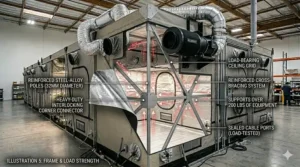
🌿 Pole thickness and frame system: 22mm interlocking steel poles are meaningfully stronger than 18mm sleeves. If you’re hanging commercial equipment, this is load-bearing infrastructure, not decoration.
🌿 Zipper cover flaps: The small fabric flap that covers the zipper track on premium tents like the CLOUDLAB 811 and Gorilla Pro is the most underrated feature in grow tent design. Without it, zipper pinholes are inevitable over hundreds of open/close cycles.
🌿 Port sizing variety: A tent with only 4″ duct ports limits your ventilation options. Look for tents that offer 4″, 6″, 8″, and 10″ port options for professional-grade airflow system flexibility.
Features that are mostly marketing:
❌ Exact mylar reflectivity percentages without lab testing: Unless the brand (like AC Infinity) has published Agilent spectrophotometer data, “98% reflective” claims are marketing estimates, not verified specs.
❌ Number of included accessories: A “complete kit” that includes cheap cable ties and a low-quality tool bag isn’t adding real value. The tent quality is what matters.
❌ Plant count claims: “Fits 30 plants!” assumes specific plant sizes, training techniques, and growth stages. Calculate your own canopy footprint based on your actual grow style.
Long-Term Cost & Maintenance: The Real ROI of a Premium Commercial Grow Tent
Here’s a calculation most buyers don’t run before purchasing.
A budget 10×10 commercial grow tent at $150 that needs replacement after 18 months costs $1.00/day to own. A CLOUDLAB 811 at $550 that lasts 5 years costs $0.30/day. The premium tent is literally two-thirds cheaper per day of operation — and that’s before accounting for the yield losses caused by the light leaks, climate inconsistencies, and frame failures that plague budget tents under commercial-use conditions.
Add the maintenance math: according to the University of Arizona’s Controlled Environment Agriculture Center, even a 5% improvement in light reflectivity consistency translates to measurable yield gains at the canopy level. In a 10×10 commercial grow tent running four 600W LED fixtures, that 5% recovery across multiple harvests annually represents real dollar value.
Practical maintenance schedule:
- After every harvest: Wipe down interior mylar with 3% hydrogen peroxide solution; inspect zipper seals; check all pole connections for loosening
- Every 6 months: Inspect canvas seams for stress points; re-cinch all duct ports; verify frame stability
- Annually: Test light-sealing integrity (dark room LED test); consider replacing high-use zipper sections if they show wear
The EPA’s guidance on indoor air quality for agricultural operations also recommends regular inspection of ventilation setups — relevant context for any grower running a sealed tent environment.
Common Mistakes When Buying a Commercial Grow Tent
Buying wrong is an expensive education. Here are the most common errors — and how to avoid them.
Mistake 1: Undersizing for current equipment, not future equipment. Buying a 5×5 when you’re planning to scale to a 10×10 within a year means you pay twice. Think about where you’ll be in 18 months, not today.
Mistake 2: Prioritizing low price on canvas, then compensating with duct tape. You cannot tape your way out of a 200D canvas. Light leaks through thin material aren’t zipper problems — they’re material problems. Buy 600D minimum for any grow tent you’re serious about; 1680D or 2000D if you’re running photoperiod-sensitive crops commercially.
Mistake 3: Forgetting to calculate equipment weight before choosing a tent. Calculate: lights + carbon filter + fan + any additional equipment. Then add a 20% safety margin. Then check your tent’s rated hang capacity. Run this math before purchasing.
Mistake 4: Buying a commercial grow tent without a dedicated electrical circuit. A 10×10 tent running commercial lighting will pull 1,500–4,000+ watts. Most standard 15-amp household circuits cannot support this safely. Consult a licensed electrician before buildout.
Mistake 5: Choosing based on brand name alone. Gorilla Grow Tent has an outstanding reputation — but the original Gorilla tent (1680D, non-Pro) is meaningfully different from the Pro version. AC Infinity’s CLOUDLAB 811 is their flagship; their smaller models have different specs. Always verify model number, not just brand.
FAQ: Commercial Grow Tent Questions Answered
❓ What size commercial grow tent do I need for a professional operation?
❓ How long does a commercial grade grow tent last with daily use?
❓ Can I run a commercial grow tent in a garage or basement?
❓ What ventilation system does a 10x10 commercial grow tent require?
❓ Is an industrial grow tent the same as a commercial grow tent?
Conclusion: The Tent Is the Foundation — Choose It Like One
Indoor growing at commercial scale is a precision operation. Every variable — temperature, humidity, CO₂, light intensity, photoperiod — contributes to yield. But none of those variables can be reliably controlled without a structurally sound, light-sealed, properly ventilated enclosure to contain them in.
The seven commercial grow tents in this guide represent the real range of what’s available on Amazon right now — from the entry-level iPower 10×10 that makes 100 square feet accessible, to the Gorilla Grow Tent Pro that sets the bar for what professional indoor cultivation infrastructure should look like. The right choice depends on your scale, your budget, your brand ecosystem, and how long you plan to run the operation.
If there’s one piece of advice worth taking from this entire analysis: don’t treat the tent as the last thing you budget for. It’s the first. Get the structure right, and every dollar you spend inside it performs better.
✨ Ready to build your professional grow operation? Check current prices and availability on any of the products above — and set your cultivation up for success from the ground up! 🌱
Recommended for You
- 7 Best Gorilla Grow Tent Premium Picks for Serious Growers in 2026
- 7 Best 2000D Grow Tent in 2026: Heavy Duty & Built to Last
- 7 Best Quality Grow Tents 2026: Expert Reviews & Buyer’s Guide
Disclaimer: This article contains affiliate links. As an Amazon Associate, I earn from qualifying purchases. If you purchase products through these links, we may earn a small commission at no additional cost to you.
✨ Found this helpful? Share it with your friends! 💬🤗
