
In This Article
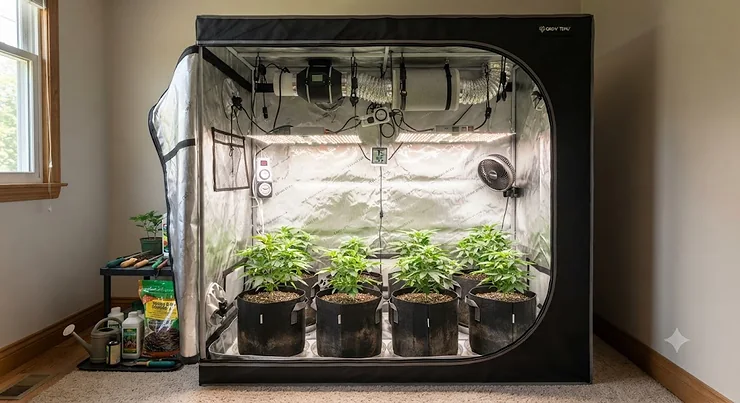
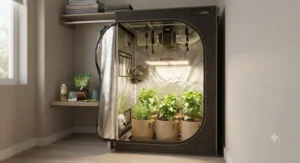
Somewhere between “I want to grow my own herbs” and “I actually have a working setup,” there’s a graveyard of half-finished Amazon carts. A fan here, a light there, a filter that doesn’t fit the ducting you already bought. A grow tent bundle exists to short-circuit that whole mess — one box (or one pallet, depending on size), every core component matched to work together, zero compatibility roulette.
What is a grow tent bundle? It’s a pre-matched package — tent, LED grow light, inline fan, carbon filter, and ducting — sized and wired to work as one system, sold as a single purchase instead of five separate ones. The idea isn’t new, but the execution has gotten genuinely good over the past couple of growing seasons, with brands now shipping WiFi-controlled fans, app-synced lights, and sensors that talk to each other out of the box.
This guide walks through seven real, currently available options — budget, mid-range, and premium — plus how to actually pick one instead of guessing. We’ll lean on quality guidance on grow-light basics like CRI and color temperature from the University of Vermont, honest aggregated review sentiment, and plain math on what each bundle costs to run. No invented “I tested this for six months” stories — just specs, sourced context, and straight talk about who each kit actually fits. If you’ve been putting off the whole project because sourcing five separate parts feels like a part-time job, this is the shortcut.
Quick Comparison Table
| Bundle | Tent Size | Light Included | Best For |
|---|---|---|---|
| VIVOSUN GrowHub Kit | 2×2 ft | 100W full-spectrum LED | Smart-home tinkerers on a budget |
| iPOW Complete Kit | 2×2 ft | 100W dimmable LED | Absolute cheapest true bundle |
| MARS HYDRO TS600 Kit | 2×2 ft | 100W TS600 LED | First-timers who want name-brand safety |
| TopoGrow Complete Kit | 2.7×2.7 ft | 300W LED panel | Buyers who want more canopy without a size jump |
| Spider Farmer SF2000 Kit | 2×4 ft | 200W SF-2000 LED | Growers who want the fullest accessory list |
| AC Infinity Advance 4×4 | 4×4 ft | Full-spectrum LM301H bar light | Automation-obsessed, app-first growers |
| Gorilla Grow Tent Kit | 2×2.5 to 5×9 ft | Full-spectrum Xi LED | Buyers who never want to replace the tent |
Reading across this table, the split is pretty clean: the top three rows are true entry-level bundles under roughly a thousand dollars, the middle two step up in either footprint or included accessories, and the bottom two are built for people who plan to run their tent for years, not one season. Notice that “Best For” isn’t just about price — the MARS HYDRO TS600 Kit and the AC Infinity Advance 4×4 sit at completely different budgets but solve the same underlying anxiety (not knowing what you’re doing) in different ways: one through brand trust and simplicity, the other through automation that makes mistakes harder to make. Keep this table in mind as you read the deeper product breakdowns below, because the “budget” label doesn’t automatically mean “worse” — it usually just means “smaller and less automated.”
💬 Already have a size in mind? Jump straight to the product that matches your space below — no need to read in order.
Top 7 Grow Tent Bundles: Expert Analysis
Seven real, currently sold bundles, spanning a 2×2 closet setup all the way up to a 4×4 room-sized system. Each one gets the same honest treatment: real specs, what those specs mean day-to-day, and where the aggregated reviewer sentiment lands.
1. VIVOSUN GrowHub Kit — smart-home automation on a starter budget
The standout here is the WiFi-connected GrowHub controller, which is unusual at this price tier and worth understanding before you write it off as a gimmick.
The VIVOSUN GrowHub Kit ships as a 2×2 foot tent paired with a full-spectrum LED light rated around 100W of draw, plus an automatic ventilation system tied into VIVOSUN’s GrowHub A22 outlet, which reads temperature and humidity and reacts without you touching a dial. In practice, that means the fan speeds up when the tent gets stuffy instead of you noticing three days later that your canopy is wilting. For a first-time grower who travels for work or just forgets things, that’s not a nice-to-have; it’s the difference between a harvest and a compost pile.
Based on the spec sheet, this kit earns its “smart” label honestly — most competitors in this price band still use manual dial fans. What most buyers overlook is that the automation only helps if you actually open the app and set sane thresholds; leaving it on defaults undercuts the whole selling point. Reviewers consistently report that the app connection is the trickiest part of setup, with a learning curve around WiFi pairing that smooths out after the first successful sync.
Pros:
- ✅ App-based automatic ventilation reacts to real conditions
- ✅ Reflective mylar interior holds up well for the size
- ✅ Genuinely beginner-friendly once the app is paired
Cons:
- ❌ WiFi setup can be fiddly on the first attempt
- ❌ 2×2 footprint limits you to one to two plants
Price sits in the $150-$220 range depending on bundle configuration at the time of research — for a smart-controlled 2×2, that’s a fair trade if the automation actually gets used.
2. iPOW Complete Kit — the cheapest true bundle that still includes everything
What stands out immediately is the sheer completeness of the box for the price — this is one of the few sub-$150 kits that doesn’t quietly skip a component.
The iPOW Complete Kit covers a 2×2 tent, a dimmable full-spectrum LED rated near 100W with roughly 240 individual diodes, a 4-inch 190 CFM inline fan, carbon filter, 8 feet of ducting, plus extras like a thermometer/hygrometer, timer, and grow bags. On paper this means you could open the box and have a fully wired system running the same afternoon, without a single trip back to Amazon for a missing clamp. The dimmable feature matters more than it sounds — seedlings scorch under full-power LEDs, so being able to dial down output during early growth stages is a genuine practical benefit, not marketing filler.
Here’s what to weigh: at this price, build quality is the trade-off. The tent uses a lighter 600D oxford exterior rather than the heavier 1680D canvas found on premium options, so it’s fine for one to two seasons but isn’t the tent you build a permanent grow room around. Reviewers note the LED runs noticeably cooler than older HPS setups, cutting summer heat buildup, which is a genuine advantage in small apartments without great airflow.
Pros:
- ✅ Genuinely complete — nothing missing from the box
- ✅ Dimmable light protects seedlings from light burn
- ✅ Lowest true all-in-one price point available
Cons:
- ❌ 600D fabric is lighter-duty than premium canvas tents
- ❌ Zippers and poles feel less rugged over multi-year use
At around $100-$150, this is the entry point for anyone who wants to try growing without committing real money first.
3. MARS HYDRO TS600 Kit — the safe, name-brand first purchase
The standout feature is the 10-speed fan controller paired with an established brand’s LED, which removes a lot of the “did I buy garbage” anxiety that comes with unknown-brand kits.
The MARS HYDRO TS600 Kit bundles a 2×2 tent (24″x24″x55″) built from 1680D-rated reflective mylar with the TS600 LED — a 100W-class light with claimed high-efficiency diodes — plus a smart WiFi ventilation kit with a 10-speed fan. What most buyers overlook about this model is that the 1680D interior fabric, at this price tier, is actually a step above several competitors that use thinner 600D material for their budget tents — meaning better light retention and a sturdier long-term feel without paying premium prices.
Based on the spec comparison against similarly priced options, MARS HYDRO’s ventilation kit stands out for offering ten distinct fan speeds instead of the more common three or four, giving finer control over airflow as plants grow larger and need more air exchange. Aggregated reviewer sentiment consistently points to the brand’s customer support and documentation as stronger than most budget competitors, which matters more than people expect when something inevitably needs troubleshooting in week three.
Pros:
- ✅ 1680D reflective fabric outperforms typical budget tents
- ✅ Ten fan speeds give genuinely fine airflow control
- ✅ Established brand with better documentation and support
Cons:
- ❌ Still a 2×2 footprint — same space limits as entry kits
- ❌ WiFi ventilation features add setup steps for non-tech users
Expect a price in the $170-$250 range — reasonable for buyers who specifically want brand-name reliability over their very first light and fan combo.
4. TopoGrow Complete Kit — more canopy without jumping tent classes
The standout advantage is the larger 32″x32″x63″ footprint paired with a genuinely stronger 300W LED, giving noticeably more usable canopy space than the 2×2 kits above without stepping all the way up to a 4×4 commitment.
The TopoGrow Complete Kit includes a full-spectrum 300W LED grow light, the larger tent, and a complete 4-inch ventilation package. Here’s what to weigh: a 300W-class light at this size means you’re not underpowering the space the way a 100W light would if simply moved into a bigger tent — wattage-to-footprint ratio is one of the most commonly ignored numbers in this category, and TopoGrow gets it closer to right than most kits in its price bracket. What the spec sheet won’t tell you, but reviewers note, is that the larger interior volume makes temperature swings gentler and easier to manage than in a cramped 2×2, since there’s simply more air buffering the heat from the light.
For a buyer who’s outgrown a windowsill herb garden but isn’t ready for a 4×4 room commitment, this is the “medium” option that genuinely earns its place in the lineup rather than existing purely as an upsell.
Pros:
- ✅ 300W light is properly matched to the larger footprint
- ✅ More forgiving temperature swings than compact 2×2 tents
- ✅ Meaningful canopy upgrade without a full size-class jump
Cons:
- ❌ Needs more floor space than a closet corner allows
- ❌ Higher wattage means a modest bump in electricity draw
Price typically lands in the $200-$320 range — a reasonable middle rung between entry kits and full 4×4 systems.
5. Spider Farmer SF2000 Kit — the most complete accessory list in this lineup
What immediately stands out is just how much is actually in the box — this isn’t a tent-plus-light bundle with a few zip ties thrown in; it’s closer to a small hardware store’s worth of grow gear.
The Spider Farmer SF2000 Kit pairs a 200W SF-2000 LED using upgraded Bridgelux diodes with a 2×4 foot, 2000D-rated tent, a 6-inch smart clip fan, a 4-inch inline duct fan and carbon filter, a smart ventilation controller, plus grow bags, trellis netting, corner shelves, and a temperature/humidity sensor. On paper, the 2000D fabric rating beats the 600D and even 1680D options seen in cheaper kits, meaning more physical durability and better light reflectivity from the interior. Based on the accessory list alone, this kit is clearly aimed at someone who wants to skip a second and third Amazon order entirely — trellis netting for plant training and corner shelving for a sensor aren’t things most competitors bother including.
Reviewers consistently highlight small design touches — a strap to hold the tent’s door flap open, a lanyard to keep the digital meter accessible from outside, cross struts sized correctly for hanging a fan and filter — as evidence the company designed around actual grow-day friction points rather than just listing specs. That level of “someone actually used this” detail in aggregated feedback is rare in a bundle at this price.
Pros:
- ✅ Most complete accessory list of any kit in this roundup
- ✅ 2000D fabric outclasses the 600D/1680D tents nearby in price
- ✅ Small design details reviewers repeatedly praise as thoughtful
Cons:
- ❌ 2×4 footprint needs a dedicated room corner, not a closet
- ❌ More parts means a longer first-time assembly session
Price generally runs in the $280-$400 range — strong value once you account for everything that would otherwise be a separate purchase.
6. AC Infinity Advance 4×4 — the automation-first choice for serious growers
The defining feature is the CONTROLLER 69 PRO, which manages the fan and light together based on real-time VPD (vapor pressure deficit) rather than just a basic timer.
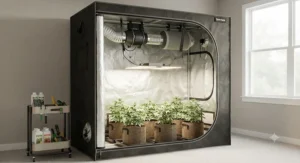
The AC Infinity Advance 4×4 bundles a 48″x48″x80″ premium 2000D mylar tent with an EC-motor inline fan, an oscillating clip fan, and a full-spectrum LED using Samsung LM301H diodes rated in the multi-hundred-watt range for genuine 4×4 canopy coverage. What most buyers overlook about VPD-based automation is that it responds to the actual relationship between temperature and humidity your plants experience — not just one number in isolation — which is a meaningfully smarter approach than fans that simply run on a dumb timer. Reviewers report the WiFi app connection unlocks alerts, historical charts, and CSV data export, features aimed squarely at growers who want to actually analyze their environment over a full season rather than just glance at a dial.
Based on the spec comparison, this is the first kit in the lineup built explicitly for multi-plant, room-scale growing rather than closet-scale experimentation — the 4×4 footprint and higher-wattage light are matched for real canopy coverage, not stretched thin across too much space the way a smaller light would be.
Pros:
- ✅ VPD-based automation is genuinely smarter than timer fans
- ✅ 4×4 canopy properly matched to light wattage
- ✅ App analytics — alerts, charts, CSV export — for serious tracking
Cons:
- ❌ Meaningful investment compared to closet-sized starter kits
- ❌ Full feature set requires comfort with an app-first workflow
Expect this bundle in the $900-$1,300 range depending on the exact configuration — a serious purchase, but one matched to a serious grow space.
7. Gorilla Grow Tent Kit — built for growers who never want to buy a second tent
The signature feature is height extension — the ability to physically add vertical inches to the tent frame as plants (or your ambitions) grow taller.
The Gorilla Grow Tent Kit pairs a heavy-duty tent — reviewers and third-party retailers alike note its 1680D canvas and 300-lb-rated poles — with a full-spectrum Xi-series LED, matched inline fan, and carbon filter, sold across sizes from a compact 2×2.5 up to a room-scale 5×9. Based on the spec comparison against the lighter 600D tents seen earlier in this list, the heavier canvas and stronger pole rating exist specifically to support the weight of upgraded lights, dehumidifiers, and hanging equipment that growers tend to add over multiple seasons — a budget tent’s poles can deform under that same load. What most buyers overlook is that this is really a total-cost-of-ownership play: paying more upfront to avoid replacing a sagging or torn tent after one or two harvests.
Aggregated reviewer sentiment specifically praises the carbon filters for lasting years without odor breakthrough, a detail that matters enormously for anyone growing in a shared home or apartment building. The height-extension kits, sold as accessories, let growers add training room for taller strains without buying an entirely new tent — a genuinely unusual feature in this category.
Pros:
- ✅ 300-lb pole rating supports years of added equipment
- ✅ Height-extension option avoids buying a second tent later
- ✅ Carbon filters reported to last multiple seasons reliably
Cons:
- ❌ Premium pricing compared to every other kit in this list
- ❌ Overkill for someone just testing the waters for one season
Pricing varies widely by size, generally in the $250-$1,000+ range — the smallest configurations are surprisingly close to mid-tier competitors, while room-scale setups sit firmly in premium territory.
Beginner-to-Harvest Setup: Your First 30 Days
Getting the box open is the easy part. The first month is where most beginner-to-harvest setups quietly go wrong, usually from impatience rather than bad equipment. Start by placing the tent somewhere with stable ambient temperature — not next to a window with direct sun, not against an exterior wall in a cold garage. Assemble the frame fully before hanging anything; rushing this step is the single most common reason poles bow or fabric tears in week one.
Run your light and fan for 24 hours empty before adding a single plant, just to confirm the whole system holds a stable temperature and humidity range without you inside the tent’s climate loop. Set your light timer immediately — most vegetative growth wants 14-18 hours on — because manually remembering to flip a switch every day is where consistency, and therefore results, fall apart. In week two and three, resist the urge to open the tent constantly to check progress; each opening dumps your carefully built humidity and temperature straight out the door. A common first-30-days mistake is overwatering out of anxiety — check soil moisture with a finger before adding water, not on a fixed schedule. By day 30, you should be adjusting fan speed and light height based on actual plant response, not guesswork — and if you’ve followed a bundle’s matched components rather than mixing mismatched parts, that tuning process is far more forgiving.
Real-World Scenarios: Matching a Bundle to Your Grow
Picture a college student in a shared apartment with a closet corner to spare and a budget under $200 — the iPOW Complete Kit or VIVOSUN GrowHub Kit fits that profile well, since both deliver a complete 2×2 system without demanding a dedicated room or a big electrical draw. Neither needs 240V wiring or a permit-level ventilation run, which matters when you don’t own the space.
Now picture a suburban homeowner with a spare bedroom corner, growing as a serious hobby across multiple seasons a year, budget somewhere around $300-$400. The Spider Farmer SF2000 Kit matches that use case precisely — its 2×4 footprint and genuinely complete accessory list (trellis netting, grow bags, sensors) mean fewer follow-up purchases, and the 2000D fabric survives repeated seasonal use rather than needing replacement.
Finally, picture someone converting an entire spare room into a dedicated grow space, running multiple plants through full veg-to-flower cycles year-round, comfortable investing over $1,000 upfront. The AC Infinity Advance 4×4 or a larger Gorilla Grow Tent Kit configuration both suit that scenario — the former for growers who want app-driven automation and data logging, the latter for growers who prioritize physical durability and the option to extend tent height as their setup matures.
✨ Not sure which scenario fits you? Scroll back up and match your space and budget against the comparison table above.
How to Choose a Grow Tent System for Your Space
Choosing a grow tent system comes down to matching seven variables to your actual space and goals, not just picking whatever has the best photo:
- Measure your space first. A 2×2 tent needs roughly a closet’s worth of floor space; a 4×4 needs a genuine room corner — measure before you shop, not after delivery.
- Match light wattage to footprint. A 100W light in a 4×4 tent leaves plants starved for intensity; a 300W light crammed into a 2×2 wastes money and generates excess heat.
- Check fabric rating. 600D suits one or two seasons; 1680D and 2000D hold up across years of repeated use and heavier equipment.
- Confirm ventilation is properly sized. Fan CFM should roughly match your tent’s cubic footage exchanged every few minutes — undersized fans can’t manage heat or humidity.
- Decide how much automation you actually want. WiFi and app controls help forgetful or busy growers, but they add a setup step some buyers would rather skip entirely.
- Factor in noise tolerance. Inline fans run continuously — a shared wall or thin apartment door makes fan noise a real consideration, not an afterthought.
- Budget for consumables, not just the kit. Carbon filter media, replacement bulbs, and grow bags are recurring costs beyond the one-time bundle price.
Extension horticulture guidance generally recommends full-spectrum fixtures with strong light output for the best indoor gardening results, which lines up with why every bundle in this list leans on full-spectrum LEDs rather than older single-spectrum bulbs. Reasoning through these seven checks before buying prevents the single most common regret reported in aggregated reviews: buying a kit sized for the photo on the listing page rather than the actual room at home.
Inside a Complete Grow Tent Package: What “All-In-One” Really Means
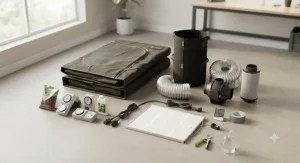
A genuinely complete grow tent package should include five non-negotiable components: the tent itself, a full-spectrum LED light, an inline exhaust fan, a carbon filter, and ducting to connect the fan and filter together. Anything calling itself “complete” without all five is missing a core function, not an optional extra.
What “everything-included” should actually mean: beyond those five essentials, genuinely everything-included kits — like the Spider Farmer SF2000 Kit and iPOW Complete Kit reviewed above — throw in the smaller items that otherwise mean three more Amazon orders: a timer for automated light cycles, rope ratchets to adjust light height as plants grow, a hygrometer for temperature and humidity readings, and fabric grow bags or pots. None of these are expensive individually, but sourcing them separately after the main kit arrives is exactly the friction a bundle exists to eliminate.
Here’s what to weigh honestly: not every “complete” listing is equally complete. Some budget kits labeled as all-in-one grow tent bundles quietly omit the timer or ducting clamps, counting on buyers not noticing until setup day. Reading the included-items list line by line before purchase — not just the marketing bullet points — is the only reliable way to confirm a package actually delivers on its name.
All-In-One Grow Tent vs Building Your Own Setup Piece-by-Piece
The core trade-off between an all-in-one grow tent and piecing together your own setup is compatibility guaranteed versus flexibility maximized. A bundle guarantees the fan’s CFM rating, the filter’s inlet diameter, and the tent’s ducting ports all match — something that sounds obvious until you’ve ordered a 6-inch filter for a 4-inch fan port and had to return it.
Building your own setup wins when you have very specific requirements — an odd-shaped grow space, a preference for one brand’s light paired with another’s ventilation, or simply already owning some components. Reviewers who piece together custom setups consistently report that the research time itself is the real cost, not the money saved; matching CFM ratings, duct diameters, and wattage-to-footprint correctly takes real study.
A bundle wins for nearly everyone else, and especially for first-time growers: what most buyers overlook is that the “savings” from DIY sourcing often evaporate once you account for a wrong-sized part that needs returning, or a fan that’s too loud because it was oversized for the tent’s actual volume. Based on the spec comparison across this article’s seven bundles, the price premium for a matched kit versus sourcing identical individual parts is typically modest — often under 10-15% — which is a small price for guaranteed compatibility on your very first attempt.
Common Mistakes When Buying a Grow Tent Bundle
The most common mistake, by a wide margin, is buying a tent sized for a photo rather than a measured space — a 4×4 looks compact online and turns out to eat an entire spare bedroom corner in person. Second is ignoring wattage-to-footprint ratio, either underpowering a large tent with a starter light or overpowering a small one and generating heat the ventilation can’t keep up with.
Third: skipping the fabric-rating check and assuming all “1680D” or “600D” labels mean the same durability across every brand — material quality genuinely varies by manufacturer even at the same denier rating. Fourth: underestimating noise — inline fans run continuously, and a fan rated fine for a garage can be genuinely disruptive in a bedroom-adjacent closet. Fifth, and probably the sneakiest: forgetting that “complete” bundles still need consumables — carbon filter media eventually needs servicing, and bulbs, while LEDs last years, aren’t truly infinite.
What to Expect: Real-World Performance
On paper, wattage and CFM numbers look abstract until you’re standing in front of a tent. In practice, a properly matched 100W LED in a 2×2 tent produces visibly dense, compact growth within the first few weeks — not the leggy, stretched-out look of underpowered lighting. A correctly sized inline fan, meanwhile, is something you mostly notice by its absence: no lingering must smell, no fogged-up observation window, no crispy leaf edges from stagnant hot air pooling near the canopy.
What the spec sheet won’t tell you is how much day-to-day comfort depends on tent placement relative to your daily routine — a tent tucked in a spare closet you walk past twice a day gets checked and adjusted more consistently than one shoved in a basement corner you visit once a week. Reviewers across brands consistently describe the first successful grow cycle as building real confidence for scaling up tent size or plant count the following season, which is arguably the biggest practical payoff a first bundle delivers beyond the harvest itself.
Long-Term Cost & Maintenance
The sticker price on any bundle is only part of the real cost. LED grow lights, unlike older HPS or fluorescent setups, typically run for years without bulb replacement, which is a meaningful long-term saving baked into every kit in this list. different LED devices and bulb types serve different roles in horticultural lighting setups, and the full-spectrum panels used across these bundles are generally the lower-maintenance category compared to older lighting technology.
Recurring costs to budget for include replacement carbon filter media roughly every 12-18 months of continuous use, occasional ducting clamp or connector replacement, and electricity — a 100W light run 16 hours daily adds a modest but real amount to a monthly power bill, scaling up proportionally for higher-wattage 4×4 systems like the AC Infinity Advance 4×4. Total cost of ownership favors the heavier-duty tents like the Gorilla Grow Tent Kit for growers planning multiple years of use, since a 600D budget tent replaced every season ends up costing more cumulatively than one premium tent bought once — the same logic that applies to buying a good pair of boots instead of three cheap ones.
Spotting Real Value Package Deals
A genuine value package deal bundles components that would cost more purchased separately, at a price that reflects real savings — not just a a higher list price with a fake strikethrough discount. The tell for a real deal: check whether the included accessories (grow bags, timers, hygrometers, netting) have actual retail value on their own; kits like the Spider Farmer SF2000 Kit, which includes trellis netting, corner shelves, and a sensor, deliver a meaningfully better package-to-price ratio than a bare tent-light-fan combo at a similar price point.
Watch for the opposite pattern too: some listings labeled as value packages simply repackage a mediocre tent and underpowered light at a price only slightly below name-brand alternatives, banking on the word “bundle” alone to suggest savings. Comparing the actual included component specs — fabric denier, light wattage, fan CFM — against name-brand equivalents at similar prices is the only reliable way to separate a genuine deal from a relabeled markup.
💬 Found a bundle that fits your budget? Check current pricing and availability before it changes!
Safety & Ventilation Compliance Guide
Every grow tent bundle in this list runs on standard household electrical outlets, which makes basic electrical safety non-negotiable rather than optional. federal consumer safety guidance on extension cord and power strip use applies broadly to household electrical setups, and the same logic applies directly to grow tent power strips: don’t daisy-chain extension cords, don’t overload a single outlet with a light, two fans, and a humidifier, and inspect cords periodically for fraying, since equipment often runs for 14-18 hours a day without a break.
Ventilation compliance matters beyond just plant health — proper carbon filtration prevents odor from becoming a shared-housing or landlord issue, and adequate exhaust prevents excess humidity from encouraging mold growth on walls or nearby surfaces. Placing a grow tent away from a bedroom’s direct airflow path, using a dedicated outlet rather than a power strip shared with other high-draw appliances, and keeping the tent’s exhaust vented toward a window or existing HVAC return are all practical steps that cost nothing but meaningfully reduce risk.
Frequently Asked Questions
❓ What's included in a typical grow tent bundle?
❓ Is a 2×2 grow tent bundle big enough for a beginner?
❓ How much does a complete grow tent package cost?
❓ Do all-in-one grow tent kits include everything needed to start?
❓ How long does a carbon filter in a grow tent system last?
Conclusion
Across all seven bundles in this guide, the pattern holds steady: the right grow tent bundle isn’t the most expensive or the most automated one — it’s the one matched to your actual space, budget, and how much hands-on tinkering you actually want to do. The iPOW Complete Kit and VIVOSUN GrowHub Kit solve the “I just want to try this” problem cheaply; the MARS HYDRO TS600 Kit and TopoGrow Complete Kit step up in either brand trust or canopy size; the Spider Farmer SF2000 Kit rewards buyers who want the fullest accessory list without going to full room scale; and the AC Infinity Advance 4×4 and Gorilla Grow Tent Kit serve growers ready to commit to a serious, multi-season setup.
What ties every recommendation together is the same underlying logic covered in the how-to-choose section above: measure your actual space, match wattage to footprint, and don’t let a shiny app or a big discount override those two basics. A bundle removes the compatibility guesswork — it doesn’t remove the need to think through what you’re actually trying to grow, and where.
✨ Don’t Miss These Exclusive Deals!
🔍 Take your indoor growing setup to the next level with these carefully selected grow tent bundles. Click on any highlighted product above to check current pricing and availability. These complete kits will help you build a genuinely beginner-to-harvest setup you’ll be proud of. 🌱
Recommended for You
- Gorilla Vs Vivosun Tent: 7 Grow Tents Ranked for 2026
- Grow Tent For Beginners: 7 Proven Kits for 2026
- Grow Tent Buying Guide 2026: 7 Tents That Won’t Let You Down
Disclaimer: This article contains affiliate links. As an Amazon Associate, I earn from qualifying purchases. If you purchase products through these links, we may earn a small commission at no additional cost to you.
✨ Found this helpful? Share it with your friends! 💬🤗
