

In This Article
Ventilation is the least glamorous part of a grow tent, right up until it becomes the only part that matters. A 4×4 tent holds roughly 100 cubic feet of warm, humid, light-heated air. Let that air go stale and you get a sauna with mildew ambitions. A well-chosen Terrabloom 6 inch fan for 4×4 grow tent builds earns its keep quietly: cheap to run, easy to forget, and (when sized properly) almost invisible.

This guide skips the hype and does the math. You’ll get seven real six-inch fans compared side by side, a plain-English walkthrough of Terrabloom CFM for 4×4 tent setups, and a Terrabloom fan sizing guide you can finish in five minutes. We’ll also cover 4×4 tent airflow with Terrabloom ducting, intake and filters, and why air exchange rate matters more than any number printed on a box.
One honesty note up front. Everything here comes from published specs, manufacturer data, retailer listings and aggregated owner reviews, not from my own bench testing. Listings often disagree with each other (the same fan can show 350 or 402 CFM depending on the seller), so I flag those conflicts instead of picking a winner and hoping.
What Is a Terrabloom 6 Inch Fan for 4×4 Grow Tent?
A Terrabloom 6 inch fan for 4×4 grow tent use is an inline duct fan with a 6-inch (150 mm) port, usually driven by an energy-saving EC motor, that pulls stale, warm, humid air out of a roughly 16-square-foot tent. Rated from about 288 to 395 CFM depending on the model, it swaps the tent’s air many times an hour.
Why six inches rather than four? Retailer sizing guides note that a 4-inch fan covers a 4×4 only by running near maximum with no headroom. A 6-inch fan can loaf along at 40-50% speed, which is where the quiet lives.
Terrabloom 6 Inch Fan for 4×4 Grow Tent: Quick Comparison Table
Here are all seven fans on one screen. Ratings are manufacturer or retailer listings and vary by seller, so verify the exact variant before you buy.
| Fan | Rated CFM | Power | Noise (listed) | Price range | Best For |
|---|---|---|---|---|---|
| TerraBloom ECMF-150 | 288 (350 variant exists) | 36W | ~31 dBA | $90-$130 range | Balanced everyday ventilation |
| TerraBloom ECMF-150-S2 | 355 | Not confirmed | Silenced housing | Premium tier, check current price | Quiet rooms needing extra headroom |
| TerraBloom ECMF-150-S | 288 | 36W | 31-50 dBA | Above standard model, check current price | Bedrooms and living spaces |
| TerraBloom TB-MFIF-6 | 395 (342 on some listings) | 70W | 70 dB on listing | Budget tier, check current price | Garages and basements on a budget |
| AC Infinity Cloudline S6 | 402 | ~28-38W | ~30 dBA | $120-$150 range | Controller-based automation |
| Spider Farmer 6-Inch Inline Fan | 402 (some listings 350-380) | 50-62W | ~32 dB | $95-$115 range | Value plus GGS controller |
| VIVOSUN AeroZesh G6 | 388 | 35W | 32 dB listed | $75-$135 range | Budget-leaning EC option |
Looking at the table, the TerraBloom ECMF-150 and VIVOSUN AeroZesh G6 sip the least power, while the TerraBloom TB-MFIF-6 trades efficiency for raw rated airflow. If silence is the priority, the two silenced TerraBloom variants are the only fans here built around it. Most buyers will land on the standard TerraBloom ECMF-150 or the AC Infinity Cloudline S6, and the next section explains why.
💬 Just one click — help others make better buying decisions too!😊
Top 7 Picks Around the Terrabloom 6 Inch Fan for 4×4 Grow Tent: Expert Analysis
1. TerraBloom ECMF-150 — the efficient all-rounder
The party trick of the TerraBloom ECMF-150 is efficiency: a brushless EC motor and dual-jet impeller push 288 CFM on just 36 watts. Dual ball bearings, an ETL listing and a two-year warranty round out the spec sheet. Some listings also sell a 350 CFM/40W version, so check which variant you’re ordering.
What does that mean in a tent? Through a carbon filter, expect roughly 190-215 CFM, or about two air exchanges a minute in a 104-cubic-foot tent at full speed. Drop to half speed and you land near one exchange a minute, which is the classic target. Based on the spec comparison, it’s the fan I’d shortlist first for 240-400W LED builds in moderate climates. It gets tight with a hot garage and a 480W+ light.
Reviewers consistently describe it as quiet at lower speeds, with noise climbing as you turn the dial. A recurring quirk is a 5-10 second spin-up delay after power-on. Some owners report running it at 30-40% and getting the airflow they needed with far less noise than a cheaper 6-inch fan.
Pros:
- ✅ Only 36W for 288 CFM
- ✅ Quiet at low-to-mid speeds
- ✅ Two-year warranty, ETL listed
Cons:
- ❌ Slow spin-up after power-on
- ❌ Thin margin in hot, high-wattage tents
Price: around the $90-$130 range, which makes it strong value for most 4×4 growers.
2. TerraBloom ECMF-150-S2 — newest silenced model with extra headroom
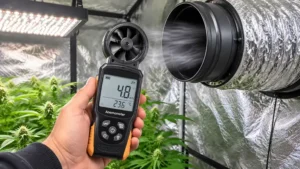
The TerraBloom ECMF-150-S2 is the 2026 refresh. It combines a brushless EC motor and dual-jet impeller with a sound-insulating EPP housing, and it’s rated at 355 CFM. It ships with an 8-speed digital controller with a numeric display, accepts PWM or 0-10V control, and can be daisy-chained through 3.5 mm connections.
The numeric display sounds trivial until you’ve tried to remember where a dial was set last week. The PWM input means climate controllers can drive it directly. Through a filter, 355 CFM works out to roughly 230-265 CFM, about 2.2-2.6 exchanges a minute in a 104-cubic-foot tent. That extra cushion is exactly what a 480W light in a warm room needs.
Because it’s brand new, I couldn’t find enough owner reviews to summarize honestly, so I won’t pretend to. I also couldn’t confirm its wattage in the sources I reviewed.
Pros:
- ✅ 355 CFM gives real headroom
- ✅ Digital controller with numeric display
- ✅ Accepts PWM and 0-10V automation
Cons:
- ❌ Little owner-review history yet
- ❌ Likely priced above the standard model
Price: premium tier, so check current price. It’s a sensible pick for hot rooms where quiet still matters.
3. TerraBloom ECMF-150-S — acoustic-foam silenced original
The TerraBloom ECMF-150-S attacks noise with a 2-inch acoustic foam layer inside a coated steel housing and a spring-suspended motor. The listing claims 10-15 dBA less sound than the regular ECMF series. It keeps the 288 CFM/36W rating, adds IP64 protection, and ships with both an analog dial and an 8-speed digital controller. It’s also listed as HVI-tested and ENERGY STAR Most Efficient (2021), with typical noise of 31-50 dBA.
The catch is size. The silenced body measures about 21.5 inches long, versus roughly 7 inches for the standard unit, so check your hanging space before ordering. The payoff is a fan you can run in a bedroom closet without negotiating with your partner.
Public owner reviews for this specific variant were sparse in what I found, so treat the acoustic numbers as manufacturer-stated. Its sibling, the standard model, has far more review history.
Pros:
- ✅ Foam-lined housing cuts fan noise
- ✅ Includes two controller styles
- ✅ Same efficient 36W motor
Cons:
- ❌ Much longer body to hang
- ❌ Sparse independent review data
Price: above the standard model, so check current price. It’s worth the premium only if the tent shares air with where you sleep.
4. TerraBloom TB-MFIF-6 — brute-force AC budget workhorse
The TerraBloom TB-MFIF-6 is the old-school option: an AC-motor inline fan with a built-in speed controller, a 6-foot grounded cord and an ETL listing. Its 395 CFM free-air rating is the highest of the Terrabloom lineup (some listings show 342), but it draws 70 watts. That’s about 5.6 CFM per watt versus roughly 8 for the EC models.
Raw pull is the attraction. It has plenty of muscle to drag air through a dense carbon filter and a long duct run. The cost is noise: the listing shows 70 dB, and retailers broadly note that EC fans run noticeably quieter than legacy AC designs. That’s a poor match for a spare bedroom and a fine one for a garage or basement.
Owners praise it as a 24/7 workhorse that pulls hard through a filter and can be dialed down. Reviews of TerraBloom’s other AC-motor boosters include noise complaints out of the box and a few durability reports.
Pros:
- ✅ Highest rated CFM in the lineup
- ✅ Strong pull through carbon filters
- ✅ Budget-friendly entry point
Cons:
- ❌ Loud compared with EC fans
- ❌ Roughly double the wattage
Price: budget tier, so check current price. It’s good value if noise isn’t your problem.
5. AC Infinity Cloudline S6 — the automation benchmark
The AC Infinity Cloudline S6 is the fan other 6-inch fans get measured against. It’s rated at 402 CFM at about 30 dBA, with an EC motor, a 10-speed controller and a listed 503 Pa of static pressure. That’s the fan’s ability to hold airflow against filter and duct resistance. It carries a two-year warranty, and the manufacturer cites a 67,000-hour motor life.
One retailer guide reckons the S6 gives roughly three to four times the throughput a 4×4 needs. In practice it spends its life at 40-60%, which is where EC motors are happiest. Its real selling point is the ecosystem. It plugs into AC Infinity’s UIS controllers for temperature, humidity and schedule triggers, and the T6 sibling ships with a smart controller.
Owners broadly describe it as quiet, well packaged and easy to integrate, and it has held a category bestseller rank in listing snapshots.
Pros:
- ✅ High static pressure for filters
- ✅ Very quiet at partial speed
- ✅ Plugs into UIS controllers
Cons:
- ❌ Costs more than the ECMF-150
- ❌ Smart features need a separate controller
Price: around the $120-$150 range. It’s worth it if you want automation and an upgrade path.

6. Spider Farmer 6-Inch Inline Fan — value with a controller ecosystem
The Spider Farmer 6-Inch Inline Fan uses a mixed-flow design with an EC motor and lightweight ABS blades. Most listings show 402 CFM at about 32 dB, and the RJ12 speed controller connects to Spider Farmer’s app ecosystem. Wattage is the confusing part: listings range from 50W to 62W, and some show 350-380 CFM. Confirm the variant before buying.
A bundled temperature-humidity controller pushes the total into the $115-$140 range. That makes it a decent middle path for growers who want some automation without an AC Infinity-level spend. In a 4×4, 402 CFM rated gives about the same real-world margin as the Cloudline S6.
The brand’s own testimonials are glowing, but those are curated, and I found little independent aggregated review data. Treat it as promising rather than proven.
Pros:
- ✅ 402 CFM rating on most listings
- ✅ Controller bundles available
- ✅ Competitive entry pricing
Cons:
- ❌ Higher wattage than rival EC fans
- ❌ Inconsistent specs across retailers
Price: around $95-$115 range for the fan alone. Good value, with an asterisk on the listing details.
7. VIVOSUN AeroZesh G6 — budget EC with a sensor probe
The VIVOSUN AeroZesh G6 is a PWM-controlled EC fan with steel housing, rated at 388 CFM, 2500 RPM and 35 watts. It includes the E12 speed controller plus a temperature-humidity probe, and it’s upgradeable to the GrowHub E42A WiFi controller. The 35W draw matches the ECMF-150 on efficiency while offering a little more rated airflow.
Noise is where listings contradict each other. Most show 32 dB for the G6, while some older variants list 45 dBA. The warranty is also shorter at one year, against two for TerraBloom and AC Infinity.
Verified review data was limited at the time of research, with only dozens of reviews on the brand’s store, so I can’t responsibly summarize owner sentiment. On paper, it’s the budget-minded EC contender.
Pros:
- ✅ EC efficiency at 35W
- ✅ Sensor probe included
- ✅ Upgradeable to WiFi control
Cons:
- ❌ Only a one-year warranty
- ❌ Conflicting noise figures on listings
Price: roughly $75-$135 depending on the controller bundle. It’s a smart choice when the budget is firm.
Practical Usage Guide: Setting Up Your Fan the Right Way
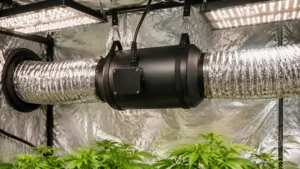
Hanging the fan is easy. Hanging it well is a different skill. Start with the order of components: air should pass through the carbon filter first and then the fan, so the fan stays clean and the tent runs under gentle negative pressure. Hang the filter-and-fan assembly from the tent’s top bars using straps, with a bit of slack. Rigid contact transfers vibration to the frame, and that hum is what people mistake for fan noise.
Keep ducting short and straight. Every extra bend and every extra foot costs airflow, so the pretty S-curve behind the tent has a real price tag. Seal joints with clamps rather than tape.
First-use routine:
- Start at about 50% speed with the tent closed.
- Watch the walls. They should pull in slightly without sucking flat.
- Adjust over the next day against temperature and humidity.
- Re-check after lights-on and lights-off, since the tent’s behavior changes between them.
Maintenance schedule: glance at the filter monthly, wipe dust off the impeller every few months, and check clamps after the first week. Common first-30-day mistakes include running at 100% “just in case”, forgetting the lights-off period (humidity often spikes then), and sealing every vent so the fan starves.
Real-World Scenarios: Matching the Fan to Your Setup
The apartment hobbyist. A 4×4 with a 240W LED in a bedroom, running 24/7 for herbs and leafy greens. Heat load is light, so the airflow target is modest and noise is the main concern. The TerraBloom ECMF-150-S at 30-40% fits well, with the standard TerraBloom ECMF-150 a cheaper near-equivalent if the tent sits in a closet or spare room.
The summer-heat garage grower. A 480W light in a warm room. Published heat calculators put a 480W fixture at about 190 CFM of removal for an 8°F rise. Divide that by 0.7 to account for filter loss and you need roughly 270 CFM rated, well above the thin margin of a 288 CFM fan. This is where the TerraBloom ECMF-150-S2 or the AC Infinity Cloudline S6 pulls ahead.
The budget builder with a long duct run. Twenty feet of ducting, two bends, a dense filter and no one nearby to complain about noise. Static pressure matters here, so the TerraBloom TB-MFIF-6 and its raw rated pull make sense. The Spider Farmer 6-Inch Inline Fan is a worthwhile alternative if you want controller options.
Problem → Solution Guide: Fixing the Usual Airflow Headaches
Problem: the tent walls cave in. This usually means intake area is too small for the fan’s output. Add passive vent area or drop the speed a notch. It’s a sign of unrestricted exhaust meeting a restricted inlet, not a sign of “good suction”.
Problem: the fan is too loud. Lower the speed first. EC fans like the TerraBloom ECMF-150 get dramatically quieter at 30-50% than at full tilt. Then isolate vibration with straps and consider the silenced TerraBloom ECMF-150-S.
Problem: humidity spikes when lights go off. Plants keep transpiring, but heat-driven airflow disappears. Keep the fan running at low speed through the dark period, or use a controller with humidity triggers like the AC Infinity Cloudline S6 ecosystem.
Problem: it hesitates on startup. Some owners of the standard TerraBloom ECMF-150 report a 5-10 second delay. That’s normal for the behavior described, not a defect, so don’t power-cycle it repeatedly.
Problem: odor leaks out. Check for gaps, since the tent must stay under negative pressure. A filter that’s undersized for the fan can also let air bypass it, so match filter and duct diameter.
Terrabloom vs Alternatives: Where Each Option Wins
The real question isn’t just which six-inch fan to buy. It’s whether a six-inch EC inline fan is the right tool at all. The alternatives each have a niche:
| Option | Typical airflow | Noise | Running cost | Best For |
|---|---|---|---|---|
| TerraBloom ECMF-150 (EC, 6″) | 288 CFM | Low at partial speed | Low (36W) | Everyday 4×4 ventilation |
| TerraBloom TB-MFIF-6 (AC, 6″) | 395 CFM | High | Higher (70W) | Budget, noise-tolerant rooms |
| 4-inch inline fan | ~170-200 CFM | Moderate | Low | Smaller 2×4 or 3×3 tents |
| Clip-on fan only | Circulation only | Low | Very low | Leaf movement, not air exchange |
The table makes the trade-off plain. A 4-inch fan covers a 4×4 on paper but runs flat out, while a clip-on fan moves leaves without removing a single cubic foot of stale air. The TerraBloom TB-MFIF-6 wins on brute force and price, and the EC TerraBloom ECMF-150 wins on everything you hear and pay for over time.
Other 402 CFM competitors exist too, such as the Mars Hydro iFresh 6-inch (419 Pa listed, app-control options), but the spec math below applies to them equally.
Terrabloom CFM for 4×4 Tent: What the Numbers Actually Mean
A fan’s headline CFM is measured in free air, with nothing attached. Add a carbon filter and a duct run and that figure drops. Retailer guidance suggests 25-35% loss depending on filter age and duct layout. Here’s the estimated reality, using a 4x4x6.5 ft tent (104 cubic feet):
| Fan | Rated CFM | Est. CFM through filter | Exchanges/min (full speed) | Best For |
|---|---|---|---|---|
| TerraBloom ECMF-150 | 288 | 187-216 | 1.8-2.1 | Moderate-heat tents |
| TerraBloom ECMF-150-S2 | 355 | 231-266 | 2.2-2.6 | Hot rooms, quiet needs |
| TerraBloom TB-MFIF-6 | 395 | 257-296 | 2.5-2.8 | High-resistance ducting |
| AC Infinity Cloudline S6 | 402 | 261-302 | 2.5-2.9 | Automation builds |
| VIVOSUN AeroZesh G6 | 388 | 252-291 | 2.4-2.8 | Budget EC |
These are my estimates from the cited 25-35% loss range, not lab results, but they show a useful pattern. Every fan here clears a one-exchange-per-minute target at full speed, so the real question is how much of that capacity you’ll have to throttle. The TerraBloom ECMF-150 keeps a comfortable margin for most LED tents, while the TerraBloom ECMF-150-S2 and the 402 CFM fans give extra insurance against a hot room. Fans running at lower speeds also tend to be quieter, which is why oversizing slightly is usually smart.
Air Exchange Rate: The Number That Actually Matters
Air exchange rate is simply how often the tent’s entire air volume is replaced. One exchange per minute equals 60 air changes per hour. Growers’ rule of thumb is one full exchange every one to three minutes, and sealed CO₂-enriched rooms can stretch that to three to five minutes because they exhaust less often.
University guidance for greenhouses is more aggressive. Alabama Extension points to sizing fans to exchange roughly 1 to 1.5 times the structure’s volume each minute, and it stresses that static pressure and inlet design decide whether that capacity shows up in practice.
The formula for a 4×4 is simple: volume in cubic feet divided by minutes per exchange. At one exchange per minute, a 104-cubic-foot tent needs about 104 CFM. At one per three minutes, it needs only about 35. Sources disagree because the exchange rate isn’t the only constraint. Heat often governs. A 480W light adds about 1,640 BTU/hr, which needs roughly 190 CFM to hold an 8°F rise. Always size for the larger of the two numbers, then add margin for the filter.

Terrabloom Fan Sizing Guide: How to Choose in Six Steps
- Measure the tent volume. Multiply length × width × height in feet. A 4x4x6.5 tent is 104 cubic feet.
- Pick an exchange target. Use one exchange per minute as a baseline, which gives about 104 CFM here.
- Check the heat load. Take the light’s wattage × 3.412 for BTU/hr, then divide by 1.08 × your allowed temperature rise. A 480W light at an 8°F rise needs about 190 CFM.
- Take the larger number and add filter margin. Divide by 0.7 to cover typical 25-35% filter and duct loss. That’s roughly 150 CFM for the baseline case and 270 CFM for the hot case.
- Match to a fan. The TerraBloom ECMF-150 covers the first case with room to spare. The second pushes you toward the TerraBloom ECMF-150-S2 or a 402 CFM model.
- Choose controls and noise. An EC fan with a controller lets you throttle to 40-60%. If the tent shares air with a bedroom, favor the silenced TerraBloom ECMF-150-S.
4×4 Tent Airflow with Terrabloom: Intake, Ducting and Balance
Exhaust is only half the loop. A fan can only remove as much air as the tent can take in. A common planning figure from grower guides is intake area in square feet equal to CFM ÷ 150. For roughly 200 CFM through the filter, that means about 1.3 square feet, or around 190 square inches, of open passive vent. Many stock tent vents fall well short of that, which is why walls collapse.
You have two common layouts. Passive intake pairs a 6-inch exhaust fan and filter at the top with open vents at the bottom. It’s simple and covers most 4×4 builds. Active intake adds a smaller fan at the bottom running at roughly 80-90% of the exhaust CFM, which gives tighter control.
Keep a separate clip-on circulation fan inside the tent. The exhaust fan exchanges air, while the clip-on fan moves it across the canopy, and they do different jobs. Finally, keep the TerraBloom ECMF-150 or whichever fan you choose as close to the filter as possible, with the shortest, straightest duct run you can manage.
Features That Actually Matter (And Those That Don’t)
Static pressure matters most after CFM. It tells you how well the fan holds airflow against resistance. The AC Infinity Cloudline S6 lists 503 Pa and the silenced TerraBloom ECMF-150-S lists 396 Pa, though those are manufacturer figures, so compare like with like.
Independent certification matters too. The Home Ventilating Institute certifies airflow, sound and energy ratings through third-party testing, so an HVI-tested listing carries more weight than an unverified spec. EC versus AC motor type matters as well, because it drives noise and efficiency.
Controller compatibility is the big practical differentiator. PWM and 0-10V inputs let climate controllers drive the fan. Warranty length is another signal: two years for the TerraBloom and AC Infinity fans versus one year for the VIVOSUN AeroZesh G6.
What doesn’t matter much: peak free-air CFM printed in giant fonts, and app features you won’t use. A fan that’s 10% stronger on paper but louder and hungrier is usually worse.
A brief safety note: use listed, grounded equipment, keep controllers and cords away from water, and check your local rules on what you’re permitted to grow.
Long-Term Cost and Maintenance
A fan that runs 24/7 is an annual expense, not a one-time purchase. Here’s the worst case, full speed all year, at 15-20 cents per kWh:
| Fan | Rated watts | kWh/year (full speed) | Est. yearly cost | Best For |
|---|---|---|---|---|
| TerraBloom ECMF-150 | 36W | ~315 | $47-$63 | Low-cost 24/7 running |
| TerraBloom TB-MFIF-6 | 70W | ~613 | $92-$123 | Short-term or budget builds |
| AC Infinity Cloudline S6 | ~28-38W | ~245-333 | $37-$67 | Automation with low draw |
| Spider Farmer 6-Inch Inline Fan | 50-62W | ~438-543 | $66-$109 | Value-focused builders |
| VIVOSUN AeroZesh G6 | 35W | ~307 | $46-$61 | Budget EC |
These are ceilings. EC fans typically run well below full speed, and their power draw falls quickly as speed drops. Even so, the gap between the AC and EC models can be $45-$60 a year, which erases the TerraBloom TB-MFIF-6‘s upfront savings within a season or two. For context, ENERGY STAR’s ventilation fan criteria tie certification to tested airflow and efficiency, which is why efficiency claims backed by testing deserve more trust.
Maintenance is light: replace or recharge the carbon filter as odor returns, dust the impeller periodically, and re-check clamps. Budget the filter, not the fan, as your recurring cost.

FAQ
❓ How much does a carbon filter reduce Terrabloom 6 inch fan airflow?
❓ Can I run a Terrabloom 6 inch fan 24/7 in a 4x4 tent?
❓ What is the quietest Terrabloom 6 inch fan for a 4x4 grow tent?
❓ Do I need an intake fan with a Terrabloom 6 inch fan?
❓ What speed should I set a Terrabloom 6 inch fan for 4x4 grow tent use?
Conclusion
A 4×4 tent doesn’t need a hurricane. It needs a steady, quiet, well-sized stream of fresh air, and a six-inch EC fan delivers exactly that when you pick it with the math in hand. The TerraBloom ECMF-150 is the sensible default for most builds: 288 CFM on 36W, comfortable headroom for LED lights in moderate rooms, and low running costs. Step up to the TerraBloom ECMF-150-S2 when the room runs hot, or choose the silenced TerraBloom ECMF-150-S when noise matters more than anything.
If you want automation and an upgrade path, the AC Infinity Cloudline S6 is the benchmark, with the Spider Farmer 6-Inch Inline Fan and VIVOSUN AeroZesh G6 as budget-friendlier controller ecosystems. The TerraBloom TB-MFIF-6 remains the brute-force budget pick for garages and basements.
Remember the order of operations: size by volume and heat load, add margin for the filter, balance the intake, and run the fan at partial speed. Do that, and the right Terrabloom 6 inch fan for 4×4 grow tent growing will fade into the background, which is the highest compliment ventilation can earn.
✨ Ready to upgrade your airflow?
🔍 Click any highlighted fan above to check current pricing and availability, and give your 4×4 the steady, quiet ventilation it deserves! 🌿
Recommended for You
- Terrabloom 6 Inch Fan EC Motor: 7 Best Picks Ranked (2026)
- Terrabloom 6 Inch Inline Fan Review For Grow Tent: 7 Best (2026)
- Terrabloom 6 Inch Fan And Filter Combo Kit: 7 Best Buys 2026
Disclaimer: This article contains affiliate links. As an Amazon Associate, I earn from qualifying purchases. If you purchase products through these links, we may earn a small commission at no additional cost to you.
✨ Found this helpful? Share it with your friends! 💬🤗
