

In This Article
Terrabloom 6 inch inline fan noise level describes how loud TerraBloom’s 6-inch EC duct fans, mainly the ECMF-150 family, run in A-weighted decibels (dBA). Listings quote 31 dBA at the quiet end and up to roughly 60 dBA at full output, so the answer depends almost entirely on where you park the speed dial.
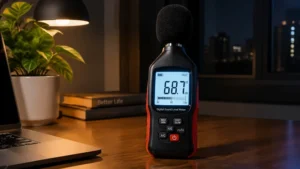
Fan noise ratings are a bit like a restaurant’s “ready in 15 minutes.” Technically true under ideal conditions, slightly optimistic on a Friday night. A single dBA number hides the speed, the distance, the room, and the duct run. This guide unpacks the Terrabloom 6 inch inline fan noise level across the whole dial, then lines it up against six rivals so you can see what 31 dBA does and doesn’t buy you.
A little context helps. According to the NIH’s hearing institute (NIDCD), sounds at or below 70 dBA are unlikely to cause hearing loss even after long exposure, while long or repeated exposure at 85 dBA and above can. Every fan in this roundup lives below that line. So we’re not talking safety. We’re talking sleep, concentration, and whether your housemate ever asks, “what’s that humming?”
One honesty note up front: I haven’t personally run any of these fans, and nothing here pretends otherwise. What follows is analysis built on published spec sheets, retailer listings, and the aggregated sentiment of real buyer reviews, flagged clearly wherever the data runs thin. Where listings contradict each other, I’ll say so rather than pick a winner and hope.
Terrabloom 6 Inch Inline Fan Noise Level vs Rivals: Quick Comparison
Here’s the whole field on one screen. Specs come from manufacturer and retailer listings, and prices are ranges as of the time of research, so check current price before buying.
| Fan | Airflow | Listed Noise | Price Range | Best For |
|---|---|---|---|---|
| TerraBloom ECMF-150 | 288 CFM (some listings 350) | 31 dBA, up to ~60 across speeds | Roughly $90-$130 | Tent owners wanting 0-100% control in a metal case |
| TerraBloom ECMF-150-S | 288 CFM | ~31-50 dBA typical | Premium over the standard model | Bedrooms, closets, stealth setups |
| AC Infinity CLOUDLINE PRO S6 | 402 CFM | 32 dBA | Above the CLOUDLINE A6 | Maximum air per decibel |
| AC Infinity CLOUDLINE A6 | 352 CFM | 34 dBA | Around $90 | Budget buyers who want smart-controller support |
| VIVOSUN AeroZesh T6 | 408 CFM | Under 45 dB | $130-$170 range | Programmable PWM setups |
| VEVOR 6-inch EC | 402 CFM | 32 dB (listing) | Around $80 | Tight budgets |
| Toolazy 6-inch 405 CFM | 405 CFM | 31 dBA | Roughly $125-$150 at third-party sellers | Most airflow at a low rated noise |
Read the table sideways and a pattern jumps out. The TerraBloom ECMF-150‘s 31 dBA rating is competitive but not unique, since the Toolazy 6-inch 405 CFM matches it while claiming roughly 40% more airflow. Where Terrabloom pulls ahead is the ECMF-150-S, the only fan here sold with built-in acoustic foam. If budget rules, the VEVOR 6-inch EC and CLOUDLINE A6 undercut the field, though the A6 gives up two dBA to do it.
💬 Just one click — help others make better buying decisions too!😊
Top 7 Quiet 6-Inch Inline Fans: Expert Analysis
Each fan below gets the same treatment: specs translated into real-world meaning, an honest read on who it suits, and a summary of what buyers consistently report.
1. TerraBloom ECMF-150 — benchmark 31 dBA with a true 0-100% dial
The ECMF-150 is the fan the Terrabloom 6 inch inline fan noise level question is really about. It moves 288 CFM on 36 watts, which works out to 8 CFM per watt. Dual ball bearings, a coated steel housing, ETL listing and a two-year warranty round out the package. Some listings show a 350 CFM, 40 W variant, so confirm which one you’re buying. The brushless design is the same EC technology ebm-papst champions: electronics handle commutation, so speed control doesn’t produce the buzzy hum of a throttled AC motor.
Based on the spec comparison, 288 CFM suits a 2×4 or 3×3 tent, or a 4×4 with short, gentle ducting. Roundup guides suggest 340-405 CFM for a 4×4 with a carbon filter, so heavy-filter setups may want more headroom. Reviewers consistently describe the first few speed steps as very quiet, with noise rising at each step after. One buyer reports mild wind noise and inlet whine near full speed, and another says the fan feels right at roughly 50%. Two controllers (analog dial and 8-speed digital) ship in the box.
Pros:
- ✅ 31 dBA-rated floor with smooth 0-100% control
- ✅ Metal casing, ETL listing, two-year warranty
- ✅ 36 W draw keeps running costs low
Cons:
- ❌ Lower airflow than most 6-inch rivals
- ❌ Audible whine and wind noise near full speed
Price sits in the roughly $90-$130 range, and it’s solid value if you plan to run it low and slow.
2. TerraBloom ECMF-150-S — foam-lined, spring-mounted, built for quiet
The ECMF-150-S is Terrabloom’s answer to “31 dBA still isn’t quiet enough.” Per the listing, a 2-inch acoustic foam layer sits inside the coated steel housing, and the motor is spring-suspended. Together they trim output by 10-15 dBA versus the standard fan. Airflow and power match the ECMF-150 at 288 CFM and 36 W, with typical noise listed at 31-50 dBA and 396 Pa of static pressure. Both wired controllers are included, and a 3.5 mm port accepts PWM or 0-10 V signals. A 2026 ECMF-150-S2 pairs the same EC motor with an EPP sound-insulating housing.
On paper, 10 dB is roughly “half as loud” to the ear, so a 10-15 dBA cut is a bigger deal than it sounds. The catch is size: the listing shows 21.5 inches of length, so measure your closet before falling in love. I couldn’t find enough verified owner reviews of this variant to summarize sentiment, though a forum user who installed the standard fan called the silenced version well worth a look. Treat the dB reduction as a manufacturer claim until more owner data appears.
Pros:
- ✅ Foam-lined housing cuts up to 10-15 dBA
- ✅ Spring-suspended motor limits vibration
- ✅ Both controllers included, PWM-ready
Cons:
- ❌ Bulkier body needs more mounting space
- ❌ Few verifiable owner reviews so far
It costs more than the standard model (check current price), and for bedrooms or stealth setups the premium is easy to justify.
3. AC Infinity CLOUDLINE PRO S6 — most airflow per decibel
The CLOUDLINE PRO S6 lists 402 CFM at 32 dBA from a 38 W PWM-controlled EC motor, with a mixed-flow design for high-resistance ducting and a 10-speed controller. That’s about 40% more air than the ECMF-150 at essentially the same rated noise. One listing puts efficiency near 10.6 CFM per watt, which edges Terrabloom’s 8.
Buyers praise it heavily. Reviewers describe it as virtually silent on low settings in cabinets and living spaces, and the listing I found shows around 4.7 stars across more than 4,700 ratings. But one reviewer who says they worked in noise-and-vibration control doubted that 32 dB holds at standard measuring distances. Another used a phone meter 12 inches above the fan in an echoey basement and logged roughly 37, 45, 53 and 60 dBA across the first four speeds. That’s a rough method, but it shows how fast level climbs.
Pros:
- ✅ 402 CFM at a 32 dBA rating
- ✅ 10-speed controller, smart-controller compatible
- ✅ Strong, consistent reviewer praise
Cons:
- ❌ Costs more than the CLOUDLINE A6
- ❌ Rated figure may flatter real-world noise at high speed
The price sits a step above the A6‘s roughly $90 mark (check current price), and the airflow headroom lets you run slower and quieter.
4. AC Infinity CLOUDLINE A6 — smart-ready budget workhorse
The CLOUDLINE A6 trades a little power for a lower price: 352 CFM, 34 dBA, EC motor with PWM control, mixed-flow design and a 10-speed USB-C controller. AC Infinity lists it around $90.
My read is that the A6 suits growers who want the CLOUDLINE ecosystem without the PRO S6 premium. Roundup reviewers note it gets louder at high speeds and ships with a more basic controller than the PRO. At 34 dBA versus 32, you’re talking about a subtle difference on paper, but it matters if the fan lives within earshot. Buyers broadly describe it as quiet and well built at moderate speeds. Compared with the ECMF-150, the A6 offers roughly 22% more airflow, though Terrabloom counters with a metal casing and a 0-100% dial rather than preset steps.
Pros:
- ✅ Smart controller compatible
- ✅ Around $90 price point
- ✅ Mixed flow handles high static pressure
Cons:
- ❌ 34 dBA rating trails the PRO S6
- ❌ Louder at higher speeds per reviewers
For a first fan in a small tent, the A6 is a sensible, quiet-enough choice.
5. VIVOSUN AeroZesh T6 — programmable PWM with steel housing
The AeroZesh T6 claims 408 CFM at 3,100 RPM on a 35 W EC motor with a steel housing and an E12 PWM controller. Its noise rating is “under 45 dB,” a looser ceiling than the 31-32 dBA claims from rivals. That could mean the number is conservative, or that the fan is simply louder. I couldn’t verify buyer reviews to settle it.
What the spec sheet won’t tell you is how that ceiling translates at partial speed. Because the AeroZesh T6 has 408 CFM on tap, you could run it at 50-60% and match the output of a smaller fan while staying well below its maximum noise. The seller pitches the steel body as vibration-damping, which is plausible but unproven here. Retailers list it in the $130-$170 range, making it the priciest fan in this group.
Pros:
- ✅ 408 CFM headroom lets you run slower
- ✅ Steel housing and programmable PWM control
- ✅ 35 W EC draw
Cons:
- ❌ “Under 45 dB” ceiling is looser than rivals’ ratings
- ❌ Highest price, few verified reviews
Choose it for control and airflow, not for bragging rights on noise.

6. VEVOR 6-inch EC — lowest price, murkiest specs
The VEVOR 6-inch EC lists 402 CFM, a 32 dB rating, and a bundle with stainless clamps and rubber vibration mats and straps, a nice touch for noise control at an around-$80 price. But listings disagree: one retailer calls it an EC motor, while a roundup lists 400 CFM at 34 dB with an AC motor. Those are different fans from a noise perspective, so verify the exact model number.
Buyer sentiment is harder to pin down. One buyer swapped a VEVOR inline fan (model unspecified) for an AC Infinity unit after hearing a loud hum, which is anecdotal but fits the AC-motor-hum pattern. If you buy this fan, prioritize confirming it’s the EC version and use the included isolation hardware.
Pros:
- ✅ Includes vibration-dampening straps and mats
- ✅ Lowest price in the group
- ✅ 402 CFM claim
Cons:
- ❌ Listings disagree on motor type and dB
- ❌ Mixed noise and build reports
It’s a good fit for tight budgets, provided you read the model number twice.
7. Toolazy 6-inch 405 CFM — big air, 31 dBA rating
The Toolazy 6-inch 405 CFM pairs an EC motor with 0-100% PWM control, dual sealed ball bearings for 24/7 operation, ETL listing and a 31 dBA rating. Roundups call it a strong airflow-per-watt pick, though wattage varies by bundle (a smart-control version lists 60 W).
On paper it matches the ECMF-150‘s noise rating while delivering roughly 40% more air, which is the cleanest “more for the same” comparison in this list. The caveat is evidence: review counts are small compared with AC Infinity’s, so confidence in the number is lower. Listings put it around $125-$150 at third-party sellers, so check current price.
Pros:
- ✅ Highest airflow here at a 31 dBA rating
- ✅ Dual sealed bearings suit 24/7 use
- ✅ External 0-100% PWM knob
Cons:
- ❌ Small review base
- ❌ Wattage varies by bundle
It’s a good bet for growers who need airflow and are willing to trust a newer brand.
How to Set Up a Terrabloom Fan for the Lowest Noise: Practical Usage Guide
Specs set the ceiling. Setup decides how close you get to it.
- Hang it, don’t bolt it. Indoor-growing guides consistently recommend suspending fans on straps or bungee cords because rigid mounting turns walls and tent frames into speakers.
- Decouple every joint. Use flexible connectors between the fan, filter and any silencer so vibration can’t bypass your noise treatment.
- Plug the controller in first. Terrabloom notes the ECMF-150 defaults to 100% if its controller is disconnected, and that rheostat controllers made for AC motors won’t work with it.
- Start at 30-50%. Buyers report this is often enough. Climb in 10% steps until temperature and humidity hold, then stop.
- Keep ducting short and straight. Every bend adds turbulence, and turbulence is audible.
- Go smart if you want. The 3.5 mm port accepts PWM or 0-10 V signals, and Terrabloom sells a wireless remote (ECMF-WR) and a thermostat controller (SC-ECMF) so the fan throttles itself.
Common mistakes in the first 30 days: running full speed “just in case,” leaving the controller loose, and bolting the fan to the tent frame. Every few months, wipe dust from the intake and listen for any change in bearing tone.
Common Terrabloom Noise Problems and How to Fix Them
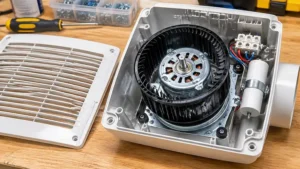
Problem 1: A low hum at low speeds. Often a controller mismatch. Woods Air Movement notes that cheap transformer-type controllers on AC motors can cause unwanted noise, which is exactly why the ECMF-150 ships with its own PWM controller. Use the supplied one.
Problem 2: Whoosh and whine at high speed. That’s airflow, not the motor. Throttle down, or step up to more CFM so you can run slower. The Toolazy 6-inch 405 CFM and CLOUDLINE PRO S6 exist for this reason.
Problem 3: Thrum through the tent frame. Suspend the fan and add rubber mats, as the VEVOR 6-inch EC bundle does.
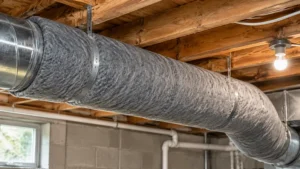
Problem 4: Rumble in the ducting. Add a silencer or insulate the duct run. Fold-and-wrap blankets even work in a pinch.
Problem 5: You need near-silence. Switch to the ECMF-150-S, or move the fan out of the room. One forum owner measured about 61 dB from roughly 3 feet away at speed 6 on a kitchen-exhaust install and expected attic mounting with a muffler to push it below 50.
✨ Ready to Pick Your Quiet Fan?
🔍 Take your ventilation to the next level with these carefully selected fans. Click any highlighted item to check current pricing and availability. These picks will help you create whisper-quiet airflow your whole household will appreciate!
How to Choose a Quiet 6 Inch Inline Fan: Buyer’s Decision Framework
What is the best way to choose a quiet 6 inch inline fan? Match CFM to your real ducting, favor EC motors, and buy headroom so you can run slow. In practice:
- Calculate your real airflow need. Tent volume, carbon filter and duct bends all add resistance, so add 20-30% to your estimate.
- Prefer EC motors. They avoid the voltage-frequency hum of throttled AC motors.
- Buy headroom. A fan rated higher than you need can run at 40% quietly.
- Check the controller. Look for true 0-100% or 8-10 steps with memory.
- Verify the dB source. Distance and speed matter, so treat single numbers skeptically.
- Budget for isolation. Straps, flex duct and a silencer can matter as much as the fan.
If your tent is a 2×4 and the fan sits in a bedroom, choose the ECMF-150-S. If it’s a 4×4 with a heavy filter, choose the CLOUDLINE PRO S6 or Toolazy 6-inch 405 CFM. If you’re watching every dollar, choose the CLOUDLINE A6 or VEVOR 6-inch EC. If you want a metal case and a two-year warranty, choose the ECMF-150.
Terrabloom Fan dB Rating: What 31 dBA Actually Means
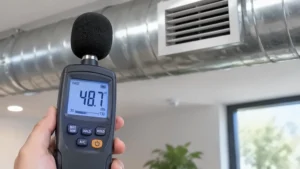
The Terrabloom fan dB rating on most listings reads 31 dBA, but the same ECMF-150 listing elsewhere gives a range of 31 to 60 dBA, and the silenced version a typical 31-50. Read that as the floor of a range, not the whole story.
For scale, a whisper is about 30 dB, and NIDCD’s chart puts normal conversation at 60-70 dBA. Quiet offices sit around 50-60. A rough rule of thumb says every 10 dB sounds about half or twice as loud, so 31 versus 60 is nearly three halvings, and your ear will register roughly seven times the loudness. That’s the real shape of the Terrabloom 6 inch inline fan noise level: a whisper at the bottom, a conversation at the top.
Also remember that dBA figures rarely state the measuring distance. The skeptical noise-control reviewer of the CLOUDLINE PRO S6 makes the point well: lab numbers and living-room numbers don’t always match.
Terrabloom Noise at Full Speed: The Honest Picture
Terrabloom noise at full speed is where marketing meets physics. Buyers report whine and wind noise near the top of the dial, with one citing about 5,000 RPM at full output, and another noting the fan gets louder with each setting after the third. Combined with the 60 dBA upper figure, full speed lands around normal conversation level.
That’s not hazardous, since it’s below the 70 dBA level NIDCD calls unlikely to damage hearing, but it’s definitely audible in a quiet home. Another buyer’s blunt advice is to be realistic: any fan at full bore is loud, so buy one you can run at 30-50%.
The practical takeaway for the ECMF-150: treat 100% as an emergency setting. If you routinely need it, you’ve undersized the fan, and the CLOUDLINE PRO S6 or Toolazy 6-inch 405 CFM will do the same job at lower RPM.

Terrabloom Quiet Mode Review: Running Low, Not Just Running Quiet
Terrabloom quiet mode review searches usually assume a button. There isn’t one. The ECMF series has no dedicated “quiet mode”; the quiet mode is the dial itself, plus the hardware choice of the silenced ECMF-150-S.
On the dial, buyers report the lowest settings as almost imperceptible, the first three digital steps as very quiet, and 30-40% as enough to replace a cheaper, louder fan with a fraction of the wattage. The fan also remembers its last setting after power loss, per a forum owner, so a quiet setting survives outages.
My verdict: set a “night” speed on the 8-speed digital controller, add the thermostat controller if you want automation, and consider the ECMF-150-S if the low setting still isn’t low enough. Quiet mode here is a habit, not a feature.
Decibel Comparison to Competitors: Where Terrabloom Really Lands
A decibel comparison to competitors shows Terrabloom is mid-pack on rated noise and strong on build.
| Fan | Rated Noise | Airflow | Airflow vs ECMF-150 |
|---|---|---|---|
| TerraBloom ECMF-150 | 31 dBA | 288 CFM | Baseline |
| Toolazy 6-inch 405 CFM | 31 dBA | 405 CFM | About 40% more |
| CLOUDLINE PRO S6 | 32 dBA | 402 CFM | About 40% more |
| CLOUDLINE A6 | 34 dBA | 352 CFM | About 22% more |
| AeroZesh T6 | Under 45 dB | 408 CFM | About 42% more |
Analysis: at equal or near-equal rated noise, rivals deliver notably more air, which is a quieter fan once you lower the speed. Terrabloom’s counterpunch is the ECMF-150-S, a hardware-level fix none of these competitors match, plus its metal casing and warranty. If your decision is purely decibels per CFM, the S6 and Toolazy 6-inch 405 CFM win. If it’s decibels at your actual bedroom wall, the ECMF-150-S is the stronger candidate.
EC Motor Noise Advantage: Why Brushless Runs Quieter
The EC motor noise advantage comes down to electronics doing the work. Assembly magazine explains that speed-controlled AC motors show noise spikes tied to voltage frequency (motor hum), which EC motors avoid. Manufacturer data puts EC efficiency up to about 90% versus 70-80% for AC, and the extra efficiency means a cooler motor.
| Factor | EC Motor (e.g., ECMF-150) | Traditional AC + Basic Controller |
|---|---|---|
| Hum at partial speed | Minimal | Often audible |
| Efficiency | Up to ~90% | ~70-80% |
| Motor heat | Cooler | Warmer |
| Speed range | Smooth 0-100% | Coarse |
| Upfront cost | Higher | Lower |
Analysis: the EC motor noise advantage is real at partial speed, which is where you’ll live. It doesn’t erase aerodynamic whoosh, which is why full speed is still loud. On cost, 36 W running nonstop is about 26 kWh a month, roughly $4-$5 at an assumed $0.17/kWh, and less when you run slower.
Grow Room Noise Reduction: Beyond the Fan
Grow room noise reduction is a system problem. Speed control is the single biggest lever, but the rest of the chain matters:
- Suspend and decouple. Straps plus flex connectors stop vibration from traveling.
- Add a silencer. AC Infinity claims its neoprene egg-crate silencers cut noise by up to 50%, and a retailer notes a 10 dB drop is perceived as roughly half the loudness. Silencers only address duct-borne sound, so vibration through rigid mounts still needs decoupling.
- Insulate ducting. Insulating runs and keeping them short and straight tackles the airflow noise that grows with every bend.
- Relocate. Moving the fan out of the room beats nearly everything else.
Put those together with the ECMF-150-S and a 40% speed setting, and the Terrabloom 6 inch inline fan noise level drops from “audible hum” toward “is it even on?”
Frequently Asked Questions
❓ Is 31 dBA quiet enough for a bedroom closet?
❓ Does a duct silencer reduce airflow on a 6-inch fan?
❓ Can I use any speed controller with a Terrabloom EC fan?
❓ Is the ECMF-150-S worth it over the standard ECMF-150?
❓ Why does my 6-inch fan sound louder than its rating?
Conclusion: Quiet Is a Setup, Not a Spec
The Terrabloom 6 inch inline fan noise level is genuinely good at the bottom of the dial: a 31 dBA-rated EC fan with 0-100% control, a metal case and a two-year warranty. At the top, it’s as loud as any 6-inch fan, roughly conversation level. The standard ECMF-150 suits growers who’ll run it low, the ECMF-150-S is the pick for bedrooms and stealth, and rivals like the CLOUDLINE PRO S6 and Toolazy 6-inch 405 CFM offer more air at the same rated noise.
The through-line is simple: buy a little more fan than you need, run it slowly, suspend it properly, and treat the duct run as part of the machine. Do that and the numbers on the box matter a lot less than the quiet in your room.
Recommended for You
- Terrabloom 6 Inch Fan For 4×4 Grow Tent: 7 Proven Picks (2026)
- Terrabloom 6 Inch Fan EC Motor: 7 Best Picks Ranked (2026)
- Terrabloom 6 Inch Inline Fan Review For Grow Tent: 7 Best (2026)
Disclaimer: This article contains affiliate links. As an Amazon Associate, I earn from qualifying purchases. If you purchase products through these links, we may earn a small commission at no additional cost to you.
✨ Found this helpful? Share it with your friends! 💬🤗
