
In This Article
Nobody buys an inline fan because they love fans. You buy one because a tent is cooking, a carbon filter is fighting for air, or a spare room shares a wall with someone who sleeps light. Then the real question arrives: how loud will this thing be at 2 a.m.?
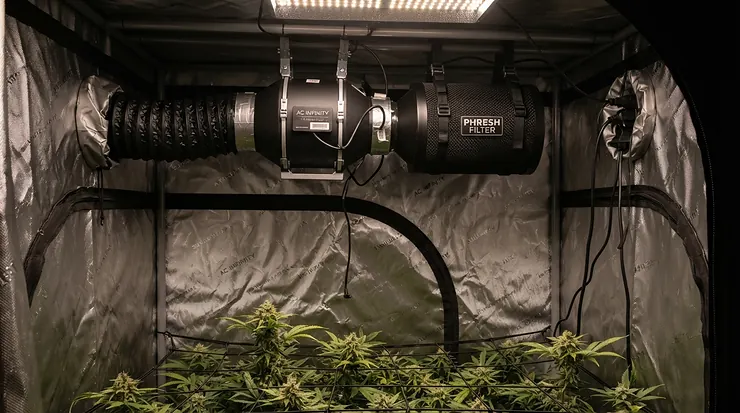
The AC Infinity Cloudline 6 inch noise level for grow room use describes how loud the Cloudline 6-inch EC-motor inline fan sounds while ventilating a tent or room. Manufacturer listings rate the PRO S6 and PRO T6 at 32 dBA and the A6 at 34 dBA at their highest setting. Real-world sound still depends on ducting, mounting, and speed.
That caveat matters because a decibel rating is a lab-style summary, not a promise about your closet. The rating uses A-weighting, which deliberately deemphasizes low frequencies. So a low, droning rumble can feel louder in a quiet room than its dBA figure suggests.
This guide pulls apart the published specs, the Cloudline 6 inch dB rating, and what reviewers consistently report. It covers quiet mode Cloudline 6 inch habits, a speed setting decibel chart built from what is actually documented, and the sound dampening accessories worth paying for. One flag before we start: some retailer pages still list an older 425 CFM / 30 dBA spec for these models, while current AC Infinity pages list 402 CFM / 32 dBA. Check which generation you’re buying.
Quick Comparison: Cloudline 6 Inch dB Rating at a Glance
Here’s the lineup this guide analyzes, from quiet EC-motor fans to the accessories that shave off the remaining noise. Prices are ranges from the time of research and will move.
| Product | Published Noise | Airflow | Price Range | Best For |
|---|---|---|---|---|
| AC Infinity Cloudline PRO S6 | 32 dBA | 402 CFM | Around $100-$120 | Quiet, no-frills tents |
| AC Infinity Cloudline PRO T6 | 32 dBA | 402 CFM | Around $150-$170 | Automated climate control |
| AC Infinity Cloudline A6 | 34 dBA | 352 CFM | Around $90 | Tight budgets |
| VIVOSUN Z6 | About 49-50 dB (listing) | 440 CFM | Around $80-$90 | Maximum airflow per dollar |
| VIVOSUN AeroZesh T6 | Varies by listing (28 to under 45) | 408 CFM | Around $130-$170 | VIVOSUN-ecosystem growers |
| AC Infinity 6″ Duct Silencer | Claims up to 50% reduction | Not applicable | Around $70 | Noisy or bedroom-adjacent setups |
| AC Infinity 6″ Noise Reduction Duct Coupler | Vibration damping | Not applicable | Under $20 | Cheap rattle fix |
Looking at the table, the Cloudline PRO S6 and Cloudline PRO T6 share the same noise and airflow numbers, so the extra money for the Cloudline PRO T6 buys automation, not silence. The VIVOSUN Z6 moves more air on paper, but its listed noise sits roughly 15 to 17 dB above the Cloudline figures, which is a big perceptual gap. Anyone worried about the sound should treat the 6″ Duct Silencer as part of the budget, not an afterthought.
💬 Just one click — help others make better buying decisions too!😊
Top 7 Picks: Expert Analysis
1. AC Infinity Cloudline PRO S6 — quietest all-rounder for tents
The headline here is a 32 dBA published rating paired with 402 CFM and a wired 10-step dial. Under the hood sits a PWM-controlled EC motor drawing about 38 watts, plus dual ball bearings. Unlike AC-motor fans that throttle speed by cutting voltage, an EC motor can crawl at low RPM without the buzz that usually comes with it.
Based on the spec comparison, this is the cleanest starting point if you care about noise first. A 4x4x6.5 foot tent holds about 104 cubic feet of air, so a 402 CFM fan has roughly three to four times the throughput it needs, which means you’ll likely run it well below maximum. That headroom is exactly where the quiet comes from.
Reviewers consistently describe it as quiet and reliable. The recurring complaints are that noise rises noticeably above speed 3 and that the controller cable is short.
Pros:
- ✅ 32 dBA published noise rating
- ✅ Ten PWM speed steps with memory
- ✅ Low 38-watt draw at full speed
Cons:
- ❌ Noise climbs noticeably above speed 3
- ❌ Short controller cable limits placement
Expect to pay around $100-$120. For quiet-first growers, that’s strong value.
2. AC Infinity Cloudline PRO T6 — same silence, smarter brain
Same motor, same housing, same 402 CFM and 32 dBA, but the controller is the upgrade. The 69 Pro smart controller adds temperature, humidity, and VPD triggers, plus dynamic fan speeds that respond as conditions change. It also connects to up to four UIS devices through the app over WiFi.
Here’s what the spec sheet won’t tell you directly: automation is a noise tool. A fan that ramps up only when the tent actually needs it spends most of its life at low speed. Pair that with time-based programming and you can hold the fan lower during sleeping hours and let it climb when the lights are on. That’s the closest thing to a built-in quiet mode Cloudline 6 inch owners get.
Review sentiment on setup is positive, with one roundup saying programming is simple enough to finish in about five minutes. The trade-off reviewers note is that full features require WiFi setup.
Pros:
- ✅ Climate-triggered speed changes
- ✅ Time-based programming for night hours
- ✅ Expandable to multiple UIS devices
Cons:
- ❌ Full features need WiFi setup
- ❌ Pricier than the dial-only model
Budget around $150-$170. Worth it if you’d otherwise adjust the dial by hand daily.
3. AC Infinity Cloudline A6 — value pick with a slightly higher floor
The standout is that it keeps the Cloudline’s EC motor and mixed-flow design in a cheaper package. It’s rated at 352 CFM and 34 dBA, draws about 35 watts, and uses dual ball bearings that AC Infinity lists at 67,000 hours. The mounting base is plastic specifically to reduce vibration noise, which is a thoughtful touch at this price.
Two decibels louder than the Cloudline PRO S6 sounds trivial, but in a very quiet room it is audible. The 352 CFM ceiling is still comfortable for a 3×3 or 4×4 tent. The practical lesson: if your fan will live at 30-50% speed anyway, the Cloudline A6 gets you most of the experience for less.
One roundup notes the Cloudline A6 has fewer reviews than the PRO model, so the sample is smaller. A reviewer in the same roundup says the mixed-flow design kept noise low even near speed 9.
Pros:
- ✅ Plastic base reduces vibration
- ✅ Compatible with Cloudline smart controllers
- ✅ Detachable motor box for cleaning
Cons:
- ❌ 34 dBA is slightly louder than PRO
- ❌ Smaller review pool than PRO models
Expect around $90. Good value for small tents.
4. VIVOSUN Z6 — raw airflow for the lowest money
The standout here is 440 CFM at 2,450 RPM. VIVOSUN lists the noise at about 49 dB, while other listings say 50 dB. It uses a knob-style variable speed controller and a steel housing that a reviewer calls fairly heavy.
Based on the spec comparison, this is a different class of quiet. A 49-50 dB rating sits near the “home air conditioning” level on common reference charts, while 32 dBA lands between “soft music” and “home computer fan.” In a bedroom-adjacent space, that gap decides the purchase.
Reviewers praise the power, and one says the lowest setting still moves plenty of air. Others call it effectively a three-speed fan and say it’s noisy. A filter attached to the intake reportedly quiets it. One buyer reported grinding noises after about five months, though VIVOSUN’s support got positive mentions for resolving problems.
Pros:
- ✅ Strong 440 CFM airflow
- ✅ Lower price than EC-motor rivals
- ✅ Reported responsive customer support
Cons:
- ❌ Listed around 49-50 dB
- ❌ Knob control feels coarse to some
Around $80-$90. Great for airflow, poor for silence.
5. VIVOSUN AeroZesh T6 — EC upgrade with confusing noise claims
The standout is that VIVOSUN’s PWM-controlled, mixed-flow EC fan comes with an E12 controller offering ten programmable speeds and an environmental probe. It moves 408 CFM at 3,100 RPM.
Here’s the catch: published noise figures disagree. One listing advertises 28 dB, another says 39 dB, and the specification table lists under 45 dB for the 6-inch size. Those can’t all describe the same measurement. Until independent measurements appear, treat the safest figure, the highest one, as your planning number.
I couldn’t verify enough independent review text for this model to summarize customer sentiment honestly, so the fair statement is that real-world loudness is unproven. The feature set, including upgrade paths to the GrowHub controller and app, is genuinely strong.
Pros:
- ✅ PWM-controlled EC motor
- ✅ Ten programmable speeds
- ✅ Includes environmental probe
Cons:
- ❌ Conflicting published noise figures
- ❌ Limited independent review evidence
Expect around $130-$170 depending on controller. Promising, but unproven on noise.

6. AC Infinity 6″ Duct Silencer — the biggest single noise cut
The standout is neoprene foam in an egg-crate pattern inside a galvanized steel body, which AC Infinity says reduces fan noise by up to 50%. It has dual aluminum flanges and fits 6-inch inline fans, and AC Infinity notes it works with other 6-inch inline fans too.
What does “up to 50%” mean? AC Infinity doesn’t define it, and the company says actual reduction varies with fan speed, duct length, and ambient noise. If it refers to perceived loudness, that would be roughly a 10 dB drop, but that’s an interpretation, not a published number. Placement matters: AC Infinity advises installing it on the output side of the fan, before the ducting run.
Listings disagree on length (roughly 13 to 20 inches), so measure your clearance first. I couldn’t verify independent review sentiment, so treat the claim as a maker’s estimate.
Pros:
- ✅ Dedicated sound dampening for ducts
- ✅ Corrosion-resistant steel body
- ✅ Fits other 6-inch inline fans
Cons:
- ❌ Added length needs room
- ❌ “Up to 50%” is not independently verified
Around $70. Worth it for bedroom-adjacent builds.
7. AC Infinity 6″ Noise Reduction Duct Coupler — cheap vibration insurance
The standout is a flexible rubber coupling with adjustable stainless steel clamps. It joins fans and filters while absorbing vibration. AC Infinity describes the nitrile butadiene rubber as suppressing noise from vibration and airflow, and the fit is airtight.
This is the unglamorous hero. Much of what people call fan noise is actually vibration traveling through rigid metal connections into ducting, then into a tent frame. Decoupling the fan with rubber stops that path. It won’t lower the motor’s own sound, but it can quiet the rattle, which is often the part you notice most at night.
Independent reviews weren’t available in the listings I reviewed, so there’s no verified sentiment to report.
Pros:
- ✅ Absorbs vibration at the fan flange
- ✅ Airtight clamped seal
- ✅ Inexpensive for the effect
Cons:
- ❌ Doesn’t reduce motor sound itself
- ❌ Needs solid ports to fit
Under $20. Excellent value.
How to Read a Cloudline 6 Inch dB Rating
A dBA figure is a weighted measurement of how loud a sound seems to human ears. The scale is logarithmic. Every 3 dB roughly doubles sound energy, and a 10 dB change is commonly perceived as about twice as loud.
Within the AC Infinity lineup, noise scales with size. AC Infinity’s PRO S-series specs show 28 dBA for the 4-inch, 32 dBA for the 6-inch, and 39 dBA for the 8-inch models, paired with 205, 402, and 807 CFM respectively. So the 6-inch sits at the sweet spot of airflow versus noise, which is why it dominates 3×3 to 4×4 tents.
Two things the label doesn’t disclose: the measurement distance and the frequency content. In the listings reviewed, neither was stated. Treat the number as a ranking tool for comparing fans, not a prediction of what you’ll measure in your own space.

Speed Setting Decibel Chart: What’s Documented and What Isn’t
AC Infinity publishes a maximum figure, not a full speed setting decibel chart. So the table below shows only what exists in published sources, and flags confidence honestly.
| Speed Setting | What’s Documented | Confidence | Best For |
|---|---|---|---|
| Speed 1 (lowest) | About 32 dB near the housing, per one retailer guide | Retailer claim, not official | Overnight, bedroom-adjacent use |
| Speeds 2-3 | Reviewers say noise stays low up to about speed 3 | Reviewer report | Sleeping hours |
| Speeds 4-6 | Retailer guide estimates 35-38 dB at 40-60% | Retailer estimate | Lights-on daytime |
| Speed 10 (max) | Official 32 dBA rating; the same retailer guide cites about 45 dB near the housing | Conflicting | Short heat purges only |
Notice the contradiction: 32 dBA is the official rating at full speed, yet the retailer guide cites roughly 32 dB at the lowest setting and about 45 dB at full speed near the housing. Both may be true if the measurements use different distances, but neither is verified. The practical answer is to measure with a free sound-level phone app at your own listening position.
Cloudline Fan Noise at Max Speed: What to Expect
Full throttle is where the honest conversation lives. The official 32 dBA rating applies to the highest setting, and a roundup describes it as less than a typical refrigerator hum. Another review says some users report noise at full speed, and one says noise increases noticeably above speed 3. Those aren’t contradictory: air turbulence rises sharply as RPM climbs.
If a fan runs at night, the World Health Organization’s Night Noise Guidelines for Europe set a target of 40 dB for annual average night exposure outside homes. That’s a different measurement from an indoor fan reading, but it shows why sleep-adjacent spaces deserve stricter standards than a basement tent.
Rule of thumb: with 402 CFM on tap, running at max is rarely necessary. Reserve it for emergencies and let the controller do the work.
Quiet Mode Cloudline 6 Inch: How to Run It Whisper-Quiet
There’s no dedicated quiet mode Cloudline 6 inch button. Quiet comes from how you configure it.
Step 1: Start low. Set the fan to speed 2 or 3 and watch tent temperature for an hour before moving up. Reviewers say the noise stays gentle up to about speed 3.
Step 2: Use the memory. The dial remembers its last setting after a power outage, so a surprise reboot won’t blast you at full speed.
Step 3: Schedule it. On the Cloudline PRO T6, use time-based programming so the fan idles lower during sleeping hours.
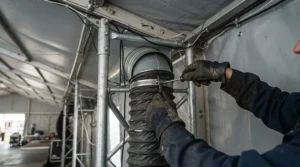
Step 4: Decouple the fan. Add the Noise Reduction Duct Coupler at the flange to stop vibration reaching the frame.
Step 5: Check month one. Common first-month mistakes include rigid mounting on a hollow wall, kinked ducting, and cranking the dial when the real problem is a clogged filter.
Do this and the fan becomes background. Skip it, and even a quiet motor can sound like a drone.
Sound Dampening Accessories That Actually Work
The best sound dampening accessories attack specific paths: vibration, airflow turbulence, and structure-borne rumble. Here’s how they compare.
| Accessory | Price Range | Noise Claim | Best For |
|---|---|---|---|
| AC Infinity 6″ Duct Silencer | Around $70 | Up to 50% (maker claim) | Airflow noise |
| AC Infinity 6″ Noise Reduction Duct Coupler | Under $20 | Vibration damping | Rattles |
| AC Infinity 6″ four-layer ducting | Around $25 | No dampening properties, per AC Infinity | Durable airflow runs |
| Carbon filter on intake | Varies | Reviewers say filters quiet some fans | Odor plus intake hush |
The surprising line is ducting: AC Infinity’s own FAQ says its four-layer ducting isn’t designed for noise dampening, so don’t expect it to muffle the fan. Prioritize the 6″ Noise Reduction Duct Coupler first because it’s cheap, then add the 6″ Duct Silencer if the fan is still audible. Order matters: fix vibration before airflow noise.
How to Choose a Quiet 6 Inch Inline Fan
- Match the airflow to the space. Oversized fans run at low speed, which is quieter than a small fan screaming at max.
- Prefer an EC motor with PWM control. It can run at very low RPM without electrical hum.
- Compare dBA, not marketing adjectives. “Whisper-quiet” is not a measurement.
- Check for conflicting specs. If one page says 28 dB and another says 39 dB, plan for the higher figure.
- Budget for accessories. A silencer and coupler can matter more than a 2 dBA fan difference.
- Plan the placement. Distance from the sleeping area and hanging method change what you hear.
- Look at controller features. Scheduling beats manual adjusting for consistent quiet.
Bedroom-Adjacent Grow Room Noise: A Practical Playbook
Bedroom-adjacent grow room noise is a different problem from basement noise because the standard isn’t “tolerable,” it’s “invisible while you sleep.” The Sleep Foundation notes a quieter bedroom is better for sleep and advises keeping the space as quiet as possible.
Consider three scenarios:
The apartment closet grower (3×3 tent, shared wall). Choose the Cloudline PRO S6, add the 6″ Duct Silencer, and run at speed 2-3. Budget around $170-$190 total.
The spare-room grower with a smart-home habit. Choose the Cloudline PRO T6. Schedule lower night speeds and let climate triggers do the rest.
The tight-budget grower. Choose the Cloudline A6 plus the 6″ Noise Reduction Duct Coupler for around $105-$110 total.
In every case, hang the fan from soft or isolated mounts, keep ducting gently curved, and avoid mounting directly to a wall shared with a bedroom.
Problem → Solution Guide: Hum, Rattle, and Whoosh
Problem: a low hum at night. Solution: drop the speed a notch, since noise reportedly increases noticeably above speed 3, then add a duct silencer.
Problem: rattling. Solution: replace any rigid connections with the Noise Reduction Duct Coupler and check hanger tension.
Problem: whooshing air. Solution: reduce speed and smooth out sharp ducting bends. The Cloudline PRO S6 and Cloudline PRO T6 use a mixed-flow design that holds airflow under static pressure, so you rarely need to compensate with extra RPM.
Problem: the fan got louder over months. Solution: dust and wear raise noise. AC Infinity describes the Cloudline A6 motor box as detachable for cleaning. If a different model grinds, such as the failure one VIVOSUN Z6 owner reported, contact support.
Cloudline vs Traditional Inline Fans
| Factor | EC-Motor Cloudline | Knob-Controlled Alternative (VIVOSUN Z6) | Best For |
|---|---|---|---|
| Speed control | Ten PWM steps with memory | Knob; some reviewers call it effectively three-speed | Precision vs simplicity |
| Low-speed behavior | Designed to run at very low RPM | One reviewer wanted a lower minimum | Quiet tents |
| Published noise | 32-34 dBA | About 49-50 dB | Bedroom-adjacent builds |
| Price range | Around $90-$170 | Around $80-$90 | Budget |
The headline difference is the low end. Cloudline’s EC design is built for quiet low speeds, while knob-controlled alternatives can leave you stuck with more airflow than you want. If you only ever run at full tilt in a basement, the savings from the VIVOSUN Z6 make sense. If you ever sleep near the tent, they don’t.
Features That Actually Matter (And Those That Don’t)
Matters: the published dBA rating, a low-speed floor, vibration isolation, and the ability to schedule speeds.
Doesn’t matter as much: peak CFM above what your tent needs, since you’ll rarely run it, and flashy app dashboards if you only set a fan once.
Also worth noting: all Cloudline 6-inch models share an EC motor, so the Cloudline PRO S6 and Cloudline PRO T6 are acoustically identical. The extra cost buys control, not quiet.
Long-Term Cost & Maintenance
Running costs are small. At the listed 38 watts, the Cloudline PRO S6 uses about 27 kWh if run at full speed around the clock for 30 days. At $0.15 per kWh that’s roughly $4 a month; at $0.20 it’s nearer $5.50. Lower speeds draw less, though AC Infinity doesn’t publish the curve.
Maintenance is mostly dust. Clean the impeller periodically, check clamps for loosening, and re-seat hangers if you notice a new rattle. The Cloudline A6 lists 67,000-hour dual ball bearings, which suggests a long runtime.
The real total cost of quiet is the fan plus accessories: around $100-$120 for the Cloudline PRO S6, around $70 for the 6″ Duct Silencer, and under $20 for the coupler.
FAQ
❓ Does a carbon filter make the Cloudline louder or quieter?
❓ Can I add a silencer to any 6 inch fan?
❓ How does 32 dBA compare with everyday sounds?
❓ Does the Cloudline PRO T6 have a night mode?
❓ Why did my Cloudline get louder after a few months?
Conclusion
The AC Infinity Cloudline 6 inch noise level for grow room use is genuinely low on paper, with published figures of 32 dBA for the Cloudline PRO S6 and Cloudline PRO T6 and 34 dBA for the Cloudline A6. But the winning move isn’t just buying the quietest rating. It’s running the fan low, decoupling vibration, and adding a 6″ Duct Silencer when walls are shared.
If silence is the priority, start with the Cloudline PRO S6, add the 6″ Noise Reduction Duct Coupler, and measure your own room. Choose the Cloudline PRO T6 if you want automation to hold quiet hours for you. Choose the Cloudline A6 when the budget is tight. The VIVOSUN Z6 and VIVOSUN AeroZesh T6 are worth considering only if you accept louder or less-verified noise numbers.
The honest limits: AC Infinity doesn’t publish a per-speed decibel table, and some listings conflict. Trust your own sound-level reading over any single claim.
✨ Ready to build a quieter grow?
🌱 Pick your fan, add the accessories that fit your walls, and check current pricing before you buy. Your sleep (and your neighbors) will thank you!
Recommended for You
- AC Infinity Cloudline 6 Inch Vs Terrabloom 6 Inch: 7 Best Fans (2026)
- AC Infinity Cloudline 6 Inch Vs Vivosun 6 Inch: 7 Best Fans 2026
- AC Infinity Cloudline 6 Inch Review For 4×4 Tent: 7 Proven Fans 2026
Disclaimer: This article contains affiliate links. As an Amazon Associate, I earn from qualifying purchases. If you purchase products through these links, we may earn a small commission at no additional cost to you.
✨ Found this helpful? Share it with your friends! 💬🤗
