

In This Article
The Vivosun 6 inch inline fan noise level is the sound a Vivosun 6-inch duct fan produces while running, quoted in decibels (dB) on the product listing. Depending on the model, listed figures range from roughly 32 dB to 50 dB. That number says little about how loud the fan feels once ducting, speed, and room acoustics join in.

Here’s the catch. The same fan can carry three different dB claims on three different pages. During research, I found the Vivosun R6 listed as under 34 dB, at 37 dB, and at 45 dBA, depending on where I looked. So this guide treats every number as a clue, not a verdict.
A quick honesty note. I haven’t put these fans on a sound meter, and nothing below is a lab measurement. What you’re getting is a careful read of manufacturer specs, retailer listings, reviewer comments, and basic acoustics, with the contradictions flagged rather than smoothed over.
Why does this matter? Noise decides whether your grow tent lives in a garage or a bedroom closet. Prolonged exposure to loud sound is also a real health topic, and the CDC’s NIOSH noise guidance is a useful yardstick. We’ll cover the dB rating, Vivosun fan noise at full speed, the speed dial noise difference, and the myth of a “quiet mode.” Then seven real fans get ranked.
Quick Comparison: Vivosun 6 Inch Inline Fan Noise Level at a Glance
| Fan | Motor | Listed CFM | Listed noise | Speed control | Best For |
|---|---|---|---|---|---|
| Vivosun 240 CFM Inline Duct Fan | AC | 240 | Under 37 dB | Variable | Quiet rooms, duct boosting |
| Vivosun R6 390 CFM | AC | 390 | 34 to 45 dBA (conflicting) | Stepless cord dial | Budget 4×4 tents |
| Vivosun Z6 440 CFM | AC | 440 | About 49 to 50 dB | Variable dial | Maximum airflow |
| Vivosun AeroZesh S6 | EC | 405 | 35 to 45 dBA (conflicting) | GrowHub E42A | Automation fans |
| Vivosun AeroZesh T6 | EC | 408 | 32 dBA (kit) to under 45 dB | GrowHub E42A+ | Noise-sensitive spaces |
| AC Infinity Cloudline S6 | EC | 402 | 32 dBA | 8-speed controller | Quietest low-speed running |
| VEVOR Tuspuzz 6-Inch | EC | 402 | Not verified | Temp/humidity controller | Budget EC shoppers |
Look at the pattern. The AC-motor fans (Vivosun R6 390 CFM, Vivosun Z6 440 CFM) cluster at the louder end, while the EC-motor fans claim the lowest numbers. The Vivosun Z6 440 CFM is the clear outlier at roughly 50 dB. If silence is the priority, the EC models deserve a closer look, but the conflicting listings mean you should treat their claims cautiously.
💬 Just one click — help others make better buying decisions too!😊
Top 7 6 Inch Inline Fans: Vivosun 6 Inch Inline Fan Noise Level Analysis
Seven real fans, five from Vivosun and two outside alternatives, with commentary on what each noise claim means in practice. Price tiers are approximate, so check current price on each listing.
1. Vivosun 240 CFM Inline Duct Fan — lowest power draw in the lineup
This is the gentle giant, or really the gentle mouse, of Vivosun’s 6-inch range. It spins at 2960 RPM, draws only 37 W, and is listed under 37 dB with a permanently lubricated bearing.
That 37 W figure is roughly half what the Vivosun R6 390 CFM draws. Low airflow is why the noise stays modest: the impeller isn’t fighting hard. The listing also states this fan can’t be used with a carbon filter, so it’s built for bathrooms, workshops, and HVAC boosting, not filtered grow tents. Vivosun’s own comparison table agrees on the 37 dB figure, which is more consistency than some siblings manage.
Reviewers on retailer listings describe it as fairly quiet but audible, like faint white noise. Others say most of the sound comes from air rushing out of the duct, and one reports running it nonstop for three years.
Pros:
- ✅ Lowest wattage of the Vivosun 6-inch group
- ✅ Consistent dB claim across sources
- ✅ Speed control described as smooth and linear
Cons:
- ❌ Can’t pair with a carbon filter
- ❌ Modest airflow limits tent use
Budget tier, so check current price. Excellent value for ducting jobs where silence matters more than muscle.

2. Vivosun R6 390 CFM — the budget tent workhorse
The R6 is Vivosun’s best-known 6-inch fan, with a plastic housing and blades, a 5.9-foot cord, and a stepless speed controller built into the cord.
Spec-wise, it runs around 2450 to 2550 RPM (the listings disagree) and draws roughly 67 to 70 W. The noise claim is where it gets messy: under 34 dB on one retailer, 37 dB on another, and 45 dBA on Vivosun’s own kit page. If I had to bet, I’d plan around the high end, around 45 dBA at full tilt, and treat the lower figures as best-case. A Walmart reviewer also notes the fan doesn’t fit Vivosun’s silencer directly and needs a short duct section in between.
One listing mirror shows the combo with a 4.6-star average across more than 1,500 ratings. Reviewer sentiment on related Vivosun fans is mixed on noise: some call it manageable, others say it’s noticeable. Most agree the dial helps.
Pros:
- ✅ Large review base and strong average rating
- ✅ Stepless dial on the cord
- ✅ Light plastic build, easy to hang
Cons:
- ❌ Dial range may not drop low enough for silence
- ❌ Conflicting dB claims across listings
Budget-to-mid tier, so check current price. Good value if you’ll run it below full speed.
3. Vivosun Z6 440 CFM — most airflow, most noise
Think of the Z6 as the pickup truck of the range. It’s the most powerful of the group, rated at 440 CFM, 2450 RPM, 135 W, and about 49 to 50 dB, with a galvanized steel body wrapped in a vegan-leather cover to damp vibration.
Honest analysis: 135 W and 440 CFM are the ingredients of a louder fan. The listing’s “under 50 dB” is also the highest claim here, and it’s the only one that doesn’t pretend otherwise. Steel housing means vibration can travel into your hanging hardware, so mounting matters.
Reviews split into camps. Fans praise raw power and the included bracket. Critics say the noise was audible throughout their home, one calls the speed dial unsatisfying, and another says it behaves like a three-speed fan in practice. A longer-term reviewer found it tolerable on the lowest setting for a few months before it began grinding.
Pros:
- ✅ Highest airflow of the Vivosun 6-inch group
- ✅ Sturdy metal construction
- ✅ Mounting bracket included
Cons:
- ❌ Loudest claim in the lineup
- ❌ Dial feels coarse to some reviewers
Mid tier, so check current price. Pick it only if airflow matters more than quiet.
4. Vivosun AeroZesh S6 — EC efficiency with smart control
The AeroZesh S6 trades the old AC motor for an EC motor and a PWM controller, with 405 CFM at 3100 RPM from just 35 W.
That wattage is dramatically lower than the AC models above. EC motors typically run cooler and quieter, and PWM control means finer speed steps. The catch is the noise label: the product page headline says 35 dB, but the bullet and spec table say 45 dBA. Which is right? Possibly both, depending on measurement conditions Vivosun doesn’t disclose. Plan for the higher number until independent measurements say otherwise.
It pairs with the GrowHub E42A WiFi controller, so you can automate speed by temperature and humidity. Reviewer data for this exact 6-inch model was thin in my research, so I can’t responsibly summarize sentiment.
Pros:
- ✅ Only 35 W for 405 CFM
- ✅ PWM-controlled EC motor
- ✅ App and automation compatible
Cons:
- ❌ Conflicting 35 versus 45 dB claims
- ❌ Limited verified review data
Mid-to-upper tier, so check current price. Strong value if you’ll use the automation.
5. Vivosun AeroZesh T6 — lowest claim in the Vivosun range
The T6 is the model most likely to earn a “quiet” label. The PRO kit listing claims 32 dBA at 3000 RPM and 408 CFM from 35 W, with IP44 protection and the GrowHub E42A+.
Now the reality check. One retailer’s listing for the standalone T6 states under 45 dB for the 6-inch size, with 39 dB in the marketing text. Vivosun’s own Amazon comparison table lists a T6 variant at 32 dB. Three claims, one fan family. My read: 32 dB is probably a low-speed or best-case figure, and full speed lives closer to the upper numbers.
Still, mixed-flow design plus EC motor is the right recipe for lower noise per CFM. Reviews specific to this model weren’t verifiable during research.
Pros:
- ✅ Lowest listed Vivosun noise figure
- ✅ Energy-efficient 35 W draw
- ✅ Smart controller included in kit
Cons:
- ❌ Claims vary across retailers
- ❌ Premium tier pricing
Upper tier, so check current price. Worth it for bedroom-adjacent tents.

6. AC Infinity Cloudline S6 — quiet at low speed, by design
An outside alternative, and the benchmark most Vivosun shoppers end up comparing against. The Cloudline S6 uses an EC motor, an 8-speed controller, dual ball bearings rated at 67,000 hours, and a stated 32 dBA.
The dial-versus-noise story is where it shines. The manufacturer says EC control avoids the voltage-suppression approach common in AC fans, enabling smooth running at very low RPM without motor whine. One retailer’s FAQ goes further, claiming about 45 dB at full speed, about 32 dB at the lowest setting, and roughly 35 to 38 dB at 40 to 60 percent. That’s a retailer’s claim, not a lab result, so hedge accordingly.
A two-year warranty and controller upgrade path add value. I didn’t verify independent review sentiment, so I’m not summarizing any.
Pros:
- ✅ Eight discrete speed steps
- ✅ Two-year warranty
- ✅ Smart-controller upgrade path
Cons:
- ❌ Higher price than the AC-motor Vivosun fans
- ❌ Noise figures aren’t lab-verified
Upper tier, so check current price. Best pick for people who’ll live at low speed.
7. VEVOR Tuspuzz 6-Inch 402 CFM — the lesser-known EC alternative
A lesser-known option with an EC motor, a temperature and humidity controller, and rubber vibration-damping mats. It was listed at around $90 on Walmart at the time of research.
I could not verify a dB rating for this fan, so I won’t invent one. What I can say: EC motors have a good noise reputation, and the rubber mats address vibration noise, which is a real contributor. The risk is a thin review base. Retailer pages showed only a handful of reviews, so long-term reliability is unproven.
This is the “interesting gamble” in the lineup. It makes sense if you want EC benefits without the Vivosun or AC Infinity premium.
Pros:
- ✅ EC motor at a modest price
- ✅ Includes temp and humidity controller
- ✅ Vibration-damping mats
Cons:
- ❌ No verified dB rating
- ❌ Few reviews to learn from
Around the $90 range at research time, so check current price. Fair value, but verify the noise yourself.
Quiet Setup Guide: How to Cut Your Vivosun 6 Inch Inline Fan Noise Level
Most noise complaints come from installation, not the fan itself. Follow these steps in order.
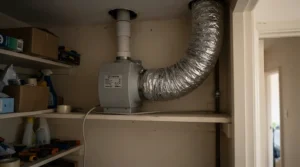
- Hang it, don’t sit it. Suspend the fan with rubber-lined straps or bungee cords. One reviewer used bungee cradles and reported a quieter result.
- Break the vibration path. Rubber washers between bracket and surface stop the housing from turning a wall into a speaker.
- Keep ducting straight and short. Kinks add turbulence, and turbulence is noise.
- Add a silencer. Vivosun’s own R6 listing recommends one. AC Infinity’s 6-inch silencer claims up to 50 percent reduction and costs around $70, though actual results depend on speed and ducting.
- Place the fan near the filter. Vivosun advises mounting it as close to the carbon filter as possible.
- Run it lower. Raising capacity with a bigger fan and running it slower often beats a smaller fan at full speed.
Pro tip: in the first 30 days, clean the fan after week one if a carbon filter is attached, as Vivosun recommends. Dust on the blades creates imbalance, and imbalance is noise.

Real-World Scenarios: Matching the Right Fan to Your Space
Scenario 1: The apartment grower. A 2×4 tent in a bedroom closet, running 18 hours a day. Here, the AeroZesh T6 or Cloudline S6 make the most sense, run at low speed with a silencer. The noise budget is tiny, so EC motors and slow speeds justify the premium.
Scenario 2: The garage grower. A 4×4 tent in a detached garage, where ambient noise already exists. The Vivosun R6 390 CFM is the rational pick: sufficient airflow, lower cost, and a dial for tuning. A louder fan is simply less of a problem here.
Scenario 3: The HVAC booster. You want to push air into a cold upstairs room through existing 6-inch duct. The Vivosun 240 CFM Inline Duct Fan fits well. Reviewers describe using it exactly this way, and its lower wattage suits continuous duty.
Scenario 4: The max-airflow tent. A tall tent running high-wattage lights, where heat removal beats everything. The Vivosun Z6 440 CFM earns its place, but budget for a silencer and vibration isolation.
✨ Don’t Miss These Exclusive Deals!
🔍 Take your ventilation setup to the next level with these carefully selected fans. Click on any highlighted item to check current pricing and availability. Matching the right motor to your space is the quickest route to a quieter grow!
Noise Problems and Fixes: A Problem-to-Solution Guide
Problem: A low hum even at the lowest dial setting.
Likely an AC motor responding to reduced voltage. Fixes: add a silencer, isolate the mount, or move to an EC fan. Reviewers of AC models often mention the dial not dropping low enough.
Problem: Rattling or buzzing.
Usually loose duct connections. One reviewer flagged the lip that joins filter to fan as a weak point. Tighten clamps, add foil tape, and check that nothing touches the housing.
Problem: A new grinding or screeching sound.
One long-term reviewer reported a screech and eventual failure after months of service. Stop the fan, inspect the blades for debris, and contact support if it’s under warranty.
Problem: “It’s louder than the listing says.”
Often, that’s physics. Sound drops about 6 dB each time you double your distance from the source, and listings rarely state their measurement distance. Add that to the fact that a 3 dB increase already represents a doubling of sound intensity, per this GreenFacts decibel definition, and a “small” dB gap becomes a big real-world difference.
Problem: Wind noise at the outlet.
Reviewers note most of the sound is air rushing out. A silencer on the exhaust side, plus larger-diameter ducting, calms it.
What Is Vivosun 6 Inch Inline Fan Noise Level?
The Vivosun 6 inch inline fan noise level is the manufacturer-stated sound output of Vivosun’s 6-inch duct fans, typically 32 to 50 dB depending on model and motor type. It reflects fan-body noise under test conditions, not what you hear after ducting, filters, and room reflections.
Think of it like a car’s fuel economy sticker: useful for comparing, rarely identical to real life. The physical drivers are simple. Higher RPM means more blade-pass noise, bigger airflow demands mean more turbulence, and motor type (AC versus EC) changes the hum character.
Two things most listings leave out: the distance the microphone sat from the fan, and whether the reading came at full speed or a lower setting. Without those, a bare number is a marketing figure, not a measurement.
The practical takeaway is to compare within a family, not across brands, and to assume the loudest listed number for each model is the realistic full-speed case.
Vivosun 6 Inch dB Rating: What the Numbers Really Mean
A Vivosun 6 inch dB rating is a single number trying to describe a complicated sound. Decibels are logarithmic, as the Wikipedia decibel article explains, so a 10 dB difference is far bigger than it looks. As a rule of thumb, +10 dB sounds about twice as loud to human ears.
Here’s how the conflicting claims stack up:
| Model | Claim A | Claim B | Claim C |
|---|---|---|---|
| Vivosun R6 390 CFM | Under 34 dB | 37 dB | 45 dBA |
| Vivosun Z6 440 CFM | 49 dB | 50 dB | Under 50 dB |
| Vivosun AeroZesh S6 | 35 dB | 45 dB | 45 dBA |
| Vivosun AeroZesh T6 | 32 dBA | 39 dB | Under 45 dB |
| Vivosun 240 CFM Inline Duct Fan | Under 37 dB | 37 dB | — |
The pattern is telling. Only the Vivosun 240 CFM Inline Duct Fan and the Vivosun Z6 440 CFM get consistent claims. For the others, the lowest number probably reflects a favorable test condition, and the highest is the safer planning figure. Also note “dBA” weighting, which accounts for human hearing sensitivity, versus plain dB, which doesn’t.
Vivosun Fan Noise at Full Speed
Vivosun fan noise at full speed is where listing claims are most likely to be tested. Here’s the honest range.
The AC-motor models sit at the high end: about 45 dBA for the Vivosun R6 390 CFM by Vivosun’s own kit page, and about 50 dB for the Vivosun Z6 440 CFM. The EC models claim lower, but the conflicting 35 versus 45 dBA labels on the AeroZesh S6 suggest a full-speed figure near the top of that range.
What does 45 to 50 dB feel like? Roughly an air conditioner’s background hum or a quiet office. It’s not harmful. NIOSH’s recommended exposure limit sits at 85 dBA over an eight-hour shift, well above any of these fans. But “not harmful” and “not annoying” are different bars, especially in a bedroom at night.
Full speed also costs you in other ways: more vibration, more wind noise at the outlet, and faster bearing wear. Most reviewers who describe their fans as quiet are not running them flat out.

Speed Dial Noise Difference: Low, Medium, and High
The speed dial noise difference is bigger than most buyers expect. An engineering rule of thumb says fan noise rises steeply with speed, roughly 50 times the log of the speed ratio in dB. Slowing a fan by 20 percent could trim around 5 dB, though airflow drops by about the same proportion.
Dial quality matters too. One reviewer described the Vivosun Z6 440 CFM dial as effectively a three-speed fan. The Vivosun R6 390 CFM has a stepless dial, and the Vivosun 240 CFM Inline Duct Fan is praised for a linear feel. AC Infinity notes that common AC fans slow down by suppressing voltage, which can leave motor noise behind. EC models using PWM avoid that, which explains why the Cloudline S6 markets low-RPM smoothness.
Practical dial settings: low for background ventilation, medium for most grows, and high only for heat spikes. A retailer FAQ suggests many growers run EC fans at 40 to 60 percent, which is the sweet spot between airflow and sound. Remember this is anecdotal guidance, not a measurement.
Vivosun Quiet Mode 6 Inch: Does It Exist?
Searching for a Vivosun quiet mode 6 inch setting? I couldn’t find a dedicated “quiet mode” documented in any Vivosun 6-inch listing. The marketing language says “low noise” and “quiet,” but that’s a description, not a switch.
What you can build is a functional equivalent:
- On AC models: set the dial to its lowest position and add a silencer. Vivosun itself recommends a compatible 6-inch silencer for the R6.
- On AeroZesh models: the listing says the GrowHub controller lets you program fan speed and airflow, so you can cap speed or schedule lower night-time settings. That’s the closest thing to a quiet mode in the range.
- On any model: reduce duct length, remove sharp bends, and mount with vibration isolation.
Be skeptical of any claim that a fan has a hidden quiet mode. A true quiet mode would cut RPM, and that cuts airflow too. There’s no free lunch, only smart trade-offs.
How to Choose a Quiet 6 Inch Inline Fan
- Decide your noise budget first. Bedroom-adjacent tents need EC fans; garages can tolerate AC models.
- Size for airflow, then run slower. A 6-inch fan running at 50 percent is typically quieter than a smaller fan at full speed.
- Prefer EC motors for low-speed use. They avoid voltage-suppression hum and draw less power.
- Distrust single dB numbers. Look for the same figure on at least two pages.
- Check dial type. Stepless or multi-step controls beat coarse two- or three-position behavior.
- Budget for a silencer. Around $70 for a quality one is cheaper than replacing a loud fan.
- Check filter compatibility. The Vivosun 240 CFM Inline Duct Fan can’t pair with a carbon filter.
EC vs AC Motors: Is the Quiet Premium Worth It?
An EC (electronically commutated) motor replaces mechanical brushes with electronics. As this Danfoss explainer notes, that removes brush wear and boosts efficiency. Speed control is also far finer than on AC motors.
| Feature | AC Models | EC Models |
|---|---|---|
| Examples | Vivosun R6 390 CFM, Vivosun Z6 440 CFM | AeroZesh T6, Cloudline S6 |
| Power draw | About 67 to 135 W | About 35 W |
| Low-speed behavior | Can hum | Smooth |
| Price | Lower | Higher |
| Best For | Budget and garages | Quiet spaces |
The wattage gap is the headline. The AeroZesh T6 draws 35 W against 135 W for the Vivosun Z6 440 CFM, so a 24/7 fan saves real money over a year. Combined with smoother low-speed running, that makes EC the logical upgrade for anyone who values silence. If noise doesn’t matter, though, the AC fans remain perfectly sensible.
FAQ
❓ How loud is a Vivosun 6 inch inline fan on low speed?
❓ Is the Vivosun R6 quiet enough for a bedroom?
❓ Do Vivosun inline fans get louder over time?
❓ Can I use a duct silencer with a Vivosun 6 inch fan?
❓ Is a Vivosun AeroZesh EC fan quieter than the R6?
Conclusion
Here’s the honest bottom line on the Vivosun 6 inch inline fan noise level. The numbers on the box are a starting point, not a promise. Expect roughly 45 to 50 dB at full speed from the AC models, and plan for the higher end of any EC claim until independent tests say otherwise.
Pick the Vivosun 240 CFM Inline Duct Fan for quiet ducting jobs, the Vivosun R6 390 CFM for budget tents, and the Vivosun Z6 440 CFM only when airflow trumps peace. If silence is the goal, the AeroZesh T6 and Cloudline S6 are the strongest candidates, with the Tuspuzz as a budget gamble. Whatever you choose, slow it down, hang it properly, and add a silencer.
✨ Ready to build a quieter grow?
Check current pricing on your favorite fan above, and pair it with a silencer and good mounting for the biggest drop in noise. 🌿
Recommended for You
- Vivosun 6 Inch Fan Vs Terrabloom 6 Inch: 7 Proven Picks (2026)
- Vivosun 6 Inch Inline Fan Review For 4×4 Tent: 7 Honest Picks 2026
- Vivosun 6 Inch Fan And Carbon Filter Combo: 7 Best Kits Ranked 2026
Disclaimer: This article contains affiliate links. As an Amazon Associate, I earn from qualifying purchases. If you purchase products through these links, we may earn a small commission at no additional cost to you.
✨ Found this helpful? Share it with your friends! 💬🤗
