
In This Article
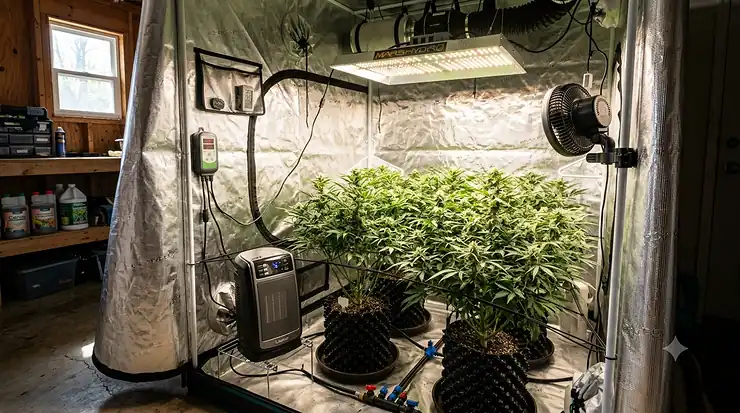
If you’ve ever walked into your grow room on a January morning and watched your thermometer read 54°F, you already know why an electric heater grow tent setup isn’t optional gear — it’s the difference between a healthy harvest and a stalled one. Cold roots slow nutrient uptake, cold air invites mold once humidity climbs, and a few rough nights during flowering can knock weeks off your timeline.
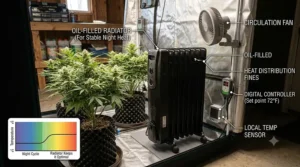
The tricky part is that “just buy a space heater” is bad advice. Tents are small, enclosed, and full of flammable fabric, which means the heater that works fine in your living room can be a genuine hazard six inches from a canopy. You need something sized correctly, built with real tip-over and overheat protection, and — ideally — smart enough to stop babysitting.
I spent time digging through what’s actually selling on Amazon right now, what growers are saying about these units on forums, and what the manufacturers’ own safety documentation says, so this isn’t a recycled spec sheet. Below you’ll find seven real products spanning budget mini heaters to app-controlled smart units, plus a winter grow tent heater buying framework, a problem/solution guide, and answers to the questions people actually search before buying.
Quick Comparison Table
| Heater | Power | Smart Controls | Best For | Price Range |
|---|---|---|---|---|
| AC Infinity THERMOFORGE T3 | 530W | VPD + app | Automated, serious growers | $100–$130 |
| VIVOSUN AeroFlux W70 | 700W | VPD + app | Strong heat in a small footprint | $80–$110 |
| Spider Farmer Grow Tent Heater | 530W | App + day/night | GGS ecosystem users | $70–$90 |
| Vornado TAVH10 | 750/1500W | Auto-climate | Heating the room around the tent | $90–$120 |
| Aikoper Oil-Filled Radiator | 600/900/1500W | Digital thermostat | Unattended overnight use | $50–$70 |
| Pro Breeze 1500W Ceramic | 750/1500W | Basic thermostat | Budget, garage-tent setups | $30–$45 |
| Brightown 400W Mini Heater | 400W | Manual | Small 2×2/2×4 tents | $20–$30 |
A pattern jumps out here: wattage and “smartness” don’t move together in a straight line. The Brightown costs a third of the Aikoper but is actually the safer pick for a tiny tent, because a 1500W unit in a 2×2 space will overheat the enclosure long before it overheats itself. Meanwhile, the AC Infinity and VIVOSUN units justify their higher price with VPD-aware automation — they’re heating based on what your plants actually need, not just a thermostat dial. If you’re running a single 4×4 tent and don’t want to think about it again, the mid-tier app-controlled options are worth the extra $20–$30 over a basic ceramic heater.
💬 Just one click — help others make better buying decisions too!😊
✨ Don’t Miss These Exclusive Deals!
🔍 Take your grow tent climate control to the next level with these seven heaters. Click on any highlighted pick to check current pricing and availability on Amazon — your plants will thank you for it. 😊
Top 7 Electric Heater Grow Tent Picks: Expert Analysis
1. AC Infinity THERMOFORGE T3
The AC Infinity THERMOFORGE T3 is the heater I’d point a serious grower toward first, mainly because of how it measures success. Most heaters in this category just chase a temperature number; the T3 tracks vapor pressure deficit (VPD) — the relationship between temperature and humidity that actually determines how well your plants move water and nutrients. That 530W rating sounds modest next to a 1500W space heater, but the included extension hose lets you pipe warm air directly into the tent’s lower canopy zone instead of just heating the room, which is a far more efficient use of those watts.
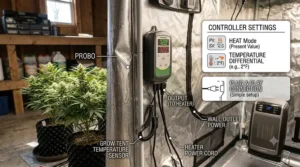
What stands out in practice: growers who’ve swapped a DIY combo of an Inkbird controller, a generic space heater, and a separate inline fan for this single unit report it replacing all three pieces of equipment cleanly. The trade-off is that the corded sensor probe and app setup take a few extra minutes the first time — not a heater you grab out of the box and have running in sixty seconds.
✅ Pros: VPD-based automation, hose for targeted heating, tilt/fall auto-shutoff
✅ Pros: Cuts down on separate controller hardware
❌ Cons: Setup curve for first-time app users
❌ Cons: 530W may be light for unheated garages
Best for: Growers running 4×4 or 5×5 tents who want one device handling temperature, humidity targets, and air circulation together. In the $100–$130 range, it’s a solid value if it’s replacing three other gadgets.
2. VIVOSUN AeroFlux Smart Grow Tent Heater (W70)
If the AC Infinity’s 530W feels underpowered for your space, the VIVOSUN AeroFlux answers that directly with 700W of PTC heating — VIVOSUN markets it as roughly 40% stronger than standard tent heaters, and the extra wattage shows up as faster recovery time after you open the tent flap to check on plants. Five adjustable heat levels paired with PWM control mean you’re not stuck choosing between “barely on” and “blasting.”
What most buyers overlook about this model is the Recipe feature buried in the app — it lets you program separate day and night temperature targets so the heater automatically backs off during the dark cycle instead of you remembering to adjust it manually every twelve hours. That’s a meaningful win for flowering-stage plants, which want a noticeably cooler night temperature to intensify color and extend bloom life.
✅ Pros: Highest wattage of the smart/app-controlled group
✅ Pros: Day/night automation via Recipe presets
✅ Pros: V0 flame-retardant housing, tip-over protection
❌ Cons: Newer to market, smaller third-party review history
❌ Cons: App dependency for full feature set
Best for: Anyone in a colder garage or basement who needs more raw heat than the THERMOFORGE T3 offers but still wants VPD-aware control. Expect to pay in the $80–$110 range.
3. Spider Farmer Grow Tent Heater (530W)
The Spider Farmer heater runs the same core spec sheet as the AC Infinity — 530W, PTC plates, PWM control, 10 heat levels — but the detail that actually changes day-to-day use is the deadband logic. Instead of cycling on and off the instant the temperature crosses your set point, it holds a ±3°F buffer by default (adjustable down to ±1°F), which means less mechanical wear and a steadier curve on a data logger instead of a sawtooth pattern.
In my experience, this kind of “lazy” thermostat behavior is exactly what you want in a tent — frequent on/off cycling is what kills cheap heating elements early. The 160cm hose is also one of the longer ones in this category, useful if your heater has to sit outside the tent for safety reasons but you still need warm air reaching the far corner.
✅ Pros: Adjustable deadband reduces cycling wear
✅ Pros: Long 160cm hose for awkward tent layouts
✅ Pros: Integrates with Spider Farmer’s GGS controller ecosystem
❌ Cons: Full automation locked behind their app/controller system
❌ Cons: 3-month warranty on refurbished units sold separately
Best for: Growers already invested in Spider Farmer tents, lights, or GGS controllers who want one connected ecosystem. Typically $70–$90.
4. Vornado TAVH10 Whole Room Heater
Here’s the one heater on this list that isn’t designed to go anywhere near the tent itself — and that’s the point. The Vornado TAVH10 uses “Vortex Action” to circulate warm air around an entire room using the walls and ceiling as pathways, which makes it the right tool when your actual problem is a 45°F garage or basement, not the tent’s internal microclimate.
What the spec sheet won’t tell you: a tent heater piping 530–700W directly inside the canopy does nothing if the ambient room around the tent is freezing, because your intake air is still pulling in cold drafts. The TAVH10’s 750W/1500W switchable output and ETL-certified cool-touch housing solve the room-level problem, letting your in-tent heater handle the fine-tuning instead of fighting a losing battle against an unheated space.
✅ Pros: Heats the whole room, not just a hot spot
✅ Pros: ETL certified, cool-to-touch exterior, auto tip-over shutoff
✅ Pros: 12-hour timer and remote control
❌ Cons: Doesn’t target the tent’s internal canopy zone
❌ Cons: 1500W high setting draws real amperage on shared circuits
Best for: Basement and garage growers whose ambient room temperature — not the tent — is the actual bottleneck. Runs $90–$120.
5. Aikoper Oil-Filled Radiator Heater
For the secondary keyword that growers search constantly — oil heater grow tent — the Aikoper Oil-Filled Radiator is the most relevant real product I found. Oil-filled radiators heat a sealed reservoir of oil rather than exposing a glowing element to open air, and Aikoper’s version adds “tail fin separation” so the heating element itself stays physically isolated from anything you’d touch. That matters enormously in a tent environment where fabric, ducting, and dry leaves are all within reach.
What most buyers overlook: oil radiators are slower to heat up than ceramic or PTC units, but they keep radiating residual warmth for several minutes after shutting off, which smooths out the temperature swings that stress plants overnight. With 600W/900W/1500W settings plus an ECO mode, you can dial in just enough heat for an unattended 8-hour stretch without the fire risk that comes with leaving an exposed-coil heater running while you sleep.
✅ Pros: No exposed heating element — safer for unattended overnight use
✅ Pros: Silent operation, 360° heat distribution
✅ Pros: Three power tiers plus ECO mode
❌ Cons: Slower initial warm-up than ceramic/PTC types
❌ Cons: Bulkier footprint than compact tower heaters
Best for: Growers who want to leave heating running overnight without supervision. Falls in the $50–$70 range — genuinely the safest “set it and forget it” option here.
6. Pro Breeze 1500W Portable Ceramic Heater
Pro Breeze actually lists “tent heater” and “greenhouse heater” directly in this product’s own marketing copy, which tells you it’s already positioned for this exact use case rather than being a generic indoor heater pressed into service. The 1500W PTC ceramic element with 750W low and fan-only modes gives you real flexibility for a heater at this price point, and the anti-tip-over ball mechanism is a nice touch — Pro Breeze even warns buyers in the manual that a rattling sound from the unit is the safety switch working, not a defect.
The real-world meaning of “PTC ceramic” here: it reaches full heat almost instantly and self-regulates its own internal temperature without a separate thermostat circuit, which is part of why it’s priced so far below the smart/app-controlled options while still carrying genuine overheat protection.
✅ Pros: Marketed explicitly for tent/garage/greenhouse use
✅ Pros: 750W/1500W/fan-only flexibility
✅ Pros: Compact 6.5″ x 5″ x 9″ footprint
❌ Cons: No app or VPD awareness
❌ Cons: Manual thermostat dial, less precise than digital units
Best for: Budget-conscious growers heating a detached tent in a garage who don’t need smart features. Usually $30–$45.
7. Brightown 400W Mini Heater
This is the heater nobody thinks to search for, and it’s exactly why it belongs on this list. A 1500W unit in a small 2×2 or 2×4 seedling tent isn’t just overkill — it’s a genuine overheating risk, because that wattage can spike a tiny enclosed volume of air far past your target before a slow thermostat catches up. The Brightown 400W Mini Heater runs at roughly a quarter of that output, ETL certified, with tip-over protection and a quiet 45dB operating volume.
What most buyers overlook about low-wattage heaters: they’re not a compromise for small spaces, they’re correct sizing. Brightown’s own listing notes it’s built for spaces around 100 square feet — which describes the room a small tent sits in, not the tent’s internal volume, so in practice this is best paired with good tent insulation rather than asked to do all the work alone.
✅ Pros: Right-sized for small tents, won’t overheat tiny spaces
✅ Pros: ETL certified, quiet, tip-over protection
✅ Pros: Cheapest entry point on this list
❌ Cons: Underpowered for anything larger than a small seedling tent
❌ Cons: No oscillation or directional hose
Best for: 2×2/2×4 tents, seedling stations, or supplementing (not replacing) insulation in a small grow space. Around $20–$30.
Practical Usage Guide: Setting Up Your Grow Tent Heater Right
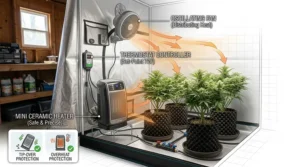
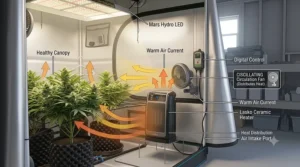
Getting a heater into the tent is the easy part — getting it set up safely is where most first-time growers slip up. Start by placing the unit either just outside the tent with a hose feeding warm air in (the AC Infinity, VIVOSUN, and Spider Farmer models are built for exactly this), or, if it has to sit inside, position it at the base of the tent pointed away from the canopy and at least a few feet from the fabric walls. The Consumer Product Safety Commission’s winter heating guidance recommends keeping any portable heater roughly three feet from anything combustible, and tent fabric absolutely counts as combustible — that rule doesn’t loosen just because you’re growing plants instead of warming a bedroom.
During the first 30 days, run the heater on a lower setting than you think you need and let your thermometer — not your hand — tell you when to bump it up. A common mistake is cranking a 1500W unit to max in a small tent overnight, which can swing temperatures 15–20°F in either direction as the thermostat overshoots and undershoots its target. For maintenance, wipe dust off any exposed PTC plates or ceramic elements every couple of weeks; dust buildup is both a fire risk and an efficiency drain, since it insulates the very surface that’s supposed to be radiating heat outward.
Real-World Scenario: Matching a Heater to Your Setup
The basement grower in a 50°F room: If your ambient space rarely climbs out of the 40s, an in-tent heater alone is fighting a losing battle against constant cold drafts. Pair the Vornado TAVH10 to warm the room generally, then let a lower-wattage in-tent unit like the Spider Farmer or AC Infinity fine-tune the canopy zone. This two-layer approach beats running one oversized heater at max power all night.
The overnight-away grower: If you’re leaving heat running for 8+ hours unattended — overnight or during a workday — safety trumps speed. The Aikoper oil-filled radiator’s lack of an exposed element and its residual radiant heat after shutoff make it the lower-risk choice over ceramic or PTC units for this specific scenario, even though it’s slower to warm up initially.
The small-tent seedling grower: A 2×2 propagation tent doesn’t need 1500W of anything. The Brightown 400W unit, possibly paired with better insulation around the tent itself, avoids the overheating swings that a too-powerful heater creates in a tiny enclosed volume.
How to Choose an Electric Heater for Your Grow Tent
- Match wattage to tent size first, not budget. As a rough rule, 200–400W suits a 2×2 to 2×4 tent, while 4×4 and 5×5 tents typically need 400–700W if heating directly inside, or a separate room heater if the space around the tent is the real problem.
- Decide if you’re heating the tent or the room. In-tent heaters with hoses (AC Infinity, VIVOSUN, Spider Farmer) target the canopy directly; whole-room units (Vornado) solve a cold-garage problem that an in-tent heater can’t fix alone.
- Check for genuine safety certification. Look for ETL or UL marks, not just a manufacturer’s own safety claims — these indicate independent lab testing.
- Consider whether you need VPD awareness or just a thermostat. VPD-based units cost more but adjust to humidity changes automatically; a basic thermostat only tracks temperature.
- Factor in unattended runtime. If the heater runs overnight without you checking it, an enclosed-element design (oil-filled radiators, sealed PTC units) is meaningfully safer than an exposed-coil heater.
- Look at the deadband or cycling behavior. Heaters that buffer a few degrees before switching on/off last longer than units that cycle constantly at a tight 1° threshold.
- Plan for the secondary keyword on every grower’s mind in winter: consistent temperature maintenance. A heater that swings 10–15°F between cycles stresses plants more than steady heat at a slightly lower average temperature.
Common Mistakes When Buying a Grow Tent Heater
The single biggest mistake is buying based on wattage alone without thinking about tent volume — a 1500W heater dropped into a 2×2 tent is a recipe for cooked seedlings and a tripped thermostat, not faster warming. A close second is placing any heater directly against the tent’s fabric wall or ducting; even “cool-touch” exteriors radiate enough heat at close range to warp plastic ducting or, worse, scorch fabric over hours of contact. People also frequently skip checking for a tip-over switch entirely, assuming all space heaters have one — plenty of the cheapest unbranded listings on Amazon don’t, and a knocked-over heater inside an enclosed tent with no shutoff is a real fire scenario, not a hypothetical one.
Electric Heater vs. Oil Heater Grow Tent: Which Wins?
This comparison comes up constantly because the two heating styles solve different problems. Electric PTC or ceramic heaters (AC Infinity, VIVOSUN, Spider Farmer, Pro Breeze, Brightown) heat up almost instantly and respond fast to thermostat changes, making them better for active daytime adjustments when you’re actually present and tweaking settings. Oil-filled radiators (the Aikoper) take longer to reach target temperature but hold heat after shutting off and never expose a glowing element, which is the safer profile for the hours nobody’s watching.
Looking at the comparison above, fast-response PTC heaters win for growers actively managing VPD throughout the day, while the oil-filled radiator wins specifically for the overnight-unattended use case where a slower, steadier, lower-risk heat source matters more than instant response. Budget growers should also note that oil radiators tend to run quieter over long stretches, since there’s no fan cycling on and off to maintain temperature.
Safety, Fire Prevention & Regulations Guide
Grow tents combine three things that don’t mix well with heating equipment: enclosed airflow, flammable fabric, and electrical cords running in tight quarters. The Consumer Product Safety Commission’s most recent winter safety guidance is blunt about the stakes — portable heaters are tied to an average of around 1,600 house fires and 70 deaths annually in the U.S., and the agency’s core advice applies directly to tents: plug heaters straight into a wall outlet rather than an extension cord or power strip, keep them roughly three feet away from combustible materials, and never leave them running unattended overnight without a certified auto-shutoff feature. (cpsc.gov)
For grow-tent-specific safety, every heater on this list carries some form of tip-over and overheat protection, but the details matter. Flame-retardant V0-rated housings (used across the AC Infinity, VIVOSUN, Spider Farmer, and Aikoper units) resist ignition even if they do contact fabric briefly, while ETL certification on the Vornado and Brightown means independent lab testing rather than a manufacturer’s self-reported safety claim. If you’re running a heater alongside grow lights and an inline fan on a single circuit, also check your outlet’s amperage — a 1500W heater alone draws around 12.5 amps, which is close to tripping a standard 15-amp household circuit if anything else is sharing that line.
Long-Term Cost & Maintenance
Running a 530W smart heater for 10 hours a night during winter costs roughly $0.06–$0.09 per hour at average U.S. electricity rates, or somewhere around $20–$30 a month for nightly overnight use — noticeably cheaper to operate than a 1500W ceramic unit run at full power, which can run closer to $0.15–$0.20 per hour. That gap is part of why the higher upfront cost of VPD-aware heaters like the AC Infinity or VIVOSUN often pencils out over a full grow season, especially if they’re also replacing a separate thermostat controller you’d otherwise need to buy.
Maintenance-wise, PTC and ceramic elements need periodic dust removal but have no moving parts to wear out beyond the internal fan. Oil-filled radiators need essentially zero maintenance since the oil is sealed for the unit’s lifetime — there’s no refilling involved despite the name suggesting otherwise. Whichever type you choose, replacing a heater every 3–5 years is reasonable even without failure, since safety standards and efficiency both improve steadily across heater generations.
What Is an Electric Heater Grow Tent Setup?
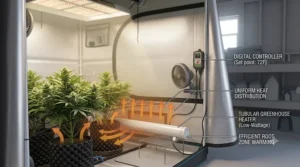
An electric heater grow tent setup is a portable electric heating device — typically PTC ceramic, oil-filled radiator, or fan-forced — sized and positioned to maintain stable temperatures inside or around an indoor grow tent. Most indoor plants thrive in daytime temperatures between roughly 70° and 80°F, with nighttime temperatures running 10–15 degrees cooler (extension.umd.edu), and a properly matched heater keeps the tent in that range through cold seasons without overheating a small enclosed space.
FAQ
❓ What size electric heater do I need for a grow tent?
❓ Is it safe to leave a heater running in a grow tent overnight?
❓ Can I use a regular space heater in a grow tent?
❓ Electric heater vs oil heater grow tent — which is better?
❓ How do I stop a grow tent heater from drying out the air?
Conclusion
There isn’t one universally “best” electric heater grow tent pick — there’s a best pick for your specific tent size, your tolerance for hands-on adjustment, and whether you’re heating the canopy directly or the room around it. If you want the most automated setup and don’t mind paying for it, the AC Infinity THERMOFORGE T3 or VIVOSUN AeroFlux earn their price tags through VPD-aware control. If your real problem is a cold garage rather than the tent itself, the Vornado TAVH10 solves that more directly than any in-tent unit could. And if you’re working with a small tent or a tight budget, the Brightown and Pro Breeze options prove that safe, effective heating doesn’t require a smart-home price tag.
Whatever you choose, prioritize genuine safety certification and correct sizing over raw wattage — a heater that’s too powerful for your tent causes more problems than one that’s slightly underpowered and steady.
✨ Don’t Miss These Exclusive Deals!
🔍 Take your grow tent heating setup to the next level with these seven carefully researched picks. Click on any highlighted item to check current pricing and availability — consistent temperature maintenance starts here. 😊
Recommended for You
- Best Space Heater for Grow Tent: 7 Top Picks for 2026
- 7 Best Hurricane Fan Grow Tent Picks for 2026
- 7 Best Oscillating Fans for Grow Tents in 2026
Disclaimer: This article contains affiliate links. As an Amazon Associate, I earn from qualifying purchases. If you purchase products through these links, we may earn a small commission at no additional cost to you.
✨ Found this helpful? Share it with your friends! 💬🤗
