
In This Article
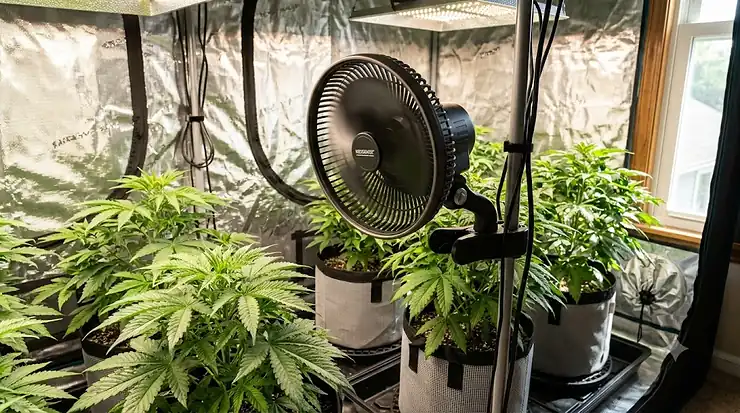
Walk into a grow tent with no air moving and you’ll feel it before you see it — that thick, swampy stillness, like stepping into a closet someone forgot to ventilate for a week. Your plants feel it too, and they hate it more than you do.
An oscillating fan grow tent setup is the unglamorous workhorse of indoor gardening. It’s not the LED panel everyone brags about, and it’s not the carbon filter that keeps your neighbors from asking questions. It’s just air, moving back and forth, all day, every day. But that quiet sweep of breeze is doing more heavy lifting than almost anything else in your tent: it evens out hot spots under the light, keeps humidity from pooling into a mold incubator on your lower leaves, and — this one surprises people — it physically toughens your plants by making them work for their posture.
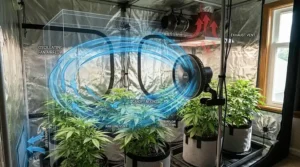
So what exactly counts as an oscillating fan for a grow tent? In short, it’s a small clip-on or wall-mounted fan engineered to sweep air side to side across your canopy rather than blast it in one fixed direction, usually built with a sealed, humidity-resistant motor since grow tents run warmer and wetter than your average bedroom.
We dug through real listings, current reviews, and spec sheets to find seven oscillating fans that are actually sitting on Amazon’s shelves right now — not discontinued models, not vaporware, not “similar items” dressed up as the real thing. Whether you’re running a 2×2 closet grow or a 4×8 tent that’s basically a second bedroom, there’s a fan on this list sized for you.
Quick Comparison Table
| Fan | Best For | Size | Motor Type | Oscillation | Price Range* |
|---|---|---|---|---|---|
| AC Infinity CLOUDRAY S6 | Best overall / app control | 6″ | EC, brushless | 10-level auto | $45–$55 |
| VIVOSUN AeroWave E6 Gen2 | Best smart/WiFi pick | 6″ | EC, dual ball bearing | 5-level auto | $35–$45 |
| Spider Farmer 6″ Clip Fan | Best natural wind mode | 6″ | EC, 0–2100 RPM | 90° auto | $30–$40 |
| Mars Hydro M6 | Best budget app fan | 6″ | Standard, app-enabled | Auto | $25–$35 |
| VIVOSUN AeroWave A6 | Best no-frills budget pick | 6″ | Standard, 2-speed | 80° auto | $20–$28 |
| VIVOSUN AeroWave D4 | Best for small/micro tents | 4″ | Standard, 3-speed | Manual tilt | $15–$22 |
| Hurricane Classic 16″ Wall Mount | Best for large tents/rooms | 16″ | Standard, 3-speed | 90° auto | $30–$40 |
*Prices fluctuate constantly on Amazon — treat these as ballpark ranges, not quotes, and always check the current price before buying.
Look at that table long enough and a pattern jumps out: this isn’t really a “which fan is best” question, it’s a “best for what” question. The CLOUDRAY S6 and AeroWave E6 Gen2 earn their higher price tags through EC motors that sip power and run for years without grinding themselves into noise machines, while the AeroWave A6 and D4 strip away the smart features entirely and just… move air, reliably, for less than the cost of a takeout dinner. The Hurricane is the odd one out structurally — it mounts to a wall or pole rather than clipping to a tent rail — which makes it the only fan here built to cover a tent big enough that a single 6-inch clip fan would leave the back corners gasping.
💬 Just one click — help others make better buying decisions too!😊
💬 Found a fan that fits your tent above?
Tap through and check today’s price — every click helps keep guides like this one free.
How to Choose an Oscillating Fan for Your Grow Tent
Before you scroll to the product breakdowns, it helps to know what you’re actually shopping for. Here’s the short version, snippet-friendly and to the point:
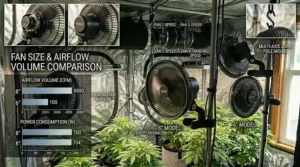
- Match CFM to tent volume. A good rule of thumb from hydroponics retailers is to size your circulating airflow to roughly match your growing space — an oscillating fan with airflow equal to or greater than the cubic size of your growing space is the target to aim for. A 2×2 tent needs far less air movement than a 4×8 room.
- Pick clip vs. wall-mount based on tent count and size. One clip fan usually handles a single small-to-medium tent; a 16-inch wall mount fan is generally recommended for grow areas around 5 feet by 5 feet or larger, with two fans suggested for 8×8 rooms and beyond.
- Check the IP rating. Grow tents run humid. A fan without weatherproofing will corrode or short out faster than you’d expect.
- Decide if you need an app. Smart control is genuinely useful if you already run a controller hub — and genuinely pointless if you’re the kind of grower who just flips a switch and walks away.
- Listen for the noise spec. Anything under 35 dB is library-quiet. Anything advertised without a noise number is hiding something.
- Confirm the clamp fits your poles. Tent pole diameters vary by brand, and a loose clamp means a fan that slowly slides down and points at your floor instead of your canopy.
- Don’t forget the motor type. EC motors cost more upfront but last longer and run quieter — a detail Amazon’s bullet points rarely explain in plain English.
Top 7 Oscillating Fans for Grow Tents: Expert Picks
1. AC Infinity CLOUDRAY S6 — Best Overall
The AC Infinity CLOUDRAY S6 is the fan growers reach for once they’ve already burned through two or three cheaper ones. It runs on a brushless EC motor with carbon steel gears engineered for a longer oscillation lifespan, offers 10 dynamic wind speeds and modes, and includes 10 levels of oscillation that can target specific zones or sweep the whole canopy while steering around obstacles. In practice, that gear ratio matters more than it sounds — cheaper plastic-gear oscillation mechanisms tend to seize up after a few months of nonstop cycling, while the CLOUDRAY’s reinforced internals are built to outlast a full grow cycle (or several).
What most buyers overlook here is the wind mode variety, not just speed. Dialing in a gentle, gusty “natural wind” setting during the seedling stage avoids the kind of windburn a constant blast can cause, then ramping to a steady, stronger setting once plants are established in veg.
Customer feedback skews heavily positive on reliability and the silky-quiet oscillation motor, with the most common gripe being app setup friction for first-time smart-controller users.
✅ Pros: Long-life EC motor, precise 10-level oscillation, app/controller compatible
❌ Cons: Premium price point, app pairing has a learning curve for first-timers
Best for: Growers running a controller hub who want one less thing to babysit. Price range: around $45–$55, check current price for exact figures.
2. VIVOSUN AeroWave E6 Gen2 — Best Smart/WiFi Pick
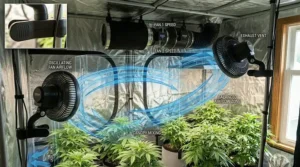
If the CLOUDRAY is the Porsche of clip fans, the VIVOSUN AeroWave E6 Gen2 is the well-built daily driver that gets you 90% of the way there for less. It runs on an upgraded dual ball bearing EC motor that delivers 320 CFM of airflow at a noise level of around 33 dB(A), with a local timer offering three cycle settings.
In real-world use, that 320 CFM figure is enough to keep a 2×4 or 3×3 tent comfortably circulating without feeling like you’re standing in a wind tunnel. The Smart Wi-Fi compatibility with VIVOSUN’s GrowHub means you can schedule on/off cycles without manually flipping a switch every morning — a small convenience until you forget to do it for three days straight and your canopy starts looking stressed.
Reviewers consistently praise the noise floor and the auto-retract feature that prevents the motor from jamming against tent walls or trellis netting.
✅ Pros: Genuinely quiet, strong CFM for the size, smart scheduling
❌ Cons: Smart features require buying VIVOSUN’s hub separately for full functionality
Best for: 2×4 to 3×3 tent owners who want quiet circulation with optional smart upgrades later. Price range: around $35–$45.
3. Spider Farmer 6-Inch Clip Fan — Best Natural Wind Simulation
The Spider Farmer 6-Inch Clip Fan leans hard into the “outdoor breeze, indoors” pitch, and for once the marketing roughly matches the hardware. It’s powered by a professional EC motor that spins from 0 to 2100 RPM across 10 customizable speeds, with 90° horizontal automatic oscillation and 100° vertical manual tilt, plus an IP-54 rating and a 35 dB noise ceiling.
What that wide RPM range actually buys you is granularity most clip fans skip — instead of jumping from “too gentle” to “too aggressive” in two steps, you get ten genuinely distinct settings to dial in per growth stage. The natural wind mode varies intensity in a loose, gusty pattern rather than a flat hum, which mimics the kind of irregular mechanical stress that triggers stronger stem development outdoors.
Customer reviews mention the secure clip grip as a standout — it’s rated for poles ranging from 16mm to 25mm with a thick rubber pad to prevent scratching — which matters more than it sounds once you’ve dealt with a fan that slowly slides down a tent pole over a week of vibration.
✅ Pros: Wide speed range, natural wind mode, weatherproof rating
❌ Cons: Vertical tilt is manual only, no app control
Best for: Growers who want fine-tuned speed control without paying for smart features they won’t use. Price range: around $30–$40.
4. Mars Hydro M6 — Best Budget App-Controlled Fan
The Mars Hydro M6 occupies a strange and useful niche: it’s one of the cheapest fans on this list that still bothers with app/WiFi control. It offers 10 fan speeds, an adjustable head tilt, and automatic oscillation built specifically for grow tent ventilation and circulation.
The honest take here is that the M6 won’t out-muscle the CLOUDRAY or the AeroWave E6 in raw airflow, and the app experience feels a notch less polished than the bigger brands. But if you’re already running other Mars Hydro gear — a light, a tent, maybe an inline fan — keeping everything inside one ecosystem simplifies your life in a way that’s easy to underrate until you’re juggling four different apps for four different devices.
Owners on growing forums tend to describe it as “does the job” rather than “impressive,” which, for a budget smart fan, is a perfectly respectable review to earn.
✅ Pros: Budget-friendly, app/WiFi control included, fits Mars Hydro ecosystems
❌ Cons: Less refined airflow control than premium EC-motor competitors
Best for: Mars Hydro tent or light owners who want one connected ecosystem. Price range: around $25–$35.
5. VIVOSUN AeroWave A6 — Best No-Frills Budget Pick
Sometimes you don’t want an app. You want a fan that clips on, turns on, and moves air until the day it dies — preferably several grow cycles from now. That’s the VIVOSUN AeroWave A6. It supports 80° horizontal automatic oscillation with 120° vertical manual adjustment, runs at two speeds adjusted by turning the power switch, and features a removable front grille for easy cleaning.
The two-speed simplicity is the whole pitch. There’s no firmware to update, no Bluetooth pairing screen that times out, no companion app demanding a login. It’s designed specifically to pair with Vivosun tents for steady airflow at every plant growth stage, and for a first-time grower trying to keep their setup under control, that lack of complexity is a genuine feature rather than a missing one.
The tradeoff is obvious: two speeds means you can’t fine-tune airflow the way you can on a 10-speed EC model, and there’s no scheduling beyond a physical switch.
✅ Pros: Dead-simple operation, secure non-slip clamp, removable grille for cleaning
❌ Cons: Only two speeds, no app or timer
Best for: First-time growers who want one less gadget to learn. Price range: around $20–$28.
6. VIVOSUN AeroWave D4 — Best for Small and Micro Tents
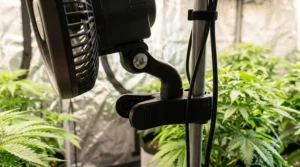
A 6-inch clip fan in a 2×2 tent is a bit like running a box fan in a phone booth — overkill, and honestly kind of in the way. That’s where the VIVOSUN AeroWave D4 earns its spot. It’s a 4-inch fan with a detachable hook, running 3-speed airflow with an adjustable angle, sized specifically for tighter footprints where a bulkier 6-inch unit eats up usable canopy space.
The detachable hook is a nice touch most competitors skip — instead of being locked to clip-only mounting, you can hang it from a horizontal bar when clip placement isn’t ideal, which matters more than it sounds in a micro tent where every pole is already claimed by a light or a trellis.
What buyers tend to flag is the obvious one: less airflow volume than the 6-inch options on this list, by design. That’s not a flaw, it’s the point — a 4-inch fan in a 2×2 closet grow is proportionate, where a 6-inch fan would just be loud overkill.
✅ Pros: Compact footprint, detachable hook for flexible mounting, budget price
❌ Cons: Not enough airflow for tents larger than roughly 2×4
Best for: Closet grows, 2×2 tents, and seedling/clone setups where space is tight. Price range: around $15–$22.
7. Hurricane Classic 16″ Wall Mount Oscillating Fan — Best for Large Tents and Grow Rooms
Every list like this eventually has to admit that clip fans don’t scale. Once you’re past a 4×4 tent, a single 6-inch fan clipped to one corner just can’t push air far enough to matter in the opposite corner. That’s the gap the Hurricane Classic 16″ Wall Mount Fan fills. It delivers 90° oscillation for wide-reaching coverage, runs at three quiet speeds adjustable via pull cord, and is built with a metal fan grill and steel neck for durability, and is explicitly marketed as suited to spaces ranging from cozy tents to bustling larger grow rooms.
What changes when you switch from clip-mounted to wall-mounted is the geometry of airflow — instead of a fan fighting gravity and tent-pole wobble from inside a 6-inch clamp, you get a stable, elevated sweep that covers a genuinely wider arc. On high, this style of Hurricane fan moves a substantial volume of air at 1250 RPM, which is the kind of horsepower a 4×8 or 5×5 tent actually needs rather than wants.
The catch: it needs wall or pole-mount hardware and a bit more installation effort than a snap-on clip fan, so it’s not the right pick if you’re trying to set up a tent in twenty minutes flat.
✅ Pros: Covers large tents a clip fan can’t, durable steel construction, quiet 3-speed operation
❌ Cons: More involved mounting, overkill for tents under 4×4
Best for: 4×4 tents and larger, multi-plant rooms, anyone outgrowing clip fans entirely. Price range: around $30–$40.
✨ Don’t Miss These Picks!
🔍 Whichever fan matches your tent size above, take a second to check today’s price and current availability before you scroll on — stock and pricing shift fast on Amazon.
Buyer’s Decision Framework
Skip the spec sheets for a second and ask yourself three quick questions:
- If your tent is 2×2 or smaller → go compact. The AeroWave D4 is sized correctly; a 6-inch fan will just dominate space you don’t have.
- If your tent is 2×4 to 3×3 and you want set-and-forget reliability → the AeroWave E6 Gen2 or CLOUDRAY S6 are built for exactly this footprint, with the E6 winning on value and the CLOUDRAY winning on motor longevity.
- If your tent is 4×4 or bigger, or you’re running multiple plants across a wider canopy → a single clip fan won’t cut it. Look at the Hurricane wall mount, or plan on two clip fans positioned at opposite corners.
- If budget is the deciding factor over everything else → the AeroWave A6 and Mars Hydro M6 both do the core job without the premium markup; pick the A6 if you want pure simplicity, the M6 if you want app control on a budget.
Real-World Scenarios: Matching a Fan to Your Grow
The apartment closet grower: Running a 2×2 tent in a spare closet, lights on a budget timer, no smart hub anywhere in the setup. The AeroWave D4’s compact size and simple 3-speed dial fit this life — no app, no fuss, just steady circulation in a space where every cubic inch counts.
The dialed-in hobbyist: Already has a controller hub, checks humidity and VPD data daily, wants every device talking to every other device. The CLOUDRAY S6 or AeroWave E6 Gen2 slot directly into that ecosystem, turning a manual chore into an automated background task.
The basement multi-tent grower: Running two or three 4×4 tents side by side, treating it more like a small operation than a hobby. A single clip fan per tent leaves dead air in the corners at this scale — pairing a Hurricane wall mount per tent, or doubling up clip fans at diagonal corners, solves the coverage gap a smaller fan can’t.
Practical Setup & Maintenance Guide
Getting a clip fan mounted correctly takes about ninety seconds, but a few habits separate a fan that lasts three grow cycles from one that dies in three months.
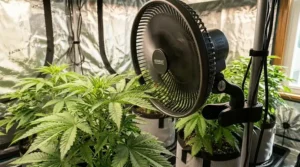
Placement matters more than power. Mount the fan so it oscillates across the canopy, not directly down at the soil or straight up at your light — direct soil-blasting dries out your medium unevenly, and direct light-blasting can rattle a cheap fixture loose over time.
Never point a fan straight at one plant for hours. That’s the fastest way to cause windburn — curled, crispy leaf edges that look alarmingly like a nutrient deficiency but are really just one unlucky plant catching the full blast while its neighbors get a gentler sweep.
Clean the grille monthly. Dust and trichome resin build up on fan blades faster than people expect in an enclosed tent, and a dirty blade throws off the balance just enough to add a faint, irritating hum.
Match speed to growth stage. Seedlings want the gentlest setting you have — barely a whisper of movement. Once plants hit vegetative growth, ramp up; by flowering, steady, moderate airflow helps prevent the dense bud rot that thrives in still, humid pockets.
Watch the cord and clamp. Vibration loosens clamps over time. A quick monthly check that the fan hasn’t slid down the pole saves you from discovering it’s been blowing sideways at your tent wall for a week.
Clip Fan vs. Wall-Mount Oscillating Fan: Which Wins?
| Factor | Clip Fan (6″) | Wall-Mount (16″+) |
|---|---|---|
| Best tent size | Up to 3×3 / 3×4 | 4×4 and larger |
| Install effort | Snaps onto pole in seconds | Requires bracket and screws |
| Coverage arc | Tight, localized | Wide, room-scale |
| Portability | High — move it anywhere | Low — fixed once mounted |
| Typical price | $15–$55 | $30–$50+ |
The table makes the tradeoff obvious once you see it laid out: clip fans win on convenience and portability for anyone running a single small-to-mid tent, while wall-mount fans win on raw coverage the moment your grow space stretches past a 4×4 footprint. Trying to force a clip fan to cover a 4×8 room is like trying to cool a living room with a desk fan — technically it’s moving air, but not nearly enough of it, and not where it needs to go.
Common Mistakes Growers Make When Buying a Tent Fan
Buying based on size alone, not CFM. A bigger-looking fan isn’t automatically a more powerful one — check the actual airflow rating, not just the fan diameter.
Skipping the IP rating. A fan without weatherproofing in a humid tent environment corrodes internally faster than the listing photos suggest, even if it looks fine from outside.
Ignoring noise specs entirely. A fan running 24/7 next to a bedroom wall at 45+ dB gets old fast. Anything under 35 dB is the sweet spot for most living situations.
Mounting only one fan in a tent that needs two. This is the single most common complaint in grower forums — one fan in a corner of a large tent just can’t reach the far side with any real force.
Overlooking clamp compatibility. Tent pole diameters vary between brands, and a clamp that’s slightly too loose will slide, vibrate, and eventually drop the fan entirely.
Features That Actually Matter (And Those That Don’t)
Actually matters: EC motor construction. It’s the difference between a fan still running quietly in year three and one rattling itself apart by month six.
Actually matters: IP rating for humidity resistance. Grow tents are not dry environments, and a non-rated motor will fail faster in that moisture.
Doesn’t matter much: The number of “wind modes” beyond 3–4 distinct settings. Once you’ve got gentle, moderate, and strong, additional micro-settings are mostly marketing padding.
Doesn’t matter much: App control, if you don’t already use a controller hub. It’s a genuinely nice convenience, but buying it specifically for the app when you have no other connected devices is paying for a feature you’ll likely ignore by week two.
Actually matters: Clamp design and pole compatibility. This is the unglamorous detail that determines whether your fan stays put or slowly droops toward the floor.
Long-Term Cost & Maintenance: The Real Math
A $20 budget clip fan and a $50 EC-motor fan don’t look that different on day one. The gap shows up two years later. Standard AC motors in budget fans tend to run hotter and wear faster under constant oscillation, which is exactly the kind of nonstop duty cycle a grow tent fan endures — running 12 to 18 hours a day, every day, for months at a stretch. EC motors are engineered specifically to handle that kind of continuous load with less heat buildup and mechanical wear, which is the entire reason they cost more upfront.
Run the simple math: if a $20 fan needs replacing every 8–10 months of heavy use, and a $50 EC fan reasonably lasts 3–4 years under the same conditions, the EC fan ends up cheaper per year of service — on top of saving you the hassle of mid-grow fan failures, which always seem to happen during flowering week, never during the slow part of the cycle.
Benefits vs. Traditional Box Fans
| Factor | Oscillating Clip/Wall Fan | Standard Box Fan |
|---|---|---|
| Tent-specific mounting | Built-in clamp or bracket | Needs improvised mounting |
| Humidity resistance | IP-rated models available | Rarely rated for moisture |
| Coverage pattern | Sweeping, even distribution | Fixed, single-direction blast |
| Noise at comparable airflow | Generally lower | Often louder |
| Footprint in small tents | Minimal | Bulky, eats canopy space |
The comparison isn’t subtle: a box fan dragged in from the garage will technically move air, but it wasn’t built for a tent’s geometry, humidity, or noise tolerance, and it’ll show that mismatch within a few months of constant use. Purpose-built oscillating fans cost more than borrowing an old box fan, but the even coverage and humidity resistance pay that difference back in healthier, more uniform canopy growth.
Why “Just a Breeze” Matters More Than You’d Think
Here’s the part most buying guides skip entirely: that gentle, constant sweep of air is doing something to your plants on a cellular level. Plants subjected to ongoing mechanical stress — wind, touch, repeated movement — undergo a documented adaptive response called thigmomorphogenesis. The key adaptations include reduced shoot elongation, increased stem thickness, enhanced root anchorage, and changes in flowering time, and these responses collectively improve a plant’s ability to withstand environmental challenges. In plain terms: a plant that gets gently buffeted by air every day grows shorter, thicker, and structurally tougher than one left to stretch upward in dead-still air. That’s not folklore — it’s basic plant physiology, and it’s the actual mechanism behind every grower’s claim that fans produce “stronger stems.”
It also matters for the less glamorous reason: moisture control. The EPA recommends keeping indoor relative humidity below 60 percent, ideally between 30 and 50 percent, and a tent with stagnant air develops localized humidity pockets — right where mold loves to start — far faster than one with constant circulation pulling moisture away from leaf surfaces.
FAQ
❓ How many oscillating fans do I need for a grow tent?
❓ Is an oscillating fan better than a box fan for a grow tent?
❓ How close should an oscillating fan be to plants?
❓ Can I run a grow tent fan 24/7?
❓ Do EC motor fans really last longer than standard motors?
Conclusion
There’s no single “best” oscillating fan for a grow tent — there’s only the best one for your specific tent, your budget, and how much you actually want to fuss with an app. If you want the long-haul, set-it-and-forget-it option, the AC Infinity CLOUDRAY S6 earns its premium price. If you’re working with a closet-sized tent, the AeroWave D4 keeps things proportionate. And if your grow has outgrown clip fans entirely, the Hurricane wall mount is the upgrade that finally reaches every corner.
Whatever you pick, the underlying point stands: that constant, gentle sweep of air isn’t a nice-to-have accessory. It’s doing real, measurable work on plant structure and humidity control every single hour it runs.
✨ Ready to upgrade your tent’s airflow?
🔍 Check today’s price on whichever pick fits your setup — your plants will notice the difference within a week.
Recommended for You
- Inline Fan for Grow Tent: 7 Quiet Picks for 2026
- Grow Tent Height Extension: 7 Game-Changing Kits for 2026
- Best Shorty Grow Tent in 2026: 7 Top Picks for Low Ceilings
Disclaimer: This article contains affiliate links. As an Amazon Associate, I earn from qualifying purchases. If you purchase products through these links, we may earn a small commission at no additional cost to you.
Found this helpful? Share it with your friends! 💬🤗
