
In This Article
You found the perfect spot. Spare corner in the basement. A tucked-away section of the attic. Maybe even a utility closet that’s just begging for a second purpose. The floor space is there. The privacy is there. The ambition is absolutely there.
The ceiling, however, is not cooperating.
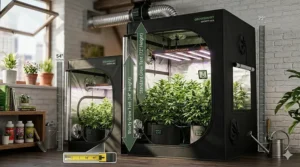
This is the single most underrepresented problem in the indoor growing world. Walk into any growing forum and you’ll find threads packed with advice about lights, nutrients, and training techniques — but ask about growing under a 5-foot ceiling and you’re met with crickets, or worse, a cheerful suggestion to “just get a bigger room.” Thanks, very helpful.
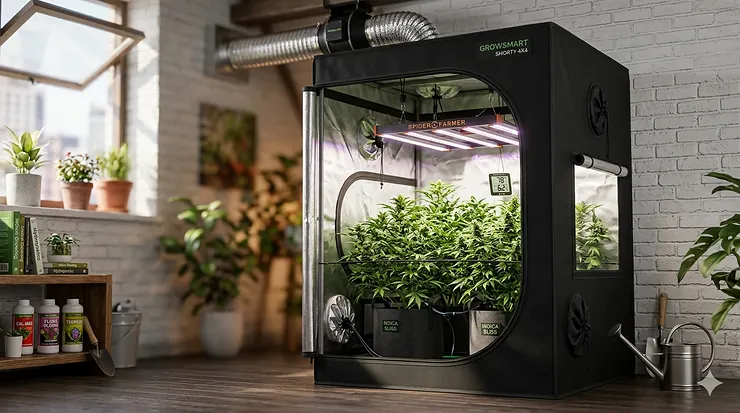
That’s exactly where a shorty grow tent earns its keep. A shorty grow tent is a purpose-built indoor cultivation enclosure designed with a reduced starting height — typically between 36 inches and 4’11” — to fit comfortably in spaces where standard 6’7″ or 6’11” tents simply won’t go. They’re not a compromise. They’re a category.
Think about what that 36 to 59 inches of vertical space actually gets you: a fully sealed, light-proof, reflective growing chamber with ventilation ports, hanging bars, observation windows, and waterproof floor trays. Everything a full-height tent offers, just without the request to knock a hole in your ceiling first.
The low height grow tent market has exploded in recent years, driven by a surge of basement and apartment growers who need cultivation solutions that fit their actual living situations. And in 2026, the options are genuinely impressive — from ultra-budget entry-level tents under $50 to Gorilla’s industrial-strength gorilla shorty tent line that could survive a small earthquake.
This guide cuts through the noise. We researched seven real products currently available on Amazon, dug into actual customer feedback, and tested the specs against real-world low-ceiling scenarios. Whether you’re nursing seedlings in a 3-foot closet shelf or running a full 4×4 basement cultivation solution with serious lighting, there’s a short grow tent in this list built for you.
Quick Comparison: Best Shorty Grow Tent Options at a Glance
| Product | Footprint | Height | Canvas | Best For |
|---|---|---|---|---|
| Gorilla GGT Shorty 4×4 | 4′ × 4′ | 4’11″–5’8″ | 1680D | Serious basement growers |
| Gorilla GGT Shorty 2×4 | 2′ × 4′ | 4’11″–5’8″ | 1680D | Tight spaces, mid-range yield |
| Gorilla GGT Shorty 3×3 | 3′ × 3′ | 4’11″–5’8″ | 1680D | Beginners with low ceilings |
| Gorilla GGT Shorty 5×5 | 5′ × 5′ | 4’11″–5’8″ | 1680D | High-yield low-profile grows |
| VIVOSUN S425 2×4 | 2′ × 4′ | 5’0″ (60″) | 600D | Budget-conscious beginners |
| VIVOSUN S223 2×2 | 2′ × 2′ | 3’0″ (36″) | 600D | Clones, seedlings, micro grows |
| zazzy Grow Tent 2×2 | 2′ × 2′ | 3’0″ (36″) | 600D | Ultra-budget, ultra-low spaces |
Reading this table: The Gorilla Shorty line dominates the mid-to-premium space with its height-adjustable design — the 4’11” base is the lowest starting point of any fully featured grow tent from a major brand. For spaces under 4 feet or growers prioritizing budget, the VIVOSUN S223 and zazzy 2×2 are excellent sub-$60 options, though you trade canvas density and structural rigidity for the lower price point. Canvas density (600D vs. 1680D) matters more than most buyers realize: thicker canvas means better light-proofing, quieter operation, and a longer lifespan.
💬 Just one click — help others make better buying decisions too! 😊
Top 7 Shorty Grow Tent Picks: Expert Analysis
🏆 1. Gorilla Grow Tent Shorty 4×4 (GGTSH44) — Best Overall Low-Ceiling Grow Tent
If there’s one product that essentially invented the shorty grow tent category as growers know it today, this is it. The Gorilla GGTSH44 starts at 4’11” — short enough to fit under a standard basement drop ceiling — and remains height-adjustable up to 5’8″ with the included 9-inch extension kit, or 6’11” with a separately sold 2-foot kit. That adjustability is what separates it from every short grow tent competitor at this price tier.
The canvas is 1680D — that’s double the thickness of most competing brands’ 600D or 800D fabric. What that actually means in practice: no pinhole light leaks at seams or zipper edges, dramatically reduced noise from fans vibrating the tent walls, and material that won’t crack or fray after two years of weekly zipping. The all-steel powder-coated frame handles up to 300 lbs of hanging weight, which means you can hang your LED, carbon filter, inline fan, and ducting without any structural anxiety.
This tent is purpose-built for the grower who has permanently committed to a basement grow and needs something professional-grade that fits the space. It is not the right tent for someone who needs to move it frequently — at 28 lbs assembled, it’s a commitment. But for a semi-permanent basement cultivation solution handling 4–6 plants through a full veg and flower cycle, the GGTSH44 is as good as it gets under 6 feet.
Customers consistently call out the zipper quality and the thick fabric as standout features. The dual EZ-view windows are a genuine bonus — most shorty tents at this price don’t offer them.
✅ Industrial-strength 1680D canvas with zero light bleed
✅ Adjustable height from 4’11” to 5’8″ (9″ extension included)
✅ 300 lb hanging capacity for full equipment setups
❌ Heavier and pricier than budget alternatives
❌ 2-foot extension kit (for 6’11” max) sold separately
💰 Price range: $250–$320 range depending on timing and promotions. Strong long-term value given lifetime build quality.
2. Gorilla Grow Tent Shorty 2×4 (GGTSH24) — Best Low Profile Grow Tent for Narrow Spaces
The 2×4 footprint is the most popular configuration for first-time and intermediate growers for a simple reason: it’s a rectangle. Rectangles fit into corners, closets, hallways, and garage walls in ways that 4×4 or 5×5 squares simply don’t. Gorilla’s Shorty 2×4 applies all the same industrial standards of the 4×4 — 1680D canvas, all-metal pole construction, the height-adjustable 4’11” to 5’8″ range — to that grower-friendly narrow footprint.
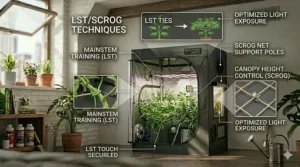
Eight square feet is genuinely productive space. Depending on your training method, you can run 2–4 plants in full flower in a 2×4. Low-stress training (LST) and Screen of Green (SCROG) setups work especially well here because you’re actively managing canopy height anyway — which pairs naturally with the tent’s limited vertical clearance. It’s almost like the confined space encourages smarter growing.
The 300 lb hanging capacity is equally impressive in this smaller format, meaning you’re not restricted to lightweight quantum board LEDs — a 200–300W strip fixture, carbon filter, and 4-inch inline fan all hang comfortably.
The ideal buyer: someone with a basement or garage side wall that’s between 5′ and 5’8″ tall, who wants a proper grow tent rather than a budget clone box. The 2×4 footprint is also the sweet spot for a two-light LED setup when running perpetual harvests.
Customers frequently note that setup takes under an hour solo and that the light-tight zipper flaps make a noticeable difference versus brands that skip them.
✅ Perfect 2×4 footprint for corner/wall placement
✅ Same canvas and frame quality as the 4×4 Shorty
✅ Ideal for SCROG and LST low-canopy techniques
❌ Not suitable for growing plants over 3.5 feet naturally tall
❌ Slightly narrower duct port access than the 4×4
💰 Price range: in the $180–$230 range — exceptional value for 1680D fabric in this format.
3. Gorilla Grow Tent Shorty 3×3 (GGTSH33) — Best Gorilla Shorty Tent for Beginners
Nine square feet. Three plants in 5-gallon pots. One LED in the 200–300W range. That’s the standard 3×3 beginner setup, and the Gorilla Shorty 3×3 wraps it in the same 1680D canvas and adjustable frame as its larger siblings — but at a more accessible price point.
What most buyers overlook about the 3×3 compared to a 4×4 is the thermal management advantage. Smaller interior volume means your inline fan can maintain consistent temperature and humidity with far less effort. If you’re in a basement that runs cold in winter, a 3×3 is easier to heat. If you’re dealing with summer heat spikes, it’s easier to cool. The physics work in your favor.
The 4’11” starting height with the ability to push to 5’8″ (9″ extension included) gives beginning growers room to make mistakes with canopy management. You have more height than a clone box but less than a standard tent — which encourages you to learn height control early, a skill that pays dividends when you scale up.
This is the go-to recommendation for a first-time grower who has a basement ceiling under 5’8″ and wants to spend money once on a quality tent rather than twice replacing a budget option that disintegrates after a year.
Customer sentiment is universally positive about the build quality. The most common complaint: it ships in a box that’s deceptively large and heavy, which is actually a feature, not a bug — those poles are the real thing.
✅ 9 sq ft footprint, ideal for single-LED beginners
✅ Easier climate control in smaller interior volume
✅ Industrial Gorilla quality at a lower price than 4×4
❌ Only 3 plants max at full canopy
❌ Limited footprint for running two separate veg/flower cycles
💰 Price range: $160–$210 range — arguably the best dollar-per-quality ratio in the Gorilla Shorty lineup.
4. Gorilla Grow Tent Shorty 5×5 (GGTSH55) — Best High-Yield Low Height Grow Tent
Twenty-five square feet is where casual grows become serious production. The Gorilla GGTSH55 is the largest tent in the Shorty line, offering the full 5×5 canopy area under the same height-restricted 4’11″–5’8″ profile. This is a rare thing: a tent large enough for 6–9 plants that still fits in a basement with a standard drop ceiling.
At this footprint, lighting strategy becomes critical. With limited vertical clearance, you essentially can’t use HID lighting — the heat and minimum hanging distance requirements make it impractical. This tent is designed for modern LED strip or quantum board setups that sit within 12–18 inches of the canopy. Brands like Mars Hydro, Spider Farmer, and AC Infinity all make lights that work beautifully in this context.
The 300 lb hanging capacity — spread across 5×5 of frame — means you can run dual LEDs, a heavy-duty carbon filter, and a 6-inch inline fan without any structural compromise. The deep waterproof tray is an often-overlooked feature: a 5×5 waterproof spill floor that actually contains runoff from 9 pots is genuinely useful and not something cheaper tents do well.
For a serious basement cultivator who needs maximum yield from limited vertical space, the GGTSH55 is the premium answer. It’s the tent equivalent of knowing exactly what you want and buying it right the first time.
Customer reviews emphasize the tent’s durability over multiple grow cycles and the effectiveness of the diamond-reflective walls at maximizing light uniformity across the full canopy.
✅ Largest footprint in the Gorilla Shorty range (25 sq ft)
✅ Supports full 6–9 plant production canopies
✅ Premium diamond reflective walls maximize LED efficiency
❌ Significant investment — not suited for casual or first-time growers
❌ LED-only at this height; no HID compatibility
💰 Price range: $300–$400 range — justified for serious production grows.
5. VIVOSUN S425 2×4 Grow Tent (48″×24″×60″) — Best Budget Short Grow Tent for Beginners
At exactly 5 feet tall (60 inches), the VIVOSUN S425 sits in an interesting middle ground: not quite ultra-short, but meaningfully shorter than the standard 80-inch tents that dominate the market. For anyone with a basement ceiling between 5’0″ and 5’6″, this is often the most practical entry-level option that doesn’t require any special product categories.
The 600D Oxford canvas is thinner than Gorilla’s 1680D — three to nine times thinner, depending on the comparison — but for a budget grow tent focused on seedlings, early veg, or a single-plant perpetual setup, it’s more than adequate. The diamond reflective Mylar lining is consistent across price points as an industry standard, so light distribution inside the S425 is genuinely effective.
What makes VIVOSUN a trustworthy brand at this price point is their decade-plus of manufacturer experience and the surprisingly attentive customer service reputation. Zipper issues (the most common point of failure in budget tents) get handled quickly. The S425’s double-cinching duct ports are a step above what you’d find on generic alternatives — a small detail that makes a meaningful difference when you’re wrestling with 4-inch ducting at 2 AM.
The 2×4 footprint holds 2–3 mature plants comfortably. Pair it with a 200W LED and a 4-inch inline fan, and you have a functional, low-profile grow tent setup for well under $200 total.
✅ Budget-friendly entry point with 10+ years of brand trust
✅ 60″ height works for many standard basement ceilings
✅ Solid double-cinching duct ports at this price tier
❌ 600D canvas allows minor vibration noise and some light bleed at seams
❌ Frame poles less robust than premium alternatives (100 lb max vs. 300 lb)
💰 Price range: $50–$80 — exceptional value for first-time growers.
6. VIVOSUN S223 2×2 Grow Tent (24″×24″×36″) — Best Ultra-Short Clone & Seedling Tent
Three feet tall. That’s it. The VIVOSUN S223 is genuinely one of the shortest functional grow tents available on Amazon, and at 24″×24″×36″, it’s purpose-built for propagation, cloning, and seedling stages where height is irrelevant and consistency is everything.
Here’s what the spec sheet won’t tell you: a 36-inch tall tent completely changes your lighting options. You’re not hanging a 200W LED in here — you’re running a 45W T5 fluorescent bar, a low-power LED strip, or a small quantum board at 30% power. That combination of low wattage and small interior volume means thermal stability is almost automatic. No temperature swings. No hot spots. Just consistent, gentle light for young plants that would stress under anything more aggressive.
The 600D canvas at this scale is perfectly adequate. You’re not running 30-gallon pots in a 2×2 — you’re running a seedling tray, a cloning machine, or 4 small containers. The structural demands are minimal, and the lightweight frame handles the task easily.
The S223 is the tent that basement cultivators buy as a permanent propagation station to feed a larger main tent. Set it up on a shelf or workbench, keep it running at 75°F and 70% humidity year-round, and transfer clones to your Gorilla Shorty 4×4 when they’re ready. The workflow logic is impeccable.
Customers love the compact size and the straightforward assembly — typically under 15 minutes without instructions. The most common upgrade path: buyers start here, scale up to a larger tent, and keep the S223 running permanently for propagation.
✅ 36″ height fits on shelves, workbenches, or spaces under 4 feet
✅ Purpose-built for clones, seedlings, and propagation
✅ Ultra-low power lighting requirements reduce operating costs
❌ Too small for vegetative or flowering stages of most plants
❌ Limited duct port options at this height
💰 Price range: $35–$60 — the most affordable functional growing environment on this list.
7. zazzy Grow Tent 24″×24″×36″ — Best Budget Ultra-Low Profile Grow Tent
The zazzy 24″×24″×36″ is an honest, straightforward ultra-budget alternative to the VIVOSUN S223. Same footprint, same 36-inch ceiling height, similar application profile — but priced slightly lower and built with the same 600D Mylar construction that has become the entry-level industry standard.
What zazzy does right: the 95% reflective Mylar lining is legitimately effective, the dual-stitched seams prevent the light leaks that plague truly cheap tents, and the all-steel frame (rated for 110 lbs) handles a small LED and inline fan without drama. The observation window is genuinely useful at this height — you’d be surprised how much you peer in at your cuttings during the first two weeks of cloning.
The honest caveat: zazzy isn’t building these in California with aerospace-grade materials. This is an entry-level product, and after 18–24 months of regular use, you may notice zipper wear or canvas fatigue in high-traffic areas. For buyers who want to test indoor growing before committing to premium equipment, this is completely fine. For buyers intending to run a permanent clone station for years, the VIVOSUN S223 is the slightly more durable choice at a modest price premium.
Where the zazzy tent genuinely shines is with intermediate growers who need a second, low-budget propagation tent alongside a premium primary tent. The math makes sense: spend your money on the Gorilla Shorty for flowering, and run clones in a $45 zazzy tent on the shelf above it.
✅ Ultra-budget price point with functional quality
✅ 95% reflective Mylar effective for propagation lighting
✅ Compact 2×2 footprint, ideal for shelves and workbench setups
❌ Less durable than VIVOSUN or Gorilla at comparable heights
❌ Limited to propagation/seedling use only — too short for vegetative growth
💰 Price range: $30–$50 — the lowest-cost entry point for low-ceiling growing.
How to Set Up Your Shorty Grow Tent for Maximum Results
Getting a short grow tent assembled and running isn’t complicated, but a few setup decisions in the first hour will define your next 12 months of results. Here’s what the instruction manual won’t tell you.
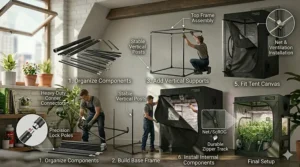
Step 1: Measure twice, buy once. Measure your ceiling height at the lowest point in the intended space, subtract 3 inches for clearance, and compare that number to the tent’s assembled height. With a Gorilla Shorty, remember that 4’11” is the base height — the tent will be slightly taller once you add hanging bars and any lights mounted on the exterior roof structure.
Step 2: Build on a tarp. This sounds obvious until you’re explaining mylar floor tray scratches to yourself at midnight. Set a cheap painter’s tarp down first. Your back will thank you too — assembly is easier at ground level before you slide the tent into its final position.
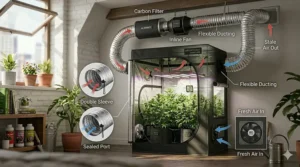
Step 3: Mount your exhaust fan first. In a limited vertical space, the fan and carbon filter placement is more constrained than in a standard tent. A 4-inch inline fan positioned horizontally inside a 4’11” tent leaves less clearance than you expect. Many growers in low-ceiling setups prefer to mount the fan outside the tent and draw air through the carbon filter via ducting — this recovers 4–6 inches of usable vertical space inside.
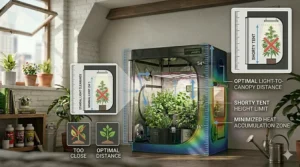
Step 4: Use LED bars, not LED panels. Quantum board LED panels typically require a minimum hanging distance of 18–24 inches above the canopy. In a 4’11” tent with 12-inch plants and 4 inches of container height, that leaves you almost no margin. LED bar-style fixtures (like the AC Infinity iongrid series or Mars Hydro FC-E series) sit within 6–12 inches of the canopy at lower power densities and are specifically designed for limited-vertical environments.
Step 5: Run a humidity test before plants go in. Seal the tent empty, run your fan and humidifier for 24 hours, and check corners for condensation. In shorty tents, the reduced air volume makes humidity stratification (wet at the bottom, dry at the top) more pronounced. A small clip fan circulating air horizontally solves this immediately.
Common first-month mistake: running the tent fully sealed. All grow tents need a slight negative pressure (fans pulling slightly more air out than in) to prevent odor escape and ensure fresh CO₂-rich air is continuously replaced. Crack one intake port 20% open and let the inline fan do its job.
Real-World Grower Profiles: Which Shorty Grow Tent Fits Your Situation?
No two growing situations are identical, and the “best” tent depends almost entirely on who you are and what you’re trying to accomplish. Here are three realistic profiles matched to specific recommendations.
Profile 1: The Basement Hobbyist — “I’ve got 5’4″ under the ductwork.” You’ve measured the ceiling. It’s actually 5’4″ at the lowest beam. You want to grow 4–6 plants through a full cycle — veg and flower — without pulling permits or breaking out the drywall saw. You have a $400 total budget for the tent, light, and fan. Best match: Gorilla Grow Tent Shorty 3×3 or 4×4. Both start at 4’11” and leave you a comfortable 5 inches of clearance without the 9-inch extension. Budget the remaining $200–$230 toward a quality 200–300W LED and 4-inch fan combo. This is the most common basement setup in 2026 and it produces genuinely impressive yields when dialed in.
Profile 2: The Apartment Clone Runner — “I need something under the kitchen shelf.” You’re renting. The “grow space” is a 36-inch gap between a shelf and the floor in a walk-in closet. You’re not flowering plants — you’re maintaining a mother plant and cycling clones into your main tent in the spare room. Best match: VIVOSUN S223 2×2 or zazzy 24″×24″×36″. Both fit in 36 inches of vertical space, both run on 45W of light, and neither will raise an eyebrow during a maintenance visit. Budget $35–$60 for the tent and another $50 for a decent T5 LED bar. Total cost: under $120 for a permanent propagation station.
Profile 3: The Attic Experimenter — “6’5″ of sloped ceiling, 5’3″ in the center.” You’ve converted an attic corner. You have 5’3″ of usable height in the middle of the space but it slopes to 4’8″ at the walls, limiting your floor options. Best match: Gorilla Grow Tent Shorty 4×4. The square footprint can be centered in the highest part of the attic and the 4’11” base keeps you under the 5’3″ ceiling with 4 inches to spare. Attic grows do run hotter in summer — prioritize a well-sized inline fan (6-inch for this footprint) and consider a portable AC or mini-split if your attic peaks above 85°F in summer months. (See EPA guidance on indoor air quality and ventilation for more.)
How to Choose the Right Shorty Grow Tent: 6 Criteria That Actually Matter
The grow tent aisle on Amazon has never been larger or more confusing. Here’s how to cut through the noise with six criteria ranked by real-world importance.
1. Canvas Density (The Most Underrated Spec)
600D canvas is the industry floor. 1680D is the industry ceiling — and the difference is real. Thicker canvas means better light containment (no “hot spots” glowing through walls at night), lower operational noise as fans vibrate the structure, and significantly longer lifespan. If you plan to run the same tent for 3+ years, the price premium of 1680D pays for itself in the second year. For single-cycle testing or propagation-only use, 600D is completely sufficient.
2. Height Adjustability
This is the feature that separates the Gorilla Shorty line from every other low height grow tent. The ability to start at 4’11” and extend to 5’8″ — or 6’11” with an additional kit — means the same tent adapts as your ceiling situation changes, or as your technique evolves. Static-height budget tents give you no flexibility.
3. Hanging Capacity
Budget tents rate for 80–110 lbs. Gorilla’s all-steel frame handles 300 lbs. The practical difference: budget tents can handle a small LED. Premium tents handle a full rig — heavy LED, carbon filter, inline fan, and ducting — all simultaneously. Overloading a budget tent frame is a real failure mode that ruins harvests and occasionally damages equipment.
4. Zipper Quality
The zipper is the most common failure point in any grow tent. Look for double-stitched zipper seams and, ideally, a light-tight flap that covers the zipper when closed. Gorilla and Spider Farmer have the best zipper systems in the category. VIVOSUN mid-range and up is acceptable. Generic ultra-budget tents often struggle here after 6–12 months of regular opening.
5. Number and Placement of Duct Ports
In a limited vertical space tent, port placement matters more than in standard tents. Look for ports at multiple heights (some brands only offer top-mounted ports, which limits your fan-outside-the-tent option). Double-cinching ports that seal tightly around your ducting without light leaks or air gaps are worth specifying. (Proper ventilation is foundational to healthy indoor growing — Cornell Cooperative Extension has excellent resources on indoor plant environment management.)
6. Floor Tray Quality
Spills happen. Waterlogged carpets are not fun. The floor tray in a low height grow tent handles overflow from containers that are proportionally larger relative to the tent’s total interior volume. Look for a tray with at least 2-inch sides and genuine waterproofing — not just a thin sheet of plastic. Gorilla’s deep spill trays are the benchmark.
Shorty Grow Tent vs. Standard Grow Tent: An Honest Comparison
Let’s be direct about what you gain and what you give up when you choose a low profile grow tent over a standard-height model.
| Feature | Shorty Grow Tent (4’11″–5’8″) | Standard Grow Tent (6’7″–6’11”) |
|---|---|---|
| Fits low ceilings | ✅ Yes | ❌ No |
| Max plant height | 2.5–3.5 ft | 4.5–5.5 ft |
| LED flexibility | Limited (bars/strips best) | Full range |
| Ventilation complexity | Slightly higher | Standard |
| Price (comparable quality) | Similar to slightly higher | Benchmark pricing |
| Best growing styles | LST, SCROG, autoflowers | All styles |
The honest analysis: a shorty grow tent is a specific solution to a specific problem. If your ceiling allows a standard tent, a standard tent gives you more versatility. But if your ceiling doesn’t allow it — and for millions of basement and apartment growers in the U.S., it genuinely doesn’t — a shorty grow tent isn’t a compromise. It’s the only viable path. Autoflowering strains (which naturally stay under 3 feet) and low-stress training techniques pair especially well with limited vertical space, turning a constraint into a genuine cultivation strategy. (Learn more about hydroponics and controlled environment agriculture at the University of Arizona’s Controlled Environment Agriculture Center.)
✨ Ready to transform your low-ceiling space?
🔍 Check out the shorty grow tent options above and click any highlighted product to see current pricing, availability, and customer reviews on Amazon. Your basement cultivation solution is just one setup away.
Common Mistakes When Buying a Shorty Grow Tent (And How to Avoid Them)
The grow tent buying process is rife with small errors that cost real money. Here are the five mistakes we see most often from buyers in the low-ceiling category.
Mistake 1: Measuring ceiling height but forgetting floor-to-beam clearance. Basement ceilings often have exposed beams, ductwork, or pipes that drop the usable height below the nominal ceiling measurement. Measure to the lowest obstacle directly above your intended tent footprint, not to the ceiling at the room’s center.
Mistake 2: Buying standard-size accessories for a shorty tent. A 4-foot LED bar designed for a 6’6″ tent is still a 4-foot LED bar in a 4’11” tent — but now you have two fewer feet of hanging distance. Buy lights specifically rated for low-clearance environments, or choose LEDs with adjustable output so you can run lower wattage closer to the canopy without burning your plants.
Mistake 3: Underestimating the importance of the carbon filter in a basement. Basements recirculate air more slowly than above-grade spaces. A properly sized carbon filter (matched to your inline fan’s CFM rating) is not optional in a basement grow — it’s essential for odor control and air quality. According to EPA guidelines on indoor air quality, poor ventilation in enclosed below-grade spaces accumulates humidity, CO₂, and VOCs faster than standard rooms.
Mistake 4: Buying a tent too small “to start” and replacing it immediately. The 2×2 tent-to-4×4-tent upgrade cycle is extremely common and entirely avoidable. Think about your intended plant count at full flower, add one plant for buffer, and buy the tent that fits that number from day one. The cost of two tent purchases almost always exceeds the cost of buying the correct larger tent initially.
Mistake 5: Ignoring the gorilla shorty tent’s height extension kit as a future option. Many buyers purchase the Gorilla Shorty line, use the 9-inch extension immediately, and forget that the 2-foot extension kit is available separately. If your ceiling ever changes — renovation, moving to a new space — the same tent can grow to nearly 7 feet. That future-proofing value is built into the price and often overlooked in the buying decision.
What to Expect: Real-World Performance in a Short Grow Tent
The spec sheet tells you canvas weight and frame load ratings. It doesn’t tell you what it’s actually like to grow in 4’11” of vertical space for six months.
Here’s the honest version.
Climate control is easier — and harder. The reduced air volume in a shorty grow tent means your environment stabilizes faster than in a standard tent. One 4-inch inline fan on a basic controller can maintain temperature and humidity in a 3×3 shorty with minimal effort. That’s the easy part. The harder part is heat management when your LED is necessarily closer to your plants than in a taller tent. You will need to dial in your light intensity more carefully — less wattage, more even distribution across the canopy, and regular canopy checks for light stress (upward leaf curling, bleaching near the center) become weekly habits rather than monthly ones.
Topping, training, and defoliation become mandatory. In a standard 6’11” tent, growers can be lazy about height management. In a shorty grow tent, you cannot. Plants that aren’t actively trained will hit the lights within weeks of entering flower. The good news: topping at week 3–4 of veg and running a SCROG net at 12–15 inches above the container creates an absolutely uniform, efficient canopy that produces exceptional yields relative to the space. Many advanced growers argue that the discipline required by limited vertical space actually improves their technique.
Autoflowering strains are a natural fit. Auto varieties from breeders like Fast Buds, Barney’s Farm, and Royal Queen Seeds routinely finish under 24 inches — a third of the way up even the shortest tent on this list. No training required, no height anxiety, just a straightforward seed-to-harvest cycle that plays completely within the constraints of a short grow tent.
Features That Actually Matter (And Those That Don’t) in a Shorty Grow Tent
Features that genuinely matter:
- Canvas density and stitching quality — this is durability and light-proofing combined
- Frame load rating — undersized frames fail under real equipment setups
- Port placement diversity — critical for fan-outside-the-tent configurations in low spaces
- Zipper flap coverage — the difference between a light-tight tent and one that glows through every crack
Features that sound good but rarely matter in practice:
- Tool pouches — nice, used once, mostly forgotten
- “Easy assembly” claims — every grow tent says this; assembly difficulty varies by user, not brand
- “Bacteria and mold resistant fabric” — standard Mylar is already non-porous; this is largely marketing
- Multiple observation windows — one good window you actually use beats three awkward ones positioned at inconvenient angles
The one feature nobody talks about enough: the interior height of the hanging bars. Many tents advertise an overall tent height but the actual hanging bar position (where your light, filter, and fan attach) is often 4–6 inches lower than the tent’s structural peak. In a 4’11” tent, that’s the difference between 53 inches and 59 inches of usable vertical space — a significant gap when you’re measuring plant heights in inches.
FAQ: Shorty Grow Tent Questions Answered
❓ What height is a shorty grow tent?
❓ Can I grow cannabis in a low height grow tent?
❓ Is a gorilla shorty tent worth the price compared to budget alternatives?
❓ What is the best low profile grow tent for a basement with a 5-foot ceiling?
❓ How do I improve ventilation in a short grow tent?
Conclusion: Your Perfect Basement Cultivation Solution Is Closer Than You Think
The limited vertical space problem has frustrated indoor growers for as long as indoor growing has existed. A low ceiling isn’t a disqualifying obstacle — it’s a solvable engineering problem. And in 2026, the solutions have never been better designed or more widely available.
If budget is tight and your ceiling is genuinely under 4 feet, the VIVOSUN S223 2×2 or the zazzy 24″×24″×36″ are remarkably capable propagation platforms that fit in spaces most people don’t even consider growing in. If you’re building a serious, multi-cycle basement cultivation solution and your ceiling tops out at 5’4″ or 5’8″, the Gorilla Grow Tent Shorty 4×4 is simply the best shorty grow tent money can buy — full stop. Its 1680D canvas, adjustable height, and industrial frame create a professional-grade growing environment that just happens to start at 4’11”.
The VIVOSUN S425 2×4 sits in the middle of that spectrum: a budget-friendly short grow tent with a 60-inch profile that handles beginner flowering grows without requiring a premium investment. It’s the right first tent for thousands of basement growers.
Whatever your ceiling height, whatever your experience level, there’s a low profile grow tent in this list that matches your reality. The growing season doesn’t wait for a renovation. Start where you are.
✨ Don’t miss out — check current prices and availability on all 7 shorty grow tents above on Amazon. Click any highlighted product name to see today’s deals.
Recommended for You
- 7 Best Cannabis Drying Tent Picks for Perfect Cures in 2026
- 7 Best Propagation Chamber Tent Options in 2026 for Thriving Starter Plants
- Best Propagation Grow Tent 2026: 7 Top Picks for Thriving Starts
Disclaimer: This article contains affiliate links. As an Amazon Associate, I earn from qualifying purchases. If you purchase products through these links, we may earn a small commission at no additional cost to you.
✨ Found this helpful? Share it with your friends! 💬🤗
