
In This Article
Here’s a confession every indoor grower eventually makes: the lights get all the glory, but the fan is what keeps the whole operation from cooking itself alive. Pick the wrong inline fan for grow tent ventilation, and you’ll watch your canopy wilt by 2 PM no matter how expensive your LED panel was. Pick the right one, and your tent quietly hums along like it’s barely working at all — heat gone, humidity dialed in, smell contained.
I’ve torn down and rebuilt more tent setups than I care to admit, chasing that sweet spot between airflow and silence. What I’ve learned is unglamorous but useful: most “bad” grows aren’t a nutrient problem or a lighting problem. They’re a stagnant-air problem wearing a disguise. Spider mites love still air. Powdery mildew loves still air. Even healthy plants slow their nutrient uptake when the air around their leaves doesn’t move enough to trigger transpiration.
This guide skips the spec-sheet fluff and gets into what actually matters: which fans move real air without sounding like a hairdryer, which ones are worth the smart-controller premium, and which budget options genuinely hold up. We tested CFM claims against tent size, dug through current Amazon listings for real model numbers, and sized everything from cramped 2×2 closets to sprawling 5×5 tents. By the end, you’ll know exactly which fan belongs in your setup — and why.
What Is an Inline Fan for a Grow Tent?
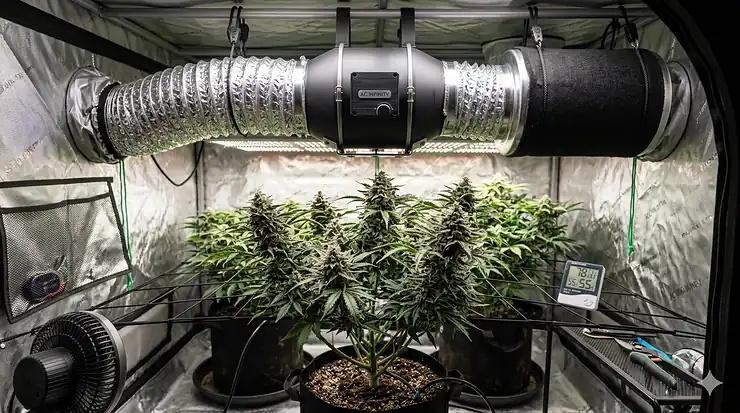
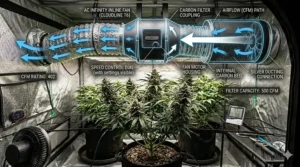
An inline fan for grow tent ventilation is a cylindrical, duct-mounted fan that pulls hot, humid, or odorous air out of an enclosed grow space and pushes it through ducting to an exhaust point. Unlike a clip fan that just stirs air around inside the tent, an inline fan creates negative pressure, drawing fresh air in through intake vents while exhausting stale air out — usually through a carbon filter.
Quick Comparison Table
| Category | Pick | Why It Wins |
|---|---|---|
| Best Overall | AC Infinity CLOUDLINE T6 | Smart VPD control, whisper-quiet EC motor |
| Best Smart Alternative | VIVOSUN AeroZesh T6 | WiFi app control at a sharper price |
| Best All-in-One Kit | Spider Farmer 6″ Fan Kit | Fan, filter, and ducting in one box |
| Best Budget High-CFM | iPower 442 CFM Inline Fan | Raw airflow without the smart-controller markup |
| Best Small-Tent Pick | AC Infinity CLOUDLINE A4 | Compact 4″ fan, same build quality as the flagship line |
Notice the pattern: every “best” pick above earns its spot for a different reason, not because one fan objectively beats the rest. If you’re running a 4×4 tent and want hands-off automation, the T6 justifies its price. If you’re flowering a single 2×2 closet tent on a budget, that same fan is overkill — the A4 or a basic VIVOSUN D4 will do the job for a third of the cost.
💬 Just one click — help others make better buying decisions too!😊
✨ Don’t Miss These Exclusive Deals!
🔍 Take your grow tent ventilation to the next level with these carefully selected fans. Click any highlighted pick to check current pricing and availability — these tools will help you create a thriving indoor garden your future harvest will thank you for!
Top 7 Inline Fans for Grow Tents: Expert Analysis
1. AC Infinity CLOUDLINE T6
AC Infinity CLOUDLINE T6 is the fan most serious home growers eventually land on, and for good reason. Its EC motor runs on a mixed-flow design with dual ball bearings rated for roughly 67,000 hours — translating to years of continuous duty without the bearing whine that kills cheaper fans early. The built-in temperature, humidity, and VPD controller connects to AC Infinity’s WiFi app, so you can dial in exact climate targets and let the fan throttle itself automatically instead of babysitting a dial every few hours.
What most buyers overlook is that this controller alone replaces a $40-80 standalone humidity controller you’d otherwise need to buy separately — the smart features aren’t just convenience, they’re a sneaky cost-saver. Owners consistently mention the near-silent operation at low-to-mid speeds, with most noise complaints only surfacing at full blast in larger tents.
✅ Pros: WiFi app automation, exceptional bearing life, mountable in any orientation
❌ Cons: Premium price, app setup has a learning curve for first-timers
Best for: growers running 4×4 or larger tents who want to “set and forget” their climate. Price sits in the $140-$160 range — pricey, but it’s the kind of purchase you make once and stop thinking about.
2. VIVOSUN AeroZesh T6
VIVOSUN AeroZesh T6 is the fan I point budget-conscious smart-home growers toward when they balk at AC Infinity’s price tag. It runs on a similar EC motor delivering airflow in the same class as the T6, paired with VIVOSUN’s E42A+ WiFi controller and smart thermostat for app-based temperature and humidity automation.
The spec sheet won’t tell you this, but VIVOSUN’s app has matured a lot over the past couple of years — it’s no longer the clunky afterthought it was when the brand first entered the smart-controller space. Reviewers note the controller mirrors AC Infinity’s logic closely enough that switching brands doesn’t mean relearning anything.
✅ Pros: WiFi automation at a lower entry price, strong airflow for the size, easy app pairing
❌ Cons: Build quality feels slightly less refined than AC Infinity, shorter track record
Best for: growers who want smart climate control without paying the brand premium. Expect to pay in the $115-$145 range depending on bundle.
3. Spider Farmer 6″ Inline Fan Kit
Spider Farmer 6″ Inline Fan Kit solves a problem nobody talks about until they’re knee-deep in it: buying a fan, then a filter, then ducting, then realizing none of the flanges quite match. This kit bundles a 402 CFM EC-motor fan with a carbon filter and ducting, all sized to fit together out of the box, and it’s compatible with Spider Farmer’s GGS smart controller ecosystem if you want to add automation later.
In my experience, kit fans get unfairly dismissed as “starter” gear, but the 62-watt EC motor here punches well above its weight class for noise control — owners frequently compare its quiet operation favorably against pricier standalone units.
✅ Pros: Complete ventilation system in one purchase, EC motor efficiency, expandable to smart controllers
❌ Cons: Included filter is good but not premium-grade, controller sold separately for full automation
Best for: first-time tent growers who don’t want to piece together a ventilation system from five different listings. Typically priced in the $90-$130 range as a kit.
4. iPower 442 CFM Inline Duct Fan
iPower 442 CFM Inline Duct Fan is the fan I recommend when someone says “I just need air moving and I don’t care about apps.” Its composite fan blades and external rotor motor are built for raw airflow rather than finesse, and the permanently lubricated bearing means zero maintenance for the life of the unit.
Here’s what that 442 CFM figure actually means in practice: in a 4×4 tent, this fan can theoretically exchange the entire air volume more than once per minute at full speed — massive overkill unless you’re running high-wattage lighting that needs aggressive heat removal. Most growers run it well below max speed, which also helps with the noise level customers describe as “louder than the smart fans but tolerable.”
✅ Pros: Exceptional CFM-per-dollar, simple plug-and-play setup, low-maintenance bearing
❌ Cons: No speed controller included on base model, noticeably louder at full speed than EC alternatives
Best for: budget growers prioritizing exhaust power over quiet automation. Generally found in the $35-$55 range.
5. Hon&Guan PRO 6″ Inline Duct Fan
Hon&Guan PRO 6″ Inline Duct Fan quietly does what AC Infinity does, at roughly half the price — which is exactly why it’s earned a cult following in grow forums. The EC motor delivers strong airflow alongside an intelligent controller offering auto mode, high/low temperature triggers, high/low humidity triggers, and ten manual speed steps, all read through an included environmental probe.
What surprised me researching this one is the IP42-rated metal housing, which is a meaningfully more durable build than the plastic shells on most fans in this price bracket. The tradeoff most reviewers flag is brand recognition — Hon&Guan doesn’t have AC Infinity’s decade of reputation, so warranty support can feel less established.
✅ Pros: Smart auto-mode controller at a budget price, durable metal housing, included environmental probe
❌ Cons: Newer brand with less long-term reliability data, customer support response times vary
Best for: growers who want automated climate control but refuse to pay AC Infinity prices. Usually priced in the $70-$95 range.
6. VIVOSUN D4 Inline Duct Fan
VIVOSUN D4 Inline Duct Fan is the no-frills 4″ option that keeps showing up in small-tent setups for one simple reason: it just works. Running at roughly 2,500 RPM for a steady airflow output, its dual-sided steel mesh design maximizes open area for airflow while a flow deflector keeps the noise output surprisingly low for an AC-motor fan.
What most first-time growers don’t realize about 4″ fans is that they’re not “less fan” than 6″ models — they’re correctly sized for smaller spaces. Pairing a 6″ exhaust fan with a 2×2 tent is like putting a leaf blower on a houseplant; you’ll over-dry the space and stress your plants. Reviewers consistently praise the quiet operation, with some specifically noting it’s quieter than fans twice its price.
✅ Pros: Genuinely quiet for an AC motor, properly sized for 2×2 and 2×4 tents, simple installation
❌ Cons: No EC motor efficiency, basic build with no smart controller option
Best for: small-tent growers (2×2 to 2×4) who don’t want to overspend on airflow they’ll never use. Typically in the $30-$45 range.
7. AC Infinity CLOUDLINE A4
AC Infinity CLOUDLINE A4 packs the same mixed-flow design and dual ball bearing motor as AC Infinity’s pricier fans into a value package built for compact tents. It ships with a wired 10-speed controller and remains compatible with AC Infinity’s smart UIS controllers if you decide to upgrade later — a nice bit of future-proofing that budget competitors rarely offer.
The IP44 rating means it shrugs off the humidity spikes that come with frequent misting or humidifier use, a detail that matters more than people expect once flowering humidity targets climb. In my experience, this is the fan I’d buy for a closet grow where I wanted AC Infinity’s reliability without committing to the full smart-controller ecosystem yet.
✅ Pros: AC Infinity build quality at a lower price point, upgrade path to smart controllers, weather-resistant housing
❌ Cons: No included smart features at this tier, 4″ size limits use to smaller tents
Best for: small-tent growers who want AC Infinity reliability without the smart-controller spend. Generally priced around $75-$85.
How to Choose an Inline Fan for Your Grow Tent
- Measure your tent’s volume first. Multiply length × width × height in feet to get cubic feet — this number drives every other decision.
- Match duct size to tent size. A 2×2 or 2×4 tent typically needs a 4″ fan; a 4×4 needs 6″; anything 5×5 or larger usually calls for 8″ or dual 6″ fans.
- Check real CFM, not marketing CFM. Manufacturer ratings are measured in open air with no ducting, filter, or bends — expect 20-30% real-world loss once everything’s connected.
- Decide if you need a carbon filter. If odor control matters (it usually does), buy a filter rated for the same diameter as your fan, and size the fan slightly larger to push through the added resistance.
- Weigh EC motor against AC motor. EC motors cost more upfront but run quieter, cooler, and more efficiently across a wider speed range — a detail covered in more depth in the Department of Energy’s guide to efficient electric motors.
- Decide how much automation you actually want. Smart controllers are genuinely useful for hands-off climate control, but a $15 manual speed dial does the same airflow job if you’re willing to adjust it yourself.
- Size up rather than down if you’re unsure. A larger fan run at low speed is quieter and more flexible than a smaller fan maxed out trying to keep pace.
Practical Usage Guide
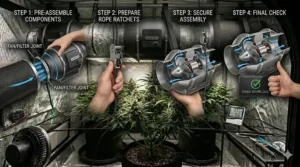
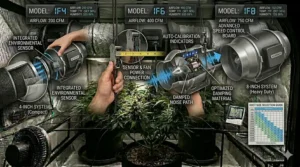
Getting your inline fan for grow tent ventilation set up correctly takes maybe twenty minutes, but the details matter more than people expect. First: always mount your fan to pull air through your carbon filter, not push it — filter, then fan, then ducting, then tent exit. Pushing air through a filter creates pressure that can blow particles past the carbon bed before they’re fully absorbed.
Keep ducting runs as short and straight as possible; every 90-degree bend adds resistance equivalent to roughly several feet of straight duct, quietly eating into your real CFM. During the first 30 days, the most common mistake is over-tightening duct clamps around flexible aluminum ducting, which crimps the internal wire coil and restricts airflow at exactly the spot you can’t see it happening.
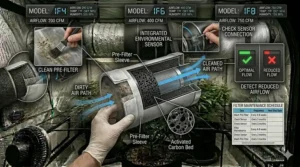
Once installed, give your fan a maintenance check every 4-6 weeks: wipe down the intake blades (dust buildup is sneaky and gradually reduces output), inspect duct clamps for slippage, and listen for any new rattling that signals a bearing starting to wear. Carbon filters typically last 12-24 months of continuous use before the activated charcoal saturates — if odors start slipping through even at full fan speed, that’s your sign it’s time to swap it.
Real-World Scenario: Matching Fans to Growers
The closet grower: Running a 2×2 or 2×4 tent in a spare closet, prioritizing stealth above all else. The VIVOSUN D4 or AC Infinity A4 fits this profile perfectly — both are properly sized 4″ fans that won’t over-dry a small space, and the A4’s IP44 rating handles closet humidity swings without complaint.
The dialed-in hobbyist: Running a 4×4 tent with real lighting wattage, wants automated climate control and doesn’t mind paying for it. This is squarely AC Infinity T6 or VIVOSUN T6 territory — both offer app-based VPD targeting that removes the guesswork from daily fan adjustments.
The budget-first beginner: Just starting out, wants reliable airflow without blowing the equipment budget on ventilation alone. The Spider Farmer kit or iPower 442 CFM fan both deliver real performance without smart-controller pricing, leaving more budget for lighting or nutrients.
Problem → Solution Guide
Problem: Tent stays too humid even with the fan running. This usually means your fan is undersized for the heat and moisture load, or your filter is too saturated to let air actually exhaust. The EPA notes that indoor humidity should ideally stay between 30-50% to discourage mold growth — if you’re consistently above that, size up your fan or check filter saturation before troubleshooting anything else.
Problem: Fan sounds fine alone but rattles once mounted in the tent. Almost always a duct clamp issue or the fan resting against the tent’s metal frame, transmitting vibration. Add a rubber isolation mount or simply reposition the fan so it’s not touching the frame directly.
Problem: Smell escapes even with a carbon filter installed. Check that air is being pulled through the filter, not pushed, and confirm your fan’s CFM still exceeds the filter’s resistance rating once ducting is attached. An undersized fan paired with a filter is a common — and easily fixed — combination.
CFM Rating Guide: Matching Airflow to Tent Size
CFM, or cubic feet per minute, tells you how much air your fan can move — but the number only matters in context of your tent’s volume. The standard formula calculates required airflow as: (tent volume in cubic feet × desired air changes per hour) ÷ 60. Wikipedia’s overview of air changes per hour explains why ACH has become the standard shorthand for ventilation adequacy across both HVAC and grow-space design — it’s the same math, just applied to a tent instead of a building.
For a 4×4×6.5-foot tent (about 173 cubic feet), targeting a strong ventilation rate means a fan in the 175-230 CFM range covers the bare minimum, though most growers size up considerably to account for grow lights, carbon filters, and ducting friction loss. The CDC’s ventilation guidance on air changes — developed for general indoor air quality — recommends aiming meaningfully above the bare minimum rather than the exact calculated floor, and that same logic applies well to grow tents: better to have airflow to spare than to find yourself short during a summer heat wave.
Inline Fan vs. Standard Exhaust Fan vs. Ventilation Fan
| Type | Static Pressure | Best For | Typical Noise |
|---|---|---|---|
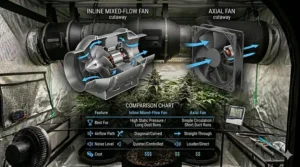
| Inline/Duct Fan | High | Grow tents, ducted exhaust | Low (EC) to Moderate (AC) |
| Box/Axial Fan | Low | Open-room circulation | Moderate |
| Wall-Mount Exhaust Fan | Low-Moderate | Bathrooms, attics | Moderate-High |
The key difference is static pressure — an inline duct fan for grow tent or exhaust fan grow tent setups is specifically engineered to push air through restrictive ducting, filters, and bends without losing much output, while a basic box or axial fan loses airflow dramatically the moment it faces any resistance. That’s exactly why a $20 box fan can’t substitute for a proper duct fan grow tent setup no matter how strong it feels standing in open air.
Common Mistakes When Buying an Inline Fan for a Grow Tent
Buying based on CFM alone, ignoring noise rating, is the single most common misstep — a fan rated at 400+ CFM but 50+ dBA will dominate a quiet room. Skipping the carbon filter sizing match is another: pairing a 6″ fan with a 4″ filter creates a bottleneck that defeats the fan’s extra power entirely.
Underestimating ducting length is sneaky too; growers often buy a fan sized for their tent volume alone, forgetting that 15 feet of ducting to reach a window adds meaningful resistance. Finally, buying the cheapest AC-motor fan without checking bearing type is a recipe for a fan that’s dead within a year — sleeve bearings wear out far faster than ball or EC-motor designs under continuous duty.
Long-Term Cost & Maintenance
A budget AC-motor fan might save $80 upfront, but EC motors typically use roughly half the energy at equivalent airflow according to industry EC motor efficiency comparisons, and that gap compounds over a fan running 18-24 hours a day for years. Running a 60-watt AC fan continuously costs noticeably more in electricity annually than a comparable EC fan pulling 30-40 watts at similar airflow — often enough to offset the price difference within the first year or two of use.
Bearing life matters just as much: a fan rated for 67,000 hours of dual-ball-bearing operation will likely outlast three or four cheap sleeve-bearing fans bought sequentially, each requiring replacement shipping costs and reinstallation time. Carbon filters need replacing every 12-24 months regardless of fan choice, so budget that recurring cost separately from the fan itself.
Features That Actually Matter (And Those That Don’t)
EC motors matter — they’re quieter, cooler-running, and more efficient across their speed range than AC motors, a difference well-documented in motor efficiency research. WiFi app control matters if you actually want hands-off automation; it’s a gimmick if you’re someone who’ll never open the app after week one. Dual ball bearings matter for longevity in a way that’s easy to underestimate until your cheap fan dies mid-flower.
What doesn’t matter nearly as much as marketing suggests: flashy LED indicator lights, branded carrying cases, or claimed CFM figures measured in open air with no resistance attached. Static pressure rating — how well a fan maintains airflow against resistance — tells you far more about real-world performance than the headline CFM number ever will.
❓ Frequently Asked Questions
❓ How many CFM do I need for a 4x4 grow tent?
❓ Can I run an inline fan 24/7 in my grow tent?
❓ Do I need a carbon filter with my inline fan grow tent setup?
❓ How loud is too loud for an inline fan in a grow tent?
❓ Should an inline fan intake or exhaust air from a grow tent?
Conclusion
There’s no single “best” inline fan for grow tent ventilation — there’s only the best fan for your specific tent, budget, and tolerance for fiddling with apps. If you want automation and don’t mind paying for it, the AC Infinity CLOUDLINE T6 remains the fan to beat. If you’re stretching a budget, the Hon&Guan PRO or iPower options deliver real performance without the premium markup. And if you’re running anything smaller than a 4×4, resist the urge to oversize — a properly matched 4″ fan will treat your plants better than an overpowered 6″ unit ever could.
Whatever you choose, remember that the fan is only half the equation. Ducting length, filter resistance, and tent placement all shape how much of that rated CFM actually reaches your plants. Get those details right, and even a budget fan will outperform an expensive one installed carelessly.
✨ Found the right fan for your setup?
🔍 Check current pricing on any of these picks before you commit — availability and prices shift, and a quick comparison now can save you a return shipment later!
Recommended for You
- Grow Tent Height Extension: 7 Game-Changing Kits for 2026
- Best Shorty Grow Tent in 2026: 7 Top Picks for Low Ceilings
- 7 Best Cannabis Drying Tent Picks for Perfect Cures in 2026
Disclaimer: This article contains affiliate links. As an Amazon Associate, I earn from qualifying purchases. If you purchase products through these links, we may earn a small commission at no additional cost to you.
✨ Found this helpful? Share it with your friends! 💬🤗
