
In This Article
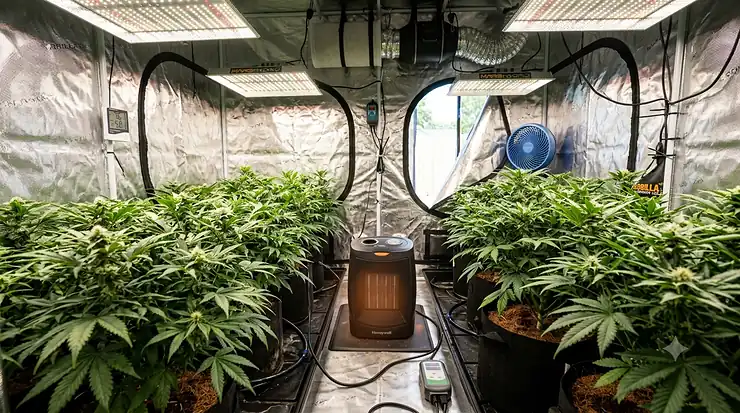
If you’ve been hunting for the best space heater for grow tent climate control, you’ve probably noticed most “buying guides” are just rehashed Amazon listings with no actual reasoning behind the picks. A space heater for grow tent use needs to do more than blow warm air — it needs to hold a steady setpoint overnight, play nice with humidity, and not turn a fabric enclosure into a fire risk.
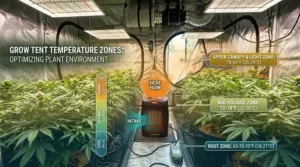
What is a space heater for a grow tent? It’s a compact electric heating unit — usually ceramic (PTC) or fan-forced — sized and ideally humidity-aware enough to maintain stable temperatures inside or just outside an enclosed grow space, without overheating plants, drying out the canopy, or compromising fire safety.
Below are seven real, currently listed products, pulled from a mix of dedicated grow-tent heaters (the kind with hoses, VPD sensors, and app control) and general-purpose ceramic heaters that growers commonly use to warm the room around a tent. Both categories have a place — which one you need depends mostly on tent size, how cold your space gets, and whether you’re already chasing VPD targets or just trying to keep things above 65°F overnight.
One thing up front: don’t assume bigger wattage is automatically better. A 1,000W heater in a 2×2 tent can swing temperature and humidity hard enough to stress plants, while a 530W unit in a 5×5 tent in an unheated garage won’t keep up at all. Match the heater to the space first, then worry about features.
Quick Comparison Table
| Heater | Type | Power | Best For | Price Range |
|---|---|---|---|---|
| VIVOSUN AeroFlux | Dedicated, VPD + App | 700W | Best overall, VPD-focused growers | around $90–$110 |
| AC Infinity THERMOFORGE T7 | Dedicated, AI + VPD | 1,000W | Premium / automated setups | around $120–$140 |
| AC Infinity THERMOFORGE S7 | Dedicated, manual + dual-duct | 1,000W | Manual control, closed-loop tents | around $90–$110 |
| Spider Farmer 530W Heater | Dedicated, App + Day/Night | 530W | Best value dedicated pick | around $60–$80 |
| Vornado TAVH10 | General whole-room | ~1,500W | Heating the room around a larger tent | around $75–$95 |
| Honeywell HeatGenius | General ceramic | 1,500W | Budget all-rounder | around $40–$55 |
| Lasko 754200 | General desktop ceramic | 1,500W / 900W | Tiny tents, ultra-budget | around $20–$30 |
Wattage alone doesn’t tell the whole story here. The VIVOSUN and both AC Infinity units cost more per watt than the Honeywell or Lasko picks because you’re paying for VPD/AI logic and direct-duct hardware, not just raw heat output. If you’re already running AC Infinity’s UIS ecosystem, the price gap between the S7 and T7 mostly buys automation rather than extra heating capacity — and if you’re heating a small 2×2 tent that already sits in a warm room, you rarely need more than the Lasko or Spider Farmer pick.
💬 Just one click — help others make better buying decisions too!😊
✨ Don’t Miss These Picks!
💬 Click through on any heater above to check today’s price and availability — and help other growers skip the guesswork. 🌱
The 7 Best Space Heaters for Grow Tents in 2026
1. VIVOSUN AeroFlux Smart Grow Tent Heater — Best Overall
Standout feature: it’s the only heater on this list that adjusts output based on VPD (vapor pressure deficit), not just a flat temperature reading.
The AeroFlux runs 700W of PTC heating across five power levels, with a probe that tracks temperature and VPD together. That distinction matters — a plain thermostat heater can hold 75°F while humidity swings widely enough to stress plants, and Michigan State University Extension’s research on VPD explains why VPD predicts plant stress better than humidity alone. The included app lets you set a target VPD directly, and a “Recipe” feature automates day/night transitions instead of you nudging dials at 2 a.m.
This is the pick for growers who already think in VPD terms and want one less manual adjustment. If you’re running a 2×4 to 4×4 tent and flowering-stage stability matters more than raw heat output, start here.
✅ VPD-based control, app scheduling, included extension hose
❌ 700W can be light for tents over 4×4 in a cold room; app dependency means a dead phone limits remote tweaks
Price & verdict: around $90–$110. For VPD-focused growers, the smart control easily justifies the premium over a basic thermostat heater.
2. AC Infinity THERMOFORGE T7 — Best Premium / AI Pick
Standout feature: AI-driven VPD and temperature targeting, paired with dual 4-inch duct ports you can run open-loop (fresh air intake) or closed-loop (recycled heat).
The T7 delivers 1,000W through individually pulsed PTC plates — true 10-level control rather than crude on/off cycling — and its adaptive logic nudges output to chase your VPD target instead of waiting for you to react to a swing. Connect it to AC Infinity’s UIS controllers and it behaves like every other smart device in that ecosystem rather than a standalone gadget.
Who it’s for: growers already invested in AC Infinity gear who want unified app control, plus anyone running a sealed or closed-loop tent who needs precise duct routing rather than open-air heating.
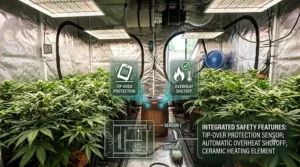
✅ AI automation reduces manual tweaking, dual-duct flexibility, ETL-certified with tip-over and overheat protection
❌ Priciest pick here, ducting sold separately, AI logic shines mainly with a UIS controller attached
Price & verdict: around $120–$140. Worth it inside the AC Infinity ecosystem; overkill if this is your only smart device.
3. AC Infinity THERMOFORGE S7 — Best for Manual Control & Dual-Duct Setups
Standout feature: the same 1,000W PTC hardware as the T7, minus the AI layer and the price premium.
The S7 still gives genuine 10-level heating via PWM-controlled PTC plates and the same dual 4-inch duct ports for open- or closed-loop configurations — you’re just dialing in the level yourself instead of letting an algorithm guess. For growers who’ve already found the airflow combo that works, that’s not a downgrade; it’s predictability.
Who it’s for: manual-control growers who want AC Infinity’s build quality and dual-duct hardware without paying for adaptive AI they may not use — especially if the heater’s job is fixed, like always running closed-loop into one tent.
✅ Same heating hardware as the T7 for noticeably less, dual-duct flexibility, tip-over alarm
❌ No app or smartphone control, ducting not included, no auto-adjustment
Price & verdict: around $90–$110. The best dollar-per-watt pick if dual-duct flexibility matters more than automation.
4. Spider Farmer 530W Grow Tent Heater — Best Value Dedicated Pick
Standout feature: built-in day/night temperature simulation instead of one flat setpoint around the clock.
At 530W, this is the lowest-wattage dedicated heater here, with 10 PTC/fan levels, app control, and a 160cm hose so warm air reaches the tent without blasting the canopy directly. A built-in “deadband” — a roughly 3°F buffer before the heater cycles on or off — cuts down on the rapid switching that wastes energy and stresses PTC elements over time. It’s a genuinely energy-efficient warming option for anyone trying to keep electric bills down through winter.
Who it’s for: 2×2 to 3×3 tent owners who want app convenience without paying for 1,000W of heating they don’t need. Smaller tents lose heat fast, but they don’t need a furnace to recover it.
✅ Lower wattage means a smaller bill, app scheduling, hose for targeted airflow
❌ Underpowered for 4×4+ tents in a cold room; day/night logic has a learning curve on first setup
Price & verdict: around $60–$80. The clear value pick for smaller tents.
5. Vornado TAVH10 — Best for Heating the Room Around a Larger Tent
Standout feature: Vornado’s “Vortex Action” airflow, which circulates heat off the walls and ceiling of a room instead of blasting it in one direction.
This is the one heater here that isn’t built to be sealed inside fabric tent walls — there’s no duct hose, and Vornado designs it as a whole-room unit. That’s exactly why it earns a spot: if your tent lives in an uninsulated garage, basement, or spare room, warming the surrounding air with something like the TAVH10 is often safer and more effective than cramming a heater into the tent itself. Auto climate control holds a set room temperature, and the digital display plus remote make adjustments easy without opening the tent and disturbing your winter temperature control setup.
Who it’s for: growers whose real problem is an unheated room, not the tent itself.
✅ Even whole-room heat, 12-hour timer and remote, Vornado’s 5-year replacement guarantee
❌ Not designed for direct tent ducting, higher wattage than the dedicated picks means a bigger bill
Price & verdict: around $75–$95 depending on sales. Pair it with a basic tent thermometer to confirm room heat is actually keeping pace with the tent’s heat loss.
6. Honeywell HeatGenius Ceramic Heater — Best Budget All-Rounder
Standout feature: six directional heat settings — personal, floor, or whole-room — on one unit.
At 1,500W with a programmable digital thermostat, the HeatGenius is a general-purpose ceramic heater grow tent owners often use just outside the enclosure, not a tent-specific model — there’s no hose or VPD sensor. What you get instead is flexibility and a low price: point it at the floor near your tent to offset cold air pooling at the base, or aim it room-wide and let the thermostat hold a target temperature.
Who it’s for: growers who want a capable backup or supplemental heater for the space around the tent without paying dedicated-heater prices, especially in a garage or spare room that’s only modestly cold.
✅ Affordable, directional heat control, 3-year warranty, tip-over and overheat protection
❌ No app/VPD awareness, not designed for sealed enclosures, a few owners report a faint odor in quiet mode worth airing out before first use
Price & verdict: around $40–$55. A smart pick if you just need to take the chill off the room, not micromanage tent climate.
7. Lasko 754200 Desktop Ceramic Heater — Best Ultra-Budget Pick
Standout feature: it’s the cheapest, simplest option here — a dial, two heat settings, and a fan-only mode.
This compact unit puts out 1,500W on high or 900W on low, with an 11-position thermostat and a 6-foot cord. There’s nothing smart about it, and that’s the point — it’s a no-frills portable heater grow tent owners can stash in a closet-sized space without thinking twice. Lasko’s similarly priced tower and desktop heaters have collectively racked up tens of thousands of five-star Amazon ratings, largely from buyers who just need consistent heat in a small footprint.
Who it’s for: closet-sized grow spaces, a tight budget, or anyone who wants a basic backup heater on hand in case a primary unit fails.
✅ Lowest price on this list, simple manual dial, lightweight and portable
❌ No smart features, no hose or ducting, manual-only thermostat means more hands-on adjustment
Price & verdict: around $20–$30. Best as a starter or backup heater, not your only line of climate control in a serious grow.
How to Choose a Space Heater for a Grow Tent
The short version: size for your tent, decide between a dedicated tent heater and a general room heater, and never compromise on safety certification. Here’s the longer breakdown:
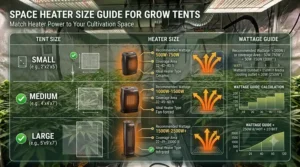
- Match wattage to tent size, not room size. Small tents (2×2–3×3 ft) generally need 300–700W; medium tents (4×4–5×5 ft) need 700–1,000W; anything larger or in an uninsulated space often needs 1,000W+ or, better, a separate room heater.
- Decide tent-dedicated vs. general room heater. Dedicated heaters duct warm air directly and are designed to sit near or inside the tent; general heaters are cheaper but shouldn’t be sealed inside a fabric enclosure.
- Look for a thermostat heater grow tent setups can actually rely on overnight — a simple on/off dial works, but a proper thermostat with a deadband prevents constant cycling that wastes energy and stresses plants.
- Check for VPD or humidity-aware control if you’re flowering moisture-sensitive plants; a temperature-only thermostat can hold the right number while humidity still swings out of range.
- Treat safety certification as non-negotiable. ETL/UL listing plus tip-over and overheat shutoff aren’t bonus features in an enclosed space — they’re the baseline.
- Decide manual vs. app-controlled based on how hands-on you want to be; app control helps most for day/night automation, less so if you’re checking the tent daily anyway.
- Estimate running cost before you buy, not after — see the cost breakdown further down.
Practical Setup & Safety Guide for Tent Heaters
Getting a heater is half the job; placing and maintaining it correctly is the other half.
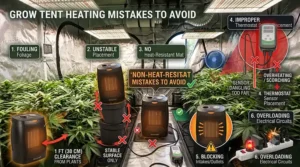
Placement: if you’re using a dedicated heater with a hose, duct the warm air in rather than placing the heater body itself directly against tent fabric. If you’re using a general-purpose heater outside the tent, keep at least three feet of clearance from anything flammable — including the tent’s canvas walls — a guideline echoed by the U.S. Consumer Product Safety Commission.
Power: plug heaters directly into a wall outlet. Never run them through an extension cord or the same power strip as your fans, lights, and humidifier — that combination is exactly how heaters overload circuits.
Monitoring: pair any heater with a separate hygrometer or VPD meter for the first week, even if the heater has its own sensor. You’re checking for two things: that the unit is actually holding its setpoint, and that nearby tent fabric isn’t discoloring or softening near the heat source.
Maintenance: dust buildup in vents is a real fire and odor risk over a multi-month grow — wipe down intake grilles monthly, and inspect the cord and plug for damage before each use.
Match Your Heater to Your Grow: Real-World Scenarios
Scenario 1 — A 2×2 closet tent in a heated bedroom. You don’t need much; the room is already close to target temperature. The Lasko 754200 or Spider Farmer 530W gives you a small, controllable boost without overheating a tiny space.
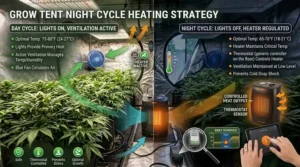
Scenario 2 — A 4×4 tent in an unheated garage through a cold winter. This is where frost protection heating actually matters — without it, lights-off temperatures can crash overnight. Either the AC Infinity S7/T7 or VIVOSUN AeroFlux ducted directly into the tent, often paired with a Vornado-style heater warming the garage itself, keeps both the tent and the surrounding air from swinging too far.
Scenario 3 — Multiple tents already running AC Infinity’s UIS ecosystem. The THERMOFORGE T7 is the obvious fit here: one app, one set of automations, and AI logic that’s actually worth paying for because it’s coordinating with fans and controllers you already own.
Common Mistakes When Heating a Grow Tent
- Oversizing wattage for tent size. A 1,000W heater in a small tent can spike temperature and crash VPD before you notice.
- Sealing a general-purpose heater fully inside a tent. These units aren’t designed for enclosed fabric spaces and lack the ducting to vent heat properly.
- Skipping tip-over and overheat protection to save a few dollars — in an enclosed space, this is the feature that actually matters most.
- Watching temperature but ignoring humidity. A heater that holds 75°F can still leave you with a VPD that stresses plants if humidity isn’t tracked alongside it.
- Daisy-chaining devices on one power strip. Heater, humidifier, and fan on a single strip is a common shortcut that overloads circuits.
Dedicated Grow Tent Heater vs. Standard Space Heater
| Factor | Dedicated Grow Tent Heater | Standard Space Heater |
|---|---|---|
| VPD/humidity awareness | Built into most models | None |
| Ducting or hose included | Usually | No |
| Safe to seal inside fabric tent | Designed for it | Not recommended |
| Typical price | $60–$140 | $20–$95 |
| Best for | Tents 2×2–5×5, flowering-stage precision | Heating the room around a larger or uninsulated space |
The practical takeaway: dedicated heaters earn their higher price when you’re heating inside the enclosure and care about humidity stability, while a standard heater is the more sensible — and safer — choice when the actual problem is a cold room, not the tent’s internal climate. Mixing the two (a room heater for the space, a dedicated unit for the tent) is a legitimate setup, not overkill, for colder climates.
Safety, Regulations & Fire Risk: What Every Grower Should Know
Heating equipment is the second-leading cause of home fire deaths in the U.S. behind smoking materials, and portable space heaters specifically account for an estimated 1,600 fires and roughly 70 deaths a year, per CPSC figures cited in that same source. None of that is a reason to skip heating a cold tent — it’s a reason to be deliberate about which heater you use and how.
The U.S. Department of Energy draws a clear line worth repeating here: unvented combustion heaters — propane, kerosene, natural gas — are not recommended indoors because of carbon monoxide risk, and that risk is worse, not better, inside a sealed fabric tent with limited airflow. Stick to electric heaters for any unit that will run near or inside an enclosed grow space.
Beyond fuel type, look for ETL, UL, or CSA safety certification, automatic shutoff on tip-over or overheat, and keep at least three feet of clearance from anything flammable. Before you buy secondhand or even new, it’s worth a quick check of the CPSC’s Safer Products database to confirm the model hasn’t been recalled.
Long-Term Energy Costs & Maintenance
Running cost is simple math: (watts ÷ 1,000) × hours run × your electricity rate per kWh. A 700W heater (like the VIVOSUN AeroFlux) running 8 hours a night at a typical U.S. residential rate works out to roughly $0.75–$1.00 a night, or somewhere around $25–$30 a month through the coldest stretch — your actual number depends entirely on your local utility rate, so check your bill before assuming.
That math is exactly why lower-wattage energy-efficient warming options like the Spider Farmer 530W or VIVOSUN AeroFlux cost less to run over a full winter than the 1,500W general-purpose heaters, even though the upfront price is higher. Maintenance-wise: clean dust from intake vents monthly, inspect the cord for fraying before each use, and replace — don’t repair — any heater with a damaged plug or visibly worn housing.
FAQ
❓ Can I put a regular space heater inside a grow tent?
❓ What size heater do I need for a 4x4 grow tent?
❓ Are ceramic heaters safe for grow tents?
❓ Does VPD control matter more than a basic thermostat?
❓ How much does it cost to run a grow tent heater overnight?
Conclusion
There’s no single best space heater for grow tent setups — there’s a best heater for your tent, your climate, and how hands-on you want to be. If you’re flowering moisture-sensitive plants and already think in VPD, the VIVOSUN AeroFlux or AC Infinity THERMOFORGE line is worth the premium. If your tent is small and your room is already warm, the Spider Farmer 530W or even the Lasko 754200 will do the job without overspending. And if the real problem is a cold garage or basement, a general-purpose heater like the Vornado TAVH10 or Honeywell HeatGenius warming the room will outperform any tent-specific unit you try to cram inside the enclosure itself.
Whatever you pick, prioritize safety certification and proper clearance over any smart feature — that’s the one thing every option on this list needs to get right.
✨ Ready to keep your grow stable through the cold months?
Check current pricing on the pick that matches your tent size and climate above! 🌡️
Recommended for You
- 7 Best Hurricane Fan Grow Tent Picks for 2026
- 7 Best Oscillating Fans for Grow Tents in 2026
- Inline Fan for Grow Tent: 7 Quiet Picks for 2026
Disclaimer: This article contains affiliate links. As an Amazon Associate, I earn from qualifying purchases. If you purchase products through these links, we may earn a small commission at no additional cost to you.
✨ Found this helpful? Share it with your fellow growers! 💬🌱
