
In This Article
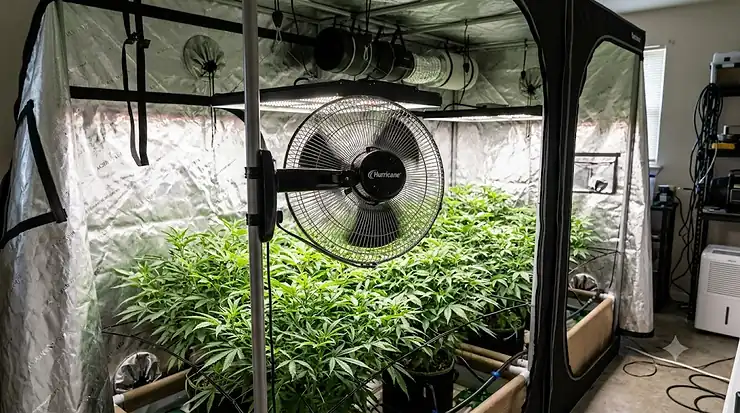
If you’ve ever opened your grow tent and noticed your seedlings leaning lazily toward one side, doing absolutely nothing to hold themselves up, you’ve met the problem a hurricane fan grow tent setup is designed to fix. A hurricane fan, in grower slang, is shorthand for any oscillating circulation fan strong enough to gently rock your canopy — named after the popular Hurricane brand of wall-mount fans that became a staple in tents long before “grow tent fan” was even a search term.

Here’s the short version: plants that never feel a breeze grow tall, thin, and floppy. Plants that get a steady, gentle wind develop thicker stems, sturdier branches, and better resistance to mold, because moving air constantly refreshes the depleted layer of carbon dioxide sitting right against the leaf surface. Plants adapt to repeated mechanical stress like wind by increasing stem thickness and improving structural stability — a response botanists call thigmomorphogenesis, and it’s the entire reason growers bother clipping a fan to a tent pole in the first place.
The tricky part isn’t whether you need a fan. It’s figuring out which one actually performs in a 2×2, 4×4, or 5×5 tent without rattling itself apart in six months, costing you a fortune to run, or drowning out your favorite podcast every time you check on your plants. Below, I’ve broken down seven real, currently available options — from $16 clip fans to smart app-controlled units — along with where each one actually shines and where it falls short.
Quick Comparison Table
| Fan | Type | Best Tent Size | Noise Level | Best For | Price Range |
|---|---|---|---|---|---|
| Hurricane Classic 16″ | Wall-mount oscillating | 4×4 and up | Moderate | Budget all-rounder | $30s–$40s |
| Hurricane Supreme 18″ | Wall-mount oscillating | 5×5 and up | Moderate | Larger tents | $40s–$60s |
| ACTIVE AIR ACF16 (2-pack) | Wall-mount oscillating | 4×4–5×5 | Moderate | Two-zone coverage | $60s–$80s |
| VIVOSUN AeroWave D4 | Clip-on | 2×2–3×3 | Quiet | Seedling/small tents | $15–$20 |
| Spider Farmer 6″ Clip Fan | Clip-on, EC motor | 3×3–4×4 | Quiet | Mid-range reliability | $30s–$40s |
| AC Infinity CLOUDRAY S6 | Clip-on, EC motor | 3×3–5×5 | Very quiet | Quiet, dense canopies | $50s–$70s |
| VIVOSUN AeroWave E6 Gen2 | Smart clip-on, EC motor | 3×3–5×5 | Very quiet | App/automation users | $50s–$70s+ |
Looking at this lineup, the clearest pattern is that wall-mount fans win on raw coverage per dollar for bigger tents, while EC-motor clip fans win on noise and precision for tents where every square foot of floor space matters. If you’re running a single 4×4 and don’t care about Wi-Fi features, the Hurricane Classic 16″ is hard to beat on value; if you’re stacking multiple small tents in a closet, the compact AeroWave D4 lets you outfit several spaces without a big spend.
💬 Just one click — help others make better buying decisions too!😊
Top 7 Hurricane Fans for Grow Tents: Expert Analysis
| # | Fan | Airflow | Speeds | Best For |
|---|---|---|---|---|
| 1 | Hurricane Classic 16″ | High volume | 3-speed | 4×4+ tents on a budget |
| 2 | Hurricane Supreme 18″ | High volume | 3-speed | Large tents/rooms |
| 3 | ACTIVE AIR ACF16 (2-pack) | High volume | 3-speed | Dual-zone airflow |
| 4 | VIVOSUN AeroWave D4 | ~Light-moderate | 3-speed | Small/seedling tents |
| 5 | Spider Farmer 6″ Clip Fan | Moderate-high | 10-speed | Mid-size tents |
| 6 | AC Infinity CLOUDRAY S6 | Moderate-high | 10-speed | Noise-sensitive setups |
| 7 | VIVOSUN AeroWave E6 Gen2 | High (320 CFM) | 10-speed | Smart/automated grows |
The table above only tells part of the story — speed counts and CFM numbers on a spec sheet don’t tell you how a fan actually behaves clipped to a tent pole at 2 a.m. when your dehumidifier kicks on and the temperature swings five degrees. That’s where the breakdowns below come in.
1. Hurricane Classic 16″ Wall Mount Oscillating Fan
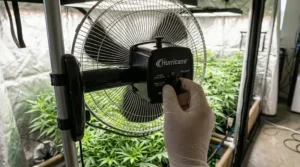
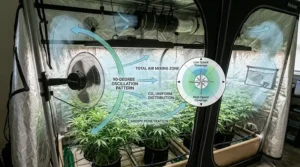
Hurricane Classic 16″ Wall Mount Oscillating Fan is the fan most growers picture when they search “hurricane fan grow tent” in the first place, and for good reason — it’s been the default budget wall-mount pick in grow communities for years. The 90-degree oscillation sweeps a wide arc across the canopy, and the steel neck and metal grill mean it isn’t held together with the same flimsy plastic clips that fail on cheaper knockoffs. What most buyers overlook is that this is a wall-mount fan, not a clip fan — it needs a flat tent pole or interior surface to bolt the bracket to, so measure your tent frame before ordering.
In practice, the three pull-cord speeds give you enough range to go from a gentle seedling breeze to a stronger vegetative-stage wind without buying a second fan. Reviewers consistently praise the price-to-airflow ratio but flag the pull-cord oscillation control as less convenient than a remote, and a handful note the motor hum becomes noticeable on the highest setting in a quiet room.
✅ Strong airflow for the price
✅ Durable metal construction
✅ Easy wall/pole mounting hardware included
❌ No remote or app control
❌ Oscillation control via pull cord only
Sitting around $30s–$40s, this is the fan to start with if you’re equipping your first 4×4 and don’t want to overthink it.
2. Hurricane Supreme 18″ Oscillating Wall Mount Fan
The Hurricane Supreme 18″ Oscillating Wall Mount Fan is essentially the Classic’s bigger sibling, built for growers who’ve graduated to a 5×5 tent or a small grow room where a 16-inch fan starts to feel undersized. The extra two inches of blade diameter pushes noticeably more air across a wider footprint, which matters once your canopy fills out and starts blocking airflow to the back corners of the tent.
What stands out about the Supreme line is that it’s marketed for greenhouses and workshops as much as grow tents, which tells you the motor is built to handle humid, dusty environments rather than just clean indoor air — a real consideration if your tent runs a humidifier. The trade-off is floor-space efficiency doesn’t change (it’s still wall-mounted) and it draws a bit more power than the 16-inch model.
✅ Wider coverage for bigger tents
✅ Built for humid/dusty environments
✅ Same reliable pull-cord 3-speed design
❌ Larger footprint needs more wall clearance
❌ Slightly higher power draw than the 16″ version
Best suited to growers running 5×5 tents or multi-plant rooms, typically in the $40s–$60s range.
3. ACTIVE AIR (Hydrofarm) ACF16 Wall Mount Oscillating Fan (2-Pack)
The ACTIVE AIR (Hydrofarm) ACF16 Wall Mount Oscillating Fan ships as a 2-pack with a spring-loaded clip mount, which solves a problem the Hurricane lineup doesn’t: flexible placement without permanent wall hardware. Hydrofarm has been supplying hydroponic equipment for decades, and this fan is built specifically with grow spaces in mind rather than adapted from a general home-fan lineup.
The real value of buying two at once is zone coverage — one ACF16 mounted low and one mounted high creates a cross-breeze that a single fan can’t replicate, which matters most in taller tents where heat stratifies near the lights. Buyer feedback is mixed on long-term durability of the spring clip under constant vibration, so growers running 24/7 cycles should periodically check the mount.
✅ Two fans for whole-tent zone coverage
✅ Spring clip avoids drilling into tent poles
✅ Purpose-built for hydroponic environments
❌ Spring clip tension can loosen over months of use
❌ Pricier than a single wall-mount fan
At $60s–$80s for the pair, it’s a strong mid-range pick for 4×4 to 5×5 tents that need airflow from two directions.
4. VIVOSUN AeroWave D4 4″ Grow Tent Clip Fan
Don’t let the size fool you — the VIVOSUN AeroWave D4 4″ Grow Tent Clip Fan is the budget pick of this entire list and it earns its spot by doing one thing well: keeping a small tent’s air moving without eating floor space or your wallet. The detachable hook means you can clip it to a pole or hang it from a tent’s interior loop, which is more flexible than a fixed wall bracket.
In real-world use, this is a seedling and propagation-tent tool more than a flowering-stage workhorse — the 3-speed motor moves enough air to strengthen young stems but won’t compete with a 6-inch EC fan once your canopy thickens up. The spec sheet’s adjustable airflow angle matters more than it sounds: in a tight 2×2, being able to angle the fan slightly downward keeps it from blasting your grow light’s heat sink directly at the plants.
✅ Extremely affordable
✅ Compact enough for tiny tents
✅ Adjustable angle and detachable hook
❌ Underpowered for tents larger than 3×3
❌ Fewer speed options than EC-motor competitors
At roughly $15–$20, it’s the easiest first-fan purchase on this list and a smart add-on for anyone running multiple small tents.
5. Spider Farmer 6″ Grow Tent Clip Fan (EC Motor)
The Spider Farmer 6″ Grow Tent Clip Fan brings EC-motor efficiency and a 10-speed range down to a more accessible price point than its premium competitors, and the circular clamp design is worth calling out specifically — it’s built to avoid the classic problem of clip fans sliding down a pole or sitting too close to the tent wall, which is what kills cheaper oscillation motors over time.
Customer feedback skews positive on quietness and build quality, with multiple buyers mentioning responsive replacement support when a unit arrived with an oscillation issue. The waterproof IP54 rating matters more than it might seem on a spec sheet: it’s the difference between a fan that survives an accidental overspray from a watering can and one that doesn’t.
✅ 10-speed EC motor with wide-angle oscillation
✅ Waterproof IP54 rating
✅ Strong clamp design resists wall-wobble
❌ No app/smart control
❌ Six-inch size may be excessive for very small tents
Priced in the $30s–$40s, this is the best value pick if you want EC-motor performance without paying for smart features you may not use.
6. AC Infinity CLOUDRAY S6 Grow Tent Clip Fan
AC Infinity built its reputation on inline exhaust fans, and the AC Infinity CLOUDRAY S6 Grow Tent Clip Fan brings that same EC-motor engineering to a 6-inch clip fan with 10 dynamic wind speeds and 10-level oscillation. What most buyers overlook about this model is the motor’s “long-life” branding isn’t just marketing — EC motors generally run cooler and quieter than the brushed AC motors found in cheaper clip fans, which translates to less wear over months of 24/7 cycling.
This is the fan for growers who’ve already invested in AC Infinity’s CLOUDLINE exhaust fans and want a circulation fan that matches the same level of quiet, weatherproof build quality. The trade-off is straightforward: you’re paying a premium for brand consistency and motor longevity rather than for features you can’t get elsewhere at this CFM range.
✅ Long-life EC motor designed for 24/7 operation
✅ 10-level oscillation for precise targeting
✅ Weatherproof IP54 build
❌ Premium pricing relative to CFM output
❌ Single-color/style option limits aesthetic choice
Expect to pay in the $50s–$70s range — worth it if quiet, long-term reliability outweighs saving an extra $20.
7. VIVOSUN AeroWave E6 Gen2 Smart Grow Tent Clip Fan
The VIVOSUN AeroWave E6 Gen2 Smart Grow Tent Clip Fan tops this list for buyers who want automation, not just airflow. With a dual ball-bearing EC motor rated for roughly 320 CFM at a noise level around 33 dB(A), it’s quiet enough for a bedroom grow while still moving real air. The standout feature is the “natural wind” mode, which varies speed and direction instead of running at one constant intensity — closer to the irregular gusts that actually trigger stronger stem development outdoors, rather than a flat, constant breeze.
Here’s the catch most spec sheets bury: without VIVOSUN’s GrowHub controller, you’re capped at 5 of the available 10 speed levels. If you already run other VIVOSUN smart devices, this fan slots into that ecosystem and pays off through automation; if you don’t, you’re buying a very good clip fan and leaving some of its functionality on the table. Reviewers are largely positive on the clamp’s grip strength and the motor’s quiet operation, with the most common complaint being that it doesn’t drop tent temperature much on its own — which makes sense, since circulation fans aren’t meant to replace your exhaust system.
✅ Industry-leading 320 CFM in a 6-inch fan
✅ Natural wind mode mimics real outdoor gusts
✅ Smart/app control when paired with GrowHub
❌ Full 10-speed range requires GrowHub controller
❌ Top of this list’s price range
Pricing runs $50s–$70s standalone, more as part of a GrowHub bundle — the right call for growers already building a connected tent setup.
Practical Usage Guide: Fan Placement & Oscillation Setup
Buying the right fan only solves half the problem — placement is where most growers actually go wrong. The goal of a circulation fan isn’t to blast your plants; it’s to keep air moving around the canopy so leaves flutter gently rather than thrash.
🔧 Setup basics that actually matter:
- Aim fans between plants and across the canopy top, not directly down at leaf surfaces — direct blasts cause wind burn and curled leaf edges within days.
- In tents 4×4 and larger, run two smaller fans pointed in opposing diagonal directions rather than one large fan pointed straight across; this creates circular airflow instead of a single dead zone on the far wall.
- Mount wall fans roughly two-thirds of the way up the tent, below the canopy top but above the lower leaves, so the breeze reaches the mid-canopy where mold most often starts.
- Run oscillating fans on a timer synced with your light cycle, but never turn circulation off completely — even during dark periods, stagnant air invites humidity problems.
- Check clip and clamp tension weekly for the first month; this is when cheap clamps loosen and fans start drooping or vibrating against the tent pole.
A common rookie mistake is treating the circulation fan like the tent’s only airflow source. It isn’t — your inline exhaust fan handles fresh-air exchange and CO2 replenishment at the room level, while the circulation fan’s job is purely local: breaking up the still air pocket that forms right at the leaf surface.
Buyer’s Decision Framework: Matching Fan Type to Tent Size
Rather than scrolling back up through seven products, use this quick framework to narrow your choice before you shop:
- If you’re running a 2×2 or 2×4 seedling/propagation tent → choose a compact clip fan like the AeroWave D4. You need gentle, adjustable airflow, not raw power, and floor space is precious in a tent this size.
- If you’re running a single 4×4 flowering tent on a budget → choose a wall-mount fan like the Hurricane Classic 16″. You get the most CFM per dollar and don’t need app features for a single-tent setup.
- If you’re running a 4×4–5×5 tent and noise is a concern (apartment, shared space, bedroom) → choose an EC-motor clip fan like the Spider Farmer 6″ or CLOUDRAY S6. The lower decibel rating is worth the price jump.
- If you’re running multiple tents or already use smart controllers → choose the VIVOSUN AeroWave E6 Gen2 to bring everything onto one app-controlled system.
- If you’re running a 5×5 or larger room → choose two fans, either a Hurricane Supreme 18″ plus a smaller clip fan, or the ACTIVE AIR ACF16 2-pack, to avoid a single dead zone where airflow can’t reach.
Hurricane & Clip Fans vs. Traditional Box and Tower Fans
| Factor | Hurricane/Clip Fans | Box/Tower Fans |
|---|---|---|
| Floor space used | None to minimal | Significant |
| Mounting flexibility | Wall, pole, or clip | Floor only |
| Built for humidity/dust | Often yes (IP-rated) | Rarely |
| Canopy-level targeting | Precise | Difficult |
| Typical lifespan in tents | 12–24+ months | Often under 12 months |
The biggest difference here isn’t airflow volume — a box fan can move plenty of air — it’s durability and placement. Standard home box and tower fans aren’t built with humidity-resistant motors, and growers consistently report they fail faster once exposed to a tent’s higher moisture levels. The base of a tower fan also eats canopy floor space that a wall-mount or clip fan simply doesn’t need. Circulation fans in growing environments work by breaking up the stagnant boundary layer of air around leaves, which prevents condensation and keeps CO2 replenished at the leaf surface, and that job is done more efficiently by a fan that can be aimed precisely at canopy height rather than one sitting on the floor blowing upward at an angle.
✨ Don’t Miss These Exclusive Deals!
🔍 Take your grow tent airflow to the next level with these carefully selected fans. Click on any highlighted pick to check current pricing and availability. The right fan can mean the difference between leggy, weak stems and a sturdy canopy your whole setup will thank you for!

How to Choose a Hurricane Fan for Your Grow Tent
- Measure your tent first. Wall-mount fans need flat pole or wall space; clip fans need a horizontal bar to clamp onto. Know which mounting style fits your tent before comparing models.
- Match CFM to tent size, not marketing claims. A 2×2 tent rarely needs more than a small clip fan; a 5×5 benefits from either a larger wall-mount unit or two smaller fans working together.
- Decide how much you care about noise. Bedroom or apartment grows should lean toward EC-motor clip fans; garage or basement setups can tolerate louder AC-motor wall fans.
- Check the IP rating if you run high humidity. IP54-rated fans tolerate splashes from misting or humidifiers far better than uncertified household fans.
- Consider your future setup, not just today’s. If you plan to scale to multiple tents, a smart/app-controlled fan pays off faster than buying separate basic units later.
- Read the oscillation spec carefully. “10 speeds” sometimes means 5 without a separate controller — check whether full functionality requires an additional purchase.
- Budget for a backup. Clip fans and small motors are consumables in a 24/7 environment; growers running multiple cycles a year often keep a spare on hand.
Common Mistakes When Buying and Using Grow Tent Fans
❌ Buying based on size alone. A bigger fan isn’t automatically better — oversized fans in small tents create wind burn and dry out the growing medium faster than expected.
❌ Pointing fans directly at the plants. Direct, constant airflow on leaves causes physical damage. Indirect, circulating airflow across the canopy is what builds stronger stems.
❌ Ignoring the mounting method. Buying a wall-mount fan for a tent with no flat mounting surface, or a clip fan for a pole too thick for its clamp, leads to returns and wasted money.
❌ Forgetting noise tolerance. A loud AC-motor fan in a bedroom-adjacent grow tent becomes a daily annoyance fast — check decibel ratings before buying, not after.
❌ Skipping the warranty/return policy check. Clip fan motors are one of the more failure-prone components in a tent; buying from a brand with responsive support saves headaches months down the line.
Features That Actually Matter (And Those That Don’t)
Actually matters: EC motor technology, because it directly affects noise level, heat output, and long-term reliability under constant operation — this is the single biggest factor separating a $20 fan from a $60 one.
Actually matters: IP rating, especially IP54, since grow tents routinely deal with humidity, misting, and the occasional watering-can splash that household fans were never designed to handle.
Doesn’t matter much: App/smart control, unless you’re already running other connected devices. A manual 10-speed fan performs identically to a smart one in terms of raw airflow — the app just adds convenience, not power.
Doesn’t matter much: Color or finish. Beyond the rare tent with limited interior light reflectivity considerations, the white-versus-black debate is purely cosmetic.
Actually matters: Clamp/mount design quality, because this is consistently the first point of failure reported across nearly every clip fan brand, regardless of price point.
Long-Term Cost & Maintenance
A $16 clip fan and a $65 EC-motor clip fan don’t just differ in upfront cost — they differ in total cost of ownership. Cheaper AC-motor fans typically draw more power for the same airflow and tend to fail faster under 24/7 cycling, meaning a grower running multiple harvests a year may replace a budget fan two or three times in the span that a single EC-motor fan keeps running.
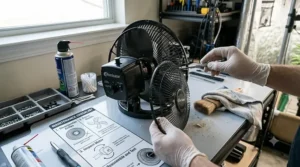
Maintenance itself is minor but easy to neglect: dust accumulation on blades and motor housings reduces airflow efficiency over time, so a quick wipe-down every couple of weeks keeps performance consistent. Clamp and mounting hardware should be checked monthly, since vibration from constant oscillation is what eventually loosens spring clips and wall brackets. Faulty electrical components like loose connections or improper grounding in cords and plugs are a leading cause of preventable household fires, so inspecting power cords for fraying — especially in a humid tent environment — is worth the thirty seconds it takes each month.
What to Expect: Real-World Performance
On paper, CFM numbers suggest bigger fans always win, but real-world tent performance depends heavily on tent size relative to fan output. In a 2×2 tent, even a modest clip fan creates a noticeably stronger breeze than the same fan would in a 5×5 space, simply because there’s less air to move. Moving air replaces the carbon-dioxide-depleted layer next to leaves with fresher, CO2-richer air, and growers typically notice visibly thicker stems within two to three weeks of consistent circulation, particularly during the vegetative stage when stem development matters most.
Noise is the other variable that surprises first-time buyers. A fan rated at 33 dB(A) sounds barely audible from across a room, but mounted inside a tent a few feet from your head while you’re checking on plants, even a quiet fan registers more noticeably. If your tent sits in a bedroom or shared living space, prioritize the EC-motor options on this list over their louder AC-motor counterparts.
Frequently Asked Questions
❓ What is a hurricane fan grow tent setup?
❓ Do grow tents really need an oscillating fan?
❓ What size fan is best for a 4x4 grow tent?
❓ How many fans should I run in a grow tent?
❓ Are quiet clip fans as powerful as louder wall-mount fans?
Conclusion
A hurricane fan grow tent setup isn’t about buying the biggest, loudest fan you can find — it’s about matching airflow to your specific tent size, noise tolerance, and growing stage. Budget growers running a single 4×4 will get excellent value from the Hurricane Classic 16″, while anyone prioritizing quiet, long-term reliability should look toward the EC-motor clip fans from Spider Farmer, AC Infinity, or VIVOSUN. Whichever you choose, remember that placement and oscillation pattern matter just as much as the fan itself — a great fan aimed badly underperforms a modest fan aimed well.
✨ Don’t Miss These Exclusive Deals!
🔍 Take your grow tent setup to the next level with these carefully selected fans. Click on any highlighted pick above to check current pricing and availability — your plants (and your future harvest) will thank you!
Recommended for You
- 7 Best Oscillating Fans for Grow Tents in 2026
- Inline Fan for Grow Tent: 7 Quiet Picks for 2026
- Grow Tent Height Extension: 7 Game-Changing Kits for 2026
Disclaimer: This article contains affiliate links. As an Amazon Associate, I earn from qualifying purchases. If you purchase products through these links, we may earn a small commission at no additional cost to you.
✨ Found this helpful? Share it with your friends! 💬🤗
