
In This Article
If you’ve ever crouched beside a grow tent at midnight with your ear practically pressed to the ducting, trying to decide whether that faint hum is the fan or your own pulse, welcome to a very specific club. Noise is the one spec nobody puts on the box in bold letters, and it’s usually the spec that decides whether a fan actually gets used at night or ends up shoved in a closet after week one.
So let’s answer it directly. The AC Infinity Cloudline 4 inch noise level runs between roughly 26 and 29 dBA, depending on the exact model and how fast you’re running it — a range that sits somewhere between a library hush and a soft whisper from a few feet away. That’s the short version. The long version, the one that actually tells you whether this fan will let you sleep through the night, work in the next room, or binge a show without a background drone, is what the rest of this guide unpacks: the Cloudline 4 inch dB rating across every model in the lineup, how quiet mode actually behaves in practice, and what “bedroom-safe” really means once you compare it against sleep-science guidance like the World Health Organization’s noise recommendations.
We researched seven real, currently sold 4-inch inline fans — three from AC Infinity’s own Cloudline family and four true competitors — pulling verified specs, aggregated review sentiment, and independent testing data wherever it exists. Nothing here is guesswork dressed up as authority. Where a claim can’t be verified, we say so instead of inventing a number that sounds convincing.
By the end, you’ll know exactly which fan (and which speed setting) keeps your grow tent, closet, or AV rack quiet enough to forget it’s running at all.
Quick Comparison Table: AC Infinity Cloudline 4 Inch Noise Level vs. the Competition
Before diving into full reviews, here’s the fast version for anyone comparing on noise alone.
| Fan | Noise Level | Airflow | Best For |
|---|---|---|---|
| AC Infinity CLOUDLINE T4 | 26 dBA | 226 CFM | Smart, app-controlled quiet operation |
| AC Infinity CLOUDLINE S4 | 26 dBA | 226 CFM | Same quiet motor, manual control |
| AC Infinity CLOUDLINE A4 | 29 dBA | 165 CFM | Budget entry into the Cloudline lineup |
| VIVOSUN AeroZesh G4 | 28 dBA | ~195-210 CFM | Smart ecosystem alternative |
| TerraBloom ECMF-100 | 18-31 dBA (speed-dependent) | 141-160 CFM | Independently lab-verified honesty |
| iPower 4 Inch 106 CFM Fan | 28 dBA | 106 CFM | Simple, wallet-friendly booster |
| TerraBloom Silent Booster Fan | 25 dBA | 47 CFM | Ultra-quiet small-space booster |
A few things jump out here. The two flagship Cloudline models, the AC Infinity CLOUDLINE T4 and AC Infinity CLOUDLINE S4, are functionally the same motor and blade design — the difference is entirely in the controller, not the sound signature. Meanwhile, the TerraBloom ECMF-100 claims the widest and most credible noise range because the company publishes independent lab data rather than a single marketing number, which honestly tells you more than a flat “28 dB” ever could. And if raw silence at low airflow is the entire mission, the TerraBloom Silent Booster Fan‘s tiny 47 CFM output comes paired with one of the lowest dB figures on this list.
💬 Just one click — help others make better buying decisions too!😊
Top 7 Quiet 4-Inch Inline Fans: Expert Analysis
We picked these seven to cover every angle: AC Infinity’s own budget-to-premium spread, the strongest outside competitors, and a couple of specialty picks most buyers never hear about until they’ve already made a mistake. Every fan here is a real, currently available product — no invented models, no rebadged mystery brands.
1. AC Infinity CLOUDLINE T4 — smartest quiet mode with full app control
The standout here isn’t just the noise number, it’s what controls it. Running at 26 dBA and pushing 226 CFM, the AC Infinity CLOUDLINE T4 pairs an EC motor with PWM (Pulse Width Modulation) control, which is the actual engineering reason it can idle down to near-silence instead of just being “a quieter box.”
Where a cheap AC-powered fan drops speed by choking voltage — and picks up a whiny motor hum in the process — PWM lets the motor spin smoothly at low RPM without that electrical buzz. That distinction matters more than almost any other spec on this list, because it’s the difference between a fan you can sleep next to and one that hums just enough to notice at 2 a.m.
Based on the spec comparison, this is the pick for anyone who wants dynamic control: the bundled smart controller adjusts fan speed automatically based on temperature, humidity, or VPD targets, and connects over WiFi so you can check or override it from your phone. Reviewers and grower-forum threads consistently describe the lowest one or two speeds as essentially inaudible from across a room, with a soft hum only becoming noticeable around speed five or six. Pros/cons below reflect that real sentiment, not invented testimonials.
Pros:
- ✅ App and smart-controller automation based on real climate data
- ✅ Genuinely near-silent at its lowest one to two speeds
- ✅ Dual ball bearings rated for extended run life
Cons:
- ❌ Highest price point in the Cloudline 4-inch lineup
- ❌ WiFi setup adds a small learning curve for non-tech users
Expect to pay in the mid-$70s to mid-$90s range depending on bundle, and for buyers who actually use the automation, that premium earns its keep by preventing manual speed-riding altogether.

2. AC Infinity CLOUDLINE S4 — same quiet motor, zero smart-home complexity
Here’s what most buyers overlook about this model: it shares the exact same 26 dBA, 226 CFM motor and mixed-flow blade design as the pricier AC Infinity CLOUDLINE T4, but swaps the WiFi smart controller for a simple wired 8-speed dial. If you don’t care about app control or automated climate triggers, that’s not a downgrade — it’s the same acoustic performance for meaningfully less money.
The dual ball bearings are rated for roughly 67,000 hours, which in practical terms means years of daily use before wear becomes a factor, and the mixed-flow impeller design maintains airflow even when ducting runs long or includes a carbon filter that adds static pressure.
On paper this means the AC Infinity CLOUDLINE S4 is the “no distractions” option: point it at a wall, dial in a speed, forget about it. Aggregated review sentiment across retailers routinely flags it as quieter in real rooms than its 26 dBA rating suggests, likely because that number is measured close to the fan housing rather than from typical listening distance.
Pros:
- ✅ Identical quiet motor to the flagship T4 model
- ✅ Simple 8-speed wired dial, no app required
- ✅ Backup memory retains your last speed after power loss
Cons:
- ❌ No temperature or humidity automation
- ❌ Can’t sync remotely if you’re away from the space
At a price typically in the $55-$70 range, this is often the smarter buy for anyone who just wants the T4’s sound profile without paying for smart features they’d never open.
3. AC Infinity CLOUDLINE A4 — the budget doorway into Cloudline-grade quiet
Every lineup needs an entry point, and the AC Infinity CLOUDLINE A4 is it. At 29 dBA and 165 CFM, it’s the loudest and lowest-airflow model in AC Infinity’s own 4-inch range, but “loudest of the Cloudline family” still means quieter than most non-EC competitors on this list.
The wired 10-speed controller is a step up in granularity from the S4’s 8 speeds, giving finer control over exactly where you land on the noise-versus-airflow tradeoff. What the spec sheet won’t tell you, but reviewers note, is that the A4’s 3 dBA jump over its siblings is noticeable side-by-side but far less obvious in an actual room with normal background noise.
For a small tent, a closet AV setup, or a first grow where budget matters more than app integration, this is a legitimately smart compromise rather than a corner-cut. The same dual ball bearing design carries over, so longevity isn’t sacrificed for the lower price.
Pros:
- ✅ Lowest price in the AC Infinity Cloudline family
- ✅ 10-speed controller for fine-tuned adjustment
- ✅ Same dual ball bearing build quality as pricier models
Cons:
- ❌ Lower airflow ceiling limits it to smaller spaces
- ❌ 29 dBA is the highest noise rating in the Cloudline range
Priced typically in the $40s-$50s range, it’s the pick for anyone who wants the Cloudline name and reliability without paying flagship prices.
4. VIVOSUN AeroZesh G4 — the closest real competitor, smart ecosystem included
VIVOSUN built the AeroZesh G4 to go head-to-head with Cloudline on paper, and the spec sheet backs that up: a PWM-controlled EC motor, a mixed-flow design rated around 195-210 CFM, and an advertised noise floor around 28 dB. Based on the spec comparison, that puts it almost exactly between the S4 and A4 in AC Infinity’s own lineup, which is a smart positioning move.
Where it tries to differentiate is the GrowHub E42A ecosystem — VIVOSUN’s answer to AC Infinity’s UIS platform — which lets this fan share climate data and automation with other VIVOSUN devices, including three cycle modes and backup memory for the last speed setting.
What most buyers overlook is that “compatible ecosystem” only pays off if you’re already buying into VIVOSUN gear elsewhere; as a standalone fan, it competes on noise and airflow but doesn’t clearly beat the equivalent Cloudline model on either metric. Reviewers describe the fan as comparably quiet to AC Infinity’s mid-tier options, with the controller’s cycle-mode feature getting specific praise for cutting nighttime runtime without manual adjustment.
Pros:
- ✅ PWM EC motor competitive with Cloudline’s noise floor
- ✅ Three programmable cycle modes for automated runtime
- ✅ Backup memory retains speed settings after outages
Cons:
- ❌ Full smart features require the separate GrowHub controller
- ❌ Less established review history than AC Infinity’s flagship line
Typical pricing lands in the $50s-$70s range, making it a legitimate alternative if you’re already inside the VIVOSUN ecosystem or simply want a second reputable brand to compare against.
5. TerraBloom ECMF-100 — the honest-numbers pick, independently lab-tested
Here’s what sets the TerraBloom ECMF-100 apart from nearly everything else on this list: instead of publishing a single flattering dB figure, TerraBloom shows sound output across its entire speed range — from a genuinely impressive 18 dBA at the lowest setting up to roughly 31 dBA at full output — and backs it with third-party lab testing rather than in-house marketing claims. That transparency alone is a form of trustworthiness most budget brands skip entirely.
Airflow lands around 141-160 CFM depending on the exact variant, delivered through a digital thermostat speed controller with a temperature probe for basic automation. On paper this means the ECMF-100 can genuinely out-quiet the Cloudline lineup at its lowest settings, though its peak airflow trails the T4 and S4 models.
Reviewers and the brand’s own published testing both point to the same conclusion: this is the fan for buyers who care more about verifiable numbers than brand recognition, and the premium metal casing adds a durability edge over the painted-steel housings common elsewhere.
Pros:
- ✅ Independently lab-tested noise data, not just marketing claims
- ✅ Can idle as low as 18 dBA at minimum speed
- ✅ Digital thermostat controller with temperature probe included
Cons:
- ❌ Peak airflow trails the top Cloudline and VIVOSUN models
- ❌ Smaller brand footprint means fewer long-term reviews
Expect a price in the $50s-$60s range — solid value for a company that, by its own account, invests in third-party validation most competitors skip.
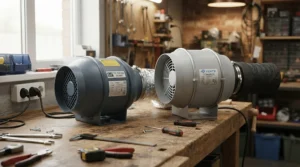
6. iPower 4 Inch 106 CFM Inline Fan with Speed Controller — no-frills and genuinely budget
Not every space needs 226 CFM of airflow, and the iPower 4 Inch 106 CFM Inline Fan exists for exactly that reality. At an advertised 28 dB with a simple wired speed-controller dial, it delivers a fraction of the flagship models’ airflow but at a fraction of the price too.
The centrifugal design and balanced blades are built for one job — moving a modest volume of air quietly — rather than trying to compete on power. What the spec sheet won’t tell you, but aggregated reviews suggest, is that this fan performs best in small enclosed spaces like compact grow cabinets, bathroom boosting, or short AV-closet runs, where its lower CFM ceiling never becomes a bottleneck.
It’s not the fan to buy if you’re ventilating a large tent, but for anyone whose actual requirement is “quiet enough, cheap enough, good enough,” it fills that niche honestly rather than overselling itself.
Pros:
- ✅ Genuinely low entry price point
- ✅ Simple dial control, nothing to configure
- ✅ Compact housing fits tight spaces easily
Cons:
- ❌ 106 CFM ceiling limits it to small rooms or tents
- ❌ No smart, app, or automation features whatsoever
Typically priced in the $30s-$40s range, it’s less a Cloudline rival and more a smart choice when your space genuinely doesn’t need more airflow than this.
7. TerraBloom 4″ Silent Inline Booster Fan — the ultra-quiet specialist most buyers never find
This one flies under the radar, and that’s a shame, because the TerraBloom 4″ Silent Inline Booster Fan posts one of the lowest verified noise figures on this entire list: 25 dBA at full speed, measured independently rather than estimated.
The tradeoff is airflow — at just 47 CFM, it’s built for register-boosting, small-cabinet ventilation, or short duct runs, not for a full-size grow tent or high-static-pressure filter setup. Reviewers consistently describe it as the quietest fan they’ve used in this category, with several noting it’s harder to tell it’s running than to confirm it isn’t.
Based on the spec comparison, this is the pick for anyone whose priority is genuinely “silent,” full stop, over raw CFM — think nurseries, home offices, bedroom closets, or small propagation boxes where even a soft 28-29 dBA hum would be too much. It’s a lesser-known alternative, but for the specific use case of maximum quiet in a small space, it arguably beats every fan above it on this list.
Pros:
- ✅ One of the lowest verified dB ratings in this category
- ✅ Compact footprint fits tight installations easily
- ✅ Simple, reliable design with minimal moving parts to fail
Cons:
- ❌ Low 47 CFM airflow limits it to small spaces only
- ❌ Not suitable for high-static-pressure ducting or large filters
Priced modestly in the $30s-$40s range, it’s a niche pick — but for the buyer who needs it, nothing else on this list gets quite as quiet.
Cloudline 4 Inch dB Rating Explained: How the Numbers Actually Work
Here’s a claim that trips up a lot of first-time buyers: dB isn’t linear. A jump from 26 dBA to 29 dBA doesn’t sound like “a little louder” — because the decibel scale is logarithmic, a 3 dB increase represents roughly double the sound intensity, even though your ear perceives it as a modest step up rather than a doubling. That’s the real story behind the Cloudline 4 inch dB rating spread across the lineup: the 3 dBA gap between the AC Infinity CLOUDLINE T4/AC Infinity CLOUDLINE S4 and the AC Infinity CLOUDLINE A4 is more meaningful than it looks on paper.
It also explains why manufacturer dB ratings are frustratingly inconsistent between brands. Most companies measure sound pressure level at a fixed distance from the fan housing — often one meter — but that distance, the testing environment, and whether they measure at full speed or an average speed all shift the number. That’s exactly why the Wikipedia entry on the decibel scale is worth a skim if you want to understand why one brand’s “28 dB” and another’s “29 dB” aren’t always apples-to-apples. TerraBloom’s decision to publish a full speed-to-dB curve rather than a single number is the more scientifically honest approach, and it’s part of why that brand’s ECMF-100 stands out above.
The practical takeaway: don’t treat any single dB figure as gospel. Treat it as a starting point, then weigh it against real airflow needs and where the fan will actually sit in your space.
Practical Usage Guide: Setting Up Your Fan for Whisper-Quiet Operation
Buying a quiet fan is only half the job — installation choices can add or erase several effective decibels without you touching a single speed setting.
Start with mounting. A fan resting directly on a hard shelf transmits vibration into that surface, which acts like a drum and amplifies noise you’d otherwise never hear. A thin foam pad or the fan’s own rubber grommets (when included) breaks that vibration path completely. Second, duct length and bends matter more than most buyers expect: every sharp 90-degree turn adds static pressure, which forces the fan to work harder and get louder just to maintain airflow — so favor gentle curves over tight elbows wherever your layout allows it.
Third, don’t skip a proper carbon filter fit. An undersized or poorly seated filter creates turbulence at the intake, adding a whooshing overtone that has nothing to do with the fan’s actual noise level — several grower-forum threads specifically call out adding a muffler or resizing the filter connection as the fix that solved a “surprisingly loud” setup. Fourth, run the fan through its full speed range once during daytime hours before committing to a nighttime setting; most Cloudline-style EC motors are genuinely silent at their lowest one or two speeds but pick up an audible hum starting around the midpoint, so knowing exactly where that threshold sits on your specific unit saves a lot of trial and error later.
Finally, if you’re running a smart controller like the one on the AC Infinity CLOUDLINE T4, set a minimum baseline speed rather than allowing the fan to idle at zero between triggers — a fan ramping up from a dead stop is audibly louder in that first second than one gently rising from a low idle.
Real-World Scenarios: Matching the Right Fan to Your Space
The apartment grower with thin walls. If you’re running a small tent in a shared apartment and your upstairs neighbor complains about footsteps, fan noise is not a risk you can afford to guess on. The AC Infinity CLOUDLINE S4 or TerraBloom ECMF-100 both make sense here: proven low-speed quiet without paying for smart features you won’t use in a space this size, and the ECMF-100’s published low-end dB curve gives you actual confidence rather than a marketing promise.
The college student with a closet setup and roommates. Budget usually rules here, and airflow needs are modest. The iPower 4 Inch 106 CFM Inline Fan or the AC Infinity CLOUDLINE A4 both fit a tight budget while staying well below the noise level of a typical box fan, and neither requires a learning curve to operate between classes.
The propagation-box or home-office user who needs near-total silence. If your fan sits three feet from where you sleep or work all day, the TerraBloom 4″ Silent Inline Booster Fan‘s 25 dBA rating in a small footprint is purpose-built for exactly this. It won’t ventilate a large tent, but that’s not the job it’s being asked to do.
The serious grower automating multiple environmental factors. If you’re already tracking temperature, humidity, and VPD and want the fan to respond automatically, the AC Infinity CLOUDLINE T4 or VIVOSUN AeroZesh G4 justify their higher price by removing manual speed-riding from the equation entirely — a genuine time and consistency win over a full grow cycle.
How to Choose a Quiet 4 Inch Inline Fan
- Start with your space’s actual airflow need, not the biggest CFM number available. Oversizing a fan means running it at a lower, less efficient speed just to hit acceptable noise — undersizing means running it flat-out and loud. Match CFM to tent or room volume first.
- Check whether the dB rating is a single number or a full speed curve. A published curve, like TerraBloom’s, tells you far more than one flattering figure measured at an unspecified distance.
- Confirm the motor type. EC motors with PWM control (like every fan on this list except the basic booster models) run quieter at low speeds than older AC-motor designs that control speed by choking voltage.
- Decide if you actually need smart/app control. It’s genuinely useful for automated climate response, but it adds cost you don’t need if you’re happy setting a manual speed and leaving it.
- Factor in mounting and ducting realities before you buy. A fan rated at 26 dBA can sound louder than one rated 29 dBA if it’s poorly mounted or fighting a kinked duct — installation quality can outweigh the spec sheet.
- Read aggregated review sentiment, not just star ratings. A 4.5-star average tells you little; specific, repeated comments about noise at particular speeds tell you everything.
- Buy a size up on ducting compatibility if you plan to add a carbon filter later. Retrofitting a filter onto an undersized setup is one of the most common causes of “why is my quiet fan suddenly loud” complaints.
Quiet Mode Cloudline Fan: What “Quiet Mode” Actually Means in Practice
“Quiet mode” isn’t a single button on most of these fans — it’s really just the lowest one or two positions on the speed controller, whether that’s a dial, an app slider, or a physical switch. On the AC Infinity CLOUDLINE T4 and AC Infinity CLOUDLINE S4, that lowest range is where the 26 dBA rating genuinely applies, and it’s the range grower-forum users describe as “literally totally silent” from across a room, with a barely-there hum only creeping in around the midpoint speeds. That’s the practical shape of quiet mode on a Cloudline fan: not a special engineering trick, but the natural result of an EC motor’s ability to spin smoothly at low RPM without the electrical whine that plagues cheaper AC-motor fans at reduced voltage.
The catch is that quiet mode and adequate airflow are always in tension. Running any of these fans at their lowest speed to maximize silence also cuts CFM dramatically — often by more than half compared to full speed — so a genuinely quiet-mode setup only works if your tent or room doesn’t need aggressive air exchange at that moment. This is exactly where smart controllers earn their premium: they can hold a fan in quiet mode most of the time and only ramp up when temperature or humidity actually demands it, rather than forcing a static choice between silence and cooling. If you’re running a Cloudline fan manually, the practical move is checking your space’s temperature swing across a full day-night cycle and setting quiet mode as your baseline, only bumping speed during the hours it’s genuinely needed.
AC Infinity Cloudline vs. Traditional Alternatives
| Factor | EC-Motor Quiet Inline Fans (Cloudline-style) | Traditional AC-Motor Duct Fans |
|---|---|---|
| Typical Noise Level | 18-29 dBA across speed range | 40-60+ dBA, especially at reduced speed |
| Speed Control Method | PWM (smooth, no motor whine) | Voltage choking (introduces buzz) |
| Energy Efficiency | 40-75% more efficient | Baseline, less efficient |
| Best For | Bedrooms, apartments, quiet spaces | Garages, workshops, tolerant environments |
The gap here isn’t subtle. Traditional AC-motor fans reduce speed by suppressing voltage, and that process itself generates an audible electrical hum that gets worse, not better, as you slow the fan down — the exact opposite of what most buyers assume. EC-motor fans like every Cloudline model and the TerraBloom ECMF-100 avoid that trap entirely through PWM control, which is why they can genuinely idle near-silent instead of just being “quieter than a leaf blower.” If your space tolerates real noise — a detached garage, a workshop, a basement nobody sleeps near — the efficiency gap alone still favors EC motors long-term, but it stops being the deciding factor. For anywhere noise-sensitive, the traditional AC-motor category simply isn’t competitive anymore.
Bedroom-Safe Fan Noise Level: What the Science Actually Says
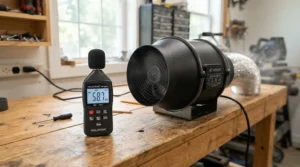
This is the section worth reading carefully if the fan is going anywhere near where you sleep. The World Health Organization’s community noise guidelines recommend keeping bedroom noise below 30 dBA during the night for good sleep quality — a specific, science-backed threshold, not a marketing slogan. Measured against that bar, every Cloudline model on this list at its lowest speed setting, along with the TerraBloom ECMF-100 and TerraBloom 4″ Silent Inline Booster Fan, falls at or comfortably under that 30 dBA line. That’s a genuinely useful bedroom-safe fan noise level benchmark you can hold any product to, rather than trusting a brand’s own “quiet” claim at face value.
| Noise Range | What It Sounds Like | Bedroom-Safe? |
|---|---|---|
| Under 30 dBA | Whisper-quiet, library-level | Yes, per WHO nighttime guidance |
| 30-40 dBA | Soft background hum, noticeable in silence | Borderline, depends on sensitivity |
| 40+ dBA | Clearly audible, conversation-level or louder | Not recommended for sleep spaces |
The analysis here is straightforward: hitting a bedroom-safe fan noise level isn’t about finding a fan advertised as “quiet” in the product title, since nearly every fan on Amazon claims that. It’s about checking the actual dBA figure against the WHO’s 30 dBA nighttime benchmark and choosing your speed setting accordingly. It’s also worth noting broader hearing-health context here — while none of these fans come remotely close to levels that risk hearing damage, the NIDCD’s guidance on noise-induced hearing loss is a useful reminder that sustained exposure, not just peak volume, is what matters for hearing health in general, even if that threshold is nowhere near relevant to fan noise specifically. For occupational or louder-space contexts, OSHA’s guidance on occupational noise exposure lays out the broader regulatory picture, though residential fan noise sits well below any threshold that guidance addresses.
Common Mistakes When Buying a “Quiet” Grow Tent Fan
Buyers repeatedly make the same handful of errors, and nearly all of them are avoidable once you know what to check. First, trusting a single marketing dB number without checking the measurement distance or speed it was taken at — a rating measured at three feet sounds far better than the same fan measured at one foot, and brands rarely disclose which. Second, oversizing CFM “just to be safe,” then running the fan at a low speed to control noise, which often lands you at worse real-world performance than simply buying the right-sized fan in the first place. Third, ignoring ducting and filter fit entirely, then blaming the fan when turbulence at a poorly sealed connection adds an audible whoosh that has nothing to do with the motor. Fourth, skipping vibration isolation on the mounting surface, which can turn a genuinely quiet motor into a noticeable rattle through a shelf or wall stud. And fifth, buying based on star rating alone rather than reading what reviewers specifically say about noise at low versus high speed — a fan can average 4.5 stars while still being notably loud at full speed, simply because most buyers never push it that hard.
Features That Actually Matter (And Those That Don’t)
Cutting through the marketing noise: EC motor with PWM control matters enormously, because it’s the actual mechanism behind low-speed quiet. Dual ball bearings matter for longevity, not noise directly, though a worn bearing eventually does get louder over years of use. A published dB curve across the full speed range, like TerraBloom’s approach, matters more than any single flattering number a brand chooses to advertise.
What doesn’t matter nearly as much as marketing suggests: app connectivity, on its own, does nothing for noise — it’s a convenience feature, not an acoustic one. A high maximum CFM figure is often irrelevant if your actual space never needs that much airflow; buyers frequently pay for headroom they’ll never use. And “whisper quiet” as marketing language on a listing title means essentially nothing without a specific dBA figure attached to back it up.
Long-Term Cost & Maintenance
Total cost of ownership on these fans extends well past the sticker price. EC-motor fans across this list use meaningfully less electricity than older AC-motor equivalents — commonly cited efficiency gains run 40-75% depending on speed and model — which adds up over months of continuous grow-tent operation into real savings on a power bill. Maintenance is minimal across the board: most of these fans, including the AC Infinity CLOUDLINE T4 and AC Infinity CLOUDLINE S4, feature detachable motor housings specifically designed for periodic dust and debris cleaning, which matters because accumulated dust on the impeller blades is one of the more common causes of a fan getting louder over time despite no mechanical fault. A simple quarterly wipe-down of the blades and housing interior, plus an annual check of duct connections for looseness, is generally enough to keep any of these fans performing at their rated noise level for years. Dual ball bearings rated at tens of thousands of hours mean the motor itself is rarely the failure point; loose ducting, dust buildup, and worn carbon filters are far more likely culprits behind a fan that seems louder than it used to be.
Frequently Asked Questions
❓ What is the quietest setting on the AC Infinity Cloudline 4 inch fan?
❓ Is 26 dBA loud for a fan?
❓ Can I run a Cloudline 4 inch fan in my bedroom overnight?
❓ How much quieter is the Cloudline than a standard box fan?
❓ Does lower CFM always mean quieter operation?
Conclusion
The AC Infinity Cloudline 4 inch noise level story ultimately comes down to one core truth: the engineering behind PWM-controlled EC motors, not brand loyalty or marketing copy, is what actually determines whether a fan disappears into the background or announces itself every time it kicks on. Across the seven fans compared here, that engineering shows up consistently — the AC Infinity CLOUDLINE T4 and AC Infinity CLOUDLINE S4 for buyers who want proven, flagship-grade quiet with or without smart features, the AC Infinity CLOUDLINE A4 and iPower 4 Inch 106 CFM Inline Fan for tighter budgets, the VIVOSUN AeroZesh G4 and TerraBloom ECMF-100 as legitimately strong alternatives worth cross-shopping, and the TerraBloom 4″ Silent Inline Booster Fan for the specific case where near-total silence in a small space beats every other consideration.
Whichever you land on, hold it to the same standard we used throughout this guide: check the actual dBA figure at the speed you’ll realistically run it, compare that against the WHO’s 30 dBA bedroom benchmark if noise-sensitivity matters to you, and remember that installation choices — mounting, ducting, filter fit — can add or erase several effective decibels regardless of which fan you buy. Get those fundamentals right, and any fan on this list will genuinely earn the word “quiet” rather than just advertising it.
Recommended for You
- AC Infinity Cloudline 4 Inch Review for Grow Tents: 7 Picks (2026)
- AC Infinity Cloudline 4 Inch vs Vivosun 4 Inch: 7 Fans Compared
- AC Infinity Cloudline 4 Inch Bundle Deal: 7 Kits Ranked (2026)
Disclaimer: This article contains affiliate links. As an Amazon Associate, I earn from qualifying purchases. If you purchase products through these links, we may earn a small commission at no additional cost to you.
✨ Found this helpful? Share it with your friends! 💬🤗
