

In This Article
Here’s the thing nobody tells you before you buy your first inline fan: the box says “quiet,” and then you plug it in, and suddenly your grow tent sounds like a hair dryer having an existential crisis three feet from your headboard. The Vivosun 4 inch fan noise level is not one number — it’s a range that swings from library-whisper to “did someone start a leaf blower in my closet,” depending on which model, which speed setting, and which motor technology you land on. What is a Vivosun 4 inch fan noise level, in plain terms? It’s the decibel (dB) rating a given 4-inch Vivosun inline duct fan produces at a stated speed, and across the current lineup that figure runs anywhere from under 30 dB on the quietest EC-motor models to nearly 50 dB on the older centrifugal designs — a genuinely huge gap for two fans that look almost identical in a product photo.

That gap matters more than most buyers realize. A fan running at 28 dB sits below the hum of a quiet refrigerator, while one at 49 dB starts creeping toward the range where exposure over 85 decibels can damage your hearing if you’re dealing with it for hours on end (obviously a single fan won’t get you anywhere near that threshold, but it tells you how the scale bends). We spent real time digging through Vivosun’s own spec sheets, competing brands, and the aggregated review chatter from actual buyers to figure out which 4-inch fans genuinely earn the “quiet” label and which ones just borrowed the word for marketing. If you’ve ever wondered whether a Vivosun fan dB rating printed on a listing can be trusted, or whether bedroom-safe operation is even realistic with a duct fan running nearby, you’re in exactly the right place.
Quick Comparison Table: Vivosun 4 Inch Fan Noise Levels at a Glance
| Model | Motor Type | Airflow (CFM) | Noise Rating | Best For |
|---|---|---|---|---|
| VIVOSUN D4 | AC | 195 | <30 dB (mfr.) | Budget-first buyers who don’t need speed control |
| VIVOSUN R4 | AC | 190 | <37 dB | Value + adjustable speed |
| VIVOSUN M4 | EC | 195 | ~28 dB | Best overall power-to-quiet ratio |
| VIVOSUN AeroZesh G4 | EC | 195 | ~28 dB | Smart/app-controlled quiet operation |
| VIVOSUN Z4 | Centrifugal AC | 203 | ~49 dB | High static pressure, noise is a tradeoff |
| AC Infinity Cloudline S4 | EC | 205 | ~28 dBA | Competitor pick for whisper-quiet ceilings |
| iPower 195 CFM Inline Fan | AC | 195 | ~30 dB | Budget alternative outside the Vivosun lineup |
Look at that table for more than five seconds and a pattern jumps out immediately: the newer EC-motor Vivosun models (M4, AeroZesh G4) sit shoulder-to-shoulder with the class-leading AC Infinity Cloudline S4 on raw dB numbers, while the older AC-motor and centrifugal designs — the D4, R4, and especially the Z4 — trail meaningfully behind. That’s not a knock on Vivosun as a brand; it’s a reflection of motor technology, since EC (electronically commutated) motors are inherently quieter at a given airflow than the AC motors used in older or lower-cost designs. If your main concern really is the Vivosun 4 inch fan noise level and nothing else, the EC-motor models are where your search should start and probably end.
Found a model here you’re already leaning toward? Save yourself the scrolling and jump straight to the comparison you actually need.
Top 7 Vivosun 4 Inch Inline Fans (and Close Competitors): Expert Noise Breakdown
Amazon and Vivosun’s own site list dozens of SKUs, and honestly, half of them are just re-skins of the same three or four core designs. We narrowed the field down to the seven models that actually represent distinct noise/performance tiers, plus two outside competitors worth cross-shopping if you want a second opinion beyond the Vivosun catalog itself.
1. VIVOSUN D4 — the honest budget baseline
The D4 is Vivosun’s no-frills, no-speed-controller AC motor fan, and honestly, that simplicity is the whole pitch. Vivosun’s own product manual rates the D4 at under 30 dB during operation, thanks to a permanently lubricated bearing design that skips the cheap sleeve bearings you’ll find rattling around in off-brand knockoffs after six months.
At 195 CFM and 2500 RPM, it moves a legitimate amount of air for a small-to-mid-size tent without pulling much wattage. Based on the spec comparison, the D4 is squarely aimed at growers who want one fixed speed, one job, and one price point — not a dial to fiddle with.
Reviewers consistently note that it runs “background hum” quiet when new, though a few longer-term owners mention the sound creeping up slightly after a year or two of continuous use, which tracks with any AC motor fan that lacks a variable controller to ease off full RPM. Since it’s fixed-speed, you can’t dial it down for a quieter night mode — what you get out of the box is what you live with.
Pros:
- ✅ Lowest published dB rating in the entire Vivosun lineup on paper
- ✅ Simple fixed-speed design means one less thing to break
- ✅ Genuinely budget-friendly entry point into 4-inch ventilation
Cons:
- ❌ No speed controller, so no quieter “night mode” option
- ❌ AC motor means noise can creep up slightly with age
Price runs in the low-to-mid range compared to most 4-inch inline fans, and for a single fixed-speed unit, it’s a reasonable value — just confirm current pricing before you buy, since it does fluctuate.

2. VIVOSUN R4 — best price-to-quiet ratio with a dial
Bump up one tier and you land on the R4, which pairs a durable plastic housing with a proper variable speed controller — something the D4 skips entirely. Vivosun rates the R4 at under 37 dB, and the plastic housing and blade assembly are specifically engineered to cut resonance, which in practice means less of that metallic buzz you get from thin sheet-metal housings vibrating against a mounting bracket.
What most buyers overlook about this model is that the speed controller isn’t just about airflow — it’s your actual noise control. Dial it down to 60% speed on a mild day and you shave several dB off the top-speed rating without sacrificing much practical ventilation. Aggregated reviewer sentiment points to the R4 being a favorite among apartment growers specifically because that dial lets them throttle noise down during sleeping hours and crank it back up during the day.
The removable duct ends with locking tabs also make it one of the easier models to pull down for cleaning, which — underrated point — keeps a fan quieter longer, since dust buildup on blades is a sneaky source of added vibration noise over time.
Pros:
- ✅ Variable speed controller doubles as a built-in noise control
- ✅ Plastic housing reduces metallic resonance and rattle
- ✅ Easy-removal duct ends simplify dust cleaning
Cons:
- ❌ Plastic housing feels less premium than metal alternatives
- ❌ Max ambient temperature rating is lower than some AC motor rivals
Expect a price in the mid-range for a controller-equipped 4-inch fan — check current pricing, since bundle deals with the controller included vary.
3. VIVOSUN M4 — the best overall balance of power and hush
If you want one answer to “which Vivosun fan is actually quiet,” the M4 is probably it. This is Vivosun’s EC-motor entry in the 4-inch category, and the PWM-controlled EC motor is the real story here — Pulse Width Modulation lets the fan run smoothly at very low RPM without the buzzy, uneven hum that plagues AC motors when you try to throttle them down.
Vivosun rates the M4 at roughly 28 dB while still pushing 195 CFM at 2800 RPM, which on paper puts it in a virtual tie with premium competitors like the AC Infinity Cloudline S4. Here’s what to weigh: EC motors also sip less power for the same airflow, so you’re getting quieter operation and a lower electric bill in the same purchase.
Reviewers consistently report that the three-speed knob makes it easy to find a “sleep setting” that all but disappears into room noise, while still handling daytime ventilation duty at higher speeds. The ETL-listed motor with automatic overheat reset and a flame-retardant junction box also check the safety boxes that budget AC fans sometimes skip.
Pros:
- ✅ EC motor delivers genuinely low noise without sacrificing CFM
- ✅ Three-speed PWM control makes a real “quiet mode” possible
- ✅ ETL-listed safety features with automatic overheat reset
Cons:
- ❌ Costs more upfront than comparable AC motor models
- ❌ Only three fixed speed steps versus a fully variable dial
Pricing sits in the mid-to-upper range for a 4-inch fan, which is typical for EC motor technology — at the time of research it’s positioned as a direct alternative to pricier competitor EC fans.
4. VIVOSUN AeroZesh G4 — the smart, app-controlled quiet option
The AeroZesh G4 takes the M4’s EC motor formula and bolts on WiFi connectivity through Vivosun’s GrowHub E42A controller. Rated at roughly 28 dB with 195 CFM of airflow, it matches the M4 on raw noise numbers, but the real differentiator is automation: you can trigger speed changes based on temperature and humidity readings from a probe, meaning the fan can automatically ease into a quieter setting overnight when your grow space naturally cools down instead of running full-blast around the clock.
Based on the spec comparison, this is the pick for anyone who’s less interested in manually adjusting a dial and more interested in “set it and mostly forget it” climate control. The GrowHub platform can also link multiple AeroZesh units together, so if you’re running an intake and exhaust setup, both fans can share the same programming logic.
What the spec sheet won’t tell you, but reviewers note, is that the app occasionally needs a firmware update to stay stable — a minor annoyance, but worth knowing going in. Reviewers also mention it’s one of the quieter Vivosun options for genuinely bedroom-adjacent setups, provided the temperature-triggered automation isn’t cranking it to full speed at inconvenient hours.
Pros:
- ✅ App and temperature/humidity automation reduce manual tinkering
- ✅ EC motor keeps noise low even during automated speed changes
- ✅ Multiple units can sync through the GrowHub controller
Cons:
- ❌ Premium price for the smart features on top of the fan itself
- ❌ Occasional firmware hiccups reported by some early adopters
Price lands in the upper range of Vivosun’s 4-inch lineup — the smart controller and WiFi hub are baked into that cost, so weigh whether the automation actually earns its keep for your setup.
5. VIVOSUN Z4 — loudest Vivosun 4-incher, built for raw static pressure
Now for the honest outlier. The Z4 uses a centrifugal impeller design wrapped in a “vegan leather” housing meant to dampen vibration, and it’s rated at roughly 49 dB — noticeably louder than every other fan on this list. Here’s what most listings gloss over: centrifugal fans are built differently than the mixed-flow or axial designs used in the M4 or Cloudline S4.
They’re engineered to punch air through high-resistance setups — long duct runs, tight carbon filters, multiple bends — where mixed-flow fans start to choke and lose CFM. Based on the spec comparison, the tradeoff is straightforward: you’re buying static pressure performance, and noise is the cost of admission.
Reviewers consistently frame the Z4 as “louder than expected but moves air like nothing else in a restrictive setup,” which lines up with the engineering. If your ducting is short and unobstructed, you genuinely don’t need this fan and you’ll be happier — and quieter — with the M4 or R4. If you’re fighting a 15-foot duct run with two 90-degree bends and a dense carbon filter, the Z4’s extra noise buys you airflow the quieter models simply can’t deliver at that resistance level.
Pros:
- ✅ Centrifugal design holds airflow in high-resistance duct setups
- ✅ Vegan leather housing measurably reduces rattle versus bare metal
- ✅ Variable speed controller lets you dial back when full power isn’t needed
Cons:
- ❌ Loudest fan in the entire Vivosun 4-inch lineup by a wide margin
- ❌ Overkill (and unnecessarily noisy) for short, simple duct runs
Priced comparably to other controller-equipped Vivosun models — the value here depends entirely on whether your ducting actually needs the static pressure boost.

6. AC Infinity Cloudline S4 — the quietest true head-to-head competitor
No honest comparison skips this one. The Cloudline S4 is arguably the fan that pushed EC-motor technology into the mainstream grow-tent conversation, and AC Infinity rates it at 28 dBA while delivering 205 CFM — numbers that go toe-to-toe with Vivosun’s own EC models. One reviewer-facing description puts it plainly: the Cloudline S4 is designed for quiet operation, producing only 28 dBA at its highest speed… comparable to a soft whisper.
What most buyers overlook when comparing brands is that the mixed-flow design and dual ball bearings are functionally similar to what’s inside Vivosun’s M4, so on pure noise-versus-airflow math, these two fans are genuine peers rather than one being a clear step up. Where the Cloudline pulls ahead is ecosystem: an 8-speed controller out of the box and compatibility with AC Infinity’s broader smart controller lineup, similar in spirit to Vivosun’s GrowHub but with a longer track record.
The honest verdict is that if you already own AC Infinity accessories, the S4 is the frictionless choice; if you’re starting fresh or already have Vivosun ducting and filters, the M4 gets you the same dB performance without brand-switching.
Pros:
- ✅ Class-leading 28 dBA rating matches Vivosun’s best EC models
- ✅ Mature 8-speed controller with broader smart-ecosystem compatibility
- ✅ Dual ball bearings built for long-term reliability
Cons:
- ❌ Typically priced at a premium versus comparable Vivosun EC options
- ❌ Adds a second brand ecosystem if you’re already Vivosun-invested
Expect pricing in the higher bracket for 4-inch EC fans — it’s a fair value if the extra ecosystem features matter to your setup, but not a clear noise upgrade over Vivosun’s own EC line.
7. iPower 195 CFM Inline Duct Fan — the budget alternative outside Vivosun
Rounding out the list with a true value-tier competitor, iPower’s 195 CFM inline fan uses a flow deflector specifically engineered to concentrate airflow and reduce turbulent noise, landing at a manufacturer-rated 30 dB. At 2500 RPM with 28W of draw, the specs sit almost identically alongside Vivosun’s own D4 — which tells you something interesting: at this price tier, the underlying engineering across brands has largely converged.
Reviewers consistently describe it as “reasonably quiet for the price,” with the caveat that it’s a fixed-speed AC motor fan, so there’s no dial to soften things further at night. Based on the spec comparison, this is the fan to consider if you’ve already decided you want to comparison-shop outside the Vivosun ecosystem entirely, or if you need a genuinely cheap second unit for an intake-side fan where noise matters less than it does on the exhaust side.
It won’t out-quiet Vivosun’s EC models, but it comfortably matches Vivosun’s budget AC-motor tier feature-for-feature.
Pros:
- ✅ Flow deflector technology genuinely reduces turbulent noise
- ✅ Price typically undercuts comparable Vivosun budget models slightly
- ✅ Simple, proven design with widely available spare parts
Cons:
- ❌ Fixed-speed only — no way to quiet it down further
- ❌ Noise creeps closer to Vivosun’s Z4 range under heavy dust buildup
Priced in the budget range, making it a reasonable second-fan option — just confirm current listings, since iPower’s lineup naming overlaps across several similar SKUs.
Setting Up Any Vivosun 4 Inch Fan for Minimum Noise From Day One
Buying the quietest model on paper is only half the battle — installation mistakes routinely add 5-10 dB to any fan’s real-world sound, quiet EC motor or not. First, mount the fan using rubber isolation grommets or foam strips between the bracket and any hard surface; metal-on-metal contact turns a smooth hum into a resonant buzz that travels through your tent poles like a tuning fork. Second, never let ducting run in a straight, taut line directly against a wall or ceiling — a slight sag or a foam sleeve around the duct absorbs vibration that would otherwise transmit and amplify. Third, in the first 30 days, check that duct clamps haven’t loosened as the ducting settles; a loose clamp creates a whistling air leak that reads as extra fan noise even though the fan itself hasn’t changed at all. Fourth, if your model has a variable controller, resist the urge to run it at 100% by default — dial in the lowest speed that still meets your calculated CFM requirement, since every notch down on an EC motor buys you a real, measurable drop in dB. Finally, orient the fan so the motor housing (the noisiest component) sits farthest from where you or a family member spends the most time, whether that’s a headboard, a desk, or a shared wall.
Real-World Scenarios: Matching a Vivosun Fan to Your Space
Picture three different growers, because the “best” fan genuinely depends on who’s asking. First, there’s the college student running a 2×2 tent in a dorm closet, sharing a thin wall with a roommate who does not care about your hobby — for that setup, the VIVOSUN M4 or AeroZesh G4 at low speed is close to non-negotiable, since a 49 dB Z4 would be audible (and socially costly) through drywall. Second, imagine a suburban homeowner running a 4×4 tent in a detached garage or basement utility room, where the walls are concrete and nobody’s sleeping nearby — here, the Z4’s extra static pressure and higher noise ceiling become a non-issue, and its ability to push air through a longer duct run to an exterior vent becomes the deciding factor instead. Third, consider a budget-conscious first-time grower experimenting with a single small tent before committing further — the VIVOSUN R4 or the iPower budget option lets them test the waters without overspending, accepting a slightly higher noise ceiling in exchange for a lower up-front cost while they figure out if this hobby sticks.
Problem → Solution: Fixing the Most Common Vivosun Fan Noise Complaints
Problem: The fan is louder than the rated dB suggests. This is almost always a resonance issue, not a defective unit — add rubber isolation mounts and re-check duct tension before assuming the fan itself is faulty.
Problem: Noise increased noticeably after a few months. Dust accumulation on the impeller blades throws off balance and adds vibration; unplug the fan, remove the housing per the manual, and wipe the blades with a dry cloth every 60-90 days.
Problem: A rattling sound appears at certain speeds only. This usually points to a loose duct clamp or a mounting bracket that’s vibrating against a hard surface at that specific RPM’s resonant frequency — tighten hardware and add foam padding at the contact point.
Problem: The fan seems fine alone but loud once the carbon filter is attached. Static pressure from the filter forces the motor to work harder, which raises both noise and RPM; this is precisely the scenario where a centrifugal model like the Z4 outperforms a mixed-flow fan like the M4.
Problem: You need it quieter at night but don’t want to lose ventilation entirely. Use the variable controller (present on the R4, M4, AeroZesh G4, and Z4) to drop to the lowest speed that still meets your tent’s minimum CFM requirement rather than turning the fan off completely.
How to Choose a Quiet Vivosun 4 Inch Fan: 6 Criteria That Matter
- Motor type first. EC motors (M4, AeroZesh G4) are inherently quieter than AC motors (D4, R4, Z4) at equivalent airflow — this single spec matters more than any other.
- CFM relative to your actual tent volume. Buying more CFM than you need means running the fan faster than necessary just because you can, which needlessly raises noise.
- Presence of a variable speed controller. A dial is a built-in noise control feature; fixed-speed fans like the D4 give you zero flexibility once installed.
- Duct run length and resistance. Long runs, tight bends, or a dense carbon filter push you toward higher-static-pressure (and louder) designs like the Z4.
- Housing material and vibration dampening. Plastic housings (R4) and leather-wrapped designs (Z4) both aim to reduce resonance versus bare sheet metal.
- Proximity to sleeping or shared spaces. If the fan will run within earshot of a bed or a thin shared wall, the dB rating should be your primary filter, not CFM or price.
Vivosun Fan dB Rating Explained: What the Numbers Actually Mean
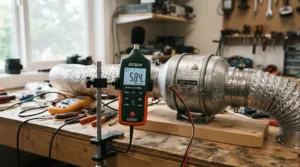
A published Vivosun fan dB rating is a manufacturer’s measurement, typically taken at a specific speed and distance, and it’s worth understanding the scale it’s built on before you compare two numbers side by side. The decibel scale is logarithmic, not linear — which is the whole reason a jump from 28 dB to 49 dB feels far more dramatic in a room than the raw numbers suggest. NIOSH established a recommended exposure limit of 85 A-weighted decibels averaged over an eight-hour workday, and while a single inline fan sits nowhere near that danger zone on its own, the logarithmic scale explains why the Z4’s 49 dB rating registers as roughly four times louder in perceived loudness than the M4’s 28 dB, not just “20-something points higher.” For a deeper technical breakdown of how the decibel scale itself is constructed, the Wikipedia entry on decibels is a solid starting point if you want the math behind the marketing. One honest caveat: manufacturer-published dB figures aren’t independently audited in most cases, so treat the numbers as directionally accurate for comparing models within the same testing methodology (Vivosun-to-Vivosun, for instance) rather than as laboratory-certified absolutes across every brand.
Still deciding between two models on this list? A quieter fan today beats a returned one next month — check current availability before the one you want sells out.
Vivosun Quiet Mode Review: EC Motor vs AC Motor Head-to-Head
“Quiet mode” isn’t an official Vivosun feature name across the whole catalog, but functionally, it’s what you get any time a variable-speed EC motor fan is dialed down to its lowest setting — and this Vivosun quiet mode review comes down to a fairly simple verdict: EC wins, decisively, every time noise is the primary concern. On the M4 and AeroZesh G4, dropping from top speed to the lowest of three settings produces a genuinely noticeable, almost surprising drop in perceived loudness, because PWM control lets the motor spin more slowly without the uneven “growl” that AC motors produce when you try to throttle them electronically. Compare that to the R4’s AC motor with a variable controller: dialing it down does reduce noise, but the character of the sound changes too, often trading volume for a lower-pitched hum that some listeners find just as noticeable in a quiet room, even at a technically lower dB reading. Reviewers consistently note the EC-motor “quiet mode” experience as closer to true silence, while the AC-motor version reads more like “turned down” rather than “quiet.” If bedroom-adjacent operation is genuinely the deciding factor, this is the single clearest reason to spend the extra money on an EC model rather than saving on an AC-motor fan with a dial.
Bedroom-Safe Operation: Is Any Vivosun 4 Inch Fan Actually Quiet Enough to Sleep Near?
Let’s be direct about bedroom-safe operation, because it’s the question most people searching for the Vivosun 4 inch fan noise level actually want answered. A comfortable home environment typically ranges from 30-50 dB during the day and should be below 40 dB at night for quality sleep, which puts the EC-motor Vivosun models (M4, AeroZesh G4, both around 28 dB) comfortably inside sleep-friendly territory, especially once you factor in that closed tent walls and any distance from the fan itself further dampen what actually reaches your ears. The R4 and D4, sitting in the 30-37 dB range, land right at the edge of that comfortable nighttime threshold — livable for most people, but noticeable for light sleepers or in a truly silent room. The Z4, at roughly 49 dB, is genuinely not a great bedroom-adjacent choice; that’s well above the recommended nighttime ceiling and will be audible through most interior walls. Practical takeaway: if the fan will run within the same room you sleep in, or against a shared wall with a bedroom, an EC-motor model at its lowest speed setting is the only category on this list that reliably qualifies as bedroom-safe operation without compromise.
Vivosun 4 Inch Fans vs 6 Inch Fans: When Size (Not Just Model) Solves Your Noise Problem
Here’s a counterintuitive point that trips up a lot of buyers: sometimes the fix for a noisy 4-inch fan isn’t a quieter 4-inch model — it’s a larger 6-inch fan running at a lower percentage of its capacity. A 6-inch inline fan moving your required CFM at 40% speed is often quieter than a 4-inch fan straining to hit that same CFM at 90% speed, because larger blades can move equivalent air at lower RPM. The tradeoff is upfront cost, physical footprint, and the fact that your ducting, filter, and tent ports all need to match the larger diameter — not a small consideration if you’ve already invested in 4-inch accessories. For most compact tents (up to roughly 4×4 feet), a well-chosen 4-inch EC fan like the M4 stays the more practical and cost-effective route; it’s really only once you’re pushing toward larger 4×8 or 5×5 setups that the 6-inch upsizing math starts to meaningfully out-quiet what any 4-inch model can offer.
Common Mistakes When Buying a “Quiet” Inline Fan
The single biggest mistake is comparing dB ratings across brands without checking whether they were measured at the same speed and distance — a 28 dB rating “at lowest speed” and a 28 dB rating “at max speed” are not remotely comparable claims, even though the listings often present them identically. A close second is oversizing CFM “just to be safe,” which forces you to run the fan at a lower percentage of its range to avoid over-ventilating, ironically landing you in a worse noise-to-performance sweet spot than a correctly sized fan running comfortably at 70-80% speed. Buyers also frequently skip isolation mounting entirely, assuming a quiet-rated fan will sound quiet regardless of how it’s installed — as covered earlier, that’s rarely true in practice. Finally, plenty of shoppers assume “EC motor” and “variable speed” mean the same thing; they don’t, and an AC motor with a cheap variable controller will never match the quiet-mode character of a true PWM-controlled EC motor, even at a similar published dB number.
Long-Term Noise, Maintenance, and Total Cost of Ownership
A fan’s noise level on day one isn’t necessarily its noise level at month eighteen, and that’s where a little maintenance discipline pays off in both quiet operation and total cost of ownership. Cleaning the impeller blades every 60-90 days, as mentioned earlier, prevents the dust-induced imbalance that’s the leading cause of rising noise in otherwise healthy fans. Sealed, permanently lubricated bearings — standard across the modern Vivosun lineup — mean you’re not budgeting for re-lubrication the way older sleeve-bearing designs required, which is a real (if often overlooked) long-term savings versus bargain-bin fans that need periodic oiling to stay quiet. On raw energy cost, EC motors sip meaningfully less power than AC motors for equivalent airflow, which adds up over a full grow season and partially offsets their higher upfront price. For anyone dialing in exact airflow requirements to avoid oversizing (and the noise penalty that comes with it), a solid grasp of proper CFM sizing based on your tent’s volume and resistance is genuinely worth the ten minutes it takes to work through, since it directly determines how hard any of these fans need to work — and how loud they’ll be while doing it.
FAQ
❓ What is a normal Vivosun 4 inch fan noise level?
❓ Is the Vivosun M4 quieter than the AC Infinity Cloudline S4?
❓ Can a Vivosun 4 inch fan run safely in a bedroom overnight?
❓ Why does my Vivosun fan sound louder than its rated dB?
❓ Does a carbon filter make a Vivosun 4 inch fan louder?
Conclusion
If there’s one takeaway from digging through every current 4-inch Vivosun fan and its closest competitors, it’s this: the Vivosun 4 inch fan noise level question doesn’t have a single answer, but it does have a clear pattern. EC motor models — the M4 and AeroZesh G4 — consistently deliver the quietest real-world experience, landing right alongside premium competitors like the AC Infinity Cloudline S4 without requiring a brand switch. Budget AC motor options like the D4, R4, and the iPower alternative are perfectly reasonable if you’re working with a tighter budget or don’t need bedroom-adjacent quiet, while the Z4 earns its noise ceiling honestly by solving a genuinely different problem: raw static pressure in demanding duct setups. Match the fan to your actual space, your actual duct resistance, and how close it’ll be running to where people sleep, and the “right” pick becomes a lot less mysterious than the marketing copy makes it sound. Whichever model you land on, a little attention to mounting and maintenance will do more for real-world quiet than any spec sheet number alone ever could.
Recommended for You
- Vivosun 4 Inch Fan For 2×2 Tent Setup: 7 Top Picks (2026)
- Vivosun 4 Inch Inline Fan Review For Grow Tent: 7 Picks Tested For 2026
- Vivosun 4 Inch Fan and Filter Combo: 7 Best Picks For 2026
Disclaimer: This article contains affiliate links. As an Amazon Associate, I earn from qualifying purchases. If you purchase products through these links, we may earn a small commission at no additional cost to you.
✨ Found this helpful? Share it with your friends! 💬🤗
