

In This Article
Basements are where good air goes to die. The slab sweats, the laundry steams, the walls stay cool all summer, and the whole space quietly collects moisture until a musty smell shows up. A Terrabloom 6 inch fan for basement ventilation is one of the more sensible tools for fighting back. It is cheap to run, simple to mount, and easy to dial up or down, but only if you understand what it can and cannot do.
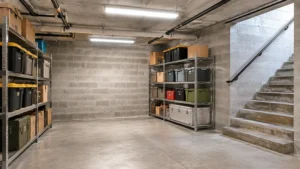
Here is the blunt version. A fan moves air, and it does not remove moisture by itself. That distinction decides whether your basement ends up fresh or soggy. EPA’s guide to mold, moisture, and your home makes the core point plainly: moisture control is mold control, and indoor relative humidity should stay below 60 percent, ideally between 30 and 50 percent. Your fan strategy has to serve that target.
This guide compares seven real 6-inch inline fans, with two Terrabloom models up front. It also covers duct routing through joists, dehumidifier pairing, and the ventilation mistakes that quietly make damp basements worse. Everything below is analysis based on published specs and aggregated review themes. I have not personally tested these fans, and I won’t pretend otherwise.
What Is a Terrabloom 6 Inch Fan for Basement Ventilation?
A Terrabloom 6 inch fan for basement ventilation is a compact inline duct fan with a 6-inch round connection. It pulls damp, stale air out of a basement or pushes it along a duct run to a safe exhaust point. Its adjustable speed lets you match airflow to the job instead of running flat out.
Quick Comparison: Terrabloom 6 Inch Fan for Basement Ventilation vs Six Rivals
| Fan | Listed Airflow | Listed Noise | Motor | Best For |
|---|---|---|---|---|
| Terrabloom ECMF-150 | 288 CFM | ~31 dB(A) | EC | Quiet, low-wattage 24/7 duty |
| Terrabloom 395 CFM Inline Fan | 395 CFM | See review note below | AC | Budget airflow with a built-in controller |
| AC Infinity CLOUDLINE PRO S6 | 402 CFM | 32 dBA | EC (PWM) | Finished basements wanting near-silence |
| Hon&Guan 6 Inch Inline Booster | 345 CFM | 32 dBA | DC | Tight budgets and short duct runs |
| VIVOSUN 6 Inch 240 CFM | 240 CFM | ~37 dB | AC | Light-duty, short runs |
| VEVOR 6-Inch Inline Duct Fan | 400 CFM | 34 dBA | AC | Value-focused high airflow |
| AC Infinity CLOUDLINE T6 | 402 CFM | 32 dBA | EC | Automation by temperature and humidity |
Look at the table with a skeptical eye. Raw CFM is a free-air number, and your real airflow drops once you add duct length, elbows, a grille, and a backdraft damper. The Terrabloom ECMF-150 gives up some headline airflow to the 400-class fans, but its listed 36-watt draw makes it an unusually good fit for a fan that may run all day. If you need maximum push on a long run, the VEVOR 6-Inch Inline Duct Fan and Terrabloom 395 CFM Inline Fan earn a closer look. If you hate fan noise, the EC models are where to shop.
💬 Just one click — help others make better buying decisions too!😊
Top 7 Fans for Basement Ventilation: Expert Analysis
Every fan below is a real, currently marketed 6-inch inline model. Specs vary between listing variants, especially for Terrabloom, so confirm the exact model number before you buy. Prices are ranges only and shift often, so check current price on the product page.
1. Terrabloom ECMF-150 — whisper-efficient EC motor for all-day duty
The headline here is efficiency. The Terrabloom ECMF-150 pairs a brushless EC motor with a dual-jet impeller to deliver a listed 288 CFM from about 36 watts. Some listing variants quote 350 CFM and 40 watts, so check the label on the exact unit you order.
That wattage matters in a basement. A fan that costs pennies per day can run continuously without guilt, which is the usual way to keep damp corners moving. The listing also mentions a powder-coated steel housing, an IPX4 splash rating, an ETL listing, a 6-foot cord, and a 2-year warranty. An IPX4 rating suggests it tolerates splashing, but that is not an invitation to bolt it where water drips on it.
Based on the spec comparison, this is the fan I’d shortlist first for a finished or semi-finished basement where noise matters. Reviewers consistently describe it as quiet at lower speeds and louder as you climb. One buyer reported swapping a cheaper 6-inch fan for this one and running it at 30-40 percent with a similar result and much less noise. A common practical note is that the speed controller or remote may be sold separately, so confirm what is in the box.
Pros:
- ✅ Very low listed power draw for 24/7 use
- ✅ Quiet at low and medium speeds
- ✅ Steel housing with IPX4 splash rating
Cons:
- ❌ Lower peak airflow than 400 CFM rivals
- ❌ Controller or remote may be a separate purchase
Price range: roughly $75-$125 at the time of research. Value verdict: strong for continuous duty where the electric bill and the noise both count.

2. Terrabloom 395 CFM Inline Fan — raw airflow with a built-in controller
The Terrabloom 395 CFM Inline Fan is the blunt instrument of the family. It lists 395 CFM, a built-in speed controller, a 6-foot grounded cord, and an ETL listing, so it plugs in without an electrician. One retailer listing even tags basements as a recommended use.
Now the honest caveats. Listings for this family disagree on some figures. One variant shows 342 CFM at 70 watts, and another lists a noise figure around 70 decibels. Treat those as flags to verify rather than gospel. If that noise figure is accurate for your unit, this is a utility-room or unfinished-basement fan, not a home-theater-room fan.
Reviewer themes are practical. Buyers describe using it as an attic exhaust, an HVAC booster, and a hobby-shop exhaust, and several mention running it for months without problems. Some note that the body feels plastic and that the airflow at the outlet is gentler than the CFM number implies. A recurring theme is that rigid metal duct amplifies sound while flexible duct tames it. That is useful for basement planning.
Pros:
- ✅ High listed airflow for the money
- ✅ Built-in speed controller, plug-and-play
- ✅ Reviewers report long, steady run times
Cons:
- ❌ Can be noisier than EC alternatives
- ❌ Plastic-feeling body per some reviewers
Price range: generally under $100, though you should check current price. Value verdict: good for unfinished spaces where airflow beats refinement.
3. AC Infinity CLOUDLINE PRO S6 — near-silent premium benchmark
The AC Infinity CLOUDLINE PRO S6 is the fan that most roundup sites crown. It pairs a PWM EC motor with a 10-speed controller, 402 CFM, and 32 dBA. On paper it beats the Terrabloom lineup on both airflow and noise.
What do those numbers mean in a basement? Roughly 400 CFM with a whisper-level noise rating means you can oversize slightly and run it low, which keeps the sound down and the airflow steady. Reviewers in comparison pieces frequently call it the quietest of the bunch.
The trade-off is cost and complexity. It sits at a premium price compared with budget inline fans, and full smart-home integration reportedly needs extra wiring. For a laundry-adjacent basement where noise and finish quality matter, it is a legitimate upgrade over the Terrabloom ECMF-150. For a plain storage basement, the money is better spent on a dehumidifier.
Pros:
- ✅ Strong airflow with very low listed noise
- ✅ Fine 10-step speed control
- ✅ Consistently top-ranked in roundups
Cons:
- ❌ Premium price versus budget fans
- ❌ Smart integration may require extra wiring
Price range: roughly $125-$200. Value verdict: worth it if quiet operation is the priority.
4. Hon&Guan 6 Inch Inline Booster — lowest wattage in the lineup
The Hon&Guan 6 Inch Inline Booster lists 345 CFM at 32 dBA while drawing just 19.2 watts, with a DC motor and a speed controller. At about 1.7 pounds, it is also light enough to hang from a joist with minimal fuss.
Efficiency is the story here. Nineteen watts running around the clock costs very little, and a light unit is easier to isolate from vibration. The plastic construction means you should keep it dry and out of direct sunlight or heat.
Buyers who compared it with higher-end fans in one review snippet were weighing it against the AC Infinity CLOUDLINE PRO S6, which tells you it is regarded as a serious budget contender. Because the case is small, expect it to struggle more than the heavier fans on long, twisty runs. Pair it with short, straight duct.
Pros:
- ✅ Only 19.2 watts at its listed rating
- ✅ Very light and easy to hang
- ✅ Quiet listed 32 dBA rating
Cons:
- ❌ Plastic body is less rugged
- ❌ Weaker on long, restrictive duct runs
Price range: under $75. Value verdict: an excellent entry point for small basements.
5. VIVOSUN 6 Inch 240 CFM — the budget workhorse for short runs
The VIVOSUN 6 Inch 240 CFM is among the most-reviewed 6-inch fans around, with ratings in the five figures on at least one listing. It lists 240 CFM, roughly 37 dB, 37 watts, a metal housing, and a permanently lubricated bearing. The marketing even names basements, bathrooms, kitchens, and attics as target uses.
The spec sheet tells you what it is. At 240 CFM it has the lowest airflow in this roundup, and it draws more power than the Hon&Guan 6 Inch Inline Booster while moving less air. That is a reasonable trade if you value the metal case and the huge review pool.
What most buyers overlook is how quickly real-world CFM falls on a long duct run. If your exhaust path exceeds about 15 to 20 feet or has several bends, the VIVOSUN 6 Inch 240 CFM may feel underpowered. For a short run to a nearby rim-joist vent, it can do the job.
Pros:
- ✅ Metal housing feels more durable
- ✅ Enormous review pool to read
- ✅ Simple, budget-friendly design
Cons:
- ❌ Lowest airflow of the seven
- ❌ Higher wattage than more efficient rivals
Price range: under $75. Value verdict: a safe pick for short, simple exhaust runs.

6. VEVOR 6-Inch Inline Duct Fan — big airflow, small checkout
The VEVOR 6-Inch Inline Duct Fan lists 400 CFM at 34 dBA with an AC motor and a simple speed knob. One roundup scored it around 4.4 out of 5 from a couple hundred ratings and named it the value pick.
The AC motor explains the price. It tends to cost less than an EC design, but it also draws more power at the same airflow. Over a year of continuous use that difference shows up on the bill. The simple knob is a plus for people who want a fast, tool-free setup and a minus for anyone hoping for automation.
For long duct runs with a few elbows, a 400 CFM fan gives you headroom that a 240 CFM fan lacks. It is the one I’d compare directly against the Terrabloom 395 CFM Inline Fan if raw airflow per dollar is your top criterion.
Pros:
- ✅ High listed airflow for the price
- ✅ Simple variable-speed knob
- ✅ Decent listed noise rating
Cons:
- ❌ AC motor draws more power
- ❌ No built-in humidity automation
Price range: under $100. Value verdict: strong for airflow-first, budget-focused installs.
7. AC Infinity CLOUDLINE T6 — humidity-triggered automation
The AC Infinity CLOUDLINE T6 lists 402 CFM, 32 dBA, an EC motor, about 38 watts, 10 speeds, and app control with temperature and humidity triggers. For a basement, the humidity trigger is the interesting part.
Here is why. Most basement moisture problems are intermittent. A humid week, a laundry day, a rain event. A controller that ramps the fan when humidity climbs and idles it otherwise matches how basements actually behave. It also removes the human factor, which is the real reason many manual fans end up switched off.
The caveat is the one I’ll repeat later: automation does not fix a wet-air-in, wet-basement problem. Set the trigger logic so the fan is not pulling humid summer air into a cool basement. And confirm the manufacturer’s rating for humid environments before mounting it near the damp zone.
Pros:
- ✅ Temperature and humidity automation
- ✅ Quiet EC motor with fine speed steps
- ✅ App control for monitoring and scheduling
Cons:
- ❌ Premium price tier
- ❌ Needs thoughtful trigger settings
Price range: over $125. Value verdict: worth it if you want the fan to manage itself.
Top 7 Specs, Price Tiers, and Review Themes
| Fan | Listed Power | Control | Price Range | Review Theme | Best For |
|---|---|---|---|---|---|
| Terrabloom ECMF-150 | ~36 W | Controller or remote | $75-$125 | Quiet at low speeds | Continuous quiet duty |
| Terrabloom 395 CFM Inline Fan | Varies by listing | Built-in dial | Under $100 | Strong airflow, plasticky build | Unfinished basements |
| AC Infinity CLOUDLINE PRO S6 | Not specified here | 10-speed controller | $125-$200 | Very quiet | Finished spaces |
| Hon&Guan 6 Inch Inline Booster | 19.2 W | Speed controller | Under $75 | Efficient, light | Small basements |
| VIVOSUN 6 Inch 240 CFM | ~37 W | Fixed or basic | Under $75 | Durable, widely reviewed | Short runs |
| VEVOR 6-Inch Inline Duct Fan | Not specified here | Speed knob | Under $100 | Good airflow value | Long runs on a budget |
| AC Infinity CLOUDLINE T6 | ~38 W | App with triggers | Over $125 | Automation-friendly | Hands-off humidity control |
The table shows a clear split. The EC models, namely the Terrabloom ECMF-150, the AC Infinity CLOUDLINE PRO S6, and the AC Infinity CLOUDLINE T6, win on noise and watts. The AC models, namely the Terrabloom 395 CFM Inline Fan, the VEVOR 6-Inch Inline Duct Fan, and the VIVOSUN 6 Inch 240 CFM, win on upfront price. Review themes are drawn from published reviews and roundups, not from my own testing.
If you plan to run the fan most of the day, the efficiency gap compounds quickly. If you plan to run it only a few hours around laundry, the cheaper AC fans make more financial sense. Either way, price tiers here are approximate, so check current price before deciding.
✨ Don’t Miss These Exclusive Deals!
🔍 Take your basement air to the next level with these carefully selected fans. Click on any highlighted item to check current pricing and availability. These picks will help you build a drier, fresher basement your family will actually want to use!
Duct Routing Through Joists: The Install Guide Amazon Won’t Give You
Most disappointment with inline fans comes from the duct, not the fan. Duct routing through joists decides whether you get the CFM on the box or half of it. Here is the practical sequence that tends to work.
Start with the exit. Pick where the air will leave the house first, usually through the rim joist to a wall-mounted exhaust hood with a backdraft damper. Keep it away from windows, intakes, and dryer vents. Check local code for clearances, because they vary.
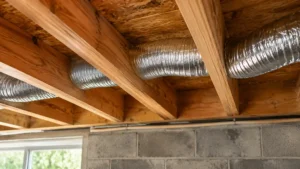
Run with the joists, not across them. A joist bay is a ready-made chase. Running parallel in a bay avoids drilling or notching structural lumber. If you must cross joists, bore holes sparingly and follow local code on size and location rather than improvising. Never notch a joist to fit a duct.
Keep it short and straight. Each elbow adds resistance, and long flexible runs sag into pockets that trap condensation. Pull flex duct fully taut, support it every few feet, and favor rigid or semi-rigid sections where you can. Reviewers of the Terrabloom 395 CFM Inline Fan noted that rigid metal duct transmitted noise while flexible duct hid it, so a short rigid section near the exit plus flex near the fan is a sensible compromise.
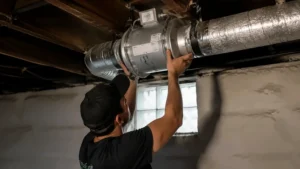
Mount the fan near the exit. Placing it close to the termination keeps most of the duct under positive pressure, which limits leaks into the house. Use mounting straps with rubber isolators to cut vibration. The Hon&Guan 6 Inch Inline Booster is light enough to hang from a joist hanger, while the heavier Terrabloom ECMF-150 and VEVOR 6-Inch Inline Duct Fan deserve a more solid bracket.
Insulate cold runs. Warm, moist air moving through an uninsulated duct in a cold bay can condense on the inside and drip back. Wrap exposed sections and pitch the run gently toward the exit.
Seal everything. Use foil tape or mastic at joints, not cloth duct tape. Leaks pull in the exact air you are trying to remove.
Real-World Scenarios: Which Fan for Which Basement?
Specs are abstract. Let’s put them in rooms.
Scenario 1: The laundry-adjacent finished basement. Picture a 900-square-foot finished basement with a washer, dryer, and a family room. Noise matters because people sit down there. The Terrabloom ECMF-150 at low speed or the AC Infinity CLOUDLINE PRO S6 fits best, with a short exhaust duct to the rim joist. Run it on a timer during and after laundry. Budget: roughly $100-$200 for the fan plus duct supplies.
Scenario 2: The unfinished storage basement. An 1,100-square-foot unfinished space with a damp concrete floor and boxes on shelves. Nobody lingers, so noise matters little. The VEVOR 6-Inch Inline Duct Fan or Terrabloom 395 CFM Inline Fan gives plenty of airflow for the dollar. Spend the savings on a dehumidifier, because that is the tool that actually lowers the moisture reading.
Scenario 3: The tight, hands-off setup. A homeowner who travels and wants the basement managed automatically. The AC Infinity CLOUDLINE T6 with humidity triggers makes sense, provided the logic avoids drawing summer humidity indoors. Pair it with a dehumidifier on a drain line and a cheap hygrometer for verification.
Scenario 4: The small, short-run bonus room. A 400-square-foot space with a nearby exterior wall. The Hon&Guan 6 Inch Inline Booster or VIVOSUN 6 Inch 240 CFM is enough. Over-buying here just adds noise and cost.
The pattern is straightforward. Match fan power to duct length, match noise to how often people are in the room, and match budget to what a dehumidifier will cost you anyway.
Basement Mold Prevention: A Problem-to-Solution Playbook
Basement mold prevention comes down to controlling moisture, and moisture arrives from several places. Here is a problem-by-problem approach, with the fans mapped to each.
Problem 1: Humid air from laundry and showers. Solution: Exhaust it at the source. A Terrabloom ECMF-150 ducted from a laundry area, run during use and for a while afterward, handles this well.
Problem 2: Stagnant corners that smell musty. Solution: Gentle, continuous air movement. Low-speed, all-day operation of a quiet EC fan like the AC Infinity CLOUDLINE PRO S6 keeps corners from going dead, though it will not dry a wet wall by itself.
Problem 3: Summer condensation on cold surfaces. Solution: Dehumidify, don’t ventilate. Building Science Corporation’s basement fundamentals recommend controlling interior vapor through winter ventilation and summer dehumidification, and avoiding contact with cold surfaces. This is the single most important idea in the whole article.
Problem 4: Liquid water from leaks or flooding. Solution: Fix the source first. No fan or dehumidifier cures a leak. Repair plumbing, improve grading and gutters, and clean up any mold promptly, since the EPA stresses cleaning mold and fixing the water problem together.
Problem 5: Persistent humidity you can’t explain. Solution: Measure. A basic hygrometer shows you the real numbers. If readings stay above the 50-60 percent zone for long stretches, escalate to dehumidification and a professional assessment.
For small patches of surface mold, basic cleanup may be reasonable, but larger or recurring growth deserves expert eyes. That applies especially to anyone with asthma or mold sensitivity.
Dehumidifier Pairing: Why the Fan Is Only Half the Team
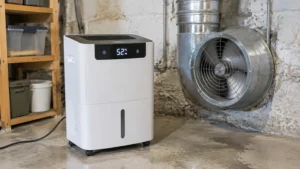
Dehumidifier pairing is the difference between a fan that helps and a fan that merely hums. The two tools do different jobs. The dehumidifier removes water from the air. The fan moves air, exhausts point-source moisture, and distributes drier air around the space.
The U.S. Department of Energy’s Building America expert meeting on humidity control treats ventilation and supplemental dehumidification as complementary strategies, and that matches the practical picture. In summer, a basement is often cooler than the outdoor air, so pulling that warm, wet air inside can raise indoor humidity.
A practical pairing recipe:
- Place a dehumidifier centrally, with a continuous drain to a floor drain if possible.
- Use the fan to exhaust laundry and bath moisture, not to import outdoor air during humid weather.
- Run the fan at low speed when the dehumidifier is working, to even out the air without creating strong drafts.
- Verify with a hygrometer and adjust.
Sizing the dehumidifier. Buying guides often put moderately to heavily damp basements between roughly 1,000 and 2,500 square feet in the 50-pint class, with smaller or mildly damp spaces in the 30-pint class. Pint ratings also changed when testing moved to a cooler 65°F standard, so compare current ratings rather than old ones. ENERGY STAR certified models generally use less energy than standard units, and oversizing slightly is usually safer than undersizing.
Fan-and-dehumidifier combos worth considering: the quiet Terrabloom ECMF-150 pairs well with a dehumidifier in a finished space because neither is intrusive. The AC Infinity CLOUDLINE T6 can trigger exhaust only when humidity spikes, while the dehumidifier handles the baseline. And a budget Hon&Guan 6 Inch Inline Booster costs so little to run that it barely dents the savings from an efficient dehumidifier.
Humidity Control Basement Terrabloom Setups: What to Expect in the Real World
Humidity control basement Terrabloom setups work best when expectations are realistic. Here is what the fan will and won’t do.
What it will do well. It will exhaust moist air from a defined source, keep a duct run moving, and provide continuous low-level air movement. The Terrabloom ECMF-150 is well suited to this, since reviewers describe low-speed operation as nearly inaudible and the listed wattage is tiny.
What it won’t do. It will not pull water out of the air on its own, dry a wet slab, or stop condensation on cold pipes and walls. The EPA’s school-focused IAQ guidance notes that dilution with outdoor air only helps when the outdoor air is drier, such as during heating season. In cooling season, outdoor air often carries as much moisture as indoor air.
Seasonal playbook. Winter and dry shoulder seasons are the best time to ventilate. In humid summer weather, lean on the dehumidifier and use the fan only to exhaust specific moisture sources or to circulate.
How to tell whether it’s working. Place a hygrometer on the far side of the basement from the fan and log readings for a week. Look for morning and evening swings. If humidity creeps above roughly 50 to 60 percent and stays there, the fan is not enough.
A note on controllers. The Terrabloom ECMF-150 listing mentions compatibility with remote and smart controllers. That opens the door to timers and humidity-based triggers, but confirm the exact controller and the fan’s compatibility before purchasing, because listing details vary.
For readers searching for basement ventilation Terrabloom fan options, the takeaway is simple. The EC model suits quiet, continuous, low-power use. The 395 CFM model suits strong, short-burst exhaust. Pick the one that matches how your basement actually behaves.
How to Choose a 6 Inch Fan for Basement Ventilation
Choosing the right Terrabloom 6 inch fan for basement ventilation, or any competitor, follows a logical order. Here are seven steps.
- Define the job. Spot exhaust for laundry, general air movement, or HVAC-style boosting? The job determines everything else.
- Measure the duct run. Count length and elbows. Long, twisty runs need more airflow headroom, so a 400 CFM class fan beats a 240 CFM fan.
- Decide how often it will run. Continuous duty favors low-wattage EC motors like the Terrabloom ECMF-150. Occasional duty tolerates cheaper AC motors.
- Rank noise tolerance. Finished spaces demand sub-35 dB class fans. Unfinished spaces can accept more.
- Pick your control style. A simple knob, a remote, or humidity-triggered automation like the AC Infinity CLOUDLINE T6. Automation is helpful only with sensible trigger rules.
- Check moisture and safety ratings. Look for ETL or similar listings and read the manufacturer’s guidance about humid environments. The Terrabloom ECMF-150 lists an IPX4 rating and an ETL listing, which is a good start but not a green light for wet locations.
- Plan the dehumidifier first. Budget for it alongside the fan, since the fan alone rarely solves a damp basement.
Quick rule of thumb: if you can’t decide between two fans, choose the quieter one and use a slightly larger duct run. Noise is the complaint that drives people to switch the fan off.
Common Mistakes When Buying a Damp Basement Exhaust Fan
A damp basement exhaust fan is easy to buy and easy to misuse. These are the pitfalls that come up most.
Mistake 1: Ventilating humid summer air into a cool basement. This one deserves the top spot. A building-science discussion on Green Building Advisor describes exactly how forced outdoor air can make a cellar “rain” in summer because warm, wet air hits cool surfaces. Dehumidification is the usual fix, and positive-pressure ventilation can also push basement air into the house.
Mistake 2: Trusting free-air CFM. The number on the box assumes no duct. After a few elbows and a damper, real airflow drops. Buy headroom.
Mistake 3: Ignoring noise until installation day. Fans that look fine on paper can irritate in practice, particularly when the duct amplifies sound. Reviewers of the Terrabloom 395 CFM Inline Fan noted this difference between rigid and flexible duct.
Mistake 4: Skipping the controller. An uncontrolled fan runs at full blast or not at all. Variable speed is cheap insurance.
Mistake 5: Exhausting into an attic or joist cavity. Moist air belongs outside. Dumping it into a hidden cavity moves the problem somewhere you can’t see it.
Mistake 6: Treating the fan as a cure for leaks. If water is coming in, no ventilation strategy will save you.
Mistake 7: Skipping the hygrometer. Without measurements, you are guessing. A small humidity monitor is among the best-value purchases in the whole project.
Damp Basement Exhaust Fan vs Dehumidifier Alone
People ask whether they need a fan, a dehumidifier, or both. Here is a clear comparison.
| Approach | Strength | Weakness | Best For |
|---|---|---|---|
| Fan only (for example the Terrabloom ECMF-150) | Cheap, exhausts point-source moisture | Can import humid summer air; doesn’t remove water | Dry climates, laundry exhaust |
| Dehumidifier only | Directly removes moisture year-round | Doesn’t exhaust odors or combustion by-products | Humid summers, closed basements |
| Fan plus dehumidifier (for example the AC Infinity CLOUDLINE T6 plus a dehumidifier) | Covers both sources and distribution | Higher upfront cost and more setup | Most damp basements |
The written verdict follows the table. For most damp basements, the combination wins because each tool covers the other’s weakness. A fan-only strategy works best in dry climates or winter conditions, which is when outdoor air is genuinely drier than indoor air. A dehumidifier-only strategy is simple and effective in humid summers, though it leaves stale air and point-source moisture unaddressed. If budget forces a choice, buy the dehumidifier first and add the fan for laundry and odor control.
Long-Term Cost and Maintenance
Total cost of ownership matters more than the sticker price, particularly for a fan that runs a lot.
Electricity. Using an assumed rate of about 17 cents per kilowatt-hour, a fan drawing 36 watts continuously uses roughly 26 kilowatt-hours a month, which is under five dollars. A fan drawing 70 watts, like one listing variant of the Terrabloom 395 CFM family, would cost about double. The Hon&Guan 6 Inch Inline Booster, at a listed 19.2 watts, costs less still. Your local rate will differ, so scale accordingly.
Upfront cost versus running cost. The Terrabloom ECMF-150 costs more than basic AC fans but may close the gap over several years if it runs continuously. The cheaper VIVOSUN 6 Inch 240 CFM and VEVOR 6-Inch Inline Duct Fan win if runtime is short.
Maintenance. Basement fans collect dust and lint. Vacuum the intake, check the duct for sagging or condensation every season, and inspect the exhaust hood for blockages or nests. The VIVOSUN 6 Inch 240 CFM lists a permanently lubricated bearing, which means no oiling.
Warranty. The Terrabloom ECMF-150 listing mentions a 2-year warranty. Confirm terms at purchase.
Replacement horizon. Budget fans may last a long time in light duty. Continuous duty is harder on cheap motors, which is another reason to favor efficient EC designs for 24/7 use.
Safety, Code, and Compliance Guide
A basement fan changes air pressure, and that has consequences. Treat this section as a checklist, not an afterthought.
Combustion appliances. Gas furnaces, water heaters, and boilers rely on proper venting. An exhaust fan that depressurizes the basement can contribute to backdrafting. If you have combustion appliances, install carbon monoxide alarms and ask a qualified HVAC professional to evaluate your setup before running a strong exhaust fan.
Radon. Changes in basement air pressure can influence soil-gas entry. If you haven’t tested for radon, test before and after making ventilation changes.
Electrical. The plug-in models listed with ETL certification and grounded cords are convenient, but keep cords out of ducts, away from water, and on proper outlets. Use a GFCI-protected receptacle in damp areas.
Exhaust termination. Follow local code for clearances from windows, doors, and intakes, and use a hood with a backdraft damper.
Moisture ratings. Check the manufacturer’s guidance on humid environments. The Terrabloom ECMF-150 lists an IPX4 rating, while some inline fans carry warnings against high-humidity locations.
Mold cleanup. Persistent or widespread growth, or any growth after a flood, deserves professional assessment. The EPA guide linked earlier covers cleanup basics and when to get help.
Permits and local rules. Requirements vary by jurisdiction. When in doubt, call your building department.
FAQ
❓ Is the Terrabloom ECMF-150 or the 395 CFM model better for a basement?
❓ Can I run a Terrabloom 6 inch fan 24/7 in a basement?
❓ Where should a basement exhaust duct terminate?
❓ Will a basement exhaust fan replace a dehumidifier?
❓ How loud is a Terrabloom 6 inch inline fan?
Conclusion
The best Terrabloom 6 inch fan for basement ventilation depends on what your basement is actually fighting. For quiet, efficient, all-day airflow, the Terrabloom ECMF-150 is the standout of the family, and the AC Infinity CLOUDLINE PRO S6 is the premium alternative. For more airflow on a budget, the Terrabloom 395 CFM Inline Fan and VEVOR 6-Inch Inline Duct Fan deserve a look. For tiny, short-run jobs, the Hon&Guan 6 Inch Inline Booster and VIVOSUN 6 Inch 240 CFM are sensible. For hands-off automation, the AC Infinity CLOUDLINE T6 is the clever one.
But remember the bigger lesson. A fan is a tool for moving air, and a damp basement is a moisture problem. Fix leaks, keep humidity in the 30-50 percent range where you can, route the duct cleanly, and add a dehumidifier before you call the job finished. Do that, and your basement stops smelling like a cave.
Recommended for You
- Terrabloom 6 Inch Inline Fan Noise Level: 7 Quiet Fans (2026)
- Terrabloom 6 Inch Fan For 4×4 Grow Tent: 7 Proven Picks (2026)
- Terrabloom 6 Inch Fan EC Motor: 7 Best Picks Ranked (2026)
Disclaimer: This article contains affiliate links. As an Amazon Associate, I earn from qualifying purchases. If you purchase products through these links, we may earn a small commission at no additional cost to you.
✨ Found this helpful? Share it with your friends! 💬🤗
