
In This Article
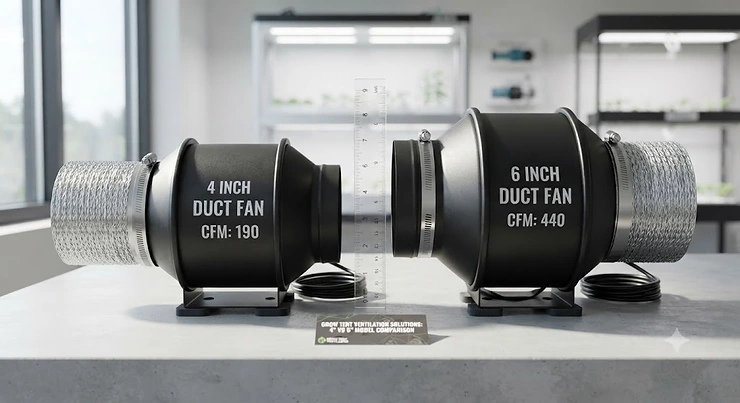
Standing in your grow tent aisle — or more realistically, squinting at a laptop at midnight — with two duct sizes staring back at you is a rite of passage. The 4 inch inline fan vs 6 inch for small tent debate trips up more first-time growers than lighting or nutrients ever will, mostly because both sizes look like they’d work fine on paper. A 4 inch inline fan is a compact ventilation blower that fits 4-inch ducting and typically moves somewhere between 150 and 230 CFM, while a 6 inch inline fan uses wider ducting and pushes 240 to over 440 CFM — the real question for a small tent isn’t which one is “better,” it’s which one matches your tent’s volume, your carbon filter, and your light’s heat output
Here’s the short version: bigger isn’t automatically better in a 2×2 or 2×4 tent, and undersized isn’t automatically bad in a well-ventilated 3×3. What actually decides this is airflow math, static pressure loss from your carbon filter, and how much heat your lights dump into that small space. Get that math wrong and you’ll either fight mold from stagnant air or fight a wind tunnel that yanks your tent walls inward every time the fan kicks on.
This guide walks through seven real inline fans — a mix of budget, mid-range, and genuinely premium picks across both duct sizes — plus the airflow exchange rate math, the CFM comparison you actually need, and the mistakes that send growers back to the return window. Let’s get your tent breathing right the first time.
Quick Comparison: 4 Inch vs 6 Inch Inline Fan
Before diving into all seven products, here’s the fast answer for anyone in a hurry.
| Feature | 4 Inch Inline Fan | 6 Inch Inline Fan | Best For |
|---|---|---|---|
| Typical CFM range | 150–230 CFM | 240–440+ CFM | Depends on tent volume |
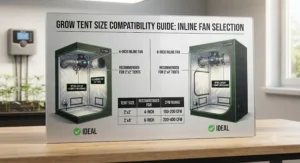
| Ideal tent size | 2×2 to 2×4, some 3×3 | 3×3 to 4×4 and larger | Match duct to floor space |
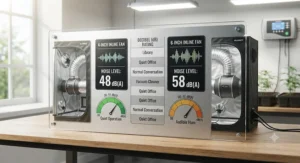
| Noise at full speed | Generally quieter (26–37 dBA) | Louder unless EC-motor (30–50 dBA) | 4 inch for bedrooms/apartments |
| Duct & filter cost | Cheaper ducting, filters, clamps | 30–50% pricier accessories | 4 inch for tight budgets |
| Carbon filter compatibility | Needs 4 inch filter (smaller charcoal volume) | Needs 6 inch filter (better odor scrubbing) | 6 inch for smellier strains |
A 4 inch inline fan wins on price, noise, and footprint for anything at or under roughly 8 square feet of floor space, while a 6 inch inline fan earns its keep the moment your tent volume, light wattage, or carbon filter demands push past what a 4 inch duct can comfortably deliver without straining. The CFM ranges above assume a straight duct run with no filter attached — bolt on a carbon filter and expect real-world output to drop by 20–25%, which matters more for the 4 inch options since they have less headroom to spare. If you’re calculating your specific tent’s numbers, AC Infinity’s grow tent CFM guide breaks down the volume-based formula step by step.
💬 Already leaning toward a size? Scroll down to see exactly which model fits your tent — and grab one before your next grow cycle starts.
Top 7 4 Inch and 6 Inch Inline Fans: Expert Analysis
We picked seven real, currently available fans spanning both duct sizes and every budget tier — from a $35 workhorse to a smart, app-connected system. Each one gets the same honest treatment: real specs, what they mean in practice, and aggregated review sentiment where it’s verifiable.
1. AC Infinity CLOUDLINE T4 — smart controller for 4 inch tents
The standout here is the UIS smart controller integration, which lets this little fan respond to temperature, humidity, and VPD instead of running at one fixed speed all day. At 226 CFM and roughly 26 dBA at lower speeds, the AC Infinity CLOUDLINE T4 is quiet enough for a bedroom closet grow but still has enough push for a 2×4 tent running a carbon filter.
The EC motor is the real story: unlike older AC-motor fans that only really have “on” and “off” as efficient states, this one throttles down smoothly, and Wi-Fi connectivity through the companion app means you can log climate history instead of guessing. Based on the spec sheet, this is built for growers who want to set it and mostly forget it — beginners who don’t want to babysit a manual dial, and tinkerers who like data.
Reviewers consistently report that the app connection and smart controller add real convenience once dialed in, though a few mention the initial WiFi pairing takes a bit of patience. What most buyers overlook is that the AC Infinity CLOUDLINE T4 and its non-smart sibling share an identical motor and airflow rating — you’re paying the price difference purely for the automation layer, not for more air movement.
Pros:
- ✅ Smart app control with temp/humidity/VPD triggers
- ✅ Quiet EC motor even at higher speeds
- ✅ Dual ball bearings rated for long service life
Cons:
- ❌ Requires a compatible smart controller for full features
- ❌ Premium price for what is still a 4 inch fan
Price sits in the $70-$90 range at the time of research, and for anyone who values automation over manual dials, it’s a reasonable value — check current price before buying since availability shifts with promotions.
2. AC Infinity CLOUDLINE S4 — quiet EC motor without the smart price tag
The AC Infinity CLOUDLINE S4 shares its EC motor and airflow rating with the T4 above but swaps the app connectivity for a simple wired 10-speed dial, which is the standout feature for anyone who just wants reliable airflow without a learning curve. At 205-226 CFM depending on the exact revision, it handles a 2×2 or 2×4 tent with room to spare even after a carbon filter is attached, and the dual ball bearing motor is rated for tens of thousands of hours of use.
Based on the spec comparison against cheaper AC-motor 4 inch fans, the practical difference shows up in the power bill and the noise floor — EC motors sip less electricity at partial speed, which is exactly where most tent fans spend their lives. This is the fan for buyers who read reviews of the smart T-series, liked the airflow numbers, and decided they didn’t need an app to control a fan in their closet.
Aggregated review sentiment for the S-series points to reliability and quiet operation as the recurring themes, with occasional complaints about the plastic housing feeling less substantial than the metal-cased competitors.
Pros:
- ✅ Same EC motor and airflow as the smart T4 model
- ✅ Simple manual dial — no app setup required
- ✅ Lower running cost than AC-motor competitors
Cons:
- ❌ No smart automation or remote monitoring
- ❌ Plastic housing feels less premium than metal options
Expect a price in the $55-$75 range at the time of research — a fair middle ground between bargain 4 inch fans and the fully automated T-series.
3. VIVOSUN D4 — budget AC-motor workhorse for small tents
The VIVOSUN D4 leads with pure value: a 195 CFM AC-motor fan that costs a fraction of the EC-motor options above while still moving enough air for a 2×2 or small 2×4 setup. The 2550 RPM motor and duct-mounted variable speed controller mean you can throttle it down when the tent doesn’t need full blast, though — and this matters — AC motors lose efficiency faster than EC motors once you dial below 50% speed, so don’t expect the same power savings at low settings.
Based on the spec sheet, this is squarely a first-tent fan: someone testing whether growing indoors is even for them, or someone replacing a fan that finally gave out after years of service. Reviewers consistently mention it moves a surprising amount of air for the price, with a recurring theme that the vibration is noticeable unless mounted with rubber grommets or a foam gasket.
What the spec sheet won’t tell you, but user reports suggest, is that the plastic duct flanges can feel a bit thin compared to metal-cased competitors, though that hasn’t stopped it from becoming one of the most recommended entry-level fans in grower forums.
Pros:
- ✅ Lowest price point of any fan on this list
- ✅ Variable speed controller included in the box
- ✅ Sufficient CFM for 2×2 and small 2×4 tents
Cons:
- ❌ AC motor is less efficient at low speeds than EC options
- ❌ Noticeable vibration without additional dampening
Price typically falls in the $35-$45 range, making it the easiest entry point on this list for anyone unsure how committed they are to the hobby yet.
4. iPower 4 Inch 195 CFM Combo Kit — fan, filter, and ducting in one box
The standout feature of the iPower 4 Inch 195 CFM Combo Kit is that it removes the guesswork of matching components — you get a 195 CFM inline fan, a 4-inch carbon filter, 8 feet of ducting, and clamps, all sized to work together out of the box. That matters more than it sounds: a common beginner mistake is buying a fan and filter from different sizing standards and discovering they don’t seal properly.
Based on the spec comparison, the fan itself performs almost identically to the standalone VIVOSUN D4 above, so the real value proposition here is convenience and avoiding a second or third Amazon order. This kit is aimed squarely at first-time growers setting up a 2×2 or 2×4 tent who want odor control and airflow solved in a single purchase rather than three separate research rabbit holes.
Reviewers consistently note that the bundled carbon filter does a genuinely good job scrubbing odor in small spaces, with recurring feedback that the pre-filter sleeve should be replaced every few months to keep the main filter from clogging prematurely.
Pros:
- ✅ Fan, filter, and ducting sized to match perfectly
- ✅ Simplifies setup for first-time tent builders
- ✅ Includes clamps and hanging rope in the box
Cons:
- ❌ Carbon filter capacity is modest for heavier odor loads
- ❌ Individual components aren’t as robust as premium standalone parts
Bundles like this typically run in the $50-$65 range for the complete kit, which is often cheaper than buying a comparable fan and filter separately — check current pricing since combo deals shift often.
5. VIVOSUN Z6 — high-CFM value pick for stepping up to 6 inch
Jumping to 6 inch territory, the VIVOSUN Z6 stands out for raw airflow per dollar: 440 CFM from an AC motor with a variable speed controller, at a price that undercuts several EC-motor competitors by a wide margin. The 2450 RPM motor and galvanized steel housing are built for tents in the 3×3 to 4×4 range, especially once a carbon filter and a few duct bends eat into that headroom.
Based on the spec sheet, this is the fan for growers who’ve outgrown a 4 inch setup — maybe the tent got bigger, maybe the lights got hotter — and need real CFM without paying a premium for smart features they won’t use. Aggregated review sentiment consistently flags this as a strong value pick, with the most common critique being that it’s noticeably louder than EC-motor alternatives at full speed, which tracks with what you’d expect from an AC motor pushing this much air.
What most buyers overlook is that 440 CFM is the rated output before any filter or ducting resistance — real-world delivered airflow in a filtered setup typically lands 20-25% lower, which is still plenty for most small-to-mid tents but worth knowing before you assume the sticker number is what you’ll actually get.
Pros:
- ✅ 440 CFM rated output at a budget-friendly price
- ✅ Durable galvanized steel housing resists corrosion
- ✅ Variable speed controller included
Cons:
- ❌ Louder than EC-motor 6 inch competitors at full speed
- ❌ AC motor draws more power at partial speeds
Look for this one in the $60-$80 range at the time of research, which makes it one of the better CFM-per-dollar options in the 6 inch category.
6. TerraBloom MFIF-6 — lightweight 6 inch fan with built-in speed control
The TerraBloom MFIF-6 leads with convenience: its variable speed controller is built directly into the power cord, so there’s no separate dial box to mount or hide inside the tent. Rated at 395 CFM with a lightweight 5.5-pound ABS housing, it’s ETL certified and ships pre-wired with a 6-foot grounded cord, which simplifies installation for anyone who’d rather spend their evening on plant training than wiring diagrams.
Based on the spec comparison, the CFM sits between the budget VIVOSUN Z6 and the premium AC Infinity T6 below, making it a genuine middle-tier choice for a 4×4 tent that doesn’t need smart-home integration. TerraBloom’s own testing data notes the controller trims output down to roughly 50% of max, which is enough range to tune noise and airflow for most small-tent setups without needing an aftermarket controller.
Reviewers consistently mention it as light and easy to hang from tent poles, with occasional comments that the ABS housing feels less substantial than the metal-cased competitors in this price range — a reasonable trade for the lighter weight if your tent frame is on the flimsier side.
Pros:
- ✅ Speed controller built into the power cord
- ✅ Lightweight ABS housing, easy to hang
- ✅ ETL certified with a straightforward install
Cons:
- ❌ Plastic housing feels less durable than metal alternatives
- ❌ Built-in controller only reduces speed to about 50%
Expect a price in the $70-$90 range, positioning it as a solid mid-tier 6 inch pick for growers who want simplicity over smart features.
7. AC Infinity CLOUDLINE T6 — premium 6 inch pick for serious small-tent setups
The AC Infinity CLOUDLINE T6 is the fan most experienced growers point to when someone asks what actually works in a 4×4 tent, and the standout feature is the combination of high rated airflow — up to 425 CFM — with a genuinely quiet EC motor that runs around 30 dBA even at moderate speeds. The smart controller adds temperature, humidity, and VPD-based automation, plus WiFi logging through the AC Infinity app, features that matter most once you’re running a carbon filter and want the fan to compensate automatically as conditions shift through a day.
Based on the spec sheet, this is squarely a step-up purchase: someone who started with a 4 inch fan, hit its ceiling, and wants headroom to grow into rather than another fan they’ll outgrow again in a year. Reviewers consistently cite the quiet operation and the smart controller’s automation as the reasons they’d buy it again, with the most common complaint being the higher upfront cost compared to AC-motor 6 inch alternatives that move similar rated airflow.
What most buyers overlook is that the dual ball bearing motor is rated for roughly 67,000 hours — at typical grow-tent duty cycles, that’s a fan built to outlast several grow cycles’ worth of everything else in the tent.
Pros:
- ✅ Up to 425 CFM with genuinely quiet EC motor
- ✅ Smart controller with temp/humidity/VPD automation
- ✅ Long-rated bearing life for years of reliable use
Cons:
- ❌ Highest price point among the 6 inch options here
- ❌ Smart features require a compatible controller to unlock fully
Price typically lands in the $110-$140 range at the time of research — a genuine premium, but one that reviewers consistently frame as worth it for the noise reduction and automation alone.
✨ Don’t Miss These Exclusive Deals!
🔍 Take your grow tent ventilation to the next level with these carefully selected fans. Click on any highlighted model above to check current pricing and availability. The right size fan today saves you a return-and-reorder headache next week!
Practical Usage Guide: Setting Up Your Inline Fan Right
Getting the fan is half the job — installing it wrong is how a perfectly good 4 inch or 6 inch inline fan ends up underperforming. Start by mounting the fan as close to the top of the tent as your setup allows, since heat naturally rises and pulling it from the ceiling area evacuates it faster than pulling from lower down. Always run the carbon filter on the intake side of the fan (air passes through the filter before hitting the fan blades) — a common first-30-days mistake is reversing this, which drastically shortens filter life and lets odor slip past the charcoal. Keep ducting runs as short and straight as possible: every 90-degree bend cuts effective airflow by roughly 60%, according to fan manufacturer data, so a fan rated at 400 CFM can easily deliver under 200 CFM once real-world ducting resistance is factored in. Check your filter’s pre-filter sleeve monthly and swap it every 4-6 months depending on odor load — a clogged pre-filter is the single most common reason a fan “suddenly” seems weaker than when it was new. For a deeper look at how duct bends and length affect real delivered airflow, Greenheck’s static pressure resource is aimed at HVAC pros but the math applies just as directly to a grow tent’s ducting.
One optimization trick that doesn’t show up on any Amazon listing: mount your fan with rubber isolation grommets or a foam gasket between the fan housing and the tent pole. Vibration transfer through metal tent frames is a major source of the “hum” growers complain about, and it’s almost entirely preventable with a few dollars of hardware-store foam.
Real-World Scenarios: Matching Fan Size to Your Grow
The apartment stealth grower. Running a 2×2 tent in a bedroom closet with a single LED under 200 watts, budget around $150 total, and noise is priority one. A 4 inch fan like the VIVOSUN D4 or the AC Infinity CLOUDLINE S4 paired with a matching 4 inch carbon filter handles this footprint easily, and the lower noise floor means nobody in the next room notices it running at 2am.
The upgrading hobbyist. Moved from a 2×4 to a 4×4 tent, added a second light, and started noticing the old 4 inch fan couldn’t keep pace with the extra heat. This is exactly the scenario the VIVOSUN Z6 or TerraBloom MFIF-6 were built for — enough CFM headroom to handle a bigger volume and a hotter light without maxing out the fan speed just to hold temperature steady.
The automation-focused grower. Running multiple tents or a single larger 4×4 with a carbon filter and wants the whole system to respond to climate shifts without manual adjustment. The AC Infinity CLOUDLINE T4 or CLOUDLINE T6 — depending on tent size — connects to a smart controller, letting VPD and humidity triggers handle speed adjustments automatically, which frees up mental bandwidth for the parts of growing that actually need hands-on attention.
Problem → Solution: Fixing Common Small-Tent Airflow Issues
Problem: Tent walls suck inward when the fan runs at higher speeds. This means your exhaust is pulling more air out than your intake can replace — either add a passive intake vent or reduce fan speed slightly; running a fan like the AC Infinity CLOUDLINE S4 at 60-70% instead of 100% often solves it instantly.
Problem: Persistent musty or ammonia-like smell despite a carbon filter. Usually a filter sizing mismatch or an expired pre-filter — confirm your filter’s rated CFM meets or exceeds your fan’s output, and replace the charcoal filter itself every 12-18 months depending on odor load.
Problem: Fan seems weaker after a few months of use. Almost always ducting or filter restriction building up gradually — check for crushed duct sections, clean or replace the pre-filter, and confirm no bends have tightened over time as the tent shifts.
Problem: Temperature still climbs even with the fan on full blast. The fan may be undersized for your light’s heat output; a 4 inch fan struggling in a tent running 400+ watts of lighting is a strong signal it’s time to step up to a 6 inch option like the VIVOSUN Z6 or TerraBloom MFIF-6.
Problem: Fan noise is louder than expected. Vibration transfer through the tent frame is the usual culprit — add foam or rubber isolation between the fan housing and any hard mounting point before assuming the fan itself is defective.
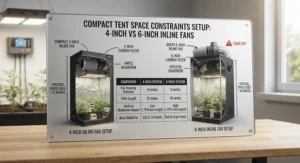
How to Choose the Right Fan Size for Your Tent Dimensions
Choosing fan size for grow tent setups comes down to a handful of concrete steps rather than guesswork:
- Calculate your tent’s volume. Multiply length by width by height in feet to get cubic feet — a 2x4x5 tent is 40 cubic feet, a 4x4x6.5 tent is roughly 104 cubic feet.
- Pick your air exchange rate. Standard guidance calls for replacing the tent’s full air volume once every 1-3 minutes; divide volume by your target minutes to get base CFM.
- Add 25% for carbon filter resistance. Filters restrict airflow meaningfully, so multiply your base CFM by 1.25 if you’re running one, which almost everyone growing anything with an odor should.
- Add another 15-20% buffer. Ducting bends, length, and filter aging all eat into real-world output, so build in margin rather than buying the exact rated minimum.
- Match duct size to the fan you land on. Fans under roughly 230 CFM are typically 4 inch models; above that, manufacturers generally step up to 6 inch construction for airflow efficiency.
- Confirm your carbon filter’s duct size matches. A 6 inch fan paired with a 4 inch filter (or vice versa) creates a bottleneck that undermines your careful CFM math.
- Size your intake to roughly match your exhaust. An exhaust fan without adequate passive or active intake will underperform regardless of how big it’s rated.
Right fan size for tent dimensions ultimately depends more on this calculation than on any single “rule of thumb” floor-space chart, since a hot 400-watt light in a 2×4 tent can need more airflow than a cooler LED in a 4×4.
4 Inch vs 6 Inch CFM Comparison: What the Numbers Really Mean
Raw CFM numbers on a box don’t tell the whole story, so here’s how the fans in this guide actually stack up once real-world factors are considered.
| Model | Duct Size | Rated CFM | Motor Type | Best For |
|---|---|---|---|---|
| VIVOSUN D4 | 4 inch | 195 CFM | AC | 2×2 tents, tight budgets |
| AC Infinity CLOUDLINE S4 | 4 inch | ~226 CFM | EC | 2×2–2×4 tents, quiet operation |
| AC Infinity CLOUDLINE T4 | 4 inch | ~226 CFM | EC | 2×2–2×4 tents, smart automation |
| TerraBloom MFIF-6 | 6 inch | 395 CFM | AC | 4×4 tents, simple controls |
| VIVOSUN Z6 | 6 inch | 440 CFM | AC | 3×3–4×4 tents, best CFM/dollar |
| AC Infinity CLOUDLINE T6 | 6 inch | ~425 CFM | EC | 4×4 tents, quiet + smart control |
Looking at the comparison above, the jump from a 4 inch to a 6 inch duct isn’t just “more CFM” — it’s roughly double the rated airflow ceiling, which matters most once a carbon filter and duct bends start eating into your real delivered air. Budget growers with a small 2×2 or 2×4 footprint genuinely don’t need to pay for that extra headroom, while anyone pushing 400+ watts of light or running a longer duct run to an exterior vent will hit the ceiling of a 4 inch fan faster than the spec sheet suggests. For a deeper technical breakdown of how CFM interacts with duct resistance, Sylvane’s explainer on static pressure and CFM is written for HVAC shoppers but applies directly to grow tent ducting too.
Airflow Exchange Rate Explained: How Fast Should Your Tent Breathe
The airflow exchange rate is simply how often your fan replaces the entire volume of air inside the tent, expressed as a time interval or as air changes per hour. Standard grower guidance recommends a full exchange every 1-3 minutes for healthy plant growth, translating to base CFM equal to your tent’s cubic footage divided by that target minute count. Here’s what most first-time growers get wrong: they calculate this base number, buy a fan that hits it exactly, and then wonder why performance feels underwhelming once a carbon filter goes on. The math above (volume ÷ exchange time) only gives you the starting point — filters, ducting bends, and heat load from lights all pull real-world delivered airflow well below that number, sometimes by 30-40% in a heavily filtered, bent-duct setup. A 2x2x5 tent, for example, is only about 20 cubic feet, which produces a laughably small base CFM requirement on paper — the real deciding factor for sizing in small tents is almost always heat output from the light, not the raw volume math. That’s precisely why a 400-watt light in a 2×2 tent might genuinely need the airflow of a 6 inch fan despite the tent itself being small enough for a 4 inch model on volume alone.
Common Mistakes When Choosing Fan Size for Grow Tent
The single most common mistake is sizing based on tent floor dimensions alone while ignoring light wattage — heat load, not square footage, drives most real-world CFM requirements in small spaces. A close second is mismatching fan and filter duct sizes, which creates a bottleneck no amount of fan power can overcome; a 6 inch fan bolted to a 4 inch filter effectively becomes a 4 inch system. Buyers also frequently skip factoring in duct bends and length, assuming the rated CFM on the box is what they’ll get inside the tent, when in reality even a single 90-degree bend can cut delivered airflow by more than half. Another recurring error: buying the cheapest fan available without checking noise ratings, then discovering at 2am that an AC-motor fan at full speed is loud enough to wake the household. Finally, many growers skip intake planning entirely, assuming the exhaust fan alone handles everything — without adequate intake, even a perfectly sized exhaust fan will underperform and stress the tent fabric.
4 Inch vs 6 Inch: Noise, Power Draw and Long-Term Cost
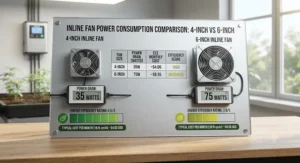
Noise and running cost are where the 4 inch vs 6 inch decision gets genuinely interesting, because motor type matters more than duct size on both fronts. EC-motor fans like the AC Infinity CLOUDLINE T4, CLOUDLINE S4, and CLOUDLINE T6 consistently run quieter and pull less power at partial speeds than AC-motor competitors of similar rated CFM, since EC motor technology is engineered specifically to stay efficient across a range of speeds rather than just at full blast. AC-motor fans like the VIVOSUN D4, VIVOSUN Z6, and TerraBloom MFIF-6 cost noticeably less upfront but draw more power once throttled down — the exact opposite of how most growers actually run their fans day to day, since a fan running at 100% around the clock is rare outside of hot summer stretches. Over a full year of continuous operation, that efficiency gap can translate into a real difference on the electric bill, though the AC-motor fans’ lower purchase price often offsets several years of that difference for smaller, occasional-use setups. The practical takeaway: if your tent runs 24/7 in a warm climate, the EC-motor premium pays for itself faster; if it’s a seasonal hobby tent, the AC-motor savings upfront are harder to argue against.
Features That Actually Matter (And Those That Don’t)
Motor type (AC vs EC) and rated CFM after filter loss matter enormously — everything else on the spec sheet is secondary. Bearing type and rated hours matter more than most buyers realize, since a fan running continuously for months benefits from dual ball bearings over cheaper sleeve bearings that wear faster. Built-in versus separate speed controllers matter for convenience but not performance — the TerraBloom MFIF-6‘s cord-integrated dial does the same job as a wired remote box, just with a slightly smaller adjustment range. What matters far less than marketing copy suggests: smart WiFi connectivity, which is genuinely useful for automation but doesn’t move a single extra cubic foot of air per minute compared to the same motor without it. Fancy housing materials (metal versus ABS plastic) affect durability and vibration transfer marginally but rarely change actual airflow performance in any meaningful way. Bottom line: chase CFM-after-filter-loss and motor efficiency first, treat everything else as a tiebreaker between otherwise comparable fans.
Benefits vs Traditional Alternatives: Inline Fans vs Box Fans and Passive Vents
| Factor | Inline Fan | Box Fan (Circulation Only) | Passive Vents Only |
|---|---|---|---|
| Actual air exchange | Yes — moves air in/out of tent | No — only circulates existing air | Minimal, relies on pressure differential |
| Odor control compatible | Yes, with carbon filter | No | No |
| Heat removal | Strong, ducted to exterior | Weak, air stays in room | Very weak |
| Noise | Low to moderate depending on model | Moderate, constant hum | Silent |
| Best For | Any serious indoor tent setup | Supplemental circulation only | Never as a sole solution |
Looking at the comparison above, a box fan alone simply can’t replace an inline fan for a sealed tent because it recirculates existing air rather than exchanging it with fresh air from outside the tent — heat and humidity just build up regardless of how strong the breeze feels. Passive vents work fine for exhaust-side airflow only when paired with an active fan creating negative pressure; on their own they can’t move enough air to matter in anything but the smallest, lightest setups. The practical reality is that inline fans aren’t competing with box fans for the same job — a box fan is still worth adding inside the tent for leaf movement and stem strengthening, but it’s a supplement to an inline fan, never a replacement for one.
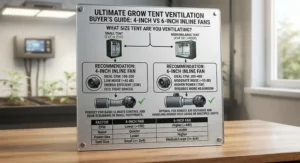
Frequently Asked Questions
❓ What size inline fan do I need for a 2x4 grow tent?
❓ Can I use a 4 inch fan with a 6 inch carbon filter?
❓ Is a 6 inch inline fan too big for a 2x2 tent?
❓ How loud is a 6 inch inline fan compared to a 4 inch?
❓ Do I need an intake fan if I already have an exhaust fan?
Conclusion
The 4 inch inline fan vs 6 inch for small tent question doesn’t have one universal answer, and honestly, that’s good news — it means the right pick is knowable once you run your tent’s actual numbers instead of guessing off a size chart. For a 2×2 or 2×4 tent under moderate lighting, a 4 inch option like the VIVOSUN D4, AC Infinity CLOUDLINE S4, or the bundled iPower 4 Inch 195 CFM Combo Kit delivers plenty of airflow without overspending on capacity you’ll never use. Step up to a 6 inch fan like the VIVOSUN Z6, TerraBloom MFIF-6, or the premium AC Infinity CLOUDLINE T6 once your tent grows past 3×3, your light wattage climbs past 400 watts, or you’re running a longer, bendier duct run to an exterior vent. Whichever size you land on, remember that the number on the box is a ceiling, not a guarantee — carbon filters, duct bends, and real-world installation choices determine what actually reaches your plants. Match the fan to your tent’s real conditions, not just its floor dimensions, and you’ll spend a lot less time troubleshooting airflow and a lot more time actually growing.
Recommended for You
- Quietest 4 Inch Inline Duct Fan for Apartment: 7 Picks (2026)
- 4 Inch Inline Booster Fan for Bathroom Exhaust: 7 Picks for 2026
- 4 Inch Inline Fan for Closet Grow Setup: 7 Best Picks for 2026
Disclaimer: This article contains affiliate links. As an Amazon Associate, I earn from qualifying purchases. If you purchase products through these links, we may earn a small commission at no additional cost to you.
✨ Found this helpful? Share it with your friends! 💬🤗
