
In This Article
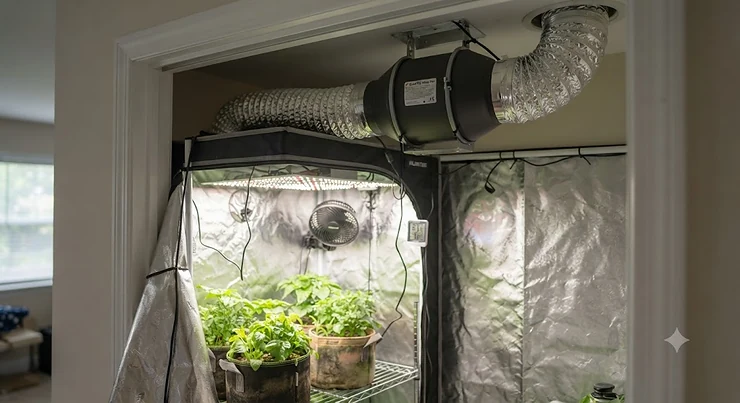
Open the closet door on a bad grow tent setup and you’ll smell the problem before you see it — a warm, swampy air that clings to your clothes and makes you wonder if something’s dying in there instead of growing. A 4 inch inline fan for closet grow setup use is the small metal cylinder that fixes all of that: it pulls hot, spent air out of an enclosed space and pushes fresh air back in, one steady breath at a time. Sized correctly for a closet (usually somewhere between 100 and 205 CFM for a space under about 16 square feet), it keeps temperature, humidity, and odor in check without needing a window or a construction project.
Here’s the tricky part: closets aren’t grow tents. They’re often shared living space, sometimes right next to a bedroom, and the walls don’t come with pre-cut ports the way a Gorilla or AC Infinity tent does. That means the fan you pick has to do double duty — moving enough air to keep plants healthy while staying quiet enough that nobody in the next room notices. Based on the spec comparisons and aggregated buyer feedback pulled together for this guide, that combination is rarer than it sounds; plenty of fans are either loud and powerful or quiet and underpowered.
This guide walks through seven real, currently available 4 inch inline fans, breaks down what their specs actually mean once installed in a closet (not a spec sheet in a vacuum), and gets into the parts nobody’s Amazon listing covers — where to cut a vent hole, how to route ducting around a closet rod, and how to keep the whole setup from being obvious to anyone who opens the door. Prices shift constantly on Amazon, so every figure below is a range based on research at the time of writing — always check current pricing before you buy.
Quick Comparison Table
| Fan | Airflow (CFM) | Noise Level | Best For |
|---|---|---|---|
| AC Infinity CLOUDLINE T4 | ~205 CFM | ~25-28 dBA | Set-it-and-forget-it smart automation |
| AC Infinity CLOUDLINE S4 | 205 CFM | 28 dBA | Quietest manual-speed option |
| VIVOSUN D4 | 195 CFM | 40-50 dBA | Proven budget workhorse |
| iPower 4 Inch 100 CFM | 100 CFM | Low-moderate | Cheapest true plug-and-play |
A quick scan of this table already tells the main story: airflow numbers cluster tightly around 100 CFM or 195-205 CFM, but noise output varies enormously between them, and that gap matters more in a closet than it would in a garage or a detached shed. The AC Infinity CLOUDLINE models justify their higher price with an EC motor that pulls the same air with noticeably less hum, while the VIVOSUN D4 and iPower fans lean on brute simplicity and a lower buy-in cost. If your closet backs onto a bedroom wall, the dBA column deserves more weight than the CFM column — a fan that’s “too quiet for its CFM rating” on paper is often the one that actually gets left running all night.
💬 Just one click — help others make better buying decisions too!😊
Top 7 4 Inch Inline Fans for Closet Grow Setups: Expert Analysis
1. AC Infinity CLOUDLINE T4 — smartest climate automation in a 4-inch fan
The AC Infinity CLOUDLINE T4 is the fan version of hiring a night-shift employee for your closet: it doesn’t just move air, it decides how much air to move based on what your grow actually needs. Specs-wise, it shares the same 4-inch EC motor platform as AC Infinity’s other CLOUDLINE fans, but adds a temperature-and-humidity-triggered controller with programmable scheduling — meaning it speeds up automatically when your closet gets warm from grow lights and idles down overnight. Based on the spec sheet, that VPD-style automation is the difference between checking your tent twice a day and setting a target range once a month. Reviewers and grow-forum regulars consistently point to the CLOUDLINE line’s dual ball-bearing motor as the reason these fans keep running quietly years into ownership, rather than developing the rattling hum cheaper AC motors pick up over time. This is the pick for closet growers who travel, work irregular hours, or simply don’t want ventilation to be a daily chore.
Pros:
- ✅ Automated temperature and humidity triggered speed control
- ✅ EC motor stays quiet even as speed increases
- ✅ Long-rated dual ball bearings for multi-year reliability
Cons:
- ❌ Premium price compared to manual-controller fans
- ❌ Controller adds a learning curve for first-time growers
Expect to pay in the low-to-mid $100s for the AC Infinity CLOUDLINE T4 — check current pricing, since AC Infinity periodically bundles it with filtration kits. For a closet that needs to run unattended for stretches at a time, the automation alone tends to justify the premium over its manual sibling.
2. AC Infinity CLOUDLINE S4 — quietest EC motor at this size
If the T4 is the automated option, the AC Infinity CLOUDLINE S4 is its manual-control sibling, and for a lot of closet setups, that’s actually the smarter buy. It moves 205 CFM of free-air airflow at a rated 28 dBA — genuinely quiet for a fan this size, and the reason multiple independent testers have called it the quietest 4-inch inline fan on the market in 2026. What that spec means in practice: at its lowest of eight speed settings, the fan all but disappears into background room noise, which matters enormously if the closet shares a wall with a bedroom. The 8-speed manual controller lets you dial in exactly the airflow a small space needs rather than running full-blast around the clock, which also stretches the motor’s lifespan. What most buyers overlook about this model is that its “no-app-needed” simplicity is actually a selling point, not a limitation — for a single closet, manual speed control is often faster to dial in than syncing a smart app.
Pros:
- ✅ 205 CFM airflow rated at just 28 dBA
- ✅ 8-speed manual controller for precise dialing-in
- ✅ Reliable EC motor build reviewers describe as long-lasting
Cons:
- ❌ No automated temperature/humidity response
- ❌ Controller and AC adapter add a bit of wiring clutter
The AC Infinity CLOUDLINE S4 typically runs in the $80-$100 range, undercutting the T4 while keeping nearly identical airflow and noise numbers — a strong value pick for anyone comfortable adjusting a dial rather than an app.
3. Mars Hydro iFresh 4″ EC Ultra Quiet Smart Inline Duct Fan Combo — best all-in-one combo kit for beginners
The Mars Hydro iFresh 4″ Inline Duct Fan solves a problem a lot of first-time closet growers don’t see coming: buying a fan, then realizing you also need a carbon filter, ducting, clamps, and a speed controller separately. This one ships as a full combo — a 4-inch inline duct fan rated at a stable 205 CFM, paired with a carbon filter, flexible duct tubing, three duct clamps, and hanging straps in a single box. The fan itself also includes a dedicated expansion port that connects to Mars Hydro’s MarsPro add-on pack, unlocking full app-based climate control if you want to upgrade later without buying a whole new fan. Based on the spec comparison, 205 CFM at the filter is right at the sweet spot for closets in the 3×3 to 4×4 footprint once you account for the airflow resistance a carbon filter adds. Reviewers of the combo kit consistently note that having every component matched and boxed together removes the guesswork of mismatched duct diameters that trips up a lot of first attempts.
Pros:
- ✅ Complete kit: fan, carbon filter, ducting, clamps, straps
- ✅ 205 CFM airflow suits small-to-mid closet footprints
- ✅ Expansion port allows future app-control upgrade
Cons:
- ❌ Full app control requires purchasing the separate Pro add-on
- ❌ Bundled components mean less flexibility to mix brands
Combo kits like this typically land in the $80-$120 range depending on active promotions — a reasonable value verdict for anyone who’d rather buy once than shop five separate product pages.
4. Spider Farmer 4-Inch 205 CFM Inline Fan Combo — best value bundle with filter and ducting
The Spider Farmer 4-Inch Inline Fan Combo takes the same “everything in one box” approach as the Mars Hydro kit, but leans harder into the filtration side: its carbon filter uses Virgin Australian activated charcoal, a detail that matters more than it sounds because virgin (as opposed to reclaimed) charcoal generally has more surface area available to trap odor compounds before it saturates. The fan itself is rated at 205 CFM with a digital touch-screen smart controller, putting it in direct competition with the AC Infinity and Mars Hydro options on raw airflow. What the spec sheet won’t tell you, but aggregated buyer feedback suggests, is that Spider Farmer’s combo kits tend to arrive with slightly more generous duct length than competitors — useful in a closet where the fan needs to sit a few feet from the actual vent hole. For growers prioritizing scent control as much as temperature control, this combo’s filter quality is the standout reason to pick it over a bare fan.
Pros:
- ✅ Virgin activated charcoal filter for stronger odor control
- ✅ 205 CFM matched to filter and ducting in one kit
- ✅ Digital touch-screen controller for precise speed settings
Cons:
- ❌ Bundled ducting length may still need extending in larger closets
- ❌ Touch controller has more to fail than a simple dial
Expect the Spider Farmer combo to sit in a similar $90-$130 range to its Mars Hydro counterpart — pricing shifts with promotions, so check current listings before buying.
5. VIVOSUN D4 — most proven budget workhorse
Popularity isn’t the same as quality, but it’s not nothing either, and the VIVOSUN D4 has racked up more customer reviews than almost any other fan in this category — north of 13,000 at last count, with a strong average rating. That’s a genuinely useful signal: it means thousands of closet and grow-tent setups have run this exact fan long enough to leave a review, which is the closest thing to real-world durability data a shopper gets without testing it themselves. Spec-wise, it’s a 195 CFM AC-motor fan — not EC — which is the honest tradeoff here: AC motors are simpler and cheaper to manufacture, but they typically run louder and less efficiently than the EC motors in AC Infinity’s lineup. Reviewers commonly describe the D4 as reliable rather than whisper-quiet, which lines up with the AC motor spec. For a closet in a garage, basement, or any space where a little hum isn’t a dealbreaker, that tradeoff is an easy one to accept for the lower price.
Pros:
- ✅ Extensive review history backing long-term reliability
- ✅ 195 CFM covers most single-closet grow footprints
- ✅ Widely available replacement parts and accessories
Cons:
- ❌ AC motor runs noticeably louder than EC alternatives
- ❌ No built-in variable speed without an add-on controller
Priced in the $40-$60 range in most listings, the VIVOSUN D4 is the fan to buy when budget matters more than bedroom-quiet operation.
6. TerraBloom 4″ (100mm) Metal Inline Fan — most compact footprint for tight closets
Not every closet grow needs 200 CFM — a lot of small tents in the 2×2 to 2×4 range are actually oversized by a fan that big, running at low speed just to avoid overpowering the space. The TerraBloom 4″ Metal Inline Fan is built for that smaller end of the range: rated at 100 CFM, it’s ETL listed (a real third-party safety certification, not a marketing sticker) and ships pre-wired with a 6-foot grounded cord, so there’s no wiring work required beyond plugging it in. Its all-metal housing is also a genuine durability upgrade over the plastic shrouds on some budget fans, particularly in a closet where the fan might sit close to grow-light heat. Based on the spec comparison, this is best paired with a smaller carbon filter and shorter duct run — trying to push it through a long, bent duct path will eat into that 100 CFM rating fast. Aggregated buyer sentiment on similarly sized TerraBloom fans points to compact dimensions and low operating noise as the recurring strengths, with the main complaint being that it’s not powerful enough for anything larger than a small closet.
Pros:
- ✅ ETL-listed metal housing built for durability
- ✅ Pre-wired grounded cord — no electrical work needed
- ✅ Compact size fits tight closet shelving
Cons:
- ❌ 100 CFM is only enough for smaller closet footprints
- ❌ No included speed controller in the base configuration
Typically priced in the $40-$70 range, the TerraBloom metal fan earns its keep as the right-sized option for closets that don’t need — and shouldn’t run — a 200 CFM fan.
7. iPower 4 Inch 100 CFM Inline Duct Fan — cheapest true plug-and-play option
Sometimes the honest answer to “what’s the best fan” is “the one that costs the least and still works,” and that’s the lane the iPower 4 Inch 100 CFM Inline Duct Fan occupies. It’s a no-frills booster fan: 100 CFM airflow, low-noise design, and nothing else — no app, no touch screen, no bundled filter. Plug it in and it runs at a fixed speed, full stop. Based on the spec comparison, that fixed-speed simplicity is exactly the point for a small closet exhaust or an intake booster feeding a larger exhaust fan elsewhere in the setup — you’re not paying for features you won’t use in a straightforward single-speed application. Aggregated review sentiment on entry-level iPower duct fans tends to describe them as reliable for basic exhaust and booster duty, with the expected caveat that a fixed-speed fan gives you no way to quiet it down beyond adding a separate inline speed controller. For a backup fan, a second closet, or a first-time grower testing the waters before investing more, it’s hard to beat on price.
Pros:
- ✅ Lowest price point in this roundup
- ✅ True plug-and-play with no setup required
- ✅ Compact enough for the tightest closet shelving
Cons:
- ❌ Fixed speed with no built-in controller
- ❌ 100 CFM ceiling limits it to smaller spaces
Look for the iPower fan in the $25-$40 range — an easy entry point if you’re not ready to commit to a $100+ smart fan yet.
Practical Usage Guide: Setting Up Your Closet Grow Ventilation
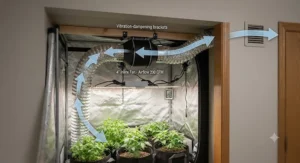
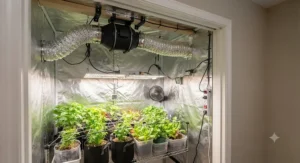
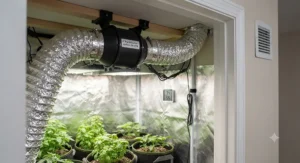
Getting a 4 inch inline fan running correctly in a closet is less about the fan itself and more about the ten minutes of setup around it. Start by deciding on airflow direction: most closet setups run the inline fan as an exhaust, pulling air out through the carbon filter and pushing it into ducting that vents outside the closet, while a passive intake port (just a cut vent covered with light-blocking material) lets replacement air in lower down. Mount the fan as close to the top of the closet as the ducting allows, since heat naturally rises and that’s where the hottest, most humid air collects first. Secure the fan with the included hanging straps or a simple bungee cord rather than letting it dangle from the ducting alone — unsupported weight stresses the duct clamps and can eventually pull them loose.
In the first 30 days, check the duct clamps weekly; ducting has a tendency to loosen slightly as it settles, especially at bends. Common early mistakes include running the fan at full speed constantly (unnecessary noise and energy use for a small closet), pointing it directly at seedlings (can dry them out or stress delicate stems), and forgetting to account for the carbon filter’s resistance when picking a CFM rating — a filter typically knocks 25-30% off a fan’s free-air rating once installed. For maintenance, wipe down the fan’s intake grill monthly to keep dust from building up on the blades, since dust accumulation is one of the more common causes of gradual noise increase over a fan’s lifespan.
Real-World Scenarios: Three Closet Growers, Three Fan Picks
The apartment grower in a bedroom closet: Living in a one-bedroom with the grow closet three feet from the bed, noise is the entire ballgame. The AC Infinity CLOUDLINE S4 or T4 makes the most sense here — 28 dBA at full speed is genuinely unobtrusive, and dialing down to a lower setting overnight makes it close to inaudible. A $100 fan is a small price for actually sleeping through the night.
The budget-conscious first-timer testing the waters: Someone trying a single small plant before committing more money shouldn’t drop $150 on a smart fan they might not use again. The iPower 100 CFM or TerraBloom metal fan covers a small closet adequately, and if the hobby sticks, that fan becomes a spare or an intake booster for a bigger future setup.
The weekend DIYer running a 4×4-adjacent closet system: With more square footage and a household less sensitive to hum, the VIVOSUN D4 or one of the combo kits from Mars Hydro or Spider Farmer hits the sweet spot — solid CFM, bundled filtration, and a price that doesn’t require justifying the purchase to anyone.
Buyer’s Decision Framework
If quiet operation next to living space matters most, choose an EC-motor fan like the AC Infinity CLOUDLINE S4 or T4, because their 28 dBA rating is the clearest differentiator in this whole category. If budget is the primary constraint and the closet sits away from bedrooms, choose the VIVOSUN D4 or iPower fan, because their lower price reflects a real but acceptable tradeoff in noise and automation. If simplicity and one-box convenience matter most, choose a combo kit like Mars Hydro iFresh or Spider Farmer, because they remove the guesswork of matching fan, filter, and ducting diameters separately. If the closet is small (2×2 to 2×4), choose a 100 CFM fan like TerraBloom or iPower rather than a 200 CFM model, because oversized airflow in an undersized space just adds noise without a real benefit.
How to Choose a 4 Inch Inline Fan for Your Closet Grow Setup
- Measure your closet’s cubic footage first. Multiply length by width by height in feet — a 2x3x6 closet is 36 cubic feet, and you generally want to fully exchange that air every one to three minutes.
- Add 25-30% for carbon filter resistance. A filter is essential for odor control, but it measurably reduces a fan’s effective CFM, so size up rather than buying to the bare minimum.
- Add more for duct bends and long runs. Every 90-degree bend in ducting adds meaningful resistance — a straight, short duct path performs closer to spec than one with several turns.
- Match the fan diameter to your ducting diameter. A 4-inch fan needs 4-inch ducting; reducing from 6-inch fan to 4-inch duct (or the reverse) creates a bottleneck that undercuts the fan’s rated performance.
- Weigh noise rating against your closet’s location. A fan bordering a bedroom wall deserves a lower dBA rating even if it costs more upfront.
- Decide if you want manual, app-based, or automated control. Manual dials are simpler and cheaper; automated temperature/humidity triggers cost more but remove daily guesswork.
- Check for a bundled kit versus buying components separately. Combo kits save time matching parts, but standalone fans give more flexibility if you already own a filter or ducting.
Common Mistakes When Buying a Closet Grow Ventilation Fan
The single most common mistake is buying based on CFM alone without accounting for the carbon filter that almost every closet setup eventually adds — a fan rated at exactly your closet’s minimum airflow needs will fall short once a filter is attached. A close second is ignoring noise ratings entirely; a fan that’s “only” 10-15 dBA louder than another sounds like a much bigger jump once it’s running for weeks on end next to a bedroom wall. Buyers also frequently underestimate duct run length, assuming the fan sits directly at the vent hole when in practice it often needs to travel a few feet through a closet’s depth, adding resistance the original CFM math didn’t include. Another recurring issue is skipping the speed controller step on fans that don’t include one — running a fixed-speed fan at full blast around the clock burns more electricity and generates more noise than a small closet actually needs. Finally, some growers buy a 6-inch fan assuming bigger is always better, then discover it doesn’t fit their existing 4-inch ducting without an adapter that itself restricts airflow.
4 Inch Inline Fan vs 6 Inch Inline Fan: Which Fits Your Closet
The honest rule of thumb from ventilation suppliers is that a 4-inch fan typically moves somewhere around 100-205 CFM free-air, while a 6-inch fan roughly doubles that to 350-440 CFM — and the deciding factor is almost always your closet’s cubic footage, not personal preference. For a standard bedroom closet in the 2×2 to 3×4 range, a 4-inch fan running at a moderate-to-high speed setting comfortably handles the air exchange without needing headroom it’ll never use. Step up to anything closer to a 4×4 footprint, though, and a 6-inch fan running at 40-50% speed for quieter, more efficient operation tends to outperform a 4-inch fan straining at maximum speed to keep up — an oversized fan running slow is almost always quieter and more durable than an undersized fan running flat-out. The tradeoff is duct diameter and mounting space: 6-inch ducting takes up noticeably more room inside a closet already tight on space, which is exactly why the 4-inch category covered in this guide remains the default choice for most single-closet setups.
Discreet Closet Exhaust Setup: Stealth Ventilation That Actually Works
A discreet closet exhaust setup isn’t about hiding that ventilation exists — it’s about making sure nobody notices unless they’re specifically looking. The two giveaways that blow a stealth setup are sound and smell, and a 4 inch inline fan for closet grow setup use addresses both when it’s paired correctly with a carbon filter and a quiet EC motor. Positioning matters as much as equipment: running ducting through the back or side of a closet, rather than straight out a visible front vent, keeps the exit point out of a casual glance. A humidity-proof or louvered exterior vent cap also matters more than it seems — a plain open duct end reads very differently to a passerby than a proper vent cover that looks like standard household ventilation. For truly stealth ventilation, the fan’s noise floor deserves priority over its CFM rating, since a 28 dBA fan blends into ambient household sound in a way a 45 dBA fan simply doesn’t, no matter how well the smell is contained.
Vent Hole Cutting: Where and How to Cut Without Wrecking Your Closet
Cutting a vent hole is the step that intimidates first-timers the most, but it’s more forgiving than it sounds if you plan the path before touching a drill. Start by locating studs with a stud finder — cutting between studs, not through one, keeps the job simple and avoids weakening the wall’s structure. Trace the duct collar’s outer diameter onto the surface with a pencil, then drill a pilot hole in the center before switching to a hole saw or jigsaw sized to the traced line; cutting slightly undersized and sanding to fit beats cutting oversized and needing to patch a gap. If the vent exits into an attic, crawlspace, or exterior wall, seal the gap around the duct with foam sealant once it’s in place — this stops both drafts and light leakage, which matters for anything running on a strict light schedule. For renters or anyone avoiding a permanent hole, an existing register, closet louvered door slats, or a window duct kit can all serve as vent points without cutting into drywall at all, trading some airflow efficiency for zero renovation.
DIY Closet Grow Airflow and Duct Routing
Good duct routing in a closet comes down to one principle: the straightest, shortest path from fan to vent wins, because every bend and extra foot of flexible ducting adds resistance that eats into your fan’s rated CFM. Where a bend is unavoidable, a gentle sweeping curve performs noticeably better than a sharp right angle — flexible aluminum ducting can be gently persuaded into a wide arc rather than folded tightly. Keep ducting pulled reasonably taut rather than sagging in loose loops; sagging sections create low points where condensation can pool, and pooled moisture inside ducting is a quiet contributor to mold that often goes unnoticed until there’s a smell. According to the U.S. Environmental Protection Agency, controlling moisture is the single most effective way to prevent mold growth indoors, and a closet grow — with its elevated humidity from watering and transpiration — is exactly the kind of space where that principle matters (EPA: A Brief Guide to Mold, Moisture, and Your Home). Beyond exhaust ducting, a small secondary circulation fan inside the closet (separate from the inline exhaust fan) makes a real difference too — researchers at the University of Massachusetts Amherst note that gentle, continuous air movement across plant foliage promotes sturdier stem growth through a response called thigmomorphogenesis, on top of drying the canopy enough to discourage fungal issues (UMass Amherst Extension: Horizontal Air Flow).
Long-Term Cost & Maintenance
The sticker price of a 4 inch inline fan is only the entry fee — the real cost of ownership shows up in electricity use, filter replacement, and eventual part wear. EC motor fans like the AC Infinity CLOUDLINE line typically draw noticeably less power at a given airflow than comparable AC motor fans, which adds up over months of near-continuous operation; running a fan 18-24 hours a day for a full grow cycle is common in closet setups, so the wattage difference between an EC and AC motor compounds fast. Carbon filters are the other recurring cost: expect to budget for a filter refresh every 12-18 months of regular use, since activated charcoal gradually loses its odor-trapping capacity as it saturates. On the electrical side, closet growers should also budget for a dedicated, undamaged extension cord if the fan doesn’t reach a wall outlet directly — the U.S. Consumer Product Safety Commission has documented thousands of residential fires each year traced to overloaded or damaged extension cords, and a fan running around the clock is exactly the kind of continuous load that should never sit on a cheap, overloaded cord (CPSC: Household Extension Cords Can Cause Fires). Weighed against those ongoing costs, the $20-$40 premium for an EC motor fan over a comparable AC motor model tends to pay for itself within a single growing season.
✨ Don’t Miss These Exclusive Deals!
🔍 Take your closet grow ventilation to the next level with these carefully selected fans. Click on any highlighted pick above to check current pricing and availability. The right fan will help you create the quiet, stable airflow your plants — and your household’s peace and quiet — actually need!
Frequently Asked Questions
❓ What size inline fan do I need for a closet grow tent?
❓ Do I need a carbon filter with a 4 inch inline fan?
❓ How loud is a 4 inch inline fan for closet grow setup use?
❓ Can I run a closet grow fan through an existing vent instead of cutting a hole?
❓ How often should I replace the carbon filter on my closet exhaust setup?
Conclusion
A closet grow only feels effortless once the ventilation disappears into the background — no smell drifting into the hallway, no hum loud enough to notice from the next room, just steady air moving in and out on its own schedule. The seven fans in this guide cover that range honestly: the AC Infinity CLOUDLINE T4 and S4 for anyone prioritizing quiet, automated control; the Mars Hydro iFresh and Spider Farmer combo kits for a one-box start; the VIVOSUN D4 for proven budget reliability; and the TerraBloom and iPower options for smaller closets or a lower-commitment first attempt. None of them is universally “best” — the right pick depends on your closet’s size, its neighbors, and how much you want to spend upfront versus over time. What matters most is matching CFM to your actual cubic footage, accounting honestly for filter resistance, and never treating noise rating as an afterthought if that closet shares a wall with somewhere you sleep. Get those three details right, and the fan you choose from this list should run quietly in the background for years.
Recommended for You
- 4 Inch Inline Fan for 2×2 Grow Tent: 7 Picks That Actually Work (2026)
- 7 Best 4 Inch Inline Fan and Carbon Filter Kits (2026 Picks)
- Inline Duct Fan vs Box Fan for Grow Tent: 7 Picks (2026)
Disclaimer: This article contains affiliate links. As an Amazon Associate, I earn from qualifying purchases. If you purchase products through these links, we may earn a small commission at no additional cost to you.
✨ Found this helpful? Share it with your friends! 💬🤗
