
In This Article
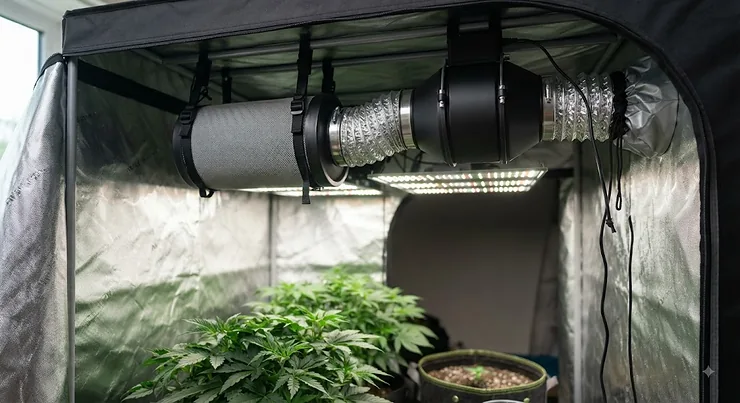
Your grow tent smells like a greenhouse full of secrets, and not in a good way. That’s the moment most indoor growers start Googling “4 inch inline fan and carbon filter kit” at 11 p.m., half-panicked, half-annoyed that a $40 seed investment turned into an air-quality crisis. Here’s the short version: a 4 inch inline fan and carbon filter kit is a paired ventilation system — a centrifugal duct fan that pulls air through an activated-carbon filter — that scrubs odor, VOCs, and excess humidity from a small grow space before exhausting clean air out through ducting.
That’s the textbook definition. What it doesn’t tell you is that not all kits are built the same, and the difference between a quiet, efficient setup and a rattling, underpowered one usually comes down to three things: motor type, filter density, and whether the ducting that ships in the box actually fits your tent’s dimensions.
We dug through real product specs, aggregated review sentiment across major retailers, and the underlying science of activated-carbon adsorption (the EPA’s overview of indoor VOC sources is a genuinely useful primer if you want the “why” behind the odor problem) to build this guide. Below you’ll find seven real 4 inch inline fan and carbon filter kit options spanning budget, mid-range, and premium tiers, a breakdown of how CFM and ducting size actually interact, and a decision framework so you’re not guessing. No fabricated testimonials, no inflated claims — just what the specs mean in practice and what reviewers genuinely tend to say.
Quick Comparison Table
Before the deep dive, here’s the 30-second version. This snapshot pulls the headline number (rated CFM), the tier, and who each kit actually suits — not who the marketing copy says it suits.
| Kit | Rated CFM | Tier | Best For |
|---|---|---|---|
| AC Infinity CLOUDLINE T4 | ~205 CFM | Premium | Whisper-quiet bedrooms, closets near living spaces |
| Hon&Guan 212 CFM EC Pro Kit | 212 CFM | Premium | Hands-off automation via humidity/temp sensor |
| Mars Hydro iFresh Smart Combo | ~190-205 CFM | Mid-Premium | Growers who hate replacing filters every season |
| VIVOSUN Smart T4 Kit | ~190 CFM | Mid-range | Manual speed dial-in on a tighter budget |
| TopoGrow 4 Inch Kit | 189 CFM | Budget | Longest ducting included out of the box |
| iPower 4 Inch 195 CFM Combo | 195 CFM | Budget | First-time growers wanting simple plug-and-play |
| GrowBright 4″ HV Combo | Not published (HV-rated) | Budget | Small 4×4 closets and tight vertical spaces |
A quick scan tells you most of what you need: CFM ratings for 4 inch kits cluster tightly between 189 and 212, which matters less than you’d think once a carbon filter’s static pressure resistance enters the equation. The AC Infinity CLOUDLINE T4 and Hon&Guan 212 CFM EC Pro Kit lead on smart-home style automation, while TopoGrow and iPower compete hardest on straightforward value. If your tent is genuinely small — think 2×2 or a cramped closet — the raw CFM number matters far less than filter contact time, which we’ll unpack later in this guide.
💬 Found a kit that fits your space already? Bookmark this page and jump straight to the pick that matches your tent size below.
Top 7 4 Inch Inline Fan and Carbon Filter Kits: Expert Analysis
Here’s the lineup, ordered roughly budget-to-premium, with the reasoning behind each placement.
1. AC Infinity CLOUDLINE T4 — quietest EC-motor kit with app control
The standout here isn’t raw airflow, it’s how AC Infinity gets there. The EC (electronically commutated) motor sips power more efficiently than the AC motors found in cheaper kits, and it does it while staying remarkably quiet even at higher speeds. Rated around 205 CFM with reported noise in the mid-20s dB range, this kit is built for people whose grow tent shares a wall with a bedroom. The included smart controller allows scheduling, temperature/humidity triggers, and app-based monitoring — features that turn a passive exhaust fan into an active climate system. Based on the spec comparison against the rest of this list, the T4’s biggest edge is motor engineering, not headline CFM; a well-built 205 CFM EC fan often feels stronger in practice than a noisier 220 CFM AC-motor competitor because it maintains speed under the static pressure load a carbon filter creates.
Aggregated reviews across major retailers consistently mention the build quality and noise level as standout strengths compared to older-generation 4-inch filter kits, with a smaller number of owners noting the companion app can be finicky on setup. This kit is for growers who’ve been burned by a loud, cheap fan before and are willing to pay for the fix.
Pros:
- ✅ EC motor stays quiet even at higher fan speeds
- ✅ App-based scheduling and humidity-triggered automation
- ✅ Reported strong build quality versus older 4″ filter kits
Cons:
- ❌ Companion app setup can be finicky for some owners
- ❌ Costs noticeably more than basic AC-motor combo kits
Price sits in the $130-$170 range at the time of research — check current pricing, since availability and bundling shift often. For anyone prioritizing quiet operation over saving $60, this is the value verdict: worth the premium.

2. Hon&Guan 4 Inch 212 CFM Air Filtration PRO Kit — smart humidity-triggered automation
Hon&Guan leans hard into “set it and forget it.” The 212 CFM EC motor pairs with a smart temperature-and-humidity controller that automatically ramps fan speed up when your tent gets muggy, rather than requiring you to babysit a manual dial. In practice, this means the fan idles low (saving noise and energy) during stable periods and kicks into higher gear exactly when your grow needs it — during lights-on heat spikes or after a heavy watering session that pushes humidity up.
What most buyers overlook about automated controllers like this one is that they reduce a very common beginner mistake: running the fan at max speed 24/7, which dries out a tent faster than necessary and shortens carbon filter life by pulling more particulate through the pre-filter. Reviewers researching this category tend to flag automated humidity control as the single feature that separates “smart” kits from “basic” ones, since manual speed dials require constant adjustment as seasons change.
Pros:
- ✅ Automatic speed ramp based on real humidity/temp readings
- ✅ 212 CFM EC motor among the strongest ratings in this class
- ✅ Reduces manual babysitting compared to dial-only fans
Cons:
- ❌ Controller adds a learning curve versus simple on/off fans
- ❌ Premium pricing puts it out of reach for tight budgets
Expect a price in the $110-$150 range at the time of research. The value verdict: strong pick if automation matters more to you than saving on upfront cost.
3. Mars Hydro iFresh 4 Inch EC Smart Combo — refillable filter cuts long-term cost
Most carbon filters are single-use — once the charcoal saturates, the whole unit gets tossed. The iFresh combo’s refillable filter design breaks that pattern, letting you swap in fresh activated carbon media instead of replacing the entire housing. Paired with an EC motor rated in the 190-205 CFM range (Mars Hydro doesn’t always publish an exact figure for this specific bundle, so treat that as an estimate consistent with their 4-inch lineup), it also includes smartphone app control for remote speed adjustment.
Here’s what the spec sheet won’t tell you outright: refillable filters only pay off if you actually refill them on schedule, and replacement carbon media is a separate purchase you need to plan for. Based on the total-cost-of-ownership math, a refillable filter can undercut buying a new sealed filter every 12-18 months — but only for growers disciplined enough to track saturation and reorder media rather than just running it into the ground.
Pros:
- ✅ Refillable carbon media avoids full filter replacement cost
- ✅ App control adds remote speed adjustment convenience
- ✅ EC motor efficiency in line with premium competitors
Cons:
- ❌ Refill carbon media is a separate, recurring purchase
- ❌ Exact CFM for this specific bundle isn’t clearly published
Price lands around $100-$140 range at the time of research. Value verdict: a smart long-term play for growers who’ll actually maintain it.
4. VIVOSUN Smart Air Filtration T4 Kit — dial-in speed control on a tighter budget
VIVOSUN’s AeroZesh T4 kit brings a genuine speed controller (the E12 dial) to a price point that undercuts the EC-motor premium kits above. Rated in the neighborhood of 190 CFM, it won’t out-muscle the Hon&Guan or AC Infinity units, but it gives you manual control over airflow without the smart-home learning curve — turn the dial, adjust the noise-versus-airflow tradeoff yourself.
Based on the spec comparison, the practical difference between a 190 CFM manual-dial fan and a 212 CFM automated one mostly shows up in convenience, not raw filtration capability, for tents under roughly 16 cubic feet. Reviewers researching VIVOSUN’s ventilation line generally note the brand’s reputation for straightforward reliability over flashy extras — a fan you plug in, dial to your preferred speed, and mostly forget about.
Pros:
- ✅ Manual speed dial gives direct control without an app
- ✅ Price sits meaningfully below EC-motor premium kits
- ✅ VIVOSUN has a broad, established grow-gear track record
Cons:
- ❌ No automated humidity/temperature response
- ❌ CFM ceiling trails the top two picks on this list
Price runs roughly $70-$100 range at the time of research. Value verdict: a smart middle-ground pick for budget-conscious growers who still want real control.
5. TopoGrow 4 Inch Ventilation Kit System — longest stock ducting included
TopoGrow’s kit ships with a genuinely long run of 25-foot silver flex ducting, which matters more than it sounds like it should. A lot of budget kits include a short 6- or 8-foot duct run that forces buyers into an immediate second purchase just to route air out a window or through a wall. At 189 CFM (2850 RPM, roughly 101 watts per the manufacturer’s listed specs), the fan itself sits in line with other budget options, but that extra ducting is a real cost-saver if your exhaust path is longer than a couple of feet.
The included coal-based activated carbon filter with a changeable velcro pre-filter is a practical touch — the pre-filter catches larger dust and plant debris before it reaches the carbon bed, extending the main filter’s working life. What most buyers overlook is that a washable pre-filter, even on a budget kit, meaningfully delays when you’ll need to replace the expensive carbon core.
Pros:
- ✅ 25 feet of ducting included, more than most budget kits
- ✅ Washable pre-filter extends carbon filter working life
- ✅ Straightforward wired setup with junction box included
Cons:
- ❌ AC motor runs louder than EC alternatives on this list
- ❌ No automated speed control, single-speed operation only
Expect the $60-$90 range at the time of research. Value verdict: the pick for anyone whose duct run is longer than the box usually assumes.
6. iPower 4 Inch 195 CFM Inline Fan Combo — best all-around value pick
iPower’s combo sits almost exactly at the category median: 195 CFM, straightforward carbon filter, backdraft-shutter-compatible ducting, and a price that undercuts most of the premium tier by half or more. It’s not flashy, but it’s a real, established brand with a wide enough footprint that replacement parts and compatible ducting sizes are easy to source later.
Based on the spec comparison, 195 CFM comfortably covers a 2×4 tent and gets close to adequate for a 4×4 space when you account for the roughly 25-30% CFM loss a carbon filter’s static pressure typically introduces. Aggregated buyer feedback for iPower’s ventilation line tends to describe the fans as “does what it says,” reliable rather than exciting — which, for a $60-ish appliance running 12+ hours a day, is arguably the highest compliment available.
Pros:
- ✅ Balanced 195 CFM rating fits most small-to-mid tents
- ✅ Backdraft shutter compatibility helps prevent air backflow
- ✅ Wide brand footprint makes replacement parts easy to find
Cons:
- ❌ Single-speed operation with no built-in controller
- ❌ Carbon filter density trails the premium-tier kits
Price falls in the $55-$85 range at the time of research. Value verdict: the safest “just works” pick if you want zero decision fatigue.
7. GrowBright 4″ HV Fan & Carbon Filter Combo — best for cramped 2×2 closets
This is the lesser-known entry on the list, and it earns its spot for a specific reason: it’s explicitly calibrated for small grow closets and tents up to 4×4 feet, not oversold as a do-everything unit. The high-velocity fan and “packed bed” carbon filter design are built to work in tandem rather than as generic interchangeable parts, and HTG Supply’s own product literature notes a 12-18 month filter lifespan with no maintenance required — no shaking, no repacking.
GrowBright doesn’t publish an exact CFM figure on its retail listing, which is a fair callout rather than something to gloss over; what’s verifiable is the pairing philosophy (fan and filter matched at the factory) and the size recommendation capping out around 4×4 feet. For anyone running a genuinely small tent — a 2×2 or a repurposed closet — buying a fan rated for a 4×8 room and choking it down with a speed controller is often less efficient than choosing a kit actually built for the smaller footprint from the start.
Pros:
- ✅ Fan and filter factory-matched specifically for small tents
- ✅ Maintenance-free packed-bed filter rated 12-18 months
- ✅ Built-in flanging integrates with air-cooled light setups
Cons:
- ❌ Exact CFM rating isn’t published on the retail listing
- ❌ Undersized for anything larger than a 4×4 tent
Price sits around $70-$100 range at the time of research. Value verdict: the smartest buy if your space genuinely is small — don’t oversize just because bigger numbers feel safer.
Practical Usage Guide: Setting Up Your 4 Inch Inline Fan and Carbon Filter Kit
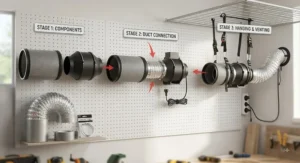
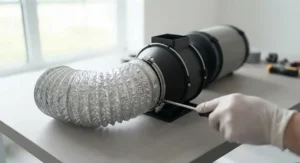
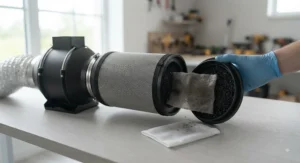
Getting the hardware right is half the job — installation mistakes are what actually cause the odor complaints and weak-airflow complaints you see in forums. Start by mounting the carbon filter inside the tent, near the top, with the fan positioned after it in the airflow path (filter first, fan second — this is called “negative pressure” setup and it keeps the filter under suction rather than pressure, which improves how tightly the carbon bed contacts incoming air). Use the rubber coupler and stainless clamps that ship with most kits to create an airtight seal at every joint; even a small gap lets unfiltered air bypass the carbon entirely.
Run your ducting with as few sharp bends as possible — every 90-degree turn adds resistance and quietly eats into your real-world CFM. During the first 30 days, the most common mistake is leaving the fan at full speed around the clock, which over-dries the tent and shortens both plant health and filter lifespan. Instead, dial in the lowest speed that still eliminates visible condensation and detectable odor at the tent’s exhaust port, then bump it up temporarily during lights-on heat spikes.
Maintenance is simple but easy to forget: wipe or replace the pre-filter every 2-4 weeks depending on dust load, and keep an eye (or a nose) out for odor breakthrough, which signals the main carbon bed is saturating. Most kits in this guide hold up for one full grow cycle before the carbon needs replacing or refilling.
Real-World Scenarios: Matching Kits to Grow Spaces
The apartment-dweller in a 2×2 closet: Odor control is non-negotiable when roommates or neighbors share a wall. This is exactly the small tent odor control kit scenario — the GrowBright combo’s factory-matched fan-and-filter pairing avoids the mismatch problem of an oversized fan choked down to whisper-quiet, which paradoxically reduces filter contact time and lets more odor slip through.
The budget-conscious first-time grower: Someone building their first 2×4 tent on a tight budget doesn’t need app control or humidity automation yet. An affordable 4 inch ventilation combo like the iPower or TopoGrow kit covers the fundamentals — adequate CFM, a real carbon filter, enough ducting to route outside — without paying for features you won’t use in year one.
The grower scaling up in a shared house: Once a 4×4 or larger tent enters the picture and noise matters (a spouse who works nights, a nursery down the hall), the calculus shifts toward EC-motor kits like the AC Infinity or Hon&Guan. The extra $60-80 buys quiet automation that a manual dial simply can’t replicate.
CFM for 2×2 Tent: How Much Airflow You Actually Need
A 2x2x4 foot tent holds roughly 32 cubic feet of air. The standard sizing rule — confirmed by ventilation retailers like Hydrobuilder’s fan and filter sizing guide — is to fully exchange that air at least once per minute, then add a 25-30% buffer to account for the static pressure resistance a carbon filter introduces. For a 2×2 tent, that math lands you at roughly 40-55 CFM as a bare minimum, which is dramatically lower than every kit on this list.
Here’s the honest analysis: virtually any 4 inch inline fan and carbon filter kit in the 189-212 CFM range is technically overpowered for a straight 2×2 tent. That’s not necessarily wasteful — most growers run these fans well below max speed with a controller, which is exactly why the VIVOSUN and Hon&Guan dial/automation features earn their keep in small spaces. The real risk with an oversized fan in a small tent isn’t wasted CFM, it’s running the fan too fast, which shortens carbon contact time and can push odor through before it’s fully adsorbed. Running a 200 CFM fan at 30-40% speed via a manual dial or smart controller typically outperforms running a smaller, cheaper fan at 100%.
Small Tent Odor Control Kit: Sizing Guide for 2×2 and 2×4 Spaces
Odor control in a small tent depends less on the fan’s top-end CFM and more on filter dwell time — how long air spends in contact with the activated carbon before exiting. A small tent odor control kit built around a properly sized carbon filter (matched in diameter and bed depth to a 4-inch duct, not oversized industrial media crammed into a small housing) generally outperforms a mismatched combo on paper-equal CFM numbers.
For 2×2 tents specifically, prioritize kits with speed control over raw horsepower — the GrowBright and VIVOSUN entries on this list both fit that profile, letting you throttle airflow down to match the smaller air volume without sacrificing filtration quality. If odor is the single biggest concern (shared walls, roommates, close neighbors), pair whichever fan you choose with a slightly denser carbon filter than the “minimum” sizing chart suggests — the extra adsorption capacity buys a margin of safety that’s cheap insurance against a smell that reaches the hallway.
Ducting Size Compatibility: Avoiding Airflow Bottlenecks
Every fan in this guide is rated 4 inches, but that number only matters if the rest of your ducting, filter flange, and exhaust port match it exactly. A 4-inch fan connected to 4-inch ducting but forced through a 3-inch dryer vent adapter, for example, creates a bottleneck that can slash real-world CFM by well over half — the fan spins at full RPM but the air simply has nowhere to go fast enough.
| Component | Correct Size for a 4″ Kit | Common Mismatch Mistake |
|---|---|---|
| Ducting diameter | 4 inches, flexible or semi-rigid | Reusing leftover 3″ or 5″ ducting from another project |
| Carbon filter flange | 4-inch reversible flange | Filter flange sized for a different fan brand |
| Exhaust port / vent cover | 4-inch matched cover | Routing through a narrower wall or window vent |
| Coupler & clamps | 4-inch rubber coupler, steel clamps | Loose zip-tie seals that leak unfiltered air |
The table above is the checklist worth screenshotting before you order anything. Mismatched ducting is one of the most common (and most avoidable) reasons a “weak” fan gets blamed for a problem that’s actually a bottleneck downstream. Before buying replacement ducting separately, confirm every connection point in your kit — fan intake, filter flange, exhaust port — is genuinely 4 inches; manufacturers sometimes list “4 inch” in the title while shipping a filter with a slightly different flange diameter that needs an adapter.
✨ Double-check your existing ducting size before you order — mismatched diameters are the #1 airflow killer.
Carbon Filter Scrubbing Efficiency: What the Spec Sheet Doesn’t Tell You
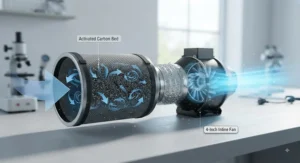
Carbon filter marketing loves throwing around “IAV” numbers (iodine adsorption value) as a shorthand for quality — you’ll see kits advertised with 900+, 1050+, or 1200+ IAV virgin charcoal. Here’s the honest analysis: IAV is a real, legitimate measure of a carbon’s porosity and surface area, and higher generally does correlate with better adsorption capacity. According to industry explainers on how activated carbon adsorption works, the mechanism is physical adsorption — gas molecules bind to the carbon’s internal pore structure, which offers an enormous surface area relative to its weight.
But scrubbing efficiency in the real world depends on three factors working together, not just IAV alone: carbon bed depth (how much material the air actually passes through), airflow velocity (faster air means less contact time per molecule), and evenness of air distribution across the filter’s full surface, not just a narrow channel through the middle. This is exactly why a slower, well-distributed airflow through a properly sized filter often outperforms a faster blast of air through an undersized one, even when the undersized filter claims a higher IAV number on the label. When comparing filters, weigh the combination of carbon quality, physical bed size, and your actual fan speed — not any single spec in isolation.
How to Choose a 4 Inch Inline Fan and Carbon Filter Kit
- Calculate your tent’s air volume first. Multiply length x width x height in feet to get cubic footage, then target a fan rated for at least that number in CFM, plus a 25-30% buffer for filter resistance.
- Match ducting size to every connection point. Confirm the fan intake, filter flange, and exhaust vent are all genuinely 4 inches before ordering anything separately.
- Decide how much automation you actually want. Manual dials cost less and work fine for stable environments; humidity/temperature-triggered controllers earn their premium in variable climates or noise-sensitive homes.
- Prioritize noise level for shared spaces. EC motors run quieter at comparable CFM than standard AC motors — worth the extra cost if the tent sits near a bedroom or living area.
- Check the pre-filter and maintenance design. A washable or replaceable pre-filter extends the main carbon filter’s life and saves money over a full grow season.
- Budget for filter replacement or refill media. Sealed filters typically need full replacement every 12-18 months; refillable designs need scheduled carbon media purchases instead.
- Read for ducting length included, not just fan specs. A shorter included duct run often means an unplanned second purchase — factor that into your total price comparison.
Common Mistakes When Buying a 4 Inch Ventilation Kit
The single most common mistake is buying based on CFM alone, without checking whether the ducting and filter flange sizes actually match your existing tent hardware — a fan can be perfectly rated and still underperform badly if it’s bottlenecked downstream. A close second is oversizing dramatically “just to be safe”: running a fan rated for a 4×8 room in a 2×2 tent at full blast tends to reduce filter contact time and can actually make odor control worse, not better, unless you’re using a speed controller to throttle it down.
Another frequent misstep is ignoring noise ratings entirely until after the fan is installed near a bedroom wall — decibel numbers vary meaningfully between AC and EC motors at similar CFM, and it’s a spec worth checking before purchase, not after. Finally, plenty of buyers skip planning for filter replacement cost, treating the initial kit price as the total cost of ownership when in reality most filters need replacing or refilling within a year of regular use.
Budget 4 Inch Fan Filter Bundle vs Premium Smart Kits
A budget 4 inch fan filter bundle like the iPower or TopoGrow combo and a premium smart kit like the AC Infinity CLOUDLINE T4 aren’t really competing on the same axis — they’re solving different problems. Budget bundles nail the fundamentals: adequate CFM, a functional carbon filter, and enough ducting to get air outside, all for roughly half the price of the premium tier. What they sacrifice is refinement — louder AC motors, single-speed operation, and carbon filters with lower published IAV ratings.
Premium smart kits justify their price through motor efficiency (EC motors run cooler and quieter at comparable output), automation (humidity-triggered speed changes instead of manual dial fiddling), and generally denser carbon filter media. The value verdict comes down to your specific constraints: if noise and hands-off automation matter because of a shared living space, the premium tier earns its markup. If you’re running a garage, basement, or a space where a bit of fan hum is a non-issue, an affordable 4 inch ventilation combo delivers nearly identical filtration outcomes for significantly less money — the core carbon-adsorption chemistry doesn’t change based on price tier.
Long-Term Cost & Maintenance
The sticker price on any of these kits is only part of the real cost. Carbon filters are consumable — expect to budget for a replacement (or, for refillable models like the Mars Hydro iFresh, replacement media) every 12-18 months of regular use, adding roughly $30-$60 annually to your total cost of ownership depending on filter size and brand. Pre-filters are cheaper and more frequent: budget for washing or swapping those every 2-4 weeks, which is functionally free if you’re washing a reusable one.
Electricity cost is the quiet variable most buyers never calculate. A typical 4-inch fan draws somewhere between 15-45 watts depending on motor type and speed setting; running one 18 hours a day for a full grow cycle costs only a few dollars in most U.S. electricity markets, which makes energy draw a minor factor compared to filter replacement in the total-cost-of-ownership picture. Where EC motors genuinely earn their premium long-term is motor lifespan — they tend to run cooler under sustained load, which can translate into fewer premature motor failures compared to cheaper AC units pushed at max speed around the clock.
Frequently Asked Questions
❓ How often should I replace a 4 inch carbon filter?
❓ What CFM do I need for a 4x4 grow tent?
❓ Can I use a 4 inch fan with a 6 inch carbon filter?
❓ Is a 4 inch inline fan and carbon filter kit loud?
❓ Do I need a speed controller for a small tent?
Conclusion
There’s no single “best” 4 inch inline fan and carbon filter kit — there’s a best kit for your specific tent size, noise tolerance, and budget, and the seven options above cover that entire spectrum honestly. If quiet automation matters most, the AC Infinity CLOUDLINE T4 and Hon&Guan EC Pro Kit lead the pack. If you’re building your first tent on a real budget, the iPower and TopoGrow combos hit the fundamentals without the premium markup. And if your space is genuinely small, resist the urge to oversize — the GrowBright combo’s factory-matched pairing and the sizing math in our CFM section both point the same direction: match the kit to the room, not the biggest number on the box.
Whichever you choose, the core physics doesn’t change: proper ducting size compatibility, adequate but not excessive CFM, and a well-maintained carbon filter will control odor and heat far more reliably than chasing the single highest spec on a listing page.
✨ Don’t Miss These Exclusive Deals!
🔍 Take your grow tent ventilation to the next level with these carefully selected kits. Click on any highlighted pick above to check current pricing and availability before you commit. The right setup makes odor-free, healthy growing genuinely low-maintenance.
Recommended for You
- Inline Duct Fan vs Box Fan for Grow Tent: 7 Picks (2026)
- Inline Duct Booster Fan for HVAC: 7 Best Picks (2026)
- Quietest Inline Fan for Bedroom Grow Tent: 7 Picks (2026)
Disclaimer: This article contains affiliate links. As an Amazon Associate, I earn from qualifying purchases. If you purchase products through these links, we may earn a small commission at no additional cost to you.
✨ Found this helpful? Share it with your friends! 💬🤗
