
In This Article
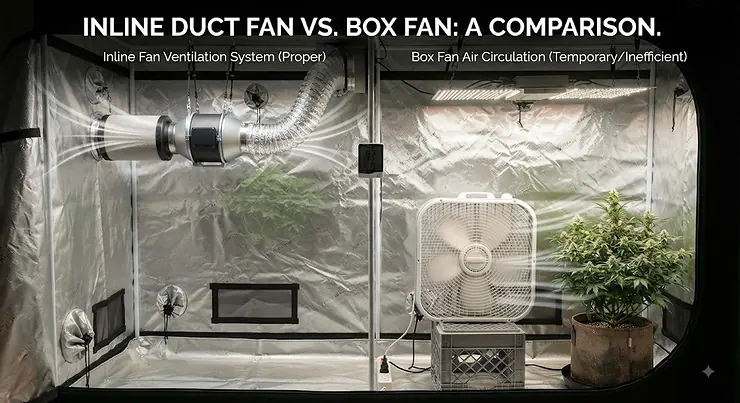
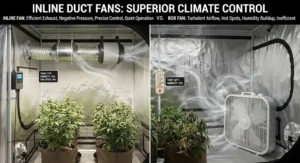
Somewhere around week three of flower, every grower asks the same panicked question at 2 a.m.: is my tent too hot because I need an exhaust fan, or too stagnant because I need a circulator? That confusion is exactly why the inline duct fan vs box fan for grow tent debate refuses to die. They look like they solve the same problem — moving air — but they’re built for almost opposite jobs, and mixing them up is one of the fastest ways to cook your canopy or drown it in humidity. An inline duct fan is a cylindrical, ducted motor designed to pull or push air through a hose, typically exhausting hot, humid air out of the tent (often through a carbon filter). A box fan, by contrast, is a flat, non-ducted household fan meant to stir air inside a room — or, with some rigging, act as a crude intake or exhaust booster. Neither replaces the other; smart growers usually run both.
This guide breaks down real, currently available products across both categories — from whisper-quiet WiFi-controlled inline units to the classic 20-inch box fan sitting in your garage right now — so you can build a ventilation setup that actually matches your tent size, grow stage, and budget. We’ll dig into specs the way an engineer would, not the way a listing does: what the CFM number means once ducting and filters are attached, what the dB rating sounds like at 3 a.m. in a spare bedroom, and where each product’s aggregated review sentiment lines up (or doesn’t) with its marketing copy. According to Wikipedia’s explanation of vapor pressure deficit, stagnant air around leaf surfaces traps moisture and directly slows transpiration — which is really the scientific reason “just add a fan” works as growing advice more often than not.
Quick Comparison Table
Before we get into the deep dives, here’s the 30-second version. Prices are shown as ranges only, since Amazon pricing fluctuates constantly — always check current pricing before buying.
| Product | Type | Airflow (CFM) | Noise | Best For |
|---|---|---|---|---|
| AC Infinity CLOUDLINE T6 | Inline duct fan | 402 CFM | 32 dBA | Best overall, serious VPD control |
| Lasko 20″ Weather Shield Box Fan | Box fan | Up to 2,000 CFM | Moderate-loud | Whole-room circulation on a budget |
| VIVOSUN AeroZesh G4 | Inline duct fan | 195 CFM | ~30-39 dB | Budget inline for 2×2–2×4 tents |
| AC Infinity CLOUDRAY S6 | Oscillating clip fan | N/A (circulator) | Low-moderate | Even canopy circulation |
| iPower 4″ 195 CFM | Inline duct fan | 195 CFM | 30 dB | Cheapest true inline option |
| Honeywell HT-900 TurboForce | Compact circulator | 185 CFM | Moderate | Tight tents, non-grow-specific budget pick |
| AC Infinity CLOUDLINE A6 | Inline duct fan | 352 CFM | 34 dBA | Mid-range value step-up from 4-inch fans |
Looking at the spread, the AC Infinity CLOUDLINE T6 wins on raw capability, but it’s genuinely overkill for a 2×2 tent — you’d be paying for VPD automation you don’t need. The Lasko 20″ Weather Shield Box Fan posts eye-popping CFM numbers, but remember: that figure is measured in open air, not through ducting or a carbon filter, so it’s not directly comparable to inline fan CFM. If you’re stuck between the budget inline options, the VIVOSUN AeroZesh G4 and iPower 4″ 195 CFM are nearly identical on paper, so the tiebreaker usually comes down to controller quality and warranty support rather than airflow.
💬 Found a comparison that actually made sense? Pass it along to a fellow grower who’s still Googling at midnight!😊
Top 7 Inline Duct Fans and Box Fans for Grow Tents: Expert Analysis
We picked these seven to cover every angle of the inline duct fan vs box fan for grow tent question — budget and premium, ducted and non-ducted, oscillating and fixed. Every product below is real, currently sold, and cross-checked against manufacturer specs and aggregated buyer sentiment.
1. AC Infinity CLOUDLINE T6 — best overall with app-based VPD automation
The CLOUDLINE T6 is the fan growers upgrade to once they’re tired of guessing. Its standout feature is the bundled temperature/humidity controller with WiFi app access, which lets the fan react to climate swings instead of running at one fixed speed all day. On the spec sheet, it delivers 402 CFM through a 6-inch duct at just 32 dBA, powered by a PWM-controlled EC motor with dual ball bearings rated for roughly 67,000 hours. In practice, that CFM number matters less than the fact that it’s achieved quietly — a static-pressure-friendly mixed-flow design means it keeps moving air even when a carbon filter and 90-degree ducting bend are choking the airflow, which is exactly the scenario that makes cheaper AC-motor fans wheeze. This is the fan for growers running 4×4 tents or larger, or anyone who wants to set a VPD target and stop babysitting the thermostat. Aggregated buyer sentiment consistently praises how quiet it runs on lower speeds and how sticky the companion app can occasionally feel during firmware updates — a common complaint in user reviews, though most report it resolves after a reinstall.
Pros:
- ✅ Genuinely quiet at 32 dBA even at moderate speeds
- ✅ App-based VPD automation removes manual guesswork
- ✅ Dual ball bearing motor built for continuous 24/7 duty
Cons:
- ❌ App occasionally needs reinstalling after updates
- ❌ Overpowered and overpriced for tents under 3×3
In the $140-$160 range at the time of research, the CLOUDLINE T6 isn’t cheap, but for a 4×4 or 5×5 tent running under lights all summer, the automation alone often pays for itself in avoided heat-stress losses.
2. Lasko 20″ Weather Shield Box Fan — best for raw whole-tent circulation on a budget
If you’ve ever wondered whether a box fan from the hardware store can double as grow tent circulation, this is the model growers actually reach for. Its standout feature is the Weather Shield motor, originally engineered for safe window installation, which happens to make it more humidity-tolerant than a typical desk fan — a real advantage in a tent that regularly sits at 55-65% RH. It moves up to 2,000 CFM on its highest of three speeds, though that figure is measured in open air with nothing obstructing the blades, so it’s not an apples-to-apples comparison with ducted inline CFM. What this fan is actually good at is bulk internal air movement: strapped horizontally near the top of a large tent or used as a crude passive-intake booster near a floor vent, it keeps the whole canopy swaying instead of just the top few inches. Reviewers consistently note it’s louder on high than most growers expect for something this cheap, and a common complaint in user reviews is that the plastic housing can rattle slightly on hard flooring after a year or two of use. It is not designed for ducting, filtration, or any kind of sealed exhaust setup — trying to force one into that role is a frequent and avoidable mistake.
Pros:
- ✅ Massive raw airflow for the price point
- ✅ Weather-resistant motor tolerates high-humidity tents
- ✅ Three-speed control and near-zero learning curve
Cons:
- ❌ Loud on high speed in a small enclosed tent
- ❌ Cannot connect to ducting or carbon filters
At around $25-$40, the Lasko box fan is the cheapest meaningful upgrade to circulation most growers will ever make — just don’t confuse it with an exhaust solution.
3. VIVOSUN AeroZesh G4 — best budget inline duct fan for small tents
The AeroZesh G4 is VIVOSUN’s answer to growers who want a real ducted exhaust fan without paying premium inline fan prices. Its standout feature is the PWM-controlled EC motor paired with the included E12 speed controller, giving ten programmable fan speeds plus three cycle modes that pulse airflow to save power overnight. Specs land at 195 CFM through a 4-inch duct, which is enough for most 2×2 to 2×4 tents once you factor in the CFM loss from a carbon filter and a couple of ducting bends. What most buyers overlook about small inline fans like this one is that the advertised CFM assumes a straight, unobstructed run — add a 90-degree bend and expect a real-world drop of 40-60%, which is exactly why undersized 2-inch or 3-inch fans so often disappoint growers who skipped the math. This model is squarely built for beginner-to-intermediate growers with tents under 16 square feet who don’t yet need WiFi automation. Aggregated review sentiment is largely positive on noise level at low-to-mid speeds, with an occasional complaint about the plastic housing flexing slightly under duct tension if the ducting isn’t supported.
Pros:
- ✅ Ten-speed EC motor controller included in the box
- ✅ Genuinely quiet at low-to-mid speed settings
- ✅ Compact footprint fits inside cramped tent frames
Cons:
- ❌ CFM drops sharply once a carbon filter is added
- ❌ Housing can flex if ducting isn’t independently supported
In the $40-$60 range, this is one of the better-value entry points into true ducted exhaust — the “when to use inline fan vs box fan” question gets a lot easier to answer once you’ve felt how differently negative pressure behaves with a unit like this pulling air.
4. AC Infinity CLOUDRAY S6 — best oscillating clip fan for canopy circulation
The CLOUDRAY S6 exists specifically to answer the circulation half of the grow tent air circulation setup equation, and its standout feature is genuinely clever: ten oscillation ranges that let you aim a wide, sweeping breeze across a full canopy or narrow it down to hit one stubborn hot corner. Under the hood it runs a brushless EC motor with carbon steel gears and dual-ball bearings, rated IP54 for splash and humidity resistance, plus a vise-grip-style metal clamp that’s noticeably more secure on tent poles than the plastic clips found on cheaper clip fans. Ten fan speeds combined with ten “dynamic wind” modes simulate the kind of irregular outdoor breeze that strengthens stem structure — something a fixed-speed box fan simply cannot replicate. This is the pick for growers who already have exhaust sorted (via an inline fan) and need to solve the classic “hot spot under the light, dead air in the corners” problem. What reviewers consistently note is that the oscillation mechanism is quieter and smoother than earlier-generation clip fans from the same category, though a handful mention the clamp, while strong, takes a firmer squeeze to open than expected on the first use.
Pros:
- ✅ True oscillation, not just a fixed-direction clip fan
- ✅ Ten dynamic wind modes mimic natural outdoor airflow
- ✅ IP54-rated for humid tent environments
Cons:
- ❌ No ducting capability — circulation only, not exhaust
- ❌ Clamp requires firm pressure to open on first use
Typically priced in the $50-$70 range, it’s a smart complement to any of the inline fans above, not a competitor to them — pair it with a small tent’s exhaust fan and the humidity swings noticeably even out.
5. iPower 4 Inch 195 CFM Inline Duct Fan — cheapest true inline option
If your budget is the deciding factor, the iPower 195 CFM fan is often the least expensive way to get an actual ducted exhaust fan rather than a repurposed household fan. Its standout feature is simplicity: no smart controller, no app, just a straightforward 4-inch inline motor rated at 195 CFM, 2500 RPM, and 30 dB, pulling 28 watts. That low noise floor comes from a flow deflector that concentrates airflow and reduces turbulent kinetic energy — the same physics trick used in far pricier fans, just without the extra electronics. For a first-time grower running a single 2×2 tent who just needs hot air out and fresh air in, this fan does that one job competently and doesn’t ask you to learn a new app to do it. Reviewers frequently mention this is a reliable “set it and forget it” option, though a common complaint in aggregated feedback is the absence of any built-in speed control — you’ll need to add a separate variable speed controller if you want anything other than full-blast operation.
Pros:
- ✅ Lowest price point among true inline duct fans
- ✅ Quiet 30 dB rating for the price tier
- ✅ Simple two-wire install with no app required
Cons:
- ❌ No built-in speed controller — full speed only out of the box
- ❌ 195 CFM ceiling limits it to smaller tent footprints
Usually found under $40, this is the fan to buy if you’re testing whether growing indoors is even for you before investing further.
6. Honeywell HT-900 TurboForce Air Circulator — best compact circulator for tight tents
Not every product on this list was designed for grow tents, and the Honeywell HT-900 is a good example of a genuinely useful crossover pick. Its standout feature is the Aerodynamic Turbo Design blade geometry, which Honeywell states projects a noticeable breeze up to 25 feet away despite the fan’s small, tabletop footprint — useful in a tent where floor space is at a premium and a 20-inch box fan simply won’t fit. Honeywell’s own spec sheet lists a maximum of 185 CFM across three speeds, with a 90-degree pivoting head for aiming airflow at specific canopy sections. Based on the spec comparison with dedicated clip fans, the trade-off here is clear: you get a sturdier, more widely available product at a lower price, but you lose the oscillation and humidity-resistant housing that purpose-built grow fans include. This is the pick for growers in a 2×2 or 2×3 tent who need a second circulator but don’t want to spend clip-fan money for it. Aggregated reviews consistently describe it as “surprisingly strong for its size,” with an occasional complaint about the plastic base scratching easily during transport.
Pros:
- ✅ Small footprint fits tight 2×2 and 2×3 tents
- ✅ Widely available with strong aftermarket support
- ✅ Pivoting head aims airflow at specific hot spots
Cons:
- ❌ No oscillation — manual repositioning only
- ❌ Not rated for high-humidity or splash exposure
At around $20-$30, it’s one of the least expensive ways to add a second circulation point to a small tent without stepping up to a dedicated grow-fan brand.
7. AC Infinity CLOUDLINE A6 — best mid-range value step-up
The CLOUDLINE A6 sits deliberately between the budget 4-inch inline fans and the flagship T6, and its standout feature is that it delivers most of the CLOUDLINE line’s build quality — the same mixed-flow design, dual ball bearings, and IP44 rating — without the WiFi controller markup. Specs come in at 352 CFM through a 6-inch duct at 34 dBA, with a wired 10-speed controller included in the box, and it remains compatible with CLOUDLINE’s smart controllers if you decide to add automation later. What most buyers overlook about the jump from a 4-inch to a 6-inch inline fan is how much headroom it buys against static-pressure losses: a carbon filter and a couple of duct bends will eat noticeably less of a 352 CFM rating than a 195 CFM one, leaving more usable airflow at the tent outlet. This is the sweet-spot pick for 3×3 or 4×4 tents where a 4-inch fan is undersized but a full smart-controller setup feels unnecessary. Reviewers consistently report it runs cooler and quieter than comparable AC-motor 6-inch fans, with the main recurring gripe being that the wired controller’s dial can feel slightly stiff at the lowest speed settings.
Pros:
- ✅ Strong CFM headroom for filtered, ducted setups
- ✅ Upgrade path to smart controllers if needed later
- ✅ Dual ball bearing EC motor built for longevity
Cons:
- ❌ Wired controller dial feels stiff at the lowest setting
- ❌ Step up in price from basic 4-inch inline fans
Expect to pay in the $85-$100 range — a reasonable middle ground for growers who’ve outgrown a 4-inch fan but aren’t ready for a full VPD controller.
Grow Tent Air Circulation Setup: A Step-by-Step Practical Guide
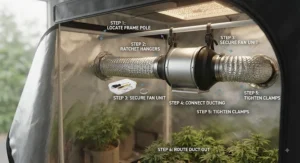
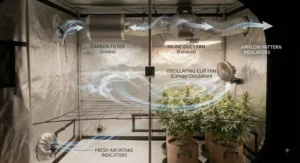
Buying the right fan is half the job; wiring your grow tent air circulation setup correctly is the other half, and it’s the part most beginner guides skip. Start with exhaust: mount your inline duct fan (like the AC Infinity CLOUDLINE T6 or CLOUDLINE A6) near the top of the tent, since hot air rises and pools there first. Run insulated ducting from the fan through the carbon filter and out through the tent’s rear port, keeping bends to an absolute minimum — every 90-degree turn can cost you 40-60% of rated CFM. Next comes intake, which is where a passive port (or a second, smaller fan) pulls replacement air in low on the opposite side of the tent, creating a diagonal airflow path across the canopy instead of a short-circuit loop near the ceiling.
Once exhaust and intake are running, add internal circulation. This is where a CLOUDRAY S6 or Honeywell HT-900 earns its keep, aimed just above the canopy rather than directly at it — blasting young plants at close range can cause “wind burn,” a stress response that curls leaf edges. During the first 30 days, check ducting connections weekly, since vibration loosens clamps faster than most growers expect, and clean the fan’s intake grille monthly to prevent dust buildup from quietly killing your airflow numbers. A common first-timer mistake is running everything at 100% speed around the clock; most growers get better humidity and temperature stability by running the exhaust fan on a moderate, thermostat-linked speed and reserving full power for lights-on peak heat hours.
✨ Ready to build this setup properly?
🔍 Compare the exhaust and circulation fans above side by side, click through to check current pricing, and put together the ventilation system your canopy has been waiting for!
Passive Intake: The Overlooked Half of Your Airflow Equation
Most grow tent troubleshooting threads eventually circle back to one overlooked culprit: passive intake. If your exhaust fan is rated for 350 CFM but your tent only has a single 4-inch mesh vent for air to enter, you’ve essentially built a straw and asked it to breathe through a coffee stirrer — the fan works harder, runs louder, and moves less air than its rating promises. What most buyers overlook about passive intake is that it should generally be sized at least as large as your exhaust duct, and ideally larger, since intake resistance is almost always the hidden bottleneck in an underperforming setup. Many growers open a second or third mesh vent, or crack the tent’s lower zipper slightly, until they can feel a gentle inward pull rather than a whistling hiss — the whistle is your first sign that intake area is undersized. For tents pulling 300+ CFM, some growers skip passive intake altogether and instead run a small second inline fan on the intake side to actively push fresh air in, matching it to roughly 80% of the exhaust fan’s CFM so the tent stays under slight negative pressure. That negative pressure matters for one very practical reason: it keeps odors and humidity from leaking out through zippers and seams instead of exiting cleanly through the filtered exhaust port.
Real-World Scenarios: Matching the Right Fan to Your Grow
Specs only mean so much until you match them to an actual grow. If you’re a first-time grower running a single 2×2 tent in a spare closet on a tight budget, the iPower 195 CFM inline fan paired with a passive intake vent and a small Honeywell HT-900 for circulation covers the basics without breaking $80 combined. If you’re managing a 4×4 tent in a garage that swings 15 degrees between day and night, the AC Infinity CLOUDLINE T6‘s VPD automation earns its price by adjusting speed automatically instead of you checking a thermometer every two hours — pair it with the CLOUDRAY S6 aimed across the canopy for even coverage. And if you’re a renter in an apartment where every decibel matters and neighbors share a wall, skip the Lasko box fan‘s louder high setting entirely and lean on the VIVOSUN AeroZesh G4 at a low-to-mid speed, which keeps noise well under normal conversation level while still exhausting effectively through a filter.
Inline Duct Fan vs Box Fan for Grow Tent: When to Use Each
This is the core question this whole guide exists to answer, and the honest answer is: they’re not really competitors. An inline duct fan is built to move air through a sealed hose — into a carbon filter, out a port, away from your grow space entirely. It’s the right tool whenever you need to exhaust hot air, control odor, or actively manage humidity by exchanging tent air with room air. A box fan, on the other hand, moves air around inside an open space; it has no way to connect to ducting or a filter, so it cannot exhaust anything cleanly. Its job is purely circulation — keeping the air near the canopy from stagnating so leaves can transpire efficiently, strengthening stems the way a light breeze does outdoors, and helping even out temperature pockets that form under grow lights.
So when do you reach for which? Use an inline duct fan whenever odor control matters, whenever you’re running a carbon filter, or whenever your tent regularly runs hotter or more humid than the room around it. Use a box fan — or, better, a purpose-built clip/oscillating circulator — when your temperature and humidity are already in range but the canopy still shows signs of stagnant air, like slow leaf movement, uneven leaf temperature, or powdery mildew starting in dense, still pockets. Most functional setups run both simultaneously: the inline fan handles the tent’s air exchange with the outside world, while a box fan or clip fan keeps the air inside that exchange loop actually moving instead of sitting in layers.

How to Choose an Inline Duct Fan or Box Fan for Your Grow Tent
Picking between models gets much easier with a short checklist. Here’s what actually matters, in order of importance:
- Tent volume first, CFM second. Multiply your tent’s length, width, and height in feet, then aim for a fan rated to exchange that volume roughly every 1-3 minutes — a useful reference point is the concept of air changes per hour, which HVAC engineers use to size ventilation for any enclosed space, tents included.
- Subtract for static pressure. Every carbon filter, duct bend, and length of flexible hose reduces real-world CFM — budget for a 40-60% drop from the rated number once everything is connected.
- Match noise tolerance to location. A fan in a garage can run loud; a fan in a bedroom closet needs to stay under roughly 35 dBA to avoid becoming background hum you can’t ignore.
- Decide if you need automation. WiFi and VPD controllers cost more but remove the daily guesswork of manual speed adjustment — worth it for larger tents, arguably unnecessary for a single 2×2.
- Check duct diameter compatibility. A 6-inch fan needs a 6-inch filter and 6-inch ducting; mismatched diameters choke airflow no matter how strong the fan itself is.
- Confirm intake capacity before buying exhaust. An oversized exhaust fan paired with undersized passive intake underperforms its own spec sheet, as covered above.
- Factor in circulation separately from exhaust. Budget for a clip or box fan in addition to your inline fan — they solve different problems and neither substitutes for the other.
Common Mistakes When Setting Up Grow Tent Circulation
Even experienced growers repeat a handful of avoidable errors. The single most common mistake is buying an inline fan sized for a bare tent and forgetting to account for the carbon filter and ducting that will immediately cut its effective CFM by nearly half. A close second is positioning the exhaust fan low in the tent instead of near the top, which fights the natural rise of hot air instead of working with it. Growers also frequently aim a box fan or clip fan directly at seedlings or clones at close range, which can stress or physically damage delicate young growth rather than strengthening it. Another overlooked issue is neglecting passive intake entirely — running a powerful exhaust fan against a single small mesh vent creates a whistling, underperforming system no matter how good the fan itself is. Finally, many first-timers run every fan at maximum speed around the clock, burning more electricity than necessary and creating more noise than the grow actually requires; a thermostat-linked or manually dialed-down speed almost always performs just as well with less wear on the motor.
Oscillating Fans and Clip Fans for Canopy Circulation
An oscillating fan solves a specific problem that a fixed-direction box fan can’t: even coverage without a dead zone. Because it sweeps side to side (and, on models like the CLOUDRAY S6, up and down through adjustable oscillation ranges), it distributes airflow across the entire canopy instead of blasting one section while leaving the corners stagnant. This matters more than it sounds like it should — plants sitting in a still-air pocket transpire more slowly, which the connection between airflow and vapor pressure deficit helps explain, and slower transpiration means slower nutrient uptake through the roots. Reviewers of dedicated grow-tent clip fans consistently mention that the variable oscillation range is the feature they didn’t know they needed until they used it, since it lets you widen coverage in a large tent or narrow it to spot-treat one persistently hot corner under an LED driver. Features that actually matter here: true oscillation, a secure clamp that won’t slip under vibration, and a low starting speed gentle enough for seedlings. Features that don’t matter nearly as much as marketing suggests: app connectivity for a fan whose only job is blowing air back and forth, and RGB lighting accents that add cost without adding airflow.
Long-Term Cost & Maintenance: CFM, Watts, and Total Cost of Ownership
The sticker price of a fan is a small fraction of what it actually costs over a grow cycle. A 30-watt inline fan like the iPower 195 CFM running 24/7 costs only a few dollars a month in most U.S. electricity markets, while a CLOUDLINE T6 running its EC motor at a moderate automated speed can actually cost less over time than a cheaper AC-motor fan running at full blast constantly, since EC motors scale power draw down at lower speeds far more efficiently. Maintenance costs matter too: inline fans with sealed, permanently lubricated bearings (like the dual ball bearing motors used across the CLOUDLINE line) rarely need anything beyond an occasional grille cleaning, while cheaper sleeve-bearing fans tend to develop an audible whine after a year or two of continuous use and may need replacing sooner. Box fans and clip fans are cheap to replace but also cheap to build, so budget for the possibility of swapping one out every one to two grow cycles if you’re running it near-constantly. Add it up over a full year of growing, and the real cost-per-use gap between a $40 fan and a $150 fan is often smaller than the sticker prices suggest — the pricier unit just tends to fail less and run more efficiently while it works.
Safety, Airflow Regulations & Odor Compliance for Grow Tents
Ventilation isn’t just about plant health — it’s also about basic electrical and moisture safety in the room the tent sits in. Grow tents run motors, lights, and often humidifiers for months at a time, so using a grounded, properly rated extension cord (or none at all, if the outlet is close enough) matters more than it might seem; the U.S. Consumer Product Safety Commission has repeatedly warned that undersized or counterfeit extension cords are a documented fire and shock hazard, and a 24/7 grow fan is exactly the kind of continuous load that exposes a weak cord’s limits. Humidity control tied to good ventilation also protects the room itself: the EPA’s guidance on mold and moisture recommends keeping indoor relative humidity below 60 percent, and a tent leaking humid air into an under-ventilated closet or spare room is a common, avoidable path to a mold problem outside the tent, not just inside it. On the odor side, most residential setups rely on activated carbon filtration paired with an inline fan rather than trying to mask smell — filters need periodic replacement (typically every 12-18 months of continuous use) to keep working, and a fan that’s undersized for its filter will bypass more unfiltered air than one properly matched to it.
Frequently Asked Questions
❓ Is an inline duct fan better than a box fan for a grow tent?
❓ Can I use a regular box fan instead of buying a grow tent fan?
❓ What size inline duct fan do I need for a 4x4 grow tent?
❓ Do I need passive intake if I already have an exhaust fan?
❓ How loud is too loud for a grow tent fan in a bedroom?
Conclusion
The inline duct fan vs box fan for grow tent question isn’t really an either-or decision once you understand what each tool is built for. Inline fans move air through ducting, filters, and out of the tent entirely — they’re the backbone of temperature, humidity, and odor control. Box fans, clip fans, and oscillating circulators keep the air inside that exchange loop actually moving, which strengthens stems and keeps transpiration humming along evenly across the canopy. Budget growers can start simple with something like the iPower 195 CFM inline fan and a Honeywell HT-900 circulator, while larger operations running 4×4 tents or bigger will get real value out of the AC Infinity CLOUDLINE T6‘s automation paired with a CLOUDRAY S6 for canopy-wide coverage. Whatever combination you land on, the setup steps matter as much as the hardware: size for static pressure losses, don’t skip passive intake, and keep circulation fans aimed just above the canopy rather than directly at it. Get that right, and the rest of your grow environment tends to fall into place.
✨ Found your fan match? Grab it, get it running, and give your canopy the airflow it’s been missing! 💬🤗
Recommended for You
- Inline Duct Booster Fan for HVAC: 7 Best Picks (2026)
- Quietest Inline Fan for Bedroom Grow Tent: 7 Picks (2026)
- Best Inline Duct Fan for Grow Tent Ventilation: 7 Picks (2026)
Disclaimer: This article contains affiliate links. As an Amazon Associate, I earn from qualifying purchases. If you purchase products through these links, we may earn a small commission at no additional cost to you.
✨ Found this helpful? Share it with your friends! 💬🤗
