
In This Article
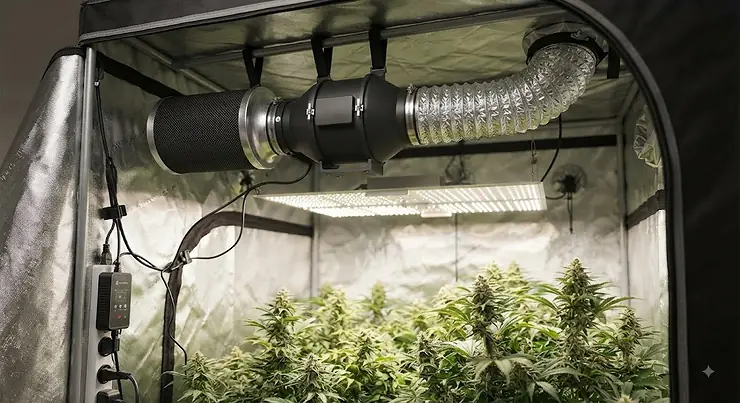
Somewhere around your third failed grow — the one where the leaves curled like a bad perm and the whole closet smelled like a hayfield fighting a skunk — you probably realized the light wasn’t the problem. The air was. An inline duct fan for grow tent ventilation is the small, cylindrical workhorse that sits in your ducting and does the unglamorous job every successful indoor garden depends on: pulling hot, stale, humid air out and making room for cooler, CO2-rich air to take its place. In plain terms, it’s a tube-shaped fan built to mount directly inside round ducting, pulling or pushing air through a carbon filter and out of an enclosed grow space rather than blowing across an open room like a box fan would.
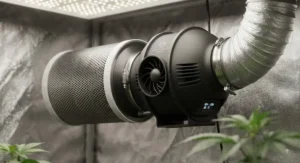
Get this one piece of equipment wrong and everything downstream suffers — mold creeps into your canopy, buds go loose and airy, and your neighbors start asking pointed questions about the smell. Get it right, and your tent practically runs itself: stable temps, tight humidity, and odor that stays exactly where it belongs. This guide walks through seven real, current-market fans across every budget, breaks down the CFM math so you’re never guessing, and answers the questions — intake vs exhaust fan, negative pressure, sizing charts — that trip up almost every first-time grower. Nothing here is a rewritten spec sheet; it’s what the numbers actually mean once that fan is bolted into your tent and running for sixteen hours straight.
Quick Comparison Table
| Fan | CFM | Best For | Price Range |
|---|---|---|---|
| AC Infinity CLOUDLINE T6 | 402 CFM | Best overall, 4×4 to 4×8 tents | $110–$140 |
| AC Infinity CLOUDLINE S6 | 351 CFM | Budget AC Infinity reliability | $70–$90 |
| iPower 6 Inch Inline Fan | 442 CFM | Best CFM-per-dollar | $45–$60 |
| Vortex Powerfan S-Line S6 | 347 CFM | Whisper-quiet premium builds | $150–$190 |
| AC Infinity CLOUDLINE T4 | 205 CFM | Small 2×2 / 2×4 tents | $70–$90 |
Notice the spread here isn’t really about who has the “biggest” fan — it’s about matching airflow to your actual tent footprint, which is where most people get it backwards. The iPower 6 Inch Inline Fan technically pushes more raw CFM than the AC Infinity CLOUDLINE T6, but it does so with a basic AC motor and no smart controls, which matters once you factor in noise and long-term reliability. If you’re running a bedroom-closet 2×2, the AC Infinity CLOUDLINE T4 will out-perform every 6-inch fan on this list simply because it’s sized correctly and won’t over-dry a tiny space.
💬 Bookmark this table — you’ll want to cross-check it against your own tent dimensions before you buy anything.
Top 7 Inline Duct Fans for Grow Tent Ventilation: Expert Analysis
1. AC Infinity CLOUDLINE T6 — smart VPD controller built in
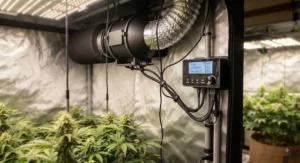
The AC Infinity CLOUDLINE T6 is the fan most experienced growers point to first, and the reason isn’t just raw airflow — it’s the fact that it manages itself. This 6-inch unit moves 402 CFM using an EC (electronically commutated) motor rather than a standard AC motor, which in practice means it sips power while still delivering strong static pressure through a carbon filter and 25 feet of ducting without stalling out. The bundled temperature-and-humidity controller reads your tent’s actual climate and automatically ramps the fan speed up or down to hit a target range, which removes the manual guesswork that trips up new growers who either run their fan too low (hello, mold) or too high (hello, wilted leaves). Based on the spec comparison against every other fan here, the T6’s mixed-flow impeller design is also what keeps it quiet at low-to-mid speeds — a genuine engineering difference, not marketing language. This is the fan for a grower who wants to set a target and walk away, particularly in a 4×4 or 4×8 tent running under high-output LEDs that generate real heat. Reviewers consistently report that the app connectivity is a nice-to-have rather than essential, but the automatic climate response is the feature people say they’d pay for again. A common thread in aggregated feedback is that the included controller reduces “chasing” temperature spikes during lights-on hours.
Pros:
- ✅ EC motor holds strong static pressure through filters and long duct runs
- ✅ Automatic temp/humidity control removes manual speed-guessing
- ✅ Quiet mixed-flow design even at higher CFM output
Cons:
- ❌ Premium price compared to basic AC-motor fans
- ❌ Smart controller adds a small learning curve for first-time setup
Expect to pay in the $110–$140 range depending on retailer promotions — a fair trade for a grower who values one less thing to babysit during flower.
2. AC Infinity CLOUDLINE S6 — same core motor, no smart controller
The AC Infinity CLOUDLINE S6 shares the same 6-inch housing and EC motor platform as its pricier sibling, but strips out the automated temperature/humidity controller in favor of a simple manual speed dial. That single change is the standout feature here: you get AC Infinity’s build quality and 351 CFM output at a meaningfully lower price point. In practice, the manual dial means you set a fan speed once — usually somewhere in the 40–60% range for a 4×4 tent — and adjust it by hand as seasons or grow stages change, rather than letting sensors do it. What most buyers overlook about this model is that the EC motor is still doing the heavy lifting on efficiency and noise reduction; you’re not sacrificing the fan’s core mechanical quality, just the automation layer wrapped around it. This makes the S6 a smart pick for growers who already own a separate environmental controller, or who simply prefer a “set it once” approach without paying for smart features they won’t use. Aggregated reviewer sentiment tends to describe the S6 as the fan people recommend to friends starting their first tent, precisely because it removes the temptation to over-tinker with settings.
Pros:
- ✅ Same EC motor efficiency as the flagship T-series at lower cost
- ✅ Simple manual dial is easy for first-time growers to understand
- ✅ Compact housing fits tight tent-top mounting spaces
Cons:
- ❌ No automatic climate response if temps spike unexpectedly
- ❌ Slightly lower CFM ceiling than the T6 for larger tents
Priced roughly $70–$90, the S6 is the value pick within the AC Infinity ecosystem for growers who don’t need the bells and whistles.
3. iPower 6 Inch Inline Fan (442 CFM) — best CFM-per-dollar
The iPower 6 Inch Inline Fan stands out for one simple reason: it delivers more raw airflow, 442 CFM, than almost anything else on this list, at a fraction of the price of the premium options. That standout feature — sheer output per dollar — comes from a straightforward centrifugal design rather than a mixed-flow EC motor, which is the honest tradeoff buyers should understand going in. The composite fan blades and center hub are engineered to cut down on vibration, and the unit ships with a grounded power cord for straightforward electrical safety in a garage or basement setup. Based on the spec comparison, this fan makes the most sense for a grower who needs to move a lot of air through a longer duct run or a warm, poorly insulated space, and who is willing to trade some quiet operation for that extra pull. It’s not a smart fan — there’s no built-in controller, so pairing it with a separate inline speed controller or thermostat is worth considering if you want more than an on/off switch. Reviewers commonly note that build quality feels utilitarian rather than premium, but that the fan simply does its job reliably across long grow cycles, which for a budget-focused buyer is really the only metric that matters.
Pros:
- ✅ 442 CFM is class-leading output for the price point
- ✅ Grounded cord and UL-listed components for basic electrical safety
- ✅ Composite blades reduce vibration versus cheaper metal-blade fans
Cons:
- ❌ No built-in speed control or smart automation
- ❌ Centrifugal motor runs louder than EC-motor alternatives
At roughly $45–$60, this is the fan to grab when your priority is pure airflow on a tight budget.
4. VIVOSUN R6 Inline Fan (390 CFM) — reliable budget workhorse with a speed dial
The VIVOSUN R6 Inline Fan carves out its niche as the dependable middle ground — 390 CFM of airflow, a variable speed controller included in the box, and a price that undercuts most of the smart-fan competition. That included speed controller is the standout feature worth expanding on: unlike the base-model iPower fan, you’re not stuck at full blast or nothing, which matters a lot when you’re trying to dial in negative pressure without over-drying young seedlings. The AC motor here won’t match an EC motor’s efficiency numbers, and here’s what the spec sheet won’t tell you: running an AC-motor fan on low can sometimes create a faint hum that’s more noticeable than a mixed-flow fan at the same output, since the underlying motor technology handles partial speeds differently. Still, for a 4×4 tent in a garage or spare room where a few extra decibels aren’t a dealbreaker, the R6 covers the fundamentals well. This is the fan for a grower who’s building their first serious setup and wants a genuine speed controller without paying AC Infinity prices. A recurring theme in aggregated review sentiment is praise for how straightforward the flange connections are, making duct and clamp installation faster than some competitors.
Pros:
- ✅ Included variable speed controller, not sold separately
- ✅ Standard 6-inch flanges fit most off-the-shelf ducting and filters
- ✅ Strong value relative to CFM output in its price class
Cons:
- ❌ AC motor runs noticeably louder than EC-motor fans on low speed
- ❌ No smart or automated climate features
Expect a price in the $45–$65 range, positioning it as one of the more complete budget kits available.
5. Vortex Powerfan S-Line S6 — whisper-quiet premium build
The Vortex Powerfan S-Line S6 earns its premium price tag through one standout trait: it’s engineered specifically to be the quietest fan in its output class, using an energy-efficient AC brushless motor paired with a patented mixed-flow dual-impeller design. Double-insulated walls and a high-impact polycarbonate casing aren’t just marketing copy — they’re the physical reason this fan runs meaningfully quieter than steel-housing alternatives at a comparable 347 CFM. Based on the spec comparison, the integrated back-draft damper is a genuinely useful detail most competitors skip: it prevents air from flowing backward through the fan when it’s off, which stops odor and cold drafts from creeping back into the tent between grow cycles. What most buyers overlook here is the 10-year warranty, which signals a level of confidence in the brushless motor’s longevity that budget AC-motor fans simply can’t match. This is squarely the fan for a grower whose tent lives in a bedroom, apartment, or shared living space where noise discretion genuinely matters more than saving fifty dollars. Aggregated reviewer sentiment consistently singles out the near-silent operation at mid speeds as the reason people justify the extra cost over cheaper 6-inch options.
Pros:
- ✅ Genuinely quieter operation than AC-motor competitors at similar CFM
- ✅ Integrated back-draft damper blocks reverse airflow when off
- ✅ 10-year warranty reflects strong build confidence
Cons:
- ❌ Highest price point among the 6-inch fans on this list
- ❌ Lower peak CFM than the iPower or AC Infinity T6 at the same duct size
Priced around $150–$190, it’s a premium buy best justified by noise-sensitive living situations.
6. Hurricane 6 Inch Inline Fan — maximum raw pull for warm rooms
The Hurricane 6 Inch Inline Fan takes a different approach entirely: a straightforward centrifugal design pushing over 430 CFM, aimed squarely at growers who need maximum air movement and don’t mind the tradeoff. That extra pull is the standout feature — centrifugal fans generate stronger static pressure than many mixed-flow designs at this price, which becomes meaningful when your ducting runs long, twists through multiple bends, or feeds through a dense carbon filter. Here’s what the spec sheet won’t tell you, but user reports suggest: centrifugal fans are inherently louder than EC-motor mixed-flow units like the CLOUDLINE or S-Line, so this isn’t the fan for a converted bedroom closet unless it’s tucked into a garage, basement, or otherwise sound-isolated space. Based on the spec comparison, the extra CFM heaadroom genuinely helps in warmer climates or during summer months when ambient room temperature is already fighting your exhaust fan’s effectiveness. This is the fan for the grower prioritizing brute-force airflow over quiet operation — someone running a detached shed, garage tent, or basement grow where a few extra decibels simply don’t register. Reviewers commonly flag the noise level directly, but pair that complaint with consistent praise for how effectively it handles heat during hot-light stretches of flower.
Pros:
- ✅ Over 430 CFM gives real headroom for long or restrictive ducting
- ✅ Strong static pressure holds up well through carbon filters
- ✅ Straightforward centrifugal design is simple to install and maintain
Cons:
- ❌ Noticeably louder than mixed-flow, EC-motor competitors
- ❌ No smart controls or included speed controller
At around $45–$60, the Hurricane is the pick for growers in sound-isolated spaces who want maximum airflow for the money.
7. AC Infinity CLOUDLINE T4 — right-sized for 2×2 and 2×4 tents
The AC Infinity CLOUDLINE T4 is the fan most guides skip because it’s not the biggest number on the spec sheet — and that’s exactly the point. At 205 CFM through a 4-inch duct, it’s purpose-built for small tents where a 6-inch fan would be genuine overkill, over-drying the space and stressing young plants with excessive negative pressure. That right-sizing is the standout feature: the same EC motor efficiency and included temperature/humidity controller from the T6 scaled down to match a 2×2 or 2×4 footprint, rather than forcing small-space growers to either underuse a 6-inch fan or settle for a cheap, uncontrolled alternative. Based on the spec comparison, the T4 runs remarkably quiet at its lowest speed — a detail that matters enormously for anyone keeping a small stealth grow in a closet or spare room. This is the fan for beginners starting with a single-plant 2×2 tent, or for anyone running a small vegetative or clone tent alongside a larger flowering space. Aggregated review sentiment describes the low-speed noise floor as close to inaudible, which reviewers consistently cite as the deciding factor over cheaper 4-inch alternatives that hum noticeably even at low settings.
Pros:
- ✅ Correctly sized airflow prevents over-drying small tents
- ✅ Same smart controller and EC motor efficiency as the larger T6
- ✅ Exceptionally quiet at low speeds, ideal for shared living spaces
Cons:
- ❌ Insufficient CFM for anything larger than a 2×4 tent
- ❌ Smaller flange size limits ducting and filter compatibility options
Priced around $70–$90, the T4 proves that “bigger fan” isn’t always the right upgrade.
Practical Usage Guide: Setup, First 30 Days, and Common Mistakes
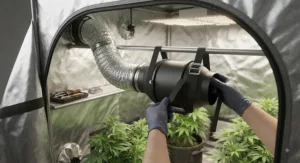
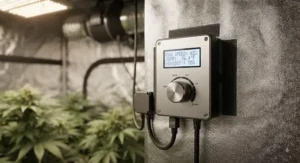
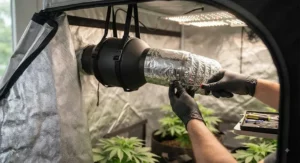
Getting an inline duct fan for grow tent ventilation installed correctly on day one saves you weeks of troubleshooting later. Start by mounting the carbon filter inside the tent near the top, then connect your fan directly to the filter’s outlet — always pull air through the filter rather than pushing it, since air scrubbed of odor compounds before it reaches the fan controls smell far more reliably than the reverse setup. Duct the fan’s exhaust out through a tent port and away from the room, keeping the run as short and straight as possible; every 90-degree bend in flexible ducting costs you measurable static pressure, which is why a fan rated for 400 CFM in a lab test might only deliver 300 effective CFM once it’s fighting three bends and a filter.
During the first 30 days, resist the urge to run your fan at maximum speed around the clock. New growers frequently overcorrect for humidity by cranking the fan to 100%, which can crash relative humidity below 40% and stress seedlings or clones that need a more humid environment to establish roots. Instead, start around 30–40% speed and adjust upward gradually as plants mature and transpire more moisture. Check your ducting connections weekly for the first month — clamps loosen as flexible ducting settles, and a gap here silently kills your negative pressure without any obvious symptom besides a faint smell escaping the tent. Wipe down the fan’s intake grille every two weeks; dust buildup on the blades is one of the most common causes of gradually declining CFM that growers mistake for fan failure.
Problem → Solution: Fixing the Five Most Common Ventilation Issues
Even with the right inline duct fan for grow tent ventilation installed, specific problems show up predictably across almost every grow. Here’s how to diagnose and fix the five that come up most often.
Problem: Tent walls are puffing outward instead of sucking in. This means your intake airflow exceeds your exhaust, creating positive pressure that pushes odor and humidity out through every seam. Solution: either add a carbon filter and step up your exhaust fan’s speed, or reduce airflow at any active intake fan until the tent visibly draws inward when you crack a zipper.
Problem: Temperature keeps climbing above 80°F despite the fan running. Your exhaust CFM likely can’t keep pace with the heat output of your lights. Solution: check whether ducting bends or filter resistance are choking effective airflow, and consider stepping up to a higher-CFM fan like the iPower 6 Inch Inline Fan or Hurricane 6 Inch Inline Fan if your current unit is maxed out.
Problem: Odor is escaping the tent despite a carbon filter. Usually a sizing mismatch — the filter’s flange doesn’t match the fan’s diameter, creating a bypass gap, or negative pressure isn’t strong enough to force all air through the filter media. Solution: match filter and fan diameters exactly and verify negative pressure with the zipper-pinch test.
Problem: Fan noise has increased noticeably over time. Dust accumulation on the impeller blades throws off balance and increases vibration. Solution: unplug the fan, remove the housing per the manufacturer’s instructions, and gently clean the blades with a dry brush.
Problem: Humidity won’t drop below 65% during flower. Your air exchange rate is too low for the moisture your plants are transpiring. Solution: increase fan speed incrementally, or add a dehumidifier if you’ve already maxed out your fan’s output relative to tent size.
Grow Tent Airflow Requirements: How Much CFM Do You Actually Need?
Grow tent airflow requirements come down to one core relationship: the volume of air in your tent versus how many times per minute you want that air completely replaced. Skipping this math is the single most common reason growers either buy an underpowered fan that can’t control heat, or an oversized fan that dries out their space and wastes electricity. Here’s how to think about it step by step:
- Calculate your tent’s volume in cubic feet — multiply length × width × height. A standard 4x4x6.5 tent works out to roughly 104 cubic feet.
- Decide your target air exchange rate — most indoor grows aim to fully replace the tent’s air every 1 to 3 minutes, which is far more frequent than typical residential ACH standards because grow tents deal with concentrated heat, humidity, and CO2 depletion.
- Divide tent volume by your target exchange time in minutes — a 104 cubic-foot tent exchanged every minute needs a fan rated at least 104 CFM before any losses.
- Add 25–35% headroom for filter and ducting resistance — carbon filters and bent flexible ducting both reduce a fan’s real-world output well below its rated CFM, so buying “just enough” fan on paper often leaves you short in practice.
- Factor in your grow light’s heat output — high-intensity LEDs or HPS fixtures push more heat into the tent, which pushes your effective CFM needs upward regardless of tent volume alone.
- Check your climate and room conditions — a tent in a hot attic or an already-humid basement needs airflow on the higher end of any calculated range.
- Round up to the nearest common fan size — it’s almost always better to buy a slightly larger fan and run it at partial speed than to buy exactly what the math says and have zero headroom.
The EPA notes that indoor carbon dioxide concentrations are a useful indicator of ventilation adequacy, which is worth understanding even outside a commercial building context — a grow tent that isn’t exchanging air fast enough will show the same telltale signs of stagnant air that poorly ventilated offices do, just with plants instead of people as the ones suffering.
CFM Calculator for Grow Tents: The Simple Formula
If you want a genuine CFM calculator for grow tents without downloading an app, the formula is straightforward and you can run it on your phone’s calculator in under a minute:
CFM needed = (Tent Length × Width × Height in feet) ÷ Desired exchange time in minutes
For a real-world example: a 5x5x7 tent has a volume of 175 cubic feet. If you want the air fully exchanged every 2 minutes — a reasonable target for a mature flowering canopy under strong lighting — you’d divide 175 by 2, landing on roughly 88 CFM as your absolute floor. Add the recommended 25–35% buffer for filter and duct resistance, and you land closer to 115–120 CFM as your realistic minimum. From there, most growers round up to whatever standard fan size clears that number comfortably at partial speed, since running a fan near its maximum constantly shortens its lifespan and adds unnecessary noise.
This same underlying logic is what HVAC engineers call the air change rate — described in more technical detail on Wikipedia’s air changes per hour page — the number of times a space’s total air volume is completely removed and replaced within a given period. Grow tents just compress that same math into minutes instead of hours because the environment inside is so much more concentrated than an average room.
✨ Don’t Miss These Exclusive Deals!
🔍 Take your grow tent ventilation to the next level with these carefully selected fans. Click on any highlighted pick above to check current pricing and availability. The right airflow setup will help you create a stable, healthy environment your plants — and your neighbors’ noses — will thank you for.
Exhaust Fan for Indoor Garden: Why It’s the Backbone of Your Setup
An exhaust fan for indoor garden ventilation does more heavy lifting than any other single piece of equipment in a tent, which surprises a lot of growers who spend most of their budget on lighting instead. Here’s what the spec sheet won’t tell you: your grow light could be perfectly calibrated, your nutrients dialed to the milliliter, and your genetics excellent — and none of it matters if hot, stagnant, CO2-depleted air sits around your canopy because the exhaust fan is undersized or poorly placed. In practice, the exhaust fan performs three jobs simultaneously: pulling heat away from grow lights that would otherwise cook the upper canopy, removing humid air that plants transpire so mold and mildew can’t establish, and constantly replenishing CO2 levels that photosynthesis draws down inside a sealed tent.
Placement matters as much as fan choice. Mounting the exhaust fan near the top of the tent takes advantage of the fact that hot air naturally rises, so you’re removing the warmest, most humid air first rather than fighting against convection. Reviewers and growers alike consistently note that fans placed outside the tent on the exhaust side — rather than inside, taking up canopy space — run quieter from the grower’s perspective and generate less heat inside the grow space itself, since the motor’s own waste heat stays outside the tent walls.
Tent Size CFM Chart: Matching Fan to Footprint
This tent size CFM chart gives you a fast reference point before diving into detailed calculations — cross-check it against the math above if your tent has unusual proportions or you’re running unusually hot lighting.
| Tent Size | Recommended Fan Diameter | Minimum CFM |
|---|---|---|
| 2×2 (24″x24″) | 4-inch | 130–150 CFM |
| 2×4 (24″x48″) | 4-inch | 205 CFM |
| 3×3 (36″x36″) | 4-inch to 6-inch | 150–200 CFM |
| 4×4 (48″x48″) | 6-inch | 400 CFM |
| 4×8 (48″x96″) | 6-inch (high) or dual 6-inch | 500–800 CFM |
| 5×5 or larger | 8-inch | 700+ CFM |
Looking at this chart, the jump from a 4×4 to a 4×8 tent isn’t linear — you’re not just doubling CFM, you’re often better off running dual fans or stepping up to an 8-inch unit entirely, since a single 6-inch fan pushed to its absolute ceiling loses efficiency and runs loud. Growers with a 5×5 or larger footprint should treat the Vortex Powerfans VTX Series and similar 8-inch-and-up options as the realistic starting point rather than trying to make a 6-inch fan stretch further than it comfortably can.
Negative Pressure Ventilation: The Secret to Odor Control
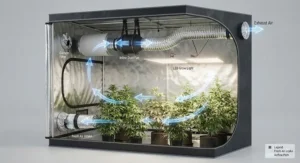
Negative pressure ventilation is the single concept that separates a grow tent that smells like nothing from one that gets your neighbors talking. The principle is simple: your exhaust fan removes more air from the tent than enters through intake, creating a slight vacuum that pulls air inward through every seam, zipper, and gap rather than pushing it outward. Reviewers consistently note the quickest way to verify it’s working — pinch a tent zipper flap while your fan runs; if it pulls inward and the tent walls bow slightly toward the center, you’ve got negative pressure dialed in correctly.
Achieving this balance means either running a purely passive intake (an open vent with no fan, sized generously enough not to restrict your exhaust fan’s pull) or, if using an active intake fan, keeping its CFM rating meaningfully lower than your exhaust fan’s output — a common target is intake running around 80% of exhaust capacity. Carbon filters play a supporting role here too, since indoor air quality guidance generally treats filtration and adequate air exchange as working together rather than as substitutes for one another. The filter itself relies on activated carbon, a material with an enormous internal surface area that adsorbs odor-causing volatile compounds as air passes through — which is exactly why filter and fan diameter need to match precisely, so every cubic foot of exhausted air is actually forced through the carbon bed rather than slipping around it.
How to Choose an Inline Duct Fan for Grow Tent Ventilation
- Start with your tent’s cubic footage, not the fan’s marketing CFM number. Work backward from the calculator above rather than picking whatever fan looks the most powerful on the box.
- Decide how much noise you can tolerate. A bedroom or apartment grow calls for an EC-motor fan like the AC Infinity CLOUDLINE T6 or Vortex Powerfan S-Line S6; a garage or basement gives you room to consider louder, cheaper centrifugal options.
- Match the fan’s duct diameter to your existing filter and ducting. Mismatched diameters create airflow bypass that quietly undermines odor control no matter how strong your fan is.
- Decide whether you want automated climate control. Smart controllers cost more upfront but save you from manually adjusting speed every time conditions shift.
- Check the motor type. EC motors run quieter and more efficiently across a range of speeds; AC motors are cheaper but noisier, especially at partial speed.
- Add headroom for future growth. If you might upgrade lighting or tent size within a year or two, sizing slightly larger now avoids a second purchase later.
- Verify the warranty and build materials. Steel or polycarbonate housings with sealed bearings tend to outlast thin-gauge plastic fans running continuously for months at a time.
Common Mistakes When Buying an Inline Duct Fan
The most common mistake is buying based purely on the largest CFM number available, without accounting for real-world losses from ducting bends and filter resistance — a fan rated at 400 CFM in ideal lab conditions might deliver closer to 280–300 CFM once it’s connected to your actual setup. A close second is ignoring noise ratings entirely, then being surprised when a centrifugal fan running at full speed in a bedroom closet sounds like a small appliance running around the clock. Growers also frequently mismatch fan and filter diameters, assuming any 6-inch fan will work with any 6-inch filter regardless of brand — flange depth and mounting hardware can differ enough to create air leaks at the connection point. Another frequent misstep is underestimating how much a fan’s effective output degrades over a long duct run with multiple bends, leading to a fan that seemed correctly sized on paper but struggles in practice. Finally, many first-time buyers skip a speed controller entirely to save money, then find themselves stuck between a fan that’s either too aggressive for seedlings or too weak for a mature flowering canopy, with no way to adjust between the two.
Inline Duct Fans vs Box Fans and Passive Vents
Comparing an inline duct fan for grow tent ventilation against a simple box fan or passive vent setup reveals why dedicated equipment earns its keep. A box fan circulates air within a room but can’t create the directional, filtered exhaust that pulls heat, humidity, and odor completely out of a sealed tent — it moves air around rather than replacing it. Passive vents alone, without any powered exhaust, rely entirely on ambient pressure differences and convection, which works only in extremely low-heat setups like a small clone tent with no active lighting heat load to manage. An inline duct fan paired with a carbon filter solves both limitations at once: it creates measurable negative pressure, forces all exhausted air through odor-scrubbing media, and gives you precise, adjustable control over your exchange rate rather than hoping ambient airflow happens to be sufficient.
| Method | Odor Control | Heat Management | Best For |
|---|---|---|---|
| Inline Duct Fan + Filter | Excellent | Excellent | Any sealed grow tent |
| Box Fan (no ducting) | Poor | Fair | Open-room circulation only |
| Passive Vent Only | None | Poor | Tiny, low-heat clone tents |
The takeaway from this comparison is straightforward: once a tent is fully zipped and running real lighting, a box fan or passive-only setup simply can’t replicate what a properly sized inline fan and filter combination delivers, no matter how it’s positioned inside the space.
Long-Term Cost & Maintenance
Thinking about total cost of ownership rather than just the sticker price changes which fan actually makes financial sense. An EC-motor fan like the AC Infinity CLOUDLINE T6 costs more upfront, but its efficient motor draws meaningfully less electricity over a 24/7 duty cycle across a multi-month flowering run, which can offset a good portion of that price gap by the time you’re a year or two into ownership. Cheaper AC-motor fans like the VIVOSUN R6 or iPower 6 Inch Inline Fan cost less initially and are simple to repair or replace if something fails, since the components are widely available and less specialized. Maintenance costs are relatively low across the board — an occasional dust wipe-down and periodic carbon filter replacement (typically every 6–12 months depending on use) — but fans running constantly at maximum speed tend to wear bearings faster than those with a variable controller allowing them to idle at a lower, sufficient speed most of the time. Factoring in a filter’s lifespan alongside the fan itself gives a more complete picture: a well-matched fan-and-filter pairing that maintains proper negative pressure will typically outlast a mismatched, overworked setup by a meaningful margin, simply because neither component is being pushed harder than necessary to compensate for the other’s shortcomings.
FAQ
❓ What size inline fan do I need for a 4x4 grow tent?
❓ Should the inline fan pull or push air through the carbon filter?
❓ How loud is too loud for a bedroom grow tent?
❓ Can I use an inline duct fan without a carbon filter?
❓ How often should I replace my grow tent's carbon filter?
Conclusion
Choosing the right inline duct fan for grow tent ventilation really comes down to matching real numbers — your tent’s cubic footage, your noise tolerance, your budget — against what each fan actually delivers once ducting and filters are factored in, rather than chasing the biggest CFM figure on the box. The AC Infinity CLOUDLINE T6 remains the strongest all-around pick for growers who want automated climate control and don’t mind paying for it, while the iPower 6 Inch Inline Fan and VIVOSUN R6 prove that solid, reliable airflow doesn’t require a premium price tag. For noise-sensitive spaces, the Vortex Powerfan S-Line S6 justifies its cost through genuinely quieter operation, and smaller tents are far better served by a right-sized option like the AC Infinity CLOUDLINE T4 than by an oversized 6-inch fan running at a fraction of its capacity. Whichever fan you land on, the fundamentals matter more than the brand name: calculate your CFM needs honestly, maintain negative pressure, match your filter diameter exactly, and keep an eye on ducting connections as your setup ages. Do those four things consistently, and the equipment differences between these seven fans become far less dramatic than the difference between a tent that’s properly ventilated and one that isn’t.
Recommended for You
- 7 Best inline fan with carbon filter combo kit Picks (2026)
- Inline Fan and Filter Combo: 7 Top Picks for 2026
- Grow Tent for Vegetables: 7 Best Picks for 2026
Disclaimer: This article contains affiliate links. As an Amazon Associate, I earn from qualifying purchases. If you purchase products through these links, we may earn a small commission at no additional cost to you.
✨ Found this helpful? Share it with your friends! 💬🤗
