
In This Article
Nobody warns you about this when you buy a house: somewhere in your attic, a length of flexible duct is quietly sabotaging your bathroom. You run the fan, the mirror still fogs, and fifteen minutes later the ceiling paint above the shower still looks like it’s sweating. That’s usually not a broken fan. It’s a starved one — a perfectly good exhaust fan trying to push air through 20, 30, sometimes 40 feet of duct with nothing helping it along the way. A 4 inch inline booster fan for bathroom exhaust is the fix nobody tells you to look for, because it doesn’t replace your ceiling fan, it just gives it the shove it’s been missing.
Here’s the good news: this isn’t a $2,000 HVAC problem. It’s a $30-to-$120 part that mounts inline, in the duct run itself, and does one job — move more air, faster, so moisture actually leaves the building instead of lingering in your walls. According to the EPA’s guidance on controlling household moisture, exhaust fans that vent to the outside are one of the primary defenses against mold, and a fan that can’t actually push air past a long, kinked, or undersized duct run isn’t really doing that job at all.
Below, we’ve dug into seven real inline booster fans on the market right now, broken down what their specs actually mean for a steamy bathroom (not a grow tent, where most of these get marketed), and built out a full buying and installation guide so you’re not guessing. Let’s get your bathroom actually dry.
What Is a 4 Inch Inline Booster Fan for Bathroom Exhaust?
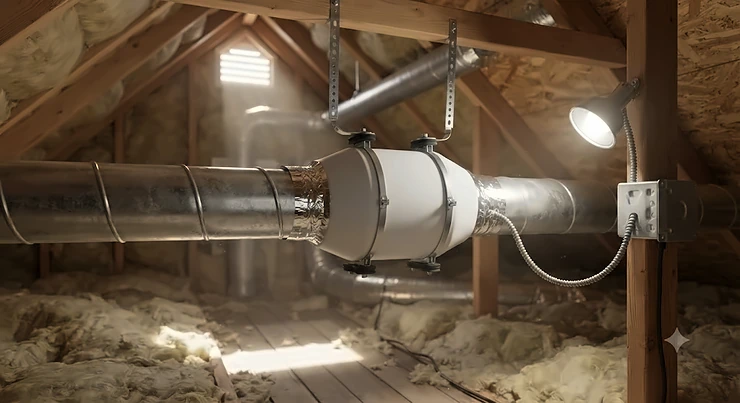
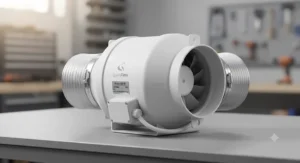
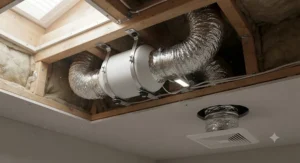
A 4 inch inline booster fan for bathroom exhaust is a small electric fan that mounts directly inside 4-inch round ductwork — usually in the attic, between your ceiling exhaust fan and the roof or wall vent — to add extra push when the existing fan can’t overcome duct length, bends, or resistance on its own. Instead of replacing the bathroom fan, it works alongside it, restoring airflow that friction and distance would otherwise cancel out.
Quick Comparison Table
| Fan | Airflow | Noise | Best For |
|---|---|---|---|
| AC Infinity CLOUDLINE S4 | 205 CFM | 28 dBA | Quietest all-around upgrade |
| AC Infinity RAXIAL S4 | Pressure-activated | Low | Hands-free automatic boost |
| Suncourt Inductor DB204C | 65-80 CFM | 52 dBA | Simple, USA-built budget pick |
| iPower 4″ Inline Duct Fan | 100 CFM | Low-moderate | Tightest budget |
| VIVOSUN AeroZesh S4 | 208 CFM | ~28 dB | High airflow with speed control |
| Hon&Guan 4″ Booster w/ Controller | 130 CFM | 26 dBA | Best value with dial control |
| VENTS-US TT PRO 100 | 210 CFM | Moderate | Energy Star, long duct runs |
Looking at the spread here, airflow alone doesn’t tell the whole story — a 65 CFM Suncourt Inductor DB204C can outperform a “bigger” number on paper if your duct run is short, while the 208-210 CFM fans from VIVOSUN and VENTS-US earn their keep on runs stretching past 25 feet. Noise matters just as much as CFM here, since a booster fan that runs continuously (as many bathroom setups require) needs to disappear into the background, which is exactly where the EC-motor models pull ahead of the older single-speed designs.
💬 Bookmark this comparison — you’ll want it again once you start measuring your own duct ru
Top 7 4 Inch Inline Booster Fans for Bathroom Exhaust: Expert Analysis
1. AC Infinity CLOUDLINE S4 — quietest EC-motor pick with 10-speed control
The CLOUDLINE S4 is the fan you buy when you’ve decided silence matters more than saving twenty bucks. Its PWM-controlled EC motor rates at 205 CFM and 28 dBA, and that noise figure is the real headline: most cheap single-speed inline fans run somewhere between 45 and 55 dBA, which is loud enough to notice through a ceiling. Based on the spec comparison, the mixed-flow design with dual hydrodynamic wind circles is what lets it hold airflow even against the static pressure of a long, bent duct run — a problem that kills performance on cheaper axial fans. The 10-speed wired controller means you can dial it down to a whisper for daily use and crank it up after a long shower.
Reviewers across major retail platforms consistently single out how little you notice it running, with common feedback that it’s mounted and forgotten rather than fought with. The dual ball bearings, rated for 67,000 hours, and IP44 rating for dust and light moisture resistance back up long-term reliability claims in an attic environment where humidity swings are constant.
Pros:
- ✅ Genuinely quiet even at higher speeds
- ✅ 10-speed control adapts to any bathroom size
- ✅ IP44-rated for humid attic installations
Cons:
- ❌ Costs more than basic single-speed fans
- ❌ Wired controller adds an extra install step
Expect to pay in the mid-$70 to $100 range depending on retailer; check current price before buying, since ventilation fan pricing shifts often. For anyone tired of fan noise being the reason they skip turning it on, this is the value verdict: worth the premium.
2. AC Infinity RAXIAL S4 — auto-activates via built-in pressure switch
The RAXIAL S4 solves a completely different problem than raw airflow: forgetting to turn the booster on in the first place. It uses a differential pressure switch that senses when your bathroom fan or HVAC system is actively pulling air, then kicks the booster on automatically, no separate switch or timer required. What most buyers overlook about this model is that “automatic” isn’t just a convenience feature — it’s what actually gets a booster fan used consistently, since a manual switch mounted in an attic is a switch nobody remembers to flip.
The mixed-flow EC motor and PWM control carry over from AC Infinity’s CLOUDLINE line, so noise and efficiency stay in the same quiet territory. It mounts in any orientation, which matters in cramped attic spaces where a horizontal-only fan simply won’t fit the available duct run.
Pros:
- ✅ Fully automatic — no manual switch to forget
- ✅ Mounts in any orientation for tight attics
- ✅ Shares AC Infinity’s quiet EC-motor design
Cons:
- ❌ Pressure-switch sensitivity can need fine-tuning
- ❌ Premium pricing versus manual-only models
Price sits in the $70-$100 range at the time of research. If you’ve ever installed a booster fan and then realized six months later the switch was still off, this is the fix — the value here is behavioral, not just mechanical.
3. Suncourt Inductor DB204C — simplest, USA-assembled budget fan
Suncourt has been building these since 1988, and the Suncourt Inductor DB204C hasn’t strayed far from that original formula: a single-speed, corded, no-frills booster rated at 65 CFM free air and up to 80 CFM boosted, with a 52 dBA noise level. Here’s what to weigh: this isn’t the fan for a long, twisting duct run or a large bathroom, but for shorter runs under 15 feet, that airflow is genuinely enough to notice a difference within days.
The galvanized steel housing and MET-listed safety certification (to UL 1995) reflect its HVAC-industry roots more than a grow-tent marketing angle, which shows in the plain, functional design. Reviewers on retailer sites are split along a predictable line — people using it on short runs report solid improvement, while a smaller group expecting it to overcome heavy resistance or long ducting come away disappointed, which tracks with its modest CFM rating.
Pros:
- ✅ Assembled in the USA since 1988
- ✅ Simple plug-and-play install, no wiring
- ✅ MET-listed for safety compliance
Cons:
- ❌ Single speed only, no adjustment
- ❌ Underpowered for long or high-resistance duct runs
Priced around $30-$40, this is the budget-conscious pick — just match your expectations to a shorter duct run, and the value holds up.
4. iPower 4 Inch Inline Duct Fan — lowest cost complete kit
At right around $20-$25, the iPower 4 Inch Inline Duct Fan is the true entry point into duct boosting. Rated at 100 CFM with a 12W motor and a 5.5-foot grounded cord, it’s built for straightforward bathroom, attic, or basement duty rather than anything demanding. Independent research into aggregated customer sentiment shows this model carrying a notably high average rating across thousands of verified reviews, with quiet operation cited again and again as the standout trait for a fan in this price bracket.
The trade-off is durability expectations: this is a lightweight plastic-housed unit, not a heavy-duty steel one, so it suits occasional-to-moderate bathroom use rather than commercial-grade continuous running. On paper this means it’s best matched to smaller bathrooms with shorter duct runs where 100 CFM is plenty.
Pros:
- ✅ Lowest price point of any fan on this list
- ✅ Strong aggregated review sentiment on noise
- ✅ Complete kit, no extra parts needed
Cons:
- ❌ Plastic housing feels less durable long-term
- ❌ No speed control included
For anyone testing whether a booster fan will even solve their problem before spending more, this is the low-risk way to find out.
5. VIVOSUN AeroZesh S4 — highest airflow with dial-in control
The VIVOSUN AeroZesh S4 pushes 208 CFM, edging out even the premium AC Infinity option on raw numbers, while staying in a comparable roughly-28-dB noise band thanks to its PWM-controlled speed controller. Reviewers consistently note that the flow deflector design is what tames what could otherwise be a noisy, turbulent airstream at this CFM level — cutting the raw output down to something livable for daily use.
What most buyers overlook about high-CFM fans generally is that more airflow only helps if your duct run and register size can actually handle it; undersized ducting paired with an 208 CFM fan can create excess noise without a proportional airflow gain. For anyone with a bathroom duct run pushing 25 feet or more, though, that airflow ceiling matters, and this fan gives you real headroom other models on this list don’t.
Pros:
- ✅ Among the highest CFM ratings in this class
- ✅ Included speed controller for fine adjustment
- ✅ Flow deflector reduces turbulence noise
Cons:
- ❌ Reported reliability concerns with plastic components in some reviews
- ❌ Best paired with a properly sized duct run to avoid wasted noise
Expect a price in the $70-$90 range. If long ductwork is your specific problem, the value case here is straightforward: buy the CFM headroom once instead of upgrading twice.
6. Hon&Guan 4 Inch Inline Booster Duct Fan — best value with included controller
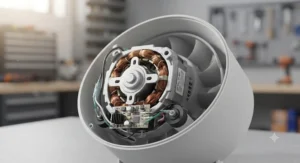
The Hon&Guan 4 Inch Inline Booster Duct Fan rates at 130 CFM while drawing just 6 watts, and ships with a variable speed controller included in the box — a feature some competitors charge extra for or omit entirely. The 26 dBA noise rating is competitive even against premium options, and reviewers frequently mention the mounting feet, which allow both vertical and horizontal installation, as genuinely useful in cramped attic spaces where duct orientation isn’t always predictable.
Here’s what the spec sheet won’t tell you, but user reports suggest: the included controller’s dial has occasionally been flagged as the weak point over long-term use, though the fan motor itself tends to outlast it. That’s a common trade-off at this price tier — you’re getting premium-adjacent features on a mid-range budget, with slightly less certainty about long-haul component life.
Pros:
- ✅ Speed controller included at no extra cost
- ✅ Ultra-low 6W power draw
- ✅ Mounting feet for flexible orientation
Cons:
- ❌ Controller durability questioned in some long-term reviews
- ❌ Plastic housing, not metal
Priced around $35-$50, this lands squarely as the best value pick for buyers who want adjustable speed without paying premium-brand prices.
7. VENTS-US TT PRO 100 — Energy Star-rated for long duct runs
The VENTS-US TT PRO 100 brings a 210 CFM mixed-flow design and Energy Star certification to the table, positioning it as the pick for buyers who want efficiency credentials alongside raw output. Sold through major retailers like Home Depot, it’s built for the kind of sustained, higher-resistance airflow that a mixed-flow impeller handles better than a simple axial blade — the same engineering principle that makes AC Infinity’s line stand out, applied at a more accessible price.
Based on the spec comparison, this fan slots in as a mid-range workhorse: not the quietest, not the cheapest, but arguably the most balanced choice for a bathroom with a genuinely long or convoluted duct run where both airflow and efficiency certification matter to a buyer thinking about utility costs over years, not months.
Pros:
- ✅ Energy Star certified for efficiency
- ✅ Mixed-flow design suited to long duct runs
- ✅ 210 CFM among the highest on this list
Cons:
- ❌ Noise level higher than EC-motor competitors
- ❌ Less brand-name recognition than AC Infinity or VIVOSUN
Priced in the $50-$70 range at most retailers, this is the practical middle-ground pick when both airflow and energy costs are on your mind.
✨ Don’t Miss These Exclusive Deals!
Take your bathroom exhaust setup to the next level with one of these carefully researched picks. Click through to check current pricing and availability, and give your bathroom the moisture control it’s been missing!
Practical Installation Guide: Setting Up Your Inline Booster Fan
Getting a booster fan into the duct run correctly is most of the battle — a great fan installed backward or mid-bend performs worse than a mediocre one installed right. Start by locating the fan as close to the midpoint of the duct run as physically possible; mounting it too close to either end reduces its ability to smooth airflow across the whole length. Cut the duct cleanly, slide the fan’s crimped ends into the existing flex or rigid duct, and secure every joint with metal foil tape rather than standard cloth duct tape, which degrades in attic heat over time.
Check the airflow arrow molded into the fan housing before final assembly — installing it backward is the single most common mistake in the first 30 days, and it’s an easy one to miss in a dim attic. Once mounted, support the fan’s weight independently of the ductwork itself using a strap or bracket; ductwork alone often can’t bear the extra weight long-term without sagging. Finally, test the full run before closing anything up: run your bathroom fan, then the booster, and confirm you feel steady airflow at the exterior vent cap, not just inside the attic.
Real-World Scenarios: Which Fan Fits Your Bathroom
Picture a young couple in a 1960s ranch house with a bathroom fan venting nearly 30 feet through the attic to a gable vent, with two 90-degree bends along the way. Their ceiling fan alone barely stirs the air. For this setup, the higher-CFM options — the VIVOSUN AeroZesh S4 or VENTS-US TT PRO 100 — make the most sense, since the extra airflow is specifically designed to overcome that kind of resistance.
Now picture a renter in a small apartment bathroom, duct run under 10 feet, straight shot to an exterior wall. Overbuying CFM here just adds noise for no benefit; the Suncourt Inductor DB204C or iPower 4 Inch Inline Duct Fan covers the need without overspending.
Finally, consider a homeowner who’s tech-comfortable, values a quiet bathroom above all else, and doesn’t want to remember to flip a switch every time someone showers. That’s the exact profile the AC Infinity RAXIAL S4 was built for — automatic activation paired with the quiet EC-motor engineering AC Infinity is known for.
Problem → Solution: Common Bathroom Ventilation Issues
Persistent mirror fog long after a shower usually points to insufficient CFM for the room’s square footage — the fix is checking your fan’s rated airflow against the room size, then adding a booster like the Hon&Guan 4 Inch Inline Booster Duct Fan if the numbers fall short. Musty odors that linger point toward a duct run that’s too long or too kinked for the existing fan to clear efficiently; a higher-CFM booster fan positioned at the run’s midpoint directly addresses this.
A booster fan that runs but seems to do nothing often means the ductwork itself is crushed, disconnected, or vented into an unconditioned attic space instead of outdoors — which the EPA specifically warns against since venting moisture into an attic just relocates the mold risk rather than solving it. And a booster fan that’s simply too loud to use regularly is often solved by swapping to an EC-motor model like the AC Infinity CLOUDLINE S4, since motor type — not just brand — drives most of the noise difference between models.
How to Choose a 4 Inch Inline Booster Fan for Bathroom Exhaust
- Measure your duct run first. A run under 15 feet rarely needs more than 80-100 CFM; runs past 25 feet benefit from 200+ CFM models like the VIVOSUN AeroZesh S4.
- Count the bends. Every 90-degree elbow adds resistance roughly equivalent to several extra feet of straight duct — factor this in before assuming your run is “short.”
- Decide how much noise you can live with daily. EC-motor fans run quieter at comparable CFM than older axial designs, which matters most if the fan runs continuously.
- Check for a speed controller. Fixed-speed fans are simpler but less adaptable; a controller lets you match output to the moment rather than running max speed constantly.
- Confirm your existing duct size. A 4-inch booster only helps a 4-inch run — mismatched sizing wastes the upgrade entirely.
- Weigh automatic activation. If you know you’ll forget a manual switch, the AC Infinity RAXIAL S4‘s pressure-triggered design solves that specific failure point.
- Match budget to actual need. Buying 210 CFM for a 10-foot run wastes money; buying 65 CFM for a 35-foot run wastes your time.
Common Mistakes When Buying a Bathroom Vent Booster Fan
The most frequent mistake is buying based on CFM alone without measuring the duct run — a high-CFM fan crammed into a short, low-resistance run often just adds unnecessary noise rather than meaningful airflow gains. A close second is skipping the noise rating entirely; a fan that’s technically powerful but loud enough to discourage daily use defeats its own purpose, since ASHRAE ventilation guidance referenced by the EPA recommends continuous, not occasional, exhaust for effective moisture control.
A third common misstep is mounting the fan in the wrong orientation relative to airflow direction, which can actually work against the existing bathroom fan rather than assisting it. And a fourth — often the most expensive one — is choosing a fan without checking whether the ductwork itself is intact; even the best booster fan can’t compensate for a disconnected or crushed duct section hiding in the attic.
Inline Booster Fan vs Traditional Bathroom Exhaust Fan
| Factor | Inline Booster Fan | Traditional Ceiling Exhaust Fan |
|---|---|---|
| Installation location | Mid-duct, usually in attic | Ceiling, directly in bathroom |
| Noise in-room | Minimal — fan is remote from living space | Noticeable, motor is overhead |
| Fixes long duct runs | Yes — this is its specific purpose | Often no, regardless of fan quality |
| Replaces existing fan | No, works alongside it | N/A — is the primary fan |
The core distinction here is purpose, not competition: a traditional ceiling fan generates suction at the room, while a booster fan like the AC Infinity CLOUDLINE S4 solves the problem of that suction losing steam over distance. Homes with short, straight duct runs may never need a booster at all, but anyone with an attic run over 20 feet, several bends, or an older, undersized duct is fighting physics that a stronger ceiling fan alone often can’t fix. Choosing between them isn’t really an either-or question — it’s recognizing which one your specific duct layout is actually missing.
What to Expect: Real-World Performance
In practice, a well-matched inline booster fan should noticeably shorten how long it takes mirror fog to clear — often from ten-plus minutes down to two or three — and that difference is usually apparent within the first week of use. Musty, lingering bathroom odor after showers, a common complaint in older homes, typically fades within days of adding a properly sized booster, assuming the ductwork itself is sound. What you shouldn’t expect is a silent transformation if you chose a high-CFM fan without checking noise ratings first — that trade-off shows up immediately, not months later. Reviewers across the models above consistently describe a “why didn’t I do this sooner” reaction once airflow is actually restored to where it should have been all along.
Bathroom Exhaust Duct Length and Why It Matters for Airflow
Bathroom exhaust duct length is arguably the single biggest hidden factor in whether any fan — booster or otherwise — actually performs as advertised. Every foot of ductwork adds friction, and every bend adds resistance roughly equivalent to several additional feet of straight run. A fan rated at 100 CFM in a lab test using a few feet of straight pipe can deliver dramatically less real airflow once it’s pushing air through 25 feet of flexible duct with two elbows in an attic.
This is precisely why measuring your actual duct length before choosing a fan matters more than chasing the highest CFM number on the shelf. Homes built before the 1990s, in particular, often have longer-than-ideal runs because the bathroom wasn’t planned with ventilation efficiency in mind — the duct simply follows whatever path was easiest during original construction. If your duct run exceeds 25 feet or includes multiple turns, prioritize the higher-CFM options on this list, like the VIVOSUN AeroZesh S4 or VENTS-US TT PRO 100, since their extra headroom exists specifically to survive that friction loss.
Long-Term Cost & Maintenance
Most 4-inch inline booster fans draw remarkably little power — the Hon&Guan 4 Inch Inline Booster Duct Fan, for example, pulls just 6 watts, which translates to only a few dollars a year in electricity even running continuously. The real long-term cost consideration is maintenance access: fans mounted in tight attic spots without a service loop of duct nearby become a headache the day the impeller needs cleaning of dust and lint buildup.
Budget for an annual visual inspection — pull back attic insulation near the fan, check that connections are still taped and sealed, and listen for any new rattling that suggests bearing wear. EC-motor fans like the AC Infinity CLOUDLINE S4, rated for tens of thousands of hours on their bearings, tend to need far less attention over a five-year span than older single-speed axial designs, which is worth factoring into the sticker-price comparison rather than judging purely on upfront cost.
Inline Fan Installation in Attic: What You Need to Know
Attic installation introduces its own set of considerations beyond the basic mounting steps. Attics swing between extreme heat in summer and near-freezing cold in winter, and humidity levels fluctuate constantly — which is exactly why fans with an IP-rated housing, like the AC Infinity CLOUDLINE S4‘s IP44 rating, hold up better long-term than unrated alternatives in this specific environment.
Access matters just as much as the fan itself: plan the installation location so a technician (or future you) can actually reach it without crawling across joists blind. Route the power cord along a joist rather than leaving it draped across insulation, both for safety and to avoid it degrading against exposed fiberglass over time. And always confirm the duct still terminates outdoors, not into open attic space — venting warm, moist bathroom air into an unconditioned attic is a well-documented cause of hidden mold growth in roof sheathing, precisely the scenario the EPA’s mold prevention guidance warns homeowners to avoid.
Safety, Regulations & Humidity Compliance
Most residential building codes call for bathroom exhaust rated at a minimum of 50 CFM for intermittent operation, or 20-25 CFM if the fan runs continuously — figures echoed in ASHRAE guidance referenced by federal indoor air quality resources. A booster fan doesn’t change your code compliance on its own; it’s there to help your existing fan actually hit that real-world CFM once duct resistance is accounted for, since a fan’s rated output on the box and its delivered output at the vent cap are rarely identical.
Electrically, any inline fan should be installed with a grounded connection and, ideally, on a GFCI-protected circuit given the humid environment it operates near. Look for UL or ETL/MET safety listings on any model you buy — several fans on this list, including the Suncourt Inductor DB204C, carry these certifications specifically because they’re rated for use in forced-air and ventilation systems, not just general household electronics.

Frequently Asked Questions
❓ Do I need an inline booster fan if my bathroom fan already works?
❓ Can a 4 inch inline booster fan replace my ceiling exhaust fan entirely?
❓ How loud is too loud for a bathroom booster fan?
❓ Where should the booster fan be installed in the duct run?
❓ Will a booster fan increase my electricity bill noticeably?
Conclusion
A weak bathroom exhaust fan is rarely actually broken — it’s usually just outmatched by the duct run it’s fighting against. Adding a 4 inch inline booster fan for bathroom exhaust is one of the few home upgrades that costs under $100 in most cases and solves a problem you can literally see clear up within days: less fog, less odor, less moisture creeping into places it shouldn’t. Whether you land on the whisper-quiet AC Infinity CLOUDLINE S4, the automatic AC Infinity RAXIAL S4, or a budget-friendly pick like the iPower 4 Inch Inline Duct Fan, matching the fan to your actual duct length and bend count matters more than chasing the highest CFM number on the shelf.
✨ Ready to Finally Fix That Foggy Mirror?
Pick the fan that matches your duct run from the comparisons above, and give your bathroom the airflow it’s been missing for years — your future self (and your ceiling paint) will thank you.
Recommended for You
- 4 Inch Inline Fan for Closet Grow Setup: 7 Best Picks for 2026
- 4 Inch Inline Fan for 2×2 Grow Tent: 7 Picks That Actually Work (2026)
- 7 Best 4 Inch Inline Fan and Carbon Filter Kits (2026 Picks)
Disclaimer: This article contains affiliate links. As an Amazon Associate, I earn from qualifying purchases. If you purchase products through these links, we may earn a small commission at no additional cost to you.
✨ Found this helpful? Share it with your friends! 💬🤗
