
In This Article
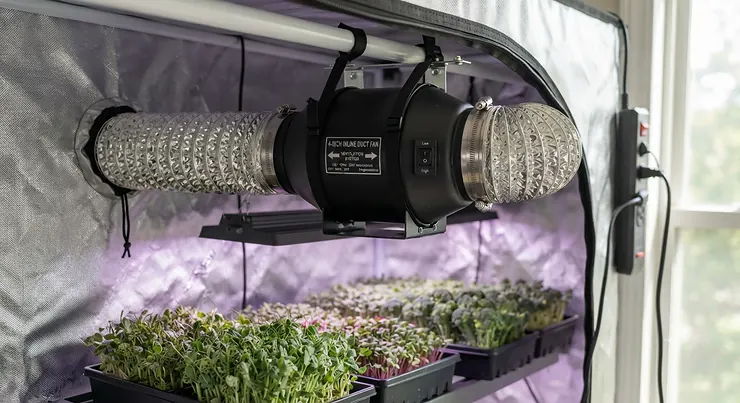
A 4 inch inline duct fan for microgreens tent setups is a small, ducted electric fan — sized to a 4-inch duct opening — that pulls or pushes air through a mini grow tent to keep humidity down and mold away from young greens. That’s the textbook definition, and if you’ve ever opened a tent lid to a wall of wet, stagnant air and a faint moldy smell, you already know why it matters. Microgreens live and die by moisture management, and moisture management lives and dies by airflow.
Here’s the thing nobody tells you when you buy your first tent: almost every inline fan on the market was designed for cannabis and vegetable grow tents running hot LED arrays, not for a tray of ten-day-old radish shoots that barely generates any heat at all. That mismatch matters more than most buying guides admit. A 4 inch inline duct fan for microgreens tent use doesn’t need to fight blazing grow-light heat — it needs to sip air gently across a canopy that bruises if you look at it wrong.
This guide walks through seven real, currently available 4-inch fans, breaks down which ones are actually built for gentle, low-CFM microgreens work versus which ones are overpowered cannabis leftovers, and gives you a framework for matching CFM, noise, and controls to your specific tent size. We’ll also dig into humidity control, mold prevention, and the seedling-specific quirks that most inline fan reviews never mention because they were written for a completely different crop. By the end, you’ll know exactly which fan fits your countertop or closet setup — and why “more CFM” is often the wrong answer for a tray of microgreens.
Quick Comparison Table
Before the deep dive, here’s the fast version for anyone who just wants a shortlist. These seven fans span budget AC motors to smart EC models with app control, and every one of them ships in a genuine 4-inch duct size — the right fit for compact microgreens tents in the 2×2 to 2×4 range.
| Fan | Airflow | Noise | Best For |
|---|---|---|---|
| TerraBloom ECMF-100 | 141 CFM | Low (variable) | Best low-CFM pick for microgreens |
| VIVOSUN D4 | 195 CFM | ~30 dB | Best budget, most reviewed |
| AC Infinity CLOUDLINE A4 | 165 CFM | 29 dBA | Best value quiet EC fan |
| AC Infinity CLOUDLINE S4 | 205 CFM | 28 dBA | Best all-rounder, expandable |
| Mars Hydro iFresh 4″ | 205 CFM | Low (EC) | Best all-in-one filter kit |
| VIVOSUN R4 | 190 CFM | Variable | Best budget variable speed |
| Gorilla GXi 4 | 212 CFM | 28 dBA | Best smart/app automation |
Looking at that spread, the CFM numbers cluster tightly between 141 and 212 — which tells you something important: none of these were designed with a tray of pea shoots in mind. The real differentiator for microgreens growers isn’t raw airflow, it’s how low and how smoothly each fan can throttle down, since a 2×2 microgreens tent rarely needs anywhere close to a fan’s maximum output. TerraBloom ECMF-100 stands out precisely because it was engineered around a lower CFM ceiling to begin with, while Gorilla GXi 4 and AC Infinity CLOUDLINE S4 offer more headroom than most microgreens setups will ever use.
💬 Already know what you’re after? Tap any highlighted pick above to check today’s price and availability.
Top 7 4 Inch Inline Duct Fans for Microgreens Tents: Expert Analysis
Here’s the honest rundown of seven real, currently sold fans — what they’re actually good at, what the spec sheets leave out, and who each one genuinely fits.
1. TerraBloom ECMF-100 — best low-CFM pick built for small spaces
The standout here is right in the model name: this is one of the few 4-inch fans engineered around a genuinely low CFM ceiling instead of a repurposed cannabis spec sheet. The ECMF-100 pushes 141 CFM using an EC (electronically commutated) motor that draws as little as 18-21 watts, paired with a potentiometer-style variable speed controller that lets you dial output down to a whisper. For a microgreens tent under roughly 8 cubic feet, that lower ceiling isn’t a limitation — it’s the whole point, since you’ll likely run this fan at 20-40% of max most of the time anyway.
Based on the spec comparison against its siblings in this list, the ECMF-100’s dual ball bearings (rated for roughly 70,000 hours) and ETL-listed, Energy Star-recognized motor suggest a fan built for continuous, years-long duty rather than occasional bursts — which matters for a tent that might run 24/7 through germination and blackout. What most buyers overlook about this model is that the included variable controller is a true potentiometer, not a stepped digital dial, so you can nudge airflow up or down in tiny increments rather than jumping between preset speeds.
Reviewers of TerraBloom’s ECMF line consistently mention smooth, low-hum operation at reduced speeds and straightforward installation, though the brand carries a smaller review footprint on major retailers than VIVOSUN or AC Infinity, so verified feedback is thinner than for the bigger names below.
Pros:
- ✅ Purpose-built low CFM ceiling suits small tents
- ✅ True variable-speed dial, not stepped presets
- ✅ EC motor rated for tens of thousands of hours
Cons:
- ❌ No app or smart controller option
- ❌ Smaller review base than major competitors
In the $40-$55 range at the time of research, the TerraBloom ECMF-100 is arguably the most honestly-sized fan on this list for a genuine microgreens tent, and the value case is strong if gentle, continuous airflow is your priority over raw exhaust power.
2. VIVOSUN D4 — most proven track record for budget buyers
The standout feature here isn’t a spec — it’s the sheer weight of real-world data behind it. This AC-motor fan has amassed well over 13,000 verified customer ratings on Amazon with a 4.3-star average, making it one of the most battle-tested 4-inch fans sold anywhere, and that volume of feedback is hard to argue with when you’re deciding whether a cheap fan will actually last.
Key specs translate directly to microgreens use: 195 CFM at 2,500 RPM with a claimed 30 dB noise floor, an ETL-listed motor with automatic overheat reset, and a flame-retardant electrical junction box. What the spec sheet won’t tell you, but the review pattern does, is that this is a genuine plug-and-play unit — there’s no built-in speed control, so it runs at one speed unless you add a separate controller, which matters a lot for microgreens since you’ll almost certainly want to throttle it down from 195 CFM in a small tent.
Aggregated review sentiment repeatedly praises reliability over months of daily use and responsive customer service when units arrive with minor issues, while a recurring complaint centers on the lack of an included speed dial and slightly higher noise at full tilt compared to EC-motor rivals.
Pros:
- ✅ Backed by 13,000+ verified customer ratings
- ✅ True plug-and-play, zero controller needed
- ✅ ETL-listed with automatic overheat protection
Cons:
- ❌ No built-in speed control out of the box
- ❌ AC motor runs louder than EC rivals at max
Priced in the $35-$50 range currently, the VIVOSUN D4 is the safest bet for anyone who wants proof-of-concept reliability before spending more, though microgreens growers should budget for a cheap inline speed controller to tame that 195 CFM down to tent-appropriate levels.
3. AC Infinity CLOUDLINE A4 — best value quiet EC fan with real speed control
The A4’s standout is baked into the CLOUDLINE lineup’s DNA: a mixed-flow EC motor rated at 165 CFM and 29 dBA, paired with a wired 10-speed controller included in the box — no separate purchase required. That 10-speed granularity means you can find the exact airflow level a microgreens tray needs without the guesswork of a single-speed AC fan.
Here’s what most buyers overlook about the A4 specifically: it sits as the entry point into AC Infinity’s CLOUDLINE family, sharing the same dual ball bearing construction and mixed-flow impeller design as the pricier S4 below it, just tuned to a slightly lower CFM ceiling. Based on the spec comparison, that lower ceiling is genuinely well-matched to a compact microgreens tent, where you rarely need anywhere near 200+ CFM of exhaust.
Reviewers across retail platforms consistently note the A4 running near-silently at its lowest 2-3 speed settings, which lines up with the EC motor’s PWM control letting it spin smoothly at low RPM without the coil whine some AC fans develop when throttled.
Pros:
- ✅ 10-speed wired controller included in the box
- ✅ EC motor keeps noise near 29 dBA at full speed
- ✅ Dual ball bearings support long service life
Cons:
- ❌ No smart or app connectivity on this model
- ❌ Costs more upfront than basic AC alternatives
At roughly $60-$75 based on current listings, the AC Infinity CLOUDLINE A4 earns its price premium mainly through the included controller — for microgreens growers who plan to run low and slow most of the time, that built-in flexibility is worth the extra cost over the VIVOSUN D4 above.
4. AC Infinity CLOUDLINE S4 — best all-rounder with room to grow
The S4’s calling card is expandability: 205 CFM at 28 dBA from an EC motor, shipped with a manual controller but fully compatible with AC Infinity’s separate smart controller line for temperature- and humidity-based automation down the road. It’s the fan you buy once and grow into, rather than one you outgrow.
Key specs interpreted for microgreens: static pressure rated at 223 Pa means the S4 keeps pushing air effectively even with some resistance in the ducting, and the dual ball bearing motor carries a two-year warranty. Based on the spec comparison, the S4’s 205 CFM ceiling is more than a small microgreens tent strictly needs, but the tradeoff is a fan with enough headroom to handle a larger tent later without buying twice.
Aggregated sentiment around the CLOUDLINE S4 consistently flags the 28 dBA noise rating as genuinely quiet in practice, particularly at lower manual speeds, with buyers commonly noting that the fan is inaudible from outside a closed tent — a detail that matters if your setup lives in a bedroom or living space.
Pros:
- ✅ Expandable to full smart climate automation later
- ✅ 28 dBA rivals the quietest fans in this roundup
- ✅ Two-year manufacturer warranty included
Cons:
- ❌ Full smart features require a separate controller purchase
- ❌ More CFM headroom than most microgreens tents use
In the $80-$100 range at the time of research, the AC Infinity CLOUDLINE S4 makes the most sense for growers who might scale from microgreens into leafy greens or small vegetable starts later and want a fan that won’t need replacing when the tent gets busier.
5. Mars Hydro iFresh 4-Inch Fan & Filter Combo — best all-in-one ventilation kit
The standout advantage is the bundle itself: a 205 CFM EC inline fan paired with a matching carbon filter, speed controller, ducting, clamps, and hanging straps in one box, plus a dedicated expansion port for optional app-based climate control down the line. For someone starting from zero, that combo removes a lot of the guesswork around compatible parts.
Key specs worth interpreting: the 205 CFM rating puts it in the same tier as the AC Infinity S4, and the smart expansion port means the standard version can be upgraded later with an add-on pack for full app monitoring of temperature and humidity — useful context since many microgreens growers eventually want that data even if they don’t need it on day one. What most buyers overlook is that the carbon filter included in this kit is really built for odor control in cannabis-style grows; for microgreens, which don’t produce strong odors, that filter mostly just adds airflow resistance you’ll need to compensate for with a slightly higher fan speed.
Reviewers of the Mars Hydro ventilation lineup frequently mention straightforward kit assembly and appreciate having every ducting component matched and included, while some buyers note that unlocking full app control requires purchasing the separate Pro sensor add-on rather than getting it standard.
Pros:
- ✅ Bundles a carbon filter and full ducting kit together
- ✅ Expansion port unlocks future app-based control
- ✅ Everything matched and included in one purchase
Cons:
- ❌ Full app control needs a separate Pro add-on purchase
- ❌ Carbon filter adds resistance most microgreens setups don’t need
Typically listed in the $70-$95 range for the combo kit, the Mars Hydro iFresh 4-Inch Fan & Filter Combo is the pick for someone who’d rather buy one matched kit than piece together a fan, filter, and ducting separately — even if the filter itself is more than microgreens strictly require.
6. VIVOSUN R4 — best budget variable-speed alternative
The R4’s headline feature is built-in variable speed control on a budget AC-style fan: 190 CFM paired with a dial controller in the box, giving buyers who don’t want to shop for a separate controller a one-purchase solution. Among lesser-known alternatives to the bigger EC brands, this is the one with real purchase volume behind it.
Interpreting the specs: 190 CFM sits right in the middle of this list’s range, and the variable dial means you can throttle output down for a small microgreens tent without an add-on part. Based on the spec comparison with the AC Infinity A4, the tradeoff is motor type — the R4 uses a more conventional variable-voltage approach rather than an EC/PWM motor, which is typically less smooth and slightly noisier at low settings, though it’s also usually cheaper to manufacture and buy.
Aggregated review sentiment on the R4 and its sibling models in the VIVOSUN line points to solid reliability for the price and appreciation for the included controller, with a recurring theme that low-speed operation introduces a mild hum some buyers notice in quiet rooms — a pattern consistent with non-EC variable speed designs generally.
Pros:
- ✅ Variable speed dial included, no add-on needed
- ✅ Budget-friendly compared to EC smart fans
- ✅ Backed by a large, established review history
Cons:
- ❌ Variable-voltage control can hum at low speeds
- ❌ Bulkier housing than some EC competitors
Sitting in the $45-$60 range currently, the VIVOSUN R4 is a solid pick for growers who want built-in speed control on a budget and can tolerate a bit more low-speed noise than the pricier EC options above.
7. Gorilla GXi 4 — best smart automation for hands-off growers
The GXi 4’s standout is full wireless control: 212 CFM at 28 dBA through an EC motor, managed entirely through the Gorilla Grow Tent App with zero external controller box required, plus a three-year warranty that beats every other fan on this list. For growers who want set-it-and-forget-it climate response, this is the most automated option here.
Key specs worth unpacking: Gorilla’s WhisperFlow engineering targets low-noise operation at that 28 dBA rating, and the app-based control lets you set temperature and humidity targets rather than manually adjusting a dial every few hours — genuinely useful if you’re managing multiple trays on a staggered harvest schedule and don’t want to babysit airflow settings. Based on the spec comparison, 212 CFM is the highest ceiling in this roundup, which is more than most single microgreens tents need, but the app’s ability to throttle down smoothly means that extra headroom doesn’t translate into noisier day-to-day operation.
Reviewers and product commentary around the GXi line consistently highlight the appeal of skipping a separate hardware controller entirely, while some buyers note the learning curve of setting up app pairing compared to a simple physical dial.
Pros:
- ✅ Full app control with no separate hardware controller
- ✅ Three-year warranty beats every other pick here
- ✅ WhisperFlow engineering targets quiet 28 dBA operation
Cons:
- ❌ Premium price for a microgreens-scale tent
- ❌ App dependency adds a modest setup learning curve
Priced around $110-$140 at the time of research, the Gorilla GXi 4 is overkill for a single 2×2 microgreens tent on paper, but it’s the clear pick for growers scaling toward multiple tents who want centralized app control instead of adjusting fans by hand.
Setting Up Your 4 Inch Inline Duct Fan for a Microgreens Tent
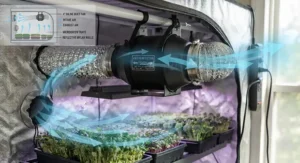
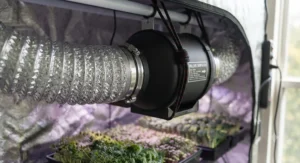
Getting a 4 inch inline duct fan for microgreens tent use running correctly on day one saves weeks of troubleshooting mold and wilt later. Start by mounting the fan near the top of the tent in exhaust configuration, pulling air out rather than pushing it in — this creates gentle negative pressure that draws fresh air through your intake vents and across the canopy on its way out, rather than blasting seedlings directly.
For the first 30 days, resist the urge to run any of these fans at full speed. Most microgreens tents under 8 cubic feet do well starting at 15-25% of a fan’s rated output, then increasing gradually as the canopy fills in and humidity rises during the germination-to-harvest window. A common first-week mistake is leaving the fan off entirely during the humidity-dome stage, then cranking it to maximum the moment the dome comes off — instead, run it low and continuous from day one, even under a dome, using the vent flaps most humidity domes include.
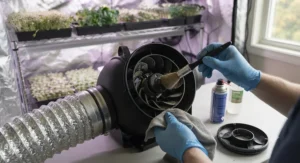
Maintenance is minimal but not optional: wipe down the intake grille monthly to prevent dust buildup that reduces airflow, and check that ducting connections stay snug, since a loose clamp near a humid tent can let condensation drip back into the fan housing. If you notice the fan struggling to maintain airflow, that’s often ducting kinked around a tight bend rather than a failing motor — straighten the run before assuming the worst.
Real Grower Scenarios: Matching the Right Fan to Your Setup
If you’re an apartment dweller running a single 2×2 tent on a kitchen counter, low noise and low CFM matter more than anything else — the TerraBloom ECMF-100 or AC Infinity CLOUDLINE A4 at a low speed setting will keep a small canopy dry without humming through thin apartment walls at 2 a.m.
If you’re a basement hobbyist running two or three trays on a shelving rack with more room to spare, mid-range CFM with speed flexibility covers you well; the VIVOSUN D4 paired with a cheap add-on controller, or the AC Infinity CLOUDLINE S4 run at moderate speed, both handle the larger air volume of a taller rack setup without breaking a sweat.
If you’re scaling toward a small side business with multiple tents and staggered harvest cycles, hands-off automation starts paying for itself; the Gorilla GXi 4 or the Mars Hydro iFresh combo kit let you set humidity targets once per tent rather than manually rechecking dials across several setups every day, which adds up fast once you’re managing five or six trays instead of one.
Understanding Microgreens Tent Airflow Needs
Figuring out the right airflow for a 4 inch inline duct fan for microgreens tent setup starts with volume math, then gets adjusted for how gentle microgreens actually need that air to be. Here’s the framework:
- Calculate tent volume. Multiply length × width × height in feet — a typical 2x2x4 tent comes out to 16 cubic feet.
- Find your baseline CFM. Divide 60 by your target air-exchange time in minutes; most microgreens setups do fine exchanging air every 2-3 minutes rather than every minute like a hot cannabis tent.
- Skip the aggressive buffer. Grow-tent guides often add 25-50% for carbon filters and duct bends — for microgreens without a filter and short duct runs, that buffer is usually unnecessary.
- Prioritize speed control over raw CFM. A 200 CFM fan throttled to 20% beats a fixed 80 CFM fan running flat out, since you keep flexibility as the canopy grows.
- Match duct size exactly. Never reduce a 4-inch fan onto smaller ducting or vice versa — mismatched sizing chokes airflow regardless of the fan’s rating, a point well documented in general air changes per hour ventilation standards used across HVAC design.
Working through that math for a typical microgreens tent usually lands you well under 100 CFM of actual needed airflow, which is exactly why the low-CFM, variable-speed fans in this roundup tend to outperform the highest-CFM options on real-world comfort and noise.
The Low-CFM Fan Use Case: When Less Airflow Wins
The low-CFM fan use case gets overlooked constantly because most inline fan marketing is written for cannabis growers chasing maximum exhaust to fight 600-watt LED heat. Microgreens generate almost none of that heat load, which flips the calculus: your fan’s job isn’t cooling, it’s gently moving moisture-laden air off the canopy surface so mold spores never get the stagnant, humid pocket they need to establish.
A fan that’s genuinely happy running at 60-100 CFM, like the TerraBloom ECMF-100, tends to run quieter and use less power over months of continuous operation than a 200+ CFM fan throttled way down, since some AC motors get less efficient and slightly noisier at very low speeds. This is the low-CFM fan use case in practice: buying to the job you actually have, not the job the spec sheet is optimized for.
Gentle Ventilation for Seedlings: Why Less Is More
Gentle ventilation for seedlings is a different discipline than ventilating a flowering cannabis plant, and treating them the same is a common, costly mistake. Microgreens have no woody stem structure to brace against strong airflow — a fan aimed directly at a tray, or one running at full CFM in a small enclosed tent, can physically flatten young cotyledons or dry out the growing medium unevenly, leaving some sections crusted and others still soggy.
The fix most experienced growers land on is positioning the fan to move air just above the canopy rather than directly across it, and running it continuously at low speed rather than intermittently at high speed. Reviewers consistently note that fans with true variable control, rather than single-speed on/off units, make this dramatically easier to dial in correctly on the first try.
Humidity Control in a Small Tent Fan Setup
Humidity control in a small tent fan setup is really the whole game for microgreens, since these crops are misted or bottom-watered constantly in a compact, enclosed space where moisture has nowhere to go without mechanical help. Reviewers and growers alike report that humidity inside an unventilated 2×2 tent can climb well past 70% within hours of watering — squarely in the range where mold problems accelerate.
Running your inline fan continuously at a low, steady speed keeps relative humidity oscillating in a safer band rather than spiking after every watering session. As a rough target, indoor air quality guidance from the EPA on mold and moisture recommends keeping indoor humidity below 60%, ideally in the 30-50% range — a useful benchmark even though it’s written for whole-home moisture control rather than a grow tent specifically. A cheap hygrometer clipped inside the tent turns this from guesswork into a number you can actually watch.
Mold Prevention Airflow: Common Buying Mistakes to Avoid
Mold prevention airflow only works if you buy the right kind of fan in the first place, and the most common mistake is picking a fan based purely on the highest CFM number on the box. A fan that’s too powerful for the tent gets run at a tiny fraction of its capacity, and cheaper units — especially AC-motor designs — often perform less smoothly and less quietly way down at the bottom of their range than a fan designed around that lower ceiling from the start.
The second common mistake is skipping a controller entirely and running a fixed-speed fan at its single available setting, which is either too weak to matter or so strong it dries out one corner of the tray while leaving another humid. The third mistake — and one that ties directly into fungal disease — is assuming airflow alone fixes overwatering. As documented in Penn State Extension’s guide to damping-off, excessive moisture and overcrowded seed trays create conditions favorable to the same fungal pathogens regardless of how much air is moving, so a good fan supports proper watering practice, it doesn’t replace it.
Seedling Tent Ventilation vs Humidity Domes and Passive Airflow
Seedling tent ventilation using a powered inline fan and passive airflow using vented humidity domes solve overlapping but distinct problems, and most growers eventually need both rather than choosing one. A humidity dome traps moisture right at the seed level during germination, which speeds sprouting but concentrates humidity in exactly the spot where mold risk is highest if left sealed too long.
A powered 4-inch fan, by contrast, continuously exchanges the larger air volume of the whole tent, which does little for a sealed dome’s internal microclimate but everything for preventing the broader tent environment from turning into a humid box once the dome comes off. In practice, the dome handles the first 3-5 days of germination with its own vent flaps cracked slightly, and the inline fan takes over as the primary moisture management tool from that point through harvest — running one without the other tends to produce either slow, uneven germination or a moldy canopy by week two.
Features That Actually Matter (And Those That Don’t)
Cutting through the marketing noise, a few features genuinely move the needle for microgreens use, and a few are borrowed hype from cannabis-tent marketing that don’t apply here. Variable speed control matters enormously, since it’s the single biggest factor in matching airflow to a small tent’s actual needs. EC motor construction matters too, mainly for quieter low-speed operation and lower long-term power draw compared to AC motors.
What matters less: maximum CFM rating, since virtually every fan on this list exceeds what a microgreens tent needs at full output; carbon filtration, since microgreens produce negligible odor compared to cannabis; and app-based automation, which is genuinely convenient at scale but adds cost and complexity that a single hobby tent rarely justifies.
Long-Term Cost & Maintenance for Inline Duct Fans
Total cost of ownership for any of these fans comes down mostly to electricity and longevity rather than the upfront price tag. EC motors in the TerraBloom ECMF-100, AC Infinity models, and Gorilla GXi 4 typically draw 15-30 watts at moderate speeds, which at average U.S. residential electricity rates works out to just a few dollars a year running continuously — a rounding error compared to grow light power draw in most setups.
AC-motor fans like the VIVOSUN D4 and R4 cost less upfront but tend to draw somewhat more power at comparable airflow and may show more wear over years of continuous duty, since AC motors generally lack the sealed, low-friction bearing designs common in EC alternatives. Maintenance across all seven fans is similar: an occasional wipe-down of the intake grille and periodic inspection of ducting connections is typically all that’s needed, and most carry ETL listing plus one- to three-year warranties that cover manufacturing defects during the years you’ll actually be relying on them most.
✨ Ready to upgrade your tent’s airflow? Check today’s price on any pick above before it changes.
Safety and Certification: What to Check Before You Buy
Before buying any inline duct fan, confirm it carries genuine ETL or UL listing — several fans in this roundup, including the TerraBloom ECMF-100 and VIVOSUN D4, explicitly advertise this certification, which confirms independent third-party testing against recognized electrical safety standards rather than just a manufacturer’s own claims.
Beyond certification, check for basic safety features like automatic thermal reset (present on the VIVOSUN line) and flame-retardant electrical housings, both of which matter more in an enclosed tent running continuously than they would for an occasional-use fan elsewhere in the house. None of these represent exotic engineering — they’re baseline expectations any reputable 4-inch fan on this list should meet.
Frequently Asked Questions
❓ What size inline duct fan do I need for a microgreens tent?
❓ Can I use a grow tent inline fan for microgreens?
❓ How many CFM is too much for microgreens?
❓ Does a 4 inch inline duct fan stop mold on microgreens?
❓ Do I need a carbon filter with a microgreens tent fan?
Conclusion
A 4 inch inline duct fan for microgreens tent setups doesn’t need to be the most powerful option on the shelf — it needs to be the most controllable one. Across the seven fans in this guide, the pattern holds steady: models built around genuine low-speed flexibility, whether that’s the purpose-built TerraBloom ECMF-100, the included 10-speed dial on the AC Infinity CLOUDLINE A4, or the app-based fine control on the Gorilla GXi 4, consistently outperform raw CFM specs when the actual job is gentle, continuous moisture management rather than aggressive heat exhaust.
If you’re just starting out with a single countertop tent, start with the TerraBloom ECMF-100 or VIVOSUN D4 and a cheap add-on controller — both give you room to learn how much airflow your specific setup and crop mix actually needs before spending more. If you’re scaling toward multiple tents or want to stop manually adjusting dials every day, the Gorilla GXi 4 or Mars Hydro iFresh combo earn their higher price through genuine automation. Whichever you choose, pair it with the humidity and watering practices covered above, and mold stops being a recurring headache and starts being a rare exception.
Recommended for You
- 7 Best 4 Inch Inline Fan With Speed Controller Picks for 2026
- 4 Inch Inline Fan vs 6 Inch for Small Tent: 7 Best Picks (2026)
- Quietest 4 Inch Inline Duct Fan for Apartment: 7 Picks (2026)
Disclaimer: This article contains affiliate links. As an Amazon Associate, I earn from qualifying purchases. If you purchase products through these links, we may earn a small commission at no additional cost to you.
✨ Found this helpful? Share it with your friends! 💬🤗
