
In This Article
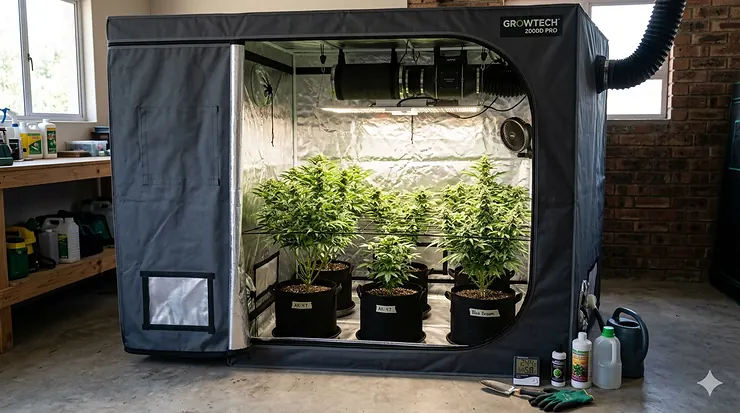
Let’s be blunt: most grow tents fail before your plants do.
A budget tent with 600D fabric might look fine in a product photo, but after a few grow cycles — zippers splitting, light leaking through pinhole-thin canvas, frames wobbling under the weight of your LED and inline fan — you start doing the math on what cheap actually costs. The answer, typically, is a ruined harvest and a replacement purchase you didn’t budget for.
That’s exactly why serious indoor growers have converged on one standard in 2026: the 2000D grow tent.
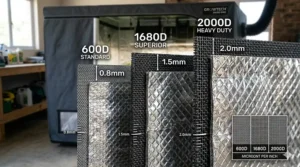
What does “2000D” actually mean? The “D” stands for denier — a unit measuring the linear mass density of the fabric fibers. Think of it like thread count on bed sheets, but for durability. A 2000 denier grow tent uses fibers roughly 3–4 times denser than entry-level 600D alternatives, which translates to three concrete advantages: near-total light lockout, far superior thermal insulation, and canvas that can handle years of zipping, unzipping, and accidental elbow-jabs from a carbon filter install without developing pinholes or tears.
According to the Hydrobuilder Learning Center’s 2026 Grow Tent Buying Guide, thicker canvas also improves noise dampening and resists punctures during years of heavy, continuous use — something growers running year-round perpetual harvests genuinely feel in practice.
In this guide, we’ve researched and compared the top seven 2000D grow tent models currently available on Amazon, covering everything from a tight 2×2 starter setup to a sprawling 8×4 professional rig. Whether you’re a hobbyist squeezing plants into a spare bedroom closet or a serious cultivator dialing in every environmental variable, one of these will fit your space, your budget, and your ambitions.
Quick Comparison Table: Best 2000D Grow Tents at a Glance
| Product | Size | Canvas | Frame | Best For | Price Range |
|---|---|---|---|---|---|
| AC Infinity CLOUDLAB 844 | 4×4 (48″×48″×80″) | 2000D | 1″ steel poles | Best overall / serious growers | $180–$220 |
| MARS HYDRO 4×2 Grow Tent Pro | 4×2 (48″×24″×71″) | 2000D | Metal poles | Rectangular spaces / veg-flower | $70–$100 |
| MARS HYDRO 2×2×5 Grow Tent Pro | 2×2 (24″×24″×63″) | 2000D | Metal poles | Small space beginners | $50–$75 |
| VIVOSUN P448 PRO Grow Tent 4×4 | 4×4 (48″×48″×80″) | 2000D | 22mm poles | Value-focused growers | $120–$160 |
| VIVOSUN PRO Grow Tent 2×4 | 2×4 (48″×24″×72″) | 2000D | 22mm poles | Beginner to intermediate | $90–$130 |
| AC Infinity CLOUDLAB 894 | 8×4 (96″×48″×80″) | 2000D | 1″ steel poles | Multi-plant / production grows | $280–$340 |
| STAYGROW 2000D 2×2 Grow Tent | 2×2 (24″×24″×48″) | 2000D | Metal corners | Ultra-budget / compact starter | $40–$65 |
Reading between the lines here: The AC Infinity options deliver the most refined engineering — lab-tested reflectivity, dedicated controller plates, superior SBS zippers — but at a real premium. The MARS HYDRO Pro models punch noticeably above their price point in canvas quality. If you’re budget-constrained but don’t want to sacrifice on the 2000 denier grow tent standard, the VIVOSUN PRO and STAYGROW are the logical landing spots.
💬 Just one click — help others make better buying decisions too! 😊
Top 7 2000D Grow Tent Models: Expert Analysis
1. AC Infinity CLOUDLAB 844 — The Gold Standard of 4×4 Grow Tents
The CLOUDLAB 844 is what happens when an engineering-first company obsesses over a single product category. This 48″×48″×80″ tent has become the de facto benchmark that every competitor is quietly trying to match.
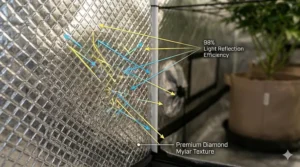
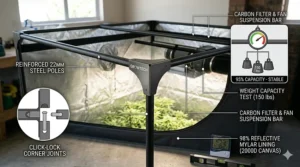
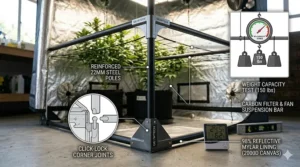
Build specs and what they actually mean: The 2000D diamond mylar canvas has been lab-tested for reflectivity — not just stated on a spec sheet, but independently measured and published. In practice, this means your grow light’s PAR output goes further because less gets absorbed by the walls. The 1-inch (22mm) steel poles are meaningfully beefier than the 18mm poles on most competing tents, and the difference is felt the moment you hang a heavy LED driver plus a carbon filter: no flex, no sag, no middle-of-the-night collapse drama. The tent supports up to 150 lbs at hanging intersections.
What most buyers overlook about the CLOUDLAB 844 is the controller mounting plate with lightproof cable passthrough. If you’re running AC Infinity’s own UIS ecosystem — fans, controllers, sensors — everything integrates without punching new holes or taping around cable gaps. It’s a small thing until it saves you an hour of troubleshooting a light leak.
Who it’s for: Intermediate to advanced growers who plan to run a complete, integrated environmental control system and want a tent they’ll never need to replace. Not the best call if you’re on a strict budget or growing casually.
Customer feedback summary: Buyers consistently praise the zipper quality and the observation window size — noting it’s genuinely large enough to get a meaningful canopy overview without opening the tent and spiking your VPD.
✅ Lab-tested reflectivity with diamond mylar interior
✅ 1″ steel poles with 150 lb hang capacity
✅ Future-ready UIS controller mount plate
❌ Premium price point — one of the most expensive standalone tents in this category
❌ Some users find the assembly instructions less intuitive than competitors
Price range: Around $180–$220 — premium, but you’ll own it for five or more grow cycles without a second thought.
2. MARS HYDRO 4×2 Grow Tent Pro — The Rectangular Powerhouse
The MARS HYDRO 4×2 Grow Tent Pro (48″×24″×71″) keeps showing up in grow room build threads in 2026 for a reason: it solves a genuinely common problem that square tents can’t. Closets, hallways, narrow garage spaces — they’re almost never square. A 4×2 footprint fits in places a 4×4 simply won’t.
The 2000D canvas here is double-stitched and features MARS HYDRO’s exclusive shade cloth over the zipper-canvas stitching seam, addressing the most common source of pinhole leaks in competitor tents. That’s not marketing language — light leaking through the stitching line is a real issue on cheaper tents that disrupts photoperiod plants during dark cycles, causing stress and hermaphroditism. Eliminating it at the design level, not with an afterthought fix, is exactly the kind of practical engineering growers care about.
The 71″ interior height gives you a bit more vertical flexibility than the shorter version, accommodating high-stress training (HST) techniques or taller autoflower phenotypes without bending your LED out of position.
Who it’s for: Beginners and intermediate growers with non-square spaces, or anyone running a dedicated veg tent alongside a separate flower tent. Pairs naturally with the TSL2000 or SP3000 bar lights that match its 4×2 footprint.
Customer feedback summary: Growers repeatedly note how much better the zipper feels compared to similarly priced competitors — and how the shade cloth on the seam actually does eliminate the stray light streaks they experienced with previous tents.
✅ Exclusive shade cloth on seam stitching prevents pinhole leaks
✅ 71″ height gives meaningful vertical room
✅ Double-stitched 2000D canvas throughout
❌ Poles feel slightly less rigid than AC Infinity’s 1″ steel
❌ Controller mount system less polished than premium options
Price range: $70–$100 — outstanding value for the construction quality on offer.
3. MARS HYDRO 2×2×5 Grow Tent Pro — Best Compact 2000D Starter
Don’t let the footprint fool you. The MARS HYDRO 2×2×5 Grow Tent Pro (24″×24″×63″) is the rare small tent that doesn’t cut corners on materials to hit its price point. The same 2000D double-stitched canvas and zipper shade cloth from the larger Pro models carries over here, which is genuinely unusual in the compact tent segment — most brands drop to 600D or 1680D once the tent size (and price) gets small.
At 63″ tall, it’s a bit shorter than ideal for full-term photoperiod cannabis, but if you’re growing autoflowers, herbs, vegetables, mushrooms, or seedlings, the height is more than adequate. The real-world use case that makes this tent shine is propagation: running it as a dedicated cloning or seedling station adjacent to a larger flower tent creates a perpetual harvest rhythm that intermediate growers quickly become addicted to.
The 2026 Pro version ships with a controller and power socket hook, Velcro cable ties, a waterproof base tray, and a tool bag — making it one of the most complete package deals at this size.
Who it’s for: First-time growers testing the waters, experienced growers building a multi-tent perpetual harvest system, or anyone needing a compact climate-controlled propagation chamber.
Customer feedback summary: First-time buyers report being genuinely surprised by the canvas quality relative to the price — several noted they expected a flimsy tent and got something that felt like it could outlast their LED lights.
✅ Full 2000D construction at a budget-friendly compact size
✅ Complete Pro kit with tray, hooks, and cable management
✅ Perfect for autoflowers or propagation use
❌ 63″ height limits use for tall photoperiod strains in full flower
❌ Smaller footprint means less room for training techniques
Price range: $50–$75 — the most accessible entry point into true heavy duty grow tent construction.
4. VIVOSUN P448 Advance PRO Grow Tent 4×4 — The Value-Forward Pro Option
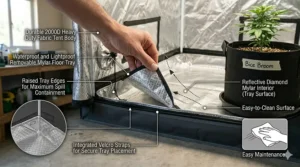
VIVOSUN’s P448 (48″×48″×80″) makes a compelling case that you don’t need to spend AC Infinity money to get professional-grade materials. The three-layer fabric construction here is genuinely interesting: 2000D Oxford canvas on the exterior, a plant-friendly PE moisture barrier in the middle, and 100% reflective mylar on the interior. That middle PE layer is something most competitors skip entirely — it adds meaningful thermal insulation, keeping your internal environment more stable when ambient room temperatures fluctuate.
The 22mm steel poles match the AC Infinity standard, and the load capacity ranges up to 400 lbs depending on the model — impressive for a tent at this price range. The SBS zipper runs smoothly and includes a black inner lining at the zipper section specifically engineered to prevent light infiltration through the zipper teeth, a design decision that shows VIVOSUN is paying attention to where failure points actually occur.
What most buyers overlook about the P448 is the door: it’s fully removable and can be fastened to the tent side with hook-and-loop fasteners. When you’re transplanting, training, or doing a deep clean, being able to get the door completely out of the way rather than holding it up with your elbow is a quality-of-life upgrade that sounds minor and feels substantial in practice.
Who it’s for: Value-conscious growers who want 2000 denier grow tent durability and 22mm frame stiffness without the premium brand markup. Great for those who already have a ventilation and lighting system they love and just need a rock-solid tent.
Customer feedback summary: Long-term users report the tent holding up well after multiple grow cycles, with the zippers remaining smooth and the canvas showing no signs of light leakage or delamination.
✅ Three-layer fabric with PE moisture barrier for thermal stability
✅ 22mm steel poles with up to 400 lb capacity
✅ Removable door design for easy access
❌ Less ecosystem integration than AC Infinity’s controller mount system
❌ Reflectivity not independently lab-tested — relies on manufacturer claims
Price range: $120–$160 — excellent value for the construction spec.
5. VIVOSUN PRO Grow Tent 2×4 — Best Mid-Range Rectangular Tent
The VIVOSUN PRO 2×4 (48″×24″×72″) occupies a sweet spot that’s easy to overlook: it’s more affordable than the AC Infinity equivalent, more solidly built than budget alternatives, and one inch taller than the MARS HYDRO 4×2 Pro. That extra inch matters more than it sounds — at 72″, you can comfortably fit most single-ended LED bars plus a carbon filter hung at ceiling level without your light-to-canopy distance getting cramped.
The same 2000D Oxford canvas with PE moisture barrier from the P448 carries over here, along with the 22mm poles and SBS zippers. The upgraded lightproof zipper lining is present, and the CFM kit supporting poles (19mm) add lateral frame stiffness that keeps the tent from racking when you’re pushing and pulling on zipper handles — something budget tents fail at constantly.
At this price point, VIVOSUN includes 3 hanging bars, 4 CFM support poles, a floor tray, and instructions. It ships ready for a complete setup without surprise accessory purchases.
Who it’s for: Beginner to intermediate growers setting up their first serious tent, or experienced growers building a dedicated 2×4 veg or propagation station. Works particularly well with VIVOSUN’s AeroLight series or any standard 2×4 LED footprint.
Customer feedback summary: Buyers frequently mention assembling the tent alone in under 30 minutes, and specifically note the observation window is large enough to be genuinely useful rather than a decorative checkbox.
✅ 72″ height — tallest in the mid-range 2×4 category
✅ 2000D three-layer fabric with PE moisture barrier
✅ CFM support poles add structural rigidity
❌ Controller mounting less refined than CLOUDLAB series
❌ Not ideal for growers fully committed to AC Infinity’s UIS ecosystem
Price range: $90–$130 — strong performance-to-price ratio for rectangular setups.
6. AC Infinity CLOUDLAB 894 — For Growers Who Think in Pounds Per Harvest
If the CLOUDLAB 844 is the hobbyist’s best friend, the CLOUDLAB 894 (96″×48″×80″) is where serious cultivators live. This 8×4 behemoth gives you 32 square feet of canopy space — enough to run 8–12 plants in 5-gallon pots, or 6 plants trained under a SCROG net with serious yield ambitions.
The construction spec is identical to the 844: 1-inch steel poles, 2000D lab-tested diamond mylar canvas, SBS zippers, and the controller mounting plate. But the 894 adds more duct ports (four 4″ and five 8″ ports), two side doors for full walk-in access, and four hanging bars that support the additional weight load of running two LEDs and multiple fans simultaneously. The wider footprint means you’re almost certainly running a bar-style LED at this size — the port arrangement anticipates this.
The spec sheet won’t tell you this, but the 894 is also where AC Infinity’s ecosystem integration starts generating real ROI. A single CLOUDLAB controller managing multiple fans, a humidifier, and a heater across 32 square feet of canopy is substantially more effective than manually babysitting conditions in that size space. The controller mount plate is not an accessory feature at this scale — it’s infrastructure.
Who it’s for: Production-oriented home growers, small-scale commercial cultivators, or serious hobbyists who’ve graduated past the 4×4 and want the industry’s most reliable build quality in a larger footprint.
Customer feedback summary: Buyers consistently emphasize how rigid the 1-inch poles feel at full assembly — no wobble, no flex when loading heavy equipment — and several note this is the tent they’ve stopped thinking about after setup, which is high praise.
✅ 32 sq ft canopy space with 9 total duct ports
✅ Same lab-tested 2000D reflectivity as the 844
✅ Built for ecosystem integration at production scale
❌ Higher price — this is a significant investment
❌ Requires more room planning; not for casual or compact setups
Price range: $280–$340 — fully justified for growers where yield output is a real priority.
7. STAYGROW 2000D 2×2 Grow Tent — The Smartest Budget Play
Here’s the thing about the STAYGROW 2×2 (24″×24″×48″): it’s obscure enough that most buyers scroll past it, which is a mistake. What STAYGROW has done is take the 2000D denier standard — typically the premium tier — and apply it to one of the most affordable compact tents on Amazon, resulting in a product that genuinely punches above its weight class.
The industry-thickest 2000D Oxford canvas is the headline, but the execution details matter too: extension cloths on the back of all zippers to block light through zipper teeth, dual-cinching port designs, and removable Velcro covers on mesh vents all point to a brand that studied where competitor tents fail before engineering their own. The metal corners with interlocking snap pieces provide a frame lock that resists the lateral wobble that usually signals cheap construction.
At 48″ tall, this is explicitly a compact setup: seedlings, herbs, microgreens, small autoflowers, mushroom cultivation, or cloning. It won’t fit a full-term photoperiod cannabis plant in flower. But for what it’s designed for, it does the job with premium-grade canvas at a price that leaves room to invest in a quality LED.
Who it’s for: Complete beginners wanting 2000D canvas quality without the matching price tag, experienced growers needing an ultra-compact propagation station, or anyone experimenting with mushroom cultivation in a controlled environment.
Customer feedback summary: Buyers highlight being impressed by how tight the light seal is compared to tents they’ve used at similar price points, with several specifically noting zero light bleeding from the zipper area.
✅ True 2000D canvas at the most budget-friendly price point in this list
✅ Smart zipper light-blocking extension cloths throughout
✅ Ideal for propagation, herbs, or compact autoflower grows
❌ 48″ height limits plant size significantly
❌ Less brand recognition means shorter user review history
Price range: $40–$65 — genuinely the best value if your grow space is compact.
✨ Don’t Miss These Exclusive Deals!
🔍 Take your indoor grow to the next level with these carefully selected 2000D grow tent picks. Click any highlighted product name to check current pricing and availability on Amazon. These tents will help you build the controlled environment your plants deserve — season after season. 🌱
How to Set Up Your 2000D Grow Tent the Right Way (And Avoid the Mistakes 80% of Beginners Make)
Buying a premium heavy duty grow tent is step one. Setting it up correctly is where most first-time growers lose the gains they paid for.
Step 1: Build the frame before adding canvas. Assemble all poles and corner connectors first, completely, before attempting to slide the canvas over. Trying to thread poles through canvas channels while simultaneously connecting frame joints is how zipper tabs break and seams get stressed on day one.
Step 2: Orient the tent correctly. Place the door facing a direction you can actually access without contorting around furniture or equipment. This sounds obvious until 3 AM when you’re checking on a plant and realize your carbon filter is blocking the zipper.
Step 3: Seal your duct ports before running equipment. Every unused duct port is a light leak and a climate leak waiting to happen. Use the cinch drawstrings to close unused ports fully — don’t assume the port fabric is lightproof when it’s loose.
Step 4: Hang your heaviest equipment at frame intersections, not on single poles. On a 2000 denier grow tent with 22mm poles, this is less critical than on budget builds, but it’s still good practice. Carbon filters, LED drivers, and inline fans should hang where poles cross for maximum load distribution.
Step 5: Run your environment for 24 hours before adding plants. Get your temperature, humidity, and VPD dialed in before your plants experience the space. A new tent can off-gas mildly from the canvas and adhesives — a pre-run cycle clears the air and lets you troubleshoot any light leaks with a flashlight in a dark room before crops are at stake.
Common first-month mistake to avoid: Over-sealing your intake. Growers so focused on preventing light leaks that they throttle fresh air intake too aggressively — starving plants of CO₂ and creating negative-pressure situations where canvas walls bow inward visually and plants stall for reasons that look like nutrient deficiencies but are actually atmospheric.
Which 2000D Grow Tent Fits Your Situation? A Real-World Scenario Guide
Specs and features only go so far. Here’s how the decision actually plays out for three common grower profiles.
Profile 1: The Apartment Hobbyist with Limited Space You’re working with a spare bedroom closet or a 5×5 corner of a studio. You want to grow 2–3 plants, you’ve never grown indoors before, and your total tent budget is under $100. Best pick: MARS HYDRO 2×2×5 Grow Tent Pro or STAYGROW 2000D 2×2. Both give you the 2000 denier grow tent material quality that will survive learning-curve fumbling without developing leaks, at a price that leaves room for a decent LED.
Profile 2: The Serious Intermediate Grower Upgrading from a Cheap First Tent You’ve completed 2–3 cycles on a budget 600D tent, you know what you’re doing, and you’re done replacing equipment. You have a 4×4 space and want something that’ll run 5+ years without drama. Best pick: AC Infinity CLOUDLAB 844. The jump in price is real, but so is the jump in everything else — reflectivity, frame rigidity, zipper durability, and ecosystem integration. You’ll stop thinking about your tent as a variable and start focusing entirely on your plants.
Profile 3: The Multi-Tent Production Grower You’re running perpetual harvests, likely with a veg tent and a flower tent operating simultaneously. You need a rectangular 4×2 to complement your 4×4, or you’re scaling up to an 8×4 for a dedicated flower room. Best picks: MARS HYDRO 4×2 Pro for the complementary veg tent; AC Infinity CLOUDLAB 894 if you’re scaling the flower operation. The 894 in particular earns its premium at production scale where the controller ecosystem integration saves measurable time and produces measurable consistency.
2000D Grow Tent vs. 600D and 1680D: What the Numbers Actually Mean for Your Grow
This comparison comes up constantly, and it deserves a direct answer rather than vague “higher is better” platitudes.
| Feature | 600D Canvas | 1680D Canvas | 2000D Canvas |
|---|---|---|---|
| Light proofing | Adequate | Very good | Excellent |
| Tear resistance | 2–3 years typical | 4–5 years typical | 5–7+ years |
| Thermal insulation | Minimal | Moderate | Noticeably better |
| Noise dampening | Very little | Some | Moderate improvement |
| Typical price premium | Baseline | +20–40% | +30–60% |
The honest analysis: For a casual grower doing 1–2 cycles a year in a temperature-controlled home, 1680D is genuinely sufficient. The step up to a 2000 denier grow tent starts making financial sense when you’re growing year-round, operating in environments with more temperature swing (basements, garages, rooms without dedicated climate control), or running expensive lighting setups where maximizing reflected PAR has a real yield impact. At that point, the cost-per-year difference between a $60 tent replaced every 2 years and a $200 tent running for 7 years isn’t even close.
According to Leafly’s grow tent buyer’s guide, denser fabric also prevents the light leaks that can trigger “undesirable hormonal responses in plants” — a real concern for photoperiod strains where light contamination during dark cycles causes stress responses that cost you yield and potency. That single factor alone justifies the premium for anyone growing light-sensitive photoperiod genetics.
How to Choose the Right 2000D Grow Tent: 6 Criteria That Actually Matter
1. Get Your Size Right Before Anything Else
The most common sizing mistake: buying based on available room space rather than light footprint. Your LED has a recommended coverage area — size your tent to match the light’s effective footprint at your target hanging height, not the maximum room you can spare. An oversized tent with an undersized light produces thin canopy coverage; an undersized tent with a powerful light produces heat stress and light burn.
2. Match Frame Spec to Load Requirements
If you’re running a heavy LED driver, a 6″ carbon filter, and an inline fan — all hanging simultaneously — you need 22mm poles minimum. The 18mm poles on budget tents will eventually bow under that combined load. Every 2000D grow tent in this list uses 22mm frames; this is one reason the 2000D category self-selects for better-built products overall.
3. Count Your Duct Ports Before You Buy
Standard LED setups need at minimum: one inlet port, one exhaust port, and one or two electrical cord pass-throughs. HID setups need additional ports for cooling the light itself. Check the port count on the spec sheet matches your ventilation architecture before purchasing.
4. Prioritize Zipper Quality Over Everything Else
The single most common failure point on grow tents isn’t the canvas — it’s the zipper. SBS zippers (the brand used by AC Infinity and VIVOSUN PRO) are industry standard for durability. Also check whether the tent includes zipper light-blocking flaps; without them, even a quality zipper leaks light through the teeth.
5. Consider Your Future Ecosystem Plans
If you plan to integrate smart controllers — AC Infinity’s UIS, VIVOSUN’s GrowHub, Spider Farmer’s GGS — choose a tent with a dedicated controller mounting plate. Running wires through improvised tape-and-hook solutions in a light-sealed tent is a recurring headache that a mount plate solves permanently.
6. Don’t Overlook the Floor Tray
A removable, waterproof floor tray is non-negotiable if you’re running any hydroponic system, or if you’ve ever experienced the slow-drip anxiety of a reservoir with a loose fitting. Every tent in this list includes one — but confirm it’s removable for cleaning, not permanently affixed.
Common Mistakes When Buying a 2000D Grow Tent (And How to Avoid Them)
Mistake 1: Buying the biggest tent your room fits. More space sounds better until your single 400W LED is struggling to illuminate a 5×5 canopy evenly and your plants in the corners look like they’re growing in a different zip code from your plants in the center. Match your tent to your light, not to your ambitions.
Mistake 2: Ignoring the observation window. This sounds minor. After your third harvest, when you’ve developed the habit of checking your plants twice daily without disturbing the environment, you’ll have strong opinions about observation window size. The CLOUDLAB 844 and VIVOSUN PRO series both get this right. Many budget alternatives put in a window small enough to see roughly one leaf at a time.
Mistake 3: Assuming all 2000D canvas is equal. “2000D” refers to the denier rating of the fiber, but it doesn’t fully specify weave density, coating quality, or how the seams are stitched. AC Infinity’s lab-tested reflectivity claims, MARS HYDRO’s double-stitching with zipper shade cloth, and VIVOSUN’s three-layer PE-barrier construction all represent meaningfully different approaches to using that 2000D fabric. The spec number is the starting point, not the whole story.
Mistake 4: Skipping the assembly dry-run. Before your plants are in the space, build the tent in daylight, close every port, seal every zipper — then take it into a dark room and look carefully for light leaks. Do this before your first grow, not during it. Most canvas leaks are fixable with small pieces of light-blocking tape and take minutes to address if caught early.
Mistake 5: Underestimating ventilation math. A perfect 2000D seal is actually a liability if you don’t properly size your inline fan. A completely airtight tent without adequate air exchange will accumulate heat, CO₂ will deplete, and humidity will either spike or crash depending on your setup. The tent creates the controlled environment; your ventilation system manages it. Refer to the University of Vermont Extension’s indoor growing guide for baseline ventilation rate calculations.
What to Expect: Real-World Performance of a Premium 2000D Grow Tent
There’s a gap between what the spec sheet promises and what growers actually experience. Here’s what 2000 denier grow tent ownership looks like in practice across a full year.
Months 1–3: Assembly is straightforward; the heavier canvas feels noticeably more substantial than cheaper alternatives and holds its shape under equipment weight. The light seal is tight from day one — no paranoid flashlight checks finding stray beam streaks. Temperature stability inside the tent is noticeably better in rooms with HVAC cycling on and off; the thicker fabric buffers short-term ambient swings.
Months 4–9: Zippers on quality 2000D tents (SBS brand especially) stay smooth with regular use. Budget tent zippers in this timeframe start requiring two-handed operation to keep from skipping teeth. The observation window earns its keep daily; growers doing daily checks without full tent entry maintain a measurably more stable internal environment than those who open up for every inspection.
Month 10 and beyond: The canvas shows no degradation in light-blocking ability. Seam integrity holds. The frame shows no rust if you’ve kept humidity under reasonable control (below 70% RH during lights-off). Budget 600D alternatives in this timeframe typically show canvas thinning, zipper failure, or light leak development from repeated handling stress. The total cost of ownership math at year two strongly favors the 2000D investment.
The USDA’s National Institute of Food and Agriculture (nifa.usda.gov) reports sustained growth in controlled-environment agriculture research, reflecting broader awareness that precise environmental control — the exact thing a premium grow tent enables — is the single most impactful factor in indoor yield consistency.
Long-Term Cost and Maintenance: Why 2000D Pays for Itself
Let’s do actual numbers, because the “premium is worth it” argument shouldn’t be taken on faith.
| Scenario | Budget 600D Tent ($50) | 2000D Grow Tent ($180) |
|---|---|---|
| Replacement cycle | Every 2 years | Every 6–7 years |
| 7-year total cost | ~$175 (3.5 replacements) | ~$180 (1 purchase) |
| Light efficiency loss (leaks) | Estimated 8–15% in year 2+ | Less than 1% throughout |
| Crop loss risk from light contamination | Moderate (photoperiod) | Very low |
| Maintenance required | Patch tape, re-sealing ports | Occasional zipper lubrication |
The math shows a break-even at roughly year three for growers running 3+ cycles annually. After that, the premium 2000 denier grow tent is generating savings through avoided replacements and better light efficiency. For growers using premium LED systems that cost $300–$800, allowing 10% of that light to leak through thin canvas walls is burning money with every photoperiod.
Maintenance for a 2000D tent is genuinely minimal: lubricate zippers once per grow cycle with a silicone-based lubricant (never petroleum-based — it degrades the zipper tape), clean the mylar interior with a damp cloth between grows to prevent any residual dust from reducing reflectivity, and inspect port seals annually. That’s it. These tents are engineered to be ignored — which is exactly what you want when you’re focused on your plants.
FAQ
❓ What does 2000D mean on a grow tent?
❓ Is a 2000D grow tent worth the extra cost over 600D or 1680D?
❓ What size 2000D grow tent do I need for 4 plants?
❓ Do 2000D grow tents completely prevent light leaks?
❓ Can I use a 2000D grow tent for mushrooms or vegetables?
Conclusion: The Right 2000D Grow Tent Starts With Knowing What You Actually Need
Here’s what it comes down to.
If you’re starting out and budget is real, the MARS HYDRO 2×2×5 Grow Tent Pro or the STAYGROW 2000D 2×2 gets you professional-grade canvas at a genuinely approachable price. Don’t compromise on the denier rating just to save $20 — that $20 comes back as a ruined dark cycle or a replacement tent purchase.
If you’re serious about your grows — running multiple cycles, investing in quality lights, tracking VPD and dialing in your environment — the AC Infinity CLOUDLAB 844 is the choice that ends the conversation. It’s expensive, it’s worth it, and you’ll understand exactly why after your first harvest in it.
For the growers in between — budget-conscious but not compromising on materials — the VIVOSUN P448 PRO and the VIVOSUN PRO 2×4 occupy a compelling middle ground where 2000 denier grow tent quality meets reasonable pricing. MARS HYDRO’s Pro series does the same for rectangular footprints.
Every tent on this list is currently available on Amazon, every one uses genuine 2000D canvas, and every one represents a meaningful upgrade over the thin-walled budget alternatives that still dominate the lower end of the market. The difference is real, the durability gap is documented, and the yield impact — through better light reflection and tighter environmental control — is measurable over a growing season.
Buy once, grow well. 🌿
✨ Don’t Miss These Exclusive Deals!
🔍 Ready to upgrade your indoor setup with a heavy duty grow tent built to last? Click any highlighted product to check current pricing and availability on Amazon. These 2000D grow tents are trusted by growers at every level — from first-time hobbyists to production-focused cultivators. Your best harvest starts with the right enclosure. 🏆
Recommended for You
- 7 Best Quality Grow Tents 2026: Expert Reviews & Buyer’s Guide
- Best 1680D Grow Tent 2026: 7 Heavy-Duty Picks That Won’t Fail You
- Budget vs Premium Grow Tent: 7 Best Choices for 2026
Disclaimer: This article contains affiliate links. As an Amazon Associate, I earn from qualifying purchases. If you purchase products through these links, we may earn a small commission at no additional cost to you.
✨ Found this helpful? Share it with your friends! 💬🤗
