
In This Article
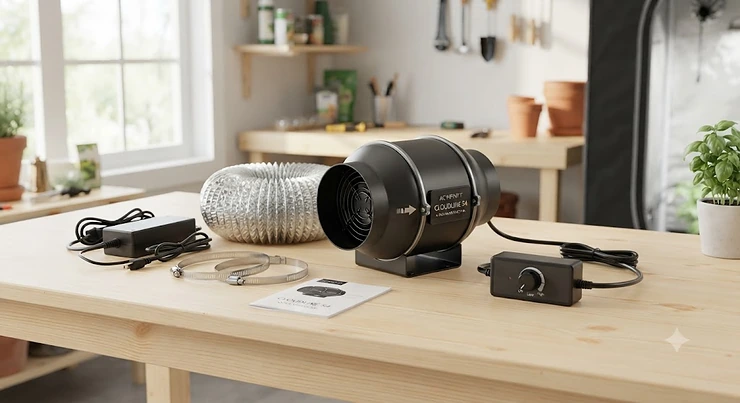
Somewhere between “my grow tent smells like a greenhouse gone rogue” and “my electric bill just doubled” sits the humble 4 inch inline fan with speed controller. It’s not glamorous. Nobody’s hanging a poster of one on their wall. But get the wrong one, and you’ll spend the next three months chasing heat spikes, wilting leaves, and a carbon filter that’s working overtime because your fan is either roaring at full blast or barely limping along.
Here’s the quick definition for anyone skimming: a 4 inch inline fan with speed controller is a ducted fan, sized to fit standard 4-inch ducting, paired with a dial, knob, or app that lets you throttle airflow up or down instead of being stuck at one fixed speed. That single feature — adjustability — is what separates a fan you’ll actually use for years from one you’ll unplug in frustration by week three.
This guide breaks down seven real, currently available models spanning budget AC-motor units to premium EC-motor systems with smart-hub integration. We researched specs, cross-referenced how electronically commutated motors actually work, and pulled aggregated review sentiment so you’re not just reading a rewritten spec sheet. You’ll get honest pros and cons, a size comparison, wiring guidance, and a decision framework for matching a fan to your actual grow space — not just the biggest number on the box.
Whether you’re outfitting your first 2×2 tent or replacing a fan that finally gave out after three seasons, you’ll walk away knowing exactly which 4 inch inline fan with speed controller fits your setup, your budget, and your patience for tinkering with dials.
Quick Comparison Table
| Product | Motor Type | Airflow (CFM) | Noise | Controller Type | Best For |
|---|---|---|---|---|---|
| AC Infinity CLOUDLINE S4 | EC | 226 | 26 dBA | Wired 10-speed + smart hub | Quietest premium pick |
| TerraBloom ECMF-100 | EC | 141-188 | 18-31 dBA | Built-in knob potentiometer | Lab-verified reliability |
| Spider Farmer 4″ GGS | EC | 205 | 26.8 dBA | Dial + GGS smart controller | Automation upgraders |
| Mars Hydro iFresh | EC | 205 | 26.8 dBA | App + physical knob | Phone-based control |
| AC Infinity CLOUDLINE A4 | EC | 165 | 29 dBA | Wired 10-speed | Best value EC option |
| VIVOSUN P4 | AC | 130 | Moderate | Simple manual dial | First-time budget buyers |
| Hon&Guan 4″ Booster | AC | 130 | Moderate | Basic speed controller | Ultra-tight budgets |
Looking at the table, the split is really between EC-motor fans (quieter, more efficient, pricier upfront) and AC-motor fans (louder, cheaper, simpler). The AC Infinity CLOUDLINE S4 leads on raw airflow-per-decibel, while the VIVOSUN P4 and Hon&Guan 4″ Booster trade some refinement for a lower entry price. Notice that CFM numbers alone don’t tell the whole story — a fan rated at 130 CFM with a well-matched carbon filter can outperform a 205 CFM fan choked by kinked ducting, which is exactly why the “Best For” column matters as much as the raw specs.
💬 Already leaning toward one? Bookmark this page and compare prices before you check out — availability shifts fast.
Top 7 4 Inch Inline Fans With Speed Controllers: Expert Analysis
1. AC Infinity CLOUDLINE S4 — quietest EC fan with smart-hub compatibility
The AC Infinity CLOUDLINE S4 is built around a PWM-controlled EC motor, and that single design choice explains almost everything else about it. Rated at 226 CFM with a noise floor around 26 dBA, it moves more air per decibel than nearly anything else in this roundup. Based on the spec comparison, the mixed-flow design with stator blades keeps static pressure loss low even when you’re running it through a carbon filter and 8-10 feet of ducting, which is exactly where cheaper fans start to choke.
It ships with a wired 10-speed controller, but it’s also compatible with AC Infinity’s UIS smart controllers, so growers who eventually want temperature- and humidity-triggered automation aren’t locked out. Reviewers consistently report that the dual ball bearings hold up well over multi-year use, with the most common complaint being the higher upfront cost relative to AC-motor competitors.
What most buyers overlook is that the “quiet” rating is measured at full speed — dial it down to 40-60% for a sealed 2×4 tent and it becomes close to inaudible from outside the room.
Pros:
- ✅ Best airflow-to-noise ratio in this lineup
- ✅ Smart controller upgrade path built in
- ✅ Dual ball bearings rated for long service life
Cons:
- ❌ Priced above most AC-motor alternatives
- ❌ Smart controller sold separately, adding to total cost
Expect to pay in the $70-$90 range for the fan alone, with the smart controller add-on pushing the full automated setup higher — still a reasonable value verdict for anyone running a tent for multiple seasons.
2. TerraBloom ECMF-100 — independently lab-verified specs and metal housing
TerraBloom ECMF-100 stands out for a reason that has nothing to do with marketing copy: the company has its EC motor performance independently verified rather than relying on self-reported numbers. Depending on the exact ECMF-100 revision, airflow ranges from 141 to 188 CFM at 18-21 watts, with a coated-steel housing that resists the rust and warping cheaper ABS-plastic fans develop in humid tents.
Here’s what to weigh: the built-in variable speed controller is a straightforward potentiometer wired inline via a 3.5mm TRRS jack, meaning it’s simple and durable but not app-connected. On paper this means less convenience than a smart-hub fan, but also fewer points of failure.
Aggregated review sentiment points to strong praise for build quality and quiet low-speed operation, with an occasional note that the AC-style rheostat controllers used on other brands are NOT interchangeable with this EC-motor fan’s controller — a compatibility detail worth double-checking before buying a replacement part.
Pros:
- ✅ Independently lab-verified airflow and efficiency numbers
- ✅ Rust-resistant coated-steel housing
- ✅ ETL listed with a 2-year warranty
Cons:
- ❌ Controller isn’t interchangeable with generic AC dimmers
- ❌ Lower CFM ceiling than some 200+ CFM competitors
Priced in the $50-$70 range at the time of research, it’s a strong mid-tier pick for growers who value verified numbers over marketing claims.
3. Spider Farmer 4″ Inline Fan with GGS Controller — best automation on-ramp
The Spider Farmer 4″ Inline Fan with GGS Controller delivers 205 CFM at a claimed 26.8 dBA, putting it right in the same performance tier as the premium EC options above, but at a friendlier price point. Its standout feature is compatibility with Spider Farmer’s GGS ecosystem — the same smart-cable ecosystem that also dims their grow lights — so the fan speed can be set anywhere between 25% and 100% through the same hub controlling other tent equipment.
Based on the spec comparison, that shared-ecosystem approach is the real differentiator here; you’re not just buying a fan, you’re buying a socket into a broader automation system if you already own or plan to own Spider Farmer lighting. Reviewers consistently note smooth low-end speed control and appreciate that the GGS hub isn’t required for basic operation.
A common complaint in user reviews is that the GGS controller itself is sold separately, and buyers who skip it are left with just a manual dial.
Pros:
- ✅ Plugs directly into the broader GGS smart ecosystem
- ✅ Smooth 25-100% adjustable range
- ✅ Works fine on manual dial without the smart hub
Cons:
- ❌ Full automation requires purchasing the GGS controller separately
- ❌ Fewer independent long-term reviews than AC Infinity’s lineup
Expect a price around the $40-$55 range for the fan and basic controller kit, making it one of the better dollar-per-CFM values here.
4. Mars Hydro iFresh 4 Inch Smart Inline Fan — app control plus a physical backup dial
Mars Hydro iFresh 4 Inch Smart Inline Fan runs at 2600 RPM and moves roughly 205 CFM, but what most buyers overlook is the fan’s dual control scheme: a companion smartphone app for remote adjustment, plus a physical variable speed controller so you’re never stuck if your phone dies or the Wi-Fi drops. The EC motor keeps noise around 26.8 dBA, comparable to the Spider Farmer unit above, and the mixed-flow blade design is built for the added resistance of a carbon filter and elbow-heavy ducting runs.
Based on the spec comparison, this is one of the few fans in this price bracket offering genuine app-based scheduling without requiring a separate smart-hub purchase — the app functionality is baked into the fan itself.
Aggregated review sentiment is generally positive on app reliability, though a recurring theme in user reports is that firmware updates occasionally require a re-pair with the fan, a minor but real annoyance for anyone allergic to app maintenance.
Pros:
- ✅ Built-in app control with no separate hub needed
- ✅ Physical dial backup if the app misbehaves
- ✅ EC motor keeps noise close to competitors’ premium tier
Cons:
- ❌ Occasional firmware re-pairing required per user reports
- ❌ App ecosystem newer and less established than AC Infinity’s
At a price typically in the $45-$65 range, it’s a compelling middle ground for growers who want smart features without committing to a full separate smart-hub purchase.
5. AC Infinity CLOUDLINE A4 — the value-tier EC fan
If the S4 is the flagship, the AC Infinity CLOUDLINE A4 is the value trim built on the same underlying EC platform. Rated at 165 CFM and 29 dBA, it trades a bit of top-end airflow and a couple of decibels of quietness for a noticeably lower price, while keeping the wired 10-speed controller and compatibility with AC Infinity’s smart controller accessories.
Here’s what to weigh: for tents in the 2×2 to 2×4 range, 165 CFM is genuinely sufficient, so the A4’s “downgrade” barely matters in practice unless you’re running a larger space or heavy-duty lighting that generates a lot of extra heat. What most buyers overlook is that because it shares AC Infinity’s build quality and dual ball bearings, the A4 tends to outlast cheaper AC-motor fans that cost about the same, making it arguably a smarter buy than shopping purely on brand recognition.
Reviewers consistently point to the same reliable low-speed hum-free operation the brand is known for, with the main gripe being that it’s still priced a notch above true budget AC-motor units.
Pros:
- ✅ Same EC motor platform and build quality as the flagship S4
- ✅ Compatible with AC Infinity’s smart controller upgrades
- ✅ Reliable dual ball bearings for long-term use
Cons:
- ❌ Lower CFM ceiling than the S4 or 205 CFM competitors
- ❌ Costs more than basic AC-motor fans of similar CFM
Typically priced in the $45-$60 range, it’s the pick for anyone who wants AC Infinity’s reputation without paying for the S4’s extra airflow.
6. VIVOSUN P4 4″ Inline Fan & Speed Control — simplest manual dial for first-timers
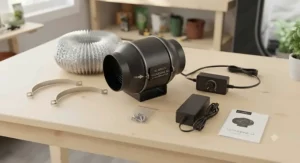
The VIVOSUN P4 4″ Inline Fan & Speed Control keeps things deliberately simple: an AC motor rated around 130 CFM, paired with a basic manual speed control dial and nothing else to configure. Based on the spec comparison, 130 CFM comfortably covers a standard 2×2 or small 2×4 tent, which is exactly the audience this fan is built for — first-time growers who don’t want to think about apps, smart hubs, or firmware. The trade-off with any AC-motor design is that it runs a bit louder and less efficiently at partial speeds than an EC-motor fan of similar airflow, and the motor draws more current for the same output. Aggregated review sentiment describes it as reliable for the price, with a common complaint being that noise becomes noticeable above the 70% speed setting, which matters if your tent sits in a bedroom or shared space.
Pros:
- ✅ Straightforward dial with zero setup required
- ✅ Sufficient airflow for 2×2 and small 2×4 tents
- ✅ Among the most affordable options with a controller included
Cons:
- ❌ AC motor runs louder than EC alternatives at higher speeds
- ❌ Less energy-efficient than EC-motor fans of similar CFM
Priced in the $30-$45 range, it remains one of the best entry points for anyone testing out their first grow tent setup without a big budget commitment.
7. Hon&Guan 4″ Inline Booster Duct Fan with Speed Controller — lowest-wattage budget pick
Rounding out the list, the Hon&Guan 4″ Inline Booster Duct Fan with Speed Controller delivers 130 CFM while drawing only about 6 watts of power, making it the most power-frugal fan in this roundup on paper. Here’s what to weigh: that low wattage figure reflects a smaller AC motor tuned for low-noise operation rather than maximum static-pressure performance, so it’s best matched to a lightly restricted setup — think ducting with minimal bends and a lighter carbon filter, not a long run with multiple 90-degree turns. What most buyers overlook is that “ultra-low power” and “high static pressure capability” are somewhat opposing design goals, and this fan leans toward the former. Reviewers consistently describe it as adequately quiet for closets, small grow cabinets, and light-duty ventilation, with an occasional note that performance drops noticeably once a carbon filter and long ducting run are added to the system.
Pros:
- ✅ Lowest power draw of any fan in this roundup
- ✅ Compact enough for tight closets or small cabinets
- ✅ Speed controller included at a genuinely budget price
Cons:
- ❌ Loses noticeable airflow under filter and ducting resistance
- ❌ Less suited to larger or heavily restricted tent setups
At a price generally under $40, it’s best treated as a light-duty or backup fan rather than the primary exhaust for a filtered, multi-bend ducting run.
Practical Usage Guide: Setup, Wiring & the First 30 Days
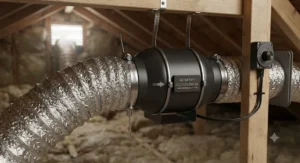
Getting a 4 inch inline fan with speed controller running correctly is less about brute force and more about sequencing. Mount the fan first, oriented so airflow pushes toward your carbon filter and out through the ducting — reversing this is a shockingly common first-time mistake. For controller wiring, most EC-motor fans use a 3.5mm TRRS jack connecting the fan body to a small potentiometer box; plug it in before powering the fan, since some EC units default to 100% speed if the controller isn’t detected on startup. AC-motor fans typically wire the controller inline with the power cord itself, so double-check polarity and make sure the connection sits somewhere accessible, not buried behind ducting where you’ll need pliers to adjust it later.
During the first 30 days, resist the urge to run the fan at maximum speed around the clock — it’s the single most common mistake new growers make, and it dries out the growing medium faster than expected while doing nothing for odor control that a moderate 50-60% speed wouldn’t accomplish. Check ducting clamps weekly for the first month since vibration loosens connections faster than most people expect, and clean the intake grille every couple of weeks to prevent dust buildup from throttling airflow silently over time. If you notice a new rattle or hum after the first week, it’s almost always a loose duct clamp rather than a fan defect — tighten before assuming the worst.
Real-World Scenarios: Matching Fans to Grow Rooms
Consider three growers with different needs. A college student running a single 2×2 tent in a shared apartment cares most about noise — for that setup, the AC Infinity CLOUDLINE S4 or AC Infinity CLOUDLINE A4 dialed down to 40% keeps things nearly silent while still exchanging enough air for a small space, and neither roommate nor landlord notices anything unusual through the wall.
A hobbyist with a 4×4 tent, higher-wattage lighting, and no serious noise constraints benefits more from raw airflow headroom. Here, the 205 CFM tier — the Spider Farmer 4″ Inline Fan with GGS Controller or Mars Hydro iFresh 4 Inch Smart Inline Fan — gives enough capacity to handle the extra heat load from stronger lights, with speed dialed up during lights-on hours and down overnight.
A budget-first grower setting up a single small tent for the first time, with a tight monthly budget and low expectations for automation, is well served by the VIVOSUN P4 4″ Inline Fan & Speed Control or Hon&Guan 4″ Inline Booster Duct Fan with Speed Controller — both keep upfront cost low while still including a real adjustable controller instead of a single fixed speed.
Problem → Solution: Fixing Common Inline Fan Headaches
Problem: The fan is too loud even at low speed. This is almost always a vibration issue, not a motor issue — add rubber isolation mounts or hanging straps rather than assuming you need a quieter fan. Problem: Airflow feels weaker than the CFM rating suggests. Check for kinked ducting or too many 90-degree bends; every sharp bend measurably reduces effective airflow, which is why static-pressure-friendly EC fans like the AC Infinity CLOUDLINE S4 or TerraBloom ECMF-100 hold up better in restrictive setups. Problem: The speed controller stopped responding. For EC-motor fans, check the TRRS jack connection first; a partially seated plug often mimics a dead controller. Problem: Persistent odor despite the fan running. This usually points to an undersized or saturated carbon filter rather than the fan itself — running the fan faster won’t fix a filter that needs replacing. Problem: The fan cycles on and off unexpectedly. On smart or app-connected units like the Mars Hydro iFresh 4 Inch Smart Inline Fan, this is frequently a firmware or Wi-Fi hiccup; the physical backup dial exists precisely for this scenario.
How to Choose a 4 Inch Inline Fan With Speed Controller
Choosing the right adjustable inline fan controller setup comes down to a handful of concrete criteria rather than gut feeling:
- Calculate your tent’s volume first. Multiply length by width by height in feet to get a baseline CFM target before comparing any fans.
- Add resistance factors. A carbon filter and several feet of ducting reduce effective CFM, so buy some headroom above your raw calculated number.
- Decide how much you care about noise. EC-motor fans like the AC Infinity CLOUDLINE S4 cost more but run notably quieter at partial speeds.
- Consider your appetite for automation. If you want temperature-triggered speed changes down the road, prioritize fans with a smart-hub upgrade path.
- Match the controller type to your comfort level. A simple manual dial, like on the VIVOSUN P4, is foolproof; app-based control adds convenience but also a dependency on Wi-Fi and firmware.
- Check physical mounting space. Confirm the fan’s housing dimensions fit your tent’s port and duct height before ordering.
- Budget for the whole system, not just the fan. Ducting, clamps, and a properly sized carbon filter often cost as much as the fan itself.
One common mistake worth flagging on its own: buyers frequently choose a fan based purely on the highest CFM number, without factoring in noise tolerance or ducting resistance, then end up running it well below its rated speed anyway — at which point a quieter, cheaper EC fan set at 70% often outperforms a loud AC fan throttled down to the same effective airflow.
Manual Fan Speed Dial vs Automatic Temperature Control
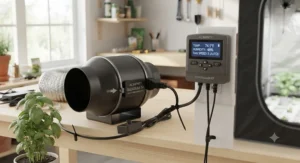
A manual fan speed dial grow tent setup means you physically turn a knob to a fixed setting and leave it there until conditions change enough that you notice and adjust it yourself. It’s simple, cheap, and has almost nothing to go wrong mechanically. Fan speed and temperature control systems, by contrast, use a sensor to automatically raise or lower fan speed in response to real-time temperature or humidity readings — no manual intervention required once it’s configured.
Reviewers consistently note that automatic control shines during seasonal swings, when a tent that runs fine in spring suddenly overheats in summer; the fan compensates without you remembering to check a dial every day. What most buyers overlook is that automatic systems typically require purchasing a separate smart controller module — as with the AC Infinity CLOUDLINE S4 or Spider Farmer 4″ Inline Fan with GGS Controller — on top of the base fan price. For a stable, climate-controlled indoor room, a manual dial on something like the VIVOSUN P4 is often perfectly adequate, and spending extra on automation you’ll rarely use doesn’t improve your actual results.
Features That Actually Matter (And Those That Don’t)
Motor type (EC versus AC) genuinely matters — it affects noise, efficiency, and how gracefully the fan handles partial speeds. Static pressure performance matters more than raw CFM once a carbon filter enters the picture, since a high-CFM fan that chokes under resistance underperforms a modest fan designed for restrictive ducting. Bearing type matters for longevity; dual ball bearings, found in the AC Infinity lineup and TerraBloom ECMF-100, tend to outlast cheaper sleeve bearings over years of continuous runtime.
What doesn’t matter nearly as much as marketing suggests: exact RPM figures in isolation, since RPM without CFM and static-pressure context tells you very little about real-world performance. App connectivity is a genuine convenience but not a performance feature — it doesn’t move more air, it just changes how you control the same motor. And flashy LED indicator rings or app dashboards, while nice to look at, have zero bearing on how well your tent actually ventilates.
4 Inch vs 6 Inch Inline Fans: Which Size Wins?
The variable speed 4 inch fan category exists for a reason: it’s the sweet spot for tents up to roughly 4×4 feet, matching standard 4-inch ducting and carbon filter ports without needing an adapter. Step up to a 6-inch fan and you gain substantially more raw CFM headroom, useful for larger tents, higher-wattage lighting, or setups with long, bend-heavy ducting runs — but at the cost of a bigger footprint, a heavier carbon filter, and typically a higher price across every brand in this roundup.
Based on the spec comparison, if your tent measures 4×4 or smaller and your lighting isn’t unusually hot, a well-chosen 4-inch fan like the AC Infinity CLOUDLINE S4 or Spider Farmer 4″ Inline Fan with GGS Controller covers you with room to spare, dialed down rather than run flat-out. Push past a 4×4 footprint, add a second light, or run ducting through multiple bends and long distances, and the extra capacity of a 6-inch system starts paying for itself in headroom you won’t need to fight for.
What to Expect: Real-World Performance and RPM Adjustment
RPM adjustment is the mechanism, not the outcome — what actually matters is how that RPM change translates into usable airflow and noise in your specific tent. On an EC-motor fan like the Mars Hydro iFresh 4 Inch Smart Inline Fan, running at 2600 RPM at full speed, dialing down to roughly 60% RPM typically cuts noise by several decibels while still exchanging air fast enough for most 2×4 setups — the relationship between RPM percentage and perceived noise isn’t linear, and most of the noise reduction happens in that first 30-40% of dial travel.
In everyday use, that means you’ll likely find a comfortable “sweet spot” setting somewhere between 40% and 70% of max RPM for most tents, adjusting upward during lights-on hours when heat output is highest and back down at night. The spec sheet won’t tell you this, but user reports across EC-motor models suggest that fans rarely need to run at 100% except during unusually hot stretches or when a carbon filter is nearing the end of its service life and adding extra resistance.
Long-Term Cost & Maintenance
Upfront price is only part of the total cost of ownership here. EC-motor fans like the AC Infinity CLOUDLINE S4 and TerraBloom ECMF-100 draw meaningfully less power at partial speeds than AC-motor equivalents, and over a few growing seasons, that efficiency difference can offset a chunk of the higher purchase price — ECM motors are commonly cited as running up to 70% more efficiently than standard AC induction motors in comparable HVAC applications. Maintenance costs are modest across the board: periodic grille cleaning, occasional duct clamp tightening, and eventually replacing worn bearings or, for AC-motor units, potentially the whole fan once bearings degrade since they’re rarely user-serviceable.
Carbon filter replacement is actually the bigger recurring cost in most ventilation setups, typically needed every 12-18 months of continuous use depending on filter quality and fan runtime — budget for that alongside the fan itself rather than treating it as an afterthought. Fans with longer warranties, like the 2-year coverage on the TerraBloom ECMF-100, reduce the risk of an unplanned replacement cost mid-season.
Safety, Electrical Compliance & Controller Wiring
Look for ETL or UL listing on any fan you buy — it’s an independent verification that the electrical design meets recognized safety standards, which matters given these fans run continuously for months at a time in a humid environment. Controller wiring should always be connected before powering on an EC-motor fan; several models default to full-speed operation if the controller isn’t detected, which can be a jarring (and needlessly loud) surprise on first startup. Keep all wiring connections away from standing water or high-humidity zones near a humidifier, and never splice or extend a proprietary speed-controller cable with generic wire — the pinout on 3.5mm TRRS jacks varies enough between brands that mismatched wiring can damage the controller or motor.
Noise exposure is worth a mention too: most of these fans sit well below levels that pose any hearing risk even at close range, but prolonged exposure to sustained loud noise is a recognized occupational health concern worth being mindful of if you’re running larger commercial-scale ventilation in an enclosed grow room for hours at a stretch. For home tent setups, this is rarely a practical concern, but it’s a reasonable data point if you’re scaling up.
✨ Ready to upgrade your tent’s airflow? Compare current pricing on today’s top picks before availability shifts.

Frequently Asked Questions
❓ What size inline fan do I need for a 4x4 grow tent?
❓ Can I use a dimmer switch as a speed controller?
❓ Do 4 inch inline fans work without a carbon filter?
❓ How loud is a 4 inch inline fan on the lowest setting?
❓ Is a smart app-controlled fan worth the extra cost over a manual dial?
Conclusion
There’s no single “best” 4 inch inline fan with speed controller — there’s a best one for your tent size, your noise tolerance, and how much automation you actually want to manage. If quiet, long-term reliability tops your list, the AC Infinity CLOUDLINE S4 earns its higher price tag. If you want independently verified specs and rugged build quality, the TerraBloom ECMF-100 delivers exactly that. Growers chasing smart-hub automation should look at the Spider Farmer 4″ Inline Fan with GGS Controller or Mars Hydro iFresh 4 Inch Smart Inline Fan, while anyone watching their budget closely will find real value in the AC Infinity CLOUDLINE A4, VIVOSUN P4, or Hon&Guan 4″ Inline Booster Duct Fan with Speed Controller.
Whichever you choose, the real performance difference comes down to matching CFM to your actual tent volume, accounting honestly for ducting and filter resistance, and picking a controller style you’ll actually use rather than one that just looks impressive on a spec sheet.
Recommended for You
- 4 Inch Inline Fan vs 6 Inch for Small Tent: 7 Best Picks (2026)
- Quietest 4 Inch Inline Duct Fan for Apartment: 7 Picks (2026)
- 4 Inch Inline Booster Fan for Bathroom Exhaust: 7 Picks for 2026
Disclaimer: This article contains affiliate links. As an Amazon Associate, I earn from qualifying purchases. If you purchase products through these links, we may earn a small commission at no additional cost to you.
✨ Found this helpful? Share it with your friends! 💬🤗
