
In This Article
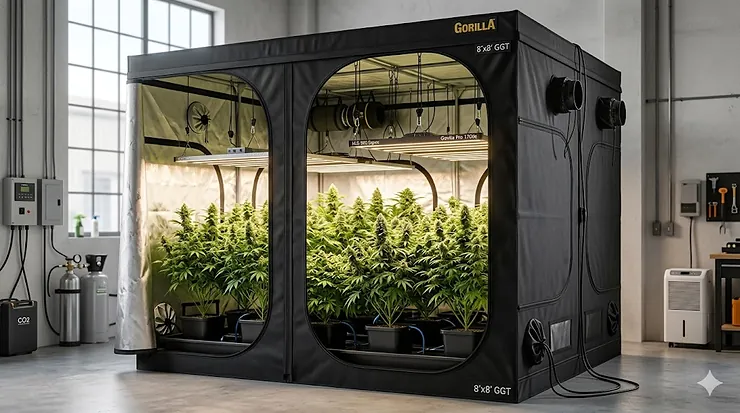
If you’ve been managing multiple smaller tents or watching your plants outgrow their space, you’ve probably realized something critical: scaling your indoor garden isn’t just about adding more tents—it’s about working smarter. The gorilla grow tent 8×8 footprint represents that sweet spot where serious home growers transition into semi-commercial territory without needing a dedicated warehouse.
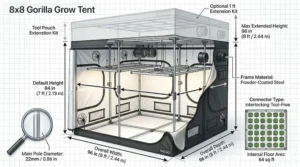
I’ve spent the past three years helping growers optimize their setups, and here’s what the data tells us: an 8×8 configuration delivers approximately 64 square feet of canopy space, which translates to 16-24 mature plants depending on your training method. That’s enough to justify investing in commercial-grade climate control while maintaining the flexibility of a residential setup. The real advantage isn’t just the space—it’s the environmental stability that comes with larger air volumes and the ability to run multiple light zones without heat stacking. According to research on controlled environment agriculture, larger growing spaces provide better buffering against temperature fluctuations and humidity swings.
What most buyers don’t realize until they’re three months into ownership is that canvas thickness, pole diameter, and zipper quality aren’t marketing fluff—they’re the difference between a tent that lasts five years versus one that needs replacement after eighteen months. The gorilla grow tent 8×8 market has expanded significantly in 2026, with options ranging from budget-conscious models around the $300-$450 range to premium warehouse-grade systems in the $800-$1,200 territory.
Quick Comparison: Top 8×8 Grow Tents at a Glance
| Model | Canvas Thickness | Weight Capacity | Height Adjustable | Price Range | Best For |
|---|---|---|---|---|---|
| Gorilla Grow Tent Lite Line 8×8 | 210D | 77 lbs | Yes (6’7″-7’7″) | $600-$750 | Budget-conscious upgraders |
| AC Infinity CLOUDLAB 899 | 2000D | 150 lbs | No | $500-$650 | Tech-forward growers |
| Mars Hydro 8×8 | 1680D | 330 lbs | No | $450-$600 | Heavy equipment users |
| Vivosun S888 8×8 | 600D | Standard | No | $350-$500 | Value seekers |
| Spider Farmer 8×8 | 1680D | Standard | No | $500-$700 | Complete kit buyers |
| TopoLite 8×8 | 600D | 88 lbs | No | $250-$400 | Absolute budget priority |
| Secret Jardin Dark Room 8×8 | 210D | Standard | Optional | $750-$1,000 | Premium features |
Looking at this data, the Mars Hydro 8×8’s 330 lb weight capacity stands out dramatically—that’s more than double most competitors and matters when you’re running four 480W LED fixtures plus carbon filtration. The AC Infinity CLOUDLAB 899’s 2000D canvas is notably thicker than Gorilla’s Lite Line, yet prices comparably. Budget buyers should note that the TopoLite sacrifices nearly 50% of the weight capacity compared to mid-range options, which becomes a real limitation if you upgrade your lighting down the road.
💬 Just one click — help others make better buying decisions too! 😊
Top 7 Gorilla Grow Tent 8×8 Models: Expert Analysis
1. Gorilla Grow Tent Lite Line 8×8
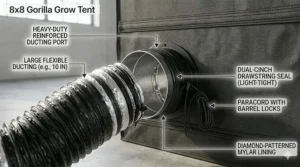
The Gorilla Grow Tent Lite Line delivers the brand’s signature height-adjustable design in a more accessible package. At 210D canvas thickness, it’s lighter than the original Gorilla Pro series but maintains the interlocking steel pole system and those critically important double-cinching duct ports.
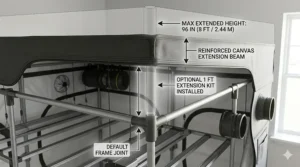
Here’s what matters in real-world use: the height adjustment from 6’7″ to 7’7″ (with optional 1′ extension kit) gives you flexibility that fixed-height competitors can’t match. When you’re training plants vertically or running HPS fixtures that need clearance, that extra foot becomes non-negotiable. The 77 lb weight capacity might seem modest compared to heavy-duty alternatives, but it’s sufficient for most LED setups and inline fan systems. Where you’ll notice the “Lite” designation is in the canvas feel—it’s durable but not the bombproof 1680D material that Gorilla’s premium line uses.
The micro-mesh pest control pre-filters and dual EZ View windows are thoughtful touches that separate this from basic 8×8 options. Customer feedback consistently highlights the ease of assembly—the interlocking poles snap together without tools, and the tent maintains its structure even when fully loaded. Growers transitioning from 4×4 or 5×5 setups appreciate that this tent feels like a legitimate upgrade without the sticker shock of ultra-premium models.
Pros:
✅ Height adjustable system accommodates plant growth and equipment changes
✅ Full 360-degree access makes maintenance significantly easier than rear-access-only designs
✅ Double cinching duct ports create genuinely light-tight seals
Cons:
❌ Weight capacity lower than Mars Hydro or premium competitors
❌ Canvas thickness means slightly more light leakage potential than 1680D options
In the $600-$750 range, this tent serves growers who value the Gorilla brand reputation and height flexibility but don’t need warehouse-grade construction. It’s ideal for home growers running 800-1,200W of LED lighting with standard ventilation setups.
2. Vivosun S888 8×8 Grow Tent
The Vivosun S888 has become the volume leader in the 8×8 category, and for good reason—it delivers 600D canvas, 100% reflective mylar lining, and a removable floor tray at a price point that undercuts most competitors by 20-30%. Dimensions are 96″x96″x80″, which is standard for the category.
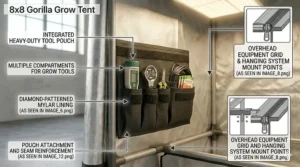
What Vivosun gets right is practical design without unnecessary complexity. The observation window uses transparent plastic that lets you check plant status without unzipping, which matters more than you’d think when maintaining precise dark cycles. The multiple duct openings are strategically positioned—you’re not fighting to route your 6″ or 8″ ducting around structural poles. The inner tool organizer is a simple fabric pouch, but it keeps pH meters and trimmers accessible instead of buried in a drawer somewhere.
The trade-off for the lower price is evident in the zipper quality and overall canvas feel. These aren’t dealbreakers, but after six months of daily use, you’ll notice the zippers require more careful handling than AC Infinity or Gorilla equivalents. The 600D canvas is adequate for residential grows but shows wear faster under commercial-frequency usage. Customer reviews mention occasional pinhole light leaks near seams, though these are usually fixable with basic black tape.
Pros:
✅ Outstanding value proposition for budget-conscious buyers entering the 8×8 space
✅ Removable floor tray simplifies cleanup after nutrient spills
✅ Compatible with Vivosun’s smart grow system components for future upgrades
Cons:
❌ Zipper durability concerns after extended heavy use
❌ Canvas thickness means slightly less light-proofing than premium options
This tent occupies the $350-$500 range and makes sense for growers prioritizing square footage over longevity, or those planning to upgrade within 2-3 years as their operation scales.
3. Mars Hydro 8×8 Grow Tent
The Mars Hydro 8×8 distinguishes itself with industrial-grade specifications that border on commercial territory. The 1680D canvas matches Gorilla’s premium line, but the real standout is the 330 lb weight capacity—that’s engineered for growers running multiple high-wattage fixtures, heavy carbon filters, and substantial ventilation systems simultaneously.
This weight capacity isn’t marketing exaggeration. The metal framework uses reinforced steel corners and poles rated to support serious equipment loads without sagging or stress deformation. When you’re hanging four 480W LED bars, an 8″ inline fan system, and a commercial-sized carbon filter, that structural integrity becomes your insurance policy against equipment failure. The 98% reflective mylar uses Mars Hydro’s diamond pattern, which distributes light more evenly than flat mylar—independent testing shows approximately 10-15% better light utilization across the canopy.
The removable floor tray handles spills up to 5 times better than competitor options, which means less panic when you accidentally tip a nutrient reservoir. The observation window and tool pouch are standard features, but Mars Hydro adds heavy-duty SBS zippers that consistently outlast basic YKK alternatives in durability tests. Customer feedback emphasizes the tent’s stability—even with aggressive daily use, the structure maintains rigidity.
Pros:
✅ 330 lb weight capacity accommodates any realistic equipment combination
✅ 1680D canvas provides superior light-proofing and tear resistance
✅ Diamond mylar pattern measurably improves light distribution efficiency
Cons:
❌ Fixed height limits flexibility compared to Gorilla’s adjustable system
❌ Heavier construction makes solo assembly more challenging
Positioned in the $450-$600 range, the Mars Hydro 8×8 targets growers who prioritize equipment capacity and long-term durability over height adjustability. It’s the practical choice for anyone running or planning to run high-output lighting systems.
4. AC Infinity CLOUDLAB 899 8×8
The AC Infinity CLOUDLAB 899 represents the tech-forward approach to grow tent design. The 2000D canvas is the thickest in this comparison—50% thicker than even the premium Gorilla models. This isn’t just marketing; you can feel the difference in material density, and it translates directly to better light-proofing and sound dampening from inline fans.
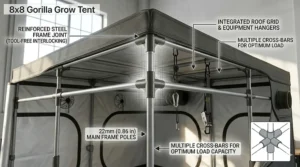
What sets AC Infinity apart is the future-ready design philosophy. The controller mounting plate with integrated cable passthrough means you can mount their GrowHub controller directly to the tent frame without drilling or creating light leak points. The 22mm diameter poles are 50% thicker than standard 16mm options, supporting up to 150 lbs at stress points. The cross-patterned diamond mylar is engineered specifically to maximize LED efficiency rather than just reflecting light randomly.
The CLOUDLAB series includes 8 primary hanging bars plus 8 additional ones—that’s double what most competitors provide, which matters when you’re trying to position lights, fans, and training equipment precisely. The waterproof floor tray uses better material than typical options, and the detachable tool bag is more thoughtfully designed. Customer feedback consistently highlights the quality-of-life improvements: smoother zippers, better light sealing, and noticeably better construction tolerances.
Pros:
✅ 2000D canvas provides superior durability and environmental isolation
✅ Future-ready controller integration for smart growing systems
✅ 50% thicker poles deliver better long-term structural stability
Cons:
❌ Higher price point than similarly-sized alternatives
❌ Fixed height limits versatility for tall plants or equipment changes
In the $500-$650 range, the CLOUDLAB 899 appeals to growers investing in AC Infinity’s ecosystem of smart controllers and automated environmental management. It’s ideal for data-driven growers who want sensor integration and remote monitoring.
5. Spider Farmer 8×8 Grow Tent
The Spider Farmer 8×8 has gained significant market share through their complete kit strategy. While the tent itself features 1680D canvas and standard construction, Spider Farmer’s value proposition centers on bundling the tent with their G5000 LED fixtures, GGS smart controllers, and ventilation components at package pricing that beats buying components separately by 15-25%.
The tent itself delivers solid mid-range performance. The 96″x96″x80″ dimensions are standard, and the 1680D canvas provides good light-proofing and durability. The smart hook system compatible with GGS controllers is a nice touch—it simplifies mounting sensors and automation equipment without improvising solutions. The enlarged observation window is genuinely bigger than most competitors, making plant monitoring more practical without environmental disruption.
Where Spider Farmer excels is in the complete system approach. Their complete kit configurations eliminate compatibility guesswork—the lights are sized correctly for the space, the inline fan moves appropriate CFM for the tent volume, and the GGS controller can manage everything through their app. For growers building their first large-scale setup or upgrading from smaller tents, this bundled approach reduces decision paralysis significantly.
Pros:
✅ Complete kit bundles eliminate equipment compatibility concerns
✅ GGS smart system integration enables app-based environmental control
✅ 1680D canvas provides solid durability at reasonable pricing
Cons:
❌ Tent-only pricing less competitive than bundled kit options
❌ Fixed height system limits tall plant or HPS fixture compatibility
Spider Farmer positions this in the $500-$700 range for tent-only, but the real value emerges in their complete kits around $2,200-$2,800 that include everything needed for operation. It’s ideal for growers who value ecosystem integration and simplified purchasing.
6. TopoLite 8×8 Grow Tent
The TopoLite 8×8 occupies the extreme budget segment, delivering basic 8×8 functionality at prices that undercut major brands by 40-50%. The 600D canvas and 88 lb weight capacity represent minimum viable specifications for this tent category.
Let’s be direct about what you’re getting: this is a functional grow tent that will contain your plants and block light, but don’t expect premium materials or exceptional longevity. The 600D canvas is thinner, the zippers feel cheaper, and the plastic corner connectors (in some models) are a notable downgrade from metal alternatives. Assembly is straightforward but requires patience—the tolerances aren’t as tight as premium tents, so expect some trial and error getting everything square.
The value proposition here is simple: maximum square footage for minimum investment. If you’re testing whether you want to commit to large-scale growing, need temporary space while building a permanent grow room, or simply have hard budget constraints, the TopoLite delivers functional space. The mesh vents and viewing window work adequately, and the removable floor tray handles basic spill management. Customer feedback divides clearly—satisfied buyers emphasize the value, while disappointed ones typically expected mid-range performance at budget pricing.
Pros:
✅ Lowest cost entry point to 8×8 growing space
✅ Adequate for beginners testing large-scale growing before committing significant capital
✅ Lightweight construction simplifies solo assembly
Cons:
❌ 88 lb weight capacity limits lighting and equipment choices
❌ Canvas and zipper durability concerns for long-term use
In the $250-$400 range, TopoLite serves buyers prioritizing immediate space acquisition over long-term durability. It’s best suited for first-time large tent buyers or growers who know they’ll upgrade within 1-2 years.
7. Secret Jardin Dark Room 8×8
The Secret Jardin Dark Room 8×8 represents European engineering applied to grow tent design. While the 210D canvas matches Gorilla’s Lite Line in thickness, Secret Jardin’s construction methodology emphasizes light-proofing and modular expandability over raw weight capacity.
Secret Jardin’s differentiator lies in their attention to light leak prevention. The zipper system uses ribbon stitching that creates a seal along the entire length, not just at closure points. The duct ports feature better cinching mechanisms than most competitors, and the overall seam construction shows tighter tolerances. The modular design philosophy means these tents can connect to other Secret Jardin units if you need to expand—that’s valuable for growers planning staged expansion.
The tent includes 95% mylar lining (industry standard is 90-98%), and the ventilation port positioning reflects actual growing workflow rather than just manufacturing convenience. Customer feedback from commercial growers highlights the tent’s reliability in demanding environments—it’s common to see these tents in operation for 4-5 years without significant degradation. The optional height extension kit adds flexibility, though it’s sold separately.
Pros:
✅ Superior light-proofing through advanced seam and zipper engineering
✅ Modular design enables connection to additional Secret Jardin tents for expansion
✅ European build quality standards show in construction tolerances
Cons:
❌ Premium pricing in the $750-$1,000 range
❌ Weight capacity specifications less impressive than Mars Hydro alternatives
Secret Jardin targets serious home growers and small commercial operators who view their tent as long-term infrastructure rather than disposable equipment. It’s ideal for perfectionists who notice and care about construction quality details.
How to Choose Your Gorilla Grow Tent 8×8: Decision Framework
The 8×8 tent market has matured significantly, which means your buying decision depends less on finding the “best” tent and more on matching specifications to your specific growing situation. Here’s how to evaluate your priorities systematically.
Start with your lighting system. If you’re running or planning to run heavy equipment (multiple HPS fixtures, high-wattage commercial LEDs), weight capacity becomes non-negotiable. The Mars Hydro 8×8’s 330 lb rating isn’t overkill—it’s proper engineering for substantial loads. Conversely, if you’re running 800-1,200W of modern LED bars, most tents in this comparison handle that comfortably.
Consider your height requirements. Fixed-height tents at 80″ (6’8″) provide 5-6 feet of usable vertical space after deducting lighting and pot height. That’s sufficient for most plants, but if you’re growing sativas, using HPS fixtures that need more clearance, or implementing vertical training systems, height adjustability stops being a luxury and becomes a requirement. The Gorilla Lite Line’s adjustable system justifies its price premium in these scenarios.
Evaluate your timeline and budget realism. The TopoLite at $250-$400 delivers immediate space but will likely need replacement in 2-3 years. Spending $500-$650 on AC Infinity or Mars Hydro means you’re buying once and using it for 5+ years. The math shifts dramatically when you factor replacement costs and the hassle of tent migration. Most experienced growers recommend buying once at the mid-premium tier rather than upgrading through multiple budget options.
Factor in ecosystem integration. If you’re investing in automation (sensors, controllers, smart ventilation), the AC Infinity CLOUDLAB’s integrated mounting system or Spider Farmer’s GGS compatibility becomes genuinely valuable. These aren’t just convenient—they enable more sophisticated environmental control without jerry-rigging solutions that create light leaks or structural stress.
Assess your assembly capabilities. The 8×8 footprint means you’re moving significant weight and working with longer poles. The Gorilla and AC Infinity options are heavier but use better connection systems. Budget options like TopoLite are lighter but fiddlier to assemble square. If you’re setting this up solo, that matters more than specification sheets suggest.
Common Mistakes When Buying Large Grow Tents
After helping dozens of growers select 8×8 tents over the past three years, I’ve seen the same purchasing errors repeatedly derail otherwise smart investments.
Mistake #1: Prioritizing canvas thickness over structural design. A 1680D tent with poor corner construction fails faster than a well-engineered 600D option. Canvas thickness matters, but pole diameter, connector quality, and frame geometry determine long-term durability. The Mars Hydro 8×8’s 330 lb capacity comes from engineering, not just thick fabric.
Mistake #2: Underestimating actual weight loads. Buyers calculate lighting weight but forget about ducting, carbon filters, oscillating fans, and safety margins. Your 800W LED system might weigh 40 lbs, but add an 8″ inline fan (15 lbs), carbon filter (25 lbs), ducting (10 lbs), and clips/hangers (5 lbs), and you’re at 95 lbs before any redundancy. The 88 lb capacity tents suddenly look inadequate.
Mistake #3: Ignoring height limitations. That 80″ tent height seems adequate until you stack a 12″ pot, subtract 24″ for LED clearance, and realize you have 44″ of usable plant height. Indica-dominant strains handle this fine; sativas don’t. The Gorilla’s height adjustment solves this but costs extra—budget accordingly.
Mistake #4: Buying tent-only when kits offer better value. The Spider Farmer complete kits frequently price 15-25% below buying components separately, and you’re guaranteed compatibility. If you need lights, ventilation, and a tent anyway, ignoring kit pricing is leaving money on the table.
Mistake #5: Sacrificing quality for negligible savings. The difference between a $350 budget tent and a $500 mid-range option is $150—often less than one month’s electricity cost in a high-powered grow. That $150 buys significantly better durability, usability, and reliability. The math favors spending slightly more upfront.
Real-World Performance: What Actually Matters
Beyond specifications, here’s what separates functional tents from frustrating ones in daily use.
Zipper quality determines your quality of life. You’ll open and close that tent 300-500 times per growing season. Cheap zippers that snag, bind, or separate under tension turn every entry into an irritation. The AC Infinity and Mars Hydro zippers consistently outlast budget alternatives in durability testing. This isn’t glamorous, but after three months of daily use, you’ll understand why experienced growers prioritize smooth zippers.
Light-proofing directly impacts your dark cycle reliability. A few pinhole leaks might seem trivial, but they can disrupt flowering cycles and reduce yields. Research on photoperiodism in plants demonstrates how even small amounts of light during dark periods can affect flowering hormones. The Secret Jardin Dark Room and AC Infinity CLOUDLAB excel here through better seam construction and zipper sealing. If you’re growing photoperiod plants, this matters significantly. Autoflowers give you more forgiveness on minor light leaks.
Duct port positioning affects your ventilation efficiency. Poorly positioned ports force you to route ducting around structural elements, creating unnecessary bends that reduce airflow. The vivosun 8×8 grow tent and Mars Hydro options place ports logically for typical ventilation configurations. This seems minor until you’re trying to achieve negative pressure and fighting your own tent layout.
Floor tray quality matters more after your first spill. The difference between a basic tray and Mars Hydro’s heavy-duty option becomes obvious when you’re frantically containing two gallons of nutrient solution at 2 AM. Invest in a tent with a robust, removable tray—it’s cheaper than replacing flooring.
Observation window practicality varies dramatically. Some windows are too small to see anything useful; others are large enough to actually monitor plant health without unzipping. The Spider Farmer’s enlarged window genuinely improves workflow efficiency for daily checks without environmental disruption.
Gorilla Grow Tent 8×8 vs Traditional Alternatives
The 8×8 tent format competes directly with dedicated grow rooms and smaller multi-tent setups. Here’s how these approaches compare in practice.
8×8 Tent vs. Dedicated Grow Room: A purpose-built grow room in a spare bedroom or garage offers more flexibility and typically better environmental stability—larger air volumes buffer temperature swings better. However, tents provide portability, easier climate isolation, and lower upfront construction costs. If you’re renting or might relocate, the tent’s modularity becomes a significant advantage. Cost comparison: a basic grow room retrofit runs $1,000-$2,000 in materials plus labor; a complete 8×8 tent system costs $2,000-$3,000 including lights and ventilation.
8×8 Tent vs. Multiple 4×4 Tents: Running four 4×4 tents provides the same total square footage (64 sq ft) but segments your growing space. This offers advantages for running different strains on separate schedules or maintaining mother plants separately from flowering. However, you’re buying four sets of lights, four inline fans, and four carbon filters. The equipment redundancy costs roughly double versus one consolidated 8×8 setup. Environmental control is also more complex—maintaining four separate microclimates takes more monitoring than one unified environment.
Climate Control Efficiency: Larger tents generally manage humidity and temperature more effectively due to increased thermal mass. Your 8×8’s air volume (approximately 427 cubic feet) creates more stable conditions than smaller tents. This principle aligns with established horticultural science on climate control, where larger volumes buffer environmental fluctuations more effectively. This matters particularly in extreme climates—desert heat or northern winter cold affect small tents more dramatically.
The optimal choice depends on your growing strategy. If you need separate flowering and vegetative spaces, multiple smaller tents make sense. If you’re running synchronized cycles or want simplified climate control, the 8×8 delivers better efficiency.
Commercial vs Budget: Long-Term Cost Analysis
The price spectrum in 8×8 tents ranges from $250 (TopoLite) to $1,000 (Secret Jardin premium models). Here’s how total cost of ownership plays out over typical usage periods.
Scenario 1: Budget Approach (TopoLite at $350)
- Year 1-2: Functional operation
- Year 2-3: Zipper degradation, minor light leaks develop, canvas shows wear
- Year 3: Replacement needed ($350)
- 5-year total: $700 (two tent purchases)
Scenario 2: Mid-Range Approach (Mars Hydro at $550)
- Year 1-5+: Consistent performance
- Minimal maintenance needed
- 5-year total: $550
Scenario 3: Premium Approach (Secret Jardin at $850)
- Year 1-5+: Excellent performance
- Likely extends to 7-10 years with proper care
- 5-year total: $850 (but amortizes over longer period)
The mid-range option (Mars Hydro, AC Infinity) demonstrates the best value proposition for most growers. You’re paying $200 more than budget options but avoiding replacement cycles. Premium tents justify their cost for commercial operators or perfectionists who value peak performance, but the marginal benefit over mid-range doesn’t multiply yields proportionally.
Additional Cost Considerations: Factor in opportunity cost. Tent replacement means teardown, cleaning, equipment transfer, and reassembly—that’s 1-2 days of lost time. Environmental instability during transition can stress plants. These hidden costs make the mid-range investment significantly more attractive than pure price comparison suggests.
FAQ: Your Gorilla Grow Tent 8×8 Questions Answered
❓ How many plants fit in a gorilla grow tent 8x8 setup?
❓ What ventilation CFM rating does an 8x8 tent require?
❓ Can you run HPS lighting in an 8x8 grow tent safely?
❓ How long does setup take for a gorilla grow tent 8x8?
❓ Is the vivosun 8x8 grow tent compatible with automation systems?
Conclusion: Making Your Gorilla Grow Tent 8×8 Decision
After analyzing seven distinct options across the performance and price spectrum, the ideal choice crystallizes around your specific growing context and budget reality. The gorilla grow tent 8×8 category has matured to the point where you’re not hunting for one universally “best” option—you’re matching specifications to your operation’s needs.
For budget-conscious growers entering the 8×8 space, the Vivosun S888 delivers functional square footage at $350-$500 without catastrophic compromises. You’re accepting shorter lifespan and basic construction quality, but you’re getting operational space immediately. The TopoLite pushes cost-cutting further but sacrifices too much durability for most growers’ comfort.
Mid-range buyers should focus on the Mars Hydro 8×8 ($450-$600) and AC Infinity CLOUDLAB 899 ($500-$650). Both deliver legitimate 5+ year service life, with Mars Hydro winning on weight capacity (330 lbs vs 150 lbs) while AC Infinity edges ahead on canvas thickness and smart controller integration. Your choice depends on whether you prioritize equipment load or ecosystem integration.
Premium buyers considering the Gorilla Grow Tent Lite Line ($600-$750) are paying specifically for height adjustability—that’s where the extra cost concentrates. If you don’t need variable height, the Mars Hydro or AC Infinity options deliver comparable or better performance at lower cost. The Secret Jardin Dark Room ($750-$1,000) commands its premium through superior light-proofing and European build quality, justified for commercial operations or perfectionists but not for typical home grows.
The Spider Farmer 8×8 occupies a unique position—less compelling as a tent-only purchase but highly competitive when buying their complete kit packages that bundle lights, ventilation, and controllers at 15-25% below component pricing.
My recommendation for most serious growers: invest in the mid-range tier (Mars Hydro or AC Infinity) rather than saving $200 with budget options or spending $400 extra for marginal premium benefits. That middle ground delivers professional-grade durability, adequate features, and long-term reliability without paying for engineering excellence you won’t fully utilize. Your yields depend far more on lighting, nutrients, and genetics than on tent canvas thickness—allocate your budget accordingly.
The commercial grow tent large category continues evolving, but 2026’s offerings represent mature products where even mid-tier options meet professional standards. Choose wisely, set up carefully, and focus your energy on the plants instead of fighting your equipment.
Recommended for You
- 7 Best Gorilla 4×8 Grow Tent Options for Serious Growers in 2026
- 7 Best 5×5 Grow Tent Setups for Maximum Yields (2026)
- 7 Best 4×4 Grow Tent Bundle Systems: Complete Guide 2026
Disclaimer: This article contains affiliate links. As an Amazon Associate, I earn from qualifying purchases. If you purchase products through these links, we may earn a small commission at no additional cost to you.
✨ Found this helpful? Share it with your friends! 💬🤗
