
In This Article
Somewhere between “my tent smells like a greenhouse fire” and “my plants are wilting by noon,” most growers discover the same humbling truth: lights and nutrients get all the glory, but airflow is what actually keeps a grow alive. A Vivosun 4 inch inline fan review for grow tent shoppers usually starts here — hunched over a laptop at 1 a.m., trying to figure out whether 195 CFM is enough, whether the EC motor upgrade is worth the extra $20, and whether “quiet” on the box means library-quiet or just quiet-compared-to-a-leaf-blower. We’ve spent the past several weeks digging through spec sheets, aggregated review data, and manufacturer documentation to answer exactly that.
This guide covers seven real 4 inch inline fans — four from Vivosun’s own lineup and three well-regarded alternatives — so you can see how the brand actually stacks up instead of just trusting a listing photo. We’ll walk through airflow and noise numbers, what those numbers mean once ducting and a carbon filter eat into your real-world CFM, and which fan fits which kind of grow. As the University of Connecticut’s Integrated Pest Management program notes in its guidance on greenhouse air circulation, moving air isn’t optional — grower-tested rules of thumb generally call for around 2 cubic feet of fan capacity per minute for every square foot of floor area, and that same logic scales right down to a 2×2 grow tent. Let’s get into it.
Quick Comparison Table
For readers in a hurry, here’s the condensed version before we go deep on each fan.
| Fan | Motor Type | Rated Airflow | Noise Level | Best For |
|---|---|---|---|---|
| Vivosun AeroZesh T4 | EC (PWM) | ~210 CFM | ~28 dB | Best all-around pick |
| Vivosun D4 | AC | 195 CFM | ~30 dB | Tightest budget |
| Vivosun M4 | EC (PWM) | 195 CFM | ~28-30 dB | Simple variable speed |
| Vivosun AeroZesh G4 | EC (PWM) | ~195-210 CFM | ~28 dB | App-upgradeable smart setup |
| AC Infinity Cloudline T4 | EC (PWM) | 205-226 CFM | 26-28 dB | Full climate automation |
| iPower 4″ Lite | AC | 195 CFM | ~30 dB | Cheapest reliable backup |
| Hon&Guan 4″ | DC | 130 CFM | Low (unrated) | Small tents, ultra-quiet |
A few things jump out immediately. Notice that airflow numbers cluster tightly around 195-210 CFM for most mid-tier options — that’s not a coincidence, it’s roughly what a 4 inch duct can physically push before turbulence starts eating your efficiency. The outlier is the Hon&Guan at 130 CFM, which trades raw power for a smaller footprint and lower draw, and the AC Infinity Cloudline T4, which pulls ahead on paper thanks to its mixed-flow EC design. Price isn’t listed here because Amazon pricing shifts constantly — check current listings for exact numbers, but expect the spread to run from budget-friendly to premium as you move down the table.
💬 Just one click — help others make better buying decisions too!😊
Top 7 4 Inch Inline Fans for Grow Tents: Expert Analysis
We picked these seven to represent a real spread: two budget options, three solid mid-range performers (including Vivosun’s flagship EC models), and two premium picks for growers who want app control and climate automation. Every fan here is a real, currently-listed product — no filler, no fictional “Brand X” placeholders.
1. Vivosun AeroZesh T4 — best overall balance of power and control
The AeroZesh T4 is Vivosun’s mainstream EC-motor fan, and it earns the “best overall” tag by not being extreme in any one direction — it’s just consistently good. The PWM-controlled EC motor pairs with the E12 speed controller, giving you ten distinct fan speeds instead of the three or four you get on cheaper AC units.
That matters more than it sounds. A three-speed fan forces you to overshoot or undershoot your target CFM; ten speeds mean you can dial in exactly enough airflow to hold VPD steady without blasting your canopy or running the fan harder (and louder) than necessary. Based on the spec comparison against Vivosun’s own AC-motor models, the EC design also draws meaningfully less power at equivalent airflow, which adds up over a 12-week flowering cycle.
Reviewers consistently report that the T4 runs noticeably quieter than older Vivosun AC fans at similar speeds, and several note the memory function — which recalls your last speed setting after a power outage — as a small but genuinely useful touch you won’t find mentioned on the product photos. What most buyers overlook is that the E12 controller can be upgraded later to the multi-device E42A system, so this fan can grow into a full smart setup without needing to be replaced.
Pros:
- ✅ Ten-speed PWM control for precise airflow tuning
- ✅ EC motor uses noticeably less power than AC equivalents
- ✅ Upgrade path to app-based smart control later
Cons:
- ❌ Costs more upfront than Vivosun’s basic AC models
- ❌ Full smart features require buying a separate controller
Expect the Vivosun AeroZesh T4 to sit in the mid-$50s to mid-$70s range — check current price before buying, since Amazon adjusts these regularly. For most growers running a single 2×4 or 4×4 tent, this is the fan we’d point you toward first.
2. Vivosun D4 — most dependable budget workhorse
The D4 is the fan Vivosun built its reputation on: a straightforward AC-motor inline fan rated at 195 CFM with a 2,500 RPM top speed and a claimed 30 dB noise floor. There’s no app, no PWM curve, no ten-speed dial — just a fan that turns on and moves air.
What the spec sheet won’t tell you, but reviewers note, is that the D4’s flow deflector design genuinely cuts down on the turbulent “whoosh” you get from cheaper axial fans, which is why it lands at 30 dB instead of the 35-40 dB range common on no-name alternatives. The lightweight housing is also a practical win in small tents where every inch of headroom counts — this thing is compact enough to tuck into a corner without stealing canopy space.
Aggregated customer sentiment on the D4 is largely positive, with recurring praise for straightforward installation and consistent long-term operation; a smaller but persistent thread of complaints centers on the lack of variable speed, which forces some growers to pair it with a separate inline controller if they want finer control.
Pros:
- ✅ Lowest price point in Vivosun’s 4 inch lineup
- ✅ Compact housing saves space in small tents
- ✅ Simple, low-maintenance single-speed operation
Cons:
- ❌ No built-in speed control out of the box
- ❌ AC motor draws more power than EC alternatives
The Vivosun D4 typically lands in the mid-$30s to mid-$50s range. If you’re outfitting a single small tent on a tight budget and don’t need granular speed control, this is the pragmatic pick.
3. Vivosun M4 — quietest simple variable-speed option
The M4 splits the difference between the no-frills D4 and the fully-loaded AeroZesh line. It keeps the EC motor and adjustable speed dial but skips the ten-step PWM controller and app connectivity, landing on a simpler analog-style speed knob instead.
Here’s what that trade-off actually buys you: a 195 CFM EC fan that’s easier to operate than the AeroZesh models (turn the dial, done) while still capturing most of the energy efficiency and noise benefits of an EC motor over an AC one. Based on the spec comparison, the M4’s efficiency gains over the D4 are real but modest — you’re paying a premium mostly for quieter, more adjustable operation rather than a dramatic airflow increase.
User reports on variable-speed EC fans in this category consistently flag one thing worth knowing before you buy: turning the speed too low on any EC-motor fan can create a faint high-pitched motor whine that some growers find more annoying than a louder AC fan at full tilt. It’s not a defect, just a trade-off inherent to EC motor design at low RPM.
Pros:
- ✅ True variable speed without a separate controller unit
- ✅ EC motor efficiency at a simpler price point
- ✅ Compact enough for tight tent corners
Cons:
- ❌ Can develop a faint whine at very low speeds
- ❌ Fewer speed steps than the ten-stage AeroZesh controller
Pricing on the Vivosun M4 generally sits in the mid-$40s to low-$60s range. It’s a solid middle-ground pick for growers who want EC efficiency without learning a new controller interface.
4. Vivosun AeroZesh G4 — best app-upgradeable smart fan
The AeroZesh G4 is functionally similar to the T4 on paper — same E12 controller, same PWM-controlled EC motor, airflow rated around 195-210 CFM — but it’s positioned as Vivosun’s flagship for growers who plan to build out a full smart ventilation stack over time.
The standout feature here is the three ON/OFF cycle modes, which let the fan pulse on a schedule to save power during vegetative growth when you don’t need constant max airflow. Based on the spec comparison with the standard T4, the practical difference is mostly about future-proofing: the G4 is explicitly marketed as compatible with Vivosun’s GrowHub app system once you add the E42A multi-device controller, letting you eventually control fan, lights, and humidity from one dashboard.
Reviewers consistently note that the memory function — which restores your last speed after a power blip — works reliably, and several mention appreciating that the fan housing can be detached from the motor for cleaning, a maintenance detail that’s easy to overlook until dust actually builds up on the impeller blades six months in.
Pros:
- ✅ Three cycle modes for scheduled power savings
- ✅ Detachable housing simplifies cleaning and maintenance
- ✅ Clear upgrade path into Vivosun’s full app ecosystem
Cons:
- ❌ Smart features are locked behind a separate controller purchase
- ❌ Marginal airflow gain over the T4 for the price jump
Expect the Vivosun AeroZesh G4 to run from around $70 into the low $90s. Growers who know they’ll eventually want app-based automation should start here rather than upgrading later.
5. AC Infinity Cloudline T4 — premium pick for full climate automation
Stepping outside the Vivosun lineup, the Cloudline T4 is the fan most frequently cross-shopped against Vivosun’s AeroZesh line, and for good reason — it’s built by a company that’s arguably done more than anyone to popularize smart inline fans for home growers. Airflow specs vary slightly by listing (205 to 226 CFM depending on the exact SKU), paired with a quoted noise floor as low as 26 dB.
What sets it apart isn’t raw CFM — it’s the bundled Controller 69 Pro, which handles dynamic temperature, humidity, and VPD-based programming out of the box, no separate purchase required. Based on the spec comparison, this is the single biggest functional gap between the Cloudline T4 and Vivosun’s AeroZesh fans: Vivosun makes you buy the smart controller separately, while AC Infinity includes it standard.
Aggregated reviews are strongly positive on build quality and app reliability, with growers frequently mentioning they’d buy AC Infinity again for future tents. The recurring critique, understandably, is price — this fan costs meaningfully more than any Vivosun option on this list, which matters if you’re outfitting multiple tents rather than just one.
Pros:
- ✅ Smart temperature and humidity controller included standard
- ✅ WiFi app access with historical climate data export
- ✅ Dual ball bearings rated for extended continuous runtime
Cons:
- ❌ Noticeably higher price than comparable Vivosun models
- ❌ Overkill for growers who just want basic on/off airflow
The AC Infinity Cloudline T4 typically runs from around $95 up into the $130-plus range depending on the bundle. It’s the fan to buy if automation matters more to you than saving $40.
6. iPower 4″ Lite — cheapest reliable backup fan
The iPower 4 Inch Lite is the closest direct competitor to the Vivosun D4 — same 195 CFM rating, same 2,500 RPM, same 30 dB noise claim, and a nearly identical AC-motor architecture. If the D4 is sold out or you want a second fan as backup, this is the natural substitute.
Spec-for-spec, there’s very little daylight between this fan and Vivosun’s budget offering; both draw around 28W at 0.45A. Based on the spec comparison, the practical decision often comes down to brand loyalty and current pricing rather than any meaningful performance gap — these two fans are close enough that picking between them is more about deal-hunting than engineering.
Aggregated review sentiment describes the iPower Lite as functionally solid but positions it as a “gets the job done” fan rather than one that inspires enthusiasm — a common theme in budget AC inline fans generally, where reliability is the main selling point rather than standout features.
Pros:
- ✅ Nearly identical specs to Vivosun’s D4 at a similar price
- ✅ Removable duct ends simplify maintenance access
- ✅ Widely available as a same-day backup option
Cons:
- ❌ No variable speed control included
- ❌ Offers little differentiation from Vivosun’s comparable models
Pricing sits in the low-$30s to mid-$40s range. Good as a second fan for redundancy, or as a fallback if Vivosun stock is thin.
7. Hon&Guan 4″ — quietest option for small, sound-sensitive tents
The Hon&Guan is the outlier on this list — rated at just 130 CFM and 6W of power draw, it’s built for smaller enclosures where a 195+ CFM fan would be overkill and unnecessarily loud. If you’re running a 2×2 tent in an apartment bedroom, this is worth a look.
The low power draw isn’t a limitation so much as a design choice: at 130 CFM, this fan is sized for smaller grow volumes where the University of Connecticut’s circulation guidance of roughly 2 CFM per square foot of floor area still gets satisfied without needing a fan rated for a 4×4 or larger space. Based on the spec comparison, this fan simply isn’t trying to compete with the 195-plus CFM crowd — it’s solving a different problem.
Reviewers in this lower-CFM category consistently highlight noise as the deciding factor over raw airflow, and Hon&Guan’s DC-motor design is frequently described as noticeably quieter at comparable speeds than budget AC alternatives, though independently verified dB ratings are harder to pin down than with the bigger, more heavily reviewed brands.
Pros:
- ✅ Ultra-low 6W power draw
- ✅ Compact size fits small or oddly-shaped spaces
- ✅ Quieter operation than most budget AC fans
Cons:
- ❌ Insufficient airflow for tents 4×4 and larger
- ❌ Smaller, less established review base than major brands
Expect the Hon&Guan 4″ to run under $35 in most listings. It’s a smart pick specifically for compact tents — not a general-purpose replacement for the bigger names on this list.
Practical Usage Guide: Setting Up Your Inline Fan Correctly
Buying the right fan is half the battle — installing it wrong undoes most of the benefit. Here’s what actually matters in the first 30 days.
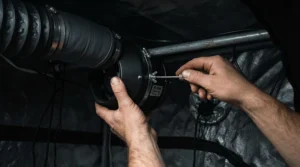
Mount your fan as close to the top of the tent as possible, ideally just outside the exhaust port, with the airflow direction arrow (printed on the housing) pointing away from the tent. Getting this backward is a surprisingly common first-time mistake, and it’s an easy one to catch: if your tent is inflating like a balloon instead of sucking in slightly at the seams, the fan is likely mounted backward or your intake is undersized.
Keep ducting runs as short and straight as possible. Every 90-degree bend meaningfully cuts your real-world CFM compared to the rated number on the box, which is measured in a straight-line lab test, not through six feet of kinked flexible ducting. If you’re running a carbon filter (and most growers should be, for odor control), budget for a further airflow reduction. Activated carbon works through adsorption, trapping odor molecules across the carbon’s enormous internal surface area rather than simply blocking them like a mechanical filter — which is effective, but it also means that “195 CFM” fan realistically delivers noticeably less once air has to push through activated carbon and a couple of bends.
For maintenance, wipe down the intake grille monthly to prevent dust buildup from restricting airflow, and inspect the impeller blades every few months if your fan housing detaches for cleaning (several models on this list, including the AeroZesh G4, are designed with this in mind). A fan running at 80% capacity because of dust buildup will quietly cost you climate control precision without ever throwing an obvious warning sign.
Real-World Scenarios: Which Fan Fits Your Grow
Specs only tell half the story — matching a fan to your actual situation tells the rest.
Consider a college student running a single 2×2 tent in a shared apartment, where noise discretion matters as much as airflow. For that setup, the Hon&Guan 4″ or a low-speed setting on the Vivosun M4 makes more sense than a 200-plus CFM fan that’s fighting against a tiny enclosed volume — you’d just be running it at 20% speed anyway, so why pay for headroom you’ll never use.
Now picture a more serious home grower running a 4×4 tent with a carbon filter and a light-mover, where consistent VPD control across a full flowering cycle matters. That’s the sweet spot for the Vivosun AeroZesh T4 or G4 — enough airflow to overcome filter resistance, plus the speed granularity to fine-tune without overcorrecting.
Finally, think about a grower managing two or three tents at once who wants centralized monitoring rather than checking each fan manually. That’s where the AC Infinity Cloudline T4’s app ecosystem earns its higher price tag — the ability to view historical climate data and set automated triggers across multiple devices genuinely saves time once you’re past a single-tent setup.
How to Choose a 4 Inch Inline Fan for Your Grow Tent
Cutting through marketing copy, here’s the actual decision framework, based on the University of Connecticut Extension’s circulation guidance and the ventilation-rate math outlined by the University of Vermont Extension’s greenhouse engineering program, scaled down to grow-tent size.
- Calculate your base CFM need first. A commonly used baseline is tent volume divided by a target air-exchange time (often one to three minutes), giving you a rough minimum CFM before accounting for accessories.
- Add 30-60% for ducting bends. Every 90-degree turn in flexible ducting reduces effective airflow — the more bends, the more oversized your fan rating needs to be.
- Add roughly 60% more if running a carbon filter. Filters are essential for odor control but they’re also the single biggest airflow tax in most setups.
- Decide how much speed control you actually need. A single-speed AC fan is fine for growers who set it and forget it; anyone chasing tight VPD targets benefits from PWM or EC variable speed.
- Weigh noise against your living situation. A fan rated 26-28 dB genuinely sounds different from one rated 30-plus dB in a bedroom-adjacent tent — trust the lower number when sound matters.
- Factor in future upgrades, not just today’s setup. If you might add a second tent or want app control eventually, a fan with an available controller upgrade path (like the AeroZesh line) saves you from buying twice.
- Compare warranty and return policies, not just price. A cheaper fan that dies in month eight and can’t be returned easily isn’t actually cheaper.
Vivosun T4 Fan Performance Test: What the Airflow Numbers Actually Mean
Every fan on this list lists a CFM rating, but that number is measured under ideal lab conditions — straight ducting, no filter, no bends. Real-world performance looks different, and understanding the gap matters more than chasing the biggest number on the box.
At its rated ~210 CFM, the AeroZesh T4’s EC motor and mixed-flow design are engineered specifically to maintain airflow better under static pressure than a basic axial fan would — this is the “high static pressure” language you’ll see in inline fan marketing, and it’s not just buzzwords. Based on the spec comparison against AC-motor competitors at similar CFM ratings, EC mixed-flow fans generally lose less airflow once a carbon filter is added to the system, which is precisely the scenario most grow tent owners are actually running.
In practical terms, that means a 210 CFM-rated EC fan paired with a filter and a couple of duct bends may realistically deliver something closer to 130-160 CFM of usable airflow — still enough for a standard 4×4 tent under the UConn Extension’s 2 CFM-per-square-foot circulation guidance, but a useful reality check against expecting the sticker number in practice. Reviewers consistently note that airflow “feels” strongest on speeds 7 through 10 on the E12 controller, with the lower settings better suited to seedling and early vegetative stages where gentle circulation is the goal, not maximum exchange.
Vivosun 4 Inch Pros and Cons: The Honest Rundown
Zooming out from individual models, here’s how the Vivosun 4 inch lineup performs as a whole compared to the market.
On the pro side, Vivosun consistently offers a genuine range across price points — the D4, M4, T4, and G4 give you a legitimate upgrade path from bare-bones AC to fully smart EC without switching brands, which matters if you’re building out a multi-tent operation and want consistent parts and support. The E12 controller’s memory function and multi-speed control are also standout features that punch above the typical budget-brand feature set.
On the con side, the most consistent theme across reviews is that Vivosun’s smart-home ecosystem (GrowHub app, E42A controller) requires separate purchases that competitors like AC Infinity bundle standard, which can make total cost of a fully automated setup less straightforward to calculate upfront. There’s also a real, if modest, CFM ceiling across the 4 inch lineup — none of the Vivosun 4 inch fans meaningfully exceed the 195-210 CFM range, so growers with larger tents or heavier filtration may need to look at Vivosun’s 6 inch options instead, or accept the airflow trade-offs discussed above.
Taken together, Vivosun’s 4 inch fans are a strong default choice for single-tent growers who want a legitimate upgrade path without switching ecosystems, but shoppers chasing maximum CFM or bundled smart controls out of the box have reasons to cross-shop AC Infinity specifically.
Vivosun Fan Durability Review: Long-Term Cost and Maintenance
Airflow numbers get all the attention, but total cost of ownership is where a fan either earns its price tag or quietly disappoints you eighteen months in.
EC motors, present in the M4, T4, and G4, generally draw less power than the AC motor in the D4 at comparable airflow — over a full year of near-continuous operation, that efficiency difference can meaningfully offset the higher upfront price of the EC models, especially for growers running lights and fans on the same circuit where every watt matters for the electric bill. Vivosun backs its fans with a manufacturer warranty, which reviewers note is straightforward to invoke for DOA units, though response times for wear-related issues later in the warranty period get mixed feedback.
On the maintenance side, dust and grow-room humidity are the two biggest long-term threats to any inline fan’s bearings and motor windings — not manufacturing defects. Fans with detachable housings, like the AeroZesh G4, have a real durability advantage here simply because they’re easier to actually clean, and growers who never open up their fan to check the impeller are the ones most likely to see gradual airflow decline over a grow cycle or two. If you want your fan to hit its full rated lifespan, monthly grille cleaning and an occasional impeller check aren’t optional extras — they’re the difference between a fan that lasts three grow cycles and one that lasts eight.

Common Mistakes When Buying a 4 Inch Inline Fan
A few recurring errors show up across grower forums and review threads, and most are avoidable with a little forethought.
The biggest one is buying strictly on CFM number without accounting for filter and ducting losses — a grower comparing a 130 CFM fan to a 210 CFM fan on paper often doesn’t realize the effective gap narrows considerably once real-world resistance is factored in, leading to disappointment with an “underpowered” fan that was actually sized correctly. A close second is skipping variable speed entirely to save money, then discovering mid-grow that full-speed airflow is too aggressive for delicate seedlings, forcing an awkward workaround with cardboard baffles or a separate speed controller purchased after the fact.
Another common misstep is ignoring noise ratings until after the fan is already running next to a bedroom wall — a difference of just a few dB sounds trivial on a spec sheet but is very noticeable in a quiet room at 2 a.m. Finally, plenty of buyers underestimate how much a carbon filter changes airflow requirements, sizing a fan for the empty tent rather than the fully-equipped one with a filter and multiple duct bends attached.
Benefits vs. Traditional Alternatives
How does a dedicated inline fan stack up against a simple box fan or passive venting setup?
| Factor | Inline Duct Fan | Box Fan / Passive Vent |
|---|---|---|
| Airflow Control | Precise, ducted, filterable | Loose, unfiltered, hard to direct |
| Odor Control | Compatible with carbon filters | Not compatible |
| Noise Management | Variable, often 26-30 dB | Fixed, often louder at comparable CFM |
| Space Efficiency | Compact, mounts outside canopy | Takes up floor or shelf space |
| Best For | Sealed tents, odor-sensitive spaces | Open-air rooms, minimal budget |
The table makes the case pretty clearly: an inline fan is purpose-built for the sealed, filtered environment a grow tent creates, while a box fan is really a stopgap for open-air circulation rather than true exhaust ventilation. If odor control or precise climate management matters to you at all, a dedicated inline fan isn’t a luxury upgrade — it’s closer to a baseline requirement, since box fans simply can’t be paired with a carbon filter or ducted outside the room.
Safety and Electrical Considerations for Grow Tent Fans
Running a fan continuously for months at a time means electrical safety deserves more attention than it usually gets in grow guides.
Avoid daisy-chaining your inline fan through multiple extension cords or an overloaded power strip shared with grow lights and humidifiers. The U.S. Consumer Product Safety Commission warns that overloaded extension cords and power strips present a serious fire hazard, and that these fires typically start because of short circuits, too many products plugged into one cord, and damaged cords — a genuinely relevant risk in a tent running lights, a fan, and a humidifier off the same outlet for months on end. Where possible, plug your fan’s controller directly into a wall outlet or a single dedicated, properly-rated power strip rather than stacking adapters.
Look for fans with visible safety or testing certifications on the housing, inspect the power cord periodically for fraying or heat discoloration near the plug, and never operate an inline fan with a damaged cord — replace it rather than repair it with tape. In a humid grow tent environment, keeping cord connections elevated off any wet surfaces and away from direct water exposure from misting or reservoir spills is a simple habit that meaningfully reduces shock and fire risk over a long grow cycle.
4 Inch Inline Fans for Small vs. Large Grow Tents
Tent size changes the calculus on which fan actually makes sense, so it’s worth breaking out explicitly.
For 2×2 and 2×4 tents, the lower end of this list — the Hon&Guan 4″ or a Vivosun M4 run at reduced speed — is usually plenty. Oversizing here just means running an expensive fan at 20% capacity permanently, which wastes both money and the fine control you paid for.
For 4×4 tents, which represent the most common home-grow footprint, the mid-tier options shine: the Vivosun AeroZesh T4, G4, or the AC Infinity Cloudline T4 all comfortably clear the airflow needed even after accounting for filter and ducting losses, while still offering enough speed range to dial back during vegetative growth.
For anyone pushing toward 5×5 tents or larger, or running two carbon filters in series, it’s worth being honest that every fan on this list is working near its practical ceiling — that’s the point where stepping up to Vivosun’s 6 inch inline fan lineup, rather than trying to stretch a 4 inch fan further than it’s built for, becomes the more sensible move.

Frequently Asked Questions
❓ Is a 195 CFM Vivosun fan enough for a 4x4 grow tent?
❓ How loud is the Vivosun AeroZesh T4 at full speed?
❓ Do Vivosun 4 inch fans work with carbon filters?
❓ What's the difference between Vivosun's D4 and T4 fans?
❓ Can I run a Vivosun inline fan 24/7 during flowering?
Conclusion
If there’s one takeaway from putting these seven fans side by side, it’s that the “best” 4 inch inline fan really does depend on which grower you are. Budget-conscious first-timers with a single small tent are well served by the Vivosun D4 or iPower Lite. Growers who want precision and a future upgrade path should look at the AeroZesh T4 or G4. And anyone who wants climate automation bundled in from day one, and doesn’t mind paying for it, should seriously consider the AC Infinity Cloudline T4.
What matters more than any single spec is matching fan capacity to your actual tent size, filtration setup, and noise tolerance — an oversized fan running at 20% speed forever is just as much of a mismatch as an undersized one straining to keep up. Use the CFM math from the “How to Choose” section above, be honest about your ducting and filter losses, and you’ll land on a fan that actually fits your grow rather than just the biggest number on the box.
Recommended for You
- Vivosun 4 Inch Fan and Filter Combo: 7 Best Picks For 2026
- Cheapest Vivosun 4 Inch Inline Fan: 7 Budget Picks For 2026
- AC Infinity Cloudline 4 Inch for Closet Grow Tent: 7 Picks for 2026
Disclaimer: This article contains affiliate links. As an Amazon Associate, I earn from qualifying purchases. If you purchase products through these links, we may earn a small commission at no additional cost to you.
✨ Found this helpful? Share it with your friends! 💬🤗
