
In This Article
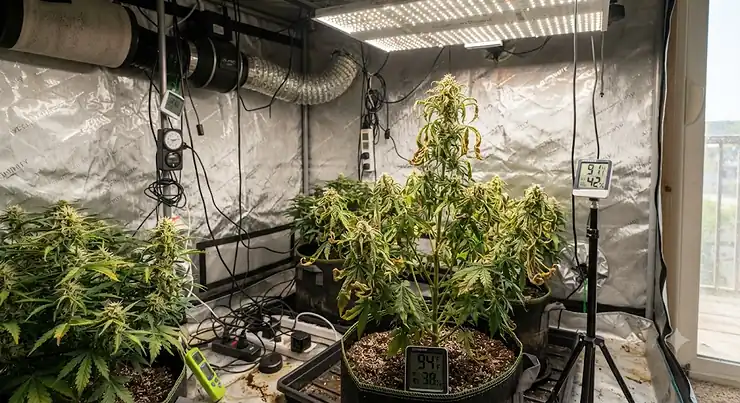
Somewhere between “the lights just turned on” and “why is my thermometer reading 91°F,” every indoor grower runs into grow tent temperature problems. It’s almost a rite of passage. Your canopy looks great one week, then a heat wave (or a cold snap) rolls through and suddenly your leaves are taco-ing, your soil dries out in six hours instead of two days, or growth just stalls for no obvious reason. The tent itself isn’t broken — it’s just doing exactly what an enclosed nylon box does: trapping whatever temperature you feed it, good or bad.
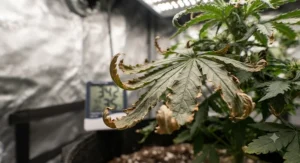
What is grow tent temperature? In practical terms, it’s the ambient air temperature inside your enclosed grow space, typically measured at canopy height, which needs to stay within a specific range (usually 65-85°F) depending on your plant’s growth stage and lighting setup.
The good news is that grow tent heat issues are almost always fixable with the right combination of ventilation, circulation, and — depending on your climate — supplemental cooling or heating. This guide walks through real, currently available equipment for both directions of the problem: summer cooling strategies for when your grow room turns into a sauna, and winter heating solutions for when your basement or garage drops below what your plants can tolerate overnight. Along the way, we’ll cover optimal temperature ranges by growth stage, what actually makes a grow tent energy efficient, and which products are worth your money versus which ones are marketing noise. According to University of Maryland Extension’s guidance on indoor plant environments, even ordinary houseplants suffer measurable stress from temperature swings and drafts — and a sealed grow tent amplifies that sensitivity considerably.
Quick Comparison Table
Before diving into the full breakdown, here’s a fast snapshot of the seven products covered in this guide, organized by what problem each one actually solves.
| Product | Category | Price Range | Best For |
|---|---|---|---|
| AC Infinity CLOUDLINE PRO T6 | Smart exhaust fan | $150–$190 range | Automated heat exhaust with app control |
| AC Infinity CLOUDLINE S6 PRO | Manual exhaust fan | Under $110 | Budget-friendly ventilation |
| VIVOSUN AeroWave E6 Gen2 | Circulation fan | $40–$60 range | Eliminating hot spots cheaply |
| Inkbird ITC-308 | Dual-stage thermostat | Under $50 | Automating a heater and fan together |
| Whynter ARC-14SH | Portable AC/heater combo | $450–$550 range | Year-round climate control in one unit |
| AC Infinity Controller 69 Pro | Smart environmental hub | Around $90 | Coordinating multiple devices automatically |
| Gorilla Grow Tent 4×4 | Insulated tent structure | $350–$450 range | Reducing temperature swings passively |
Looking at the table, notice that the fixes split into two camps: devices that move air (the fans) and devices that actively change air temperature (the AC/heater and the thermostat that drives them). Most growers dealing with grow tent temperature problems actually need one from each camp, not just a bigger fan — a common and expensive mistake we’ll unpack later. The tent itself, meanwhile, is the one item on this list that reduces the size of the problem before any electronics get involved.
💬 Bookmark this comparison — it’ll save you from buying the wrong piece of gear twice.😊
Top 7 Grow Tent Temperature Solutions: Expert Analysis
1. AC Infinity CLOUDLINE PRO T6 — smart auto-adjusting exhaust fan
The standout feature here is that the AC Infinity CLOUDLINE PRO T6 doesn’t wait for you to notice the tent is overheating — it reacts on its own. The fan pairs a 6-inch inline duct fan with a built-in temperature, humidity, and VPD controller, so it automatically ramps its speed up or down based on live conditions inside your tent, and it can be managed remotely through AC Infinity’s WiFi app.
In practice, that automated ramping matters more than the raw CFM number on the box. A fan that runs at full blast 24/7 dries out your medium and stresses plants just as much as one that’s undersized; the CLOUDLINE PRO T6‘s dynamic speed control means it only pushes hard when your tent actually needs it, which keeps both temperature and humidity closer to your target range without constant manual adjustment. Based on the spec comparison with fixed-speed inline fans, the smart controller alone justifies most of the price premium for anyone running lights hot enough to spike temperatures during the day.
Reviewers consistently note the fan runs noticeably quieter than earlier AC Infinity generations, and several growers report the app’s alert notifications catching temperature spikes before they’d have noticed on their own. A few users mention the WiFi setup can be fiddly on certain router configurations — worth knowing before you assume plug-and-play.
Pros:
- ✅ Automatically adjusts speed to real-time temperature and humidity
- ✅ WiFi app control with remote alerts for spikes
- ✅ Dual ball bearing motor rated for long service life
Cons:
- ❌ App/WiFi pairing can be inconsistent on some networks
- ❌ Premium price compared to manual-speed inline fans
At around $150–$190, the AC Infinity CLOUDLINE PRO T6 isn’t the cheapest exhaust fan on this list, but for anyone tired of manually tweaking fan speed every time the weather shifts, it’s a genuinely strong value.
2. AC Infinity CLOUDLINE S6 PRO — same core motor, budget-friendly controller
The short version of the AC Infinity CLOUDLINE S6 PRO‘s appeal: you get the same underlying EC motor and mixed-flow fan design as the pricier smart models, minus the automated sensor package.
Instead of app-based automation, this unit ships with a wired 10-speed manual controller, letting you dial in airflow by hand and lock it in. For a 4×4 tent, that’s plenty of exhaust capacity to clear heat generated by a mid-range LED fixture, and the EC motor still runs quieter and more efficiently than older AC-motor fans in this size class. What most buyers overlook about the “PRO” naming is that it doesn’t mean weaker performance — it means you’re doing the temperature monitoring yourself with a separate thermometer or thermostat, which is exactly the kind of pairing we’ll cover in the Inkbird section below.
Aggregated reviews are largely positive, with growers frequently praising the noise level relative to older inline fans they’d previously used, though a handful of buyers note the plastic mounting clips feel less substantial than the metal hardware on higher-tier models.
Pros:
- ✅ Same EC motor efficiency as premium CLOUDLINE models
- ✅ Simple 10-speed manual dial, no app required
- ✅ Quieter operation than older AC-motor inline fans
Cons:
- ❌ No automated temperature/humidity response
- ❌ Mounting hardware feels less premium than PRO+ lines
Priced under $110, the AC Infinity CLOUDLINE S6 PRO is the fan to buy if you’d rather spend your remaining budget on a dedicated thermostat instead of paying extra for a built-in one.
3. VIVOSUN AeroWave E6 Gen2 — energy-efficient circulation that kills hot spots
The VIVOSUN AeroWave E6 Gen2‘s standout trait is its EC motor efficiency: 320 CFM of airflow at just 33 dB(A), sipping power compared to older AC-motor clip fans that ran louder and hotter for similar output.
Here’s the thing exhaust fans can’t fix on their own — a tent can have perfectly balanced intake and exhaust and still develop a hot, stagnant pocket right where your canopy sits, because ventilation moves air through the tent while circulation moves air around inside it. The AeroWave E6 Gen2 solves that second problem specifically, oscillating across the canopy to prevent the kind of localized hot spots that show up as crispy leaf edges on one side of the tent and fine growth on the other. Reviewers note that the “natural wind” mode, which varies fan speed instead of holding one constant setting, seems to reduce leaf-clawing stress compared to a fan blasting continuously at one speed — though as with most anecdotal grower feedback, results vary by setup.
The IP54 weatherproof rating means it tolerates the humidity spikes that come with early flowering or added humidifiers, and the clamp mechanism holds securely on both round poles and square tent frames.
Pros:
- ✅ 320 CFM airflow at a whisper-quiet 33 dB(A)
- ✅ IP54 weatherproof rating tolerates high humidity
- ✅ Auto-oscillation prevents canopy-level hot spots
Cons:
- ❌ Clamp works best on poles under roughly 1 inch thick
- ❌ Smart app features require a separate GrowHub controller
At roughly $40-$60, the VIVOSUN AeroWave E6 Gen2 is one of the cheapest fixes on this list for a genuinely common problem — and arguably the single best return-on-investment item here if your issue is uneven canopy temperature rather than overall heat.
4. Inkbird ITC-308 — the $50 fix for manual thermostat guesswork
The Inkbird ITC-308‘s core trick is dual-relay output: one outlet for a heating device, one for a cooling device, both driven off a single temperature probe.
Instead of manually checking a thermometer and flipping switches, you plug your space heater into one side and your exhaust fan (or portable AC) into the other, set your target range, and the ITC-308 handles the rest — energizing whichever device is needed to pull the tent back toward your setpoint. Based on the spec comparison with pricier WiFi-enabled controllers, the tradeoff here is that you lose remote app monitoring, but you gain a controller that’s dead simple to wire in and has been a staple in home-brewing and reptile-keeping circles for years, which speaks to its reliability track record outside the cannabis-specific market.
Reviewers report the compressor-delay protection feature is a genuine safeguard, preventing rapid on/off cycling that can burn out cooling equipment, and the buzzer alarm for out-of-range temperatures gets frequent praise as a “why doesn’t every controller have this” feature. A minority of users note the probe cable is shorter than ideal for larger tents.
Pros:
- ✅ Dual relay runs a heater and cooler from one probe
- ✅ Compressor-delay protection prevents equipment damage
- ✅ High/low temperature alarm with audible buzzer
Cons:
- ❌ No WiFi or app monitoring on the base model
- ❌ Probe cable length can be limiting in larger tents
Under $50, the Inkbird ITC-308 is the cheapest way to fully automate the swing between heating and cooling equipment, and it’s the backbone product for several of the setups we’ll walk through later in this guide.
5. Whynter ARC-14SH — one machine for both summer and winter
The Whynter ARC-14SH‘s headline feature is genuinely rare in this category: it’s a dual-hose portable air conditioner and a 13,000 BTU heater in the same unit, meaning it addresses grow tent temperature problems in both directions without buying two separate machines.
At 14,000 BTU cooling (9,200 BTU SACC under current DOE testing standards), the unit is sized for spaces up to 500 square feet, which is considerably more than most single or double grow tent setups need — so for a 4×4 or 5×5 tent, expect it to cool (or heat) quickly with headroom to spare, rather than running flat-out constantly. That headroom matters for equipment longevity: an AC unit that’s oversized for the space cycles on and off rather than running continuously at max load, which reduces wear. The dual-hose design also draws intake air from outside the room rather than depressurizing your grow space, which is meaningfully more efficient than the single-hose portable units that dominate the budget end of the market.
Aggregated reviews consistently flag the unit as quieter than expected for its size, and the ARC-14SH holds a strong reputation among tested picks from mainstream appliance reviewers. The most common complaint is straightforward: it’s a genuinely large, heavy floor unit, and “portable” means movable on casters rather than something you’ll lift and relocate often.
Pros:
- ✅ Combines AC, heater, dehumidifier, and fan in one unit
- ✅ Dual-hose design is more efficient than single-hose models
- ✅ Sized with headroom for typical grow tent footprints
Cons:
- ❌ Large, heavy floor unit despite “portable” branding
- ❌ Overkill (and overpriced) for a single small tent alone
In the $450-$550 range, the Whynter ARC-14SH is the priciest single item here, but for anyone running a grow room that swings from hot summers to cold winters, it replaces what would otherwise be two separate purchases.
6. AC Infinity Controller 69 Pro — the command center for multi-device setups
The AC Infinity Controller 69 Pro‘s standout advantage is device coordination: it links up to four AC Infinity UIS-compatible devices — fans, lights, humidifiers — under one set of temperature, humidity, and VPD-based rules.
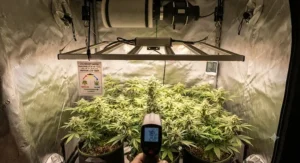
Rather than each device reacting independently (or not reacting at all), the Controller 69 Pro lets you set a single target VPD or temperature range and have your exhaust fan, circulation fan, and grow light all respond to the same real-time data, each with its own independent program. What most buyers overlook about VPD-based automation specifically is that it accounts for both temperature and humidity simultaneously, which is a meaningfully more accurate way to judge plant stress than watching temperature alone — a 78°F reading at 40% humidity feels completely different to a plant than 78°F at 70% humidity. The 12-foot sensor probe with a thermal-alloy head is built to sit at canopy height rather than near the tent’s exhaust port, which is where a lot of DIY thermostat setups measure temperature inaccurately.
Reviewers frequently mention the historical data charts and CSV export as a legitimately useful feature for tracking whether a change in fixture height or fan speed actually stabilized conditions over time, rather than guessing.
Pros:
- ✅ Coordinates up to four compatible devices from one hub
- ✅ VPD-based automation, not just simple temperature triggers
- ✅ Historical data logging with CSV export via app
Cons:
- ❌ Only works fully with AC Infinity’s own UIS-connector devices
- ❌ Advanced programming has a learning curve at first
At around $90, the AC Infinity Controller 69 Pro is the piece of gear that turns a collection of individually decent fans and lights into an actual system — assuming you’re already invested in the AC Infinity ecosystem.
7. Gorilla Grow Tent 4×4 — fixing the problem before electronics get involved
The Gorilla Grow Tent 4×4‘s standout trait isn’t a motor or a sensor — it’s 1680D canvas fabric, roughly two to five times denser than the 200-600D material used in many budget tents, which does a measurably better job insulating the interior from outside temperature swings.
That thickness matters more than it sounds like on paper. A thin-walled tent in a garage or attic essentially tracks the ambient room temperature with a short lag, meaning your exhaust fan and AC unit are constantly fighting outside conditions instead of just managing the heat your own lights generate. The thicker, better-insulated fabric on the Gorilla Grow Tent 4×4, combined with its taller-than-average frame (which gives rising hot air more vertical room before it settles onto the canopy), reduces the amount of active cooling or heating your equipment needs to do — which is the real definition of an energy efficient grow tent, rather than any single “eco” gadget you bolt onto it afterward.
Reviewers and independent teardowns consistently point to the metal interlocking frame (rated to hold up to 300 lbs of lights and equipment) as noticeably sturdier than tents using plastic corner connectors, which tend to crack under heavier fixture loads over time.
Pros:
- ✅ Ultra-dense 1680D fabric insulates against outside temperature swings
- ✅ Taller frame gives rising heat room before it reaches canopy
- ✅ Metal interlocking frame rated for heavier equipment loads
Cons:
- ❌ Higher price point than thinner budget-tent alternatives
- ❌ Bulkier setup and breakdown than lightweight pop-up tents
In the $350-$450 range for the 4×4 size, the Gorilla Grow Tent 4×4 is the one product on this list that reduces your temperature problem passively — every fan and controller works easier once the tent itself isn’t leaking heat in or out.
Practical Usage Guide: Setting Up Your Grow Tent Climate Control System
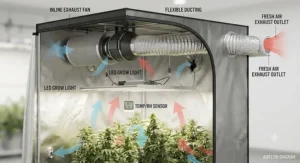
Getting a new fan or controller out of the box is the easy part — dialing in the actual setup is where most grow tent heat issues either get solved or quietly persist. Start with exhaust before anything else: your inline fan, whether it’s the AC Infinity CLOUDLINE PRO T6 or the AC Infinity CLOUDLINE S6 PRO, should always pull air through your carbon filter and out of the tent, not push into it — this maintains negative pressure, which keeps odors contained and creates consistent airflow direction.
In the first 30 days, the most common mistake is running the exhaust fan at maximum speed constantly “just to be safe.” This over-dries the growing medium and can pull humidity out of the tent faster than your plants or humidifier can replace it. Instead, start around 40-50% fan speed and adjust upward only when your thermometer shows you need it — this is exactly the kind of decision the Inkbird ITC-308 or AC Infinity Controller 69 Pro can automate once you’ve found your baseline.
For maintenance, clean fan blades and carbon filter intakes monthly; dust buildup on an EC motor fan like the VIVOSUN AeroWave E6 Gen2 reduces airflow efficiency gradually enough that you might not notice until temperatures creep up. Recalibrate your temperature controller’s probe placement seasonally too, since a probe sitting too close to your exhaust port will always read cooler than actual canopy temperature.
Real-World Scenarios: Which Setup Actually Fits Your Grow?
The apartment grower in a warm climate. If you’re running a single 4×4 tent in a bedroom closet somewhere hot and humid, budget matters and space is tight. The AC Infinity CLOUDLINE S6 PRO paired with the VIVOSUN AeroWave E6 Gen2 for circulation covers 90% of ventilation-based heat issues for under $150 combined, without a separate AC unit eating floor space you don’t have.
The basement or garage grower facing seasonal extremes. If your grow space swings from a chilly 55°F basement in January to a stuffy 90°F garage in July, buying separate heating and cooling equipment adds up fast. This is exactly the use case the Whynter ARC-14SH was built for — one machine, both directions, run through the Inkbird ITC-308 so it switches automatically instead of you remembering to swap modes every season.
The multi-tent grower scaling up. Once you’re running two or more tents, manually monitoring each one becomes unrealistic. The AC Infinity Controller 69 Pro lets you standardize temperature and VPD targets across your CLOUDLINE PRO T6 exhaust fans and lighting, with historical data to confirm each tent is actually tracking the same conditions rather than trusting that they probably are.
Problem → Solution: Fixing Common Grow Tent Heat Issues
Grow tent heat issues tend to repeat themselves across growers, so here are the five that show up most often, with a specific fix for each.
Problem: Temperature spikes right when lights turn on. LED and HID fixtures dump their heat output almost immediately at lights-on, and a fan running at a static low speed can’t keep up with that sudden jump. Solution: a temperature-responsive fan like the AC Infinity CLOUDLINE PRO T6, or the Inkbird ITC-308 driving a fixed-speed fan, catches that spike within minutes rather than leaving it to build for an hour.
Problem: One side of the tent runs hotter than the other. This is almost always a circulation issue, not an exhaust issue — air is leaving the tent fine, it’s just not moving evenly across the canopy first. Solution: add a clip fan like the VIVOSUN AeroWave E6 Gen2 positioned to sweep across the full canopy width, not aimed at a single spot.
Problem: Winter temperature drops overnight when lights are off. Without active lighting generating heat, an uninsulated tent in a cold garage can fall well below the 65°F floor most plants need. Solution: a dedicated heater on a thermostat, like the Inkbird ITC-308 controlling a small space heater, or the heating mode on a combo unit like the Whynter ARC-14SH.
Problem: High humidity alongside high heat, encouraging mold risk. Heat and humidity often spike together, and cranking exhaust speed alone can actually worsen this by not removing moisture fast enough relative to new humidity being generated. Solution: a controller monitoring VPD rather than temperature alone, like the AC Infinity Controller 69 Pro, catches this combined stress condition that a simple thermometer misses.
Problem: The whole room the tent sits in runs hot, undermining everything else. No amount of internal fan speed fixes a tent that’s essentially sitting inside an oven. Solution: this is where fabric and insulation quality — the kind found in the Gorilla Grow Tent 4×4 — reduce how much outside heat penetrates in the first place, easing the load on every other device on this list.
✨ Don’t Miss These Exclusive Deals!
🔍 Take your grow tent climate control to the next level with these carefully selected products. Click on any highlighted item to check current pricing and availability. These tools will help you create a genuinely stable growing environment your plants will thrive in!
How to Choose Temperature Control Equipment for Your Grow Tent
- Measure your actual problem before buying anything. A cheap digital thermometer/hygrometer for a week tells you whether you’re dealing with overall heat, uneven circulation, humidity-linked heat, or overnight cold — and each has a different fix.
- Size your exhaust fan to your tent volume, not your budget. As a rough rule, a 2×4 tent needs at least a 4-inch fan (roughly 205 CFM), a 4×4 needs a 6-inch fan (roughly 400 CFM), and anything 5×5 or larger benefits from an 8-inch fan or dual 6-inch units.
- Decide if you need automation or if manual control suffices. A smart controller like the AC Infinity Controller 69 Pro earns its price if you’re frequently away from the grow space; a manual dial like on the AC Infinity CLOUDLINE S6 PRO is fine if you check in daily anyway.
- Match cooling/heating capacity to your actual square footage, not the marketing number. BTU ratings on portable units like the Whynter ARC-14SH often list ASHRAE figures that overstate real-world SACC performance — check both numbers.
- Prioritize circulation as much as exhaust. Growers frequently over-invest in a bigger exhaust fan while ignoring canopy-level air movement, which a unit like the VIVOSUN AeroWave E6 Gen2 solves far more cheaply.
- Factor in the tent itself. Thin, budget fabric undermines even well-chosen electronics by leaking heat in both directions; a better-insulated structure like the Gorilla Grow Tent 4×4 reduces the workload on everything else.
Optimal Temperature Ranges by Grow Stage: What to Expect
What is the optimal temperature range for a grow tent? Most plants, including common indoor cultivars, do best around 70-85°F during the light-on period and roughly 10-15°F cooler when lights are off, though exact numbers shift by growth stage.
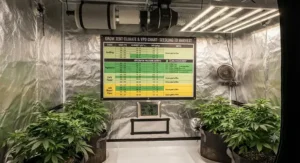
During seedling and early vegetative stages, aim for the warmer end of that range with high humidity, since young plants are more sensitive to chill than heat stress at this point. Once plants move into full vegetative growth, temperatures of 70-85°F with 55-70% relative humidity support the fastest development — this is where an under-sized fan often first reveals itself, since a fuller canopy generates and traps more heat than a handful of seedlings did. Flowering stages generally want temperatures dialed back slightly, into the 68-80°F range, alongside lower humidity to reduce mold risk on denser buds or fruiting bodies.
This temperature-humidity relationship is often described using vapor pressure deficit, a measurement of how much moisture the surrounding air can still absorb from a leaf’s surface — a more complete picture of plant stress than temperature alone. What most growers miss is that the number on a wall-mounted thermometer isn’t the number that matters most — canopy-level temperature, measured close to where the leaves actually sit, tends to run several degrees warmer than air near the tent’s exhaust port. A controller like the Inkbird ITC-308 or AC Infinity Controller 69 Pro with a properly placed probe corrects for this; a thermometer stuck to the tent wall usually doesn’t.
Summer Cooling Strategies That Actually Work
When outdoor temperatures climb, grow tent temperature problems shift almost entirely toward excess heat, and the fixes escalate in a fairly predictable order. Start with exhaust and circulation — an efficient combination like the AC Infinity CLOUDLINE PRO T6 paired with a VIVOSUN AeroWave E6 Gen2 solves a surprising number of summer heat complaints on its own, especially if your grow space isn’t already at a dangerously high ambient temperature before lights even turn on.
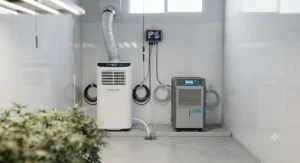
If fans alone aren’t cutting it, the next step is passive intake improvement — pulling cooler air from a different part of the house (a basement register, for instance) rather than recirculating already-warm room air back into the tent repeatedly. Only after those steps are maxed out does active cooling make sense: a portable AC like the Whynter ARC-14SH earns its cost specifically when ambient room temperature itself is the problem, not just the heat your lights add. Running it through the Inkbird ITC-308 or its own built-in thermostat prevents it from cycling constantly and shortening its compressor lifespan.
One frequently overlooked lever: LED grow lights run meaningfully cooler than older HID fixtures for equivalent light output, and swapping fixture type can reduce the cooling burden more cheaply than any additional fan or AC purchase.
Winter Heating Solutions Without Wrecking Humidity
Cold-weather grow tent temperature problems are less discussed than summer heat, but they’re just as common for growers running basements, garages, or unheated spare rooms through winter. The core challenge is different, too: you’re not fighting excess heat, you’re preventing overnight temperature crashes once lights switch off and stop contributing warmth.
A small space heater run through a dual-relay controller like the Inkbird ITC-308 is the most common and cost-effective fix, automatically switching on only when temperature drops below your setpoint rather than running continuously and overheating the space during the day. For growers who’d rather consolidate equipment, the heating mode on a unit like the Whynter ARC-14SH handles this without adding a second appliance to the tent’s footprint.
The tradeoff to watch for: heaters lower relative humidity as they run, sometimes sharply, so a heating fix paired with zero humidity monitoring can trade one grow tent heat issue (cold) for another (dry, stressed foliage). This is where VPD-aware automation, like the AC Infinity Controller 69 Pro, earns its keep in winter specifically — it accounts for the humidity side effect of heating rather than just chasing a temperature number.
Space heaters remain a leading cause of residential heating fires according to federal safety data, which makes automated shutoff and stable placement inside a tent especially important — more on that in the safety section below.
Energy Efficient Grow Tent Setups: Cutting Your Power Bill
An energy efficient grow tent isn’t really one product — it’s the combination of a well-insulated structure and equipment that only runs as hard as conditions actually require. The Gorilla Grow Tent 4×4‘s dense fabric is the passive half of that equation, reducing how much your fans and AC/heater need to fight outside temperature in the first place.
On the active side, EC motor fans like the VIVOSUN AeroWave E6 Gen2 and the CLOUDLINE series both draw meaningfully less power than older AC-motor equivalents for the same airflow output, and automated controllers prevent the classic energy waste of running an exhaust fan or heater at full output around the clock out of caution. Federal efficiency standards from the U.S. Department of Energy have also pushed newer portable AC models toward meaningfully better real-world efficiency than units sold even a few years ago, which is worth checking if you’re comparing an older secondhand unit against something like the Whynter ARC-14SH.
The math on total cost of ownership favors spending more upfront on efficient equipment: a portable AC running constantly at full output because it’s undersized for the space costs more in electricity over a single grow cycle than the price difference between it and a properly sized unit. The same logic applies to fans — a smart controller like the AC Infinity Controller 69 Pro that idles equipment down when conditions are stable pays for itself in reduced runtime hours over a season.
Common Mistakes When Buying Grow Tent Climate Equipment
The most frequent mistake is buying an exhaust fan sized for tent volume alone and ignoring static pressure added by carbon filters and ducting — a fan rated for 400 CFM in open air delivers noticeably less once it’s pulling through a filter and 10 feet of flexible ducting, which is why growers with a “properly sized” fan on paper still see grow tent temperature problems.
A close second: treating circulation as optional. Plenty of growers max out their exhaust fan budget and skip a clip fan entirely, then wonder why one side of the canopy looks stressed while the other thrives — the VIVOSUN AeroWave E6 Gen2 or similar circulation fan solves this for a fraction of what an exhaust fan upgrade would cost. Third, buyers frequently trust a portable AC’s advertised ASHRAE BTU rating without checking the SACC figure, leading to real-world cooling capacity noticeably below what the box implied. Finally, skipping a dedicated thermostat controller like the Inkbird ITC-308 and instead manually toggling heaters or fans is a common source of the exact temperature swings growers are trying to eliminate in the first place.
Safety & Regulations Guide for Heaters and AC Units in Grow Tents
Running electric heaters and AC equipment inside an enclosed fabric structure adds fire-safety considerations that don’t apply the same way in an open room. Any space heater — including the heating mode on a combo unit like the Whynter ARC-14SH — should sit on a level, non-flammable surface with at least three feet of clearance from tent fabric, cords, and any flammable materials, and should never run unattended overnight without a thermostat cutoff like the Inkbird ITC-308 managing it.
CPSC guidance specifically recommends choosing heaters tested to current safety standards by a nationally recognized lab, since older units may lack tip-over shutoff or overheat protection that’s now standard. Avoid running any heater or portable AC through an extension cord if possible — plug directly into a wall receptacle, since undersized extension cords are a documented fire risk under sustained heater loads.
On the electrical side, avoid daisy-chaining multiple high-wattage devices (a heater and a portable AC, for instance) onto a single household circuit, since combined draw can trip breakers or, worse, overheat wiring not rated for the combined load. If you’re running a dedicated grow room with multiple heat-producing devices long-term, it’s worth having an electrician confirm the circuit’s rated capacity rather than assuming it can handle everything you’ve added over time.
Frequently Asked Questions
❓ What temperature should a grow tent be at night?
❓ How do I cool down a grow tent without AC?
❓ Can a grow tent overheat with LED lights?
❓ What is the best way to heat a grow tent in winter?
❓ How many CFM inline fan do I need for grow tent temperature control?
Conclusion
Grow tent temperature problems almost never come down to one missing gadget — they’re usually a combination of undersized ventilation, missing circulation, and equipment running on guesswork instead of automation. The fix that matters most depends entirely on which direction your problem runs: summer cooling strategies built around efficient exhaust and circulation, or winter heating solutions that add warmth without tanking your humidity in the process.
Across the seven products in this guide, the pattern holds up — pair a properly sized fan with a controller that actually reacts to real conditions, add circulation before assuming you need a bigger exhaust fan, and don’t underestimate what a genuinely insulated tent structure like the Gorilla Grow Tent 4×4 does to reduce the load on everything else. Whether your setup calls for the automated convenience of the AC Infinity CLOUDLINE PRO T6 or the budget-conscious combination of the AC Infinity CLOUDLINE S6 PRO and VIVOSUN AeroWave E6 Gen2, the goal is the same: a stable, optimal temperature range your plants don’t have to fight against.
Recommended for You
- Grow Tent Light Leaks Fixed: 7 Lightproof Tents for 2026
- Grow Tent Ventilation Setup: 7 Real Fixes for Heat & Smell (2026)
- Grow Tent Bundle 2026: 7 Complete Kits Worth Your Money
Disclaimer: This article contains affiliate links. As an Amazon Associate, I earn from qualifying purchases. If you purchase products through these links, we may earn a small commission at no additional cost to you.
✨ Found this helpful? Share it with your friends! 💬🤗
