
In This Article
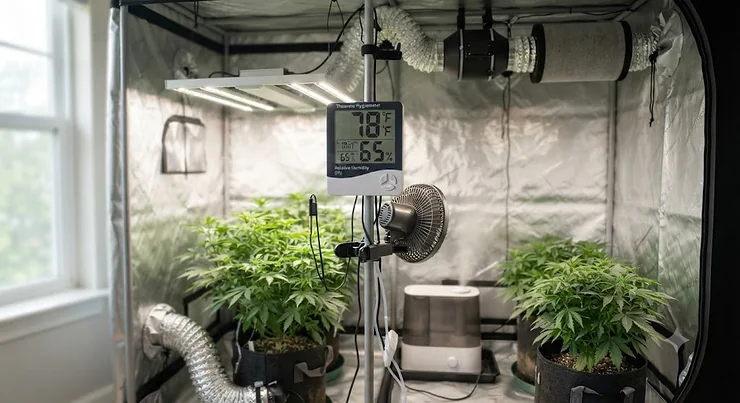
Here’s a truth nobody tells first-time growers: your lights, your genetics, your nutrient schedule — none of it matters if the air inside your tent is working against you. grow tent humidity control is the quiet variable that decides whether your canopy pumps out resin-heavy colas or turns into a science experiment in bud rot. What is grow tent humidity control? It’s the practice of actively managing relative humidity (and, more precisely, vapor pressure deficit) inside a sealed growing enclosure so plants transpire, absorb nutrients, and resist disease at every stage of growth.
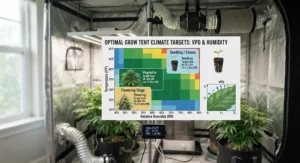
Most guides stop at “keep it around 50%,” which is a bit like telling someone to “drive safely” without mentioning brakes. The real work happens in the gap between a cheap dial hygrometer and a system that actually reacts to swings before they become a problem. The EPA’s guidance on residential moisture control notes that keeping relative humidity below 60 percent — ideally between 30 and 50 percent — is the single most effective mold-prevention strategy, and that principle applies just as hard inside a 4×4 tent as it does inside a basement.
This guide walks through seven real products that handle different pieces of the humidity puzzle, then digs into the analysis growers actually need: how humidity needs shift stage by stage, why VPD optimization beats chasing a single humidity number, how to stop grow tent condensation before it drips onto your canopy, and the dehumidification strategies that separate a clean harvest from a moldy one.
Quick Comparison Table
| Product | Type | Best For | Price Range |
|---|---|---|---|
| Eva-Dry E-500 | Renewable desiccant | 2×2 tents, no-power backup | around $25-$35 |
| VIVOSUN Mini Dehumidifier | Thermoelectric | Small tents, quiet operation | around $35-$50 |
| Govee WiFi Thermometer Hygrometer H5179 | Smart hygrometer | Remote monitoring & alerts | around $20-$35 |
| AC Infinity CloudForge T3 | Ultrasonic humidifier | Clones, seedlings, early veg | around $70-$90 |
| hOmeLabs 22-Pint Dehumidifier | Compressor dehumidifier | 4×4 tents, flowering rooms | around $180-$230 |
| AC Infinity Controller 69 Pro | Smart VPD controller | Full automation, multi-device | around $120-$160 |
| Spider Farmer Upgraded Dehumidifier | Duct-out compressor unit | Heat-sensitive premium setups | around $180-$250 |
Looking at the spread above, notice how the cheapest and priciest picks aren’t competing for the same job at all. The Eva-Dry E-500 and VIVOSUN Mini Dehumidifier cover small-tent maintenance without adding heat, while the hOmeLabs 22-Pint Dehumidifier and Spider Farmer Upgraded Dehumidifier are built for the higher water-vapor load a dense 4×4 or 5×5 flowering canopy throws off. The AC Infinity Controller 69 Pro sits in its own category entirely — it doesn’t remove moisture itself, it decides when everything else should.
💬 Found a product here that fixed your humidity swings? A quick share helps other growers avoid the same mistakes.
Top 7 Grow Tent Humidity Control Products: Expert Analysis
1. Eva-Dry E-500 — no-power desiccant backup for tiny tents
The standout here is simple: zero electricity, zero heat output, zero noise, and it still pulls real moisture out of the air. The Eva-Dry E-500 uses renewable silica gel beads that absorb roughly six ounces of water per cycle, then you plug it in for about ten hours to recharge the desiccant and start over — no compressor, no coils, no drainage tank to babysit.
Rated for spaces up to around 500 cubic feet, it’s realistically a supplement rather than a primary system in anything larger than a 2×2 or 3×3 tent. Based on the spec comparison, its appeal isn’t raw capacity — it’s redundancy. Growers running a compressor dehumidifier elsewhere in the room often keep one of these inside the tent itself as insurance against a sudden humidity spike overnight, when running a full compressor unit would add unwanted heat right when lights are off and temperatures are already dropping.
Reviewers consistently report that the indicator beads change color reliably, giving a visual cue for recharge timing without needing to check a separate hygrometer. A common complaint in user reviews is that the six-ounce capacity empties fast in genuinely humid climates, so growers in the Gulf Coast or Pacific Northwest tend to treat it as backup rather than a solo solution.
Pros:
- ✅ Runs with zero electricity during the absorption cycle
- ✅ Adds no heat or noise to a sealed tent
- ✅ Reusable indefinitely with no consumable refills
Cons:
- ❌ Six-ounce capacity is too small for larger tents alone
- ❌ Requires manual recharge cycles every few weeks
At around $25-$35, the Eva-Dry E-500 earns its keep as a low-risk backstop rather than a standalone answer for grow tent humidity control.
2. VIVOSUN Mini Dehumidifier — quietest pull for 2×2 and 3×3 setups
What most buyers overlook about this model is the technology underneath it: the VIVOSUN Mini Dehumidifier uses a thermoelectric Peltier module instead of a compressor, which is why it’s virtually silent and sips only around 23 watts of power. At roughly 400ml of water removed per day, it’s sized for the tent it’s actually meant for, not oversold as something it isn’t.
That daily capacity matters in practice — it comfortably handles a 2×2 tent running one or two plants, particularly during propagation and early veg when transpiration loads are lower. Push it into a 4×4 flowering tent with a full canopy, though, and it will lose the battle against the moisture output of six or eight mature plants.
Aggregated review sentiment consistently praises the near-silent operation, which matters if the tent lives in a bedroom or apartment closet. Some reviewers note the auto shut-off tank fills faster than expected in genuinely damp basements, which lines up with the honest capacity ceiling on a compressor-free unit.
Pros:
- ✅ Whisper-quiet Peltier operation, ideal for shared living spaces
- ✅ Energy-efficient at roughly 23 watts of draw
- ✅ Compact footprint fits easily inside small tents
Cons:
- ❌ 400ml daily capacity caps out fast in humid rooms
- ❌ Not sufficient for tents larger than 3×3
Priced around $35-$50, the VIVOSUN Mini Dehumidifier is a smart entry point for anyone whose grow tent humidity control needs are modest in scale but constant in demand.
3. Govee WiFi Thermometer Hygrometer H5179 — most reliable remote monitoring
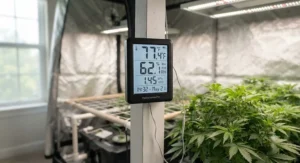
Here’s the thing about humidity control most growers get backwards: you can’t manage what you can’t measure accurately, and a $10 dial hygrometer from a hardware store is often off by 10 percent or more. The Govee WiFi Thermometer Hygrometer H5179 solves that with a genuinely precise sensor, rated at roughly ±3% RH and ±0.54°F, refreshing every two seconds.
The practical value here is the alert system. Set a target humidity range in the Govee app, connect via Bluetooth or WiFi, and you get a push notification the moment your tent drifts outside it — at 2 a.m., not eight hours later when you check in the morning. Two years of stored data export also means you can look back at exactly when a spike happened and cross-reference it against your lights-off schedule or a watering event.
Reviewers consistently report the app’s alert reliability as the standout feature, particularly for remote grows where the tent isn’t in the same room the grower spends time in. A recurring theme in user feedback is that the 2.4GHz-only WiFi requirement trips up growers with 5GHz-only routers, so checking network compatibility before setup avoids a frustrating first night.
Pros:
- ✅ Precision sensor accurate to about ±3% relative humidity
- ✅ Instant app alerts when readings drift out of range
- ✅ Two years of free historical data storage and export
Cons:
- ❌ Requires a 2.4GHz WiFi network, not 5GHz
- ❌ Needs a companion app for full alert functionality
At around $20-$35, the Govee WiFi Thermometer Hygrometer H5179 is arguably the highest-value single purchase on this list — accurate data is the foundation every other decision here is built on.
4. AC Infinity CloudForge T3 — targeted humidifier for clones and early veg
Most of this guide focuses on pulling moisture out. The AC Infinity CloudForge T3 exists for the opposite problem: seedlings and clones that need relative humidity in the 70-90 percent range to root successfully, a level standard room humidifiers weren’t designed to sustain inside a sealed tent.
Its 4.5-liter tank and ultrasonic vaporizer produce fine mist across 10 intensity levels, and a telescopic hose lets you route output directly into the canopy zone rather than just fogging the tent floor. That routing detail matters more than the spec sheet suggests — a humidifier blasting mist at ankle height barely raises humidity where your clones’ leaves actually are.
Reviewers consistently note the roughly 32-hour runtime as accurate, meaning fewer overnight refills than competing units in this price bracket. A common theme in aggregated feedback is that the telescopic hose reaching into the canopy is the single biggest reason growers upgrade from a basic desktop humidifier once they hit repeated rooting failures.
Pros:
- ✅ Telescopic hose delivers mist directly into the canopy zone
- ✅ 10-level intensity control for precise humidity targeting
- ✅ Roughly 32-hour runtime reduces overnight refills
Cons:
- ❌ 4.5L tank still needs daily attention in dry climates
- ❌ Ultrasonic mist can leave mineral dust with hard water
Running around $70-$90, the AC Infinity CloudForge T3 fills a gap most humidity guides skip entirely: the early-life stages where too little moisture, not too much, is the real threat.
5. hOmeLabs 22-Pint Dehumidifier — the trusted workhorse for 4×4 tents
Ask in any grow forum what handles a 4×4 flowering tent reliably, and the hOmeLabs 22-Pint Dehumidifier comes up constantly — not because it’s flashy, but because it pulls a genuinely useful 22 pints per day and includes a built-in pump option for continuous drainage, meaning you’re not emptying a tank every few hours during peak flowering.
That continuous-drain feature is the real differentiator. Late flower, when dense colas are transpiring heavily and lights-off temperature drops trigger condensation risk, is exactly when growers can’t be checking a water tank every four hours. Compressor-based extraction also handles warm, humid climates more efficiently than the thermoelectric units on this list, at the cost of running a bit warmer itself.
Aggregated customer sentiment describes the unit as quiet enough to sit in the same room without disrupting sleep, and reliable across long unattended stretches. A recurring complaint in reviews is that the control panel feels basic compared to smart-enabled competitors — there’s no app, no VPD tracking, just a dial and a display.
Pros:
- ✅ 22-pint daily capacity handles dense 4×4 flowering canopies
- ✅ Continuous drainage pump eliminates constant tank-emptying
- ✅ Reliable, quiet compressor performance during long unattended runs
Cons:
- ❌ No app connectivity or VPD monitoring built in
- ❌ Compressor generates more heat than thermoelectric alternatives
At around $180-$230, the hOmeLabs 22-Pint Dehumidifier remains the mid-range default for a reason: it does the one job it’s built for without asking you to learn new software.
6. AC Infinity Controller 69 Pro — the automation hub for VPD-based control
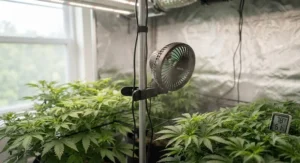
This is the piece that turns a pile of separate gadgets into an actual system. The AC Infinity Controller 69 Pro doesn’t dehumidify or humidify anything itself — instead, it reads temperature, humidity, and VPD through a 12-foot thermal-alloy sensor probe, then automatically adjusts up to four connected devices (fans, humidifiers, dehumidifiers in the UIS ecosystem) in response.
What most buyers overlook about this model is that it tracks VPD as a calculated value from temperature and humidity, not a separate sensor — meaning the accuracy of your VPD reading is only as good as the probe placement. Mount it too close to a light or too near an intake vent and the whole automation chain follows a skewed number. Positioned correctly in the canopy zone, though, it removes the manual guesswork of constantly checking a hygrometer and adjusting a dial by hand.
Reviewers consistently report that humidity swings essentially disappeared once they automated their exhaust fan response through the app rather than reacting to alerts manually. A common theme in feedback is that the WiFi and Bluetooth dual connectivity makes remote adjustment genuinely convenient, though the four-device limit pushes larger grows toward the Pro+ variant.
Pros:
- ✅ Automates up to four devices based on live VPD readings
- ✅ 12-foot sensor probe allows flexible, accurate placement
- ✅ WiFi and Bluetooth app control with historical data logging
Cons:
- ❌ Limited to four connected devices on the standard Pro
- ❌ VPD accuracy depends heavily on correct probe placement
Priced around $120-$160, the AC Infinity Controller 69 Pro is the closest thing on this list to a genuine set-and-forget upgrade for serious growers.
7. Spider Farmer Upgraded Dehumidifier — premium duct-out unit for heat-sensitive flower rooms
For growers running high-intensity LEDs where every extra degree of heat matters, the Spider Farmer Upgraded Dehumidifier solves a problem the other units on this list don’t: it uses a dedicated air duct so the compressor itself sits outside the tent, pulling humid air through a hose rather than dumping compressor heat directly into your growing space.
The digital humidity sensor probe feeds real-time readings from inside the tent even while the unit body stays outside it, and the dual drainage setup — a 2-liter tank with auto shut-off plus a direct-drain hose option — means it scales from manual monitoring up to fully hands-off operation. Technically, its high-efficiency compressor outperforms the thermoelectric units on this list in warm, humid conditions, which is exactly the scenario where a 4×4 or 5×5 flowering tent needs the most help.
Reviewers consistently highlight the caster wheels and integrated handles as small details that matter a lot once you’re repositioning a unit this size in a cramped grow space. A recurring theme in feedback is that the duct-out design genuinely lowers ambient tent temperature by a few degrees compared to sealed-unit dehumidifiers of similar capacity.
Pros:
- ✅ Duct-out design keeps compressor heat outside the tent
- ✅ Dual drainage options support hands-off continuous operation
- ✅ High-efficiency compressor performs well in warm, humid rooms
Cons:
- ❌ Premium price relative to sealed compressor competitors
- ❌ Requires extra duct routing during initial setup
Sitting around $180-$250, the Spider Farmer Upgraded Dehumidifier is the pick for growers who’ve already solved basic humidity control and are now optimizing for temperature stability too.
Practical Usage Guide: Setting Up Your Grow Tent Humidity Control System
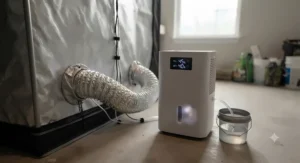
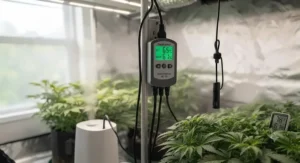
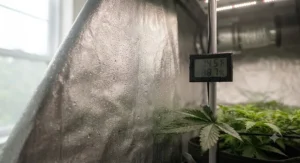
Getting a new dehumidifier or hygrometer out of the box is the easy part. The first 30 days are where most setups go wrong. Start by placing your hygrometer — whether that’s the Govee WiFi Thermometer Hygrometer H5179 or the sensor probe on the AC Infinity Controller 69 Pro — at canopy height, not on the tent floor or clipped to a pole near the exhaust fan, both of which give readings that don’t reflect what your plants actually experience.
Run any new dehumidifier or humidifier for 24 hours before trusting its target settings; compressor units especially need a break-in period where internal coils reach stable operating temperature. Clean removable filters on units like the hOmeLabs 22-Pint Dehumidifier every one to two weeks — a clogged filter is the single most common reason a perfectly good dehumidifier suddenly seems to “stop working” mid-flower.
A mistake almost every first-time grower makes: setting a single humidity target for the entire grow cycle. Your target should shift as plants move from clone to harvest, which is exactly why stage-specific humidity settings matter more than a fixed number. Schedule a five-minute daily check — same time, same routine — logging temperature, humidity, and any condensation on tent walls, so a slow drift gets caught before it becomes a crisis.
Real-World Scenarios: Matching Gear to Your Grow
Picture a college student running a single 2×2 tent in a dorm closet, growing two autoflowers under a budget LED. Noise and stealth matter more than raw capacity here — the VIVOSUN Mini Dehumidifier paired with the Eva-Dry E-500 as backup covers the entire cycle without anyone in the next room noticing a compressor humming at 2 a.m.
Now picture a hobbyist with a 4×4 tent in a finished basement, running four photoperiod plants through a full veg-to-flower cycle. Basements run naturally humid, so the hOmeLabs 22-Pint Dehumidifier becomes the backbone, with the AC Infinity CloudForge T3 stepping in only during the cloning phase when humidity needs to spike the opposite direction.
Finally, picture a small commercial-adjacent grower running two 5×5 tents side by side, chasing consistent quality across every harvest. Here, the AC Infinity Controller 69 Pro ties fans and the Spider Farmer Upgraded Dehumidifier into one automated system, with VPD optimization — not just a humidity percentage — as the actual target metric tracked daily.
How to Choose Grow Tent Humidity Control Equipment
- Measure your tent’s actual water-vapor load first. A 2×2 with two seedlings and a 4×4 with eight flowering plants are entirely different jobs — don’t size a dehumidifier off tent dimensions alone.
- Match technology to climate. Thermoelectric units like the VIVOSUN Mini Dehumidifier suit dry regions and small tents; compressor units like the hOmeLabs 22-Pint Dehumidifier handle humid climates and larger canopies far more efficiently.
- Prioritize accurate monitoring before automation. A precise hygrometer such as the Govee WiFi Thermometer Hygrometer H5179 is worth buying before any smart controller, since automation is only as good as the data feeding it.
- Account for heat output, not just moisture removal. If your grow room already runs warm, a duct-out unit like the Spider Farmer Upgraded Dehumidifier avoids compounding a temperature problem.
- Plan for stage-specific humidity swings, not one fixed setting. Clones and seedlings need humidifying gear; late flower needs aggressive drying — most growers need both categories eventually.
- Budget for drainage convenience during flowering. Continuous-drain or ducted units save real time during the exact weeks you’ll have the least patience for emptying a tank.
- Leave headroom for automation later. Even a budget setup benefits from being UIS-compatible or WiFi-enabled from day one, since retrofitting a controller onto incompatible gear later means buying twice.
Stage-Specific Humidity: What to Expect at Each Growth Phase
Here’s where a single “keep it at 50%” rule falls apart. Clones and seedlings actually want relative humidity in the 70-90 percent range, since they can’t yet pull water efficiently through an undeveloped root system — this is precisely the phase where the AC Infinity CloudForge T3 earns its place in the lineup rather than sitting unused.
As plants shift into vegetative growth, target humidity drops into the 55-70 percent band, giving roots more incentive to develop while still supporting vigorous leaf growth. By the time flowering begins, stage-specific humidity needs to drop further still, ideally into the 40-50 percent range, and by late flower — the weeks growers fear most — pushing down toward 35-45 percent dramatically reduces bud rot risk on dense, tightly packed colas.
What the spec sheet won’t tell you, but experienced growers note constantly, is that this isn’t just about humidity for its own sake — it’s about matching the drying power of the air to how much water each growth stage is actually releasing. A seedling barely transpires; a fully flowering plant under strong lights transpires constantly, and the air needs to be able to absorb that output without saturating.
VPD Optimization: Why Vapor Pressure Deficit Beats Relative Humidity Alone
Relative humidity tells you how saturated the air is right now. It doesn’t tell you how hard that air is pulling moisture out of your plant’s leaves, which is the number that actually determines transpiration, nutrient uptake, and stress. That’s the entire case for VPD optimization: vapor pressure deficit combines temperature and humidity into a single figure, measured in kilopascals, that reflects the real drying demand your plants experience.
Michigan State University Extension research found that relative humidity above roughly 85 percent creates conditions favorable for fungal pathogens because moisture lost through plant stomata lingers on leaf surfaces rather than evaporating — a risk that a raw humidity percentage doesn’t fully capture on its own. The same research recommends greenhouse growers maintain a VPD above 0.5 kPa during finishing stages specifically to keep plants transpiring and less vulnerable to disease.
In practice, VPD optimization means running a controller like the AC Infinity Controller 69 Pro that reads leaf-adjacent temperature and humidity together, rather than staring at a humidity percentage in isolation. Two tents can both read “55% humidity” and have completely different transpiration rates depending on temperature — which is exactly the blind spot VPD tracking closes.
Grow Tent Condensation: Problem → Solution Guide
Problem 1: Water droplets on the tent’s inner walls at lights-off. This is classic grow tent condensation — warm, moisture-laden air hitting a cooler surface as ambient temperature drops overnight. UMass Amherst Extension research on greenhouse humidity explains that as air cools toward its dew point, water vapor condenses on the coolest available surfaces — tent walls, ducting, and leaves alike. Solution: reduce the lights-off temperature drop and run gentle exhaust ventilation through the night rather than sealing the tent completely.
Problem 2: Fogged-up viewing windows. Usually a sign that internal humidity is running higher than your dehumidifier’s current capacity. Solution: step up from a unit like the VIVOSUN Mini Dehumidifier to compressor-based extraction such as the hOmeLabs 22-Pint Dehumidifier once plant count or canopy density increases.
Problem 3: Puddling at the tent floor near intake vents. Often traced to a dehumidifier drain hose kinking or a tank overflowing unnoticed. Solution: switch to continuous drainage and check hose routing weekly.
Problem 4: Condensation specifically on ducting and reflective walls. Solution: insulate exposed ducting where it passes through temperature differentials, mirroring the fix greenhouse operators use on cold glazing.
Grow Tent Mold Prevention: Safety and Regulatory Guide
Grow tent mold prevention isn’t just a yield concern — it’s a health one. Mold spores that establish in a sealed growing environment don’t stay contained to the plant; they circulate through the same air the grower breathes every time the tent is opened. Penn State Extension’s research on Botrytis notes that gray mold infection is encouraged by free moisture sitting on plant tissue for 8-12 continuous hours combined with high relative humidity in the canopy — conditions that describe an unventilated, over-humid tent almost exactly.
Practical grow tent mold prevention starts with airflow, not just dehumidification. Dense, overcrowded canopies trap humid air against leaf surfaces regardless of how good your dehumidifier is — pruning for airflow and spacing plants matters as much as any piece of equipment on this list. Beyond airflow, scheduled filter cleaning on units like the Spider Farmer Upgraded Dehumidifier prevents the unit itself from becoming a mold reservoir that recontaminates clean air.
Regulatory-wise, most residential grow setups fall under the same general moisture-control guidance the EPA applies to any indoor space — keep relative humidity below 60 percent, and treat any visible condensation as an immediate signal to act rather than a cosmetic issue.
Dehumidification Strategies for Different Tent Sizes
A 2×2 tent and a 5×5 tent aren’t just different sizes — they need entirely different dehumidification strategies. In a 2×2, total air volume is small enough that a thermoelectric unit like the VIVOSUN Mini Dehumidifier or a passive desiccant like the Eva-Dry E-500 can keep pace, especially paired with adequate exhaust ventilation to prevent stagnant pockets of humid air.
Step up to a 4×4, and plant count typically triples or quadruples, which means transpiration load does too. This is where compressor-based dehumidification strategies like the hOmeLabs 22-Pint Dehumidifier stop being optional upgrades and start being the baseline requirement, particularly through the final weeks of flower when canopy density peaks.
At 5×5 and beyond, dehumidification strategies shift again — toward duct-out units like the Spider Farmer Upgraded Dehumidifier that remove compressor heat from the equation entirely, often paired with automation through the AC Infinity Controller 69 Pro so the system reacts to VPD swings faster than any manual check could.
Common Mistakes When Buying Grow Tent Humidity Control Gear
The single most common mistake: buying a dehumidifier sized for the tent’s square footage rather than its plant count and growth stage. A 4×4 tent with two small seedlings needs almost nothing; the same tent at peak flower with eight plants needs serious extraction capacity.
A close second: skipping a dedicated hygrometer entirely and trusting the display built into a cheap dehumidifier, which is often inaccurate by several percentage points. Reviewers across multiple products in this guide note that pairing any dehumidifier with an independent unit like the Govee WiFi Thermometer Hygrometer H5179 catches discrepancies fast.
A third mistake is ignoring drainage logistics until the unit is already running — realizing mid-flower that a tank needs emptying every three hours is a preventable headache that continuous-drain models solve from day one.
Grow Tent Dehumidifiers vs Standalone Room Dehumidifiers
A standalone room dehumidifier — the kind sold for basements — is built to dry an entire room’s air volume slowly and evenly. A purpose-built grow tent dehumidifier, by contrast, is engineered for a sealed, small-volume space with a much higher localized moisture output relative to its size, which is why capacity and drainage convenience matter disproportionately more inside a tent.
Running a basement-style unit inside a 4×4 tent often means oversized heat output relative to the space, since these units aren’t designed with the tight thermal margins a grow light already creates. Purpose-built options like the hOmeLabs 22-Pint Dehumidifier and the Spider Farmer Upgraded Dehumidifier are sized and, in the Spider Farmer’s case, ducted specifically to avoid that problem — a distinction that matters more than raw pint-per-day capacity on a spec sheet.
Long-Term Cost & Maintenance
Sticker price is only part of the total cost of ownership here. Compressor units like the hOmeLabs 22-Pint Dehumidifier and Spider Farmer Upgraded Dehumidifier carry higher upfront costs but lower per-gallon energy costs at scale compared to running multiple smaller thermoelectric units to cover the same load. Filter replacement, typically every few months, is a recurring but minor cost across every compressor-based option here.
The AC Infinity Controller 69 Pro has effectively no consumable cost, but its long-term value comes from reduced electricity waste — automated devices only run at the intensity actually needed, rather than at a fixed manual setting that’s often higher than necessary. Over a full grow cycle, that efficiency gain frequently offsets the controller’s upfront price.
Features That Actually Matter (And Those That Don’t)
Actually matters: continuous drainage, accurate independent monitoring, and heat output relative to your tent’s thermal margin. These three factors determine whether a unit fits your specific setup or fights against it.
Doesn’t matter nearly as much as marketing suggests: app aesthetics, Bluetooth range beyond what your tent’s location requires, and maximum coverage ratings listed for open rooms rather than sealed tents — a “2,000 sq ft” rating on a dehumidifier is measuring an entirely different scenario than a sealed 4×4 tent.
Frequently Asked Questions
❓ What is the best grow tent humidity control system for beginners?
❓ How do I stop grow tent condensation overnight?
❓ What humidity level works best for grow tent mold prevention?
❓ Is VPD optimization better than tracking relative humidity alone?
❓ How much does a dehumidifier cost for grow tent humidity control?
Conclusion
Grow tent humidity control isn’t one purchase — it’s a system that has to flex as your plants move from clone to harvest. The gear on this list covers every piece of that system: the Eva-Dry E-500 and VIVOSUN Mini Dehumidifier for small tents and backup coverage, the Govee WiFi Thermometer Hygrometer H5179 for the accurate data everything else depends on, the AC Infinity CloudForge T3 for the early stages nobody plans humidity for, the hOmeLabs 22-Pint Dehumidifier and Spider Farmer Upgraded Dehumidifier for the heavy lifting during flower, and the AC Infinity Controller 69 Pro for growers ready to stop checking a hygrometer manually and let VPD data do the work.
Start with accurate monitoring, size your dehumidification to your actual plant load rather than your tent’s square footage, and adjust targets stage by stage rather than chasing one fixed number. Do that consistently, and mold, condensation, and stressed plants stop being a recurring fight — they become a problem you solved once and rarely think about again.
✨ Ready to Take Control of Your Grow Tent Climate?
🔍 Check current pricing and availability on the picks above before your next grow cycle starts. A stable, well-monitored environment now saves you a lost harvest later!
Recommended for You
- Grow Tent Temperature Problems: 7 Proven Fixes for 2026
- Grow Tent Light Leaks Fixed: 7 Lightproof Tents for 2026
- Grow Tent Ventilation Setup: 7 Real Fixes for Heat & Smell (2026)
Disclaimer: This article contains affiliate links. As an Amazon Associate, I earn from qualifying purchases. If you purchase products through these links, we may earn a small commission at no additional cost to you.
✨ Found this helpful? Share it with your friends! 💬🤗
