
In This Article
A closet is a weird little ecosystem. It’s not a room, not a box, and definitely not designed with airflow in mind — which is exactly why picking the right AC Infinity Cloudline 4 inch for closet grow tent setup matters more than people expect going in. Closets trap heat behind clothes rods and shelving, they share walls with bedrooms that need to stay quiet at 2 a.m., and they usually offer you one measly outlet to work with. So the fan you choose isn’t just moving air — it’s deciding whether your plants thrive or your whole closet turns into a swamp.
What is an AC Infinity Cloudline fan? It’s a mixed-flow inline duct fan built around a PWM-controlled EC motor, designed to quietly exhaust heat, humidity, and odor from grow tents, AV closets, and similarly enclosed spaces while running on programmable or manual speed control. The 4-inch versions are the sweet spot for most closet tents in the 2×2 to 3×3 footprint range.
Here’s what most first-time closet growers get wrong: they buy based on CFM alone, ignore noise ratings entirely, and then wonder why their partner can hear the fan through the bedroom wall. Below, I’ve pulled together seven real 4-inch inline and circulation fans — three from AC Infinity’s own Cloudline lineup, plus honest competitors from VIVOSUN, iPower, and Vortex — with actual specs, aggregated review sentiment, and the kind of closet-specific installation advice that Amazon listings never bother to include.
Quick Comparison Table
| Fan | Airflow | Noise | Control Type | Best For |
|---|---|---|---|---|
| AC Infinity CLOUDLINE T4 | Up to 226 CFM | 26-28 dBA | WiFi/Bluetooth smart, temp+humidity+VPD | Full climate automation |
| AC Infinity CLOUDLINE S4 | 205 CFM | 28 dBA | 8-speed manual EC | Manual control, no app needed |
| AC Infinity CLOUDLINE A4 | 165 CFM | 29 dBA | 10-speed wired EC | Budget closets, small tents |
| VIVOSUN Z4 | 203 CFM | ~30 dBA | Variable dial controller | Tight budgets |
| iPower EC 10-Speed | 214 CFM | 29 dBA | 10-speed wired EC | Value-priced EC performance |
| Vortex Powerfan VTX400 | 172 CFM | Rated quiet, steel-dampened | Single-speed (add-on controller available) | Durability-first buyers |
| AC Infinity CLOUDRAY S4 | Circulation only | Low | 10-speed, 10 oscillation | Internal air circulation, not exhaust |
Look at this table long enough and a pattern jumps out: AC Infinity CLOUDLINE T4 and VIVOSUN Z4 sit at nearly identical CFM numbers, yet one costs roughly double the other — the gap is entirely in the control electronics, not the raw air-moving hardware. Meanwhile the AC Infinity CLOUDRAY S4 isn’t really competing on this list at all; it’s a circulation fan, not an exhaust fan, and belongs in your tent as a companion device rather than a replacement for one of the inline options above. If your closet has a single accessible outlet and thin walls to a living space, noise rating should outweigh raw CFM every time.
💬 Just one click — help others make better buying decisions too!😊
Top 7 AC Infinity Cloudline 4 Inch Fans and Closet-Ready Alternatives: Expert Analysis
Ventilation in a hydroponics closet isn’t optional — it’s the mechanism that keeps relative humidity in the safe band that mold and mildew can’t exploit, and it’s what carries heat out from under a light that’s baking a space roughly the size of a phone booth. The seven picks below span the actual price ladder growers face, from a $45 entry-level fan to a $150 steel-bodied unit that will probably outlast the tent itself.
1. AC Infinity CLOUDLINE T4 — full temp, humidity, and VPD automation
The standout here is the Controller 69 Pro, which does something none of the other fans on this list attempt: it reads your closet’s temperature and humidity in real time and adjusts fan speed automatically to hold a target range. Specs first — this is a 4-inch mixed-flow fan rated up to 226 CFM depending on the exact SKU, running at 26-28 dBA, with dual ball bearings and a detachable motor housing for cleaning.
In practice, that airflow ceiling matters less than the automation layer sitting on top of it: instead of you guessing at a manual dial every time lights-on hits and the closet heats up, the fan ramps itself. Based on the spec comparison against the S4 below, you’re paying the price premium almost entirely for the sensors, the app, and the scheduling — not for meaningfully more raw air movement.
This is the pick for anyone who travels, works long shifts, or simply doesn’t want to babysit a thermometer taped to a tent pole. Reviewers consistently report that the Bluetooth/WiFi handoff between app and controller is reliable once set up, though a recurring theme in aggregated feedback is that the initial app pairing step trips up less tech-comfortable buyers on the first attempt.
Pros:
- ✅ Automates fan speed from real temp/humidity/VPD readings
- ✅ Whisper-quiet 26-28 dBA even at higher speeds
- ✅ App logs historical climate data and exports CSV
Cons:
- ❌ Highest price point in the Cloudline 4″ lineup
- ❌ App setup can be fiddly on first pairing
Price sits in the roughly $90-$130 range depending on retailer and bundle at the time of research — check current price before buying, since inline fan pricing shifts with supply. For a closet grower who wants to “set it and forget it,” this is the clearest value verdict on the list: fewer manual adjustments, more consistent plant stress avoidance.
2. AC Infinity CLOUDLINE S4 — same hardware, no app required
Strip the WiFi/Bluetooth smart controller off the T4 and you basically land on the S4: a 205 CFM, 28 dBA mixed-flow fan with the identical PWM-controlled EC motor and detachable housing, just paired with a wired 8-speed manual controller instead. What most buyers overlook about this model is that it can later be connected to a T4’s smart controller if you upgrade — so buying the S4 now doesn’t lock you out of automation down the road, it just delays it.
The 8 discrete speed steps give you finer control than the typical 3-speed dial fans in this price bracket, and because the motor is EC rather than AC, you avoid the classic low-speed hum and heat buildup older-style fans are known for.
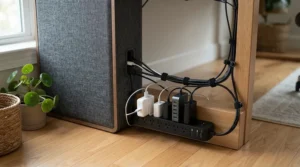
A common complaint in user reviews is that the small wired controller box needs somewhere to live, and in a shallow closet that’s one more thing competing for shelf space alongside your outlet timer and light driver.
Pros:
- ✅ Same quiet EC motor and airflow class as the T4
- ✅ 8 manual speed steps for precise dial-in
- ✅ Upgrade path to smart control later
Cons:
- ❌ No automatic climate response
- ❌ Controller box needs its own mounting spot
Expect this one in the $70-$90 range at the time of research. If you’re comfortable checking a thermometer once a day and nudging a dial, the S4 delivers nearly the T4’s airflow performance for meaningfully less money.
3. AC Infinity CLOUDLINE A4 — the budget entry point into EC motor quiet
The A4 is AC Infinity’s value tier, and the standout feature is simply that it exists — a genuine EC-motor Cloudline fan under $60 that still ships with a 10-speed wired controller. Rated at 165 CFM and 29 dBA, it moves noticeably less air than the S4 or T4, which is the trade-off for the lower price.
Here’s what the spec sheet won’t tell you, but the category context makes clear: 165 CFM is still enough for a 2×2 or 2×4 closet tent running a single small LED, but it starts to fall short once you add a carbon filter (which typically eats 40-60% of a fan’s effective CFM through resistance) or step up to a larger light.
Reviewers note the A4 is compatible with UIS smart controllers as an upgrade path, similar to the S4, which softens the “budget fan” positioning somewhat — you’re not locked into manual-only forever.
Pros:
- ✅ Lowest-priced EC motor fan in the Cloudline family
- ✅ 10-speed wired controller included
- ✅ Compatible with smart controller upgrades later
Cons:
- ❌ Lower 165 CFM ceiling limits headroom for filters/bigger lights
- ❌ Noticeably less overhead than S4/T4 for future scaling
Typical pricing runs in the $45-$60 range at the time of research. Budget-conscious first-time growers should note this trades long-term headroom for day-one savings — fine for a small closet tent, tight for anything bigger.
4. VIVOSUN Z4 — the non-AC-Infinity budget staple
VIVOSUN has built a real footprint in home hydroponics, and the Z4 is one of several 4-inch inline fans in their catalog sitting around 203 CFM with a variable speed dial controller. Based on the spec comparison, the raw airflow number here is genuinely close to the AC Infinity S4’s 205 CFM — on paper this means a budget buyer isn’t sacrificing much air-moving capacity to save money.
The catch shows up in motor technology: VIVOSUN’s variable-speed dial fans in this tier commonly use traditional AC-style speed control rather than PWM-controlled EC, which tends to produce more audible motor hum and heat at low-to-mid dial settings compared to the Cloudline’s EC-driven quiet.
Reviewers consistently report satisfaction with the plug-and-play simplicity, and a recurring theme in aggregated feedback across VIVOSUN’s fan lineup is that the flow-deflector design does a solid job keeping the rated noise output down at full speed, even if the character of that noise differs from an EC motor’s smoother hum.
Pros:
- ✅ Airflow nearly matches the pricier Cloudline S4
- ✅ Simple dial controller, no wiring puzzles
- ✅ Widely available with accessible customer support
Cons:
- ❌ AC-style speed control runs hotter/louder at low settings than EC
- ❌ Dial has less granular control than 8-10 discrete speed steps
Price typically runs $40-$55 at the time of research, making it one of the cheapest ways into a legitimate 200+ CFM fan for a closet tent.
5. iPower 4 Inch EC 10-Speed — competitive CFM at a value price
iPower’s EC-motor 4-inch fan is worth a look specifically because it undercuts AC Infinity’s S4 on price while matching or slightly beating its airflow, rated at 214 CFM and 29 dB with a 10-speed wired controller and smartphone-remote compatibility noted on some retailer listings. What most buyers overlook about lesser-known brands like this is that the core engineering — PWM-controlled EC motor, wired multi-speed controller — is functionally similar to what the bigger names sell, just without the years of accumulated review volume backing it up.
That’s the honest trade-off: a common complaint in user reviews across iPower’s product catalog in general is a comparatively smaller aggregate review pool than VIVOSUN or AC Infinity, which makes long-term reliability harder to verify from outside.
The 4.3-foot power cord is also shorter than some competitors’, which closet growers tend to notice when their tent sits far from the nearest outlet — a detail worth planning around before checkout.
Pros:
- ✅ 214 CFM edges out AC Infinity’s similarly priced S4
- ✅ True EC motor with 10 discrete speed steps
- ✅ Smartphone remote compatibility on select listings
Cons:
- ❌ Smaller aggregate review history than category leaders
- ❌ Shorter stock power cord may require a rated extension
Expect a $50-$65 range at the time of research. If a closet-adjacent outlet is close by, this is a legitimate way to get EC-motor performance without paying the AC Infinity brand premium.
6. Vortex Powerfan VTX400 — steel-built, 10-year warranty durability
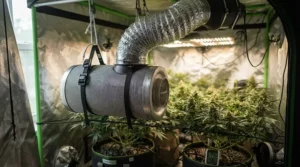
Vortex takes a different engineering approach entirely: instead of a lightweight plastic mixed-flow housing, the Powerfan line uses heavy-gauge steel casing with a hammertone powder coat finish, rated at 172 CFM with a balanced impeller designed for vibration-free operation and backed by a genuine 10-year warranty. The honest analytical take here is that 172 CFM trails every EC fan on this list, so you’re not buying this for raw airflow — you’re buying it for build quality that’s meant to survive a decade of continuous grow-room duty, which matters if you’re running this closet setup year-round rather than seasonally.
Reviewers in the inline fan category broadly note that Vortex units ship as effectively single-speed performers, with variable control requiring a separately sold speed controller accessory — an extra line item that shifts the total cost of ownership higher than the sticker price suggests.
In a shallow closet, the steel housing’s extra weight and bulk compared to plastic Cloudline-style units is also worth measuring for before you buy, since mounting brackets rated for lighter fans may not be adequate.
Pros:
- ✅ All-steel housing built for long-term durability
- ✅ Genuine 10-year manufacturer warranty
- ✅ Balanced impeller minimizes vibration noise
Cons:
- ❌ 172 CFM trails EC competitors at a similar price
- ❌ Variable speed control sold as a separate add-on
Pricing tends to land in the $130-$160 range at the time of research, positioning it as the premium, buy-it-once option rather than the airflow leader.
7. AC Infinity CLOUDRAY S4 — the space-saving circulation companion
This one’s a deliberate curveball: the CLOUDRAY S4 isn’t an inline exhaust fan at all, it’s a 4-inch clip-on circulation fan built for tight tent interiors, with 10 speed levels, 10 dynamic wind modes, and 10 oscillation settings packed into a compact, IP54-rated housing that clamps directly onto a tent pole. The standout feature is genuinely the form factor — its miniaturized EC motor and space-saving metal clamp are engineered specifically for setups with limited spacing, which describes basically every closet grow tent by definition.
Here’s what the spec sheet won’t tell you: an exhaust fan like the T4 or S4 pulls stale, humid air out of the tent, but it does nothing to stop hot or humid pockets from forming near the canopy in between exhaust cycles — that’s the circulation fan’s job, keeping air moving across leaf surfaces to support healthy transpiration.
Reviewers note the oscillation range does a good job covering a small tent’s interior without hitting the fabric walls, and the IP54 rating means it tolerates the humidity swings a closet tent naturally produces better than a non-rated household fan would.
Pros:
- ✅ Purpose-built compact clamp for tight closet tents
- ✅ 10 oscillation levels plus dynamic wind modes
- ✅ IP54-rated for humidity resistance
Cons:
- ❌ Not a substitute for an inline exhaust fan
- ❌ Adds a second device and cord to manage in the closet
Typical pricing sits around $35-$45 at the time of research. Pair it with any of the six exhaust fans above rather than choosing between them — that pairing is genuinely the recommended setup for a closet tent, not an upsell.
Cloudline Fan Closet Installation: A Practical Setup Walkthrough
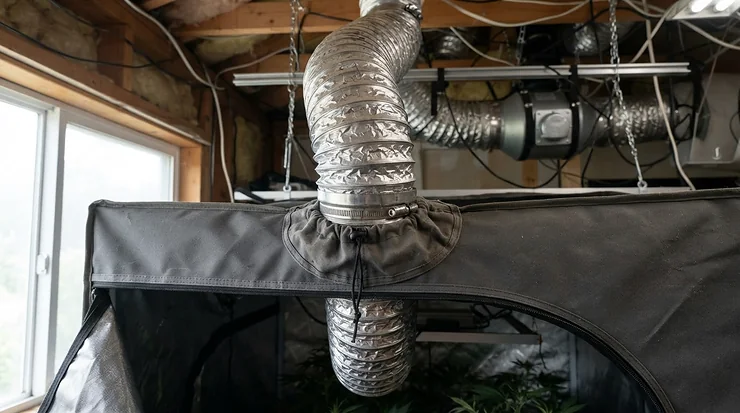
Installing any of these fans in a closet follows a similar sequence, but closets punish sloppy planning more than open grow rooms do because there’s so little slack space to correct mistakes later. Start by measuring your closet’s height and depth before ordering ducting — closet grow tents routinely run 6 to 8 inches shorter in usable vertical space than the tent’s rated height once you account for shelving, rods, or a low ceiling. Mount the fan itself near the top of the tent or closet, since heat and humidity naturally rise and concentrate there first; most Cloudline units ship with a mounting bracket and hardware specifically for this orientation.
Next, route your ducting with as few bends as possible. VIVOSUN’s own ventilation guidance notes that each 90-degree bend in ducting can increase your effective CFM requirement by roughly 40-60%, which in a cramped closet is almost unavoidable — plan for at least one extra fan-speed step of headroom to compensate. Finally, decide where the fan exhausts: venting into an attic space or a shared wall cavity is a common first-30-days mistake, since it just relocates your humidity problem rather than solving it. Venting to an exterior-facing window insert or through an existing dryer-style vent is the safer long-term solution.
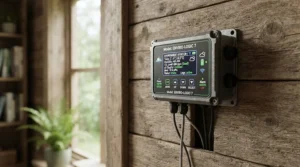
Mounting Cloudline in a Tight Space: Space-Saving Fan Mounting Tricks
Mounting Cloudline in a tight space usually comes down to orientation flexibility rather than finding more room that doesn’t exist. Because Cloudline fans use dual ball bearings, they’re rated to run in any orientation — vertical, horizontal, or even upside-down — which means you can mount the fan flush against a closet’s back wall or ceiling corner instead of needing open floor space around it. Space-saving fan mounting in a closet context typically means choosing between two positions: inside the tent’s port sleeve (keeping the fan hidden but adding heat inside the tent itself) or immediately outside the tent, ducted through the port (keeping the closet’s ambient air cooler at the cost of a slightly longer duct run).
For genuinely tight closets, mounting the fan outside the tent and against the highest available point of the closet wall tends to win, since it uses vertical space that’s otherwise dead air anyway. The detachable motor housing on Cloudline units also matters here in a way people underestimate: because the impeller and blades separate cleanly from the mounted frame, you can service the fan without unmounting the entire bracket, which is a meaningful convenience when the mounting spot is wedged behind a shelf.
Real-World Scenarios: Matching the Right Fan to Your Closet Setup
The apartment dweller with paper-thin walls. If you’re running a small 2×2 tent in a bedroom closet and your neighbor’s headboard is on the other side of that wall, noise rating should override every other spec on this list. The AC Infinity CLOUDLINE T4 at 26-28 dBA, run on its lower automated speed settings most of the day, is the safest bet — its climate automation also means you’re not manually cranking it to a louder setting during the day and forgetting to turn it back down at night.
The budget-first weekend grower. If this is a first attempt at a single small tent and the budget cap is real, the VIVOSUN Z4 or AC Infinity CLOUDLINE A4 get you functional exhaust ventilation without overspending on automation you may not use yet. Pair either with the AC Infinity CLOUDRAY S4 clip fan for internal circulation, and you’ve covered both airflow jobs for well under $100 combined.
The long-term, always-on grower. If this closet setup is going to run continuously for years rather than a season, the Vortex Powerfan VTX400‘s steel housing and 10-year warranty start to make more financial sense than they would for a casual hobbyist — total cost of ownership over a decade can actually undercut replacing a plastic-housed fan two or three times.
Problem → Solution: Common Closet Grow Airflow Issues, Solved
Problem: the closet stays humid no matter what. This usually means your exhaust CFM is undersized relative to your tent volume plus filter resistance. Step up from something like the 165 CFM AC Infinity CLOUDLINE A4 to the 205-226 CFM range of the S4 or T4, and check that your ducting isn’t kinked behind a shelf.
Problem: the fan is audible through the bedroom wall. Swap a manual AC-style dial fan for a PWM-controlled EC motor unit — the CLOUDLINE S4 or T4 — and run it at a lower continuous speed rather than cycling a louder fan on and off, since steady low-speed EC operation is quieter than intermittent higher-speed AC bursts.
Problem: hot spots form near the canopy despite good exhaust. Exhaust fans move air out; they don’t necessarily move it evenly across the plant canopy first. Adding a small circulation fan like the CLOUDRAY S4 inside the tent typically resolves this within a day or two.
Problem: the outlet is too far from the tent. Rather than daisy-chaining household extension cords, use a single rated extension cord sized for the fan’s actual wattage draw — overloaded or damaged extension cords are a documented residential fire risk worth taking seriously in an enclosed closet running unattended for hours at a time.
Problem: mold or mildew smell despite regular exhaust. Check that relative humidity is actually being pulled down, not just circulated — if your hygrometer reads above 60% RH consistently, your fan’s CFM or run schedule needs an increase, not just a relocation of the same air.
How to Choose an AC Infinity Cloudline 4 Inch Fan for a Closet Grow Tent
- Measure your closet’s actual usable volume first. Shelving, rods, and low ceilings eat into a closet’s rated dimensions more than people expect, and CFM needs scale with real air volume, not the closet’s listed square footage.
- Add filter and duct-bend resistance to your CFM math. A carbon filter alone can reduce effective airflow by roughly half, so buy headroom above the bare minimum your tent size suggests.
- Weigh noise rating as heavily as airflow. A closet shares walls with living spaces in a way a dedicated grow room usually doesn’t — dBA numbers matter here more than most buying guides admit.
- Decide if automation is worth the premium. If you’re consistently home and willing to check a thermometer, a manual fan like the S4 saves real money over the automated T4.
- Confirm your outlet situation before ordering ducting length. A too-short cord forces either a relocated fan or an extension cord you didn’t plan for.
- Plan your exhaust destination, not just your intake. Venting into a shared wall cavity or attic space just moves your humidity problem elsewhere in the house.
- Budget for a circulation fan as a separate line item. An exhaust fan and a circulation fan solve two different problems, and treating them as one purchase is a common first-time mistake.
Cloudline vs Traditional AC Motor Fans: What Actually Changes
The difference between AC Infinity’s EC-motor Cloudline fans and traditional AC-motor inline fans isn’t marketing fluff — it’s a real mechanical distinction with practical consequences for a closet setup. Traditional AC motor fans control speed by suppressing voltage, which is a blunt method that tends to generate audible motor hum and excess heat at anything below full speed. PWM-controlled EC motors instead adjust the motor’s actual switching pattern, allowing smooth, quiet operation across a wide range of speeds without that low-speed penalty.
| Factor | EC Motor (Cloudline-style) | Traditional AC Motor |
|---|---|---|
| Low-speed noise | Minimal hum, stays quiet | Noticeably louder at low settings |
| Heat generation | Lower across speed range | Higher, especially at partial speed |
| Energy efficiency | Generally more efficient per CFM | Less efficient at partial speeds |
| Typical price | Moderate to higher | Lower upfront cost |
In a closet where the fan runs continuously for months at a time, the efficiency and heat gap compounds — an EC motor fan run at 40% speed all day genuinely uses less power and generates less parasitic heat than an AC motor fan throttled to the same output, which matters when you’re already fighting to keep a small enclosed space cool. For a weekend hobby tent that only runs a few hours a day, the gap matters less, which is exactly why budget AC-style options like the VIVOSUN Z4 remain reasonable choices for lighter-duty setups.
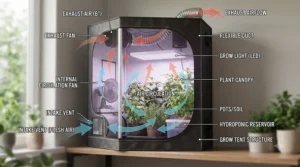
Closet Humidity Control: Reading and Using Your Fan’s Sensors Correctly
If you’ve stepped up to the AC Infinity CLOUDLINE T4, its thermal probe and humidity sensor are doing more work than most buyers realize, and using them well is the difference between a genuinely automated closet and one that just looks automated. Indoor relative humidity above roughly 60% creates the conditions mold needs to establish itself on organic surfaces, and a closet tent’s sealed, low-volume environment can cross that threshold faster than an open grow room would. The T4’s Controller 69 Pro lets you set a humidity trigger point, a minimum baseline fan speed, and a VPD target simultaneously, which is meaningfully different from just setting one temperature alarm and hoping humidity follows along passively — it often doesn’t, especially overnight when lights go off and temperature drops but moisture from the growing medium keeps releasing into a now-cooler, more saturated closet.
Probe placement matters here more than the manual suggests: mount the thermal probe near the canopy height, not near the fan itself, since a probe reading air close to the exhaust point will consistently under-report the actual conditions your plants are experiencing. For closets specifically, also account for the fact that closet doors — even louvered ones — restrict passive air exchange with the rest of the house far more than an open grow room’s doorway would, meaning your target humidity trigger point may need to sit slightly lower than what open-room grow guides typically recommend.
Common Mistakes When Buying a 4 Inch Inline Fan for a Closet
The single most common mistake is buying based on CFM rating alone without accounting for ducting length, bends, and filter resistance — a fan rated at 205 CFM in a lab test routinely delivers noticeably less in a real closet installation with a carbon filter and two duct bends. The second mistake is ignoring noise ratings entirely, then discovering after installation that a “quiet” 30 dBA fan sounds louder than expected through a thin closet door at 2 a.m. A third mistake: buying the cheapest fan available without checking motor type, since AC-style motors that seem identical to EC options on paper behave very differently in continuous, months-long operation. Finally, plenty of first-time buyers skip the circulation fan entirely, assuming their exhaust fan handles everything — it doesn’t, and hot, stagnant pockets near the canopy are the predictable result.
Long-Term Cost and Maintenance: What These Fans Actually Cost to Run
| Fan | Approx. Wattage | Est. Monthly Run Cost* | Maintenance Note |
|---|---|---|---|
| AC Infinity CLOUDLINE T4 | ~28W | Low, EC-efficient | Detachable housing, periodic dust cleaning |
| AC Infinity CLOUDLINE S4 | ~28W | Low, EC-efficient | Same detachable design as T4 |
| VIVOSUN Z4 | Varies by speed | Moderate at low AC-motor speeds | Standard bearing check over years of use |
| Vortex Powerfan VTX400 | Moderate | Moderate, steady draw | Sealed bearings, minimal upkeep needed |
*Estimated relative to continuous daily operation; actual electricity cost depends on your local utility rate and daily runtime, so use this as a comparative guide rather than a fixed number.
Looking at the table above, the EC-motor Cloudline fans consistently edge out AC-motor alternatives on efficiency, but the gap in dollars is genuinely small for a single 4-inch fan — where it adds up is in reduced motor wear and heat stress over years of continuous closet operation, which is where the Vortex’s steel build and 10-year warranty start to look like a legitimate long-game investment rather than an overspend.
Features That Actually Matter (And Those That Don’t)
Airflow headroom above your bare CFM math actually matters, because filters and duct bends will eat into it regardless of what the box promises. A detachable motor housing actually matters for a closet fan specifically, since you’ll be cleaning dust and lint out of it in a cramped space where full removal isn’t always possible. WiFi connectivity, on the other hand, matters far less than marketing suggests if you’re someone who’s home daily and willing to check a manual dial — it’s a genuine convenience, not a performance upgrade. Similarly, an ultra-wide range of oscillation settings on a circulation fan is a nice-to-have, not a must-have, in a closet tent small enough that basic side-to-side motion already covers the whole canopy.
Frequently Asked Questions
❓ What size Cloudline fan do I need for a closet grow tent?
❓ Is the AC Infinity Cloudline T4 worth it over the S4 for a closet?
❓ Can I mount a Cloudline fan inside a small closet without extra space?
❓ How do I stop my closet grow tent from getting too humid?
❓ Do I need both an exhaust fan and a circulation fan in a closet tent?
Conclusion
Choosing between these seven fans really comes down to three honest questions: how much automation do you actually want, how quiet does this need to be for the room next door, and how long do you expect this closet setup to run. The AC Infinity CLOUDLINE T4 wins for hands-off automation, the S4 and A4 cover manual control at two different price points, VIVOSUN’s Z4 and iPower’s EC 10-Speed give budget-conscious buyers legitimate non-AC-Infinity alternatives, the Vortex Powerfan VTX400 answers the “buy it once” crowd, and the AC Infinity CLOUDRAY S4 rounds out any of the above as the circulation companion your canopy actually needs. None of these are wrong choices — they’re just built for different closets, different patience levels, and different budgets. Match the fan to your actual situation rather than the highest CFM number on the page, and the humidity, heat, and noise problems that plague most first-time closet grows tend to sort themselves out.
Recommended for You
- AC Infinity Cloudline 4 Inch Controller App: 7 Best Picks for 2026
- AC Infinity Cloudline 4 Inch Noise Level: 7 Quietest Picks 2026
- AC Infinity Cloudline 4 Inch Review for Grow Tents: 7 Picks (2026)
Disclaimer: This article contains affiliate links. As an Amazon Associate, I earn from qualifying purchases. If you purchase products through these links, we may earn a small commission at no additional cost to you.
✨ Found this helpful? Share it with your friends! 💬🤗
